Cleanroom Mop vs Regular Mop: What Is the Difference?
A cleanroom mop is designed for controlled environments where lint, particles, residues, and contamination risks must be managed. A regular mop is designed for general cleaning in homes, offices, warehouses, and commercial areas where cleanroom-level contamination control is not required.
The main difference is contamination control. Cleanroom mops use low-lint materials, controlled packaging, compatible frames, and SOP-based workflows. Regular mops may shed fibers, hold residues, and introduce particles that are unsuitable for GMP, ISO, pharmaceutical, biotech, semiconductor, or medical device cleanrooms.
Cleanroom Mop vs Regular Mop Comparison Table
The table below summarizes the key differences between cleanroom mops and regular mops for B2B buyers, QA teams, cleanroom supervisors, distributors, and facility managers.
| Comparison Point | Cleanroom Mop | Regular Mop |
|---|---|---|
| Main Purpose | Support contamination control in controlled environments | Remove visible dirt in general cleaning areas |
| Material | Low-lint polyester, microfiber, nonwoven, foam, or cleanroom-compatible materials | Cotton, rayon, sponge, or general synthetic materials |
| Lint and Fiber Release | Designed to reduce fiber shedding and particle release | May release fibers, lint, and loose particles during use |
| Typical Use Area | GMP cleanrooms, ISO cleanrooms, pharma, biotech, semiconductor, medical device, labs | Homes, offices, schools, public areas, warehouses, general facilities |
| Packaging | May be cleanroom-compatible, sterile, gamma-irradiated, or individually packed | Standard retail or janitorial packaging |
| Workflow | Used with SOPs, defined zones, mop replacement rules, buckets, wringers, and documentation | Used according to general cleaning habits or janitorial routines |
| Documentation | May require TDS, product specification, packaging details, sterility information, and traceability | Usually limited documentation |
What Is a Cleanroom Mop?
A cleanroom mop is a controlled-environment cleaning tool designed for areas where ordinary cleaning materials may create contamination risks. It is commonly used in GMP cleanrooms, ISO-classified rooms, pharmaceutical production, biotechnology facilities, semiconductor cleanrooms, laboratories, and medical device manufacturing.
Cleanroom mops are usually reviewed based on material, lint level, surface contact, packaging, sterility status, chemical compatibility, mop frame fit, bucket workflow, and documentation support.
What Is a Regular Mop?
A regular mop is a general-purpose cleaning tool used for ordinary floor cleaning. It is commonly made from cotton, rayon, sponge, or standard synthetic fibers and is used in commercial, household, school, warehouse, and public-area cleaning.
Regular mops may work well for visible dirt removal, but they are usually not designed for cleanroom lint control, particle control, sterile presentation, disinfectant-controlled workflows, or QA documentation.
Cleanroom Mop
- Designed for controlled environments
- Uses low-lint or cleanroom-compatible materials
- May be sterile or non-sterile
- Supports SOP-based workflows
- May require product documentation
- Works with cleanroom frames, handles, buckets, and wringers
Regular Mop
- Designed for general cleaning
- May use cotton or general synthetic fibers
- Usually not sterile
- Usually not used with cleanroom SOPs
- Limited documentation
- May shed fibers or retain residues
Key Difference 1: Lint and Particle Control
Lint and particle control is the most important difference. Cleanroom mops are designed to reduce the release of fibers, lint, and particles during cleaning. Regular mops may release fibers or carry residues that are unacceptable in controlled environments.
Fiber Shedding
Cleanroom mop materials are selected to reduce fiber-shedding concerns during controlled cleaning.
Surface Contact
Flat mop systems help improve controlled contact on floors, walls, ceilings, and smooth cleanroom surfaces.
Contamination Risk
Lower-shedding materials help reduce the chance that the cleaning tool becomes a contamination source.
Key Difference 2: Material Construction
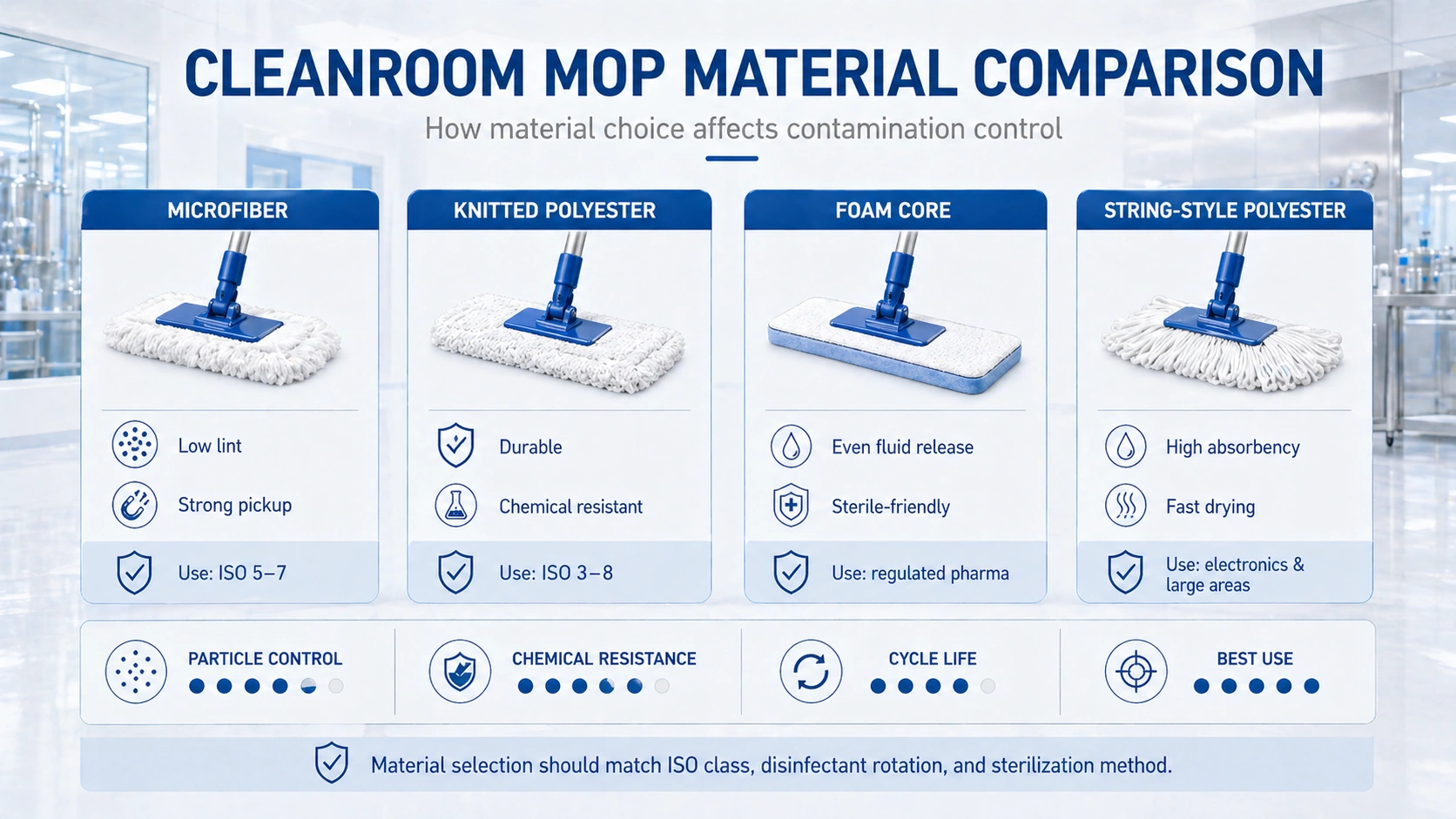
Cleanroom mop materials are selected for cleanroom suitability, low-lint performance, absorbency, chemical compatibility, and surface wiping behavior. Regular mop materials are usually selected for general cost, absorbency, and durability.
| Material Type | Cleanroom Mop Use | Regular Mop Concern |
|---|---|---|
| Polyester | Common low-lint mop material for controlled cleaning | Not all polyester mops are cleanroom-grade |
| Microfiber | Useful for surface contact and fine particle pickup | General microfiber may not meet cleanroom packaging or shedding expectations |
| Nonwoven | Often used for disposable workflows and controlled replacement | General nonwoven products may not be suitable for cleanroom use |
| Cotton | Usually avoided in cleanroom mops due to lint concerns | Common in regular mops but may shed fibers |
Key Difference 3: Packaging and Sterility
Some cleanroom mops are supplied in controlled packaging, sterile packaging, or gamma-irradiated formats. Regular mops are usually supplied in standard retail or janitorial packaging and are not intended for sterile presentation.
Cleanroom Mop Packaging
- May be individually packed
- May be sterile or gamma-irradiated
- May include controlled packaging details
- May include lot or product code information
- May support QA review and cleanroom entry workflow
Regular Mop Packaging
- Usually retail or janitorial packaging
- Not designed for cleanroom entry control
- Usually not sterile
- Limited traceability information
- Not usually supported by cleanroom documentation
Key Difference 4: GMP and ISO Cleanroom Suitability
GMP and ISO cleanrooms require cleaning tools that support contamination-control procedures. Cleanroom mop suitability depends on the room grade, SOP, cleaning agent, surface type, sterility requirement, and facility QA expectations.
Key Difference 5: Cleaning Workflow and Documentation
Cleanroom mop systems are often used with defined cleaning direction, replacement rules, zone separation, bucket workflow, disinfectant control, and cleaning records. Regular mops are usually not managed under this level of control.
| Workflow Element | Cleanroom Mop System | Regular Mop Use |
|---|---|---|
| Cleaning Direction | Defined by SOP, often clean-to-dirty or zone-based | Usually operator preference |
| Mop Replacement | Defined by area, zone, frequency, or contamination risk | Reused until visibly dirty or worn |
| Bucket Workflow | May use single, dual, or triple-bucket systems | Usually standard bucket or janitorial cart |
| Records | May include cleaning logs, product codes, lot records, or sample approvals | Usually no detailed records |
| Supplier Documents | TDS, specifications, packaging, sterility, traceability, sample support | Usually basic product information only |
When Should Buyers Choose a Cleanroom Mop?
Buyers should choose a cleanroom mop when cleaning is performed in a controlled environment where particles, fibers, microorganisms, residues, or cross-contamination may affect product quality or process control.
Choose Cleanroom Mops For
GMP cleanrooms, ISO cleanrooms, pharmaceutical production, biotech, semiconductor, medical device, and labs.
Use Regular Mops For
General floors, public areas, warehouses, offices, schools, and non-controlled cleaning environments.
Ask QA Before Use
For regulated cleanrooms, QA and validation teams should confirm whether the mop fits internal SOP requirements.
MIDPOSI Cleanroom Mop Options
MIDPOSI supports B2B buyers with cleanroom mop systems and low-lint mop options for GMP, ISO, pharmaceutical, biotechnology, semiconductor, medical device, laboratory, and controlled-environment cleaning applications.
White Cleanroom Mop Series
- 40g light mop option
- 55g medium mop option
- 65g heavy-duty mop option
- Sterile and non-sterile versions
- Low-lint polyester construction
Cleanroom Mop System Support
- Mop heads and mop covers
- Flat mop frames and cleanroom handles
- Bucket and wringer workflow support
- Sample and specification support
- B2B procurement and distributor support
FAQ: Cleanroom Mop vs Regular Mop
What is the main difference between a cleanroom mop and a regular mop?
The main difference is contamination control. A cleanroom mop is designed to reduce lint, particles, and contamination risks in controlled environments. A regular mop is designed for general cleaning.
Can a regular mop be used in a cleanroom?
A regular mop should not be used in a cleanroom unless the facility’s QA or validation team has approved it. Regular mops may shed fibers, hold residues, or introduce particles into controlled environments.
Why are cleanroom mops low-lint?
Cleanroom mops are low-lint because fibers and particles can become contamination risks. Low-lint materials help reduce fiber-shedding concerns during controlled cleaning workflows.
Are cleanroom mops always sterile?
No. Cleanroom mops may be sterile or non-sterile. The correct choice depends on the facility SOP, cleanroom grade, contamination-control strategy, and QA requirements.
What materials are used for cleanroom mops?
Common cleanroom mop materials include polyester, microfiber, nonwoven fabrics, and foam. Buyers should compare lint control, absorbency, chemical compatibility, packaging, and cleanroom suitability.
What documents should buyers request for cleanroom mops?
Buyers should request product specifications, material information, packaging details, sterile or non-sterile status, lot traceability information, sample approval records, and supplier qualification support where required.
Need Help Choosing Between Cleanroom Mops and Regular Mops?
Contact MIDPOSI to discuss cleanroom mop materials, sterile and non-sterile options, low-lint performance, sample availability, documentation support, and B2B supply details.