A comprehensive, field-ready audit framework designed for QA managers, procurement leads, and quality systems professionals evaluating cleanroom mop suppliers. Contains 33 specific checkpoints across 7 dimensions, a pre-audit preparation guide, and a post-audit scoring methodology.

A cleanroom mop supplier audit must assess seven interconnected dimensions. A standard ISO 9001 supplier audit form will miss at least four of them. The seven dimensions that constitute a complete audit are:
Verify the cleanroom classification of the production area, HVAC/filtration records, gowning protocols, and environmental monitoring data.
Assess in-process particle monitoring, post-production cleaning procedures, and product handling protocols that preserve cleanliness from production to packaging.
Review raw material sourcing, incoming inspection procedures, and material traceability from receipt through to finished product batch.
Examine packaging process validation, seal integrity testing, sterilization validation, sterile product segregation, and shelf-life data.
Evaluate batch numbering logic, end-to-end traceability from raw material to finished product, and recall capability.
Review QMS structure, document control, CAPA system, change control, training records, and complaint handling.
Confirm the supplier’s understanding of GMP/ISO requirements applicable to your facility, regulatory inspection history, and compliance posture.
Each dimension is detailed with specific observable checkpoints in the sections below. The full 33-item audit checklist is provided in Section 5 for direct use during a site visit.
Many QA teams approach a cleanroom mop supplier audit with a standard supplier qualification checklist — typically derived from ISO 9001 or a generic QMS audit template. While these checklists cover important fundamentals, they miss the sector-specific risks that distinguish a cleanroom consumable supplier from a general manufacturer.
A cleanroom mop is not a commodity product. It enters controlled environments where particle counts are monitored in real time, where microbiological contamination can shut down a production batch, and where packaging integrity determines whether a product remains sterile at the point of use. A standard audit cannot evaluate these risks because it was not designed for them.
| Audit Dimension | Standard ISO 9001 Audit | Cleanroom Mop Supplier Audit |
|---|---|---|
| Production Environment | General housekeeping; basic cleanliness | Cleanroom classification verification; HVAC records; differential pressure monitoring; particle count data; gowning protocol observation |
| Post-Production Control | Standard finished goods inspection | Post-production particle control; product handling protocols between manufacturing and packaging; packaging environment classification; seal integrity verification |
| Packaging Validation | Visual packaging inspection; label accuracy | Packaging process validation documentation; seal integrity testing records; sterile/non-sterile segregation verification; aseptic transfer protocol validation |
| Sterility Assurance | Not addressed in standard audits | Sterilization process validation (gamma/EO parameters); sterility shelf-life studies; sterile batch segregation; Certificate of Sterility for each lot |
| Particle Documentation | Not addressed in standard audits | Particle test data for finished product; material-specific particle shedding data; test method documentation referencing ISO 14644 or equivalent standards |
The five differences above represent gaps that a standard audit form does not address. If a supplier audit covers only ISO 9001 criteria, the auditor has not evaluated the factors that most directly affect cleanroom product performance.
Before scheduling a site visit, also review the guidance on how to choose a cleanroom mop supplier and how to qualify a pharmaceutical cleanroom mop supplier. These resources complement the audit framework with supplier selection criteria. If you are considering China-based manufacturers, see the cleanroom mop manufacturers China B2B suppliers 2026 overview. For foundational context on cleanroom mop components and system design, refer to the cleanroom mop system overview.
An effective supplier audit begins weeks before the site visit. Arriving without prior document review wastes audit time on questions that could have been answered remotely and increases the risk of missing critical issues in the limited on-site window.
Send the following document request at least two to three weeks before the scheduled audit date. Request that documents be returned at least one week before the visit to allow adequate review time.
ISO 9001, ISO 13485 (if applicable), or equivalent QMS certification. Request the current certificate and a copy of the quality manual or QMS structure overview.
Documentation confirming the cleanroom classification of the production area, including the certifying body and date of most recent re-certification.
Non-viable and viable particle monitoring data from production areas. This provides the baseline before the on-site observation.
For sterile products: sterilization validation report, packaging validation report, and sterility shelf-life study summary. For non-sterile products: material validation documentation and particle test data.
The documented procedure for batch numbering and traceability from raw material receipt through production to finished product release.
A summary of CAPA records from the previous 12 months. This reveals the supplier’s quality issue frequency, root cause investigation rigor, and corrective action closure rate.
A summary of production or material changes initiated in the last year. This surfaces any changes that may affect product consistency.
A training matrix or summary covering production operators and QA personnel, with training dates and competency assessment records.
For a detailed breakdown of what to look for in supplier documentation, refer to the cleanroom mop validation documents guide and the companion article on COA for cleanroom mops.
Along with the document request, send a structured questionnaire. This serves multiple purposes: it signals professionalism, it reveals gaps before you travel, and it creates a documented record of supplier claims that can be verified during the site visit.
A cleanroom mop supplier audit should not be conducted by a single person. The minimum recommended team includes:
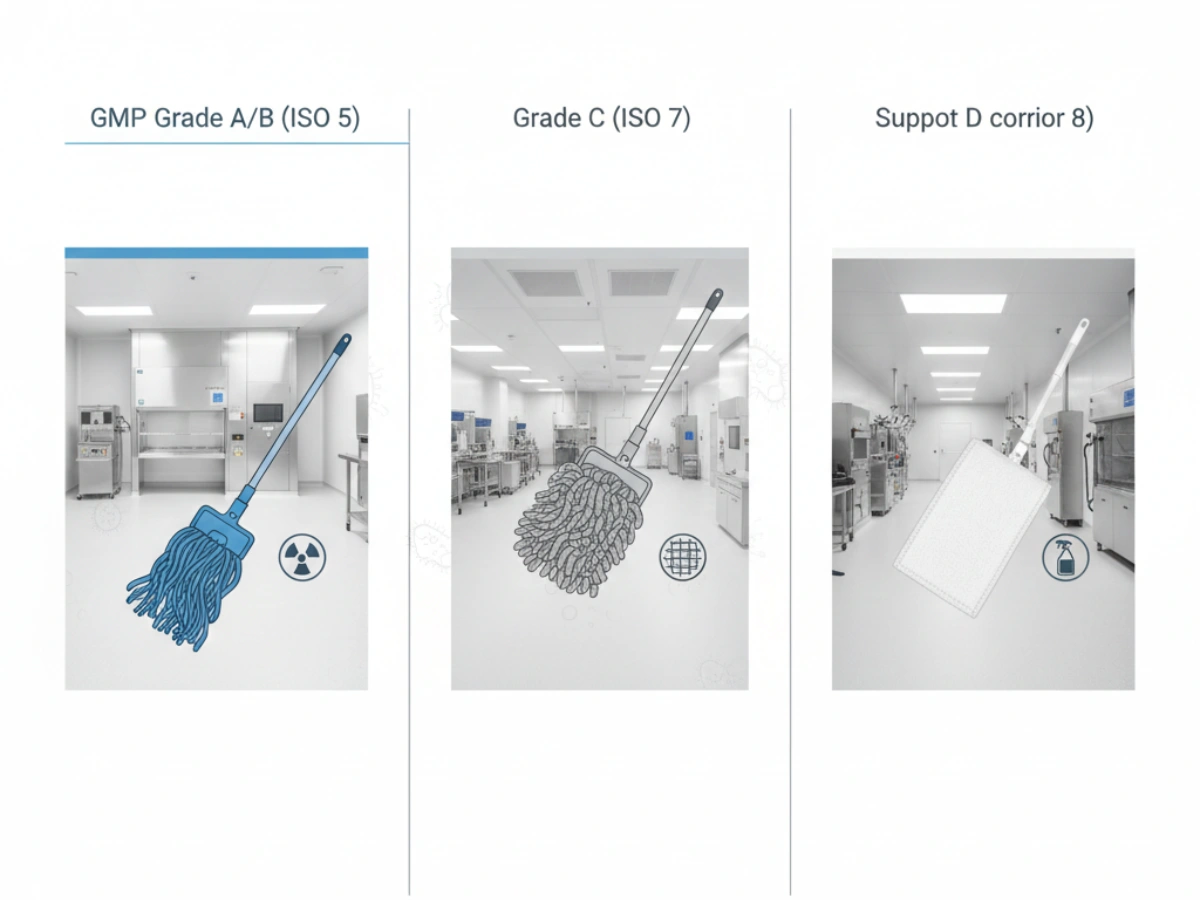
For pharmaceutical or sterile product audits, consider adding a Microbiology or Sterility Assurance representative if the facility operates GMP Grade A/B zones.
Before the audit, prepare a one-page summary of the regulatory framework applicable to your facility. Include:
This summary becomes the benchmark against which the supplier’s capabilities are measured during the audit. It also ensures the audit team has a shared understanding of what constitutes a compliant supplier for your facility.
Each dimension below includes specific observable checkpoints. The auditor should verify each checkpoint through observation (what you see), documentation (what you review), and discussion (what you hear from operators and management). An observation-only or document-only approach to any single dimension is insufficient.
The manufacturing environment is the single most important physical factor in cleanroom consumable production. If the production area itself is not controlled, no amount of downstream processing can compensate.
Observe whether the production area visibly matches the claimed cleanroom class. Request the cleanroom classification certificate and note the certifying body, date, and class achieved. A classification certificate older than 12 months should be flagged. For GMP-regulated buyers, confirm the classification is appropriate for the cleanroom grades you operate.
Request the HVAC maintenance log for the last 12 months. Check for regularity of filter changes, differential pressure across HEPA/ULPA filters, and any periods of system downtime. During the walk-through, note whether air returns are clean and whether airflow patterns appear consistent.
Observe pressure differential gauges between production rooms and adjacent areas. Request monitoring logs for the last 6 months. Pressure cascades should follow cleanroom design principles: cleaner areas at higher pressure, with transitions that protect product from contamination.
Observe the gowning room and at least two operators entering the production area. Check: Are gowning procedures posted and followed? Are garments appropriate for the cleanroom class? Is there a clear demarcation between gowning and production areas? Request the gowning SOP and training records for operators observed during the walk-through.
Request the environmental monitoring plan and 6 months of monitoring data. Review viable (microbiological) and non-viable (particle) monitoring results. Confirm that monitoring locations include production areas, gowning rooms, and material transfer zones. Check for any exceedances and the associated investigation records.
Cleanroom mops exist to remove contamination — they should not introduce it. A supplier’s particle control practices during production determine whether the finished product meets the cleanliness claims made on its specification sheet.
Ask whether particle monitoring is performed during production or only as finished product testing. In-process monitoring provides earlier detection. Request particle count data from recent production runs. If monitoring is only performed at finished product stage, ask how the supplier detects and responds to in-process particle excursions.
Observe what happens to mop heads between production completion and packaging. Are products covered, bagged, or left exposed? Is there a post-production cleaning or de-particulation step? Products left unprotected between production and packaging accumulate particles that may not be detected if testing occurs before this stage.
Observe how finished products are moved from production to packaging. Are transfer containers appropriate for the cleanroom class? Is there a documented product handling SOP? Are operators handling products with gloves appropriate for cleanroom use?
If the supplier manufactures both sterile and non-sterile products, physical segregation or temporal segregation must be demonstrated. Observe whether there is a physical barrier, separate rooms, or a documented line clearance procedure between product types. Cross-contamination risk between sterile and non-sterile production is a critical finding.
The materials that go into a cleanroom mop — fabric, thread, backing material, packaging — determine the product’s baseline cleanliness, durability, and compatibility with cleaning agents and sterilization processes.
Request Certificates of Analysis for the primary fabric and component materials used in mop head production. Verify that material specifications reference fiber type (e.g., continuous filament polyester, knitted microfiber), construction, and any relevant cleanliness or purity claims. Third-party material certifications carry more weight than self-declared specifications.
Request the incoming quality control (IQC) SOP and a sample of IQC records. Observe the receiving area if possible. Check: Are incoming materials held in quarantine until released? Are inspection criteria defined and followed? How are non-conforming materials handled?
Request a trace-back demonstration: select one finished product batch and ask the supplier to trace it back to the specific incoming material lots used. The demonstration should be completed within the audit session, not promised for later. Material traceability gaps represent a recall capability risk.
Request the current approved supplier list for raw materials and components. Review whether raw material suppliers are qualified (not just listed) and whether there is a process for re-evaluating suppliers periodically. Ask when the last raw material supplier audit was conducted.
Observe raw material storage. Are fabrics stored in a controlled environment (temperature, humidity, cleanliness) or in a general warehouse? Is there a FIFO (First-In, First-Out) system in place? Materials stored in uncontrolled conditions may degrade or accumulate contamination before they enter production.
For a cleanroom mop to function as specified, it must arrive at the point of use in the same condition it left the production line. Packaging is not a secondary consideration — it is a contamination barrier.
Request the packaging process validation report. The report should describe the packaging materials, process parameters (temperature, pressure, dwell time for heat sealing), and acceptance criteria. A validated packaging process is essential for sterile products and strongly recommended for non-sterile cleanroom products.
Request seal integrity test records for recent production batches. The test method should be specified (e.g., dye penetration, burst test, visual inspection with defined criteria). Ask about the sampling frequency — 100% inspection or statistical sampling — and how seal integrity failures are investigated.
If the supplier provides sterile product, request the sterilization validation report. Key information: sterilization method (gamma, EO), validated dose or cycle parameters, biological indicator results, and the Sterility Assurance Level (SAL) achieved. Ask whether sterilization is performed in-house or subcontracted. If subcontracted, request evidence that the sterilization provider is also qualified and audited.
Observe how sterile finished products are stored and handled after sterilization. Is there a clear segregation between sterilized and non-sterilized finished goods? Are there defined and controlled storage conditions? Is there a documented release process that includes review of sterilization cycle data before product release?
Request the shelf-life validation study for sterile products. The study should demonstrate that sterility is maintained through the claimed shelf life under defined storage conditions. A shelf-life claim without supporting data is a finding. Ask about the real-time aging study status if accelerated aging data is provided.
In a regulated environment, the ability to trace a finished product batch back through production, sterilization, and raw material receipt is not optional — it is a compliance requirement. A supplier’s traceability system determines whether a problem detected in the field can be contained to a specific batch.
Request the batch numbering SOP. Review the numbering structure: does it encode production date, product type, production line, or shift? A well-designed numbering system allows rapid identification of the production context from the batch number alone. Unstructured or sequential-only batch numbers are a weakness in recall scenarios.
Select a finished product batch on the shelf and request a trace-back to raw material lots. The supplier should be able to identify: which raw material lots were used, which production date and shift, which sterilization cycle (if applicable), and which packaging materials. This demonstration must be performed during the audit.
Request documentation of the most recent mock recall exercise. Review: how long did it take to identify all affected batches? What percentage of product was successfully accounted for? Were any traceability gaps identified and addressed? A supplier that has never conducted a mock recall has not tested its recall system.
Request and review one complete batch record. The record should document: raw material lots used, production date and time, operators involved, in-process checks performed, any deviations noted, QC release signature, and (for sterile product) sterilization cycle confirmation. Incomplete or unsigned batch records are a documentation control finding.
For a detailed analysis of batch traceability requirements specific to pharmaceutical cleanroom mops, see the batch traceability for pharmaceutical cleanroom mops article.
The QMS is the backbone of a supplier’s quality capability. It determines whether quality is managed systematically or reactively. An audit that skips the QMS in favor of a production floor walk-through has missed half the picture.
Request the current QMS certificate and quality manual. Verify that the certification body is accredited and that the scope of certification includes the products and processes being audited. An expired certificate or a certification scope that does not match the supplier’s operations is a critical finding.
During the audit, request three different documents (e.g., an SOP, a work instruction, and a batch record template). Verify that each has: a document number, version number, effective date, and approval signatures. Ask how obsolete documents are removed from points of use. A document control failure means operators may be working to outdated procedures.
Request the CAPA log for the last 12 months and select one closed CAPA for deep review. Assess: Was the root cause investigation rigorous or superficial? Was the corrective action appropriate to the root cause? Was effectiveness verified after implementation? Was the CAPA closed within a reasonable timeframe?
Request the change control log. Look for changes to raw materials, production processes, equipment, or packaging. Ask how customers are notified of changes that may affect product performance or compliance. A supplier that does not proactively communicate material or process changes introduces uncontrolled variability into the buyer’s supply chain.
Request the training matrix for production operators and QA staff. For the operators observed during the walk-through, request their individual training records. Verify that training includes: gowning, process-specific SOPs, contamination control, and documentation practices. Operators performing tasks without documented training constitute a finding.
Request the complaint log for the last 12 months. Review how complaints are classified, investigated, and closed. Ask specifically about any complaints related to contamination, packaging integrity, or sterility. The supplier’s response to these complaints reveals more about quality culture than any policy document.

A supplier does not need to be a regulatory expert in every buyer’s framework. But the supplier must demonstrate awareness of the regulatory environment in which its products are used and must maintain compliance with the standards applicable to its own operations.
During the QA manager discussion, ask: “Which GMP or ISO requirements are most relevant to the products you manufacture?” The quality of the response reveals the depth of regulatory awareness. A supplier that can discuss ISO 14644 classification, GMP Annex 1 requirements for sterile products, and the documentation expectations of regulated buyers demonstrates sector-relevant knowledge.
Request the outcome of the most recent regulatory inspection (by a health authority, notified body, or certification body). Review any observations, findings, or non-conformances and the supplier’s response. A history of repeated findings in the same area indicates a systemic weakness.
Ask directly whether the supplier has received any warning letters, regulatory enforcement actions, or product recall requirements. If yes, review the details and corrective actions. This question should be asked even if no such history appears in the provided documentation.
Ask about the qualification and monitoring of sub-tier suppliers (raw material providers, sterilization service providers, packaging material suppliers). A supplier that does not audit or qualify its own critical suppliers introduces uncontrolled risk into the supply chain. Request evidence of sub-tier supplier qualification.
This is the core operational tool of the audit. Each of the 33 checkpoints below maps to one of the 7 dimensions. The auditor should rate each checkpoint as Compliant, Partial, or Non-Compliant and document observations in the Notes column. This checklist can be printed and used directly during the site visit.
| # | Dimension | Checkpoint | Evidence to Request | Rating | Notes |
|---|---|---|---|---|---|
| 1 | Mfg Environment | Cleanroom classification certificate is current (<12 months) and appropriate for intended use | Cleanroom classification certificate; certifying body name and date | ||
| 2 | Mfg Environment | HVAC system maintenance is documented; HEPA/ULPA filters changed per schedule | 12-month HVAC maintenance log; filter change records | ||
| 3 | Mfg Environment | Differential pressure between clean zones is monitored and within specification | 6-month pressure differential monitoring records | ||
| 4 | Mfg Environment | Gowning protocols are posted, followed, and operators are trained | Gowning SOP; training records for observed operators | ||
| 5 | Mfg Environment | Environmental monitoring (viable and non-viable) is performed per defined schedule | Environmental monitoring plan; 6 months of monitoring data | ||
| 6 | Particle Control | In-process particle monitoring is conducted during production (not only finished product testing) | In-process particle monitoring data from recent production runs | ||
| 7 | Particle Control | Post-production products are protected from contamination between manufacturing and packaging | Observation: product handling between production line and packaging area | ||
| 8 | Particle Control | Product handling SOP is documented and followed; operators use appropriate gloves | Product handling SOP; operator observation | ||
| 9 | Particle Control | Sterile and non-sterile production lines are physically or temporally segregated | Observation: line segregation; documented line clearance procedure | ||
| 10 | Material Control | Raw material CoA and certifications are available for primary fabric components | Raw material CoA for fabrics and components | ||
| 11 | Material Control | Incoming materials are inspected against defined criteria before release to production | IQC SOP; sample IQC records | ||
| 12 | Material Control | Material traceability from receipt to finished product batch is demonstrable | Trace-back demo: one finished batch to raw material receipt lots | ||
| 13 | Material Control | Approved supplier list for raw materials is maintained and sub-tier suppliers are qualified | Current approved supplier list; sub-tier qualification records | ||
| 14 | Material Control | Materials are stored in controlled conditions; FIFO system is in place | Observation: material storage conditions; FIFO procedure | ||
| 15 | Packaging & Sterility | Packaging process is validated; validation report is available | Packaging process validation report | ||
| 16 | Packaging & Sterility | Seal integrity testing is performed and records are available for recent batches | Seal integrity test records (last 3 batches) | ||
| 17 | Packaging & Sterility | Sterilization process is validated; SAL is documented (sterile products only) | Sterilization validation report; SAL documentation | ||
| 18 | Packaging & Sterility | Sterile finished products are segregated from non-sterile; release process is documented | Observation: segregation; product release SOP | ||
| 19 | Packaging & Sterility | Sterility shelf-life is validated with supporting data (real-time or accelerated aging) | Shelf-life validation study report | ||
| 20 | Batch Traceability | Batch numbering system is structured and documented in an SOP | Batch numbering SOP | ||
| 21 | Batch Traceability | End-to-end traceability from finished product to raw material lots is demonstrated during audit | Live trace-back demonstration | ||
| 22 | Batch Traceability | Mock recall exercise has been conducted; results are documented and gaps addressed | Most recent mock recall report | ||
| 23 | Batch Traceability | Batch records are complete: raw materials, production parameters, QC checks, release signature | One complete batch record (random selection) | ||
| 24 | Documentation & QMS | QMS certificate is current; scope of certification covers audited products and processes | Current QMS certificate; quality manual | ||
| 25 | Documentation & QMS | Document control system is effective: version numbers, approval dates, obsolete document removal | Review 3 documents (SOP, WI, form); check version control | ||
| 26 | Documentation & QMS | CAPA system is functioning: root cause analysis, corrective action, effectiveness verification | CAPA log (12 months); one closed CAPA deep review | ||
| 27 | Documentation & QMS | Change control process is documented; customers are notified of relevant changes | Change control log (12 months); customer notification SOP | ||
| 28 | Documentation & QMS | Training records are complete and current for production operators and QA staff | Training matrix; individual records for observed operators | ||
| 29 | Documentation & QMS | Complaint handling system is functioning: complaints are classified, investigated, and closed within defined timeframes; contamination/packaging/sterility complaints are specifically addressed | Complaint log (12 months); sample complaint investigation records | ||
| 30 | Regulatory | Supplier demonstrates understanding of the GMP/ISO requirements applicable to buyer’s facility | QA manager discussion; documented regulatory awareness | ||
| 31 | Regulatory | Regulatory inspection outcomes are available; any findings have been addressed with documented CAPA | Most recent regulatory inspection report; associated CAPA records | ||
| 32 | Regulatory | No unresolved warning letters or regulatory enforcement actions; any past enforcement actions have documented corrective actions and closure | Direct inquiry during QA manager discussion; regulatory correspondence review | ||
| 33 | Regulatory | Sub-tier suppliers (raw materials, sterilization, packaging) are qualified and monitored; evidence of sub-tier supplier qualification is available | Sub-tier supplier qualification records; sub-tier supplier audit or monitoring documentation |
Using this checklist: Print this table before the site visit. Rate each checkpoint as Compliant (C), Partial (P), or Non-Compliant (NC). A finding of Partial or Non-Compliant in any Dimension 4 or Dimension 6 checkpoint should trigger a formal CAPA request. Multiple Non-Compliant ratings in a single dimension may indicate a systemic failure rather than an isolated gap.
A supplier can prepare documents that present a controlled picture. The production floor tells a different story. Effective auditing distinguishes between what is documented (“We have a gowning SOP”) and what is observed (“Operators entered the production area without changing gloves”).
Every audit finding falls into one of three categories:
The SOP exists and operators follow it. This is the target state. Example: a gowning SOP is posted, and operators are observed following each step.
The SOP exists on paper but is not followed in practice. Example: an environmental monitoring SOP specifies monthly sampling, but the monitoring log shows gaps of 2-3 months.
Neither a procedure nor a practice exists. This is the highest-risk gap. Example: no post-production product cleaning step is documented or performed between manufacturing and packaging.
Certain observations during the site visit should be treated as red flags regardless of what documentation says:
During the walk-through, speak directly with production operators. Their answers often reveal more than management presentations. Sample questions:
Establish photography rules with the supplier before the audit. Some facilities prohibit photography in certain areas. At minimum:
The site visit produces observations and evidence. The post-audit phase converts that raw data into a structured evaluation and a defendable supplier decision.
Use the 33-item checklist from Section 5 as the scoring instrument. Two approaches are available:
Assign higher weight to dimensions critical for your facility. For sterile manufacturing: Dimension 4 (weight x2) and Dimension 6 (weight x1.5). For non-sterile: Dimension 2 and Dimension 3 may carry higher weight. Multiply the rating score by dimension weight. Calculate total score as percentage of maximum possible weighted score.
Define 5-8 critical checkpoints that are automatic disqualifiers if rated Non-Compliant. Example critical gates: cleanroom classification current (Check #1), sterilization validation available (Check #17), end-to-end traceability demonstrated (Check #21), QMS certificate current (Check #24). This method is simpler but less nuanced for comparison across suppliers.
| Rating | Score | Definition |
|---|---|---|
| Compliant (C) | 2 | Documented evidence exists and was verified through observation or record review. No gaps identified. |
| Partial (P) | 1 | Some evidence exists but is incomplete, outdated, or not fully implemented. Gaps identified that can be resolved with corrective action. |
| Non-Compliant (NC) | 0 | No evidence exists, or existing evidence contradicts the requirement. This represents a systemic gap or absence of controls. |
A complete audit report should contain:
Each finding that requires corrective action should be documented with:
Finding Statement: Describe the specific observation or evidence gap. Reference the checkpoint number.
Regulatory/Quality Impact: Explain why this finding matters for product quality, compliance, or patient/product safety.
Required Corrective Action: Specify what the supplier must do to close the finding. Be specific — “improve gowning compliance” is too vague. “Retrain all production operators on gowning SOP SOP-023 Rev 4 and provide dated training records” is actionable.
Target Date: Set a realistic but firm deadline.
Verification Method: Specify how the corrective action will be verified (e.g., follow-up audit, documentation submission, remote evidence review).
| Decision | Criteria | Next Step |
|---|---|---|
| Approve | All critical checkpoints are Compliant. Weighted score above 85%. No Partial or NC ratings in Dimension 4 (Packaging/Sterility) or Dimension 6 (QMS). No safety or regulatory red flags. | Add supplier to approved supplier list. Define ongoing monitoring plan (periodic re-audit, quality scorecard). |
| Conditional Approve | All critical checkpoints at least Partial (none NC). Weighted score 65-85%. NC or P findings are in non-critical dimensions and can be resolved within 60-90 days with documented CAPA. | Issue conditional approval with specified CAPA closure deadline. Do not place production orders until CAPA verification. Schedule follow-up audit within 6 months. |
| Reject | Any critical checkpoint is NC. Weighted score below 65%. NC ratings in Dimension 4 or Dimension 6. The supplier cannot demonstrate the controls required for cleanroom consumable production. | Document rejection rationale. If the supplier is the only qualified source, escalate to management with risk assessment. Re-audit only if fundamental changes are demonstrated. |
These thresholds are guidelines. For GMP sterile manufacturing facilities, the bar for Approval should be higher. For non-sterile lower-grade cleanrooms, a Conditional Approve with agreed CAPA may be an acceptable outcome if all critical checkpoints are at least Partial.
Supplier audits are not one-time events. Establish a re-audit schedule based on:
The supplier audit is one component of a broader supplier management and procurement system. The following resources extend the audit framework with related decision-support content:
Focus on five observable areas: (1) the cleanroom classification of the production area and whether it is maintained (check pressure differentials, gowning compliance, environmental monitoring data), (2) how products are handled between production completion and packaging — this is where many cleanroom products lose their cleanliness, (3) whether sterile and non-sterile lines are physically segregated, (4) packaging operations and seal integrity practices, and (5) whether operators can answer process questions without referring to a supervisor. Documentation alone is not sufficient without on-site observation.
A standard ISO 9001 supplier audit evaluates general quality management: document control, training, corrective action, and basic process control. A cleanroom mop supplier audit adds five critical dimensions that a generic audit does not address: (1) production environment cleanroom classification and monitoring, (2) post-production particle control and contamination prevention, (3) packaging integrity validation relevant to cleanroom transfer, (4) sterility assurance processes including sterilization validation, and (5) particle testing and documentation for the finished product. If your audit form does not include these five areas, it is not adequate for a cleanroom consumable supplier.
At minimum, request and review before the site visit: QMS certificate and quality manual, cleanroom classification certificate, 6 months of environmental monitoring records, validation package summary (sterilization, packaging, shelf-life), batch traceability SOP, CAPA log for the last 12 months, change control log, and training records summary. Send this request 2-3 weeks before the audit. If the supplier cannot or will not provide these documents in advance, that is itself an audit finding — it may indicate documentation gaps or a lack of audit readiness.
Verify particle control through three methods: (1) Request in-process particle monitoring data from recent production runs and review any exceedances and investigations, (2) observe the production line directly — note whether products are exposed between process steps, whether operators are handling materials with appropriate gloves, and whether transfer containers are cleanroom-appropriate, and (3) ask the supplier how they validate that the finished product meets particle specifications — request the test method, acceptance criteria, and recent results. A supplier that only tests finished products without in-process monitoring has no way to detect particle excursions before they become finished product problems.
Ask operators, not just managers, these questions: “Can you show me what you do if you see something unusual during production?” (tests deviation reporting), “When was this SOP last updated?” (tests awareness), “What do you do if a product falls on the floor?” (tests contamination handling), “How do you know which batch of material you are using?” (tests traceability awareness), and “Have you ever reported a quality issue that resulted in a process change?” (tests CAPA culture). The way operators answer these questions often reveals more about the actual quality culture than any management presentation.
For sterile lines, physical segregation from non-sterile lines is essential. Verify that sterile products do not share production space, equipment, or personnel flow paths with non-sterile products without documented line clearance and environmental monitoring between runs. For non-sterile lines, segregation may be temporal rather than physical, but it must be documented and verified. The key difference: a segregation failure on a sterile line can directly compromise sterility claims; a segregation failure on a non-sterile line introduces contamination risk to a product that makes no sterility claim.
The most common findings include: (1) expired or missing cleanroom classification certificate, (2) incomplete environmental monitoring data with unexplained gaps, (3) packaging that is not validated for cleanroom transfer — seal integrity testing is absent or insufficient, (4) batch traceability that breaks at the raw-material-to-production link, (5) operators observed not following gowning protocols during the walk-through, (6) sterilization subcontracted to a provider that has not been audited or qualified by the supplier, and (7) CAPA investigations that are superficial — root cause is stated as “operator error” without deeper systemic analysis. Each of these findings indicates a gap between documented quality systems and operational reality.
Use the following framework: (1) Approve if all critical checkpoints are compliant, weighted score exceeds 85%, and there are no gaps in Packaging/Sterility (Dimension 4) or QMS (Dimension 6). (2) Conditionally Approve if critical checkpoints are at least Partial, the weighted score is 65-85%, and gaps are in non-critical dimensions with documented CAPA that can be closed within 60-90 days. Do not place production orders until CAPA is verified. (3) Reject if any critical checkpoint is Non-Compliant, the weighted score is below 65%, or there are NC ratings in Dimension 4 or 6. Document the rejection rationale and the conditions under which a re-audit would be considered. For GMP sterile manufacturing, the bar is higher: any NC in Dimension 4 is typically disqualifying.
Our technical team can support your supplier qualification process with facility documentation, validation packages, and technical consultation. Apply this 7-dimension, 33-point checklist and request the documentation you need to complete your audit preparation.
Documentation packages including COA, material certifications, and batch traceability records available for audit review.