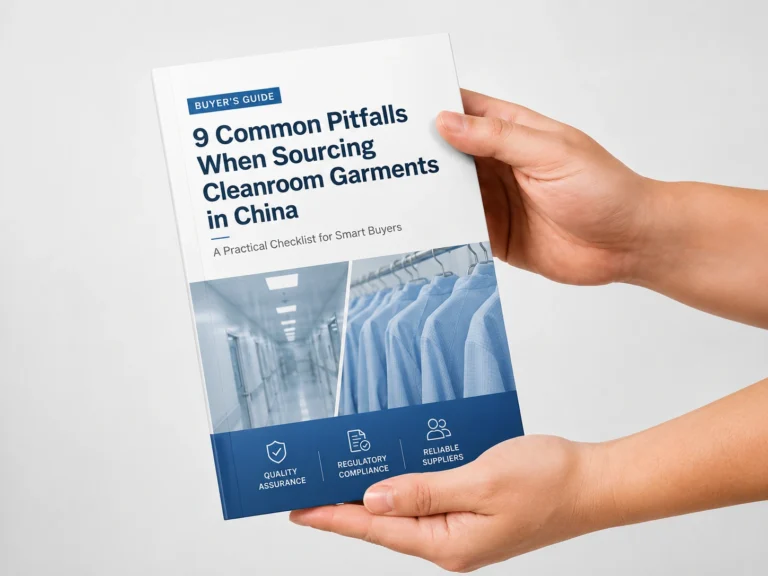
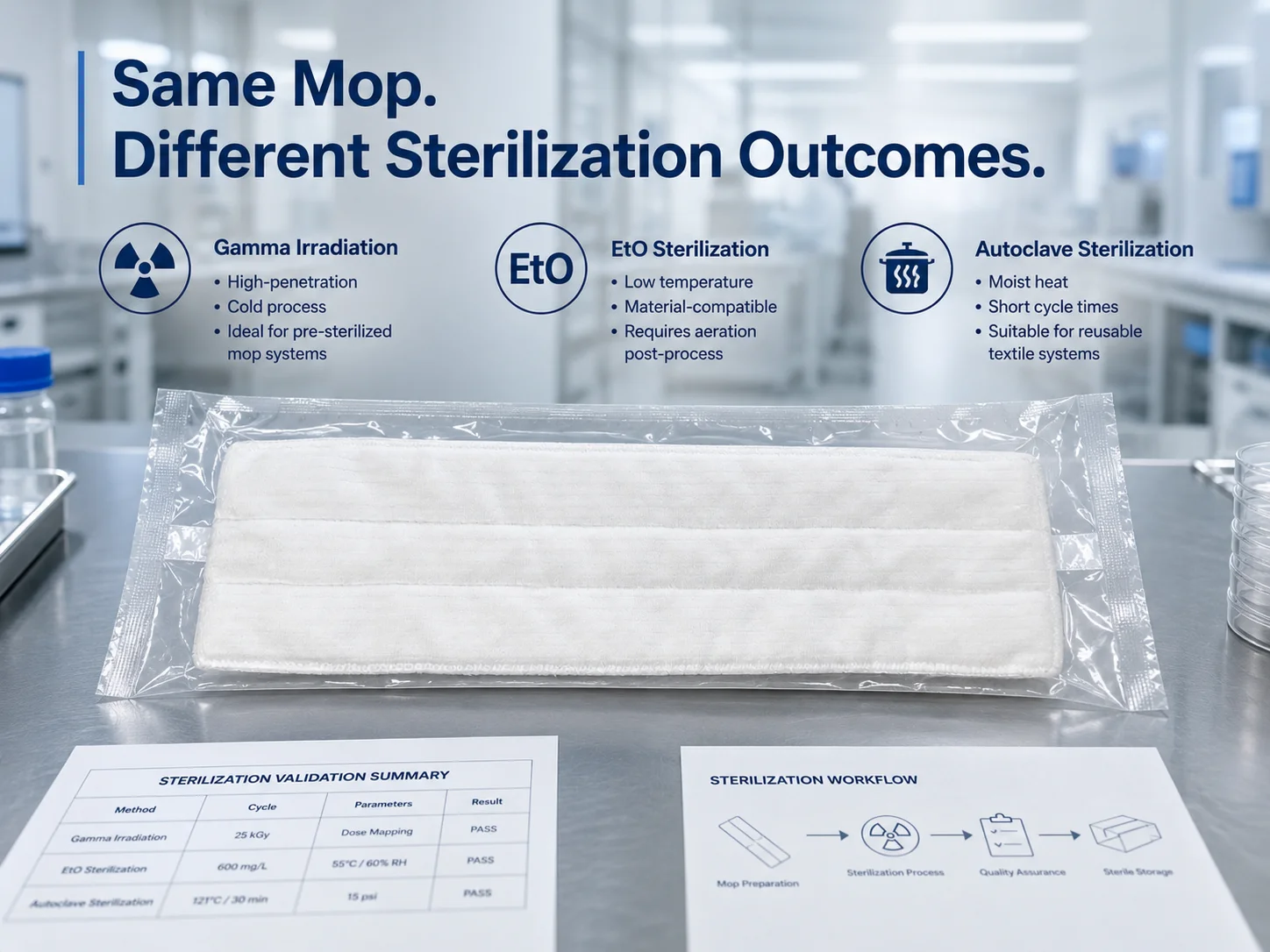
Sterile cleanroom mops can be sterilized by three primary methods — gamma irradiation, ethylene oxide, and steam autoclave — each with fundamentally different effects on mop materials, packaging requirements, sterility assurance levels, validated shelf life, and documentation. The choice is not interchangeable: a mop validated for gamma may degrade under autoclave heat, and a mop designed for EtO gas penetration may be incompatible with gamma’s radiation effects on certain polymers. This guide maps the technical trade-offs that QA, procurement, and validation teams need to evaluate when specifying sterile mops for GMP environments.

The choice of sterilization method depends on three primary factors: material compatibility (can the mop material withstand the method without degrading?), packaging requirements (does the packaging allow sterilization and maintain sterility?), and facility validation capability (is sterilization performed by the supplier or in-house?). Gamma irradiation is the most common method for single-use sterile mops — it penetrates sealed packaging without residuals and provides the longest validated shelf life. Autoclave is the standard for reusable mop systems — it can be performed in-house but applies cumulative thermal stress. Ethylene oxide is the gentlest on materials but requires extended aeration to remove residual gas — and is less common for mops than for medical devices.
| Method | How It Works | Best For | Key Limitation |
|---|---|---|---|
| Gamma Irradiation | Cobalt-60 source emits ionizing radiation that disrupts microbial DNA. Penetrates sealed packaging. | Single-use sterile mops. Long shelf life required. Supplier-managed sterilization. | May degrade polyamide (microfiber component) at higher cumulative doses. Cannot be applied post-packaging to some materials. |
| Ethylene Oxide (EtO) | Gaseous EtO alkylates microbial DNA. Requires gas-permeable packaging and post-sterilization aeration. | Heat-sensitive or radiation-sensitive materials. When gamma is not suitable for the polymer. | Residual EtO requires validated aeration time. Gas penetration limitations. Longer cycle time. |
| Steam Autoclave | Saturated steam at 121°C or 134°C under pressure denatures microbial proteins. | Reusable autoclavable mops. In-house sterilization. No chemical residuals. | Cumulative thermal stress limits reusable mop lifespan. Sterility shelf life depends on post-autoclave handling. |
The takeaway: No single method is universally “better.” The right choice follows the mop material, the use model (single-use or reusable), and the facility’s documentation requirements. For the upstream decision on whether to specify sterile or non-sterile mops, see the sterile vs non-sterile cleanroom mop decision framework. For sterile mop options, see the sterile cleanroom mop options page.
Gamma irradiation uses a Cobalt-60 radioactive source to emit high-energy photons (gamma rays) that penetrate the product and its packaging. The ionizing radiation disrupts the DNA of microorganisms, preventing replication and rendering them non-viable. Unlike autoclave — which relies on heat and moisture — gamma sterilization is a “cold” process: the product temperature does not rise significantly during irradiation, making it suitable for materials that cannot tolerate thermal stress.
Gamma radiation penetrates sealed packaging completely — the product can be packaged in its final sterile barrier system before irradiation. This is a critical advantage: sterility is achieved inside the sealed package, and as long as the packaging remains intact, the product remains sterile. The entire sterilization event happens post-packaging, which eliminates post-sterilization handling as a contamination variable.
Gamma irradiation affects polymer materials differently depending on their chemical structure:
For a detailed analysis of how these materials perform in cleaning applications, see the microfiber vs polyester cleanroom mop comparison.
The standard sterilization dose for cleanroom consumables and medical devices is 25 kGy (kilogray). This dose is validated to achieve a Sterility Assurance Level (SAL) of 10⁻⁶ — meaning a probability of no more than one non-sterile unit per one million units processed. The dose is not arbitrary: it is based on the product’s initial bioburden (the microbial load present before sterilization) and is verified through dose audit procedures.
Gamma-sterilized mops must be packaged in materials that remain stable under radiation — typically Tyvek (flash-spun high-density polyethylene) or medical-grade polyethylene film. The packaging must: (1) allow gamma penetration without degrading, (2) maintain seal integrity through the irradiation process, (3) provide a microbial barrier after sterilization, and (4) remain stable over the validated shelf life. For products entering aseptic areas, double-bagging is common — the outer bag is removed at the Grade C/D boundary, and the inner bag maintains sterility through the Grade B gowning area into Grade A. See the double-bagged sterile cleanroom mops page for packaging configuration details.
Gamma-sterilized products typically carry a validated shelf life of 3–5 years from the date of irradiation, contingent on packaging integrity. This is the longest shelf life of the three methods. Documentation includes: Certificate of Irradiation per batch (confirming the dose delivered and date of irradiation), dosimetry records (measurements of actual dose received at multiple positions in the irradiation chamber), and sterility test results (performed on samples from each batch to verify SAL). The Certificate of Irradiation is the primary document a buyer should request — it is the equivalent of a Certificate of Sterility for gamma-sterilized products.
Ethylene oxide is a gaseous sterilant that alkylates the DNA of microorganisms — it chemically modifies the DNA bases, preventing replication. The process occurs in a sealed chamber at controlled temperature (typically 30–60°C), humidity, and EtO gas concentration. Because the temperature is low compared to autoclave, and the mechanism is chemical rather than radiation-based, EtO is the gentlest sterilization method for polymer materials.
The full EtO cycle includes: preconditioning (temperature and humidity stabilization), EtO gas exposure (sterilization phase), and aeration (removal of residual EtO gas). The aeration phase is critical — EtO is a known carcinogen and residual levels must be reduced below regulatory limits (ISO 10993-7) before the product is released. Aeration can take 12–72 hours depending on the product material, packaging, and chamber conditions.
EtO is the most material-compatible of the three methods. It does not cause the polymer chain scission that gamma can induce, nor the thermal degradation that autoclave can cause. Polyester, polyamide, polypropylene — all tolerate EtO well at standard process parameters. This makes EtO the preferred method when the product contains gamma-sensitive materials (such as polyamide in microfiber) or heat-sensitive components that would warp or degrade at autoclave temperatures.
However, material compatibility is not the same as process suitability: while the mop material may tolerate EtO, the gas must penetrate the product and its packaging to reach all surfaces. Dense or tightly packed products may not receive adequate gas exposure to all surfaces, reducing sterilization efficacy. Products must be validated for the specific EtO cycle parameters — not just assumed compatible.
EtO sterilization requires gas-permeable packaging — the packaging must allow EtO gas to enter during the sterilization phase and exit during the aeration phase. Common materials include Tyvek (gas-permeable) or medical-grade paper. Non-permeable films (solid polyethylene, foil laminates) block EtO penetration and cannot be used as the primary packaging for EtO sterilization. The packaging must also maintain a microbial barrier after sterilization — permeable to gas does not mean permeable to microorganisms.
The primary disadvantage of EtO is residuals management. EtO and its reaction byproducts (ethylene chlorohydrin, ethylene glycol) must be reduced to levels specified in ISO 10993-7 before the product is released. The aeration time required depends on the product material, packaging, and load configuration. Facilities using EtO must manage occupational exposure limits for EtO gas — this is typically the sterilization contractor’s responsibility (the supplier or a third-party sterilization service), not the end user’s. However, buyers should verify that the supplier’s EtO residual testing data is included in the documentation package.
EtO-sterilized products should be accompanied by: Certificate of Sterility per batch (confirming the EtO cycle parameters and sterility test results), EtO residual test results (confirming residuals below ISO 10993-7 limits), and cycle parameter records (temperature, humidity, gas concentration, exposure time, aeration time). The Certificate of Sterility for EtO is not the same document as the Certificate of Irradiation for gamma — each is method-specific and should reference the relevant process validation.
Steam autoclave sterilization uses saturated steam under pressure to achieve temperatures above the boiling point of water — typically 121°C at 15 psi (gravity cycle) or 134°C at 30 psi (pre-vacuum cycle). The high temperature denatures microbial proteins and disrupts cell membranes, achieving sterilization through thermal energy. Autoclave is the most widely available sterilization method in GMP facilities — most pharmaceutical and biotech production sites have validated autoclaves for sterilizing equipment, garments, and consumables.
Unlike gamma and EtO — which are typically performed by the supplier or a contract sterilization service — autoclave can be performed in-house by the end user. This is a significant operational advantage: the facility controls the sterilization schedule, cycle parameters, and documentation, reducing dependency on supplier sterilization timelines.
Autoclave sterilization subjects mop materials to the most aggressive conditions of the three methods — high temperature, moisture, and pressure — in each cycle. The effects are cumulative:
These cycle counts are triggers for intensified inspection — not automatic retirement thresholds. Facilities should implement the inspection criteria described in the cleanroom mop maintenance and longevity guide.
Autoclave-sterilized mops may be packaged before or after sterilization depending on the facility’s protocol. Pre-packaged autoclave sterilization uses breathable packaging (similar to EtO) that allows steam penetration. Post-sterilization packaging requires the mops to be packaged in a sterile environment after the autoclave cycle — which introduces handling as a contamination variable.
Unlike gamma-sterilized products, autoclave-sterilized mops do not carry a manufacturer-validated shelf life unless they are packaged under controlled conditions post-sterilization and the packaging integrity is validated. Facilities using in-house autoclave sterilization typically define their own shelf life based on packaging method, storage environment, and risk assessment — commonly 30–90 days for items used within the facility.
Autoclave documentation is generated by the facility, not the supplier: autoclave cycle log (date, cycle type, temperature, pressure, duration), biological indicator results (spore strip or self-contained BI placed in the load to verify sterilization), and chemical integrator results (confirming that temperature and time parameters were met). These records form part of the facility’s GMP documentation — not a Certificate of Sterility in the supplier-issued sense. During an audit, the facility must demonstrate that autoclave cycles were valid, biological indicators passed, and the items were used or stored within the defined shelf life.
The following matrix consolidates the three methods across eight operational dimensions. Use it to evaluate which method aligns with your mop material, facility capability, and documentation requirements.
| Dimension | Gamma Irradiation | Ethylene Oxide (EtO) | Steam Autoclave |
|---|---|---|---|
| Material Compatibility — Polyester | Good | Excellent | Good (cumulative thermal stress) |
| Material Compatibility — Microfiber | Moderate (polyamide sensitivity) | Excellent | Limited (10–20 cycle range) |
| Sterility Assurance Level | 10⁻⁶ (standard) | 10⁻⁶ (standard) | Facility-validated (typically 10⁻⁶) |
| Packaging Requirement | Radiation-stable sealed packaging | Gas-permeable packaging | Steam-permeable packaging (or post-cycle sterile packaging) |
| Validated Shelf Life | 3–5 years (supplier-validated) | 2–3 years (supplier-validated) | Facility-defined (typically 30–90 days) |
| Documentation Type | Certificate of Irradiation per batch | Certificate of Sterility per batch | Autoclave cycle log (facility-generated) |
| Residuals | None | EtO gas and byproducts (requires aeration) | None (chemical) |
| Best Application | Single-use sterile mops. Supplier-managed. Long shelf life. | Radiation/heat-sensitive materials. | Reusable autoclavable mops. In-house sterilization. |
Disclaimer: This comparison describes general characteristics of each sterilization method. Specific mop products may behave differently based on material formulation, construction, and supplier validation. Always consult the supplier’s sterilization validation documentation for product-specific compatibility and performance data. For a complete framework of supplier documentation to request, see the cleanroom mop validation documents guide.
Selecting a sterilization method for cleanroom mops follows the decision logic outlined below. Each criterion narrows the options until the appropriate method emerges from the intersection of material, use model, and facility requirements.
Single-use mops → gamma or EtO (supplier-sterilized). Reusable mops → autoclave (facility-sterilized). This is the first and most definitive filter: a mop that will be reused after cleaning must tolerate repeated sterilization cycles, which favors autoclave. A mop that is discarded after one use should arrive sterile, which favors gamma or EtO.
Polyester mops → all three methods are viable (with supplier validation). Microfiber mops → gamma may degrade polyamide at higher doses; EtO is the gentlest option for preserving microfiber structure; autoclave limits microfiber cycle life to 10–20 cycles. The material decision drives the method decision — selecting a material without considering its sterilization compatibility results in a specification that looks valid on paper but fails under production conditions.
Long shelf life (years) → gamma (3–5 years validated). Medium shelf life → EtO (2–3 years). Short shelf life → autoclave (30–90 days, facility-defined). The required shelf life should reflect the procurement cycle: if sterile mops are ordered monthly and used within 30 days, a long shelf life is unnecessary. If sterile mops are ordered quarterly and held in inventory, gamma’s 3–5 year shelf life provides buffer against expiration.
If yes, autoclave is an option for reusable mops — and reduces supplier dependency for sterilization. If no, and reusable mops are used, the facility must contract with an external sterilization service or switch to supplier-sterilized single-use mops (gamma or EtO). The availability of validated in-house autoclave is a practical constraint that eliminates or enables the autoclave option regardless of material compatibility.
Supplier-issued Certificate of Irradiation (gamma) or Certificate of Sterility (EtO) → externally generated documentation that transfers to the buyer. In-house autoclave cycle logs → internally generated documentation that the facility owns and controls. The documentation path should match the quality system’s preference: some facilities prefer supplier-managed documentation for audit simplicity; others prefer in-house documentation for process control.
The upstream decision — whether to specify sterile or non-sterile mops in the first place — is covered in the sterile vs non-sterile cleanroom mop decision framework. The method selection described in this guide applies once the sterile specification decision has been made.
A facility switches from gamma-sterilized single-use mops to autoclaving reusable mops, assuming the same sterility outcome. The mop material was validated for gamma, not for repeated autoclave cycling. By cycle 15, the quilting stitches begin to separate. The sterility outcome was the same, but the material durability was not — because the sterilization method affects material longevity as well as sterility.
Correction: Treat the sterilization method as part of the mop specification, not as an interchangeable final step. A mop validated for gamma has not been validated for autoclave unless the supplier explicitly confirms autoclave compatibility and provides cycle limit data.
EtO residuals are regulated and validated. A properly aerated EtO-sterilized product has residual levels below ISO 10993-7 limits — which are conservative safety thresholds. The concern is valid (EtO is a carcinogen) but the risk is controlled through validated aeration and residual testing. Avoiding EtO entirely eliminates the gentlest sterilization option for polymer materials — which may force the use of gamma or autoclave on materials that do not tolerate them well, creating a material durability problem that is more operationally significant than the residual risk from validated EtO sterilization.
Correction: Evaluate EtO based on the supplier’s residual testing data and aeration validation — not on the hazard classification of EtO gas alone. A supplier that provides complete EtO residual documentation has managed the risk. A supplier that cannot provide residual data has not.
SAL 10⁻⁶ (one non-sterile unit per million) is the standard for sterile medical devices and cleanroom consumables. Achieving SAL 10⁻⁷ or 10⁻⁸ is technically possible but requires higher radiation doses, longer EtO exposure, or more aggressive autoclave cycles — all of which accelerate material degradation. The incremental sterility benefit between 10⁻⁶ and 10⁻⁷ is negligible for cleanroom mop applications, but the material degradation penalty may not be. Specifying a higher SAL than necessary trades material service life for a sterility margin that provides no practical contamination control benefit.
Correction: Verify that the product achieves SAL 10⁻⁶ — the standard threshold. Do not request or specify higher SAL unless a documented risk assessment demonstrates that 10⁻⁶ is insufficient for the specific application. In cleanroom mop applications, 10⁻⁶ is the appropriate standard.
Packaging maintains sterility — it does not create it. If the packaging is compromised (pinhole, seal failure, abrasion during transport), the product inside is no longer sterile regardless of the original sterilization method or documentation. Packaging integrity is validated at the time of sterilization, but it must be maintained through storage, transport, and transfer into the cleanroom. A gamma-sterilized mop with a pinhole in the outer bag may have been sterile when irradiated, but it is not sterile when the operator opens the bag at the Grade B gowning bench.
Correction: Include packaging integrity verification in the incoming inspection procedure for sterile mops. Train operators to inspect packaging before opening — damaged packaging = do not use. For aseptic transfer protocols, see the sterile cleanroom mop aseptic transfer guide for staged packaging verification.
A facility autoclaves reusable mops, packages them in-house, and stores them for six months — assuming the same shelf life as gamma-sterilized supplier-packaged mops. Gamma-sterilized mops carry a supplier-validated shelf life (3–5 years) based on packaging integrity testing conducted under controlled conditions. In-house autoclaved mops carry no supplier-validated shelf life — the shelf life is defined by the facility based on their packaging method, storage environment, and risk assessment. A six-month storage without validated packaging integrity is outside the typical facility-defined shelf life for autoclaved items.
Correction: Define and document the shelf life for autoclaved mops in the facility’s cleaning SOP. Base the shelf life on packaging method, storage conditions, and environmental monitoring data from the storage area. If no packaging integrity validation has been performed, adopt a conservative shelf life (30 days) and adjust with data.
Gamma irradiation (Cobalt-60 ionizing radiation), ethylene oxide (EtO gas alkylation), and steam autoclave (saturated steam at 121°C or 134°C under pressure). Gamma and EtO are typically performed by the supplier or a contract sterilization service. Autoclave can be performed in-house by the facility and is the standard method for reusable autoclavable mops.
Gamma irradiation at standard sterilization doses (25 kGy) is generally well-tolerated by polyester, which maintains structural integrity and cleaning performance. Microfiber’s polyamide component is more gamma-sensitive — it can undergo chain scission, leading to reduced tensile strength and accelerated degradation of the split-fiber structure at higher cumulative doses. Polyester mops are the more conservative choice for gamma-sterilized products.
All three methods can achieve SAL 10⁻⁶ (one non-sterile unit per million) when properly validated. This is the standard for sterile medical devices and cleanroom consumables. Gamma and EtO achieve this through validated supplier processes with dosimetry (gamma) or cycle parameter verification (EtO). Autoclave achieves this through validated facility cycles with biological indicator testing. Specifying higher SAL (>10⁻⁶) is generally unnecessary for cleanroom mop applications and may accelerate material degradation without providing practical contamination control benefit.
Gamma: Certificate of Irradiation per batch (dose delivered, date of irradiation), dosimetry records, sterility test results. EtO: Certificate of Sterility per batch, EtO residual test results (confirming residuals below ISO 10993-7 limits), cycle parameter records. Autoclave: Autoclave cycle log (facility-generated), biological indicator results, chemical integrator results. The documentation type differs fundamentally between supplier-sterilized (gamma/EtO) and facility-sterilized (autoclave) products.
Gamma: 3–5 years (supplier-validated, contingent on packaging integrity). EtO: 2–3 years (supplier-validated). Autoclave: 30–90 days (facility-defined, based on packaging method, storage environment, and risk assessment). Autoclave-sterilized items do not carry a manufacturer-validated shelf life unless packaged under controlled conditions and validated for packaging integrity — which is uncommon in facility-operated autoclave programs.
No method is universally better — the appropriate method depends on the mop material, use model (single-use or reusable), required shelf life, and facility capability. Gamma is the most common for single-use sterile mops because it provides the longest shelf life and penetrates sealed packaging without residuals. Autoclave is the standard for reusable mops because it can be performed in-house. EtO is the best choice for materials that cannot tolerate gamma or heat — but is less common for mops than for medical devices. The method should follow the material and the application, not be selected independently.
Technically possible but requires re-validation. A gamma-sterilized mop is not automatically validated for autoclave re-sterilization, and an autoclaved mop is not automatically validated for gamma. The cumulative effect of different sterilization mechanisms on the same material is not predictable without testing. If a facility needs to re-sterilize mops using a different method than the original sterilization, the supplier should be consulted for compatibility data — and the re-sterilization should be validated before production use. In practice, switching sterilization methods on the same item should be avoided unless specifically validated.
Each method imposes different packaging requirements. Gamma requires radiation-stable materials (Tyvek, medical-grade PE) that remain stable under irradiation and maintain seal integrity. EtO requires gas-permeable packaging that allows EtO penetration during sterilization and outgassing during aeration. Autoclave requires steam-permeable packaging if packaged before sterilization, or sterile packaging applied post-cycle in a controlled environment. The packaging must maintain a microbial barrier regardless of method — the sterilization method determines how the packaging is validated, not whether a barrier is required.
Specify your sterilization method, target SAL, packaging requirements, and cleanroom grade. MIDPOSI provides sterile mop specifications with sterilization validation documentation and material compatibility data.
Documentation availability may vary by product configuration. Standard technical documentation provided with every inquiry.
{
“@context”: “https://schema.org”,
“@graph”: [
{
“@type”: “Article”,
“headline”: “Cleanroom Mop Sterilization Methods — Gamma, EtO, and Autoclave Compared”,
“description”: “Sterile cleanroom mops can be sterilized by gamma irradiation, ethylene oxide, or steam autoclave — each with different effects on materials, packaging, shelf life, and documentation. This comparison helps QA and procurement teams select the appropriate method.”,
“author”: { “@type”: “Organization”, “name”: “MIDPOSI” },
“publisher”: { “@type”: “Organization”, “name”: “MIDPOSI”, “url”: “https://midposi.com/” },
“datePublished”: “2026-06-01”,
“dateModified”: “2026-07-14”,
“mainEntityOfPage”: { “@type”: “WebPage”, “@id”: “https://midposi.com/cleanroom-mop-sterilization-gamma-eto-autoclave/” },
“image”: “https://midposi.com/wp-content/uploads/2025/12/Double-bagging-for-aseptic-products-for-sterile-cleanroom-mop.webp”,
“articleSection”: “Cleanroom Mop Sterilization”,
“keywords”: “cleanroom mop sterilization gamma eo autoclave, sterile mop sterilization comparison, gamma irradiation cleanroom mop”
},
{
“@type”: “FAQPage”,
“mainEntity”: [
{
“@type”: “Question”, “name”: “What are the three primary sterilization methods for cleanroom mops?”,
“acceptedAnswer”: { “@type”: “Answer”, “text”: “Gamma irradiation (Cobalt-60 ionizing radiation), ethylene oxide (EtO gas alkylation), and steam autoclave (saturated steam at 121°C or 134°C). Gamma and EtO are typically supplier-performed. Autoclave can be performed in-house for reusable mops.” }
},
{
“@type”: “Question”, “name”: “How does gamma irradiation affect cleanroom mop materials?”,
“acceptedAnswer”: { “@type”: “Answer”, “text”: “Polyester tolerates gamma well at standard 25 kGy doses, maintaining structural integrity. Microfiber’s polyamide component is more gamma-sensitive — it can undergo chain scission leading to reduced strength and accelerated split-fiber degradation at higher cumulative doses.” }
},
{
“@type”: “Question”, “name”: “What sterility assurance level (SAL) do these methods achieve?”,
“acceptedAnswer”: { “@type”: “Answer”, “text”: “All three methods can achieve SAL 10⁻⁶ when properly validated — the standard for sterile medical devices and cleanroom consumables. Specifying higher SAL is generally unnecessary for mop applications and may accelerate material degradation without practical benefit.” }
},
{
“@type”: “Question”, “name”: “What documentation should a buyer request for each sterilization method?”,
“acceptedAnswer”: { “@type”: “Answer”, “text”: “Gamma: Certificate of Irradiation per batch with dosimetry records. EtO: Certificate of Sterility with EtO residual test results. Autoclave: Cycle log, biological indicator results, chemical integrator results — facility-generated, not supplier-issued.” }
},
{
“@type”: “Question”, “name”: “What is the validated shelf life for each sterilization method?”,
“acceptedAnswer”: { “@type”: “Answer”, “text”: “Gamma: 3–5 years supplier-validated. EtO: 2–3 years supplier-validated. Autoclave: 30–90 days facility-defined, based on packaging method, storage environment, and risk assessment.” }
},
{
“@type”: “Question”, “name”: “Is one sterilization method inherently better for cleanroom mops?”,
“acceptedAnswer”: { “@type”: “Answer”, “text”: “No method is universally better. Gamma is most common for single-use sterile mops. Autoclave is standard for reusable mops. EtO is best for materials that cannot tolerate radiation or heat. The method should follow the material and application.” }
},
{
“@type”: “Question”, “name”: “Can a mop sterilized by one method be re-sterilized by a different method?”,
“acceptedAnswer”: { “@type”: “Answer”, “text”: “Technically possible but requires re-validation. The cumulative effect of different sterilization mechanisms is not predictable without testing. Switching methods on the same item should be avoided unless specifically validated by the supplier.” }
},
{
“@type”: “Question”, “name”: “How does the sterilization method affect cleanroom mop packaging?”,
“acceptedAnswer”: { “@type”: “Answer”, “text”: “Gamma requires radiation-stable packaging. EtO requires gas-permeable packaging. Autoclave requires steam-permeable packaging if packaged pre-cycle, or sterile post-cycle packaging. The packaging must maintain a microbial barrier regardless of method.” }
}
]
},
{
“@type”: “BreadcrumbList”,
“itemListElement”: [
{ “@type”: “ListItem”, “position”: 1, “name”: “Home”, “item”: “https://midposi.com/” },
{ “@type”: “ListItem”, “position”: 2, “name”: “Blog”, “item”: “https://midposi.com/blog/” },
{ “@type”: “ListItem”, “position”: 3, “name”: “Cleanroom Mop Sterilization Methods”, “item”: “https://midposi.com/cleanroom-mop-sterilization-gamma-eto-autoclave/” }
]
}
]
}