Grade C and D areas account for the majority of cleanroom square footage in a typical GMP facility — yet their cleaning programs are often designed as an afterthought. This guide provides a structured approach to building a cost-effective, operationally practical, and audit-ready cleaning tool program specifically for support zones. For a companion overview of grade-level mop specifications, see the GMP cleanroom mop grade-by-grade selection guide.
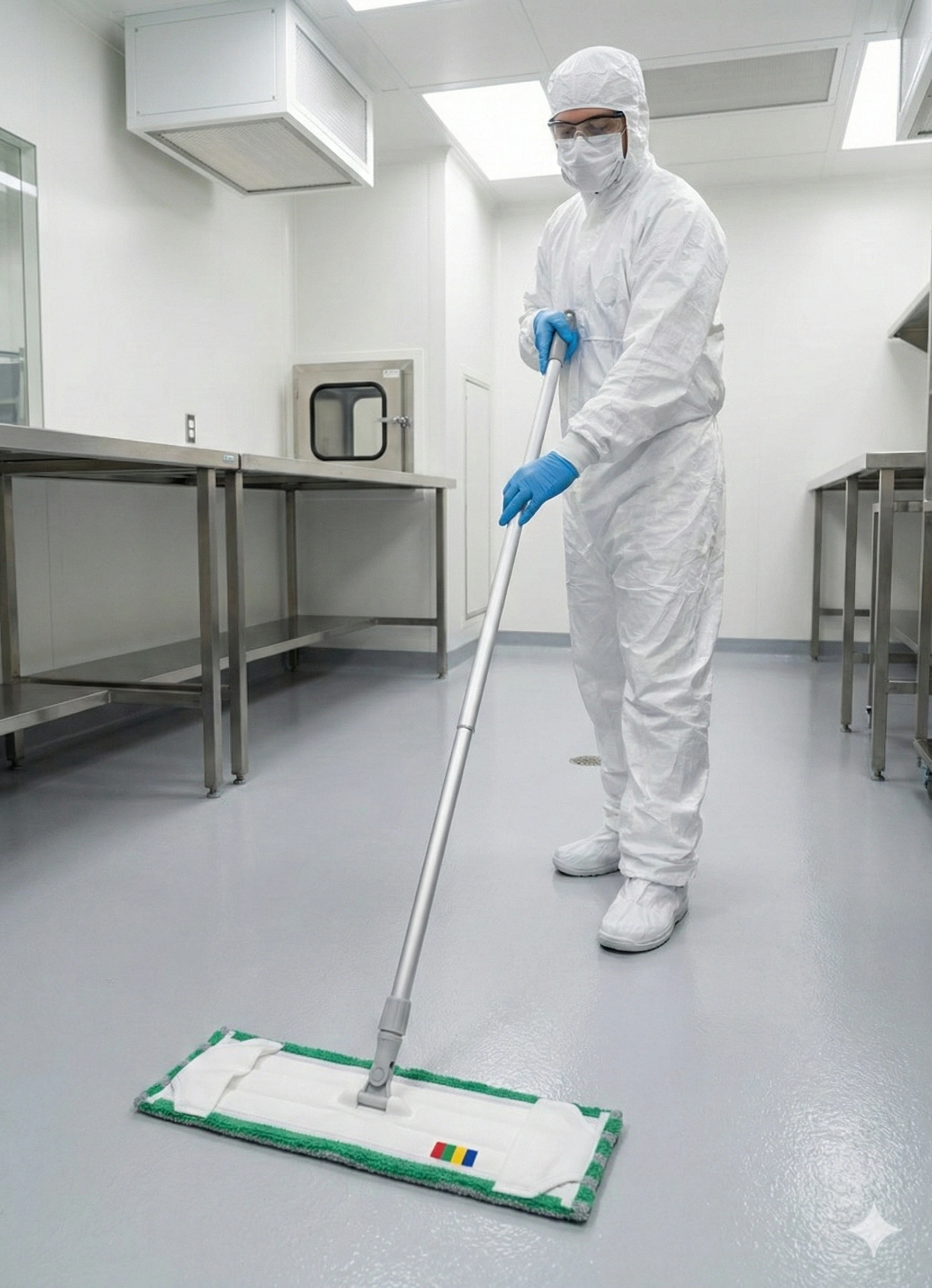
Building a cleaning tool program for GMP Grade C/D areas involves five interconnected design decisions: (1) choose between disposable and laundered mop economics based on throughput and facility capabilities, (2) select mop materials suited to C/D cleaning intensity and disinfectant chemistry, (3) apply color-coded zone separation to prevent cross-contamination, (4) design SOPs with practical frequency, mop change triggers, and sequencing, and (5) determine documentation requirements proportionate to C/D risk — detailed enough for audit readiness but not the level required for aseptic areas. Each decision is explored in detail below.
A common approach to C/D cleaning programs is to take the Grade A/B specification and remove what looks unnecessary: skip sterility, downgrade the material, buy a cheaper frame. This produces a program that is cheaper — but not one that is well-designed for the operational reality of support zones.
The operational profile of C/D areas is fundamentally different from A/B in three ways that should shape the program design:
Grade C/D corridors, gowning rooms, and material airlocks are cleaned more frequently and cover more square footage than aseptic cores. A mop program designed for a small Grade A suite does not scale to a 2,000 m² C/D support zone. Mop durability, absorbency per unit, and operator fatigue over extended cleaning sessions become primary design parameters — not secondary considerations.
Grade A/B cleaning is typically performed by a small number of highly trained operators following tightly controlled protocols. C/D cleaning often involves a larger team with higher turnover. The mop system and SOP must be robust to operator variability — forgiving of technique differences, easy to train, and difficult to misuse. If an SOP step is easily skipped or misunderstood, it will be.
Grade A/B consumable budgets are typically protected because sterility assurance is non-negotiable. C/D budgets face more scrutiny because the risk is perceived as lower — but under-spending on cleaning tools can create contamination issues that migrate into higher-grade areas through material and personnel flow. The program design challenge is not “cheapest option” but “cost-optimized without compromising the contamination control chain.” A cleanroom mop system overview can help identify where component-level decisions affect overall program cost and performance.
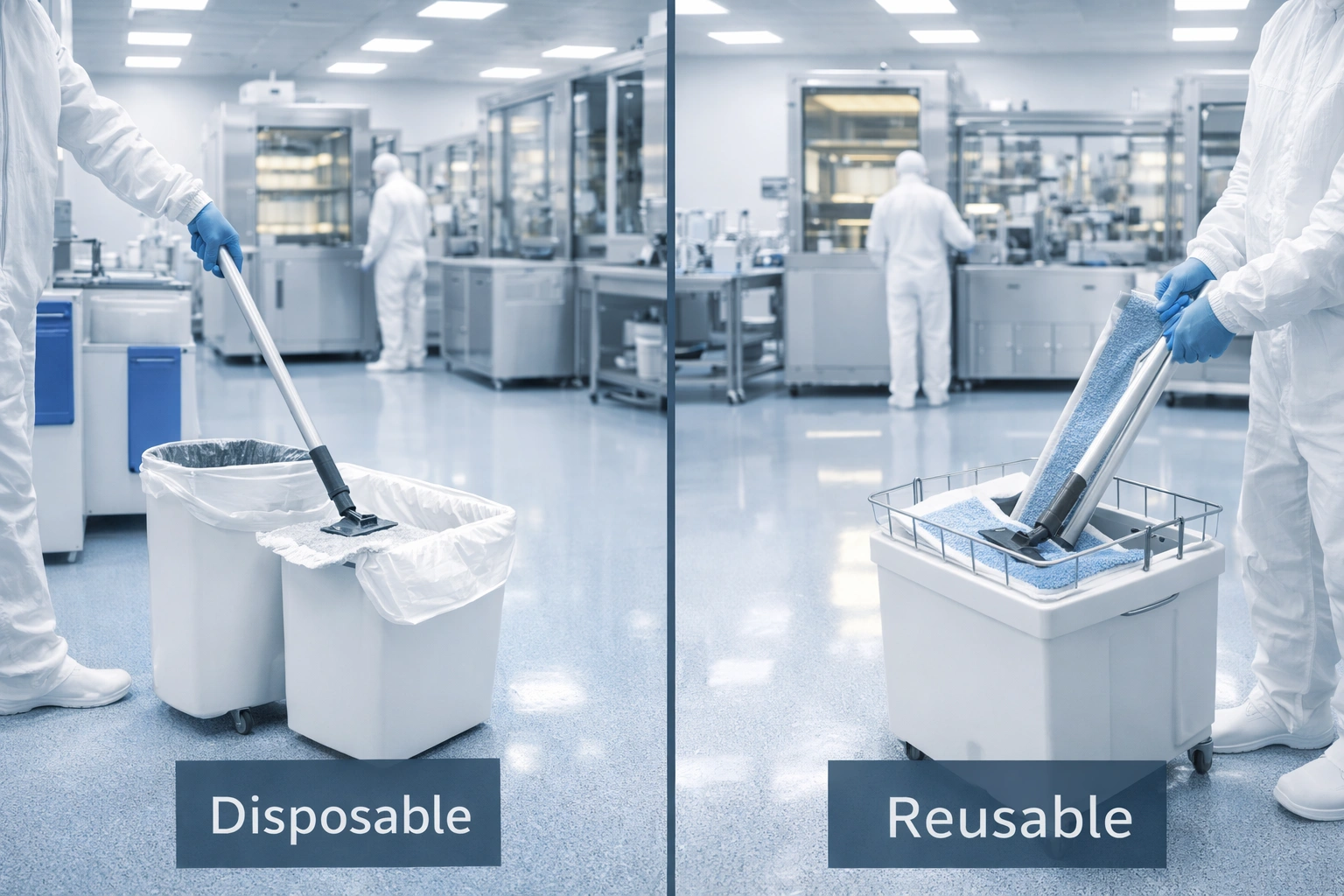
In Grade A/B, the sterile requirement often makes disposable the default decision — the economics of sterility assurance drive single-use. In C/D, sterility is generally not required, which opens a more nuanced cost analysis between disposable and laundered options. For a full decision framework, see the disposable vs reusable cleanroom mop decision guide.
| Factor | Disposable (Single-Use) | Laundered (Multi-Use) |
|---|---|---|
| Per-unit cost | Lower upfront per mop cover | Higher upfront; amortized over cycles |
| Break-even point | N/A (always single-use) | Typically 20–40 cycles depending on laundering cost |
| Laundry infrastructure | None required | Requires validated laundry process (in-house or contracted) |
| Cross-contamination risk | Lower (fresh cover per session) | Requires validated segregation between zones during laundry |
| Waste volume | Higher (disposed after each use) | Lower (replaced at end of usable life) |
| Best for | Facilities without laundry capability; smaller C/D areas; multiproduct facilities where segregation is difficult | Large C/D areas with in-house laundry; single-product facilities; facilities with sustainability targets |
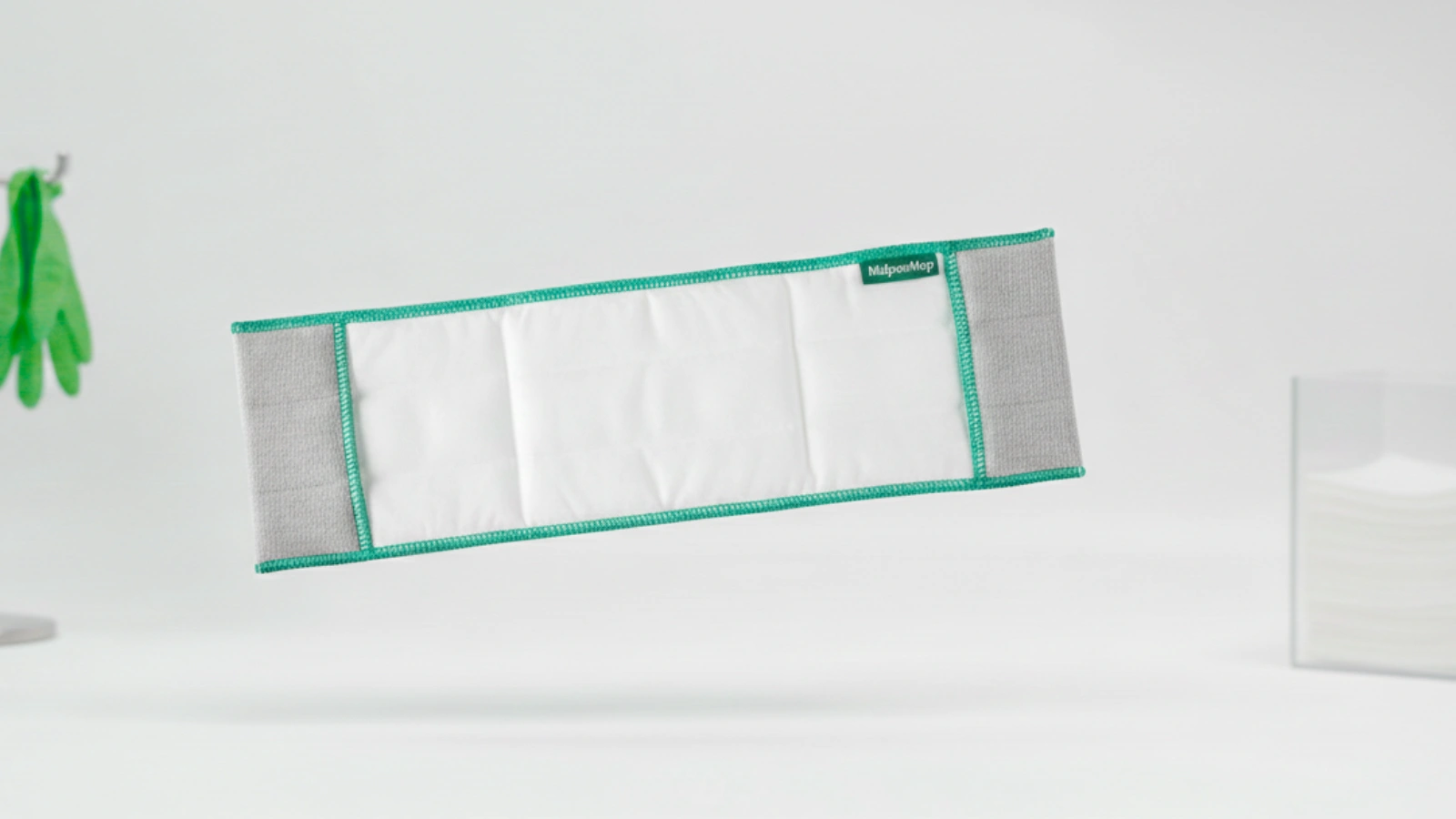
C/D areas present a different material optimization problem than aseptic cores. In Grade A/B, particle generation is the dominant selection criterion. In C/D, the balance shifts toward durability under high-frequency use and chemical compatibility with facility disinfectants — because the mop will be used across larger areas, more frequently, with more aggressive cleaning agents.
Polyester and microfiber both have roles in C/D, but the selection logic differs from higher grades. For a deeper look at material tradeoffs, see the microfiber cleanroom mop guide.
Color coding is one of the most operationally effective — and cost-effective — contamination control measures available for C/D programs. A well-designed color system makes zone violations visible before they become audit observations.
Corridors, material airlocks, secondary gowning. Use green-coded mop covers and hardware.
Primary gowning, material transfer into Grade B. Use blue-coded mop covers and hardware.
Within any single grade, differentiate floor mops from wall/ceiling mops. Red is commonly used for floor designation.
A C/D cleaning SOP should address the following operational parameters. These are starting-point recommendations that should be adapted to each facility’s specific layout, traffic patterns, and contamination control risk assessment.
Per shift as a minimum for active production days. High-traffic corridors and material airlocks may require twice per shift. Document the rationale for frequency decisions in the SOP, referencing traffic volume and environmental monitoring data where available.
Define the trigger for mop cover change: per room, per defined area (e.g., per 50 m²), or when visibly soiled. A per-room change policy with a maximum area cap provides the clearest audit trail. The policy should be written so that an operator can execute it without ambiguity.
If the facility uses sporicidal agents on a scheduled basis (e.g., weekly), the SOP should specify which mop cover type is used for sporicidal vs. routine disinfection. Some facilities dedicate separate mop sets for sporicidal cleaning to avoid cross-contamination of disinfectant residues.
Specify the order of cleaning within C/D: cleanest-to-dirtiest flow (Grade C areas before Grade D, if combined in a single shift). Within a room: ceiling, walls, equipment surfaces, floor — in that order. The sequence should be explicit in the SOP, not assumed.
Define disinfectant preparation, pot life, and change frequency for mop bucket solution. Document solution concentration verification steps. For large C/D areas where solution may be used over extended periods, define maximum solution age and re-verification requirements.
Define visual inspection criteria for post-cleaning sign-off. For C/D areas, visual inspection is typically the primary release criterion — but the SOP should define what “visually clean” means (no visible residue, no standing liquid, no debris) with enough precision to make pass/fail consistent across operators and shifts.
One of the most common C/D program errors is applying Grade A/B documentation requirements to support zones — creating paperwork burdens that consume QA resources without a corresponding contamination control benefit. The principle is proportionality: documentation should match risk.
The documentation package for C/D should be retrievable within a reasonable timeframe, organized by zone and cleaning date, and reviewed periodically for completeness — but it does not need the same depth or retrieval speed as aseptic area documentation. An auditor reviewing C/D cleaning records is typically looking for a functioning program with consistent execution, not the exhaustive traceability expected in Grade A/B.
Floors in C/D areas carry particulate load from foot traffic and material movement. Using the same mop — or even the same mop type without a change — for walls and ceilings transfers that load upward. Designate separate mop sets or enforce a strict sequence (walls before floors) with cover change between surfaces.
Visual inspection is useful but insufficient as the sole mop change criterion in GMP environments. Particulate and residue loading can reach levels that compromise cleaning effectiveness before they are visually obvious. A defined area-based or room-based change policy provides consistency that visual judgment alone cannot.
Applying the full A/B documentation package to C/D areas creates paperwork that does not improve contamination control and diverts QA resources from higher-risk areas. Audit each document type: “Does this document reduce contamination risk in C/D, or is it procedural inertia?”
C/D programs often allocate budget to mop covers — the consumable — while reusing old or mismatched frames and handles. A worn frame that does not hold the cover flat against the surface reduces cleaning effectiveness regardless of cover quality. Include hardware replacement cycles in the program design.
A C/D cleaning program that is designed once and never reviewed will drift. Operator turnover, new disinfectants, changed traffic patterns, and environmental monitoring trends should trigger a program review. Build a scheduled review — not just an audit-triggered review — into the program design from the start.
Generally, no — Grade C and D are classified as “clean” support zones under EU GMP Annex 1, not aseptic areas. Sterility is not a regulatory requirement for cleaning tools used in these zones. Non-sterile mop covers are standard for C/D applications. The decision should be confirmed by your facility’s contamination control risk assessment. If a facility chooses to use sterile mop covers in C/D for operational consistency, that decision should be documented — but it should be recognized as a facility election, not a regulatory requirement.
Calculate total cost per cleaning event, not per-unit cost. For disposable: unit cost of mop cover × covers used per shift × shifts per day. For laundered: (unit cost of mop cover ÷ usable life in cycles) + (laundering cost per cycle × cycles per shift × shifts per day). Include indirect costs: laundry validation (for laundered), waste disposal (for disposable), and inventory carrying cost. The break-even point where laundered becomes cheaper than disposable typically falls between 20 and 40 use cycles, depending on laundering cost. Facilities without validated laundry capability should include the cost of building or contracting that capability in the analysis.
At minimum, three color sets for a multi-grade C/D facility: one for Grade C floors, one for Grade D floors, and one for walls/ceilings across both grades. If the facility also has a Grade B transition area cleaned by the same team, add a fourth set. The key principle is that an operator should never have to think about whether a mop is in the right zone — the color should answer the question. Color coding should be applied to mop covers, frames, and handles (or at minimum covers and handles) so that the entire assembly is visually identifiable.
Per room or per defined area (e.g., 50 m²) is a common starting point for both C and D. Grade C transition areas that feed into Grade B may warrant more frequent changes — per 25–30 m² — because contamination introduced in C can migrate into higher-grade areas. The specific frequency should be based on your facility’s environmental monitoring data and documented in the cleaning SOP. Avoid “change when visibly soiled” as the only criterion for GMP areas — define a quantitative trigger that operators can follow without interpretation.
Using the same bucket and wringer across C and D zones introduces cross-contamination risk. If a single bucket system must be used for both grades, implement a strict cleaning sequence (Grade C before Grade D) and change the disinfectant solution between grades. The preferred approach is dedicated buckets per grade with color-coded identification. Buckets themselves should be included in the cleaning and disinfection schedule, not just the mop covers.
An auditor reviewing C/D cleaning typically expects: cleaning SOPs with defined frequencies and change triggers, completed cleaning logs showing date/zone/operator/disinfectant, mop cover change records, COA documentation for mop products in use, operator training records, and any cleaning deviation reports with associated CAPA. They are generally not looking for Certificate of Irradiation, sterility assurance documentation, or endotoxin data for C/D-specific tools. The documentation should demonstrate that a program exists, is being followed consistently, and is periodically reviewed — not that it matches the depth of aseptic area documentation.
Annually as a scheduled review, plus event-triggered reviews when: a new disinfectant is introduced, environmental monitoring shows a negative trend, facility layout or traffic patterns change, a new product or supplier is introduced, or a cleaning-related deviation or audit observation occurs. The scheduled annual review should include: review of environmental monitoring data for cleaning-related trends, operator feedback on tools and procedures, supplier performance review, and a cost-effectiveness analysis of the current mop product and program design.
Whether you are building a C/D program for a new facility or redesigning an existing one, MIDPOSI can provide product samples, volume pricing for multi-grade programs, technical data sheets, and program design consultation. Request samples for in-house evaluation against your specific C/D disinfectants and protocols.
MIDPOSI provides non-sterile mop covers, stainless steel hardware, and technical documentation suitable for evaluation in Grade C/D cleaning programs. Volume planning and multi-site program support available upon request.
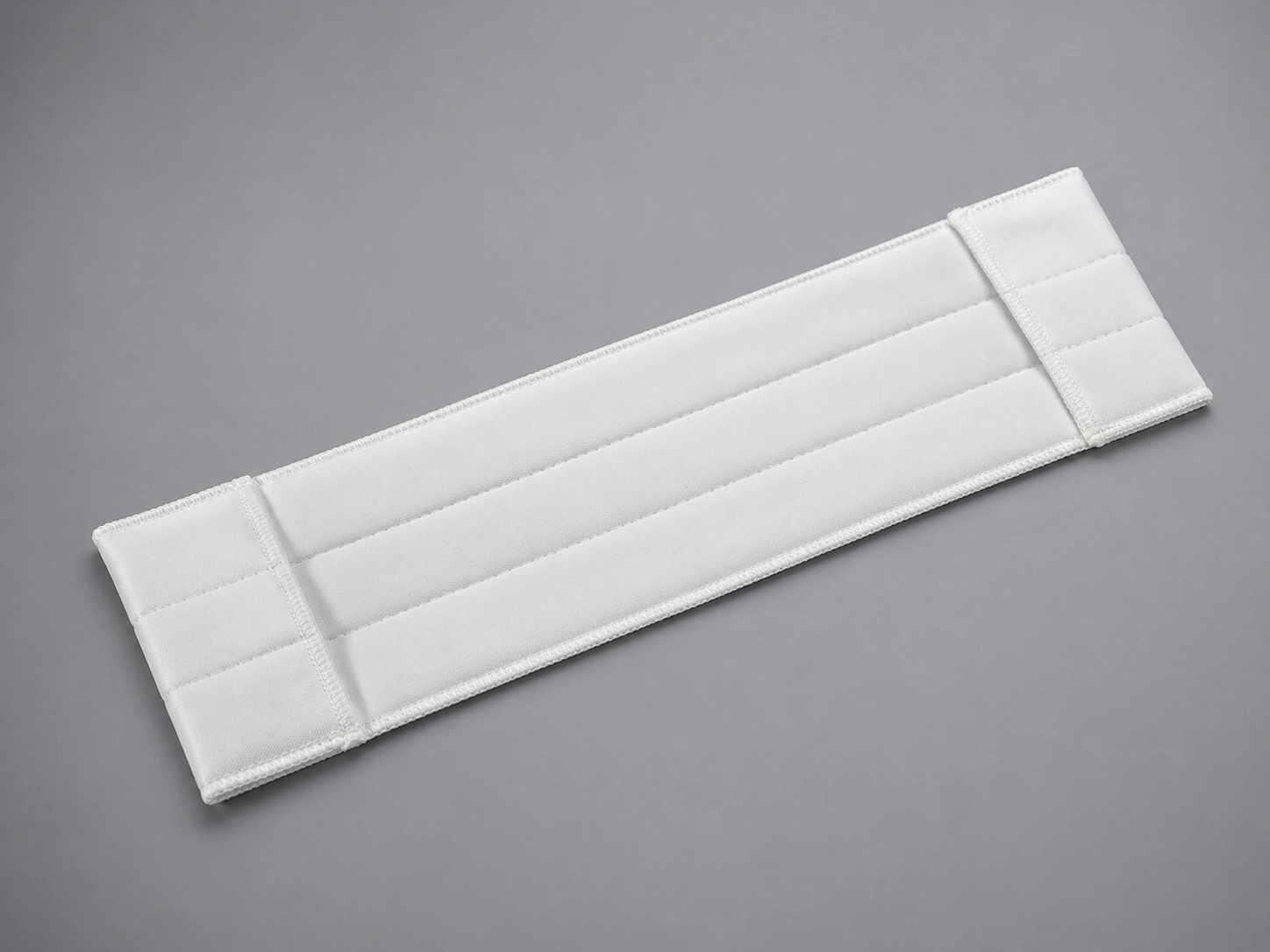
Disclaimer: This guide provides a general framework for designing Grade C/D cleaning tool programs and does not constitute regulatory or legal advice. Cleaning frequencies, documentation requirements, mop change triggers, and program parameters should be determined by each facility based on its specific layout, traffic patterns, environmental monitoring data, contamination control risk assessment, and applicable regulatory requirements. MIDPOSI does not claim that following this framework satisfies all regulatory requirements for all facilities.