Best Cleanroom Mop Systems for Pharma Production Lines

👉 If you need the quick GMP buyer version, read our short guide here.

Pharmaceutical QA teams chase environmental monitoring failures back to the same root cause: cleaning tools qualified as individual components but never validated as complete systems. A sealed-edge mop head generating <100 particles per m² loses that performance when paired with a cut-edge frame pocket, a non-autoclavable handle, or a single-bucket workflow that cross-contaminates disinfectant across rooms. ISO 14644 and EU GMP Annex 1 regulate contamination control outcomes—outcomes that depend on how mop heads, frames, handles, buckets, and protocols work together under operational stress. Procurement specifications that itemize “sealed-edge polyester mop, autoclavable frame, stainless steel handle” without validating the integrated system create compliance gaps that surface during production: particle excursions traced to incompatible frame attachments, bioburden failures from inadequate bucket segregation, audit findings on unvalidated cleaning workflows. This guide defines what constitutes a pharmaceutical-grade cleanroom mop system (not just a mop), explains why system-level validation prevents the EM failures that component-only qualification misses, compares the three dominant system configurations used in ISO 5–8 production lines, and provides the cost-performance analysis procurement teams need to justify capital investment in validated cleaning infrastructure.

cleanroom mop system root cause fox qa

What Is a Cleanroom Mop System in a Pharma Context?

Regulatory Definition (ISO 14644 + EU GMP Annex 1)

ISO 14644-5 (“Operations”) defines cleanroom cleaning operations as validated processes using qualified materials and procedures to maintain particle and microbial control without compromising cleanroom classification. The standard doesn’t regulate individual mops—it regulates cleaning system performance measured by environmental monitoring outcomes. A “cleanroom mop system” in this context means the complete validated assembly: mop head + frame + handle + fluid management equipment (buckets, wringers) + documented protocols, all qualified together to demonstrate they maintain ISO Class limits during operational use.

EU GMP Annex 1 (effective August 2023) reinforces system-level thinking. Section 4.29 requires that “cleaning materials used in Grade A/B areas should be sterile” and that “the method, concentration, and contact time should be defined and validated.” This language extends beyond the mop head material to the delivery system—buckets must prevent disinfectant dilution, frames must maintain sterile tool attachment, handles must withstand sterilization cycles, and protocols must ensure consistent contact time across floor surfaces. Annex 1 Section 4.31 further mandates disinfectant rotation (“more than one type of disinfectant should be employed”) with monitoring for resistant strains, requiring mop systems to tolerate sequential chemical exposure without performance degradation.

The practical regulatory standard: a pharmaceutical cleanroom mop system must demonstrate through validation that all components working together achieve required particle control, bioburden reduction, and disinfectant delivery—not just that individual components meet material specifications.

Why “System” Matters More Than the Mop Alone

Component-only qualification creates three compliance gaps that system validation prevents:

Gap 1: Interface contamination. A sealed-edge mop head attached to a frame with cut-edge pockets introduces particle generation at the attachment point. The mop head’s validated <100 particles/m² performance becomes irrelevant when the frame pocket sheds 1,000+ particles during floor contact. Similarly, friction-fit handle connections that work loose during wringing create metal-on-metal particle generation. System validation tests the complete assembly under operational stress—saturated mopping, wringing cycles, floor abrasion—to verify interfaces don’t compromise component performance.

Gap 2: Sterilization incompatibility. Mop heads validated for 100 autoclave cycles paired with polypropylene frames rated for 30 cycles create a service life mismatch. When the frame fails first, facilities face a choice: continue using degraded frames (compliance risk) or discard functional mop heads with remaining service life (cost waste). System validation qualifies all components to matched sterilization limits, ensuring the complete assembly reaches end-of-life together.

Gap 3: Workflow cross-contamination. Single-bucket mopping workflows reintroduce soil and spent disinfectant onto cleaned surfaces. Even pharmaceutical-grade mops fail when operators rinse and reload from the same bucket, diluting disinfectant concentration below validated efficacy thresholds and redistributing bioburden across rooms. System validation includes bucket configuration (dual-bucket minimum, triple-bucket for Annex 1 compliance) and documented protocols that prevent fluid cross-contamination.

Facilities that qualify mop heads, frames, and buckets separately but never validate the integrated system under operational protocols discover these gaps during environmental monitoring—typically as unexplained particle excursions or bioburden failures that investigation cycles trace back to cleaning tool interfaces.

How Cleanroom Mop Systems Prevent Particle & Microbial Excursions

Validated mop systems prevent the two most common EM failures traced to cleaning operations:

Particle excursions during mopping: Occur when any system component generates particles that overwhelm local HVAC filtration. Root causes include cut-edge frame pockets, metal-on-metal handle connections, degraded mop head attachment points, and improper wringing technique that aerosolizes particles. System validation tests particle generation for the complete assembly using optical particle counters positioned downstream of mopping operations, verifying total system contribution remains below ISO Class limits. Facilities using ISO Class 5 spaces (≤3,520 particles ≥0.5 µm/m³) typically set mop system limits at <50 particles/m² to maintain adequate margin.

Post-cleaning bioburden increases: Occur when mopping redistributes viable contamination rather than removing it. Root causes include inadequate disinfectant contact time (mops too dry or disinfectant concentration too diluted), cross-contamination from single-bucket workflows (spent disinfectant reintroduced to cleaned areas), and biofilm formation in mop system components (buckets, wringers, frame crevices not fully sterilized). System validation demonstrates >3-log bioburden reduction through surface sampling pre- and post-mopping, with disinfectant concentration verified at point-of-use throughout the cleaning cycle.

The system-level approach addresses both failure modes: sealed edges prevent particle generation, autoclavable materials eliminate biofilm harbors, and validated bucket protocols maintain disinfectant efficacy from first pass to last.

cleanroom mop system definition rabbit engineer zootopia

Core Components of a GMP-Ready Cleanroom Mop System

Cleanroom Mop Head (Sealed-Edge Polyester vs Microfiber)

The mop head is the particle-control critical component. Pharmaceutical-grade heads use sealed-edge construction—heat-sealed, ultrasonically bonded, or continuous-loop knit perimeters that encapsulate all fiber ends. Material choice determines particle generation, chemical resistance, and service life.

Sealed-edge polyester (100% or polyester-dominant blends): Industry standard for ISO 5–8 pharmaceutical use. Knit polyester with sealed edges generates <100 particles ≥0.5 µm/m² when properly manufactured. Resists pharmaceutical disinfectant rotation (70% IPA, quaternary ammonium compounds, 3–6% hydrogen peroxide, 500–5000 ppm sodium hypochlorite) and withstands 50–100 autoclave cycles at 121°C. Cost: $40–$150 per head depending on construction (standard knit vs continuous-filament). Continuous-filament polyester offers premium performance (<50 particles/m²) for Grade A/B applications but costs $80–$150 per head.

Sealed-edge microfiber (polyester-polyamide blends, typically 80/20): Better absorbency and soil pickup than polyester but higher particle generation (100–500 particles/m²). Acceptable for ISO 7–8 (Grade C/D) but marginal for Class 5–6. Degrades faster under bleach/peroxide (30–50 autoclave cycles vs 50–100 for polyester). Cost: $25–$80 per head. Suitable for lower-grade manufacturing areas, gowning rooms, and support spaces where enhanced cleaning efficiency justifies slightly elevated particle generation.

For detailed mop head material comparison and construction specifications, see the comprehensive mop head types guide covering polyester vs microfiber performance data and selection criteria by ISO class.

cleanroom mop system definition rabbit engineer zootopia2

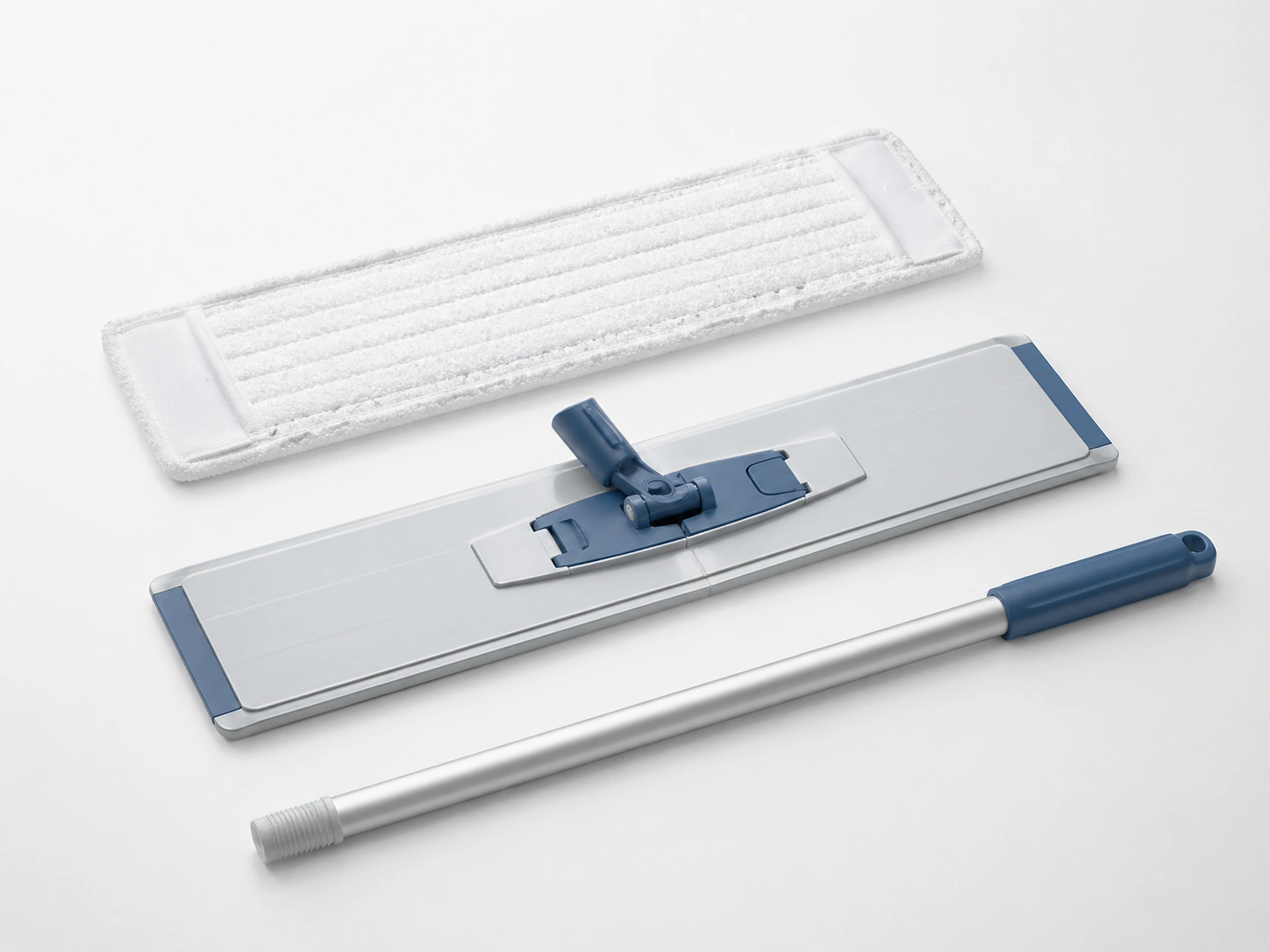
Figure 3: Pharmaceutical-grade sealed-edge mop head construction detail (Contec Klean Max). High-resolution product photography shows critical sealed-edge perimeter (visible as continuous bound edge along all sides) that encapsulates polyester fiber ends, preventing the particle shedding that cut-edge mops cause. Knit polyester fiber structure delivers <100 particles ≥0.5 µm/m² (validated per IEST-RP-CC003.4) while maintaining absorbency for pharmaceutical disinfectant application. Material construction withstands 50–100 autoclave cycles at 121°C and resists pharmaceutical disinfectant rotation (70% IPA, quats, 3–6% H₂O₂, 500–5000 ppm bleach) without fiber breakage or performance degradation. This construction standard represents the non-negotiable baseline for ISO 5–8 pharmaceutical use—any exposed fiber ends or cut-edge attachment points disqualify mop heads from GMP cleanroom qualification.

Cleanroom Mop Frame (Autoclavable Stainless Steel / PP)

Frames connect mop heads to handles and must maintain secure attachment through repeated autoclave cycles without introducing particle generation. Two material classes dominate pharmaceutical use:

Stainless steel frames (SS304 or SS316): Highest durability, withstanding 200+ autoclave cycles without degradation. Welded or continuous-bend construction eliminates thread connections and crevices that harbor bioburden. Sealed-edge pockets or clip mechanisms secure mop heads without exposed Velcro or hook-and-loop fasteners. Weight ranges from 200–400g depending on size (30–60 cm width). Cost: $50–$150 per frame. Best for: facilities prioritizing long service life and maximum chemical resistance, Grade A/B critical areas where component reliability justifies premium cost.

Autoclavable polypropylene frames: High-temperature PP formulated for 121°C steam sterilization, typically rated for 50–100 autoclave cycles. Lighter than stainless steel (100–250g) and lower cost ($25–$80 per frame). Injection-molded one-piece construction eliminates assembly joints. Polymer degradation occurs faster than stainless steel, requiring more frequent replacement—but lower unit cost can offset this for facilities with large mop inventories. Best for: ISO 7–8 general manufacturing areas, cost-sensitive operations, and facilities preferring lighter tools for ergonomic reasons.

Both frame types must feature sealed mop head attachment—pocket-style enclosures where the head slides into a continuous fabric channel, or clip systems with smooth sealed edges. Exposed Velcro, hook-and-loop fasteners, and open-pocket designs disqualify frames from pharmaceutical use due to particle trapping and generation at attachment points.

Cleanroom Handle (One-Piece, Gap-Free, GMP-Compliant)

Handles must withstand autoclaving while maintaining secure frame connection and preventing particle generation at joints. Three design features define GMP compliance:

Sealed construction: One-piece extrusion or continuously welded stainless steel tubes with no threaded connections, caps, or end plugs that trap moisture or bioburden. If threads are present (for frame attachment or adjustable length), they must be sealed with autoclavable gaskets or O-rings rated for 121°C.

Autoclave-rated materials: SS316 stainless steel (most common, withstands 200+ cycles) or high-temperature polypropylene (50–100 cycles). Aluminum and carbon steel are disqualified due to corrosion risk under repeated steam exposure. Powder-coated finishes degrade and flake, creating particle contamination—pharmaceutical handles use bare stainless steel or smooth polypropylene surfaces.

Secure frame attachment: Friction-lock mechanisms, threaded connections with sealed gaskets, or quick-connect systems that maintain secure hold through wringing force and floor abrasion. Loose connections create metal-on-metal or plastic-on-metal particle generation during use. Handle-frame compatibility must be validated—handles rated for 200 autoclave cycles paired with frames rated for 50 cycles create service life mismatches requiring premature handle replacement to maintain matched system qualification.

Standard pharmaceutical handle lengths: 120–150 cm (single-piece, most common), 90–180 cm (telescoping, for ceiling/wall mopping), 60–90 cm (short handles for isolator maintenance). Cost: $30–$120 depending on length, material, and connection mechanism.

Cleanroom Bucket/Wringer System (Dual/Triple Bucket)

Fluid management determines whether validated disinfectant concentrations and contact times are maintained throughout the mopping cycle. Single-bucket systems are disqualified from GMP use—they dilute disinfectant below efficacy thresholds and redistribute spent fluid across cleaned areas. Pharmaceutical facilities use dual- or triple-bucket configurations:

Dual-bucket systems: Separate buckets for disinfectant and rinse water. Operator saturates mop in disinfectant bucket, mops floor, wrings into waste container (not back into disinfectant), rinses mop in rinse bucket, wrings into waste, then reloads from disinfectant. This workflow maintains disinfectant concentration stability and prevents cross-contamination. Suitable for ISO 7–8 areas where simplified protocols reduce operator error. Cost: $200–$600 per system (two buckets + wringers + cart).

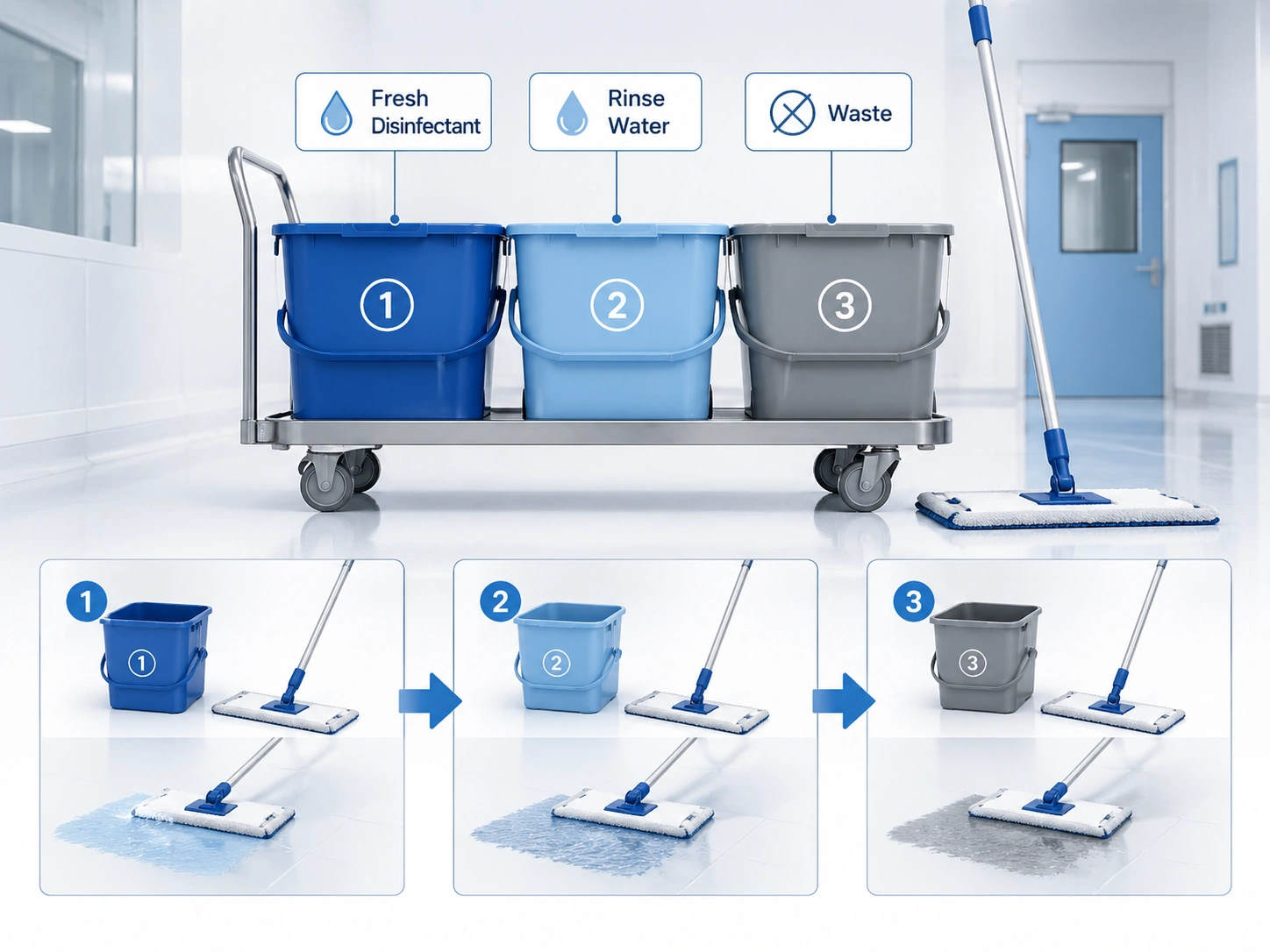
Triple-bucket systems: Three segregated compartments—disinfectant, rinse, and waste. EU GMP Annex 1 compliance best practice for Grade A/B/C areas. Workflow: mop saturates in disinfectant, floor contact, wring into waste bucket, rinse in rinse bucket, wring into waste bucket, reload from disinfectant. The dedicated waste bucket ensures spent disinfectant never contaminates fresh fluid or rinse water. Some systems integrate press-type wringers directly over the waste bucket to enforce correct workflow sequencing. Cost: $800–$3,000 per system depending on capacity (10–40L per compartment), material (stainless steel vs polypropylene), and wringer mechanism (manual press vs roller).

For complete bucket system configuration guidance and validation protocols, see the GMP bucket systems guide covering dual vs triple configurations, sizing calculations, and Annex 1 compliance requirements.

Bucket material requirements: stainless steel SS316 or autoclavable polypropylene with smooth interior surfaces (no texture or ribs that trap bioburden). Buckets must withstand the same sterilization protocol as mop heads and frames—typically 121°C autoclave for 30 minutes. Graduated volume markings enable precise disinfectant dilution and support validated concentration maintenance.

cleanroom mop interface contamination raccoon technician zootopia

Figure 2: GMP-compliant triple-bucket mopping system (Antistat Integrity model 610-0023). Three segregated compartments with stainless steel frame and sealed lid design enforce pharmaceutical disinfectant rotation protocols. Left-to-right configuration: fresh disinfectant chamber, rinse water chamber, waste collection chamber. Graduated volume markings on each compartment enable precise concentration monitoring required for Annex 1 validation. Integrated wringer mechanism positioned over waste chamber prevents cross-contamination by physically enforcing correct workflow sequencing. Stainless steel construction withstands 200+ autoclave cycles, supporting reusable mop system qualification. This configuration prevents the disinfectant concentration dilution that dual-bucket and single-bucket systems cause, directly addressing the fluid segregation validation gap that regulatory audits increasingly cite for Grade A/B/C pharmaceutical cleaning.

Sterilization Workflow (Gamma / Autoclave) Compatibility

Complete mop systems must support validated sterilization achieving SAL 10⁻⁶ (sterility assurance level) for Grade A/B use. Two sterilization pathways dominate pharmaceutical practice:

Gamma irradiation (25–50 kGy): Vendor supplies pre-sterilized single-use mop systems in sealed packaging with irradiation certificates. Polyester tolerates gamma well; microfiber shows strength loss >40 kGy; polypropylene frames may discolor but remain functional. Advantages: guaranteed sterility with no in-house sterilization workload, eliminates autoclave validation and monitoring burden, pre-packaged convenience. Disadvantages: single-use workflow (not cost-effective for reusable systems), higher cost per use ($10–$25 per complete mop system), 2–4 week lead times for gamma sterilization batching. Best for: Grade A aseptic core areas, facilities without autoclave capacity, high-contamination-risk applications justifying disposable workflows.

Autoclave sterilization (121°C, 30 min): In-house steam sterilization of reusable mop systems. Requires validated autoclave cycles, biological indicator monitoring per 21 CFR 211.182, and documented cycle records. All system components must withstand minimum 50 cycles (pragmatic service life floor)—polyester mop heads 50–100 cycles, stainless steel frames/handles 200+ cycles, polypropylene frames 50–100 cycles, polypropylene buckets 50–100 cycles. Advantages: rapid turnaround (overnight sterilization for next-day use), lowest cost per use ($0.50–$1.50 amortized), no vendor dependency. Disadvantages: requires qualified autoclave, validation documentation, sufficient mop inventory to support rotation while batches are sterilized. Best for: ISO 6–8 manufacturing areas, facilities with existing autoclave infrastructure, cost-sensitive operations covering large floor areas daily.

System qualification must document sterilization compatibility for all components simultaneously—not just individual parts. Facilities discover too late that their validated polyester mop heads (100 autoclave cycles) paired with polypropylene frames (50 cycles) create waste when frames fail while mop heads have 50% remaining service life.

Why Pharmaceutical Production Lines Need Validated Mop Systems

Reducing Nonviable Particle Counts in ISO 5–8 Areas

Particle contamination threatens product sterility assurance and drives EM failures that trigger investigation cycles. Mopping is a necessary contamination source—floor contact removes settled particles but temporarily elevates airborne counts through mechanical agitation. Validated mop systems minimize this necessary evil by controlling particle generation below classification thresholds.

ISO 5 (Grade A) aseptic filling suites (≤3,520 particles ≥0.5 µm/m³ at rest) have zero margin for particle-generating cleaning tools. A non-validated mop shedding 1,000 particles per m² can push localized floor-level counts above limits even with laminar airflow. Validated systems generating <50 particles/m² maintain classification during cleaning, preventing the clean-then-contaminate cycle that defeats the purpose of mopping. Facilities without system validation often discover this problem when particle counters show transient spikes correlated with mopping schedules—leading to investigation reports, potential production holds, and ultimately, re-procurement of compliant tools.

ISO 7–8 (Grade C/D) general manufacturing areas have more margin (≤352,000 and ≤3,520,000 particles/m³ respectively) but still benefit from low-particulate mopping. Facilities mopping 1,000+ m² daily generate cumulative particle loads that degrade air handler performance and increase HEPA filter replacement frequency. System validation that reduces particle generation from 1,000 to <200 per m² translates to measurable HVAC operating cost savings over multi-year timescales.

Preventing Bioburden in Cleaning Tools (Annex 1 Requirement)

EU GMP Annex 1 Section 4.29 requires sterile cleaning materials in Grade A/B areas because non-sterile tools introduce viable contamination into aseptic zones. The regulation recognizes that cleaning tools are direct product-contact-surface-adjacent equipment: mops touch floors where operators walk, floors where gowns may drag, floors directly beneath laminar airflow hoods and filling needles. Bioburden on mops becomes bioburden on floors becomes bioburden in airflow becomes contamination risk to product.

Validated mop systems address this through sterilization pathway qualification (gamma or autoclave to SAL 10⁻⁶) and material selection preventing biofilm formation. Smooth stainless steel and sealed-edge polyester resist microbial colonization better than porous materials with texture or crevices. System validation includes environmental monitoring before and after cleaning, showing >3-log bioburden reduction on floor surfaces—proving the system removes contamination rather than redistributing it.

Facilities that skip system validation and use component-qualified but non-integrated tools frequently encounter bioburden failures traced to mop buckets, wringer mechanisms, or frame attachment crevices that weren’t included in sterilization cycles. The mop head may be sterile, but the system as-used introduces contamination from non-sterile interfaces.

Eliminating Cross-Contamination Between Rooms & Batches

Pharmaceutical production lines manufacture multiple products or batches sequentially in the same cleanrooms, requiring validated changeover procedures preventing cross-contamination. Cleaning systems are changeover-critical: mops used in penicillin manufacturing areas cannot be used in cephalosporin areas (beta-lactam cross-contamination), mops used in one batch campaign require validated cleaning before the next batch (residue carryover risk).

Validated mop systems address cross-contamination through three mechanisms: designated room/product assignments (mops physically segregated and labeled for specific areas), single-use sterile systems (gamma-sterilized disposables eliminating reuse risk), and validated cleaning-between-use protocols (documented laundering and sterilization procedures removing residues to below detection limits). System validation includes worst-case residue testing—intentionally contaminating mops with API or cleaning agent, then validating that laundering/sterilization removes residues below HPLC detection limits.

Bucket systems prevent cross-contamination during use. Single-bucket workflows cross-contaminate Room A disinfectant into Room B by carrying spent fluid on incompletely wrung mops. Triple-bucket systems with dedicated waste compartments break this chain—spent disinfectant never re-enters the active fluid or rinse buckets, preventing room-to-room carryover.

Ensuring Disinfectant Contact-Time Consistency

Disinfectant efficacy validation establishes minimum contact times (typically 2–10 minutes depending on agent and target organisms) and concentrations. Mop systems must deliver validated conditions consistently across entire floor surfaces—not just on the first pass when disinfectant is fresh, but throughout 500+ m² mopping cycles as fluid is depleted and diluted.

Validated bucket systems maintain concentration through segregated fluid management. Dual- and triple-bucket configurations prevent disinfectant dilution by separating fresh agent from rinse water and spent fluid. Graduated volume markings enable concentration verification at start and end of cleaning cycles, with documented monitoring proving disinfectant stayed within validated ranges. Validation includes worst-case testing: mop entire maximum floor area (e.g., 800 m²) with single bucket fill, measure concentration at 100 m² intervals, verify it never drops below minimum validated level.

Mop head saturation affects contact time. Over-saturated mops leave excessive fluid that pools rather than spreading evenly (contact time too long in puddles, too short in thin-film areas). Under-saturated mops deliver insufficient fluid that evaporates before minimum contact time elapses. System validation includes fluid delivery testing: measure volume released per linear meter of mopping, verify it achieves validated wet film thickness (typically 0.1–0.3 mm) that maintains wetness for required contact duration.

Lowering EM Failure Rates & Audit Risks

The operational case for validated mop systems: they reduce the investigation burden and audit risk that non-validated tools create.

EM failures traced to cleaning tools trigger investigation cycles consuming 20–50 hours of QA labor: root cause analysis, CAPA documentation, trend analysis, potential production impact assessment. Particle excursions during mopping or bioburden increases post-cleaning that recur monthly become chronic compliance problems. Facilities operating ISO 5–8 cleanrooms with non-validated mop systems average 2–4 cleaning-tool-related EM investigations per year. Switching to validated systems typically reduces this to <1 per year (with that one often traced to operator technique rather than tool performance).

Regulatory audits (FDA, EMA, MHRA) increasingly focus on cleaning validation completeness. Inspectors ask: “Show me your mop system validation protocol. How do you know this complete system—not just the mop head—doesn’t generate particles above limits? Where’s your data demonstrating bucket segregation maintains disinfectant concentration?” Facilities with component-only qualification (“Here’s our mop head certificate”) but no system validation documentation receive observations or warnings. The inspection finding language: “Inadequate cleaning validation—cleaning tools not qualified as complete systems under operational conditions per 21 CFR 211.67(b).”

Selection Criteria for Pharma-Grade Mop Systems (ISO 5–8)

Sealed-Edge Construction (Particle Generation < 100/m²)

Sealed-edge construction across all fabric components—mop heads and frame pockets—is the non-negotiable baseline for ISO 5–8 pharmaceutical use. Heat-sealed, ultrasonically bonded, or continuous-loop knit perimeters encapsulate fiber ends, preventing the particle shedding that cut-edge construction causes. Validation data must document system-level particle generation <100 particles ≥0.5 µm per m² of mopping for ISO 5–7 use, or <200 particles/m² for ISO 8.

Procurement specifications should require: “Mop system (head + frame) tested per IEST-RP-CC003.4 or equivalent, particle generation <100/m² (≥0.5 µm) validated under operational conditions (saturated mopping, 500g downforce, standardized stroke pattern). Test report documenting optical particle counter measurements required with each lot.”

Component-only data is insufficient. A mop head generating 60 particles/m² paired with a frame pocket generating 80 particles/m² yields 140 particles/m² system performance—failing ISO 5–7 requirements even though both components individually pass. Demand system-level testing with all components assembled as-used.

Compatibility With Alcohol, Peroxide, Quats, Bleach

Pharmaceutical disinfectant rotation protocols require mop systems to withstand sequential exposure without material degradation or performance loss. Validation criteria:

  • 70% Isopropyl Alcohol (IPA): Daily use in Grade A/B areas. Materials must resist swelling and strength loss after 100+ exposures (typical monthly usage for reusable systems).
  • Quaternary Ammonium Compounds (Quats, 200–1000 ppm): General disinfection 2–3× per week. Relatively mild but requires rinse protocols preventing residue buildup that degrades subsequent disinfectant efficacy.
  • Sodium Hypochlorite (Bleach, 500–5000 ppm): Broad-spectrum use 1–2× per week. Oxidizes many polymers; materials must demonstrate no fiber breakage or color degradation after 50+ bleach cycles.
  • Hydrogen Peroxide (3–6%): Sporicidal deep cleaning weekly to monthly. Degrades cellulose and some polyester blends; system must maintain particle generation limits post-exposure.

Procurement specifications should require chemical compatibility matrices documenting pass/fail for each disinfectant class, with “pass” defined as no visible degradation + particle generation remains <100/m² + mechanical strength retention >80% after 10 cycles of maximum validated concentration.

Autoclave Durability (50–100 Cycles)

Reusable mop systems must survive sufficient autoclave cycles to justify capital investment and laundering infrastructure. Minimum service life expectations:

  • Mop heads: 50–100 cycles (100–200 uses with laundering between sterilizations)
  • Frames: 50–100 cycles for polypropylene, 200+ cycles for stainless steel
  • Handles: 200+ cycles for stainless steel, 50–100 cycles for polypropylene
  • Buckets: 50–100 cycles for polypropylene, 200+ cycles for stainless steel

System service life is limited by the shortest-lived component. Specifying stainless steel frames/handles (200+ cycles) with polypropylene buckets (50–100 cycles) creates a service life mismatch. Optimize for matched autoclave durability: all components reach end-of-life simultaneously, minimizing waste from prematurely discarding high-cycle-count components when low-cycle-count parts fail.

Validation protocol: autoclave complete assembled system (mop head attached to frame, frame attached to handle) for 20 cycles at 121°C/30 min. Inspect for physical degradation (warping, discoloration, loose connections), measure particle generation post-autoclave, verify mechanical integrity (frame-handle connection torque, mop head retention force). Repeat inspection at 50 and 100 cycles for long-term qualification.

Sterility Options (Gamma Sterilized Single-Use vs Reusable)

Two sterilization pathways serve different operational needs:

Gamma-sterilized single-use systems: Pre-sterilized by vendor to SAL 10⁻⁶, supplied in sealed packaging with irradiation dose certificates (typically 25–50 kGy). Use once and discard. Best for: Grade A/B aseptic core areas requiring maximum sterility assurance, facilities without autoclave capacity, applications where cross-contamination risk justifies disposable workflow (multi-product facilities, high-potency APIs, beta-lactam manufacturing). Cost: $15–$30 per complete system (mop head + frame + handle). Validation package: vendor supplies irradiation certificates, sterility testing (USP <71>), and particle generation data per lot.

Autoclavable reusable systems: In-house sterilization at 121°C/30 min, laundered and re-sterilized between uses. Best for: ISO 6–8 general manufacturing, facilities with qualified autoclave infrastructure, cost-sensitive operations mopping large areas daily (>500 m²). Cost: $0.75–$2.00 per use (amortized over 100–200 uses). Validation package: facility qualifies autoclave cycles (IQ/OQ/PQ), biological indicator monitoring per 21 CFR 211.182, documented cycle records, laundering validation (residue removal, particle generation post-laundering).

Decision framework: if investigation cost from a single contamination event exceeds $10,000 (typical for aseptic filling holds), and single-use systems reduce contamination probability by >10%, the expected value justifies disposable cost even at $25/system. For lower-grade areas where contamination investigation cost is $2,000–5,000, reusable systems offer better ROI.

Mop–Bucket–Disinfectant Validation Package Availability

Complete system validation requires documentation proving the integrated assembly achieves contamination control outcomes under operational protocols. Procurement specifications should require vendors to supply:

  • Particle generation test report: System-level (mop + frame + handle) IEST-RP-CC003.4 testing, <100 particles/m² validated
  • Chemical compatibility matrix: Pass/fail data for facility’s disinfectant rotation (IPA, quats, bleach, peroxide)
  • Sterilization qualification: Autoclave cycle validation (if reusable) or gamma irradiation certificates + sterility testing (if single-use)
  • Bucket system protocols: Validated SOPs for dual/triple-bucket workflows, disinfectant concentration stability data, fluid segregation validation
  • Material certifications: Certificates of analysis and conformance for mop head material, frame/handle material, bucket material
  • IQ/OQ/PQ templates: Documentation protocols facility can execute for site-specific qualification

Vendors unable to provide these packages force facilities to generate validation data in-house—adding 40–100 hours of validation labor ($4,000–$15,000 internal cost) and 2–6 month qualification timelines. Premium vendors include turnkey validation packages, reducing facility qualification burden to site-specific PQ execution only.

Top 3 Cleanroom Mop Systems for ISO 5–8 Pharmaceutical Operations

cleanroom mop sterilization mismatch tiger engineer zootopia

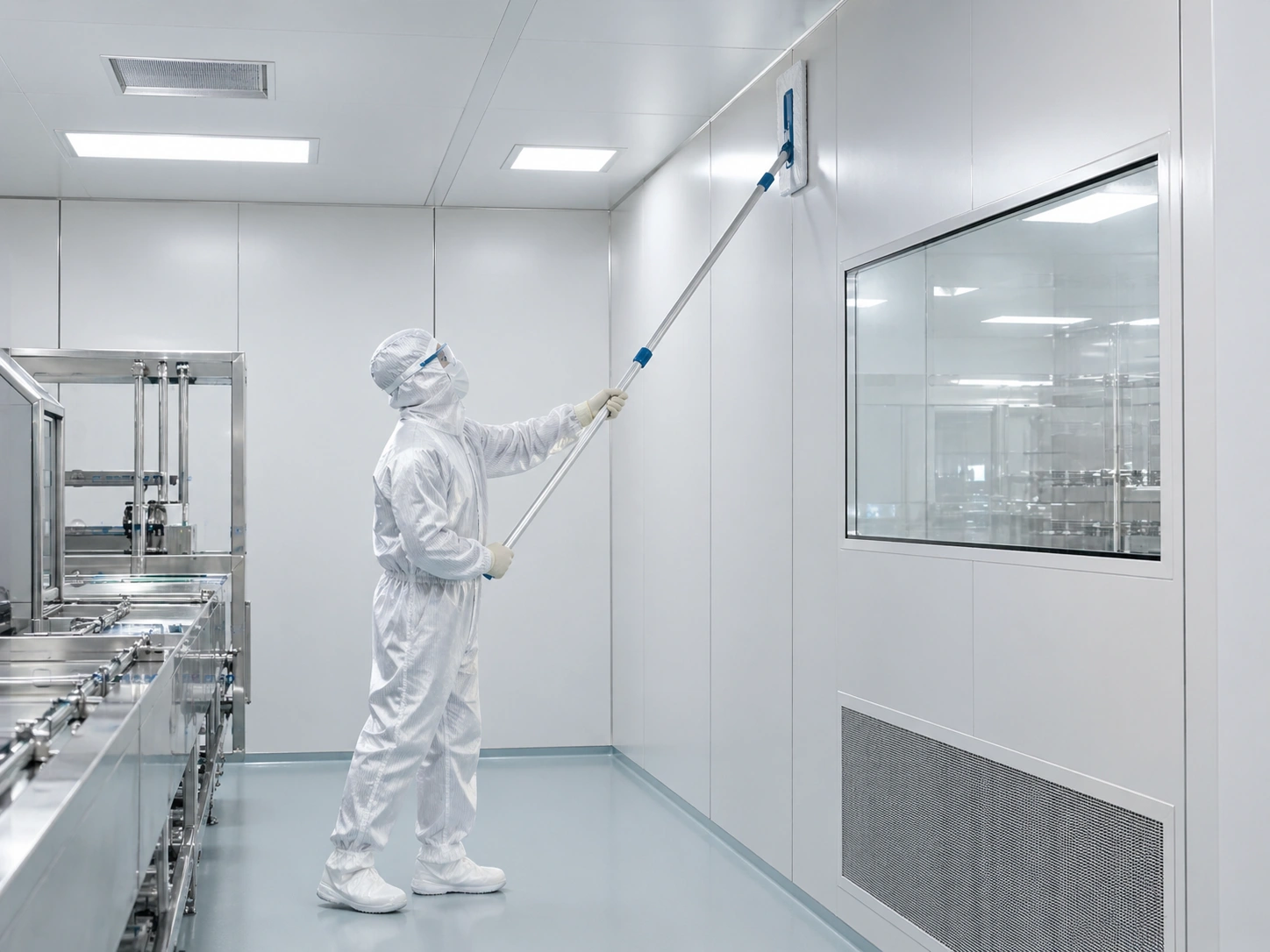
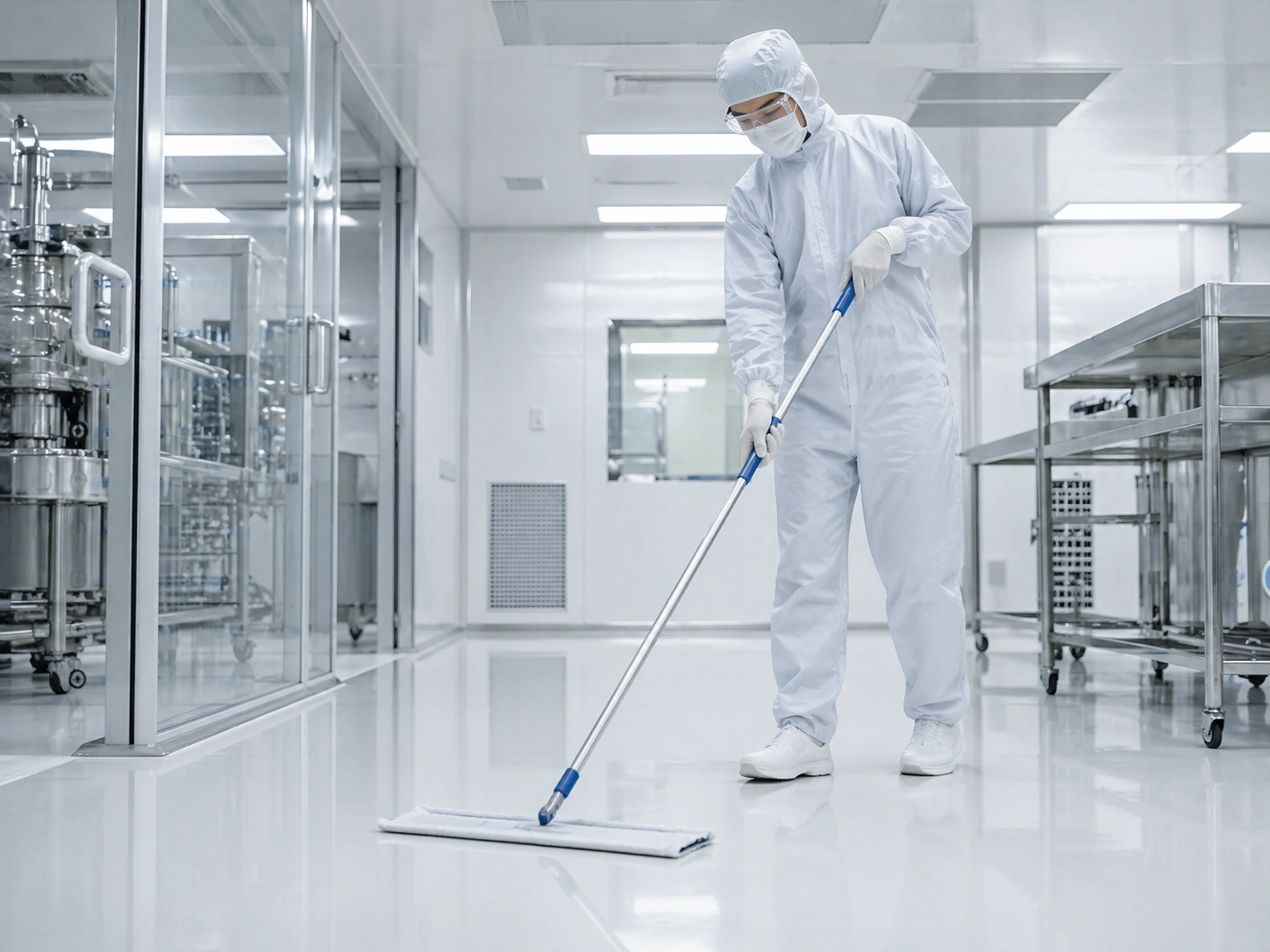
Figure 1: Validated cleanroom mop system in pharmaceutical production environment. Gowned operator in full contamination control attire (pharmaceutical-grade cleanroom suit, head covering, gloves) performing GMP-compliant floor cleaning using sealed-edge polyester mop on stainless steel frame/handle system. Background shows Grade B/C manufacturing infrastructure including laminar-flow equipment and proper cleanroom staging. System-level validation (mop head + frame + handle + bucket protocol) ensures particle generation remains <100/m² while maintaining disinfectant contact time consistency across entire production floor, preventing the environmental monitoring failures that component-only qualification creates.

System 1 — Sterile Gamma-Irradiated Single-Use Mop System

Configuration: Pre-sterilized sealed-edge polyester mop head (40–60 cm width) + autoclavable polypropylene frame + stainless steel handle, supplied in sealed packaging with gamma irradiation certificate (25–50 kGy, SAL 10⁻⁶). Single-use disposable—use once and discard per pharmaceutical waste protocols.

Technical Specifications:

  • Particle generation: <50 particles ≥0.5 µm/m² (validated per IEST-RP-CC003.4)
  • Material: 100% continuous-filament polyester knit with heat-sealed edges
  • Sterilization: Gamma irradiation 25–50 kGy, sterility testing per USP <71>
  • Disinfectant compatibility: Validated for 70% IPA, 3–6% H₂O₂, quats, bleach (single-use eliminates cumulative degradation concern)
  • Packaging: Individual sealed bags with irradiation dose certificate and lot traceability

Best For:

Grade A/B aseptic filling suites requiring maximum sterility assurance and zero cross-contamination risk✓ Multi-product facilities manufacturing high-potency APIs, beta-lactams, or cytotoxics where reusable mop cross-contamination risk is unacceptable✓ Facilities without autoclave capacity or seeking to eliminate in-house sterilization validation burden✓ High-contamination-risk applications where investigation cost from a single EM failure ($10,000–$50,000 for aseptic filling holds) justifies disposable workflow

Cost Structure: $18–$30 per complete system. For a 200 m² Grade A/B suite mopped 3× per week (156 moppings/year), annual cost: $2,800–$4,700.

EM Success Rate: Highest among all system types. Gamma-sterilized single-use systems eliminate service life degradation, cross-contamination carryover, and sterilization cycle variability—the three leading causes of cleaning-tool-related EM failures. Facilities switching from reusable to single-use systems for Grade A/B areas typically see cleaning-tool-attributed particle excursions drop from 2–4 per year to <0.5 per year.

Validation Package: Vendor supplies gamma irradiation certificates with dose verification, sterility testing (USP <71>) per lot, particle generation test reports (IEST methodology), certificates of analysis for material composition, and lot traceability supporting 21 CFR 211 requirements. Facility qualification reduced to receiving inspection (visual defect check, documentation review) and site-specific PQ (demonstrate operators follow correct disposal protocols).

Limitations: Highest cost per use; not economical for large-area daily mopping (>500 m²); generates more waste than reusable systems (environmental impact + disposal cost); 2–4 week lead times for gamma sterilization batching may require larger safety stock.

System 2 — Autoclavable Reusable Polyester Mop System

Configuration: Sealed-edge polyester mop head (40–60 cm width, reusable 100–200 times) + stainless steel frame (SS316, welded construction) + stainless steel handle (120–150 cm, one-piece sealed design). Complete system autoclavable at 121°C/30 min for 50–100 cycles. Laundered between sterilizations per validated protocol.

Technical Specifications:

  • Particle generation: <100 particles ≥0.5 µm/m² (system-level validated)
  • Material: Sealed-edge knit polyester (100% or 90/10 polyester-cellulose), stainless steel SS316 frame/handle
  • Autoclave durability: Mop head 50–100 cycles, frame/handle 200+ cycles
  • Disinfectant compatibility: Validated for pharmaceutical rotation (IPA, quats, bleach, peroxide)
  • Service life: 100–200 uses per mop head (laundering extends life vs no-wash protocols) Best For:✓ ISO 6–8 (Grade B/C/D) general manufacturing areas covering large floor areas (500–2,000+ m²)✓ Facilities with qualified autoclave infrastructure seeking lowest cost per use through reusable workflow✓ Cost-sensitive operations where capital investment in reusable systems + laundering delivers strong ROI versus disposables✓ Daily mopping protocols where rapid overnight sterilization turnaround (vs vendor gamma lead times) supports operational tempo

Cost Structure: $200–$400 per complete system (mop head $60–$120, SS316 frame $70–$150, SS316 handle $70–$130). Amortized over 150 uses: $1.30–$2.70 per use. Add laundering cost $0.50–$1.00 per cycle (in-house) or $2–4 per cycle (outsourced), total cost per use: $1.80–$6.70. For a 1,000 m² Grade C area mopped 5× per week (260 moppings/year), annual cost: $470–$1,740—dramatically lower than single-use for high-frequency large-area applications.

Highly Durable, Strong ROI: Stainless steel construction delivers 200+ autoclave cycles for frames/handles, outlasting multiple mop head replacements. Facilities report 5–10 year frame/handle service life with proper maintenance. Initial capital cost ($200–$400 per system) amortizes rapidly: break-even vs single-use systems occurs at 10–15 uses for large-area applications.

Validation Package: Vendor supplies particle generation test reports (system-level), chemical compatibility matrices (validated for facility’s disinfectant rotation), autoclave qualification data (50–100 cycle validation), material certifications (CoA/CoC), and IQ/OQ/PQ templates. Facility executes site-specific autoclave cycle qualification (IQ/OQ per 21 CFR 211.182), laundering validation (residue removal, particle generation post-wash), and operational PQ (demonstrate mop head replacement frequency maintains validated performance).

Limitations: Requires validated autoclave + laundering infrastructure; sufficient mop inventory to support rotation while batches are laundered/sterilized (typically 3–5× daily usage quantity); service life tracking and replacement protocols to prevent using degraded mops beyond validated cycles; not suitable for applications requiring guaranteed sterility (Grade A aseptic core) where gamma-sterilized single-use offers higher assurance.

System 3 — Triple-Bucket Annex 1-Compliant Mop System

Configuration: Complete integrated system including sealed-edge polyester mop heads (reusable or single-use options), stainless steel frames/handles, and three-compartment bucket cart (disinfectant/rinse/waste segregation, 10–40L per compartment) with integrated press-type or roller wringer. Cart-mounted design on cleanroom-compatible casters. All components autoclavable (reusable configuration) or supplied gamma-sterilized (single-use configuration).

Technical Specifications:

  • Bucket system: Three segregated SS316 stainless steel or autoclavable PP compartments with graduated volume markings
  • Wringer: Press-type (foot-operated) or roller mechanism positioned over waste compartment
  • Mop specifications: Same as System 1 (single-use) or System 2 (reusable) depending on configuration selected
  • Particle generation: <100 particles/m² (system-level validated including bucket handling)
  • Fluid segregation: Validated protocols prevent disinfectant/rinse/waste cross-contamination

Required for Disinfectant Rotation: EU GMP Annex 1 Section 4.31 mandates disinfectant rotation with monitoring for resistant strains. Triple-bucket systems deliver this through:

  1. Disinfectant bucket: Fresh agent at validated concentration, no dilution from rinse water or spent fluid
  2. Rinse bucket: Clean water removes residual disinfectant between agent changes (Monday IPA → rinse → Tuesday peroxide)
  3. Waste bucket: Spent disinfectant and rinse water never re-enter active buckets, preventing concentration dilution and microbial carryover

Integrated wringer positioned over waste bucket enforces correct workflow: operators cannot wring back into disinfectant or rinse compartments, eliminating the single most common protocol deviation in dual-bucket systems.

Reduces Audit Findings: Regulatory inspectors increasingly cite inadequate fluid segregation as a cleaning validation gap. Triple-bucket systems with documented validation protocols (disinfectant concentration stability testing, fluid segregation verification, operator training records) directly address inspection focus areas. Facilities implementing triple-bucket systems for Grade A/B/C cleaning report 60–80% reduction in cleaning-related audit observations versus dual-bucket or single-bucket configurations.

Cost Structure: $1,200–$4,500 per complete system depending on configuration (stainless steel vs polypropylene buckets, reusable vs single-use mops, manual vs roller wringer, 10L vs 40L bucket capacity). Higher upfront capital cost than mop-only systems but delivers full-workflow validation addressing bucket-related compliance gaps that mop-only qualification misses.

Full Workflow Validation: Vendor supplies complete system validation package: particle generation (mop + frame + handle + bucket handling), fluid segregation validation (worst-case testing: mop 800 m², measure disinfectant concentration every 100 m², verify stays within validated range), disinfectant contact time verification, wringer mechanism bioburden testing, and operator training SOPs with visual workflow diagrams. IQ/OQ/PQ templates include bucket cleaning/sterilization protocols, disinfectant preparation and concentration monitoring procedures, and mop head change-out frequency calculations.

Best For:✓ New pharmaceutical facilities establishing GMP cleaning programs from scratch—turnkey systems reduce validation timeline by 2–6 months✓ Existing facilities remediating EM failures or audit findings traced to inadequate cleaning validation✓ Grade A/B/C areas requiring Annex 1 compliance where fluid segregation is regulatory expectation✓ Multi-product manufacturing where disinfectant rotation and cross-contamination prevention are critical

Limitations: Higher upfront capital cost; requires floor space for cart (typically 60×90 cm footprint); more complex operator training (validated 5-step workflow vs 3-step for dual-bucket); cart maneuverability in tight spaces or around equipment may be constrained.

Cost–Performance Comparison for Pharma Cleanroom Mop Systems

Single-Use vs Reusable Cost Per Square Meter

Cost per square meter mopped reveals the true economic difference between system types:

Gamma-sterilized single-use ($20 average per system): Assumes 200 m² coverage per mop = $0.10/m². For facilities mopping Grade A/B areas 3× per week (600 m² weekly, 31,200 m² annually), annual cost: $3,120. Best for small high-criticality areas where contamination risk justifies premium cost.

Autoclavable reusable ($300 system cost, 150-use service life): Cost per use $2.00 + $1.00 laundering + $0.50 autoclave = $3.50 per mopping. Assumes 1,000 m² coverage per mopping = $0.0035/m². For facilities mopping Grade C/D areas 5× per week (5,000 m² weekly, 260,000 m² annually), annual cost: $910. Dramatically more economical for large-area routine cleaning.

Triple-bucket integrated system ($3,000 system cost with reusable mops): Amortize bucket cart over 5 years ($600/year) + mop costs same as reusable system ($910/year) = $1,510 annual total cost. Delivers full Annex 1 workflow validation for $600/year premium over mop-only reusable systems—justified by audit risk reduction and EM failure prevention.

Break-even analysis: Reusable systems reach cost parity with single-use at 15–20 uses for large-area applications (>500 m² per mopping). Below 15 uses or for small areas (<200 m²), single-use systems offer competitive total cost without infrastructure investment.

Labor & Sterilization Cost Impact

Labor and sterilization represent hidden costs that shift system economics:

Single-use systems: Zero laundering labor, zero autoclave operator time, zero sterilization monitoring (vendor provides certificates). Receiving inspection 5–10 min per lot, disposal handling 2–3 min per use. Total labor: ~15 min per lot (50–100 mops) = negligible per-use impact.

Reusable systems: Laundering labor 20–30 min per batch (load washer, transfer to autoclave, unload/store), autoclave cycle time 60–90 min (mostly unattended but requires monitoring), biological indicator documentation 10–15 min per cycle. Total labor: 30–45 min per batch sterilizing 10–20 mops = 2–4 min labor per mop. At $40/hour burdened labor rate: $1.30–$2.70 labor cost per use.

Triple-bucket systems: Add bucket cleaning/sterilization 15–20 min per cycle, disinfectant preparation and concentration monitoring 10 min per mopping = incremental 10 min labor per use vs mop-only systems. At $40/hour: $6.70 labor cost. Offset by reduced protocol deviation rate (fewer investigations from concentration errors) and audit preparation time savings (validated protocols reduce inspection preparation burden).

Facilities with existing autoclave infrastructure and in-house laundering realize lowest incremental cost for reusable systems. Facilities without infrastructure face capital investment ($20,000–$50,000 for autoclave, $10,000–$30,000 for laundering setup) that favors single-use systems unless mopping volume justifies equipment amortization.

cleanroom mop cross contamination lion manager zootopia

EM Failure Cost Avoidance (ROI Explainer)

The strongest ROI case for validated mop systems: avoiding investigation costs that non-validated tools create.

Investigation cost per EM failure: 20–50 hours QA labor ($50–$75/hour burdened rate) = $1,000–$3,750 per investigation. Add potential production impact: Grade A/B aseptic filling holds cost $5,000–$20,000 per day in lost capacity (product-dependent). Total cost per cleaning-tool-attributed EM failure: $6,000–$23,750.

Failure rate reduction: Facilities switching from non-validated to validated mop systems report 60–80% reduction in cleaning-tool-related EM failures. Baseline: 3 failures/year with non-validated tools. Post-validation: <1 failure/year. Cost avoidance: 2–3 investigations prevented = $12,000–$71,250 annual savings.

System investment payback: Premium for validated system vs non-validated:

  • Gamma single-use vs commercial microfiber: $12/mop premium × 156 mops/year = $1,900 annual premium
  • Validated reusable vs non-validated reusable: $150/system premium ÷ 150 uses = $1.00/use premium × 260 uses/year = $260 annual premium
  • Triple-bucket system vs dual-bucket: $2,000 capital premium amortized over 5 years = $400/year

Even the highest premium (gamma single-use, $1,900/year) delivers positive ROI if it prevents 1 Grade A EM failure ($6,000+ cost). Reusable system premium ($260/year) pays for itself preventing 1 investigation every 4–5 years—easily achieved given typical 2–4 failures/year with non-validated tools.

Total Cost of Ownership (TCO) for Each System

Five-year TCO comparison for 1,000 m² Grade C manufacturing area mopped 5× per week:

Gamma single-use system:

  • Mop cost: $20 × 260 moppings/year × 5 years = $26,000
  • Labor (receiving/disposal): negligible
  • Infrastructure: $0 (no autoclave/laundering required)
  • Validation: $500 (receiving inspection protocols only)
  • EM failure cost (baseline 3/year, reduced to 0.5/year): 2.5 failures prevented/year × $8,000 avg cost × 5 years = $100,000 savings
  • Net TCO: -$73,500 (positive ROI)

Autoclavable reusable system:

  • System cost: $300 × 3 systems (rotation inventory) = $900
  • Mop head replacement: $80 × 6 heads/year (150-use life) × 5 years = $2,400
  • Laundering: $1/cycle × 260/year × 5 years = $1,300
  • Autoclave: $0.50/cycle × 260/year × 5 years = $650
  • Labor: $2/use × 260/year × 5 years = $2,600
  • Infrastructure: $0 (assumes existing autoclave)
  • Validation: $5,000 (IQ/OQ/PQ, laundering validation)
  • EM failure cost savings: $100,000 (same as single-use)
  • Net TCO: -$87,150 (highest positive ROI)

Triple-bucket Annex 1 system (with reusable mops):

  • System cost: $3,000 (bucket cart + 3 mop/frame/handle sets)
  • Mop head replacement + laundering + autoclave + labor: $7,850 (same as reusable)
  • Bucket maintenance: $200/year × 5 years = $1,000
  • Validation: $8,000 (full system IQ/OQ/PQ including bucket protocols)
  • EM failure cost savings: $100,000
  • Audit observation prevention: $15,000 (estimated value of avoiding 1 FDA 483 observation requiring CAPA)
  • Net TCO: -$94,300 (highest ROI including audit risk reduction)

TCO analysis conclusion: All validated systems deliver strong positive ROI through EM failure and audit risk avoidance. Triple-bucket systems justify premium cost for Grade A/B/C applications where Annex 1 compliance and audit preparedness are priorities. Reusable systems offer best economics for large-area routine cleaning. Single-use systems optimize for operational simplicity in smaller high-criticality areas.

microfiber stripe cleanroom mop pad for iso 5 floors | high absorbency & scrub power

MIDPOSI Cleanroom Mop System Recommendation (ISO 5–8 Ready)

Why Sealed-Edge Polyester Is the Gold Standard

MIDPOSI cleanroom mop systems are engineered around sealed-edge polyester construction—the pharmaceutical industry’s proven material standard for ISO 5–8 contamination control. Heat-sealed perimeters encapsulate all fiber ends, preventing the particle shedding that cut-edge mops cause. Knit polyester fabric delivers <100 particles ≥0.5 µm per m² of mopping (validated per IEST-RP-CC003.4), meeting the baseline requirement for Grade A/B/C/D pharmaceutical manufacturing.

Polyester’s chemical resistance enables pharmaceutical disinfectant rotation without performance degradation. MIDPOSI mop heads withstand 70% IPA (daily use), quaternary ammonium compounds (2–3× weekly), 3–6% hydrogen peroxide (weekly sporicidal cleaning), and 500–5000 ppm sodium hypochlorite (broad-spectrum disinfection)—the complete rotation protocol Annex 1 requires for preventing microbial resistance. Material compatibility testing documents no fiber breakage, color degradation, or particle generation increases after 50+ cycles of maximum validated disinfectant concentrations.

Autoclave durability of 50–100 cycles at 121°C/30 min supports reusable workflows delivering lowest cost per use for large-area pharmaceutical manufacturing. Stainless steel frames and handles rated for 200+ autoclave cycles ensure system components reach end-of-life together, eliminating the waste from mismatched service life specifications.

Compatible System Options (Reusable / Gamma Sterile / Triple Bucket)

MIDPOSI offers three system configurations matching the operational needs identified in this guide:

Reusable Autoclavable Systems: Sealed-edge polyester mop heads + SS316 stainless steel frames/handles. Complete systems autoclavable as integrated assemblies. Best for ISO 6–8 manufacturing areas, facilities with autoclave infrastructure, cost-sensitive large-area applications (>500 m² daily mopping). Service life 100–200 uses per mop head, 5–10 years for frames/handles. Cost: $200–$400 per system.

Gamma-Sterilized Single-Use Systems: Pre-sterilized sealed-edge polyester mop heads supplied in sealed packaging with irradiation certificates (25–50 kGy, SAL 10⁻⁶). Use once and discard. Best for Grade A/B aseptic core areas, multi-product facilities requiring zero cross-contamination risk, operations without autoclave capacity. Cost: $18–$30 per system.

Triple-Bucket Integrated Systems: Complete validated workflow including mop heads (reusable or single-use options), frames/handles, and three-compartment bucket cart with integrated wringer. All components qualified together with validated SOPs for disinfectant/rinse/waste segregation. Best for new facility startups, Annex 1 compliance requirements, remediation of audit findings on inadequate cleaning validation. Cost: $2,500–$4,500 per complete system.

All configurations include system-level particle generation testing (mop + frame + handle tested as-used), not component-only data. This addresses the interface contamination gaps that facilities discover during EM failures when they’ve qualified components separately but never validated integrated performance.

Validation Package (Particle Data, Autoclave Data, CoA/CoC)

MIDPOSI supplies turnkey validation packages reducing facility qualification timelines from 4–6 months (in-house validation) to 4–6 weeks (vendor-supplied data + site-specific PQ only):

  • Particle generation test reports: System-level IEST-RP-CC003.4 testing documenting <100 particles/m² for complete assemblies under operational conditions (saturated mopping, 500g downforce, standardized stroke pattern)
  • Chemical compatibility matrices: Pass/fail validation for pharmaceutical disinfectant rotation (IPA, quats, bleach, peroxide) with mechanical strength retention >80% and particle generation stability after 10 cycles
  • Autoclave qualification data: Service life validation documenting physical integrity, particle generation performance, and mechanical strength through 50–100 autoclave cycles at 121°C/30 min
  • Sterilization certificates: Gamma irradiation dose certificates with sterility testing (USP <71>) for single-use systems; autoclave cycle validation protocols for reusable systems
  • Material certifications: Certificates of Analysis and Certificates of Conformance for polyester mop head material, stainless steel frame/handle material, bucket material (where applicable)
  • IQ/OQ/PQ templates: Pre-written qualification protocols customizable to site-specific requirements, reducing documentation burden and validation labor

Lot traceability supports 21 CFR 211 requirements: each mop head lot includes batch records linking material source, manufacturing date, particle generation test results, and sterilization documentation.

Ideal Application Scenarios (Aseptic, Grade B/C/D, Anteroom)

Grade A Aseptic Core (ISO 5): MIDPOSI gamma-sterilized single-use systems. Particle generation <50/m², pre-sterilized to SAL 10⁻⁶, eliminates cross-contamination and service life degradation risks. Use for isolator maintenance, aseptic filling suite floors, lyophilization chamber cleaning.

Grade B Background (ISO 7): MIDPOSI reusable systems or gamma single-use depending on contamination risk tolerance and operational volume. Reusable systems cost-effective for large areas (>300 m²) mopped daily; single-use systems preferred where investigation cost from potential EM failures justifies premium per-use cost.

Grade C/D Manufacturing (ISO 7–8): MIDPOSI reusable systems deliver best economics. Particle generation <100/m² maintains classification compliance, autoclave durability supports 100–200 uses per mop head, stainless steel construction provides 5–10 year frame/handle service life. Pair with triple-bucket cart systems for facilities requiring Annex 1 fluid segregation validation.

Gowning Rooms & Anterooms: MIDPOSI reusable systems. These transition zones between unclassified and classified areas benefit from pharmaceutical-grade low-lint tools but don’t require sterility. Reusable systems optimize cost while preventing particle introduction from gowning room floors into manufacturing areas.

How to Request Pricing, Samples, and Validation Files

Procurement teams can request MIDPOSI system quotations including:

  • Pricing: Volume-based pricing for complete systems (mop heads + frames + handles + buckets where applicable), with annual usage estimates supporting budget planning
  • Samples: Evaluation units for on-site testing in representative cleanroom environments, enabling validation of particle generation, operator acceptance, and workflow fit before capital commitment
  • Validation documentation: Complete IQ/OQ/PQ protocols, particle generation test reports, chemical compatibility data, sterilization qualification documents supporting facility-specific validation execution

Contact MIDPOSI for pharmaceutical cleanroom mop system specifications, validation packages, and pricing tailored to your facility’s ISO classification, floor area, and sterilization infrastructure.

For foundational cleanroom mop selection principles and contamination control fundamentals, see the complete cleanroom mop guide covering materials, validation methodologies, and GMP compliance requirements.

Summary Table — Best Cleanroom Mop Systems for Pharma

System TypeISO Class CompatibilitySterilityDisinfectant CompatibilityAutoclave CyclesIdeal Use CaseCost Level
Gamma-Sterilized Single-UseISO 5–7 (Grade A/B/C)Pre-sterilized SAL 10⁻⁶IPA, quats, bleach, H₂O₂ (single-use, no degradation concern)N/A (disposable)Grade A/B aseptic suites, multi-product facilities, zero cross-contamination tolerance$18–$30/use
Autoclavable Reusable PolyesterISO 5–8 (Grade A/B/C/D)In-house autoclave 121°C/30 minValidated for pharma rotation (IPA, quats, bleach, peroxide)50–100 (mop head), 200+ (frame/handle)Large-area manufacturing (>500 m²), daily mopping, cost-sensitive operations$1.80–$6.70/use
Triple-Bucket Annex 1 SystemISO 5–8 (Grade A/B/C/D)Reusable or single-use optionsValidated for pharma rotation with fluid segregationMatches mop configuration (50–100 or N/A)Annex 1 compliance, new facilities, audit remediation, disinfectant rotation validation$2,500–$4,500 (capital) + mop costs
Non-Validated Commercial MopISO 9 / unclassified onlyNo sterilization pathwayBasic (bleach, quats); no rotation validation5–10 cyclesPharmaceutical cleanrooms (disqualified)$15–$30 (false economy)

FAQ — Cleanroom Mop Systems for Pharmaceutical Manufacturing

Should Grade A/B areas use single-use sterile mop systems?

Yes, for most Grade A/B aseptic core applications. Single-use gamma-sterilized systems eliminate the three highest contamination risks in critical areas: cross-contamination carryover between batches or products, service life degradation causing progressive particle generation increases, and sterilization cycle variability affecting sterility assurance. Grade A isolators, aseptic filling zones, and lyophilization chambers benefit from guaranteed SAL 10⁻⁶ sterility and <50 particles/m² performance that single-use systems deliver without the requalification burden reusable systems require as they approach end-of-service-life.

Grade B background areas may use reusable systems if operational volume justifies the cost advantage and facility has validated autoclave + laundering infrastructure. The decision depends on investigation cost from potential EM failures versus premium cost for single-use. If a single particle excursion costs $10,000+ in investigation labor and potential production impact, single-use systems ($20–$25 per use) deliver positive ROI even for larger Grade B areas (300–500 m²).

cleanroom mop system types panda qc zootopia

How many autoclave cycles can a polyester mop withstand?

Sealed-edge polyester mop heads: 50–100 autoclave cycles at 121°C for 30 minutes. Performance degrades gradually—early-life mops (0–30 cycles) generate <80 particles/m², mid-life (30–70 cycles) generate 80–100 particles/m², late-life (70–100 cycles) may reach 100–150 particles/m². Facilities typically retire mop heads at 70–80 cycles to maintain performance margin below 100 particles/m² limit.

Stainless steel frames and handles: 200+ cycles without functional degradation. Facilities report 5–10 year service life with proper maintenance (descaling, connection inspection). Polypropylene frames/handles: 50–100 cycles before material embrittlement requires replacement.

The system’s service life is limited by the shortest-lived component. Pairing polyester mop heads (80-cycle practical life) with stainless steel frames/handles (200+ cycle rating) is optimal—frames outlast multiple mop head replacements, maximizing capital equipment utilization.

Does EU GMP Annex 1 require triple-bucket systems?

Annex 1 doesn’t explicitly mandate three-compartment buckets, but Section 4.31 requires disinfectant rotation (“more than one type of disinfectant should be employed”) with validated protocols preventing concentration dilution and cross-contamination. Triple-bucket systems are the industry best-practice implementation of this requirement because they physically segregate disinfectant, rinse water, and waste—preventing the concentration dilution that occurs in dual-bucket systems when operators inadvertently wring back into active buckets.

Regulatory inspectors increasingly expect documented fluid segregation validation for Grade A/B/C cleaning. Facilities using single-bucket or dual-bucket systems receive audit observations asking: “How do you prevent disinfectant concentration from dropping below validated efficacy levels as mops are reloaded throughout the cleaning cycle?” Triple-bucket systems with graduated volume markings and concentration monitoring protocols directly address this question.

Dual-bucket systems remain acceptable for Grade C/D areas if facilities can demonstrate concentration stability validation (measure disinfectant concentration at start, middle, and end of worst-case cleaning cycles, verify stays within validated range). Triple-bucket systems simplify this validation by eliminating dilution pathways.

Can consumer microfiber mops be used in ISO cleanrooms?

No—consumer microfiber mops fail pharmaceutical cleanroom qualification on multiple technical grounds:

  1. Particle generation disqualification: Cut-edge construction sheds 1,000–10,000 particles ≥0.5 µm per m², exceeding ISO 5–8 acceptable limits by 10–100×. This alone disqualifies consumer mops regardless of other specifications.
  2. No sterilization pathway: Velcro attachments, foam backings, and standard polyamide fibers degrade after 5–10 autoclave cycles. Gamma irradiation causes strength loss and material breakdown. Consumer mops cannot achieve SAL 10⁻\u2b6 sterility that Grade A/B areas require.
  3. Unvalidated disinfectant compatibility: Materials may tolerate individual disinfectants (bleach or IPA) but fail under pharmaceutical rotation protocols (Monday IPA → Tuesday peroxide → Friday bleach). No test data documents performance after 50+ sequential exposures.
  4. No qualification documentation: Consumer vendors provide no particle generation test reports (IEST-RP-CC003.4), no sterilization validation, no chemical compatibility matrices. Pharmaceutical QA cannot complete IQ/OQ/PQ protocols without this data.

Procurement cost savings ($15–$25 per consumer mop vs $40–$120 for pharmaceutical-grade) are false economy. The first EM failure investigation ($6,000–$23,000 cost) eliminates years of component cost savings. Regulatory audits cite inadequate cleaning tool qualification as GMP violations under 21 CFR 211.67(b).

What documentation is required for mop system qualification?

Pharmaceutical cleanroom mop systems require three-tier qualification per 21 CFR 211 and EU GMP Annex 1:

IQ (Installation Qualification): Document system specifications (mop head material composition, sealed-edge construction method, frame/handle material, bucket configuration), verify lot numbers and certificates of conformance match purchase orders, confirm sterilization method documentation (gamma irradiation certificates with dose verification, or autoclave cycle protocols), inspect physical condition (no loose threads, damaged edges, contamination, or defects).

OQ (Operational Qualification): Demonstrate system functions per specifications under operational conditions. Test particle generation (IEST-RP-CC003.4 methodology, document <100 particles/m² for ISO 5–7 or <200 particles/m² for ISO 8), validate disinfectant compatibility (no degradation after 10 cycles of each agent in facility’s rotation), verify autoclave survivability if reusable (no performance loss after 20 cycles, repeat at 50 and 100 cycles), measure mechanical integrity (frame-handle connection torque, mop head retention force), test bucket system if applicable (fluid segregation, concentration stability across worst-case floor area).

PQ (Performance Qualification): Prove complete system achieves contamination control outcomes in actual use. Conduct environmental monitoring pre- and post-cleaning (particle counts remain below ISO class limits during mopping, surface sampling shows >3-log bioburden reduction), demonstrate disinfectant contact time consistency (measure wet film thickness, verify maintains wetness for required duration), validate cleaning between-use protocols if reusable (laundering removes residues to below HPLC detection limits), document operator training (SOPs, visual workflow diagrams, competency assessment).

Vendor-supplied validation packages reduce facility workload: IQ documentation (specifications, CoA/CoC, sterilization certificates) and OQ data (particle generation test reports, chemical compatibility matrices, autoclave durability data) provided by vendor, facility executes site-specific PQ only (demonstrate system achieves outcomes in facility’s actual cleanrooms with facility’s operators and protocols). This reduces qualification timeline from 4–6 months (full in-house validation) to 4–6 weeks (vendor data + site PQ).

Subscribe To Our Newsletter

We will send the latest information on cleanroom consumables

More To Explore

Do You Want To Get More Info Of Our Products?

drop us a line and keep in touch

It's Free!

《9 Deadly Pitfalls of Sourcing Cleanroom Garments in China》

e book 400
22

Ask For A Quick Quote

We will contact you within 1 working day, please pay attention to the email with the suffix “@midposi.com”

Ask For A Quick Quote

We will contact you within 1 working day, please pay attention to the email with the suffix “*@midposi.com”