عندما يقوم مدير ضمان الجودة الصيدلاني بوضع مواصفات لمماسح غرف الأبحاث، غالبًا ما يكون القرار الأول هو المادة: ألياف دقيقة أم بوليستر؟ تسير ادعاءات التسويق في اتجاهين متعاكسين - يؤكد بائعو الألياف الدقيقة على الامتصاص الفائق والتقاط الجسيمات، بينما يشير موردو البوليستر إلى انخفاض إنتاج الوبر وعمر أطول للأوتوكلاف. بالنسبة للمنشآت العاملة بموجب المعيار ISO 14644-1 والملحق 1 لممارسات التصنيع الجيدة للاتحاد الأوروبي، فإن هذا الاختيار ليس مسألة تفضيل. إنه قرار موثق للتحكم في التلوث يحدد ما إذا كان برنامج التنظيف الخاص بك يحافظ على تصنيف ISO، ويجتاز المراقبة البيئية، ويصمد أمام التدقيق التنظيمي.
The truth: neither material is universally “better.” Each has optimal use cases determined by fiber architecture, area classification, disinfectant chemistry, and operational priorities. Microfiber’s split-fiber construction delivers 6–8× absorbency and enhanced particle capture—ideal for spill management and large-area mopping in ISO 7–8 zones. Polyester’s continuous-filament design eliminates cut ends and maintains particle generation below 50 particles per stroke across 150–200 autoclave cycles—essential for ISO 5–6 aseptic support areas and aggressive disinfectant rotation programs. Choosing the wrong material for your application introduces contamination risk, shortens mop life, and complicates validation.
This guide compares microfiber and polyester cleanroom mops across five dimensions: fiber architecture and edge construction; absorption, durability, and particle control performance; pharma facility selection criteria; ISO grade decision framework; and MIDPOSI product recommendations. By the end, you’ll have a clear decision matrix that matches material to cleanroom classification, operational workflow, and budget constraints—backed by particle generation data, chemical compatibility validation, and real-world pharmaceutical deployment.
الألياف الدقيقة مقابل البوليستر - الاختلافات الهيكلية في غرف الأبحاث
تبدأ فجوة الأداء بين مماسح غرف الأبحاث المصنوعة من الألياف الدقيقة والبوليستر عند مستوى الألياف. إن فهم كيفية تصميم كل مادة - بدءًا من قطر الفتيل وحتى طريقة إغلاق الحافة - يفسر سبب تصرفها بشكل مختلف في ظل ظروف غرف الأبحاث الصيدلانية.
نظرة عامة على بنية الألياف
الألياف الدقيقة: ألياف مقسمة، مساحة سطح عالية
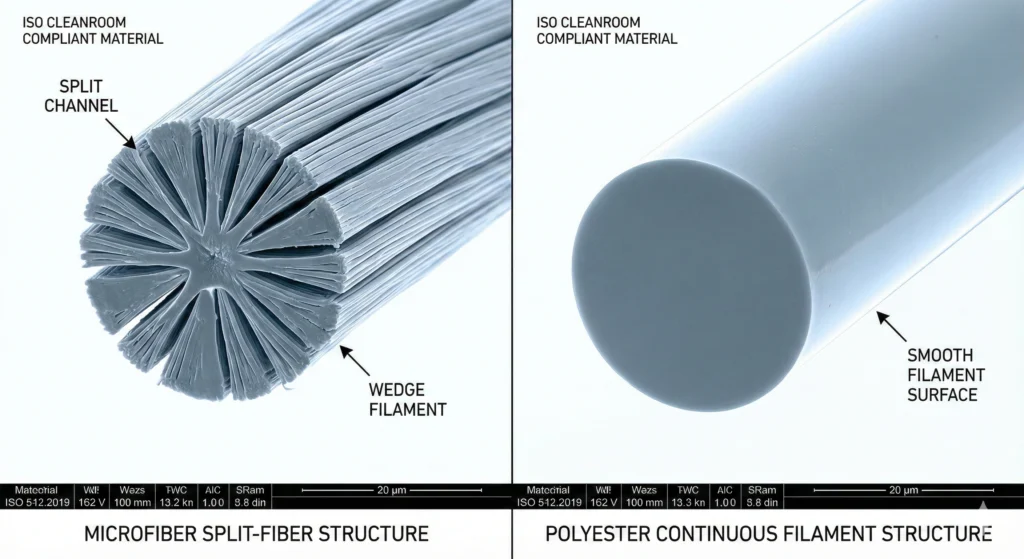
Microfiber mop heads are constructed from ultra-fine synthetic fibers below 1 denier (≈10 micrometers in diameter)—roughly one-tenth the thickness of a human hair. Most pharmaceutical-grade cleanroom microfiber uses an 80/20 polyester/polyamide (nylon) blend engineered with split-fiber cross-sections. During manufacturing, the polyester and polyamide polymers are co-extruded, then mechanically or chemically split to create star-shaped or wedge-shaped fiber profiles with multiple grooves running lengthwise.
This split-fiber geometry serves two functions. First, it dramatically increases surface area per gram of fabric—each fiber presents multiple capillary channels that wick liquid through surface tension, delivering 6–8× dry-weight absorbency. Second, the grooves create mechanical traps for particles: sub-micron contaminants lodge in the channels during mopping, improving particle pickup efficiency compared to smooth monofilament fibers. For pharmaceutical facilities, this means microfiber excels at removing residual particulates and absorbing large volumes of disinfectant solution in a single pass.
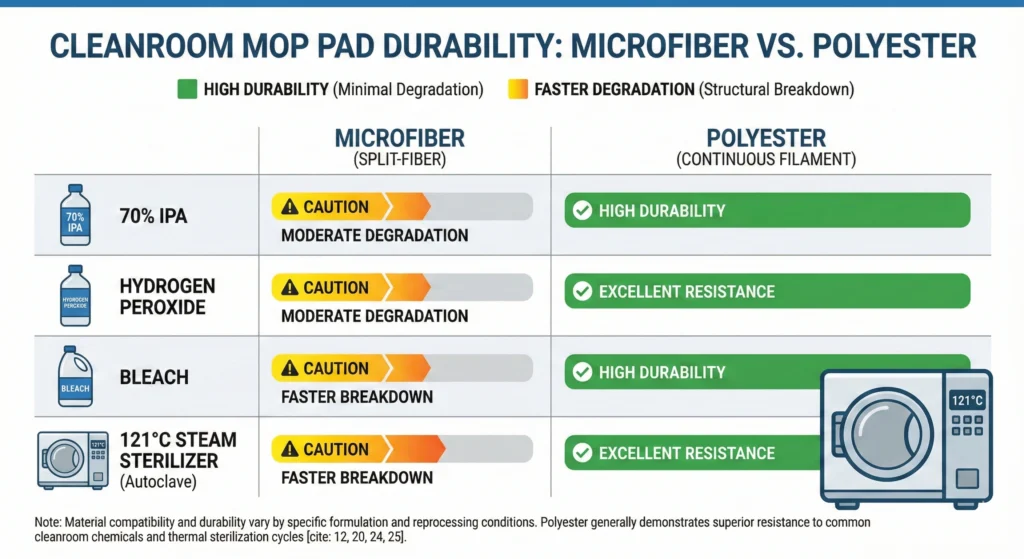
Split-fiber architecture introduces a structural trade-off. The grooves and thin fiber diameter make microfiber more vulnerable to mechanical abrasion and chemical degradation. Repeated autoclaving (steam at 121°C) and exposure to oxidizing disinfectants (hydrogen peroxide, sodium hypochlorite) can cause fiber splitting to progress into fiber breakage, increasing particle shedding over time. Microfiber mops typically qualify for 50–100 autoclave cycles—shorter than polyester, but sufficient for facilities with validated single-use or medium-cycle-life protocols.
Polyester: Continuous Filament, Low Particle Release
Polyester cleanroom mops use continuous-filament 100% polyester yarns—long, unbroken strands knitted into a tight fabric structure with no cut fiber ends. Unlike spun yarns (which twist short fibers together, creating weak points where fibers can pull out), continuous filament eliminates internal discontinuities. Each yarn runs the full length of the mop pad, and the knit structure distributes mechanical stress across the entire fabric.
This construction delivers inherent low-lint performance. With no cut ends to fray and no short fibers to break loose, continuous-filament polyester generates particle counts well below ISO Class 5 limits (<10 particles ≥0.5 µm per stroke) when edges are properly sealed. The smooth, round cross-section of polyester filaments also resists particle capture—absorbency is lower than microfiber (typically 3–4× dry weight)—but the material’s chemical inertness and thermal stability allow 150–200+ autoclave cycles with minimal dimensional change or performance degradation.
For low-lint cleanroom mopsيعتبر البوليستر ذو الخيوط المستمرة هو المعيار الصناعي في مناطق الدعم المعقمة من فئة ISO 5-7، حيث تكون حدود توليد الجسيمات ضيقة وعمر الخدمة الطويل يقلل من التكلفة الإجمالية للملكية. تتحمل بنية الألياف أيضًا دوران المطهر العدواني: 70% IPA، 3-35% بيروكسيد الهيدروجين، مركبات الأمونيوم الرباعية (2000 جزء في المليون)، وهيبوكلوريت الصوديوم حتى 1% دون تلف كبير في الألياف أو فقدان اللون.
لماذا تحدد هندسة الألياف عملية البطانة وسلوك التنظيف وثبات التعقيم؟
الاختلافات الهيكلية بين الألياف الدقيقة المقسمة والبوليستر ذات الخيوط المستمرة تتسلسل في كل مقياس للأداء:
- فحص: Microfiber’s thin, split fibers break under stress, releasing fibrous particles. Continuous-filament polyester’s thick, unbroken yarns resist breakage, maintaining low particle generation across hundreds of cycles.
- Absorbency: Microfiber’s capillary channels wick liquid aggressively; polyester’s smooth surface absorbs more slowly but releases disinfectant more predictably during mopping.
- متانة: Microfiber degrades faster under oxidizers and heat; polyester maintains dimensional stability and mechanical strength across extended autoclave and chemical exposure.
- Particle capture: Microfiber traps particles in fiber grooves; polyester relies on knit density and does not capture particles as efficiently, but also does not release captured contaminants as easily during subsequent mopping.
These trade-offs mean material selection cannot be made on absorbency alone. A microfiber mop that absorbs 8× its weight may shed 200 particles per stroke in an ISO Class 6 area, pushing the environment out of classification. A polyester mop that absorbs only 3× its weight but generates <20 particles per stroke maintains compliance and lasts three times as many cycles.
اختلافات بناء الحافة
Edge construction is the single most critical factor determining whether a mop qualifies as “low lint” for pharmaceutical use. Even high-quality fiber material becomes a particle source if edges are left unsealed.
Microfiber: Higher Lint Risk Due to Split Ends
Microfiber’s split-fiber architecture makes edge sealing especially important. If edges are simply cut and left unsealed, the thin filaments unravel rapidly—each mopping pass pulls fibers loose, and the split structure accelerates breakage. A cut-edge microfiber mop can shed 500–1,000 particles per stroke, disqualifying it from any ISO-classified environment.
Pharmaceutical-grade microfiber mops address this through sealed-edge construction:
- Laser cutting: Simultaneous cutting and heat-sealing in a single pass, using focused laser energy to melt fiber ends and fuse them into a solid border. This method delivers the cleanest edge and is preferred for ISO Class 5–6 microfiber applications.
- Ultrasonic sealing: High-frequency vibration generates heat at the fabric edge, welding fibers together without introducing adhesives or foreign materials. Suitable for ISO Class 6–8 applications.
- Heat sealing: Thermal welding using heated tools to melt and bond fiber ends. Effective but may leave a thicker, stiffer edge compared to laser or ultrasonic methods.
Even with sealed edges, microfiber’s thin fiber diameter means sealed borders are less robust than polyester equivalents. Edges can separate after 30–50 autoclave cycles if the mop is subjected to aggressive wringing or abrasion, requiring earlier replacement to prevent particle excursions.
Polyester: Heat-Sealed, Ultrasonic Sealed, Continuous Perimeter Construction
Continuous-filament polyester’s thicker yarns create stronger sealed edges that resist separation across 150–200+ cycles. The same edge sealing methods are used—laser cutting, ultrasonic welding, thermal bonding—but the result is a more durable perimeter that tolerates repeated mechanical stress and chemical exposure.
Some polyester mop pads also use continuous perimeter construction، حيث تم تصميم نمط الحياكة بحيث تدور الخيوط بشكل مستمر حول الحواف الأربعة دون قطع الأطراف. وهذا يلغي إغلاق الحواف باعتباره نقطة فشل واحدة، مما يوفر أقل قدر ممكن من توليد الجسيمات للتطبيقات الأساسية المعقمة من الدرجة A/B.
لماذا تعتبر الحواف المختومة إلزامية لمساحات ISO الصيدلانية
يصنف المعيار ISO 14644-1 غرف الأبحاث حسب تركيز الجسيمات المحمولة بالهواء - حيث تقدم الحواف المقطوعة على المماسح مصدرًا للجسيمات غير المنضبط الذي يمكن أن يدفع البيئات خارج المواصفات. يفرض الملحق 1 من برنامج الرصد العالمي للاتحاد الأوروبي (الفقرة 4.10) على المواد المستخدمة في المناطق المصنفة تقليل توليد الجسيمات؛ تنتهك حواف الممسحة غير المختومة أو المغلقة بشكل سيئ هذا المطلب.
أثناء عمليات التفتيش التنظيمية، يقوم المدققون بفحص سجلات تأهيل أدوات التنظيف. أشارت رسالة تحذير إدارة الغذاء والدواء الأمريكية لعام 2020 على وجه التحديد إلى "الاهتراء الملحوظ على رؤوس الممسحة المستخدمة لتنظيف الجناح المعقم" و"رأس ممسحة واحد على الأقل مصنوع من مادة مولدة للجسيمات"، وخلصت إلى أن المنشأة تفتقر إلى السيطرة الكافية على التلوث. لا يعد البناء ذو الحواف المختومة ميزة متميزة - فهو أحد متطلبات GMP الأساسية لأي ممسحة تدخل مناطق ISO Class 5-8.

الشكل 2: يحدد بناء الحافة توليد الوبر لكل من مماسح غرف الأبحاث المصنوعة من الألياف الدقيقة والبوليستر. تتفكك الحواف المقطوعة (يسارًا) أثناء الاستخدام، مما يؤدي إلى إطلاق ما بين 500 إلى 1000 جسيم في كل حركة، مما يؤدي إلى استبعاد المماسح من البيئات المصنفة وفقًا لمعايير ISO. تستخدم الحواف المختومة بالحرارة (الوسط) اللحام الحراري لدمج أطراف الألياف، مما يقلل من توليد الجسيمات <100 جسيم/شوط — مناسب للمناطق من فئة ISO 7-8. حواف محكمة الغلق بالموجات فوق الصوتية (يمين) تربط الألياف من خلال الاهتزاز عالي التردد بدون مواد لاصقة، مما يحقق ذلك <50 جسيمًا/شوطًا للتطبيقات الصيدلانية من الفئة ISO 5-7. يعتبر بناء الحافة المختومة أحد متطلبات ممارسات التصنيع الجيدة (GMP) الأساسية وفقًا لملحق ممارسات التصنيع الجيدة (GMP) للاتحاد الأوروبي رقم 1 الفقرة 4.10.
دعم & الاختلافات المرفقة
تحدد كيفية ربط وسادة الممسحة بإطارها سهولة الاستخدام، ومخاطر التلوث المتبادل، والتوافق مع بروتوكولات الغسيل أو التعقيم المعتمدة.
الخطاف والحلقة (الألياف الدقيقة) مقابل الجيب/المشبك (حافة مختومة من البوليستر)
تستخدم العديد من المماسح التجارية المصنوعة من الألياف الدقيقة أنظمة ربط الخطاف والحلقة (فيلكرو): شريط من البلاستيك أو القماش مخيط على ظهر وسادة الممسحة، ويتزاوج مع الخطافات المقابلة على إطار الممسحة. يسمح هذا التصميم بتغييرات سريعة للوسادة وهو شائع في تطبيقات الحراسة.
بالنسبة لغرف الأبحاث الصيدلانية، تقدم أنظمة الخطاف والحلقة خطرين للتلوث:
- توليد الجسيمات من خطافات الفيلكرو: تتخلص الخطافات البلاستيكية من الجسيمات الدقيقة عند تعرضها لدورات التثبيت/الفصل المتكررة وضغط الأوتوكلاف. حتى الفيلكرو "المستخدم في الغرف النظيفة" يولد جزيئات قابلة للقياس - عادةً ما بين 50 إلى 100 جزيء لكل دورة ملحقة - والتي قد تتجاوز معايير القبول من فئة ISO 5-6.
- انحباس الجسيمات في هياكل الخطاف: الوبر والألياف والعبء الحيوي من عمليات التطهير السابقة يستقر في مصفوفة الخطاف ولا تتم إزالتها بالكامل أثناء الغسيل أو التعقيم. يؤدي هذا إلى إنشاء خزان تلوث مخفي يلوث دورات التطهير اللاحقة.
ونتيجة لذلك، تستخدم ممسحات البوليستر ذات الحواف المختومة للتطبيقات الصيدلانية عادةً طرق ربط بديلة:
- مرفق الجيب/الأكمام: The mop frame slides into a sewn pocket along one edge of the mop pad. No Velcro, no adhesives—just continuous-filament fabric throughout. This method is compatible with 200+ autoclave cycles and eliminates hook-related particle generation.
- Clip attachment: Spring-loaded or magnetic clips on the mop frame grip the mop pad edge. Clips are constructed from stainless steel or autoclave-stable polymers, validated for particle generation and cleanable between uses.
Why Velcro Disqualifies Most Microfiber Pads from ISO Applications
على الرغم من أن الربط بالخطاف والحلقة ملائم، إلا أن مخاطر توليد الجسيمات والتلوث المتبادل تجعلها غير مناسبة لغرف الأبحاث الصيدلانية من الفئة 5-7 ISO. يجب أن تتطلب المرافق التي تحدد ممسحات من الألياف الدقيقة لهذه المناطق وسادات ذات حواف محكمة الغلق مزودة بجيب أو مشبك ملحق، وليس تصميمات مدعومة بشريط فيلكرو.
بالنسبة لمناطق الدعم من الفئة ISO 8 والمناطق غير المعقمة، حيث تكون حدود الجسيمات أكثر تساهلاً (3,520,000 جسيم/م³ عند ≥0.5 ميكرومتر)، قد تكون الألياف الدقيقة المدعومة بالفيلكرو مقبولة إذا كان تقييم مخاطر احتجاز ثاني أكسيد الكربون وتخزينه يبرر المقايضة بين الراحة والتحكم في التلوث. ومع ذلك، تظل أفضل الممارسات هي استخدام الجيب أو المشبك في جميع المناطق المصنفة للحفاظ على الاتساق على مستوى النظام وتبسيط تدريب المشغلين.
الامتصاص، المتانة & مقارنة التحكم بالجسيمات
عندما تقوم فرق المشتريات بتقييم مواد ممسحة غرف الأبحاث، تهيمن ثلاثة مقاييس للأداء على القرار: الامتصاص (كمية المطهر التي يمكن أن تحملها الممسحة)، وتساقط الجسيمات (ما إذا كانت الممسحة تلوث البيئة)، والمتانة (كم عدد دورات الأوتوكلاف قبل الاستبدال). تتبادل الألياف الدقيقة والبوليستر هذه السمات في اتجاهين متعاكسين.
امتصاص & أداء إزالة التربة
الألياف الدقيقة = امتصاص فائق (6-8× الوزن الجاف)
تعمل قنوات الألياف المنقسمة من الألياف الدقيقة على إنشاء شعيرات دموية مجهرية تعمل على امتصاص السائل من خلال التوتر السطحي. يمكن أن تمتص وسادة الممسحة الجافة المصنوعة من الألياف الدقيقة بوزن 200 جرام ما بين 1200 إلى 1600 جرام من المحلول المطهر، أي ما يعادل 6 إلى 8 أضعاف وزنها تقريبًا. تترجم هذه الامتصاصية العالية إلى مزايا عملية:
- تغييرات أقل في الممسحة: A single microfiber pad can clean larger floor areas (200–300 m² in ISO Class 7–8 environments) before requiring re-saturation or replacement.
- Spill management: Microfiber excels at absorbing and containing liquid spills—critical for facilities handling bulk disinfectants, buffer solutions, or cleaning chemical concentrates.
- Particle pickup: The fiber grooves mechanically trap particles during mopping, removing residual dust and lint more effectively than smooth-fiber materials.
ومع ذلك، فإن الامتصاص العالي ليس دائمًا ميزة في سير عمل GMP. يمكن أن يؤدي امتصاص السائل القوي للألياف الدقيقة إلى صعوبة التحكم في سمك الطبقة الرطبة أثناء التطهير المعتمد. إذا امتصت الممسحة كمية كبيرة جدًا من IPA بنسبة 70%، فقد تتجاوز رطوبة السطح المتبقية مواصفات وقت التجفيف، مما يؤخر تحرير الغرفة أو يخلق مخاطر الانزلاق. يجب أن يتعلم المشغلون كيفية تشبع المماسح المصنوعة من الألياف الدقيقة مسبقًا إلى مستوى رطوبة يمكن التحكم فيه - عادةً ما يتم عصرها إلى نسبة تشبع 70-80٪ قبل المسح - مما يضيف تعقيدًا إجرائيًا.
البوليستر = امتصاص متحكم فيه، إطلاق مطهر يمكن التنبؤ به
Pharmaceutical cleaning validation protocols specify contact time, disinfectant concentration, and surface coverage—not “maximum absorbency.” A mop that absorbs 8× its weight but leaves puddles or takes 15 minutes to dry may fail validation even if it removes more soil than a 3× absorbency mop that delivers controlled, compliant application. Procurement decisions should align material absorbency with operational workflow requirements, not assume “more is better.”
- Uniform wet film thickness: Polyester releases liquid more consistently during mopping, delivering controlled surface coverage that meets validated disinfection protocols (e.g., 10 mL/m² contact time specifications).
- Faster drying: Less residual moisture on floors reduces drying time and room turnaround, especially important in high-throughput aseptic filling areas where downtime costs are significant.
- Operator control: Easier to train operators to maintain consistent mopping technique, reducing variability in cleaning validation performance.
For facilities prioritizing compliance and reproducibility over maximum absorbency, polyester’s controlled moisture management is a feature, not a limitation.
Why High Absorbency Is Not Always an Advantage in GMP Cleaning
Pharmaceutical cleaning validation protocols specify contact time, disinfectant concentration, and surface coverage—not “maximum absorbency.” A mop that absorbs 8× its weight but leaves puddles or takes 15 minutes to dry may fail validation even if it removes more soil than a 3× absorbency mop that delivers controlled, compliant application. Procurement decisions should align material absorbency with operational workflow requirements, not assume “more is better.”
سفك الجسيمات & سلوك الوبر
Particle generation is the primary regulatory concern for cleanroom mops. ISO 14644-14 provides the test framework: mops are subjected to simulated-use conditions (mechanical agitation, wet mopping strokes) while optical particle counters measure airborne particle release at ≥0.5 µm and ≥5 µm.
Microfiber Lint Range: 100–500 Particles/m²
Sealed-edge microfiber mops validated for pharmaceutical use typically generate 100–200 particles ≥0.5 µm per square meter mopped when new. After 25–50 autoclave cycles, particle generation increases to 200–500 particles/m² as fiber splitting progresses and sealed edges begin to separate.
This performance envelope makes microfiber acceptable for ISO Class 7–8 environments (352,000 and 3,520,000 particles/m³ limits, respectively) where the mop’s contribution remains a small fraction of total particle budget. However, in ISO Class 5–6 areas (3,520 and 35,200 particles/m³ limits), microfiber’s particle generation can represent 5–10% of the classification limit—significant enough to trigger environmental monitoring excursions when combined with other particle sources (personnel gowning, material transfer, equipment operation).
Key variables affecting microfiber lint performance:
- Edge sealing method: Laser-cut edges shed 30–40% less than ultrasonic or heat-sealed edges.
- Autoclave cycle count: Particle generation doubles between cycle 0 and cycle 50 for most microfiber formulations.
- Disinfectant chemistry: Exposure to >1% sodium hypochlorite or >10% hydrogen peroxide accelerates fiber degradation and lint generation.
- Mechanical stress: Aggressive wringing, abrasive floor surfaces, and high-pressure mopping increase particle release.
Polyester Lint Range: <50–100 Particles/m²
Continuous-filament polyester mops with sealed edges generate <50 particles ≥0.5 µm per square meter mopped when new, and maintain this performance across 100–150 autoclave cycles before increasing to 50–100 particles/m². Even at end of qualified life (150–200 cycles), polyester particle generation remains below microfiber’s new-mop baseline.
This 5× to 10× particle generation advantage makes polyester the only defensible choice for ISO Class 5–6 aseptic support areas, sampling booths, and weighing rooms. For ISO Class 7 environments, polyester reduces baseline particle counts, simplifying environmental monitoring trend analysis and making it easier to detect true contamination events versus tool-related noise.
Why Polyester Dominates in ISO 5–7 Due to Particle Generation Limits
ISO Class 5 allows a maximum of 3,520 particles ≥0.5 µm per cubic meter of air. A typical cleanroom floor area mopped per shift might be 50–100 m². Using microfiber (200 particles/m² generation) introduces 10,000–20,000 particles during cleaning—enough to create measurable particle spikes in continuous monitoring systems. Polyester mops (50 particles/m²) generate 2,500–5,000 particles for the same area—4× lower contamination contribution that keeps the room within specification during and after cleaning.
For facilities operating close to their ISO classification limits—common in high-utilization aseptic filling lines—polyester’s particle control advantage directly translates to fewer EM excursions, reduced investigation burden, and lower batch contamination risk.

Figure 3: Particle generation performance across autoclave cycle life. Microfiber (orange bars) starts at 100–200 particles ≥0.5 µm per m² when new, doubles to 200–500 particles/m² by cycle 50, then requires replacement to prevent ISO classification excursions. Polyester (blue bars) maintains <50 جسيمًا/م2 خلال الدورة 100 ويبقى أقل من 100 جسيم/م2 خلال الدورة 200 - مما يوفر مساهمة أقل في التلوث بنسبة 5× إلى 10× طوال الحياة المؤهلة. تجعل فجوة الأداء هذه من البوليستر الخيار الوحيد الذي يمكن الدفاع عنه لمناطق الدعم المعقمة من الفئة ISO 5-7 حيث يتم التحكم بإحكام في حدود الجسيمات.
المقاومة الكيميائية
تقوم المنشآت الصيدلانية بتدوير المطهرات وفقًا للملحق 1 لممارسات التصنيع الجيدة للاتحاد الأوروبي لمنع مقاومة الميكروبات ومعالجة أنواع التلوث المختلفة (البكتيريا النباتية، وصانعات الجراثيم، والفطريات). يجب أن تتحمل مواد الممسحة التعرض الأسبوعي أو اليومي لكيميائيات متعددة دون تدهور.
التعرضات الشائعة للمطهرات:
- 70% كحول الأيزوبروبيل (IPA): التطهير الروتيني؛ الاستخدام اليومي
- مركبات الأمونيوم الرباعية (الكات، 2000 جزء في المليون): Broad-spectrum disinfection; 2–3× per week
- 3–6% hydrogen peroxide: Sporicidal treatment; weekly or after contamination events
- 0.5–1% sodium hypochlorite (5,000 ppm bleach): Sporicidal treatment; monthly or after high-risk events
Microfiber Suffers Faster Degradation
Microfiber’s 80/20 polyester/polyamide blend shows excellent compatibility with IPA and quats—no measurable performance loss after 50 exposures. However, the polyamide component degrades under oxidizing disinfectants:
- Hydrogen peroxide (>6%): Polyamide fibers yellow and lose tensile strength after 10–15 exposures; particle generation increases by 50–100%.
- Sodium hypochlorite (>0.5%): Severe degradation after 5–10 exposures; fibers become brittle and break during mopping.
Facilities using aggressive oxidizer programs must either (1) limit microfiber mops to IPA/quat-only applications, or (2) accept shorter service life (25–50 cycles instead of 50–100) and replace mops more frequently.
Polyester Continuous Filament = Broad Chemical Tolerance
100% polyester fiber is chemically inert to alcohols, quats, and moderate oxidizers. Validated polyester mops tolerate:
- IPA and quats: No degradation across 200+ exposures.
- 3–35% hydrogen peroxide: <5% dimensional change and no color loss after 100 exposures.
- 0.5–1% sodium hypochlorite: <10% tensile strength loss after 50 exposures; acceptable for monthly sporicidal treatment.
Polyester’s broad chemical compatibility simplifies disinfectant rotation validation and allows a single mop material to be used across all cleaning protocols—reducing SKU complexity, operator training burden, and the risk of using the wrong mop with incompatible chemistry.
The Impact on Long-Term System Validation
Cleaning validation protocols qualify mop materials through worst-case chemical exposure studies: materials are subjected to maximum disinfectant concentrations at maximum frequency, then tested for particle generation, dimensional stability, and mechanical integrity. Polyester’s chemical resistance allows qualification across full disinfectant rotation programs with 150–200 cycle life. Microfiber requires split qualifications (IPA/quat protocols vs oxidizer protocols) or shorter qualified life, complicating validation documentation and increasing requalification frequency.
متانة التعقيم
Reusable cleanroom mops must maintain performance across repeated sterilization cycles. Autoclave durability determines total cost of ownership and replacement frequency.
Microfiber: 30–50 Autoclave Cycles (ISO Class 7–8)
Pharmaceutical-grade sealed-edge microfiber mops are validated for 50–100 autoclave cycles at 121°C, depending on edge sealing quality and fiber formulation. In practice, most facilities replace microfiber mops at 50 cycles to maintain particle generation within acceptance criteria:
- Dimensional change: 3–5% shrinkage by cycle 50; 5–10% by cycle 100.
- Edge integrity: Sealed borders begin separating after 30–50 cycles under aggressive use (frequent wringing, abrasive floors).
- توليد الجسيمات: Doubles between cycle 0 and cycle 50 for typical split-fiber formulations.
بالنسبة لمناطق الدعم من فئة ISO 8 والمناطق غير الحرجة، يعد العمر 50 دورة مقبولًا ويوفر تكلفة معقولة لكل استخدام عند موازنته مع الامتصاص الفائق للألياف الدقيقة. بالنسبة للمناطق من فئة ISO 6-7، يزيد عمر الدورة الأقصر من تكرار الاستبدال والتكلفة الإجمالية للملكية مقارنة بالبوليستر.
البوليستر: 50-100 دورة الأوتوكلاف (فئة ISO 5-7)
ممسحات البوليستر ذات الخيوط المستمرة ذات الحواف محكمة الغلق مؤهلة لأكثر من 150-200 دورة للأوتوكلاف مع الحد الأدنى من تدهور الأداء:
- Dimensional change: <انكماش بنسبة 2% خلال الدورة 100؛ 3-5% بالدورة 200.
- Edge integrity: تظل الحواف المختومة بالحرارة أو الملحومة بالموجات فوق الصوتية سليمة خلال أكثر من 150 دورة.
- توليد الجسيمات: <50 particles/m² maintained through cycle 100; increases to 50–100 particles/m² by cycle 150–200 (still within ISO Class 5–7 acceptance criteria).
Polyester’s 3× to 4× longer service life translates directly to lower cost-per-cycle, reduced replacement logistics, and less frequent requalification. For high-volume facilities mopping 500–1,000 m² per day, polyester’s durability advantage can reduce annual mop purchases by 50–70% compared to microfiber.
Why Polyester Maintains Integrity Better After Heat/Chemical Stress
Continuous-filament construction distributes thermal and chemical stress across long, unbroken yarns. Polyester’s crystalline molecular structure resists hydrolysis and oxidation better than polyamide blends. The combination of structural design (no weak points from cut ends or fiber junctions) and material chemistry (inert polyester vs reactive polyamide) gives polyester inherent durability that microfiber cannot match.
ما هي المرافق الصيدلانية التي يجب أن تختارها؟
Material selection should follow a risk-based framework that matches fiber architecture to area classification, operational workflow, and contamination control priorities. The following guidance provides decision logic by facility type and use case.
التصنيع المعقم (الدرجة A/B، ISO 5–7)
Recommended: Polyester Sealed-Edge Only
Grade A/B aseptic cores—filling lines, lyophilization loading, vial capping under unidirectional airflow—operate under extreme particle limits (3,520 particles/m³ at ≥0.5 µm for ISO Class 5). Any cleaning tool that generates measurable particle contribution risks classification excursions and batch contamination.
Why polyester is non-negotiable:
- توليد الجسيمات: <50 particles/m² maintained across 150+ autoclave cycles, delivering 5×10× lower contamination than microfiber.
- Sterilization pathway: Compatible with gamma irradiation (for pre-sterilized disposables) or in-house autoclaving (for reusable systems) per EU GMP Annex 1 paragraph 4.22.
- التوافق الكيميائي: Tolerates full disinfectant rotation including sporicidal agents (6% H₂O₂, 0.5% bleach) without performance degradation.
- Validation simplicity: Single material qualification covers all aseptic workflows, simplifying IQ/OQ/PQ protocols and reducing documentation burden.
For Grade B support areas (ISO Class 7), polyester remains the safest choice to prevent particle migration into adjacent Grade A cores. While sealed-edge microfiber may technically meet ISO Class 7 limits, the narrow margin of safety and shorter service life make polyester the more defensible specification.
التصنيع غير المعقم (الدرجة C/D، ISO 7–8)
Microfiber Acceptable If Sealed-Edge + Particle-Tested
Grade C/D manufacturing areas—non-sterile compounding, tablet production, secondary packaging—operate under relaxed particle limits (352,000 and 3,520,000 particles/m³ at ≥0.5 µm). Sealed-edge microfiber can meet these limits if properly validated.
When microfiber makes sense in Grade C/D:
- Large-area mopping: Facilities cleaning 500+ m² per shift benefit from microfiber’s 6–8× absorbency, reducing mop changes and operator fatigue.
- Spill response: Areas handling bulk liquids (buffer preparation, cleaning chemical storage) need high absorbency for rapid spill containment.
- Budget constraints: Microfiber’s lower upfront cost (typically 30–40% less than polyester) can be justified in non-critical areas where shorter service life is acceptable.
Qualification requirements for Grade C/D microfiber:
- Laser-cut or ultrasonic-sealed edges (no cut-edge mops)
- Particle generation testing per ISO 14644-14 showing <200 particles/m² when new and <500 particles/m² at end of qualified life
- Chemical compatibility validation for facility-specific disinfectant program
- Replacement at 50 autoclave cycles or when visual inspection reveals edge separation
Use cases: Support rooms, airlocks, equipment corridors
Microfiber is well-suited for:
- Gowning rooms and personnel airlocks: ISO Class 8 areas with high foot traffic where absorbency and particle pickup efficiency outweigh particle generation concerns.
- Equipment corridors and staging areas: ISO Class 7–8 zones supporting production but not directly contacting product or product-contact surfaces.
- Material airlocks: Transfer areas where sealed-edge microfiber can handle both cleaning (IPA/quat application) and spill containment without introducing unacceptable contamination.
For these applications, specify pocket or clip attachment (not Velcro) and validate particle generation under actual use conditions including worst-case disinfectant exposure and mechanical stress.
المناطق عالية التربة & الانسكابات الثقيلة
Microfiber Better for Spill Pickup
When contamination events occur—bulk disinfectant spills, buffer overflows, cleaning chemical releases—absorbency becomes the primary concern. Microfiber’s 6–8× capacity allows a single mop to absorb and contain 1–2 liters of liquid, preventing spread to adjacent areas and reducing cleanup time.
But Must Be Paired with Low-Lint Polyester for Final Disinfection Pass
A validated two-step protocol addresses both spill containment and particle control:
- Step 1 — Spill removal with microfiber: Use sealed-edge microfiber mop to absorb bulk liquid and remove visible soil. Discard mop (if single-use) or transfer to contaminated waste staging (if reusable).
- Step 2 — Disinfection with polyester: After spill area is dry, perform validated disinfection using polyester sealed-edge mop saturated with qualified disinfectant (70% IPA or facility-standard protocol). This final pass delivers low-particle-count surface disinfection that meets GMP requirements.
This hybrid approach captures microfiber’s absorbency advantage while maintaining particle control through polyester’s low-lint finish.
مشغلي & الاعتبارات المتعلقة ببيئة العمل
Microfiber Lighter, Easier for Large-Area Mopping
Microfiber mop pads weigh 150–200 grams dry; when saturated to 6× absorbency, total weight reaches 1,200–1,400 grams. Polyester pads weigh 200–250 grams dry; at 3× absorbency, total weight is 800–1,000 grams. For operators mopping 200–500 m² per shift, the lighter microfiber system reduces arm and shoulder fatigue.
However, this ergonomic advantage comes with a procedural trade-off: microfiber requires careful wringing to control moisture content before mopping, adding 10–15 seconds per mop change. Polyester’s controlled absorbency allows simpler “dip and wring once” procedures that operators master quickly.
Polyester Preferred for Disinfectant Consistency & Precise Wet Film Thickness
Pharmaceutical cleaning validation specifies wet film thickness to ensure adequate disinfectant contact time. Polyester’s predictable liquid release—depositing 8–12 mL/m² with consistent mopping technique—delivers reproducible surface coverage that meets validation acceptance criteria. Microfiber’s variable absorbency and aggressive wicking make it harder to achieve consistent wet film thickness without extensive operator training and monitoring.
For facilities prioritizing validation compliance and reproducibility, polyester’s operational simplicity outweighs microfiber’s ergonomic advantages.
ما هي المادة الأفضل لدرجات ISO المختلفة؟
The following decision framework maps material selection to ISO classification, balancing particle control requirements with operational priorities and cost constraints.
ISO 5 (القلب المعقم)
Polyester Only
ISO Class 5 environments—Grade A filling zones, lyophilization loading, aseptic compounding—demand particle generation below 10 particles/m² to avoid measurable contamination contribution. Only continuous-filament polyester with sealed edges and validated particle testing meets this threshold.
Prefer Continuous Filament + Gamma Sterile Option
For Grade A cores, specify:
- Pre-sterilized disposable polyester mops: Gamma-irradiated to SAL 10⁻⁶, individually packaged in double-pouch sterile barrier systems. Eliminates reprocessing risk and simplifies material transfer into aseptic zones.
- Pre-saturated option: Polyester mops pre-wetted with sterile 70% IPA in triple-layer packaging for direct use in Grade A areas without additional disinfectant handling.
تعتبر ممسحات البوليستر القابلة لإعادة الاستخدام مقبولة في مناطق دعم ISO 5 (أكشاك أخذ العينات، وغرف الوزن) إذا تم تعقيمها مباشرة قبل الاستخدام والتحقق من صحتها لتوليد الجسيمات <10 جسيمات/م² عبر الحياة المؤهلة.
ISO 6–7 (الخلفية & مناطق الدعم من الدرجة B/C)
البوليستر = أفضل تحكم في الجسيمات
تدعم مناطق فئة ISO 6-7 (35,200 و352,000 جسيم/م3 عند ≥0.5 ميكرومتر) العمليات المعقمة من خلال تنظيم المواد، وإعداد المعدات، وملابس الأفراد. تعد حدود الجسيمات أقل تطرفًا من ISO 5، ولكن التلوث في هذه المناطق يمكن أن ينتقل إلى مناطق ذات درجة أعلى عبر تدفق الهواء، أو حركة الأفراد، أو نقل المواد.
لماذا يظل البوليستر هو الخيار الأمثل:
- توليد الجسيمات: 50–100 particles/m² even at end of qualified life (150–200 cycles), maintaining 5× safety margin below microfiber baseline.
- EM trend stability: Lower baseline particle counts simplify environmental monitoring, making it easier to detect true contamination events versus cleaning tool noise.
- Cross-area contamination prevention: Using polyester facility-wide eliminates the risk of accidentally using a higher-shedding microfiber mop in a critical area.
Microfiber = Acceptable If Sealed-Edge + Validated
Sealed-edge microfiber can meet ISO 6–7 particle limits if:
- Particle generation validated at <200 particles/m² when new; <500 particles/m² at end of qualified life (cycle 50)
- Edges laser-cut or ultrasonically sealed (not heat-sealed, which degrades faster)
- Pocket or clip attachment (no Velcro)
- Replacement at 50 autoclave cycles or when edge separation visible
- CCS risk assessment justifies trade-off between cost/absorbency and particle generation
For risk-averse facilities or those with limited QA resources for ongoing mop qualification, polyester’s superior particle control and longer service life simplify compliance and reduce total cost of ownership.
ISO 8 (الإنتاج العام & التخزين)
Microfiber Widely Acceptable
ISO Class 8 areas (3,520,000 particles/m³ at ≥0.5 µm)—general manufacturing, packaging, warehousing adjacent to cleanrooms—have lenient particle limits that both microfiber and polyester easily meet. Material selection in these areas prioritizes cost, absorbency, and operational efficiency over maximum particle control.
When to choose microfiber in ISO 8:
- Large-area cleaning (>300 m² per shift) where 6–8× absorbency reduces mop changes
- Spill-prone environments (buffer prep, cleaning chemical storage) requiring rapid liquid containment
- Budget-conscious procurement where 30–40% lower upfront cost justifies shorter service life
Polyester Recommended When Disinfectant Rotation Involves Peroxide/Bleach
Even in ISO 8 areas, polyester makes sense when:
- Disinfectant program includes frequent oxidizer use (>6% H₂O₂, >0.5% bleach) that degrades microfiber polyamide fibers
- Facility operates single-material policy (all areas use polyester to eliminate cross-contamination risk and simplify operator training)
- Long-term cost optimization: polyester’s 150–200 cycle life delivers lower cost-per-use despite higher upfront price
جدول ملخص مصفوفة القرار
| Priority | Optimal Material | Why |
| Particle control | البوليستر | 5×10× lower lint generation; <50 particles/m² across 150+ cycles |
| Spill absorption | ستوكات | 6–8× absorbency vs 3–4× for polyester; faster liquid containment |
| متانة الأوتوكلاف | البوليستر | 150–200+ cycles vs 50–100 for microfiber; lower replacement cost |
| ISO 5–7 compliance | البوليستر | Only material meeting <50 particles/m² limit for aseptic areas |
| ISO 7–8 cost optimization | Microfiber/Polyester hybrid | Microfiber for large areas & spills; polyester for final disinfection |
B2B Procurement Recommendation
For pharmaceutical facilities building cleanroom mop specifications:
- نهج مادة واحدة (البوليستر فقط): أبسط عملية تحقق، وأقل مخاطر للتلوث المتبادل، وأفضل تكلفة استخدام على المدى الطويل. يوصى به للمنشآت ذات مناطق ISO 5–7 أو موارد ضمان الجودة المحدودة.
- النهج الهجين (البوليستر لمعيار ISO 5-7، والألياف الدقيقة لمعيار ISO 8): يوازن بين الأداء والتكلفة. يتطلب بروتوكولات فصل معتمدة (ترميز الألوان، والفصل المادي، وتدريب المشغلين) لمنع التلوث عبر المنطقة.
- تجنب الألياف الدقيقة في ISO 5-6: خطر توليد الجسيمات مرتفع للغاية؛ التوقعات التنظيمية هي بوليستر ذو خيوط مستمرة أو ما يعادله من مادة منخفضة الوبر.
توصية MIDPOSI – عندما نوصي بالبوليستر أو الألياف الدقيقة
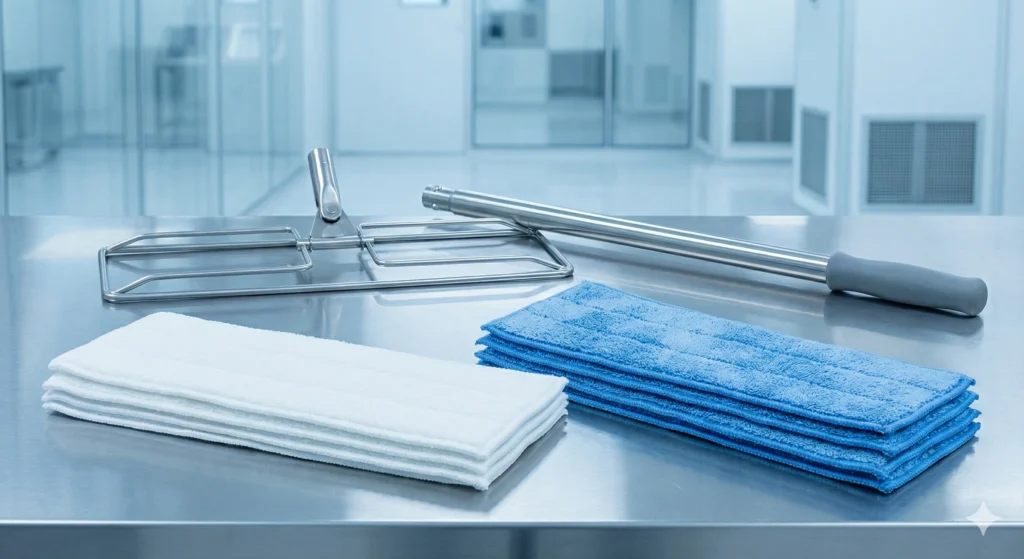
MIDPOSI manufactures both continuous-filament polyester and sealed-edge microfiber cleanroom mops validated for pharmaceutical GMP applications. Our material recommendations follow the same risk-based framework outlined in this guide, matching fiber architecture to your facility’s ISO classification, disinfectant program, and operational workflow.
عندما يوصي MIDPOSI بالبوليستر
ISO 5–7 Pharmaceutical Use
For aseptic manufacturing cores (Grade A/B), sampling/weighing rooms, and Grade C support areas, MIDPOSI specifies continuous-filament polyester as the only material meeting particle generation and durability requirements:
- MIDPOSI Gamma-Sterile Polyester Mop Pad (Product Code: CMP-DS-POLY-GS): 100% continuous-filament polyester knit, heat-sealed edges, gamma-irradiated to SAL 10⁻⁶. Particle generation <10 جسيمات/م² تم التحقق من صحته وفقًا لمعيار ISO 14644-14. عبوة فردية مزدوجة الكيس للنقل المباشر إلى مناطق الدرجة A/B.
- MIDPOSI ممسحة بوليستر ذات حافة محكمة الغلق وقابلة لإعادة الاستخدام (رمز المنتج: CMP-RUS-POLY-150): تم التحقق من صحته في الأوتوكلاف لأكثر من 150 دورة عند 121 درجة مئوية. توليد الجسيمات <يتم الحفاظ على 50 جسيمًا/م² طوال فترة الحياة المؤهلة. متوافق مع 70% IPA، 3-35% H₂O₂، الكوات، و0.5-1% مبيض.
دورة المطهر في الملحق 1 من برنامج الرصد العالمي (GMP) الخاص بالاتحاد الأوروبي
تستفيد المنشآت التي تقوم بتدوير الكحوليات والكوات وبيروكسيد الهيدروجين وهيبوكلوريت الصوديوم وفقًا لمتطلبات الملحق 1 من مبيدات الجراثيم من التوافق الكيميائي الواسع للبوليستر. تعتبر مادة ممسحة بوليستر واحدة مؤهلة عبر جميع بروتوكولات التطهير، مما يبسط التحقق من الصحة ويقلل من خطر عدم توافق كيمياء المواد.
سير عمل الأوتوكلاف القابل لإعادة الاستخدام
بالنسبة للمنشآت التي تتمتع ببنية تحتية داخلية معتمدة للغسيل والتعقيم، توفر متانة البوليستر التي تبلغ 150-200 دورة أقل تكلفة لكل استخدام. تحافظ ممسحات البوليستر القابلة لإعادة الاستخدام من MIDPOSI على ثبات الأبعاد (<انكماش بنسبة 3% خلال الدورة 100) وتوليد الجسيمات ضمن المواصفات، وتجنب تكاليف الاستبدال المبكرة المرتبطة بعمر خدمة أقصر للألياف الدقيقة.
مناطق المراقبة البيئية عالية المخاطر
تستفيد المناطق التي لها تاريخ في رحلات EM أو تعمل بالقرب من حدود تصنيف ISO من توليد جسيمات أقل بمقدار 5 × 10 × من البوليستر. أدى التحول من الألياف الدقيقة إلى البوليستر في مناطق دعم الدرجة C إلى حل اتجاهات عدد الجسيمات المزمنة في العديد من منشآت العملاء، مما أدى إلى التخلص من عبء التحقيق وتقليل مخاطر OOS.
عندما يوصي MIDPOSI باستخدام الألياف الدقيقة
منطقة كبيرة ISO 7-8
بالنسبة لمناطق التصنيع والتعبئة والمستودعات غير المعقمة حيث تكون حدود الجسيمات متساهلة (352000+ جسيمات/م3 عند ≥0.5 ميكرومتر)، توفر الألياف الدقيقة ذات الحافة المغلقة مزايا تشغيلية:
- MIDPOSI ممسحة ميكروفايبر قابلة لإعادة الاستخدام (حافة محكمة الغلق) (رمز المنتج: CMP-RUS-MF-100): مزيج من البوليستر/البولي أميد 80/20، حواف محكمة الغلق بالموجات فوق الصوتية. توليد الجسيمات <200 particles/m² when new; <500 جسيم/م² في الدورة 50. قدرة الامتصاص 6-8× الوزن الجاف لضمان كفاءة مسح مساحة كبيرة.
يؤدي تنظيف المرافق لأكثر من 500 متر مربع لكل نوبة عمل في مناطق ISO 8 إلى انخفاض بنسبة 30-40% في تغييرات الممسحة باستخدام الألياف الدقيقة مقابل البوليستر، مما يقلل من إجهاد المشغل ويحسن الإنتاجية.
إدارة الانسكابات/التنظيف المسبق
تتطلب المناطق التي تتعامل مع السوائل السائبة - إعداد المخزن المؤقت، وتخزين المواد الكيميائية التنظيفية، ومحطات غسيل المعدات - احتواء الانسكابات بسرعة. تمتص ممسحات MIDPOSI المصنوعة من الألياف الدقيقة سائلًا أكثر بمقدار 1.5-2× لكل وسادة من مكافئات البوليستر، مما يحتوي على الانسكابات بشكل أسرع ويمنع الانتشار إلى مناطق غرف الأبحاث المجاورة.
نوصي ببروتوكول من خطوتين: الألياف الدقيقة لامتصاص الانسكابات وإزالة التربة؛ البوليستر لتمرير التطهير النهائي المعتمد.
سيناريوهات تحسين التكلفة
بالنسبة للمنشآت ذات الميزانية المحدودة حيث تمثل مناطق ISO 8 >70% من إجمالي مساحة غرف الأبحاث، يمكن تبرير التكلفة الأولية الأقل للألياف الدقيقة بنسبة 30-40% إذا:
- يتجنب برنامج المطهر المواد المؤكسدة عالية التركيز (>6% H₂O₂, >0.5% مبيض)
- يعد استبدال الممسحة عند 50 دورة أمرًا مقبولًا وموثقًا في إجراءات التشغيل القياسية الخاصة بالتنظيف
- Particle generation validated at <500 جسيم/م2 خلال فترة الحياة المؤهلة
توفر MIDPOSI تقارير اختبار توليد الجسيمات، ومصفوفات التوافق الكيميائي، وبيانات التحقق من صحة الأوتوكلاف لدعم بروتوكولات IQ/OQ/PQ للعملاء لتأهيل الألياف الدقيقة.
غرف الأبحاث غير المعقمة
التكنولوجيا الحيوية ر&يمكن لمختبرات D، ومرافق زراعة الخلايا، ومناطق تركيب المستحضرات الصيدلانية غير المعقمة المصنفة وفقًا لمعايير ISO 7-8، استخدام الألياف الدقيقة حيث لا يلزم تعقيم المنتج. تلبي ممسحات MIDPOSI المصنوعة من الألياف الدقيقة حدود الجسيمات، وتتحمل برامج IPA/quat، وتوفر الامتصاص اللازم للتنظيف الفعال لمساحة كبيرة.
طلب عينات & حزمة التحقق من الصحة
يقدم MIDPOSI دعمًا تأهيليًا شاملاً لمساعدة فرق ضمان الجودة ومهندسي المرافق ومتخصصي المشتريات في اختيار المواد والتحقق من صحتها:
مجموعات العينات
- عبوات تقييم تحتوي على 5-10 رؤوس ممسحة (مزيج من البوليستر والألياف الدقيقة، قابلة لإعادة الاستخدام ويمكن التخلص منها) للاختبار التجريبي الداخلي
- مقارنة جنبًا إلى جنب في إطار برنامج التطهير الفعلي، وتقنية التطهير، وبروتوكول الأوتوكلاف
- أخذ عينات بدون تكلفة لتقييم المرافق >100 رأس ممسحة في السنة
بيانات اختبار الجسيمات
- ISO 14644-14 particle generation test reports showing particle counts at ≥0.5 µm and ≥5 µm under simulated-use conditions
- Testing performed on new mops and after accelerated aging (25, 50, 75, 100+ autoclave cycles)
- Acceptance criteria aligned to ISO Class 5, 6, 7, and 8 limits
Chemical Compatibility Reports
- ASTM D543 exposure validation for 70% IPA, 3–35% H₂O₂, quats (2,000 ppm), and 0.5–1% NaOCl
- Dimensional stability, tensile strength retention, and color fastness data after 10, 25, 50, and 100 exposures
- Worst-case chemical stress testing simulating daily disinfectant rotation per EU GMP Annex 1
Autoclave Durability Charts
- يُظهر مؤهل دورة الحياة تغير الأبعاد وسلامة الحافة وتوليد الجسيمات عبر 50 و100 و150 و200 دورة للأوتوكلاف عند 121 درجة مئوية
- معايير القبول لتحديد نهاية العمر (زيادة توليد الجسيمات، وفصل الحواف، >5% انكماش)
- جداول الاستبدال الموصى بها حسب درجة ISO وكثافة الاستخدام
إجراءات التشغيل الموحدة للتأهيل (IQ/OQ/PQ)
- بروتوكولات القالب لتأهيل التثبيت (استلام الفحص ووضع العلامات والتخزين)
- التأهيل التشغيلي (اختبار توليد الجسيمات، التحقق من التوافق الكيميائي، التحقق من صحة دورة الأوتوكلاف)
- مؤهلات الأداء (مراقبة الاستخدام، تحليل اتجاهات EM، تدريب المشغلين)
- مخصصة لإطار التحقق من صحة التنظيف في منشأتك والمتطلبات التنظيمية
للحصول على كتالوجات المنتجات، والمواصفات الفنية، أو لطلب مجموعة عينات وحزمة التحقق من الصحة، تفضل بزيارة MIDPOSI المواد الاستهلاكية غرف الأبحاث أو اتصل بالممثل الفني الإقليمي لديك. متخصصو مكافحة التلوث لدينا متاحون لمراجعة تصنيف ISO الخاص بمنشأتك، وبرنامج التطهير، والأولويات التشغيلية - ثم التوصية بالتكوين الأمثل للممسحة المصنوعة من البوليستر أو الألياف الدقيقة الذي يوازن بين التحكم في الجسيمات، والمتانة، والتكلفة، والامتثال لممارسات التصنيع الجيدة.