Cleanroom garments are not ordinary workwear. They are part of the contamination control system. A practical garment care SOP should define how garments are collected, washed, dried, inspected, packed, sterilized, tracked and removed from service.
This guide gives QA teams, cleanroom managers and procurement teams a clear framework for managing reusable cleanroom garments in ISO and GMP environments.

Even a well-designed cleanroom can be compromised if garments are poorly handled, over-used or released without inspection. Washing and sterilization are only part of the process. A useful SOP must also control garment collection, segregation, packaging, release, traceability and end-of-life decisions.
Garments must continue to reduce particle and microbial transfer after repeated use and processing.
Each wash, dry, inspection and sterilization cycle should follow validated parameters.
Garments should be released based on records, inspection status and lifecycle controls.
A garment care SOP should be easy to follow on the floor and clear enough for QA review. The workflow below can be adapted to your cleanroom class, garment type and risk level.
| Step | Control Point | What to Check |
|---|---|---|
| 1. Collection | Soiled garment handling | Use closed containers. Keep soiled garments separated from clean or released garments. |
| 2. Sorting | Garment type and risk level | Separate coveralls, hoods, boots, masks and heavily soiled items according to SOP. |
| 3. Pre-inspection | Visible damage and missing parts | Remove garments with tears, broken closures, heavy stains or excessive wear. |
| 4. Washing | Water, detergent and cycle control | Use DI / RO water where required, neutral non-ionic detergent and validated wash parameters. |
| 5. Drying | Controlled drying environment | Use dedicated cleanroom-compatible dryers and avoid exposure to uncontrolled air. |
| 6. Final inspection | Cleanliness and garment integrity | Check seams, zippers, cuffs, fabric surface, shedding and packaging readiness. |
| 7. Packing | Clean or sterile packaging | Pack according to area requirement, garment type and release status. |
| 8. Sterilization | Validated sterilization method | Apply gamma, autoclave or another approved method where sterile release is required. |
| 9. Release & tracking | QA release and lifecycle record | Record batch, cycle count, inspection result, sterilization status and expiry where applicable. |
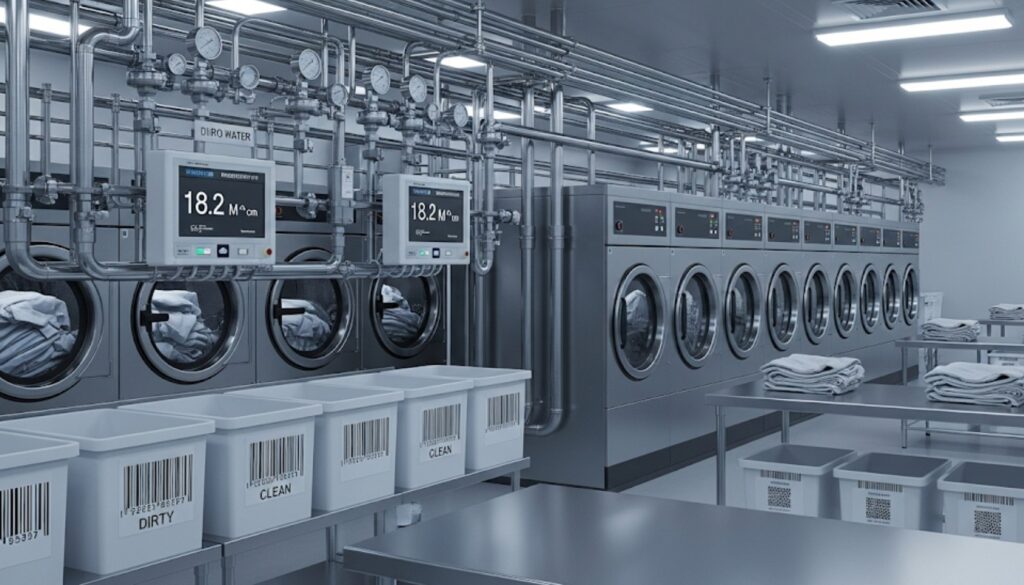
Cleanroom garment washing should avoid uncontrolled residues, fiber damage and re-contamination. The SOP should specify water quality, detergent type, machine loading, cycle settings and rinse control.
The right sterilization method depends on garment material, packaging, required sterility level, turnaround time and the number of reuse cycles expected from the garment.
| Method | Advantages | Limitations | Best Use Case |
|---|---|---|---|
| Steam Autoclaving | Effective, familiar, no toxic residue | Heat and moisture can shrink or degrade some garments | Autoclavable garments validated for repeated steam cycles |
| Ethylene Oxide | Good material compatibility and package penetration | Requires aeration control and strict safety management | Materials unsuitable for heat or certain radiation processes |
| Gamma Irradiation | Strong penetration, no chemical residue, widely used for sterile items | Dose must be validated to limit material degradation | Packaged sterile garments and cleanroom consumables |
| E-beam | Fast process and high dose rate | Lower penetration than gamma for dense loads | Selected products with validated package configuration |
Visual inspection is necessary, but it is not enough. Cleanroom garments can lose performance before damage becomes obvious. A practical reuse program should combine inspection, cycle tracking and periodic performance review.
Use barcode, RFID, UHF chip or logbook tracking to record washing, sterilization and repair history.
Set a maximum number of validated reuse cycles by garment type, zone and sterilization method.
Immediately remove garments with broken seams, fabric damage, missing components or failed inspection.
Neither option is automatically better. The correct choice depends on contamination risk, operating model, laundry capability, sustainability targets, storage conditions and cost structure.
| Factor | Reusable Garments | Disposable Garments |
|---|---|---|
| Cost Structure | Requires laundry, inspection, sterilization and tracking | More predictable purchase and disposal model |
| Compliance Management | Needs lifecycle records and validated care cycles | Needs supplier qualification and lot traceability |
| Storage | Requires clean return flow and controlled inventory | Requires enough stock and controlled packaging integrity |
| Environmental Impact | Can reduce waste if lifecycle is well managed | Higher waste volume but simpler contamination control in some cases |
| Best Fit | Facilities with validated laundry and reuse management | Facilities prioritizing simple single-use control or limited laundry capacity |
A cleanroom garment SOP is only useful when the records prove that it was followed. The following records should be easy to retrieve during internal review or customer audit.
MIDPOSI supplies autoclavable cleanroom garments and controlled cleanroom apparel solutions for GMP, pharmaceutical, biotech, laboratory and controlled manufacturing environments.
Cleanroom garment care is important because garments act as a barrier between personnel and the controlled environment. Washing, inspection, sterilization and reuse tracking help maintain barrier performance and reduce contamination risk.
Facilities commonly use purified water such as DI or RO water depending on the SOP and cleanliness requirement. The goal is to reduce detergent residue, ionic contamination and particle risk during garment processing.
A neutral, non-ionic detergent is commonly preferred because it helps reduce residue and lowers the risk of fiber damage compared with aggressive or poorly controlled detergents.
There is no single best method for every garment. Steam, EtO, gamma and e-beam sterilization all have different advantages and limits. The method should be validated against garment material, package format, required sterility level and reuse cycle target.
Service life should be controlled through cycle tracking, inspection, performance review and defined retirement rules. A garment should be removed when it reaches its validated cycle limit or fails inspection.
Key records include washing cycles, drying cycles, inspection results, packing records, sterilization batch records, garment lifecycle counts, rejected garment records and deviation reports.