Cleanroom Mop Bucket System Guide — GMP Setup, Materials, and Selection
A cleanroom mop bucket is not a commodity janitorial item. In a GMP or ISO-classified environment, the bucket system becomes part of the contamination control strategy. How it separates disinfectant, rinse water, and waste liquid directly affects disinfectant stability, bioburden control, operator repeatability, and audit readiness.
This guide explains how to evaluate single-, dual-, and triple-bucket configurations, when to choose stainless steel (SS304/SS316) or cleanroom-grade polypropylene, how wringer design affects particle control, and how to integrate the bucket system into a validated GMP cleaning workflow.
What Makes a Cleanroom Mop Bucket Different from Standard Commercial Buckets?
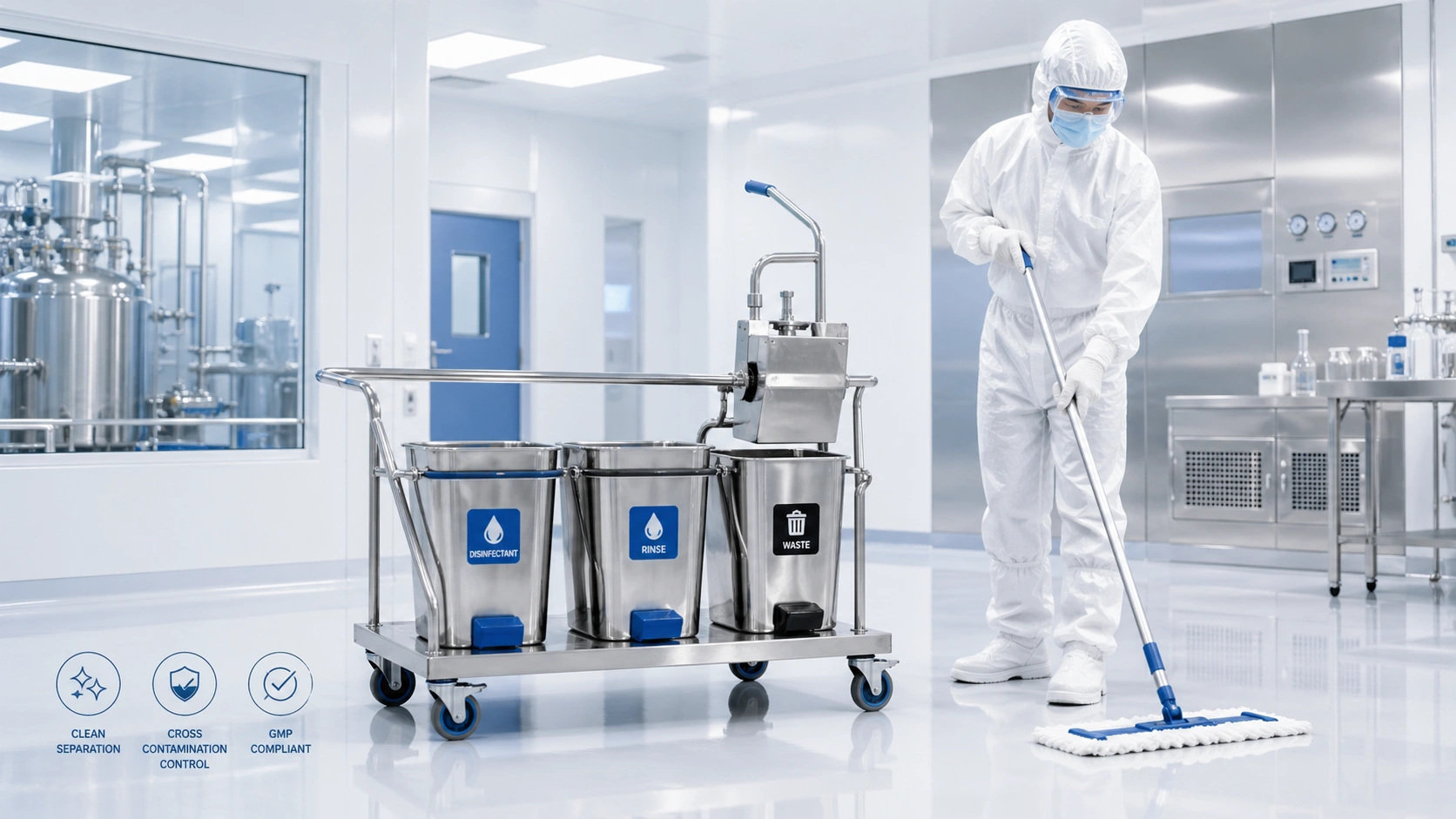
A standard janitorial mop bucket is designed for speed and convenience. A cleanroom mop bucket system is designed for controlled cleaning, fluid segregation, and repeatable performance inside classified or GMP-regulated environments.
Common commercial buckets typically include rough plastic surfaces, exposed seams, open joints, low-grade casters, or wringer assemblies that trap residue and are difficult to clean. These details can shed particles, harbor contamination, or make it impossible to verify that the equipment is ready for the next use.
In a cleanroom, the bucket must support the cleaning process rather than becoming an additional contamination source. Key design requirements include:
- Smooth, crevice-free surfaces that can be wiped down and inspected
- Continuous welds and rounded internal corners (for stainless steel systems)
- Smooth molded surfaces with cleanable edges (for polypropylene systems)
- Proper drainage so liquid does not pool in corners or around wringer mounts
- Chemical compatibility with the facility’s disinfectant rotation
- Compatibility with written SOP requirements for cleaning, drying, and storage
GMP and ISO 14644 environments also expect that cleaning tools minimize particle generation, support documented procedures, and help operators maintain clear separation between disinfectant, rinse water, and waste liquid. A well-chosen bucket system makes these expectations easier to meet and easier to demonstrate during internal audits and regulatory inspections.
If you are evaluating bucket materials alongside mop heads, frames, and handles, review the full cleanroom mop system overview to understand how each component works together in a controlled cleaning workflow.
Cleanroom Mop Bucket Configurations — Single, Dual, and Triple-Bucket Systems
Single-Bucket System
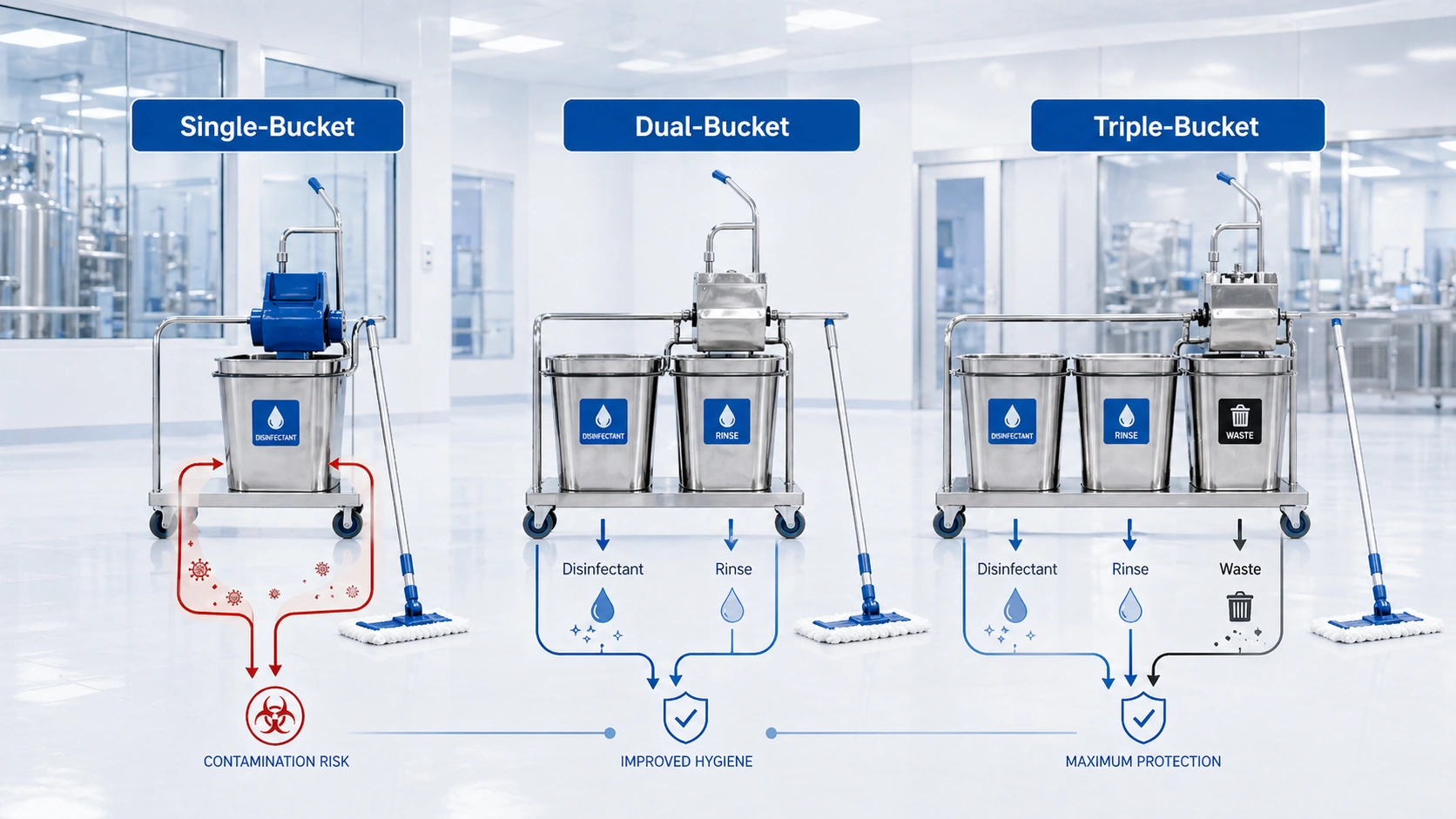
A single-bucket system uses one vessel for the cleaning or disinfectant solution. The mop is dipped, applied to the surface, and returned to the same bucket. This is the simplest arrangement but also the weakest from a contamination-control perspective — soil and removed bioburden flow back directly into the active solution.
Single-bucket systems may be acceptable for non-critical support areas where risk is low and the procedure is clearly defined. For GMP cleanroom cleaning, a single-bucket approach is difficult to justify because it provides no separation between clean solution and dirty return liquid.
Dual-Bucket System
A dual-bucket system separates the active cleaning or disinfectant solution from rinse water. Operators apply solution from the clean bucket, rinse the mop in the second bucket, wring the mop, and then return to the clean solution. This prevents dirty liquid from returning directly into the disinfectant bucket.
Dual-bucket configurations are commonly used in controlled areas where cleaning risk is moderate and the facility has defined change-out rules for rinse water and mop heads. They represent a practical balance between process control and operational simplicity.
Triple-Bucket System
A triple-bucket system separates disinfectant, rinse water, and waste liquid. The waste bucket receives all liquid wrung from the mop, which prevents contaminated liquid from mixing back into either the disinfectant or rinse bucket.
For pharmaceutical, biotech, aseptic support, and higher-grade GMP cleaning workflows, this layout provides the strongest process control. Each bucket has a clear single function: one for active solution, one for rinse, and one for waste collection. This clarity simplifies operator training and audit documentation.
Single-Bucket
Lowest complexity, weakest separation. Best reserved for low-risk or non-critical support areas where the procedure does not require fluid segregation.
Dual-Bucket
Separates clean solution and rinse water. Suitable for controlled cleaning routines when rinse water change-out and mop handling are clearly defined.
Triple-Bucket
Separates disinfectant, rinse water, and waste liquid. Preferred when contamination control, disinfectant stability, and process repeatability are priorities.
Wringer vs Press Systems — Which Mechanism for Your Facility?
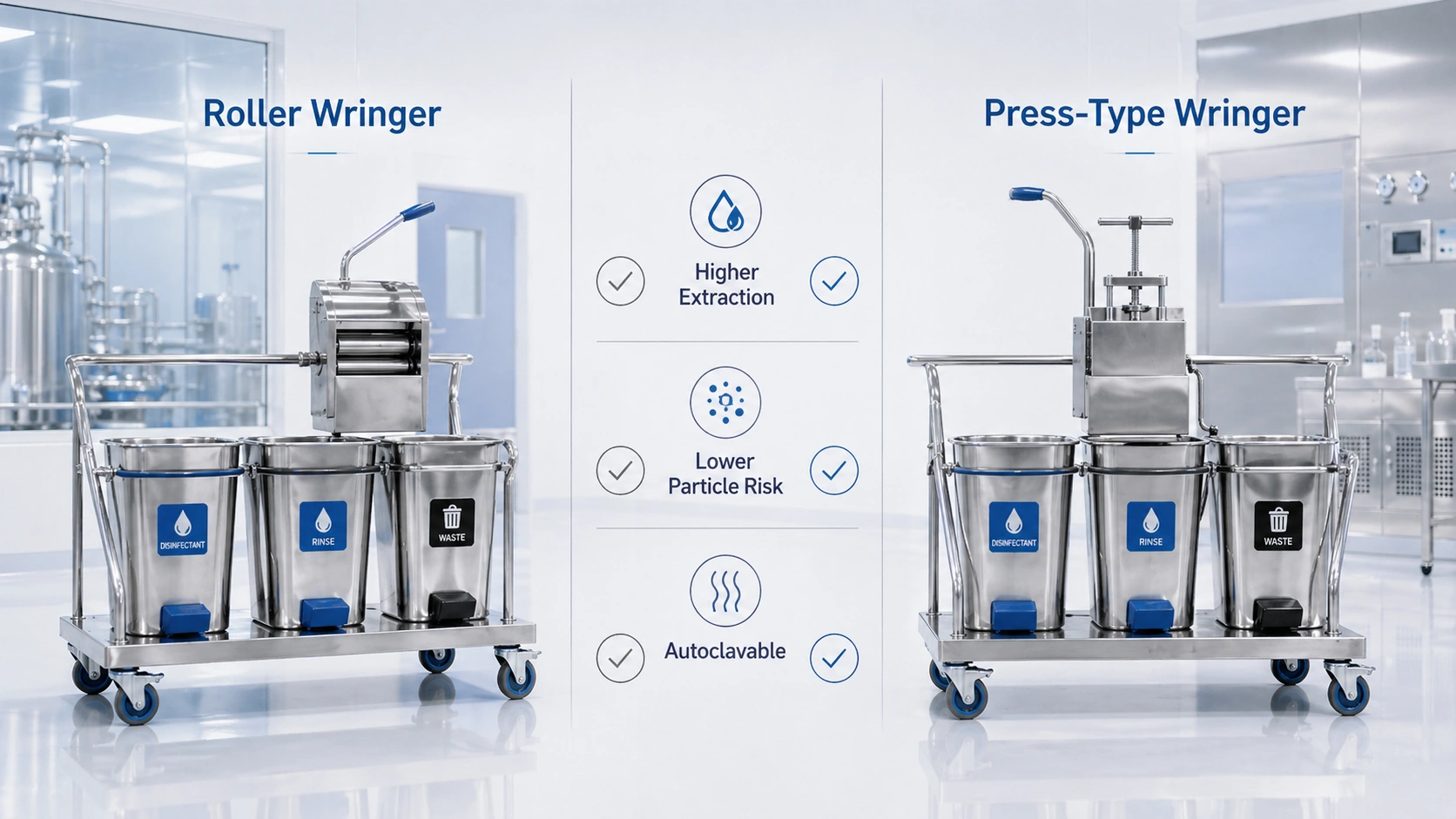
Roller Wringer
Roller wringers use rotating rollers to squeeze liquid from the mop head. They can provide efficient liquid extraction and are useful when operators need faster handling during larger-area cleaning.
The trade-off is mechanical complexity. Bearings, shafts, rollers, and connection points should be carefully reviewed for cleanability, corrosion resistance, and particle generation risk. Roller systems with exposed lubrication points or inaccessible joints may not be suitable for higher-grade cleanroom environments.
Press-Type Wringer
Press-type wringers use a basket, plate, or compression mechanism to remove liquid from the mop head. They are typically simpler in construction with fewer moving parts, which can make them easier to clean, inspect, and validate.
For Grade A/B support zones and other sensitive cleanroom workflows, a press-type wringer is often preferred because it reduces the number of components that must be assessed for particle shedding and cleanability. The final decision should be based on mop head type, cleaning area size, operator ergonomics, and sterilization requirements.
| Factor | Roller Wringer | Press-Type Wringer |
|---|---|---|
| Liquid extraction | Generally stronger, consistent across the mop head | May vary by operator pressure and mop head thickness |
| Mechanical complexity | More moving parts (rollers, bearings, shafts) | Fewer moving parts; simpler construction |
| Cleanability | Requires inspection of roller gaps and bearing points | Easier to wipe down; fewer inaccessible areas |
| Particle risk | Roller wear can generate particles over time | Lower moving-part risk; inspect compression surfaces |
| Autoclave compatibility | Must verify all roller components rated for steam | Must verify basket/plate material rated for steam |
| Best suited for | Larger-area cleaning; Grade C/D environments | Grade A/B support zones; sensitive workflows |
How Bucket Configuration Affects Bioburden Control and Disinfectant Use
Bucket configuration directly affects how quickly the cleaning liquid becomes loaded with soil, residue, and removed bioburden. The more separation the system provides, the easier it is to maintain the active solution at an effective concentration throughout the cleaning cycle.
Fluid Separation and Bioburden Management
When contaminated liquid returns to the same bucket holding the disinfectant, the active solution is progressively diluted and loaded with organic material. This can reduce disinfectant efficacy and increase the risk of re-depositing contamination onto cleaned surfaces. A system that directs waste liquid into a dedicated bucket preserves the integrity of both the disinfectant and rinse water.
Disinfectant Dilution Prevention
Disinfectant dilution is a practical risk in any workflow that allows used liquid to return to the active solution. In a triple-bucket system, waste liquid is wrung into the waste bucket, so the disinfectant remains concentrated at its prepared level for a longer practical duration. This can help facilities define clearer rules for solution change-out, waste handling, and cleaning coverage per batch.
Residue Re-Deposition Control
When a mop head carries soil and returns it to the disinfectant, the next application may transfer residue back onto surfaces already cleaned. Clear fluid separation — between disinfectant, rinse, and waste — helps reduce this cycle. Combined with defined mop head change-out rules, it supports a more consistent cleaning outcome.
Operator Movement and Particle Generation
Bucket system design also affects operator movement. Unstable carts, awkward wringer positions, or difficult-to-push configurations can force operators to use excessive motions. In cleanrooms, unnecessary movement contributes to particle generation. Smooth-rolling casters, stable frames, appropriate wringer height, and clear bucket positioning support controlled, low-friction cleaning operations — especially when operators are in full gowning.
When evaluating how bucket design fits into a complete cleaning program, see the Cleanroom Mop System Buyer Evaluation Framework for a structured approach to comparing equipment across material, workflow, and validation dimensions.
Recommended Bucket Materials — Stainless Steel (304/316) vs Polypropylene

SS304 and SS316 Stainless Steel
Stainless steel bucket systems are commonly selected for facilities that need long service life, repeated cleaning cycles, and strong mechanical durability. SS316 is preferred when the system may contact stronger disinfectants or when enhanced corrosion resistance is required — for example, in facilities using chlorine-based disinfectants or aggressive oxidizers.
When evaluating stainless steel systems, review weld quality, surface finish (polished surfaces are preferred for cleanability), caster design, and whether the wringer and frame components are also constructed from compatible, cleanroom-suitable materials.
Cleanroom-Grade Polypropylene (PP)
Polypropylene bucket systems are lightweight, easy to maneuver, and cost-effective. They are practical for facilities that need multiple dedicated sets, area-specific allocation, or lower initial capital investment. PP is also inherently resistant to pitting corrosion from chloride-based disinfectants, which can be an advantage in certain chemical environments.
The main consideration is service life. PP buckets should be inspected regularly for cracking, whitening, warping, surface degradation, or loss of fit around lids and wringer components. Facilities should define a replacement schedule based on observed wear rather than waiting for visible failure.
Chemical Compatibility Matrix
| Disinfectant or Process | SS316 Stainless Steel | Cleanroom-Grade PP |
|---|---|---|
| 70% Isopropyl Alcohol (IPA) | Generally compatible when surfaces are properly maintained | Generally compatible at normal room temperature |
| Hydrogen Peroxide (H2O2) | Good compatibility, dependent on concentration and exposure time | Good compatibility for many controlled cleaning applications |
| Sodium Hypochlorite (NaOCl) | Requires careful control; chloride exposure increases pitting corrosion risk | No pitting corrosion; repeated oxidizer exposure may age the polymer over time |
| Quaternary Ammonium Compounds | Generally compatible | Generally compatible |
| Peracetic Acid | Compatibility depends on concentration; review per manufacturer specifications | Generally compatible at typical use concentrations |
| Autoclave Exposure (121°C / 134°C) | Strong long-term durability when all components are designed for steam exposure | Can be suitable depending on resin grade and cycle frequency; requires regular inspection |
| Weight and Handling | Heavier, more stable, higher operator effort to maneuver | Lighter, easier to move, lower physical strain on operators |
| Typical Selection Logic | Best for long service life and high-frequency GMP cleaning programs | Best for lightweight handling, dedicated-area sets, or lower initial investment |
How Material Choice Affects Long-Term Cost
Stainless steel typically has a higher initial purchase cost but may provide better long-term value when the system is used frequently and needs durable, long-term performance. PP can be more economical when use volume is lower, the system is dedicated to a single area, or the facility benefits from lighter handling.
The best financial decision includes more than the purchase price. Factor in expected replacement frequency, cleaning method, disinfectant exposure, operator ergonomics, and the operational cost of requalification when equipment is changed or replaced.
Ideal Mop Bucket Setup by Facility Type
Different facility types present different cleaning risk profiles, room classifications, and regulatory expectations. The table below provides a practical starting point for matching bucket system configurations to facility types.
| Facility Type | Typical Grade / ISO Class | Recommended Configuration | Preferred Material | Key Consideration |
|---|---|---|---|---|
| Pharmaceutical Manufacturing | Grade A/B (ISO 5) — aseptic filling | Triple-bucket | SS316 stainless steel | Strongest fluid segregation required; compatible with aggressive disinfectant rotation; autoclave-ready components |
| Pharmaceutical Manufacturing | Grade C/D (ISO 7/8) — support areas | Triple-bucket or dual-bucket | SS304 or cleanroom-grade PP | Balance segregation needs with operational throughput; defined change-out rules |
| Biotech / Biologics | Grade A/B (ISO 5) — cell therapy, aseptic processing | Triple-bucket | SS316 stainless steel | Dedicated systems per product area; strong visual management with clear labeling and color coding |
| Biotech / Biologics | Grade C/D (ISO 7/8) — process support | Dual-bucket minimum | SS304 or PP | Coordinate with disinfectant rotation schedule; confirm change-out frequency |
| Medical Device Manufacturing | ISO 7/8 (Class 10,000/100,000) | Dual-bucket or triple-bucket | Cleanroom-grade PP or SS304 | May benefit from PP for lighter handling across larger floor areas; verify chemical compatibility with cleaning agents |
| Compounding Pharmacy (USP <797>/<800>) | ISO 5/7 (buffer and ante areas) | Triple-bucket | SS304 or cleanroom-grade PP | Strong waste segregation for hazardous drug compounding; dedicated systems per HD/non-HD area |
SOP Integration Points
Regardless of facility type, the bucket system should support — not complicate — the written SOP. Key integration points include:
- Solution preparation: Which bucket holds what; preparation time and expiry labelling
- Fill levels: Bucket size should balance coverage area against operator handling; overfilled buckets are harder to move and more likely to spill
- Mop change-out: When mop heads are replaced (per area, per room, after visible soil, per batch)
- Waste handling: When and how waste liquid is emptied, treated, and disposed
- Post-use cleaning: Bucket cleaning, rinsing, drying, inspection, and storage before next use
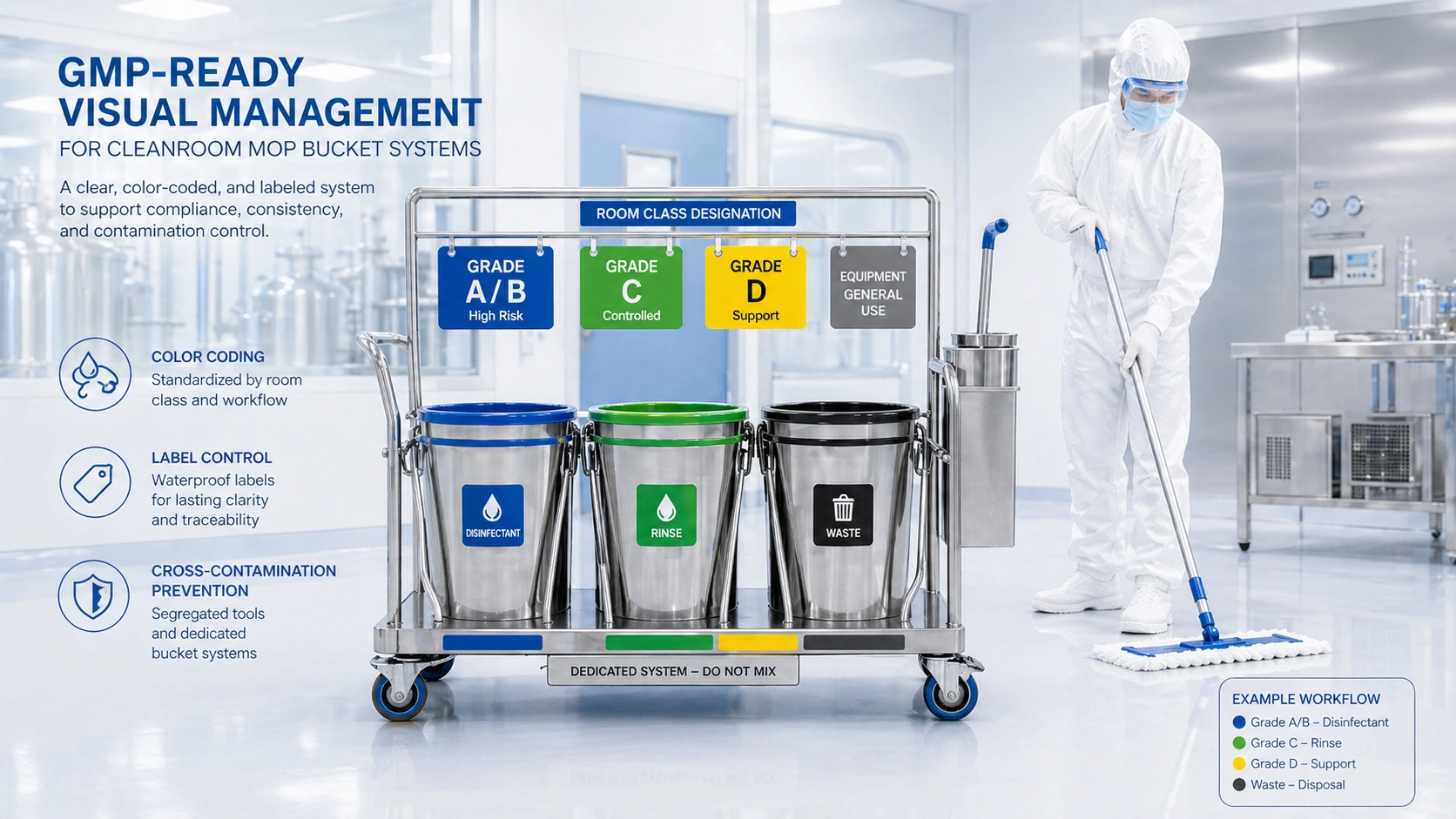
- Visual management: Labels, color coding, and area dedication that operators can recognize quickly and reliably
For application-specific guidance on matching cleaning tools to GMP grade requirements, review the GMP cleanroom mop grade selection guide and cleanroom mop solutions for GMP facilities.
Cleanroom Mop Bucket Selection Checklist
Use this checklist when evaluating or procuring a bucket system for GMP-controlled cleaning. Each point addresses a factor that affects contamination control, operator workflow, or audit readiness.
- Room classification and risk level. Identify the target ISO class, GMP grade, and cleaning risk for each area. Higher-risk areas (Grade A/B, ISO 5) should default to triple-bucket systems with maximum fluid segregation.
- Bucket configuration requirement. Determine whether single, dual, or triple-bucket fits the cleaning risk. For GMP cleanroom areas, single-bucket should be the exception, not the default.
- Material selection: stainless steel or PP. Match material to disinfectant chemistry, sterilization method, cleaning frequency, and expected service life. Document the rationale for the selected material.
- Wringer type. Evaluate roller wringer vs press-type wringer based on particle generation risk, cleanability, autoclave compatibility, and operator handling. Consider having the wringer evaluated by the facility’s contamination control or validation team.
- Caster and mobility assessment. Check caster material, smoothness, locking mechanism, and compatibility with the cleanroom floor surface. Unstable or rough-rolling carts increase operator movement and particle generation.
- Drainability and cleanability. Inspect bucket shape, internal corners, wringer mounting points, and drainage. The system should allow complete emptying, rinsing, drying, and visual inspection without complicated handling.
- Visual management setup. Plan labels, color coding, and area designation before deployment. Labels must be durable enough to survive the cleaning and sterilization process.
- SOP compatibility. Confirm the bucket system supports — rather than complicates — the written procedures for solution preparation, mop change-out, waste handling, and post-use cleaning.
- Sterilization method. If autoclaving, verify all components are rated for steam exposure. Confirm loading procedures allow proper steam contact and drainage. If chemical sterilization is planned, verify full material compatibility.
- Spare parts and replacement schedule. Identify wear items (casters, wringer components, seals, labels) and establish a replacement schedule. Document the procurement lead time for critical spare parts.
- Operator training. Plan training on the exact workflow: where to load the mop, where to wring, when to rinse, when to change the mop head, and when to empty the waste bucket. Training records should be maintained per SOP.
- Validation and monitoring integration. Define how the bucket system fits into environmental monitoring trending. If particle or microbial results shift after implementation, the bucket system — alongside the mop head and operator technique — should be part of the investigation scope.
Validation-Friendly Cleaning Workflow with Bucket Systems
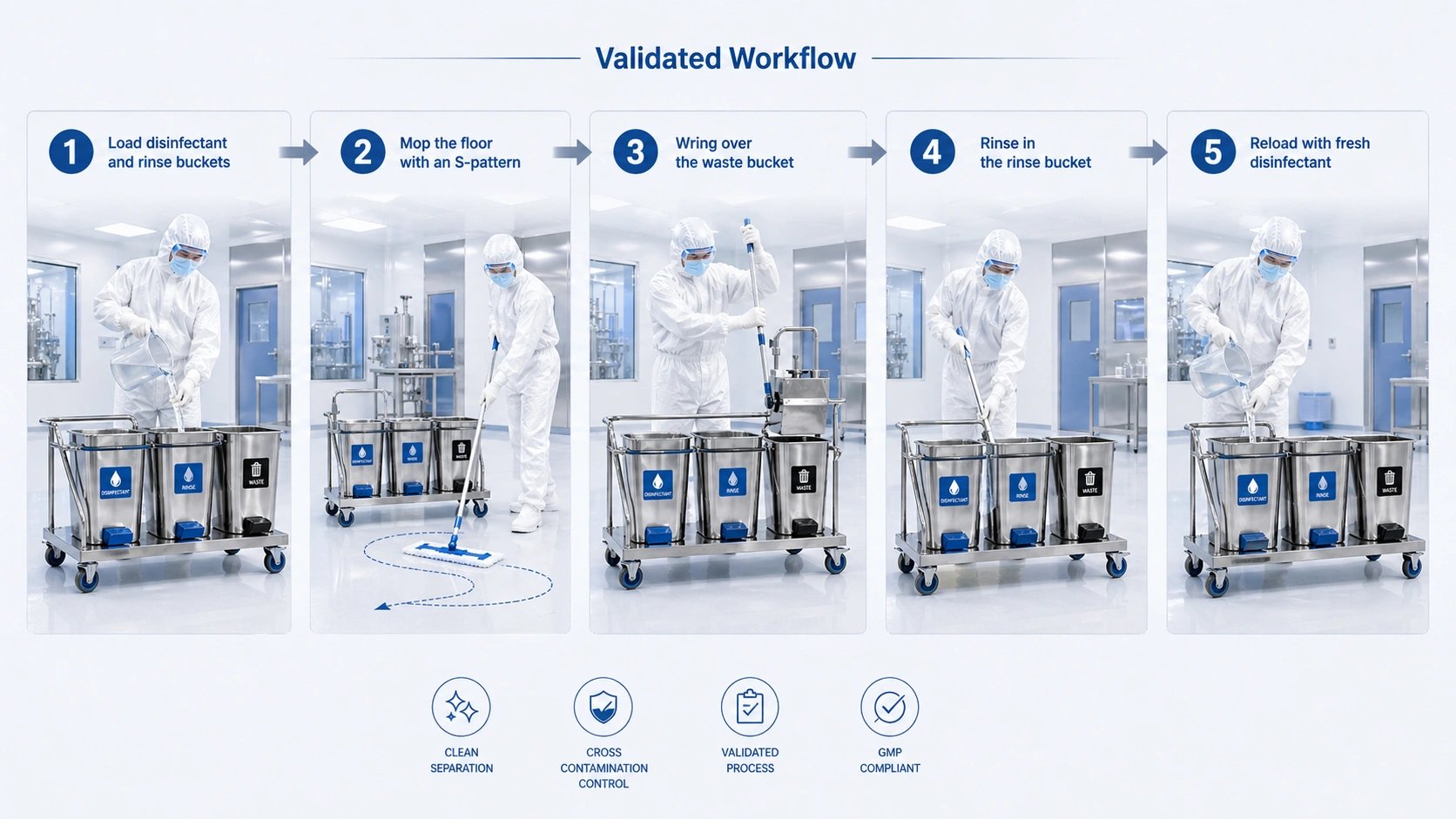
A validation-friendly workflow is repeatable, documentable, and designed so that each step has a clear purpose. The triple-bucket workflow below is structured for GMP environments where fluid segregation and operator consistency are priorities.
Prepare the Bucket System
Verify bucket labels and confirm the target area. Load disinfectant into the first bucket, rinse water (WFI or purified water as specified) into the second bucket, and leave the third bucket ready for waste collection. Record disinfectant type, concentration, preparation time, and expiry time per the facility SOP.
Mop with a Controlled Pattern
Apply the cleaning solution using a consistent, overlapping S-pattern. The goal is to achieve full surface coverage while avoiding missed areas or unnecessary operator movement. Work from cleanest to least-clean areas within the room.
Wring into the Waste Bucket
After the mop contacts the floor, wring contaminated liquid into the waste bucket. Do not return it to the disinfectant bucket. This is the central control advantage of the triple-bucket workflow.
Rinse the Mop
Rinse the mop in the rinse water bucket to release soil and residual disinfectant from the mop head. After rinsing, wring again into the waste bucket — not into the rinse bucket.
Reload with Fresh Disinfectant
Return the mop to the disinfectant bucket only after the rinse and waste steps are complete. This sequence keeps the active solution cleaner and more stable throughout the cleaning cycle.
Post-Cleaning: Empty, Clean, Inspect, Store
After cleaning is complete, empty all buckets per the facility waste-handling procedure. Clean, rinse, dry, inspect, and store the bucket system. Document any observations per the SOP and prepare for the next use.
Operator Technique: Common Pitfalls
- Skipping the rinse step. Returning a soiled mop directly to the disinfectant dilutes and contaminates the active solution.
- Walking over wet cleaned surfaces. This re-contaminates the cleaned area and can transfer particles from footwear to the floor.
- Over-wetting the floor. Excess liquid can pool in low areas and leave disinfectant residue that complicates surface monitoring.
- Mixing tools between areas. Using the same bucket system across zones without decontamination defeats the purpose of area segregation.
- Continuing to use a visibly soiled mop head. Mop heads should be changed per the defined interval — not when the operator decides it looks dirty.
For a structured approach to cleaning procedure documentation, see the cleanroom mopping SOP guide for GMP compliance and the cleanroom mop workflow validation checklist.
Cleanroom Mop Bucket System — Frequently Asked Questions
What is a cleanroom mop bucket system?
A cleanroom mop bucket system is a controlled cleaning setup designed to manage disinfectant, rinse water, and waste liquid during cleanroom floor and surface cleaning. Unlike commercial janitorial buckets, it is constructed with cleanable surfaces, chemical-resistant materials, and fluid-separation capability to support GMP and ISO-classified cleaning workflows. Its primary role is to help operators maintain clean-to-dirty separation while following a repeatable, documented procedure.
Is a triple-bucket system always better than a dual-bucket system?
A triple-bucket system provides stronger fluid separation because it keeps waste liquid separate from both disinfectant and rinse water. This is generally preferred for Grade A/B, aseptic, and higher-risk GMP cleaning workflows. A dual-bucket system may be suitable for Grade C/D areas and lower-risk controlled cleaning when change-out rules for rinse water and mop heads are clearly defined and followed. The final choice should match the cleaning risk, not a universal default.
Should I choose stainless steel (SS316) or polypropylene (PP) for my cleanroom mop buckets?
SS316 stainless steel is typically selected for long service life, frequent use, and high-durability GMP cleaning programs. It offers strong corrosion resistance and withstands repeated autoclave cycles. Cleanroom-grade polypropylene is lighter, easier to maneuver, and cost-effective — suitable for dedicated-area use, lower-volume cleaning, or facilities that prefer reduced operator physical strain. The selection should be based on disinfectant chemistry compatibility, sterilization method, cleaning frequency, and budget. Neither material is universally correct — each serves different operational priorities.
Which wringer type — roller or press — is better for cleanroom cleaning?
Press-type wringers are generally simpler, with fewer moving parts, making them easier to clean, inspect, and validate. They are often preferred for Grade A/B support zones and sensitive workflows. Roller wringers may provide more consistent liquid extraction across the mop head but introduce additional mechanical components (bearings, shafts, rollers) that should be carefully reviewed for particle generation risk and cleanability. The decision should weigh cleanability requirements against liquid extraction efficiency, operator ergonomics, and sterilization compatibility.
How does a cleanroom mop bucket system support GMP compliance?
It supports GMP compliance by enabling a controlled and repeatable cleaning process. A properly selected system helps operators separate clean and dirty liquids, follow defined change-out rules, manage waste, and document the workflow more clearly. It also provides the structural consistency needed for environmental monitoring trending — when particle or microbial results shift, the bucket system is a defined, reviewable variable rather than an uncontrolled one.
Can I use a single-bucket system in a GMP cleanroom?
A single-bucket system is difficult to justify in GMP cleanroom areas because it provides no separation between clean disinfectant and dirty return liquid. It may be acceptable for non-classified support spaces, corridors, or areas where the cleaning risk is demonstrably low and the procedure is clearly defined. For any area subject to GMP cleaning requirements, a dual-bucket or triple-bucket configuration provides stronger process control and is easier to defend during audits.
What role does visual management play in cleanroom bucket systems?
Visual management — color coding, function labels, area designation, and solution identification — reduces operator confusion and tool mix-up during routine cleaning. A facility may code by room grade, product area, disinfectant type, or cleaning sequence. The key requirement is consistency: operators should be able to recognize the correct bucket and its intended use immediately. Labels and color bands must remain durable through cleaning, disinfection, and sterilization cycles.
How often should cleanroom mop buckets be replaced or requalified?
Replacement frequency depends on material, usage intensity, cleaning chemistry, and sterilization method. SS316 systems may serve for years with proper maintenance and inspection. PP systems should be inspected more frequently for cracking, warping, surface degradation, or loss of component fit. Replace any bucket system when visible damage, corrosion, or wear compromises cleanability or structural integrity. Include requalification in the change control procedure when switching bucket material, configuration, or supplier.
Need a Cleanroom Mop Bucket System for Your GMP Facility?
MIDPOSI supports pharmaceutical, biotech, and medical device cleanroom cleaning programs with mop systems, bucket configurations, disposable mop options, and application-specific selection guidance. Whether you are evaluating a first-time procurement or upgrading an existing cleaning workflow, speak with us to compare configuration, material, and compatibility options for your facility’s cleaning requirements.
Professional cleanroom cleaning tools for controlled environments — supported by structured selection guidance and application documentation.