

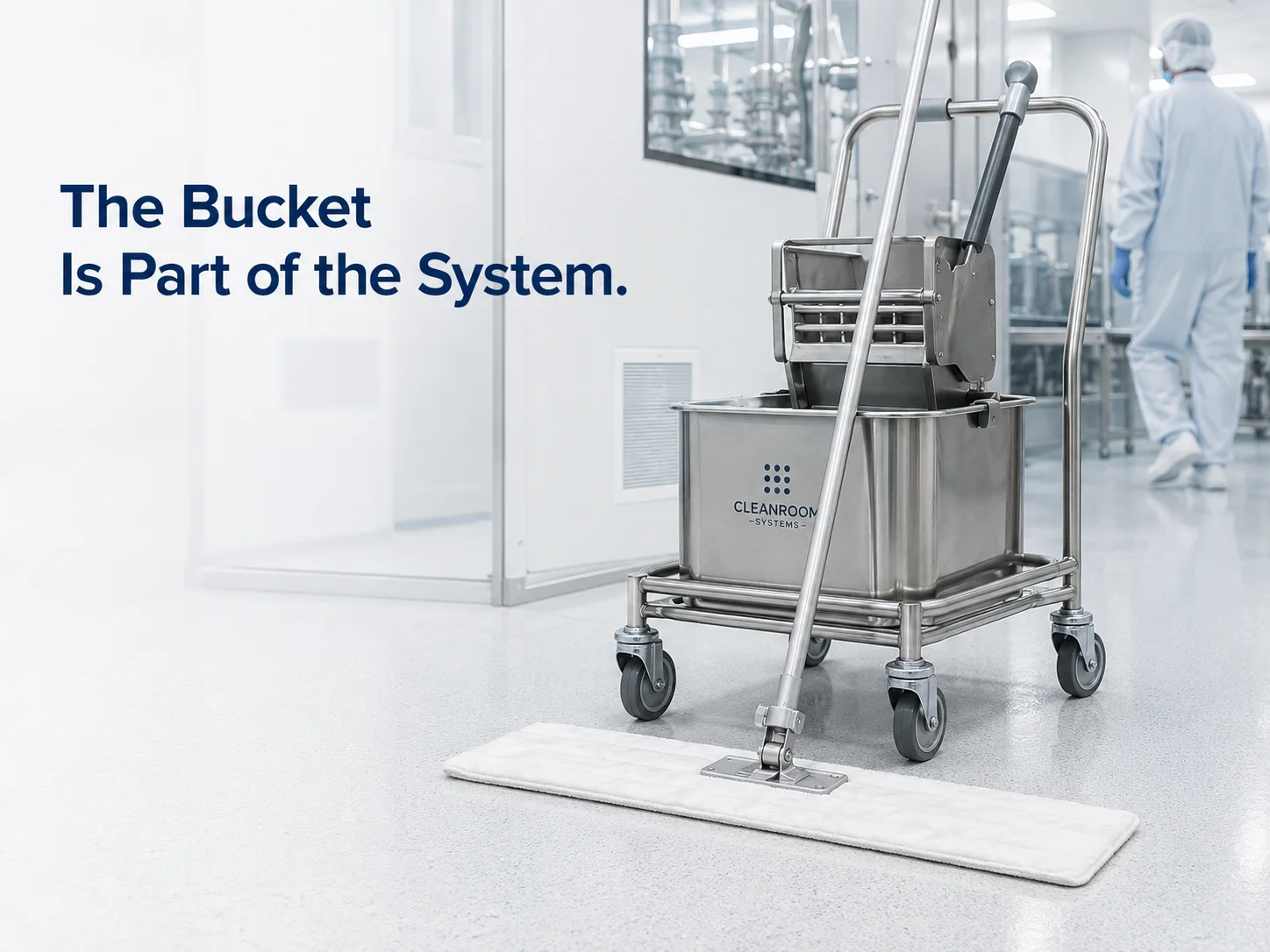
The cleanroom mop bucket and wringer is the fourth component of a complete mop system — and the most frequently overlooked in procurement specifications. While mop heads, frames, and handles receive structured evaluation, the bucket and wringer are often treated as generic janitorial accessories. This is a specification error with operational consequences: dimensional mismatch with the mop frame, particle shedding from incompatible bucket materials, and an unvalidated solution management system that undermines cleaning consistency. This guide provides the selection criteria to evaluate bucket and wringer systems with the same rigor applied to the other three components.
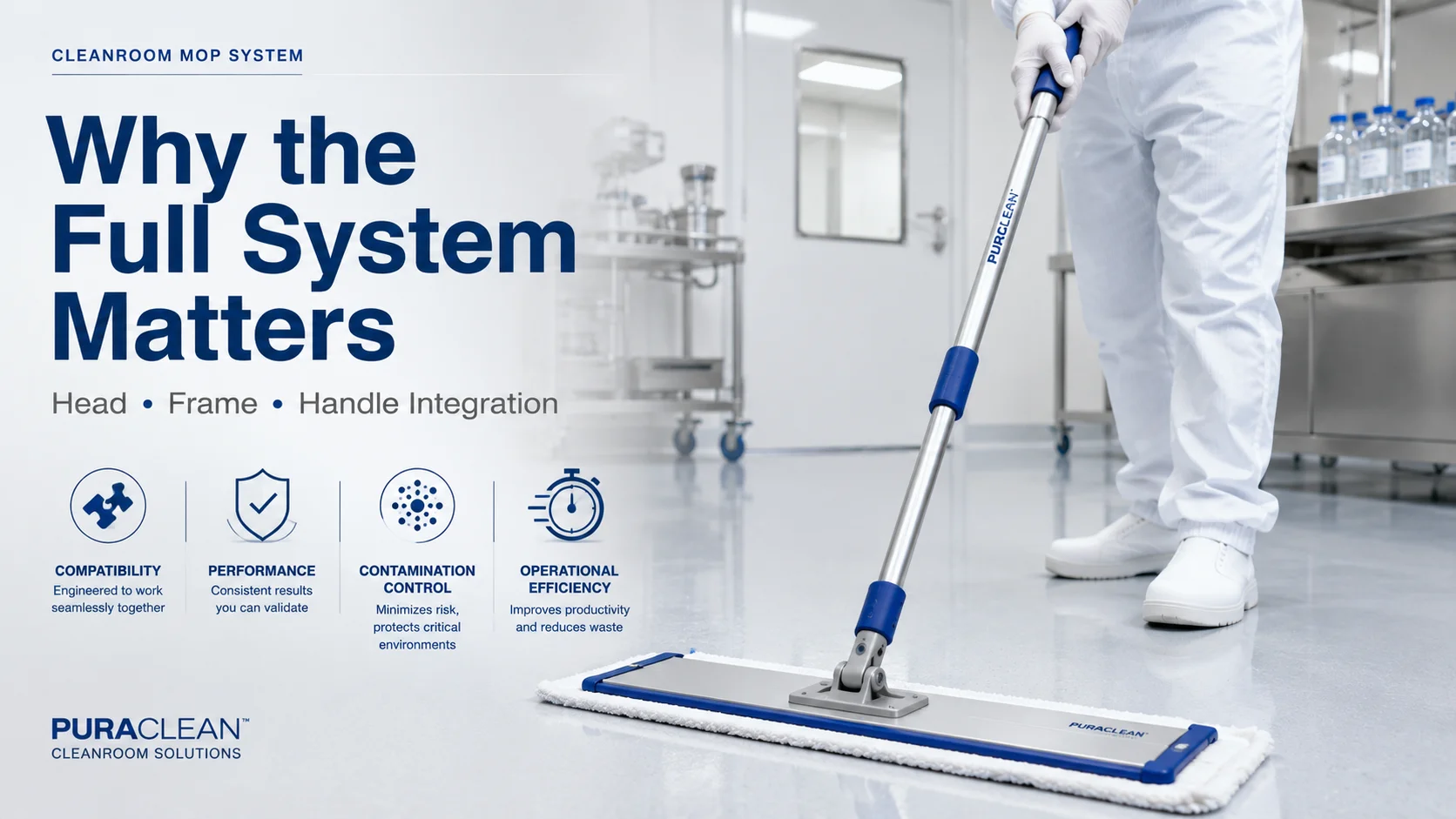
Three criteria distinguish a cleanroom-grade bucket and wringer from a general-purpose janitorial bucket: material (stainless steel or validated cleanroom-compatible polymer — not untreated plastic that sheds particles), dimensional compatibility (the wringer opening must match the mop frame width, and the bucket depth must accommodate the frame geometry), and solution management capability (the system must support validated solution preparation, change frequency, and disposal — not left to operator discretion). A bucket that fails any of these three criteria introduces an unvalidated variable into a cleaning protocol that is otherwise documented and controlled.
| Feature | Janitorial Bucket | Cleanroom-Grade Bucket |
|---|---|---|
| Materiale | Untreated plastic (PE, PP) — may shed particles, absorb chemicals, harbor contamination in surface pores | 304/316 stainless steel or validated cleanroom polymer — smooth, non-shedding, chemically resistant surface |
| Wringer Compatibility | Generic opening — may not match cleanroom mop frame width. Uneven pressure during wringing. | Wringer opening matched to specific frame width. Even pressure distribution across the mop head during solution removal. |
| Solution Management | No volume markings. Solution change left to operator discretion. | Graduated volume markings. Defined capacity matched to cleaning area coverage. Dual-bucket option for clean/dirty separation. |
| Surface Finish | Rough or textured — harbors residue, difficult to validate clean | Smooth, crevice-free. Defined surface roughness (Ra value). Cleanable and visually inspectable. |
| Dokumentation | Ingen | Material certificate, dimensional specifications, surface finish documentation, chemical compatibility statement |
For the broader system-level argument of why component compatibility matters — including the head-to-frame and handle-to-frame interfaces — see the why the full cleanroom mop system matters guide. For the foundational overview, see the renrumsmoppesystem oversigt.
A general-purpose janitorial bucket used in a cleanroom is not just suboptimal — it actively introduces contamination vectors that the rest of the cleaning protocol is designed to control. The following four failure modes describe why a bucket specification matters.
Untreated plastic buckets have surface micro-texture that releases particles when agitated — and a bucket containing cleaning solution is constantly agitated during use. The plastic surface also abrades over time, generating additional particles. In a Grade B cleanroom where particle counts are monitored, a particle-shedding bucket can be the source of an environmental monitoring excursion that triggers an investigation — and the bucket is rarely the first variable examined.
Some plastics degrade when exposed to oxidizing disinfectants (hydrogen peroxide, peracetic acid) over extended contact. A bucket that holds a sporicidal solution for an 8-hour shift may experience surface degradation that is not visible but releases chemical byproducts into the cleaning solution — altering the effective disinfectant concentration and potentially leaving residues on cleaned surfaces.
Porous or textured plastic surfaces harbor residue in microscopic crevices. When the bucket is “cleaned” between uses, visual inspection may show a clean surface — but swab testing can reveal residual disinfectant, cleaning agent, or microbial contamination in surface pores. A bucket that cannot be validated clean between uses is not a cleanroom-compatible tool.
An auditor reviewing the cleaning protocol asks: “What is the specification for the cleaning solution container?” If the answer is “a standard janitorial bucket” — with no material specification, no dimensional documentation, no cleanability validation — the auditor has identified a gap in the contamination control program. This single question can escalate into a broader review of all unvalidated cleaning consumables. For GMP grade-specific tool requirements, see the GMP vejledning til valg af renrumsmoppekvalitet.
| Materiale | Grad | Renrumsegnethed | Nøgleovervejelser |
|---|---|---|---|
| Stainless Steel 316 | Præmie | Karakter A/B/C/D | Highest chemical resistance (molybdenum content resists chloride pitting). Autoclavable. Smooth, non-shedding surface. Highest cost. Preferred for Grade A/B aseptic environments where chemical exposure is most aggressive. |
| Stainless Steel 304 | Standard | Grade C/D; Grade A/B evaluated case-by-case | Good chemical resistance for most cleanroom disinfectants. Autoclavable. More cost-effective than 316. May be susceptible to chloride pitting with prolonged exposure to chlorine-based disinfectants (which should generally be avoided in cleanroom cleaning regardless). |
| Polypropylene / HDPE | Acceptable (if validated) | Grade C/D (with supplier validation) | Lighter weight than stainless steel. Lower cost. Must be verified particle-shedding-free for the specific grade. Chemical compatibility must be validated with the facility’s specific disinfectants. Not autoclavable — limits sterilization options. Surface condition degrades over time; lifespan shorter than stainless steel. |
| Galvanized / Painted Steel | Not Acceptable | Do not use in any cleanroom | Zinc coating (galvanized) corrodes with common disinfectants. Paint chips become particulate contamination. Surface cannot be validated cleanroom-compatible. |
Stainless steel is the preferred material for cleanroom bucket and wringer systems in GMP environments. The material premium over plastic is justified by: longer service life (stainless steel does not degrade with repeated chemical exposure), autoclavability (supports in-house sterilization if required), and documentable surface finish (Ra values can be specified and verified). For Grade C/D support zones where cost is a primary constraint and chemical exposure is less aggressive, validated cleanroom-grade polymers may be evaluated as an alternative — provided the supplier can document particle shedding performance and chemical compatibility.
The wringer controls how much solution is removed from the mop head before each pass — and therefore how much solution is applied to the floor. This directly affects disinfectant contact time, floor drying time, and cleaning consistency. The wringer type should be selected based on the cleaning protocol’s requirements, not on availability.
| Type | Hvordan det virker | Bedst til | Begrænsninger |
|---|---|---|---|
| Press-type | Operator presses the mop head (still on the frame) against a flat or curved plate. Solution is squeezed out by mechanical pressure. | Light to moderate use. Facilities with simple solution management requirements. Lower maintenance — few moving parts. | Solution removal consistency depends on operator technique — pressure applied varies between operators and over a shift. Less consistent than roller-type. |
| Roller-type | Mop head passes between two rollers that squeeze solution out as the operator pulls the mop through. | Facilities requiring consistent solution removal across operators and shifts. Higher-volume cleaning programs. | More moving parts — rollers and bearings require maintenance. Roller pressure must be calibrated and verified periodically. Higher initial cost than press-type. |
| Hands-free / Foot-operated | Operator activates the wringer by foot pedal, keeping hands away from the solution. Mop head is mechanically pressed or rolled. | Grade A/B aseptic environments where operator contact with cleaning solution should be minimized. Facilities with strict personnel hygiene protocols. | Highest complexity. Mechanical linkage between pedal and wringer requires maintenance. Higher cost. May not be necessary for Grade C/D environments. |
The wringer opening width must match the mop frame width. A wringer opening that is too narrow will not accept the frame — the operator cannot wring the mop head at all. A wringer opening that is too wide applies uneven pressure: the center of the mop head is wrung more than the edges, leaving excess solution at the frame ends that creates inconsistent floor wetness and variable disinfectant contact time. Before specifying a wringer, verify the frame width from the cleanroom mop frame types specification and confirm that the wringer opening accommodates that width with the mop head mounted.
A single-bucket system holds one reservoir of cleaning solution. As the operator mops, the solution becomes progressively contaminated with residues from the floor. Toward the end of the cleaning session, the operator is applying increasingly contaminated solution to surfaces — which can leave residues and reduce cleaning efficacy. A dual-bucket system separates clean solution (one bucket) from dirty solution (the other bucket, into which the wringer drains). The mop head is rinsed in the dirty-solution bucket, wrung, then re-loaded with clean solution from the second bucket. Dual-bucket systems are preferred for GMP cleaning because they maintain solution quality throughout the cleaning session.
Bucket capacity should be calculated based on the cleaning area coverage and solution application rate — not selected by approximate size. A general formula:
Required solution volume per change = cleaning area (m²) × solution application rate (L/m²)
The solution application rate depends on the mop head material, the disinfectant type, and the required contact time — and should be established during cleaning validation. The bucket capacity must accommodate this volume plus a working margin (typically +20%) to prevent the operator from running out of solution before completing the designated cleaning area. If the bucket is too small, the operator must interrupt cleaning to refill — which introduces a process deviation. If the bucket is too large, the solution may sit unused beyond its validated use-life.
The cleaning SOP must define when the solution is changed — not leave it to operator discretion. Validated triggers include: after a defined area (m²), after a defined number of rooms, when visible soiling is observed, or at a defined time interval (if the solution has a validated use-life). The bucket should have graduated volume markings to support solution preparation verification — the operator fills to a defined mark, not “about this much.”
Bucket, wringer, and mop handle storage integrated on a stainless steel cart. The operator pushes one unit through the cleaning area — no trips back to a stationary bucket. Mop heads are carried on the trolley for change-out.
Bucket and wringer as stationary units. The operator returns to the bucket location to wring and reload the mop head.
The decision between trolley-mounted and standalone depends on: floor area per cleaning zone, number of zones per shift, operator count, and corridor accessibility. Large facilities with open production suites benefit from trolley systems. Multi-room facilities with tight corridors may find standalone buckets more practical per room.
The bucket and wringer — like any other cleanroom tool — should be supported by documentation that demonstrates fitness for purpose in a GMP environment. The following documentation should be requested from the supplier:
For the complete supplier documentation framework covering all mop system components, see the valideringsdokumenter for renrumsmoppe guide.
A facility specifies cleanroom mop heads and frames from a qualified supplier — and buys the bucket from a janitorial supply catalog. The bucket sheds particles, the plastic is incompatible with the sporicidal disinfectant, and the wringer opening does not match the frame width. The most carefully specified mop head in the most rigorously validated cleaning protocol is undermined by an unvalidated bucket.
Rettelse: Specify the bucket and wringer as part of the mop system procurement — not as a separate janitorial purchase. If the mop supplier does not offer bucket/wringer systems, evaluate cleanroom-grade alternatives with documented material specifications and dimensional compatibility.
The bucket is ordered. The frame is ordered. No one verified that the frame fits through the wringer opening. The operator discovers this on the first day of use — and either forces the frame through (damaging the mop head or wringer) or skips the wringing step (applying excess solution to the floor). Both outcomes are protocol deviations.
Rettelse: Before procurement, verify the wringer opening width against the frame width with the mop head mounted. Document this verification. If the mop system supplier offers a matched bucket/wringer, this verification is the supplier’s responsibility — confirm it is included in the system specification.
The procurement specification says “bucket and wringer” with no mention of wringer type. The supplier provides the least expensive option — a basic press-type wringer. The facility’s cleaning protocol requires consistent solution removal for validated disinfectant contact time. The press-type wringer produces variable results depending on operator technique — some operators press harder than others, and the same operator presses differently at the beginning and end of a shift. The validated contact time assumes consistent solution application, which the specified wringer does not deliver.
Rettelse: Specify the wringer type (press, roller, or hands-free) in the procurement document. If the cleaning protocol requires validated solution removal consistency, a roller-type wringer provides more reproducible results than press-type. Match the wringer type to the protocol’s requirements, not to the lowest-cost option.
The mop heads arrive with COA, material certificates, and sterility documentation. The bucket arrives with a packing slip. During an audit, the cleaning tool documentation package is complete for heads, frames, and handles — and empty for the bucket and wringer. The auditor asks: “What is this bucket made of? Is it compatible with your disinfectants? Has its cleanability been validated?” The answers are not documented.
Rettelse: Request material certification, dimensional specifications, and chemical compatibility documentation for the bucket and wringer — the same documentation standard applied to the other mop system components. Include these documents in the cleaning tool documentation binder.
General-purpose janitorial buckets are typically made from untreated plastics that shed particles when agitated, may be chemically incompatible with cleanroom disinfectants, have porous surfaces that harbor contamination, and lack the dimensional specifications needed to verify compatibility with the mop frame. In a GMP environment, every tool that contacts the cleaning solution or the cleaned surface is part of the validated cleaning protocol — an unvalidated bucket introduces an uncontrolled variable.
Stainless steel — 316 for Grade A/B environments with the most aggressive chemical exposure, 304 for Grade C/D environments. Stainless steel provides a smooth, non-particle-shedding surface, chemical resistance to common cleanroom disinfectants, autoclavability, and documentable surface finish (Ra values). Validated cleanroom-grade polymers (polypropylene, HDPE) may be evaluated for Grade C/D zones where cost is a primary constraint, provided the supplier can document particle shedding performance and chemical compatibility.
If the wringer opening is too narrow, the frame cannot be inserted — the mop head cannot be wrung. If the wringer opening is too wide, pressure is uneven — the center of the mop head is wrung more than the edges, creating inconsistent solution application and variable disinfectant contact time across the floor surface. The wringer opening width must be verified against the frame width before procurement. The specification should come from the mop system supplier as a matched set, not from independent measurement.
Dual-bucket systems are preferred for GMP cleaning. They separate clean solution from dirty solution — the mop head is rinsed in the dirty-solution bucket, wrung, and re-loaded with clean solution from the second bucket. This maintains solution quality throughout the cleaning session and prevents the progressive application of increasingly contaminated solution to cleaned surfaces. Single-bucket systems may be acceptable for small-area cleaning with frequent solution changes, but the solution change frequency must be defined and validated — not left to operator discretion.
Bucket capacity should be calculated as: cleaning area (m²) × solution application rate (L/m²) + 20% working margin. The solution application rate depends on the mop head material, disinfectant type, and required contact time — and should be established during cleaning validation. The bucket must hold enough solution to complete the designated cleaning area without refilling. Undersized buckets force mid-cleaning refills (process deviation). Oversized buckets may result in solution sitting unused beyond its validated use-life.
Trolley-mounted systems are best for large-area cleaning (corridors, production suites) where reducing operator trips improves productivity. Standalone buckets are best for small-area or zone-specific cleaning (individual rooms) where a trolley would be impractical or where dedicated buckets per zone reduce cross-contamination risk. The decision depends on floor area per zone, operator count, and corridor accessibility.
Stainless steel buckets and wringers can be autoclaved — this is one of the advantages of stainless steel over polymer alternatives. The autoclave compatibility should be confirmed by the supplier, including maximum temperature and cycle type. Polymer buckets are generally not autoclavable — they may warp or degrade at autoclave temperatures. If in-house sterilization of cleaning equipment is required, stainless steel is the appropriate material choice.
At minimum: material certification (mill test report or composition statement for stainless steel), dimensional specifications (capacity, wringer opening width, overall dimensions), surface finish documentation (Ra value for stainless steel), chemical compatibility statement with common cleanroom disinfectants, and autoclave compatibility confirmation if sterilization is required. This documentation should be included in the cleaning tool documentation binder alongside the documentation for mop heads, frames, and handles.
Specify your mop frame dimensions, cleanroom grades, and cleaning solution management requirements. MIDPOSI provides cleanroom-grade stainless steel bucket and wringer recommendations with material certifications for audit documentation.
Tilgængeligheden af dokumentation kan variere afhængigt af produktkonfigurationen. Standard teknisk dokumentation leveres med hver forespørgsel.


 Optimized by Seraphinite Accelerator