Cleanroom Mop Frame Materials and Articulation — A Deep-Dive Selection Guide
Frame material grade and articulation type directly determine cleaning pressure distribution, chemical compatibility during disinfection, autoclave durability, and wall-to-corner reach. This guide breaks down SS 304, SS 316, aluminum, and composite frame options alongside fixed, swivel, and hinged articulation mechanisms — with selection matrices designed for facility engineers, procurement managers, and QA reviewers evaluating cleanroom mop system components.

Hurtigt svar
A cleanroom mop frame is the rigid structural component that transfers operator-applied force from the handle to the mop head, holds the mop pad in position against the cleaning surface, and determines whether the head can pivot to reach corners, walls, and irregular surfaces. Frame material — typically SS 304, SS 316, aluminum, or a composite/polymer — directly affects chemical resistance, autoclave tolerance, corrosion risk, and overall system weight. Frame articulation — fixed, swivel, or hinged — determines the range of motion between the handle and the cleaning surface, which in turn affects coverage uniformity, corner access, operator fatigue, and suitability for floor-only versus wall-and-ceiling cleaning workflows.
The selection decision is not cosmetic. A frame material that corrodes under repeated VHP exposure, or an articulation type that cannot reach the wall-floor junction, can compromise an entire GMP cleaning program. Facility engineers evaluating renrumsmoppesystem oversigt components, procurement teams comparing material-grade cost trade-offs, and QA stakeholders auditing cleaning tool compatibility should treat frame selection as a structured engineering decision with defined selection criteria.
Why Frame Selection Is an Engineering Decision, Not an Accessory Choice
In many procurement conversations, the mop frame is treated as the least strategic component — something that “just holds the pad.” This is a costly misunderstanding. The frame is the force-transmission link in the cleaning system. Every newton of operator-applied pressure passes through the frame before reaching the cleaning surface. If the frame material flexes excessively, corrodes under disinfectant exposure, or cannot survive the facility’s chosen sterilization cycle, the entire cleanroom mop frame types investment is compromised.
Consider four concrete engineering dimensions that make frame selection a non-trivial decision:
1. Pressure Distribution Uniformity. A frame that flexes or warps under load creates uneven pad-to-surface contact. This produces inconsistent cleaning pressure — some areas receive full mechanical action while others are under-cleaned. In ISO 5 / GMP Grade A zones where particle removal consistency is audited, frame rigidity is a contamination-control variable.
2. Chemical Compatibility During Disinfection. Cleanroom mop frames are exposed to the same disinfectants used on floors and surfaces — hydrogen peroxide (VHP), quaternary ammonium compounds, sodium hypochlorite, peracetic acid, isopropyl alcohol. Each material grade responds differently. An SS 304 frame tolerates most common cleanroom disinfectants. An aluminum frame can pit and corrode under chlorine-based agents. A composite frame may absorb or degrade with prolonged solvent exposure. The frame must survive the facility’s disinfection chemical program, not just the cleaning task.
3. Sterilization Cycle Survivability. If the facility’s SOP requires the entire mop system — including the frame — to pass through an autoclave cycle (typically 121 degrees C or 134 degrees C saturated steam), frame material selection becomes binary: only stainless steel grades survive repeated autoclave exposure without degradation. Aluminum softens. Composites warp or lose structural integrity. This single requirement often eliminates frame material options before any other criterion is evaluated.
4. Weight and Operator Ergonomics. Frame weight directly adds to the total system weight the operator must push or pull through an entire shift. In multi-shift pharmaceutical operations where cleanroom mopping runs continuously, a 200 g weight difference per frame, multiplied by thousands of strokes per shift, becomes a measurable ergonomic and productivity variable. Lighter materials reduce fatigue but may sacrifice rigidity. Heavier materials improve ground contact pressure but increase operator strain.
Engineering takeaway: Frame selection is not about choosing “the best material” — it is about matching material properties (corrosion resistance, thermal tolerance, weight, rigidity) to the specific chemical, thermal, mechanical, and workflow demands of the facility in which the frame will operate.
Frame Materials — SS 304 vs 316 vs Aluminum vs Composite
Four material categories dominate cleanroom mop frame manufacturing. Each offers a distinct trade-off profile across corrosion resistance, weight, sterilization tolerance, cost, and chemical compatibility. The following breakdown is designed to support specification-level comparison.
SS 304 — Cost-Effective Workhorse
SS 304 (UNS S30400) is the most widely specified stainless steel grade for cleanroom mop frames. It contains approximately 18% chromium and 8% nickel, providing good general corrosion resistance at a reasonable material cost.
- Corrosion resistance: Good for most cleanroom environments. Resists oxidation, organic acids, and most common cleanroom disinfectants at standard concentrations.
- Autoclave tolerance: Excellent. Repeated 121-134 degrees C autoclave cycles do not degrade structural integrity.
- Weight: Moderate. Typical frame weight ranges from approximately 400 g to 700 g depending on dimensions.
- Cost position: Lowest among stainless steel options. Widely available. Minimal supply-chain risk.
- Limitations: Vulnerable to chloride-induced pitting and stress-corrosion cracking in environments with prolonged, concentrated chloride exposure (e.g., undiluted sodium hypochlorite at elevated temperatures).
- Bedst til: Grade C/D pharmaceutical facilities, medical device cleanrooms, ISO 7/ISO 8 zones, standard GMP cleaning programs using routine disinfectant rotation.
SS 316 — Enhanced Corrosion Resistance
SS 316 (UNS S31600) adds approximately 2-3% molybdenum to the SS 304 formulation. This molybdenum addition significantly improves resistance to chloride pitting and crevice corrosion, making it the preferred choice for more aggressive chemical environments.
- Corrosion resistance: Superior to SS 304, especially against chlorides, halogens, and acidic disinfectants. Better pitting resistance in environments with frequent VHP or peracetic acid exposure.
- Autoclave tolerance: Excellent. Equivalent to SS 304 in thermal cycling performance.
- Weight: Moderate to slightly heavier than SS 304. Density difference is negligible in practical terms.
- Cost position: Higher than SS 304. Material premium is typically justified when the chemical exposure profile exceeds SS 304 tolerance.
- Limitations: Higher cost. May be over-specified for facilities using only routine quaternary ammonium or alcohol-based disinfectants where SS 304 is sufficient.
- Bedst til: Grade A/B aseptic manufacturing areas with aggressive sporicidal agent rotation, facilities using VHP bio-decontamination where frames are exposed, semiconductor cleanrooms with strong acid/base cleaning chemistries, biotech facilities with peracetic acid disinfection cycles.
Aluminum — Lightweight with Chemical Considerations
Aluminum frames offer the best strength-to-weight ratio among cleanroom mop frame materials. They are significantly lighter than stainless steel equivalents, which reduces operator fatigue in extended cleaning shifts. However, aluminum’s chemical compatibility limitations make it unsuitable for many cleanroom disinfection programs.
- Corrosion resistance: Good in dry or neutral-pH environments. Aluminum forms a protective oxide layer that resists atmospheric corrosion.
- Chemical vulnerability: Critical limitation. Aluminum corrodes rapidly in the presence of chlorine-based disinfectants (sodium hypochlorite/bleach), strong acids, and strong alkalis. Hydrogen peroxide (VHP) can also attack aluminum surfaces over repeated exposure cycles.
- Autoclave tolerance: Poor. Aluminum softens and loses structural properties under repeated autoclave cycling. Not suitable for steam-sterilized cleaning systems.
- Weight: Significantly lighter than stainless steel. Typical weight reduction of 30-50% compared to equivalent SS frames.
- Cost position: Lower than stainless steel in raw material cost. Cost advantage may be partially offset by shorter service life in chemically aggressive environments.
- Bedst til: ISO 8 / controlled-but-not-classified areas with alcohol-only or neutral-pH cleaning agents, electronics assembly areas with IPA-only disinfection, dry cleaning applications where chemical exposure is minimal.
Composite / Polymer — Niche Applications
Composite and engineered polymer frames (e.g., glass-filled nylon, polypropylene, PPS) represent the smallest category in cleanroom mop applications. They are typically found in single-use or limited-reuse scenarios where metal frames introduce unacceptable contamination risk from particle shedding or metal ion leachables.
- Corrosion resistance: Excellent chemical inertness for most polymer formulations. No metal ion leachables. No galvanic corrosion risk.
- Autoclave tolerance: Material-dependent. Standard polypropylene warps at autoclave temperatures. High-performance thermoplastics (PPS, PEEK) can survive limited autoclave cycles but at significantly higher material cost.
- Weight: Lightest category. Can be less than 50% of SS frame weight.
- Cost position: Highly variable. Basic polypropylene frames are low-cost. High-performance engineered polymers (PPS, glass-filled nylon) approach or exceed SS 304 cost.
- Limitations: Lower mechanical rigidity than metal frames. May flex under high contact pressure, reducing cleaning uniformity. Limited thermal stability. Not suitable for steam sterilization in standard formulations. Particle generation characteristics must be validated per material grade.
- Bedst til: Single-use/disposable cleaning workflows, semiconductor fabs with metal-ion sensitivity, applications requiring complete metal elimination from the cleaning tool set, R&D and pilot-scale cleanrooms with low-volume cleaning programs.
Material decision shortcut: If the frame must survive autoclave cycles, go directly to SS 304 or SS 316 and bypass aluminum and composite entirely. If the frame is used in a VHP or chlorine-heavy disinfection program, consider SS 316 over SS 304 for long-term corrosion margin. If autoclave is not a requirement, the decision opens up to weight and cost trade-offs.
Frame Articulation — Fixed, Swivel, and Hinged
Beyond material, the articulation mechanism built into the mop frame determines how the mop head moves relative to the handle. The three primary types — fixed, swivel, and hinged — each serve distinct cleaning applications. Selecting the wrong articulation type produces either poor corner coverage or unnecessary mechanical complexity.
Fixed Frame
The mop head remains in a rigid, non-pivoting position relative to the handle. The cleaning angle is determined entirely by the operator’s hand position. Fixed frames are the simplest mechanically, have the fewest failure points, and provide the most consistent pressure transfer for large, flat floor areas.
Bedst til: Open-floor corridor cleaning, large-area production suites, standard floor mopping workflows where wall and corner access is not a priority.
Swivel Frame
A 360-degree rotational joint connects the frame to the handle, allowing the mop head to pivot freely in the horizontal plane. This enables the operator to steer the mop around equipment legs, under bench edges, and into irregular floor geometries without repositioning their stance. Swivel articulation is the most common choice for general-purpose cleanroom floor mopping.
Bedst til: Equipment-dense cleanrooms, production areas with tank farms or bioreactor skids, any floor that requires navigation around fixed obstacles.
Hinged Frame
A hinge joint allows the mop head to pivot in the vertical plane — essential for transitioning from floor to wall surfaces, reaching ceiling panels, and cleaning the wall-floor junction where most contamination accumulates. Hinged frames are the defining feature of cleanroom wall-and-ceiling mop systems and are not typically found in floor-only flat mops.
Bedst til: Wall and ceiling cleaning, wall-floor junction decontamination, complete-room cleaning programs that require a single frame to reach all six surfaces.
Selection error to avoid: Specifying a fixed frame for a facility that requires wall and ceiling cleaning. A fixed frame simply cannot reach vertical surfaces. This forces operators to either use the wrong tool or skip wall cleaning entirely — both of which create audit findings in GMP environments where complete-room cleaning is documented in the facility SOP.
Articulation type selection logic:
- Floor-only cleaning, large open areas: Fixed frame (simpler, fewer mechanical failure points, lower cost).
- Floor-only cleaning, equipment-dense areas: Swivel frame (navigability around obstacles).
- Floor + wall cleaning: Hinged frame (vertical plane articulation required).
- Complete-room (floor + wall + ceiling): Hinged frame, often combined with an extension handle for ceiling reach.
Note that many facilities maintain multiple frame types in their cleaning inventory — fixed frames for corridor and open-area floor mopping, swivel frames for equipment-dense production suites, and hinged frames for wall and ceiling cleaning rotations. There is no single “best” articulation type; the decision is driven by the set of surfaces the frame must clean in a given cleaning task.
Frame Dimensions — Width, Weight, and Mop Head Compatibility
Frame dimensions are not arbitrary. The frame width must precisely match the mop head pocket or attachment width. A frame that is too narrow for the head pocket leaves the pad unsupported at the edges, producing uneven cleaning pressure. A frame that is too wide cannot be inserted into the head pocket, making the entire system unusable.
Typical cleanroom mop frame dimensions fall into these ranges:
| Frame Type | Typical Width | Typical Weight (SS 304) | Compatible Head Width | Typisk anvendelse |
|---|---|---|---|---|
| Standard Flat Frame | 40-45 cm (approx. 16-18 in) | 400-550 g | 40-45 cm pocket mop heads | General floor mopping in cleanroom corridors and production areas |
| Wide-Area Frame | 60 cm (approx. 24 in) | 600-750 g | 60 cm pocket mop heads | Large open production suites, high-throughput GMP facility corridors |
| Compact / Narrow Frame | 30-35 cm (approx. 12-14 in) | 300-400 g | 30-35 cm pocket mop heads | Tight spaces, around bioreactors, under low-clearance equipment |
| Wall/Ceiling Hinged Frame | 40-45 cm | 500-650 g | 40-45 cm wall mop heads | Wall and ceiling cleaning, wall-floor junction decontamination |
Compatibility rule. A mop frame and renrumsmoppehovedtyper og udvalg must be matched by width. The frame’s outer dimensions should sit fully inside the head’s pocket or attachment channel without excess play or compression. A common procurement mistake is ordering frames and heads from different suppliers without verifying dimensional compatibility. This is one of the simplest failure modes to prevent during specification.
Procurement note: When evaluating a cleanroom mop frame types supplier, request the frame’s exact outer dimensions (width, length, thickness) in millimeters and compare them against the head’s internal pocket dimensions before finalizing the purchase order. Dimensional mismatch discovered after delivery results in unusable inventory.
Weight trade-offs. A heavier SS frame provides better ground-contact pressure with less operator effort — the frame’s own mass contributes to downward force. However, in wall and ceiling cleaning where operators work above shoulder height, every gram of frame weight multiplies fatigue. Facility managers planning wall-and-ceiling cleaning programs should prioritize frame weight in their specification alongside material and articulation type.
Chemical Compatibility by Frame Material
The single most common cause of premature mop frame failure in GMP environments is chemical incompatibility — the frame material degrading under repeated exposure to a disinfectant it was never rated to withstand. The following reference table summarizes compatibility across the four frame material categories against the disinfectants most commonly used in renrumsmoppe til GMP-rengøring programs.
| Disinfectant / Chemical Agent | SS 304 | SS 316 | Aluminium | Composite / Polymer |
|---|---|---|---|---|
| Isopropyl Alcohol (70% IPA) | Compatible | Compatible | Compatible | Compatible* |
| Kvaternære ammoniumforbindelser (quats) | Compatible | Compatible | Forsigtighed | Compatible |
| Sodium Hypochlorite (Bleach, dilute) | Caution (limit exposure time) | Compatible | Not Compatible | Compatible* |
| Hydrogen Peroxide (VHP / liquid H₂O₂) | Compatible | Compatible | Not Compatible | Material-dependent |
| Peracetic Acid (PAA) | Caution (concentration-dependent) | Compatible | Not Compatible | Material-dependent |
| Phenol-Based Disinfectants | Compatible | Compatible | Forsigtighed | Not Compatible* |
| Glutaraldehyde | Compatible | Compatible | Forsigtighed | Compatible* |
* Composite/polymer compatibility is highly material-specific. The markings above assume standard polypropylene or glass-filled nylon formulations. High-performance thermoplastics (PPS, PEEK) may have broader compatibility. Always verify against the specific polymer grade datasheet. The information in this table represents general engineering guidance; facility-specific chemical concentration, temperature, and contact-time conditions should be validated. This table does not replace formal material compatibility testing.
Practical guidance: The key incompatibility to remember is aluminum + chlorine-based disinfectants and aluminum + hydrogen peroxide (VHP). If a facility’s disinfection program includes these agents, aluminum frames should be excluded from consideration. This single rule eliminates the most common frame material selection error seen in GMP procurement.
For facilities using aggressive sporicidal rotation — which may include peracetic acid, vapor hydrogen peroxide, and chlorine-based agents at elevated concentrations — SS 316 provides the broadest safety margin. The additional cost of SS 316 over SS 304 is typically small relative to the cost of a frame corrosion failure that generates a deviation report or requires replacement of an entire frame inventory. Refer to cleanroom mop sterilization methods for a parallel discussion on how sterilization cycle selection interacts with frame material choice.
Frame Selection by Application
The following matrix maps cleanroom grade and area type to recommended frame material and articulation type. Use this as a starting point for specification, adjusting for facility-specific chemical and sterilization requirements.
| Application / Area Type | Renrumsklasse | Recommended Frame Material | Recommended Articulation | Begrundelse |
|---|---|---|---|---|
| Aseptic filling suite — floor | Grade A/B (ISO 5) | SS 316 | Fixed or Swivel | SS 316 for maximum sporicidal agent compatibility. Fixed for open areas; swivel around filling lines. |
| Aseptic filling suite — walls & ceiling | Grade A/B (ISO 5) | SS 316 | Hinged | Hinged required for vertical surface reach. SS 316 for chemical margin in aseptic core. |
| Grade C production — floor | Grade C (ISO 7) | SS 304 | Swivel | SS 304 sufficient for standard disinfectant rotation. Swivel for equipment-dense production layouts. |
| Grade C production — walls | Grade C (ISO 7) | SS 304 | Hinged | SS 304 adequate. Hinged for wall-floor junction coverage. |
| Grade D support areas — floor | Grade D (ISO 8) | SS 304 | Swivel or Fixed | Cost-effective SS 304. Swivel preferred for corridors and material airlocks. |
| Grade D — walls | Grade D (ISO 8) | SS 304 | Hinged | Standard SS 304 frame. Reduce cleaning frequency may reduce corrosion risk. |
| Corridor / transition zones | Grade C/D / ISO 7-8 | SS 304 | Fixed | Large open area — fixed frame simplest, lowest cost, most consistent pressure. |
| Semiconductor fab — floor (IPA only) | ISO 5-7 | Aluminum or SS 304 | Swivel | If IPA is the only cleaning agent and no autoclave required, aluminum is viable. If any acid/base chemistry is used, switch to SS. |
| Biotech — bioreactor floor area | Grade C (ISO 7) | SS 316 | Swivel | Biotech facilities often use PAA for sporicidal efficacy. SS 316 provides corrosion margin. Swivel for navigating around skids. |
| Single-use / disposable workflow | Various | Composite / Polymer | Fixed | Metal elimination requirement. Composite frame typically paired with disposable head for complete single-use system. |
How to use this table: Identify your cleanroom grade and area type. Confirm the recommended material against your facility’s specific disinfection chemistry list and sterilization requirements. If your disinfection program contains an agent that is incompatible with the recommended material, upgrade to a compatible grade. Then verify articulation type against the surfaces you need to clean. For more detailed grade-specific selection logic, see the GMP vejledning til valg af renrumsmoppekvalitet.
System Integration — Frame + Handle + Head Compatibility
A frame never operates in isolation. It must physically connect to the handle on one side and hold the mop head on the other. The three components — frame, handle, and head — form a single integrated cleaning tool. If any interface fails, the entire tool fails. This is why cleanroom mop head frame handle integration should be evaluated as a system, not as three separate purchasing decisions.
Frame-to-Handle Connection
The frame connects to the handle via a mechanical joint — typically a threaded screw fitting, a quick-release clip, or a bayonet-style connector. The connector type must be consistent between the frame and the cleanroom mop handle selection. Key considerations:
- Thread type compatibility: Some frames use ACME threads, others use standard metric or imperial threads. A handle with the wrong thread type simply will not connect.
- Quick-release reliability: Quick-release connectors reduce setup and changeover time but introduce a mechanical wear point. Verify the connector’s cycle-life rating against expected daily use frequency.
- Autoclave effect on connectors: Repeated thermal cycling can loosen threaded connections and degrade plastic quick-release components. Inspect frame-to-handle joints as part of routine cleaning tool maintenance.
Frame-to-Head Attachment
The frame must securely hold the renrumsmoppehovedtyper og udvalg during the full stroke cycle — push, pull, lift, and turn. The three most common attachment mechanisms are:
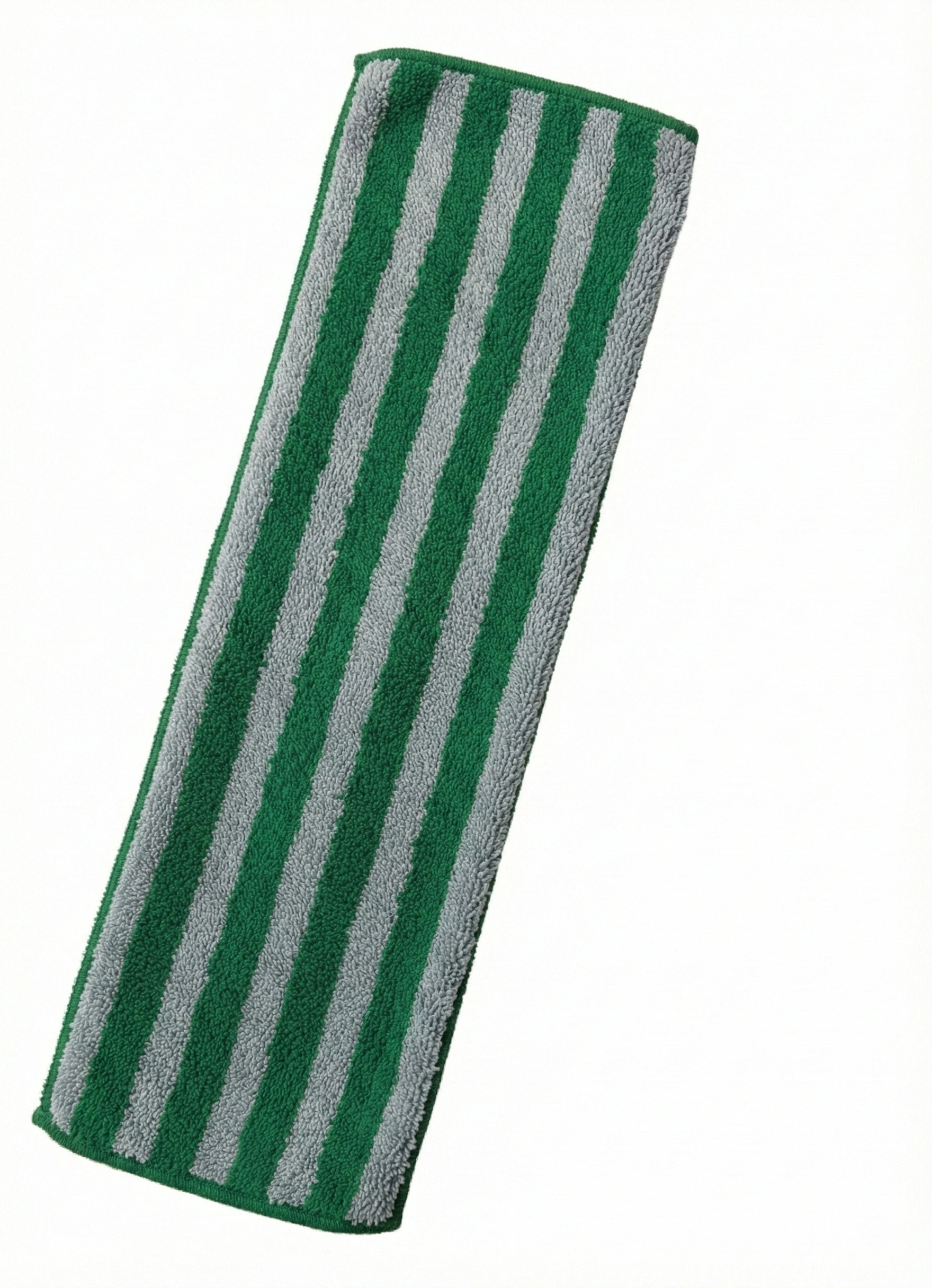
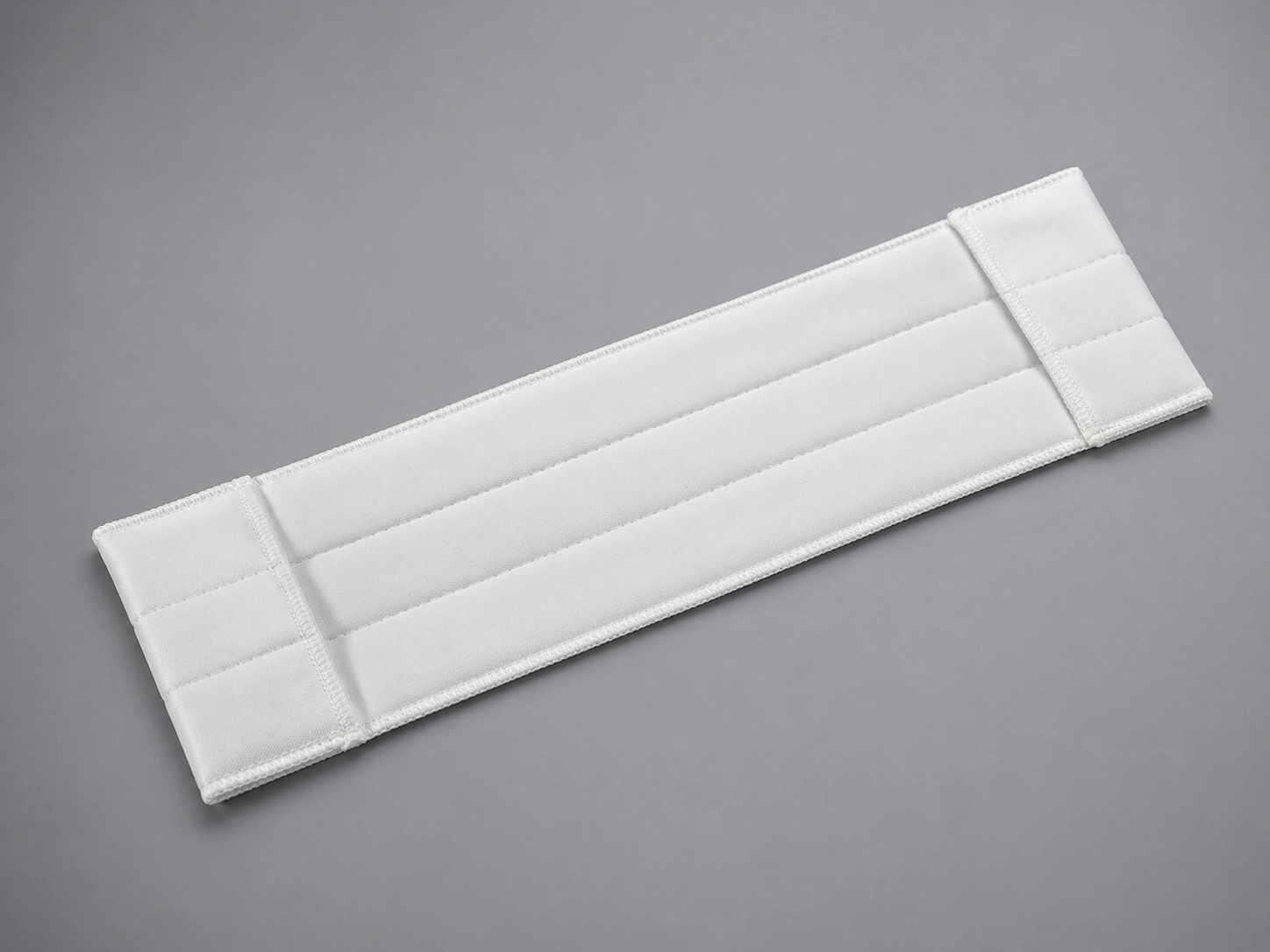
- Pocket-style: The frame slides into a fabric pocket sewn into the back of the mop head. Most common in cleanroom applications. Requires precise width matching between frame and pocket.
- Velcro / hook-and-loop: The head attaches to the frame via hook-and-loop strips. Faster changeover than pocket-style but the Velcro itself can become a particle source as it degrades over repeated use.
- Clip / mechanical fastener: The head clips onto the frame via plastic or metal fasteners. Fastest changeover but introduces additional mechanical components that can fail or generate particles.
Common failure mode: A pocket-style head that is slightly too wide for the frame will bunch and slip during the push stroke, creating uneven cleaning pressure and exposing the frame edge directly to the cleaning surface — a contamination risk if the frame edge is not smooth or if it scratches the floor.
System Integration Checklist
Frame-to-System Compatibility Verification (8 Points)
Summary: Frame Material and Articulation Decision Framework
Sequential Frame Selection Logic
- Does the frame require autoclave sterilization? If yes, eliminate aluminum and composite. Choose SS 304 or SS 316.
- Review the disinfection chemical list. If it includes chlorine-based agents, VHP, or peracetic acid, select SS 316 for maximum corrosion margin. If it is quats and IPA only, SS 304 is sufficient.
- Identify all surfaces to be cleaned. If walls and ceilings are included, a hinged frame is required. If floor only, choose fixed (open areas) or swivel (equipment-dense areas).
- Verify head compatibility. Ensure frame width matches head pocket width. Confirm attachment mechanism (pocket, Velcro, clip) is consistent with operational preference.
- Verify handle compatibility. Ensure frame connector type matches handle connector type.
- Consider total system weight. For wall/ceiling applications, prioritize lower frame weight within the required material grade.
- Request material certification. Obtain mill test report or material certificate from the frame supplier. File with cleaning tool qualification documentation.
Frame selection ultimately reduces to three questions: What chemicals will it touch? Will it go through an autoclave? What surfaces does it need to reach? Answer these, and the material + articulation decision follows logically from the answers. Everything else — cost negotiation, supplier comparison, inventory planning — becomes an operational discussion rather than an unresolved technical specification.
Ofte stillede spørgsmål
Can an SS 304 frame be used in a Grade A cleanroom?
It depends on the disinfection chemistry and sterilization requirements. SS 304 is structurally acceptable for Grade A environments, but if the facility’s sporicidal program includes peracetic acid or concentrated chlorine-based agents, SS 316 is preferred for its superior pitting and crevice corrosion resistance. Additionally, if the frame will undergo frequent autoclave sterilization at 134 degrees C, SS 304 is capable but SS 316 provides additional margin against chloride stress-corrosion cracking if any chloride residues remain on the frame surface. A facility risk assessment should drive the material grade decision, not a blanket grade-to-material mapping.
What is the most common mistake in cleanroom mop frame procurement?
Ordering frames and heads from different suppliers without verifying dimensional compatibility. A frame that is 42 cm wide does not automatically fit a head pocket marked “40-45 cm” — the pocket’s actual internal dimension in millimeters must match the frame’s external dimension. The second most common mistake is specifying aluminum frames for facilities that use chlorine-based disinfectants, which leads to rapid frame corrosion and particle generation.
How often should cleanroom mop frames be replaced?
There is no fixed replacement interval. SS frames should be replaced when visual inspection reveals any of the following: (a) surface pitting or crevice corrosion that cannot be cleaned, (b) bent or warped frame geometry affecting pad contact uniformity, (c) connector joint looseness or play that cannot be tightened to specification, or (d) weld failure at any frame joint. A practical inspection protocol is to check all frames during the monthly cleaning tool inventory review and flag any that show visible degradation for replacement. Aluminum and composite frames have shorter service lives due to lower mechanical durability and should be inspected more frequently.
Do I need different frames for floor cleaning and wall cleaning?
Typically yes. Floor-only frames are usually fixed or swivel articulation and optimized for horizontal pressure transfer. Wall and ceiling cleaning requires a hinged frame that can pivot in the vertical plane to maintain pad contact against vertical surfaces. Using a fixed floor frame for wall cleaning is ineffective because the frame cannot angle itself to the wall surface. Most GMP facilities maintain separate frame inventories for floor and wall/ceiling cleaning rotations.
What frame surface finish is recommended for ISO 5 / Grade A areas?
Electropolished stainless steel provides the smoothest surface finish, minimizing particle adhesion and making the frame easier to wipe down during cleaning tool disinfection. A surface roughness of Ra less than or equal to 0.8 micrometers (32 micro-inches) is a commonly referenced target for Grade A/ISO 5 applications. Brushed or mill finishes are acceptable for Grade C/D areas where surface finish requirements are less stringent.
Can I use the same frame with different mop head weights (40g, 55g, 65g)?
Yes, provided the frame width matches the head pocket width. Mop head weight (40g, 55g, 65g) affects the pad’s absorbency and thickness but does not typically change the pocket dimensions for a given width. The same frame can be used with different-weight heads of the same width. However, verify that a thicker 65g head does not create excessive friction or bunching inside the frame, which can occur if the pocket tolerance was designed for a thinner pad.
What documentation should I request from a frame supplier?
At minimum, request: (a) material grade certificate (mill test report or equivalent confirming the alloy grade, e.g., SS 304 or SS 316), (b) frame dimension drawing with tolerances (width, length, thickness in mm), (c) surface finish specification (Ra value), (d) connector type specification, and (e) weight specification. For facilities with autoclave requirements, additionally request confirmation that the frame material and connector assembly are rated for the specified autoclave temperature and cycle count. This documentation supports cleaning tool qualification in GMP environments.
Are swivel frames more prone to mechanical failure than fixed frames?
Yes, by design. A swivel frame introduces a rotating joint — a mechanical component that fixed frames do not have. This joint is a wear point. Over time, the swivel mechanism can develop play (looseness), produce metallic particles from friction, or seize if not maintained. The trade-off is that swivel frames provide navigability around equipment that fixed frames cannot match. The risk is managed through (a) selecting frames with sealed or low-particle-generation swivel bearing designs, (b) including swivel joint inspection in routine cleaning tool maintenance, and (c) replacing frames whose swivel joints show measurable wear rather than waiting for failure.
Need a Cleanroom Mop System with the Right Frame Configuration?
Frame material and articulation type directly affect your cleaning program’s effectiveness, chemical compatibility, and sterilization throughput. Whether you are specifying SS 316 frames for a Grade A aseptic filling suite or comparing SS 304 vs aluminum for a Grade D support area, MIDPOSI can help you match frame, head, and handle components into a validated, compatible system.
Frame material certification and dimensional specifications available upon request. Built for controlled cleaning programs in GMP, ISO, and contamination-sensitive facilities.
Disclaimer: The chemical compatibility information in this article is provided as general engineering guidance. Material compatibility depends on chemical concentration, temperature, contact duration, and the specific alloy or polymer grade. Always verify frame material compatibility against the manufacturer’s chemical resistance data sheet and your facility’s specific disinfection SOP before procurement. This article does not constitute formal material qualification or validation advice.