A flat mop is a single cleaning tool. A cleanroom mop system is an integrated assembly of head, frame, handle, and bucket/wringer designed to work as a unified cleaning platform. This comparison is not about brands or materials—it is about product format architecture and the operational, compliance, and procurement implications of choosing one over the other.
The choice between a renrumsmoppesystem and a standalone flat mop is fundamentally a decision about integration versus independence. An integrated mop system locks in component compatibility, simplifies SOP documentation, and reduces procurement fragmentation—at the cost of higher initial specification effort. A standalone flat mop offers purchasing simplicity and replacement flexibility—at the cost of compatibility risk, documentation gaps, and higher operational coordination burden when components are sourced independently.
| Decision Dimension | Integrated Mop System | Standalone Flat Mop |
|---|---|---|
| Component Compatibility | Guaranteed — all components designed to work together | User must verify and manage |
| Cross-Contamination Control | System-level design supports zone segregation | Depends on user protocol discipline |
| SOP Documentation | Single-system specification = cleaner documentation | Multiple part numbers per cleaning line item |
| Procurement Complexity | One supplier, one system specification | Potentially multiple suppliers, multiple SKUs |
| Replacement Flexibility | Locked to system family | Each component independently replaceable |
| Initial Setup Effort | Higher — system selection and trial required | Lower — buy and deploy |
| Audit Trail Clarity | One system document set | Fragmented across component sources |
Det korte svar: If your facility operates in GMP Grade A/B or ISO 5–6 environments and values documentation simplicity and component compatibility, an integrated mop system typically provides stronger operational control. If your facility operates in Grade C/D or ISO 7–8 environments with simpler cleaning protocols and you prioritize initial purchasing simplicity, a standalone flat mop may suffice—provided you have the internal processes to manage component compatibility and documentation.
A cleanroom mop system is the integrated assembly of a cleanroom-grade mop head, a compatible frame, a purpose-designed handle, and (for wet cleaning protocols) a bucket and wringer system. Unlike a standalone flat mop—which is essentially a mop head that the user pairs with whatever frame and handle are available—the system approach treats cleaning as an end-to-end tooling platform where each component is specified, tested, and documented to work with the others.

The key distinction is that in a system, component compatibility is designed in, not improvised after purchase. The mop head pocket dimensions match the frame width. The frame attachment mechanism is engineered for the specific handle connector. The bucket and wringer dimensions accommodate the mop head size and frame geometry. When any single component is changed, the system-level performance can be affected—which is why the system concept matters for controlled-environment cleaning where repeatability and documentation are essential.
For a deeper definition of what constitutes a cleanroom mop system, including component-by-component breakdown and GMP relevance, see our renrumsmoppesystem oversigt. For the flat mop format specifically, see our cleanroom flat mop system overview.
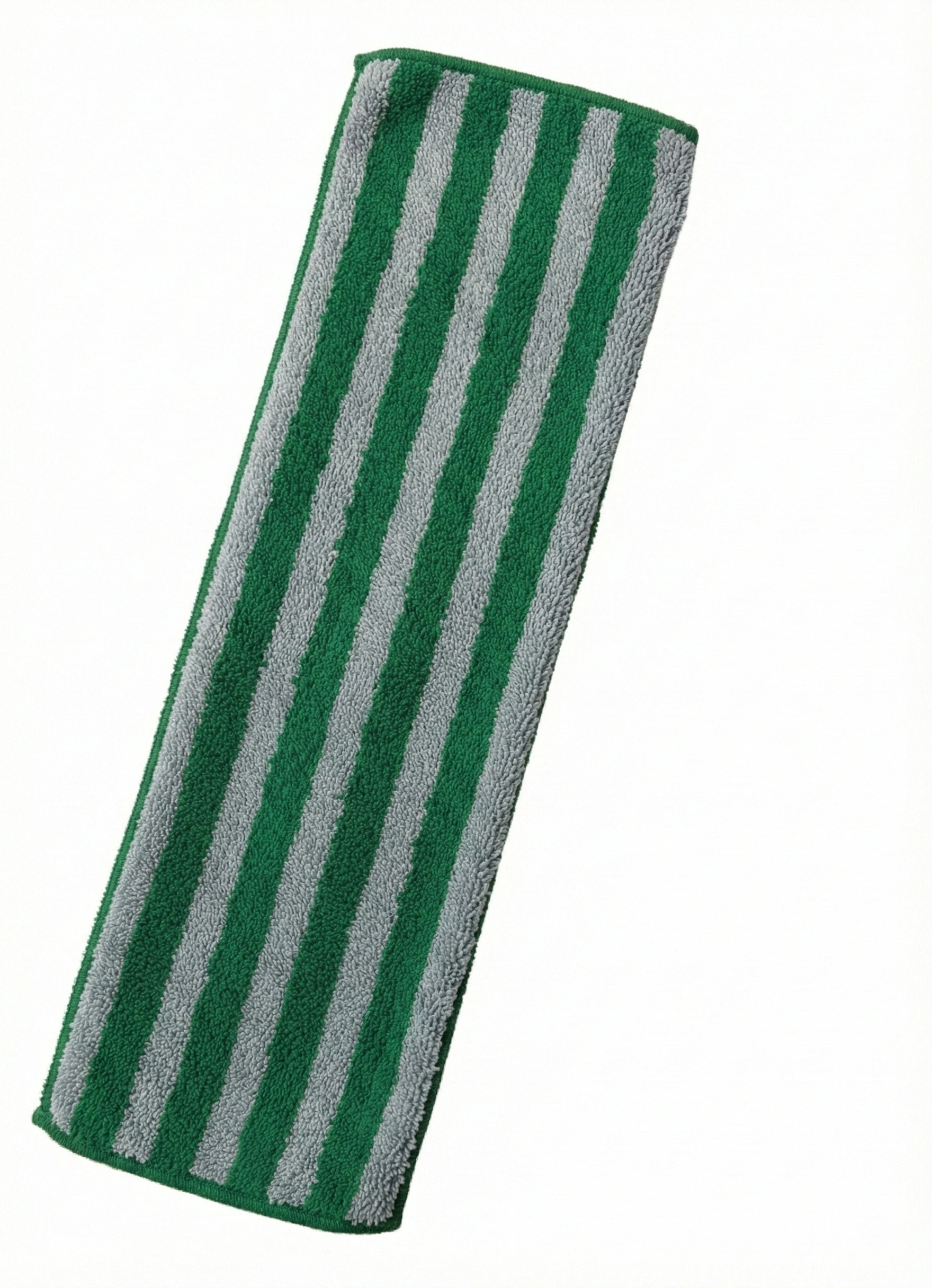
A flat mop, in the cleanroom context, is a rectangular mop head designed to attach to a flat frame and handle. It is the working surface that contacts the floor, wall, or ceiling during cleaning. The flat mop head is typically a textile pad—polyester knit or microfiber—with a pocket or strap system for mounting to a frame.
When purchased as a standalone product (not as part of a system), the flat mop arrives as a mop head only. The buyer is responsible for sourcing the frame, handle, and bucket/wringer separately—from the same supplier or from different suppliers. This gives the buyer maximum freedom but also maximum responsibility for compatibility verification.
This is not to say standalone flat mops are inherently problematic. Many facilities use standalone flat mops effectively. The point is that the standalone approach shifts compatibility verification and documentation assembly from the supplier to the buyer. For some facilities, this additional coordination burden is manageable. For others, particularly those operating under regulatory scrutiny, the system approach removes variables that can complicate audits and SOP management.
The following five dimensions represent the areas where the choice between an integrated system and standalone flat mops creates operational differences. Each dimension is weighted differently depending on your facility type, regulatory environment, and internal capability.
The mop head pocket dimensions, frame width and mounting mechanism, handle connector type, and bucket/wringer dimensions are engineered as a matched set. The supplier validates that all components work together at the dimensional and functional level before the system is specified. When it is time to reorder, the buyer references one system specification rather than multiple individual part numbers.
This matters because incompatibility is invisible until it causes problems: a mop head that slips off the frame mid-cleaning, a handle that does not lock securely to the frame, or a bucket that is too narrow for the frame to fit into the wringer mechanism. In a cleanroom context, these failures represent contamination events as well as productivity losses.
When components are purchased independently, the buyer becomes the compatibility manager. A flat mop head from one source must be verified to fit the frame from another source, which must in turn fit the handle from a third source. Dimensional tolerances, material compatibilities, and attachment mechanisms must all be cross-checked.
In practice, procurement teams often default to a single supplier for all components even when buying flat mops, which effectively creates a de facto system. The difference is that with standalone flat mops, the compatibility verification is the buyer’s responsibility, not the supplier’s guarantee.
Når denne dimension er afgørende: Facilities with limited in-house technical evaluation capability, or those where cleaning tool failures carry high contamination risk, benefit from the system approach’s built-in compatibility guarantee. See cleanroom mop head types and selection for understanding how head design interacts with frame compatibility.
An integrated system enables system-level zone segregation. A facility can specify one complete system for Grade A/B zones, a different system (or color-coded variant of the same system) for Grade C zones, and yet another for Grade D support areas. Because each system is a matched set, there is no risk that a frame from one zone inadvertently carries a mop head from another zone’s system.
System-level color-coding—where the mop head, frame, and handle are all color-matched—provides a visual cross-contamination control layer that is harder to achieve with independently sourced components from multiple suppliers.
Zone segregation with standalone components relies entirely on operating procedure discipline. A flat mop head purchased for a Grade A zone can physically fit onto a frame used in a Grade C zone if the operator does not follow zone-specific component storage and usage procedures. Color-coding can be implemented with flat mops, but it requires the facility to source color-matched components from potentially multiple suppliers, making procurement more complex.
Cross-contamination risk in a standalone flat mop approach is managed by SOP, not by system design. This is achievable but requires stronger procedural controls and operator training.
Når denne dimension er afgørende: Multi-product pharmaceutical facilities, operations handling potent compounds, and facilities where zone-to-zone contamination is a primary regulatory concern benefit from the system approach’s built-in segregation capability.
When an entire mop system is specified as a single unit, the cleaning SOP references one system identifier, not four to six individual part numbers. This simplifies SOP authorship, operator training, and audit review. An auditor reviewing a cleaning SOP sees: “Use Mop System X for Zone Y”—clear, traceable, and linked to a single set of validation documents.
If the system specification changes (e.g., a new mop head material is adopted), the SOP update references the system change—one update, one document revision, one training update.
A standalone flat mop approach typically results in a cleaning SOP that lists separate part numbers for the mop head, frame, handle, and bucket. If these come from different suppliers, the SOP must also reference multiple supplier document sets. When any single component changes, the SOP must be updated. When multiple components change at different times, SOP revision tracking becomes more complex.
This added complexity is manageable but represents incremental effort in SOP management, operator training, and audit preparation.
Når denne dimension er afgørende: Facilities with frequent SOP review cycles, lean QA teams, or regulatory environments where documentation completeness is heavily scrutinized will find the system approach’s documentation simplicity a meaningful operational advantage.
Procurement operates at the system level. The buyer qualifies one supplier for the complete system. Reordering is a single action referencing the system specification. Inventory management tracks mop heads as consumables within a known system context.
The trade-off is supplier lock-in. The system components are designed to work together, and switching any component supplier may require re-validating the entire system. This reduces supplier flexibility in exchange for procurement simplicity.
Procurement can optimize each component independently. Mop heads from Supplier A, frames from Supplier B, handles from Supplier C—each selected on its own merits. This provides maximum supplier flexibility and the ability to switch any component supplier without affecting others.
The trade-off is procurement complexity. Each component requires its own supplier qualification, its own PO process, and its own inventory tracking. An audit that touches cleaning tools may need to review documentation from multiple suppliers rather than one.
Når denne dimension er afgørende: Facilities with lean procurement teams or those seeking to consolidate supplier relationships for audit efficiency typically prefer the system approach. Facilities with established multi-vendor procurement processes and the internal capability to manage component compatibility may find standalone flat mops workable.
The system approach often carries a higher per-unit component cost at the specification stage but a lower operational overhead cost over time. The cost advantage emerges from:
These operational savings are real but often unquantified in a simple purchase-price comparison.
Standalone flat mops may have a lower per-unit purchase price because the buyer can source each component from the most cost-competitive supplier. Mop heads—the highest-volume consumable—can be priced competitively when they are not bundled into a system specification.
The hidden cost components include: compatibility verification labor, fragmented documentation management, increased SOP revision frequency when components change independently, and the operational cost of a component mismatch event. These costs are real but often absorbed into general operational overhead and not attributed to the cleaning tool procurement model.
Når denne dimension er afgørende: A pure purchase-price comparison favors standalone flat mops. A total-cost-of-ownership comparison that includes documentation, compatibility management, and mismatch risk often favors the system approach—particularly in regulated environments where documentation and audit-readiness carry real operational cost.
| Dimension | Integrated Mop System | Standalone Flat Mop |
|---|---|---|
| Component Compatibility | Guaranteed by design | User-managed |
| Cross-Contamination Control | System-level zone segregation | SOP-dependent |
| SOP Documentation | One system reference | Multiple part numbers |
| Procurement Complexity | Single-source simplicity | Multi-source flexibility |
| Samlede ejeromkostninger | Lower operational overhead | Lavere stykpris |
The choice between an integrated mop system and standalone flat mops is not made in a vacuum—it is made in the context of your facility’s cleanroom classification, regulatory framework, and cleaning protocol requirements. The following recommendations are structured by GMP Grade and ISO Class.
| Facility Grade | ISO klasse | Recommended Format | Rationale |
|---|---|---|---|
| GMP Grade A | ISO 5 | Integrated System | Aseptic filling zones require maximum documentation control, minimum operator intervention variability, and validated component compatibility. The system approach aligns with Annex 1 expectations for documented, integrated contamination control strategies. |
| GMP Grade B | ISO 5 (at rest) / ISO 7 (in operation) | Integrated System | Background to Grade A zones. Cleaning tools used in Grade B directly influence Grade A environment risk. System-level documentation and compatibility reduce variables that could affect Grade A zone integrity. |
| GMP Grade C | ISO 7 (at rest) / ISO 8 (in operation) | System Preferred; Flat Mop Evaluable | Less stringent contamination control requirements. Standalone flat mops can be used if the facility has established SOPs and compatibility verification processes. The system approach still offers documentation advantages but is not a strict requirement. |
| GMP Grade D | ISO 8 (at rest) | Flat Mop Evaluable; System Optional | Standalone flat mops are widely used in Grade D environments where cleaning tool compatibility risk is lower and procurement simplicity may be prioritized. The system approach is not required but may still be chosen for consistency with higher-grade zones. |
These recommendations are directional, not prescriptive. A facility operating exclusively in Grade C/D with well-established SOPs and internal technical evaluation capability can use standalone flat mops effectively. Conversely, a facility operating across Grade A through D may standardize on an integrated system for all zones to maintain documentation consistency. For facility-specific guidance on GMP cleaning tool selection, see our article on cleanroom mop for GMP facility.
Not every facility needs to commit exclusively to one format across all zones. A hybrid approach—integrated system for critical zones, standalone flat mops for support zones—is a practical model used by many multi-grade facilities.
Grade A/B, aseptic filling, sterile manufacturing areas where documentation completeness and component compatibility are non-negotiable. Use an integrated mop system with system-level specification, one supplier, and one document set.
Grade C/D, non-classified support areas, warehouse ante-rooms, and gowning areas where cleaning frequency is high, protocols are less stringent, and procurement simplicity is valued. Use standalone flat mops.
The following five mistakes are patterns observed when procurement and facility teams evaluate these two product formats. Recognizing them early helps avoid decisions that look reasonable on paper but create operational friction after implementation.
Standalone flat mops typically have a lower per-unit purchase price. But a unit-cost-only comparison ignores SOP management labor, compatibility verification effort, audit preparation time, and the cost of a component mismatch failure. These operational costs are real and should be part of the format selection decision.
Not all flat mops fit all frames. Pocket dimensions, strap configurations, and material thicknesses vary across manufacturers. Assuming any flat mop will work with any frame is the most common source of component mismatch failures in facilities using a standalone flat mop approach.
Many facilities operate across multiple cleanroom grades. Applying one format decision to all zones—either “all system” or “all flat mop”—can result in over-specifying support zones or under-specifying critical zones.
The term “system” does not equate to “expensive” and “flat mop” does not equate to “cheap.” A well-specified cleanroom flat mop from a qualified supplier using validated materials can cost more than a basic integrated system from a general supplier. The format decision should be based on operational fit, not price tier assumptions.
When components come from multiple suppliers, the audit documentation package is fragmented across those suppliers. During an audit, procurement records referencing three or four different suppliers for cleaning tool components require more time to assemble and present coherently than a single-supplier system specification.
Choosing between an integrated system and standalone flat mops is the format-level decision. Once this decision is made, several other selection dimensions remain. These related decisions are covered in separate articles designed to guide the next stage of your evaluation:
Once you have decided on the system approach, this guide walks through the full evaluation framework—material selection, sterility options, head weight, and supplier qualification.
hvordan man vælger et renrumsmoppesystem →If you are at an earlier stage of the buying journey, understanding the fundamental differences between cleanroom-grade and regular mops is essential context for any format decision.
cleanroom mop vs regular mop differences →A grade-by-grade selection framework covering material, sterility, and documentation requirements for GMP Grade A/B/C/D facilities.
cleanroom mop for GMP facility →A flat mop is a single cleaning tool–a mop head that attaches to a frame. A cleanroom mop system is an integrated assembly of mop head, frame, handle, and bucket/wringer where all components are specified, tested, and documented to work together as a unified cleaning platform. The system approach guarantees component compatibility; the standalone flat mop approach requires the buyer to manage compatibility.
Not in every case. For GMP Grade A/B and ISO 5-6 cleanrooms with strict documentation requirements, the integrated system approach typically provides stronger operational control and simpler audit preparation. For Grade C/D or ISO 7-8 environments with high cleaning frequency and less stringent documentation requirements, standalone flat mops can be a practical choice if the facility has established component compatibility verification processes.
Technically yes, but this introduces compatibility risk. The mop head pocket dimensions, strap configuration, and material thickness must be verified against the frame dimensions and attachment mechanism. In a cleanroom context, a component mismatch that causes the mop head to detach during cleaning is a contamination event, not just an inconvenience. If using multi-supplier components, perform dimensional compatibility verification and document the results before deploying the combination in production cleaning.
On a per-unit purchase price basis, standalone flat mops typically cost less. However, the integrated system approach often has a lower total cost of ownership when operational factors are included: reduced SOP management labor, lower compatibility verification effort, faster audit preparation, and avoidance of component mismatch failures. For a complete cost picture, include these operational costs in the comparison, not just the invoice price.
An integrated system typically means the components are sourced from a single supplier, which does create a degree of supplier dependency. However, many suppliers offer systems with modular component options (different head weights, frame materials, handle lengths) within the same system family. If supplier flexibility is a priority, the standalone flat mop approach provides more independence but requires more internal management of compatibility and documentation.
An upgrade in cleanroom classification is an appropriate trigger to re-evaluate your cleaning tool format. If moving from Grade D to Grade C, standalone flat mops may remain workable if you strengthen your SOPs and documentation practices. If moving to Grade B, the integrated system approach becomes strongly recommended due to the increased documentation and contamination control expectations. A phased transition–system first for the new higher-grade zones, standalone flat mops retained for existing lower-grade zones–is a common approach.
With an integrated system, your cleaning tool documentation references one supplier, one specification, and one set of validation documents. With standalone flat mops sourced from multiple suppliers, an auditor may request documentation from each component supplier. The system approach generally results in faster, cleaner audit preparation because the documentation is consolidated by design. If using standalone flat mops, prepare a consolidated documentation binder that centralizes all supplier certificates into a single audit-ready reference.
Yes. A hybrid approach is common in multi-grade facilities. Use an integrated system for critical zones (Grade A/B, ISO 5-6) where documentation and compatibility requirements are highest, and standalone flat mops for support zones (Grade C/D, ISO 7-8) where protocols are less stringent. The key is clear SOP documentation that distinguishes which cleaning tools are used in which zones and why different formats were chosen.
Whether you are comparing product formats, upgrading from standalone flat mops, or specifying a new cleanroom cleaning platform, MIDPOSI’s White Cleanroom Mop Series offers integrated systems with documented component compatibility, material certification packages, and format options designed for GMP and ISO cleanroom operations.
System specifications backed by material certificates, sterility documentation, and batch traceability records for your cleanroom qualification process.