A structured decision framework for determining when each cleanroom zone in your facility should specify sterile mops and when non-sterile options are functionally adequate and cost-appropriate. Covers GMP grade requirements, Annex 1 risk assessment, product-contact proximity, transfer path considerations, and the cost-validity tradeoffs that inform a defensible procurement specification.
How this article is different: This is a decision framework — when to choose sterile vs non-sterile. It is not a general definition of sterile mops, and not a deep dive into aseptic transfer protocols. For those topics, see the related articles linked in Section 8.

The sterile-vs-non-sterile mop decision is not a single facility-wide answer. It is zone-stratified. The following matrix provides a rapid-reference overview of how the sterility recommendation shifts across common cleanroom scenarios. Each row represents a general evaluation starting point, not a universal regulatory mandate. Facility-specific risk assessments, product-contact proximity, and cleaning validation data should inform final specifications.
| Cleanroom Situation | Henstilling | Primary Rationale |
|---|---|---|
| Grade A / ISO 5 aseptic filling zone | Steril | Product-contact risk is highest; sterility of all consumables entering the aseptic core is a baseline expectation under EU GMP Annex 1. Non-sterile introduction is not considered compliant in this zone. |
| Grade B background to Grade A | Sterile (default) | Grade B serves as the protective background for Grade A; sterility of cleaning tools supports environmental control. Non-sterile may be evaluated for standalone Grade B only under a formal, documented risk assessment with QA approval. |
| Grade C / ISO 7 solution preparation | Non-Sterile | Non-sterile, particle-controlled mops are typically acceptable. Sterile specification for purely Grade C zones adds cost without commensurate contamination-control benefit. Focus instead on material quality and zone segregation. |
| Grade D / ISO 8 material staging | Non-Sterile | Sterile mops in Grade D are typically a cost-inefficient over-specification. Airborne particle limits are significantly higher than aseptic zones. Non-sterile mops with appropriate material specifications and color-coded zone segregation are the standard recommendation. |
| Multi-grade facility with shared cleaning team | Mixed (zone-stratified) | A single sterility specification for all zones is neither cost-efficient nor operationally optimal. A grade-stratified approach — sterile for Grade A/B, non-sterile for Grade C/D — is the recommended practice. The operational complexity of managing two specifications is generally outweighed by the cost and compliance benefits of matching sterility to actual zone requirements. |
Ansvarsfraskrivelse: These are general evaluation guidelines based on common industry practice and EU GMP Annex 1 / ISO 14644 framework principles, not regulatory mandates. Specific facility risk assessments, cleaning validation protocols, product-contact proximity, and applicable regional regulatory requirements should drive final mop sterility specifications.
The sterile vs non-sterile cleanroom mop decision is not based on a single factor. Five interconnected criteria typically determine whether a facility should specify sterile mops for a given zone. Understanding the weight of each criterion — and how they interact — is the foundation of a defensible procurement specification. A renrumsmoppesystem oversigt defines the components; this section defines which sterility specification applies to them per zone.
What it determines: The baseline sterility expectation. Grade A / ISO 5 zones carry a clear regulatory expectation that all consumables entering the zone are terminally sterilized and introduced via validated aseptic transfer. Grade C / ISO 7 and Grade D / ISO 8 zones do not carry the same expectation for cleaning tools. However, classification alone is not the sole determinant — a Grade B zone physically connected to Grade A operations requires a different analysis than a standalone Grade B research lab, even though both carry the same GMP classification.
What it determines: The regulatory context that makes sterility a compliance requirement rather than an optional quality choice. EU GMP Annex 1 requires that “disinfectants and detergents used in Grade A and Grade B areas should be sterile prior to use.” While the text primarily addresses liquids, the contamination control principle extends to cleaning tools entering those zones: a non-sterile mop head saturated with sterile disinfectant creates a contamination control gap. Regulatory authorities reviewing cleaning programs in aseptic manufacturing facilities will expect to see a rationale for why sterility decisions were made at each zone boundary. A formally undocumented decision is itself a potential audit finding.
What it determines: The acceptable sterility threshold based on how close the cleaned surface is to the product. A floor cleaned in a Grade A aseptic filling suite is closer to open product than a floor cleaned in a Grade D material warehouse — even if both are floors. The proximity principle is: the closer a mop’s cleaning surface gets to a product-contact surface, the higher the sterility standard should be. This criterion is particularly relevant in borderline cases, such as Grade B anterooms where the floor is physically adjacent to but separated from a Grade A filling line by an airflow barrier. In such cases, the risk assessment should consider whether a non-sterile mop on the Grade B side creates an unacceptable contamination pathway.
What it determines: Whether the sterility chain can be maintained from packaging through to point of use. A sterile mop spec is only as valid as the transfer path that delivers it into the cleanroom. If a facility specifies terminally sterilized, double-bagged mops but does not have a validated staged aseptic transfer protocol (outer bag removal at zone boundary, inner bag removal inside the receiving zone under aseptic conditions), the sterility specification is undermined at the point of introduction. This criterion also works in reverse: if the transfer path through a Grade C zone to a Grade C storage area does not include any stage where sterility could be maintained or verified, specifying sterile mops for that zone introduces cost without any achievable sterility benefit.
What it determines: Whether the incremental cost of sterile specification is justified by measurable contamination-control benefit in the specific zone. Sterile mops carry a cost premium over non-sterile equivalents due to the additional sterilization process, validated packaging, sterility testing per batch, and the documentation package that accompanies each sterile batch. If the zone’s regulatory framework does not require sterility and the product-contact risk is low, the sterile premium generates minimal contamination-control return. This is examined in detail in Section 4.
This section translates the five criteria above into zone-specific sterility recommendations. The framework is structured around the four GMP cleanroom grades because sterility expectation correlates most strongly with cleanroom classification. For a full specification matrix covering material, weight, and packaging per grade — beyond sterility alone — refer to the GMP vejledning til valg af renrumsmoppekvalitet. For the specific aseptic transfer protocols that maintain sterility during introduction, see the sterile cleanroom mop aseptic transfer and packaging guide.
Decision: Sterile. There is no credible non-sterile argument for Grade A aseptic processing zones.
Rationale: Grade A is the zone where open product, sterile components, and aseptic connections are directly exposed to the environment. EU GMP Annex 1 defines Grade A as “the local zone for high-risk operations.” Every consumable that enters this zone — including cleaning tools — is expected to be terminally sterilized and introduced through a validated aseptic transfer process. A non-sterile mop head entering Grade A, even saturated with sterile disinfectant, represents an uncontrolled contamination source that is difficult to defend during regulatory inspection.
Sterility specification should include:
MIDPOSI options for this zone: sterile cleanroom mop options include White Mop 40g, 55g, and 65g in gamma-irradiated sterile configurations with double-bagged packaging for staged aseptic transfer.
Decision: Sterile is the default recommendation. Non-sterile may be evaluated under specific conditions.
Rationale: Grade B serves as the background environment for Grade A aseptic operations. Its at-rest particle limits mirror Grade A (≤3,520 particles/m³ at ≥0.5 µm). While Annex 1 does not explicitly mandate sterile cleaning tools for Grade B in the same way it addresses disinfectants, the contamination control principle extends naturally: the background that protects the aseptic core should not itself be a contamination source. A non-sterile mop used in Grade B creates a microbiology load in the immediate vicinity of the aseptic boundary.
Exception framework — Non-sterile mops may be evaluated for Grade B only when ALL three conditions are satisfied:
In practice, many facilities default to sterile mops for all Grade B zones because the cost of the sterile premium is lower than the cost of documenting and defending a non-sterile exception during a regulatory audit. If the risk assessment, monitoring data, and QA approval are already in place, a non-sterile specification for a standalone Grade B zone can be both compliant and cost-efficient. If any of the three conditions is uncertain, sterile remains the recommended path.
Decision: Non-sterile is the standard recommendation. Sterile may be used if a facility adopts a uniform sterile program.
Rationale: Grade C zones — solution preparation, component washing, equipment assembly areas — do not carry a sterility requirement for cleaning tools. The airborne particle limit for Grade C at rest is 352,000 particles/m³ at ≥0.5 µm (100x higher than Grade A), and the operational limit is 3,520,000 particles/m³. At these thresholds, the contamination-control value of a sterile mop is marginal relative to its cost premium. The more important specification focus for Grade C is: (1) particle-controlled material (polyester or microfiber with appropriate edge sealing), (2) zone segregation to prevent cross-zone contamination, and (3) compatibility with the facility’s disinfectant formulary. A well-designed non-sterile mop program for Grade C delivers the contamination-control outcomes that matter at this classification level.
Sterile exception: Some facilities choose to extend their sterile mop specification from Grade A/B into Grade C for operational simplicity — one mop specification across all classified zones, one supplier, one validation package. This is a valid operational choice, not a regulatory requirement. The decision should be made with full awareness of the cost differential and with documentation that the Grade C zone does not require sterile mops from a regulatory standpoint.
Decision: Non-sterile. Specifying sterile mops for Grade D is typically a cost-inefficient over-specification.
Rationale: Grade D zones handle the least critical stages of sterile product manufacturing: material staging, equipment cleaning, packaging. Airborne particle limits at rest for Grade D are 3,520,000 particles/m³ at ≥0.5 µm — 1,000x higher than Grade A. The contamination-control return on a sterile mop in this environment is negligible. A non-sterile mop with appropriate material quality, edge sealing, and zone-visibility features (color-coding, zone labeling) is fully adequate.
Common pitfalls specific to Grade D: The most frequent error in Grade D zones is not under-specification but over-specification — purchasing sterile mops for Grade D “because Grade A uses sterile mops” without asking whether the Grade D zone’s regulatory framework, product-contact risk, or environmental monitoring data justify the expense. A second common error is inadequate zone segregation between Grade D and higher-grade zones, where a mop used in Grade D is inadvertently taken into Grade C. This is a usage protocol and training issue, not a sterility specification issue. The mop itself does not need to be sterile; the facility’s system for preventing cross-zone movement needs to be robust.

The sterile-vs-non-sterile decision has an economic dimension that is separate from — but complementary to — the regulatory dimension. Sterile cleanroom mops carry a cost premium over their non-sterile equivalents. This premium reflects the cost of the sterilization process (typically gamma irradiation), validated sterile packaging, per-batch sterility testing, and the documentation package that accompanies each sterile production batch. For a broader discussion of sterile vs non-sterile mop characteristics, see the sterile vs non-sterile cleanroom mop overview page.
While exact pricing depends on order volume, product configuration, and supplier, the relative cost relationship can be described in terms of a percentage framework:
| Cost Layer | Non-Sterile Mop | Sterile Mop | Incremental Driver |
|---|---|---|---|
| Base product | Standard unit cost | Equivalent base product cost | Identical base material and construction; sterility does not change the mop head itself |
| Sterilization process | Not applicable | +Gamma irradiation per batch (fixed cost per cycle) | Gamma irradiation facility cost; the per-unit cost decreases with higher batch volume but never reaches zero |
| Emballage | Single-bag or bulk pack; standard clean packaging | Double-bagged; validated sterile barrier packaging | Additional bag layer, validated seal integrity, and packaging material qualification add material and process cost |
| Quality testing | Standard COA per production batch | COA + Certificate of Sterility per sterile batch + sterility testing | Sterility testing per batch (biological indicators, dose verification) adds a recurring quality control cost |
| Dokumentation | COA, material certification | COA + Sterility Certificate + batch traceability records + irradiation certificate | Additional documentation preparation, review, and archiving; largely a fixed per-batch cost |
| Logistics and storage | Standard warehousing; no shelf-life constraint tied to sterility | Sterile storage conditions; sterility expiry date monitoring; FIFO inventory management | Shelf-life management adds operational complexity; expired sterile product must be re-sterilized or discarded |
The sterile premium is clearly justified when the zone requires sterile cleaning tools as a regulatory or product-safety necessity — Grade A aseptic filling, and Grade B zones serving as background to Grade A operations. In these zones, the cost of a contamination event (batch rejection, regulatory finding, product recall, or patient-safety investigation) dwarfs the incremental cost of a sterile mop specification. This is a straightforward cost-of-failure calculation: the sterile premium is a fraction of the cost of defending a single environmental monitoring excursion that could be attributed to non-sterile cleaning tools.
The sterile premium is difficult to justify when the zone’s regulatory framework, product-contact risk, and environmental monitoring data do not support a sterility requirement. In Grade C and D zones specifically:
A grade-stratified sterility program — sterile for Grade A and connected Grade B, non-sterile for Grade C and D — typically represents the cost-optimal compliance position. The operational complexity of managing two sterility specifications (sterile inventory for the aseptic core, non-sterile inventory for support zones) is generally outweighed by the cost efficiency of not over-specifying the support zones. Facilities that choose a uniform sterile program should document that this is an operational choice and not a regulatory requirement — this documentation can be useful during procurement reviews and internal cost optimization audits.
The following decision tree translates the five criteria and zone-by-zone analysis into a structured, stepwise decision flow. Start at the top and follow the path that matches your facility’s zone profile.
Terminally sterilized (gamma, SAL 10-6), double-bagged, staged aseptic transfer, full documentation package including Certificate of Sterility per batch.
Same sterile specification as Grade A. Non-sterile exception only with formal QA-approved risk assessment, validated monitoring data, and documented zone independence.
Documented risk assessment, validated environmental monitoring, QA approval on file. Non-sterile with appropriate material specification may be used. Retain the risk assessment documentation for regulatory audits.
Particle-controlled, appropriately packaged non-sterile mops. Focus on material quality, edge sealing, zone segregation (color-coding), and disinfectant compatibility. Sterile option available if the facility chooses a uniform sterile program for operational simplicity — this is an operational choice, not a regulatory requirement.
For non-classified areas, standard non-sterile cleaning tools with appropriate industrial specifications are typically adequate. Facility-specific cleaning protocols should define the requirement.
IMPORTANT: This decision tree is a general guidance framework. It does not replace a formal facility-specific risk assessment, cleaning validation protocol, or regulatory review. Each facility should verify its specific sterility decisions against current applicable regulations and the facility’s environmental monitoring history. When in doubt between two paths, default to the more conservative sterility specification — the cost of over-specifying is financial; the cost of under-specifying can be regulatory and operational.
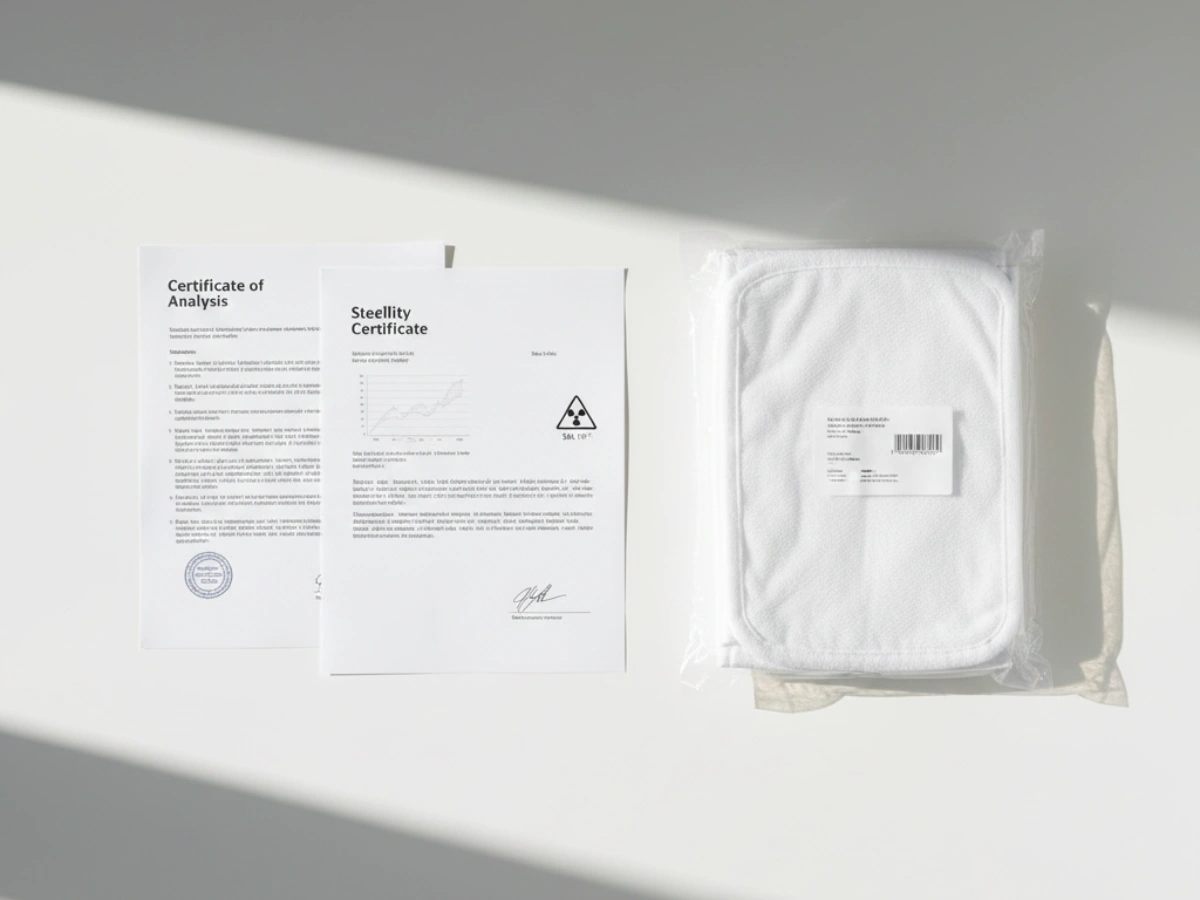
Choosing sterile over non-sterile mops changes the documentation package the facility should expect — and in many cases should require — from its supplier. The sterility specification adds specific document types that are not part of a non-sterile mop procurement. Understanding this documentation difference is important for two reasons: (1) it directly affects supplier qualification scope, and (2) it determines what the facility’s QA team will need to review and archive for each mop batch received.
| Dokumenttype | Non-Sterile Mop | Sterile Mop | Why the Difference Matters |
|---|---|---|---|
| Certificate of Analysis (COA) | Required | Required | Standard for both: confirms product meets stated physical specifications (weight, dimensions, material composition). Same expectation regardless of sterility. |
| Certificate of Sterility | Not applicable | Critical | Per-batch sterility assurance document with batch identifier, sterilization method, sterilization date, SAL. This is the primary document that auditors will request for sterile mop batches entering Grade A/B zones. Absence of this document for a product claimed as sterile is a critical finding. |
| Certificate of Conformance (CoC) | Optional / Often provided | Required | Confirms the product conforms to stated specifications. For sterile products, the CoC should reference the applicable sterility standard and the batch’s sterility certificate identifier. |
| Batch Traceability Records | Optional | Required | Linking the mop batch to raw material lots, production date, sterilization cycle date, and sterility test batch. Required for sterile products because a sterility failure must be traceable to the affected production batch for recall or investigation purposes. |
| Irradiation Certificate / Sterilization Process Record | Not applicable | Required | Documents the sterilization process parameters: gamma irradiation dose, dose mapping, and cycle validation. This is part of the evidence that the sterilization process was executed correctly for the specific batch. |
| Aseptic Transfer Protocol (facility-side) | Not applicable | Facility-generated | The supplier provides the sterile, double-bagged product. The facility is responsible for the documented, validated aseptic transfer protocol that introduces the sterile mop into the cleanroom. This protocol should be part of the facility’s cleaning SOP, not the supplier’s documentation package. During an audit, the inspector will expect to see both: the supplier’s sterility documentation AND the facility’s transfer protocol. |
| Endotoxin Test Data | Not typically applicable | Conditionally applicable | Required when sterile mops are used in aseptic processing of parenteral products where endotoxin limits are specified. Not required for all sterile mop applications. The facility should determine whether the product-contact pathway in its specific use case triggers endotoxin testing requirements. |
For a structured buyer checklist covering what documentation to request and how to review supplier submissions, refer to the cleanroom mop validation documents buyer checklist. For a detailed explanation of each document type including COA content and sterility certificate verification, see the cleanroom mop validation documents and COA guide.
Practical note for procurement teams: When a facility’s sterility decision transitions from non-sterile to sterile for a specific zone, the supplier documentation requirement expands from approximately 2-3 document types to 5-7 document types per batch. This has a direct impact on incoming QA review workload, batch release turnaround time, and documentation archive requirements. Facilities planning a transition from non-sterile to sterile mop specification should factor this documentation overhead into their QA resource planning.
The following five scenarios represent commonly observed errors in how facilities approach the sterile-vs-non-sterile mop decision. Each includes practical correction guidance.
The problem: A facility adopts one sterility specification — typically “all mops must be sterile” — and applies it uniformly from Grade A through Grade D without zone-level evaluation. This creates unnecessary cost in support zones where non-sterile mops with appropriate material specifications are functionally equivalent.
How to correct: Conduct a zone-by-zone sterility review using the decision tree in Section 5. For each zone, document the regulatory requirement, product-contact risk, and the cost-validity of the sterile premium. Where non-sterile is acceptable, implement the specification change with supplier notification, updated cleaning SOP, and operator training. The cost savings from this re-stratification are typically measurable within the first procurement cycle.
The problem: The purchase order specifies “sterile, gamma-irradiated, double-bagged mops” for Grade A, but the facility’s cleaning SOP does not include a validated staged aseptic transfer protocol. The outer bag is removed in a Grade D material airlock, the inner bag is opened in a Grade C corridor, and the supposedly sterile mop is carried into Grade A without any additional transfer steps. The sterility claim is broken well before the mop reaches its point of use.
How to correct: A sterile mop specification without a validated transfer protocol is a specification without a supporting system. Implement staged aseptic transfer: outer bag removed at the Grade B/C boundary, inner bag removed inside the receiving zone under aseptic conditions. Document the protocol in the cleaning SOP, train operators, and include transfer protocol verification in the facility’s internal audit program. The supplier’s sterility documentation proves the mop was sterile when it left the manufacturer; the facility’s transfer protocol proves it was still sterile when it was used.
The problem: A facility treats Grade B as “cleaner than Grade C” but does not apply sterile mops because “sterile is only for Grade A.” This misjudges the regulatory and contamination-control role of Grade B as the protective background for aseptic operations. A non-sterile mop in a Grade B zone during active Grade A aseptic filling creates a microbiology source physically adjacent to the aseptic boundary.
How to correct: Review the specific Grade B zone’s proximity to Grade A operations. If the Grade B zone is actively serving as background during aseptic filling, apply the same sterile mop specification as Grade A. Reserve non-sterile evaluation for standalone Grade B zones where the three conditions in Section 3 are fully satisfied. This is the single most impactful sterility decision adjustment for many facilities — upgrading Grade B mops from non-sterile to sterile eliminates a contamination-control gap at the boundary of the aseptic core.
The problem: A facility focuses exclusively on “sterile or non-sterile” as the mop specification decision, treating sterility as the single dimension of mop selection. Important specification variables — material composition (polyester vs microfiber), edge sealing method, mop head weight, packaging configuration, and zone color-coding — are not evaluated because the sterility question consumed the entire specification discussion.
How to correct: Sterility is one dimension of the mop specification, not the entire specification. A sterile mop with an unsuitable material for the facility’s disinfectant chemistry, or a non-sterile mop without sealed edges generating particle counts above the zone’s expectations, are both specification failures. The sterility decision should be made first (using this framework), then the remaining specification variables should be addressed: material, weight, edge sealing, packaging, and zone segregation features. See Section 8 for related topic resources covering these additional dimensions.
The problem: The facility’s QA team receives sterile mops with the appropriate supplier documentation (COA, Certificate of Sterility, etc.), but no internal document records WHY the facility chose sterile for Grade A/B and non-sterile for Grade C/D. The decision exists as an unwritten consensus among the facility, engineering, and QA teams, with no formal rationale, risk assessment reference, or decision record. During an audit, the team can demonstrate that the sterile mops are sterile — but cannot demonstrate why the facility decided that sterility was required for the zones using them.
How to correct: Create a simple Sterility Specification Rationale document for the facility’s cleaning program. For each zone, record: (1) the GMP grade, (2) the sterility decision (sterile or non-sterile), (3) the primary criteria supporting the decision (reference the five criteria in Section 2), (4) the date of the most recent review, and (5) the QA approval. This document does not need to be lengthy — a one-page matrix is typically sufficient. Include it in the cleaning validation documentation package so it is available during internal and regulatory audits. A documented decision is defensible; an undocumented consensus is not.
This guide addresses the sterility dimension of cleanroom mop selection. The following resources address complementary dimensions that intersect with the sterility decision:
A sterile cleanroom mop is required in Grade A / ISO 5 aseptic processing zones where open product, sterile components, or aseptic connections are directly exposed to the environment. In these zones, EU GMP Annex 1 expectations for contamination control extend to all consumables entering the aseptic core, including cleaning tools. Grade B zones that serve as background to active Grade A operations should also default to sterile mops. Outside these scenarios, sterility should be evaluated based on a facility-specific risk assessment that considers cleanroom classification, product-contact proximity, transfer path integrity, and cost-validity.
In practical terms, the difference has three dimensions. (1) Process: Sterile mops have undergone a validated sterilization process (typically gamma irradiation achieving SAL 10-6); non-sterile mops have not. (2) Packaging: Sterile mops are double-bagged in validated sterile-barrier packaging designed for staged aseptic transfer; non-sterile mops are typically single-bagged or bulk-packed for clean storage. (3) Dokumentation: Sterile mops include a Certificate of Sterility per batch, batch traceability records, and an irradiation certificate; non-sterile mops typically include a Certificate of Analysis and material certification. The mop head itself — the fabric, construction, weight, edge sealing — may be identical between sterile and non-sterile versions of the same product line. The sterility difference is in the post-production processing, packaging, and documentation, not in the fundamental mop head design.
EU GMP Annex 1 explicitly states that “disinfectants and detergents used in Grade A and Grade B areas should be sterile prior to use.” It does not make an explicit, identically worded statement about cleaning tools such as mops. However, regulatory inspectors interpret the contamination control principle as extending to cleaning tools: a non-sterile mop saturated with sterile disinfectant introduces an uncontrolled microbiology source at the point of cleaning. In practice, most facilities default to sterile mops for Grade B zones that serve as background to Grade A to avoid this regulatory interpretation risk. A non-sterile evaluation for standalone Grade B zones is possible under a formal risk assessment (see Section 3, Condition Framework), but it should be documented and QA-approved.
Yes, and this is the recommended approach for multi-grade facilities. A grade-stratified program — sterile for Grade A and connected Grade B, non-sterile for Grade C and D — is cost-efficient and compliant. The operational requirements for managing mixed sterility specifications are: (1) clearly labeled, physically separated storage for sterile and non-sterile inventories; (2) SOP documentation specifying which zones receive which mop type; (3) operator training that includes the rationale for the sterility difference so operators understand why Grade A mops are sterile and Grade C mops are not; and (4) line clearance verification to confirm the correct mop type is staged at each zone before cleaning begins. The operational complexity of managing two specifications is generally outweighed by the cost savings of not over-specifying Grade C and D zones.
Sterile cleanroom mops carry a cost premium over their non-sterile equivalents. The premium reflects sterilization process cost (gamma irradiation per batch), validated sterile barrier packaging (double-bagging with seal integrity verification), per-batch sterility testing and documentation, and shelf-life management. The exact percentage premium depends on order volume, product configuration, and supplier, but the general relationship is that the sterile premium is most justified in low-volume, high-risk zones (Grade A/B) and least justified in high-volume, low-risk zones (Grade C/D). Facilities should evaluate the sterile premium against the contamination-control benefit in each zone rather than treating it as a fixed cost applied uniformly. For a detailed cost differential framework, see Section 4 of this article.
A sterile mop with compromised packaging should not be used in a zone where sterility is required. The sterility claim is tied to the integrity of the sterile barrier packaging. If the outer bag or inner bag seal is breached, torn, or shows signs of moisture ingress, the sterility of the product cannot be assured and the mop should be discarded or, if the product allows, returned for re-sterilization. This is why facilities should include a visual packaging integrity check as a step in the mop staging or transfer protocol. During an audit, an inspector may ask to see evidence that packaging integrity is verified before sterile mops are introduced into the cleanroom. A documented, photographed packaging integrity check is a straightforward compliance measure.
Using a non-sterile mop with sterile disinfectant in Grade B creates a contamination-control inconsistency. The disinfectant is sterile at the point of use; the mop head delivering it is not. The non-sterile mop head can introduce microorganisms at the point of cleaning, potentially negating the sterility of the disinfectant for the specific zone being cleaned. Regulatory inspectors reviewing the cleaning program may identify this as a contamination-control gap: if the facility has determined that a sterile disinfectant is required for Grade B, the cleaning tool delivering it should meet a comparable contamination-control standard. If the facility has determined through a formal risk assessment that non-sterile mops are acceptable for a particular Grade B zone (under the three-condition framework), then the use of sterile disinfectant with non-sterile mops in that specific zone is internally consistent with the risk assessment’s conclusions. The key is that the mop sterility specification and the disinfectant sterility specification should be evaluated using the same contamination-control logic for the same zone.
The documentation should be proportionate to the regulatory risk but should, at minimum, include: (1) A zone-by-zone sterility specification matrix listing each GMP-classified zone, its assigned sterility requirement (sterile or non-sterile), and the primary criteria supporting the decision. (2) For zones where non-sterile mops are used, a brief rationale referencing the applicable criteria (e.g., “Grade D — non-sterile: product-contact risk is low, airborne particle limits do not necessitate sterility, cost-validity assessment supports non-sterile specification”). (3) The date of the most recent sterility specification review and QA approval. (4) Reference to any supporting risk assessments, environmental monitoring data, or cleaning validation studies that informed the decisions. (5) Inclusion of this document in the facility’s cleaning validation or contamination control strategy documentation package. A one-to-two-page matrix with a brief rationale section is typically sufficient. The purpose is to demonstrate that the sterility decision was made deliberately, with documented criteria, rather than by default or historical inertia.
Whether your facility requires terminally sterilized, double-bagged mops for Grade A/B aseptic core zones or cost-optimized non-sterile options for Grade C/D support areas, MIDPOSI White Cleanroom Mop Series is available in both sterile (gamma-irradiated) and non-sterile configurations across 40g, 55g, and 65g weights. Each sterile batch includes Certificate of Sterility, Certificate of Analysis, and batch traceability records to support your QA documentation package. Non-sterile configurations include Certificate of Analysis and material certification. Contact our technical team to discuss your facility’s zone-specific sterility requirements and request product samples for internal evaluation.
MIDPOSI supplies cleanroom mops in sterile and non-sterile configurations to pharmaceutical, biotech, and medical device manufacturers. Batch-level documentation including Certificate of Analysis (COA) and, for sterile configurations, Certificate of Sterility is available upon request. Contact our team to discuss your facility’s zone-specific sterility requirements and request product samples for internal qualification.