
Enkonduko
Purĉambraj vestadoproceduroj estas unu el la plej gravaj personaj kontuokontrolaj mezuroj en farmacia fabrikado. Aneksaĵo 1 (revizio de 2022) igis vestajn atendojn pli eksplicitaj postulante formalan vestadkvalifikon, daŭran monitoradon, kaj pli striktajn kontrolojn de eniro al Grade A medioj. :contentReference[oaicite:2]{index=2}
Via originala artikolo ĝuste emfazas, ke vestaj misfunkciadoj estas inter la ĉefaj poluadofontoj en puraj operacioj. Forta vesta programo devus ne nur difini kian PPE porti, sed ankaŭ kiel porti ĝin, kiel kvalifiki dungitaron, kiel kontroli observon, kaj kiel malhelpi poluadon dum de-robo. :contentReference[oaicite:3]{index=3}
Reguligaj Postuloj
Annex 1 expects grade-specific gowning controls and requires that gowning for Grade A areas be formally qualified. Personnel must demonstrate that they can gown correctly and repeatedly without creating unacceptable microbiological contamination. :contentReference[oaicite:4]{index=4}
| Grado | Requirement focus | Practical meaning |
|---|---|---|
| Grade A (ISO 5) | Qualified sterile gowning | Full sterile PPE and formal qualification before entry |
| Grade B (ISO 7) | Full non-sterile gowning | Coverall, hood, gloves, and shoe covers with visual control |
| Grade C / D | Clean room attire | Basic cleanroom clothing appropriate to zone risk |
| All grades | Training, procedures, monitoring | Documented SOPs, training, and compliance review required |
Gowning Requirements by Grade
Grade A (ISO 5)
Required sterile PPE
- Sterile bouffant cap or full hair cover
- Sterile face mask
- Sterile goggles or eye protection
- Sterile hood
- Sterile coveralls
- Sterile gloves
- Sterile shoe covers / over-shoes
Control objective
- No exposed skin
- No exposed hair
- No PPE gaps at neck, wrists, or ankles
- Fit sufficient to allow movement without opening barriers
Grade B (ISO 7)
Grade B typically requires non-sterile full-body gowning including coveralls, hood, gloves, and shoe covers. The control objective is still full coverage, but sterility expectations are lower than Grade A.
Grade C / D (ISO 8 / 9)
Grade C and D generally require clean room attire appropriate to contamination risk, such as hair cover, lab coat or smock, gloves, and dedicated footwear or shoe covers.
Gowning Procedure Steps
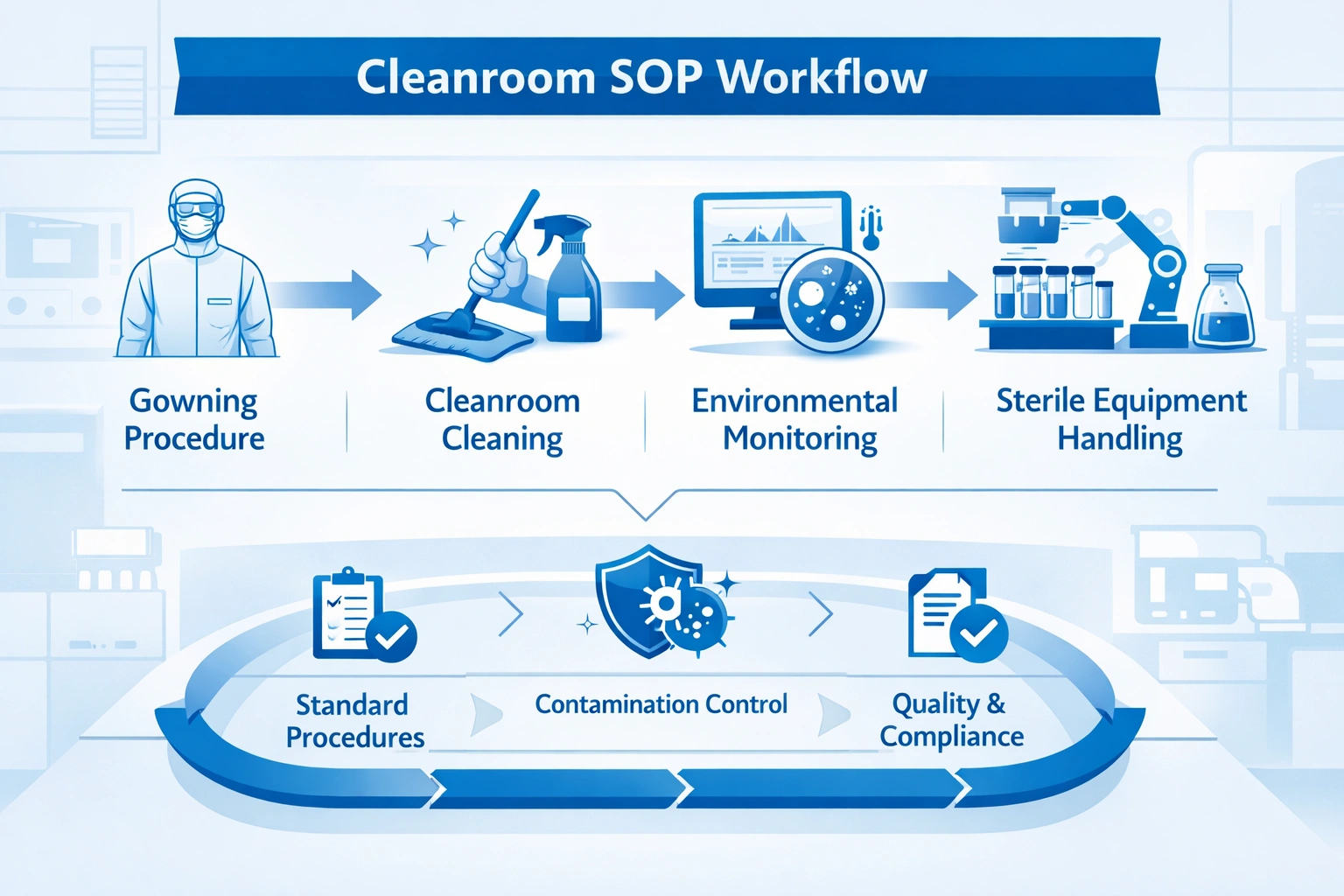
Via originala artikolo provizas fortan A-gradan paŝosekvencon. Por publikigo, la plej grava afero estas klarigi la logikon: preparo unue, poste kapo kaj vizaĝkovrado, tiam korpokovrado, tiam gantoj kaj piedvesto, sekvita de fina vida inspektado. :contentReference[oaicite:5]{index=5}
Paŝo 1: Preparado
Forigu juvelojn, horloĝojn, kosmetikaĵojn kaj personajn objektojn. Faru manlavon kaj sekigu manojn ĝisfunde antaŭ tuŝi PPE.
Paŝo 2: Kapa kovrado
Surmetu harkovrilon kaj kapuĉon por ke ĉiuj haroj kaj kolaj areoj estu protektitaj sen malfiksaj fadenoj elmontritaj.
Paŝo 3: Okula kaj vizaĝo protekto
Apliku maskon kaj okulvitrojn ĝuste por ke la baro restu kompleta kaj ne kreu interspacojn kun la kapuĉo.
Paŝo 4: Korpa kovrado
Don coveralls with correct fit. The garment should provide full coverage without being so loose that it creates risk or so tight that it tears.
Step 5: Gloves
Sanitize hands, don sterile gloves, and ensure the glove overlaps the garment cuff with no exposed skin.
Step 6: Footwear
Don sterile shoe covers or over-shoes and verify complete coverage and safe fit.
Step 7: Final check
Supervisor or trained reviewer verifies no exposed skin, no PPE gaps, and correct fit before entry into the zone.
Gowning Qualification
Aneksaĵo 1 postulas ke personaro eniranta Grada A medioj pruvu sukcesan robkvalifikon. Via originala artikolo ĝuste deklaras, ke 3 sinsekvaj testoj kun plene akcepteblaj rezultoj estas postulataj antaŭ ol personaro povas eniri Grada A-areojn. :contentReference[oaicite:6]{index=6}
| Grado | Testa tipo | Specimenoj | Akceptaj kriterioj |
|---|---|---|---|
| Grade A (ISO 5) | Solvu telerojn | 3 po persono | 0 CFU per telero |
| Grade A (ISO 5) | Fingrospuraj kusenetoj | 5 po persono | 0 CFU per kuseneto |
| Grade B (ISO 7) | Solvu telerojn | 3 po persono | ≤ 1 CFU per telero |
| Grado C (ISO 8) | Solvu telerojn | 1 po persono | ≤ 5 CFU per plato |
| Grado D (ISO 9) | Solvu telerojn | 1 po persono | ≤ 10 CFU per plato |
De-gowning Procedures
De-gowning is often treated as a lower-risk activity, but your original article correctly shows that it can become a cross-contamination event if PPE is removed incorrectly. The basic principle is controlled removal inside-out, with waste segregation and hand washing at the end. :contentReference[oaicite:7]{index=7}
Best-practice sequence
- Exit into designated de-gowning area
- Remove shoe covers
- Remove gloves
- Remove coverall inside-out
- Remove hood and hair cover inside-out
- Perform hand washing
Why de-gowning fails
- Touching face or exposed skin during removal
- Improper waste handling
- Removing PPE in the wrong order
- Pulling garments in a way that spreads contamination
Gowning Monitoring
A compliant gowning system requires more than initial training. It requires continuous visual oversight, periodic microbiological testing, and annual requalification. This is one of the strongest compliance sections in your original article and should remain central in the published version. :contentReference[oaicite:8]{index=8}

| Monitoring point | Ofteco | Expectation |
|---|---|---|
| Hair coverage | Every entry | No hair exposed |
| Fit and gaps | Every entry | No visible openings |
| Tears / damage | Every entry | No damage to PPE |
| Glove integrity | Every entry | No tears or holes |
| Microbiological testing | Periodic / quarterly | Within zone-specific criteria |
| Rekvalifiko | Annually | Current and approved |
Common Issues & Remediation
Your original article identifies the most common gowning failures clearly: hair exposure, PPE gaps, torn gloves, contaminated PPE, and poor fit. These are exactly the kinds of issues that should drive retraining, size review, and tighter supervision. :contentReference[oaicite:9]{index=9}
| Issue | Typical root cause | Recommended remediation |
|---|---|---|
| Hair exposed | Incorrect hair cover or hood placement | Retraining and supervisor verification |
| PPE gaps | Wrong size or poor fit | Re-size garments and repeat fit check |
| Torn gloves | Wrong glove size or weak handling practice | Replace gloves and retrain technique |
| Contaminated PPE | Reuse of single-use items or poor storage | Enforce single-use policy and storage control |
| Microbiological failure | Technique or environment-related contamination | Root-cause review, retraining, requalification |
Need Help Building an Annex 1 Gowning System?
Get practical guidance on gowning SOP structure, qualification design, compliance monitoring, and contamination-risk reduction for controlled environments.
- Annex 1-aligned gowning workflow guidance
- Qualification and retraining logic
- Monitoring and audit-readiness improvement
Oftaj Demandoj
How long is gowning qualification valid?
Initial qualification is typically valid for 1 year, with annual requalification required under Annex 1. Earlier requalification may be triggered by procedure change, contamination events, or extended personnel absence.
Can sterile gowning PPE be reused?
No. Grade A sterile gowning PPE should be treated as single-use to protect sterility assurance and reduce cross-contamination risk.
What happens if personnel fail gowning qualification?
Personnel should be retrained, root cause reviewed, and re-tested. They should not enter Grade A areas until qualification is successfully completed.
How do I choose the correct PPE size?
Size should be selected to ensure full coverage without tears, excessive looseness, or movement-related gaps. Initial fit verification is essential.
Can I wear jewelry or cosmetics in a cleanroom?
No. Jewelry, cosmetics, and personal items are major contamination sources and should not be taken into controlled cleanroom areas.
How do I monitor gowning compliance?
Use visual inspection at every entry, periodic microbiological testing, annual requalification, and environmental monitoring trend review where appropriate.
Rekomenditaj Internaj Ligiloj
- Kiel Prepari por GMP Purĉambra Revizio — for gowning records, compliance evidence, and audit preparation
- Media Monitorado-Lokoj en GMP-Puriga ĉambroj — for monitoring the effectiveness of gowning and personnel control
- Sterilaj Purĉambraj Mopoj por Asepsa Pretigo — for sterile consumables used in Grade A environments
- Plej bonaj Praktikoj pri Puraĉambra Bontenado — for maintaining gowning rooms and controlled change areas
- Purĉambra Purigado kaj Sanigigo SOP — for linking gowning with broader contamination-control workflows