
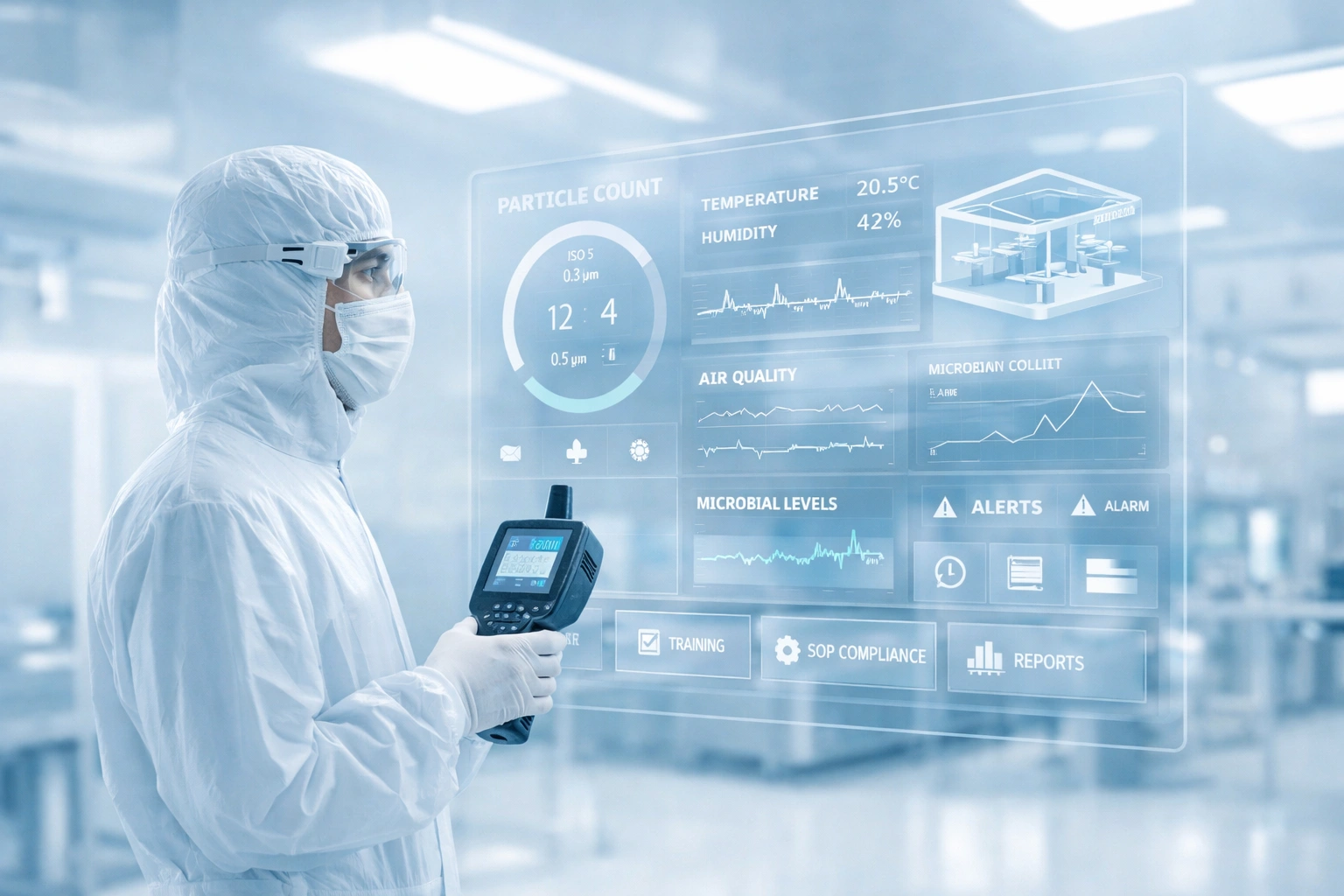
Enkonduko
Cleanroom maintenance is the foundation of contamination control. Even the most well-designed cleanroom will fail to maintain specifications without consistent, documented maintenance procedures. Many contamination events can be traced back to maintenance gaps rather than design failure.
Your original article correctly frames maintenance as a risk-based program tied to daily, weekly, monthly, and quarterly tasks, with HEPA integrity, pressure differential, airflow, surface cleanliness, and documentation as the core control points. :contentReference[oaicite:2]{index=2}
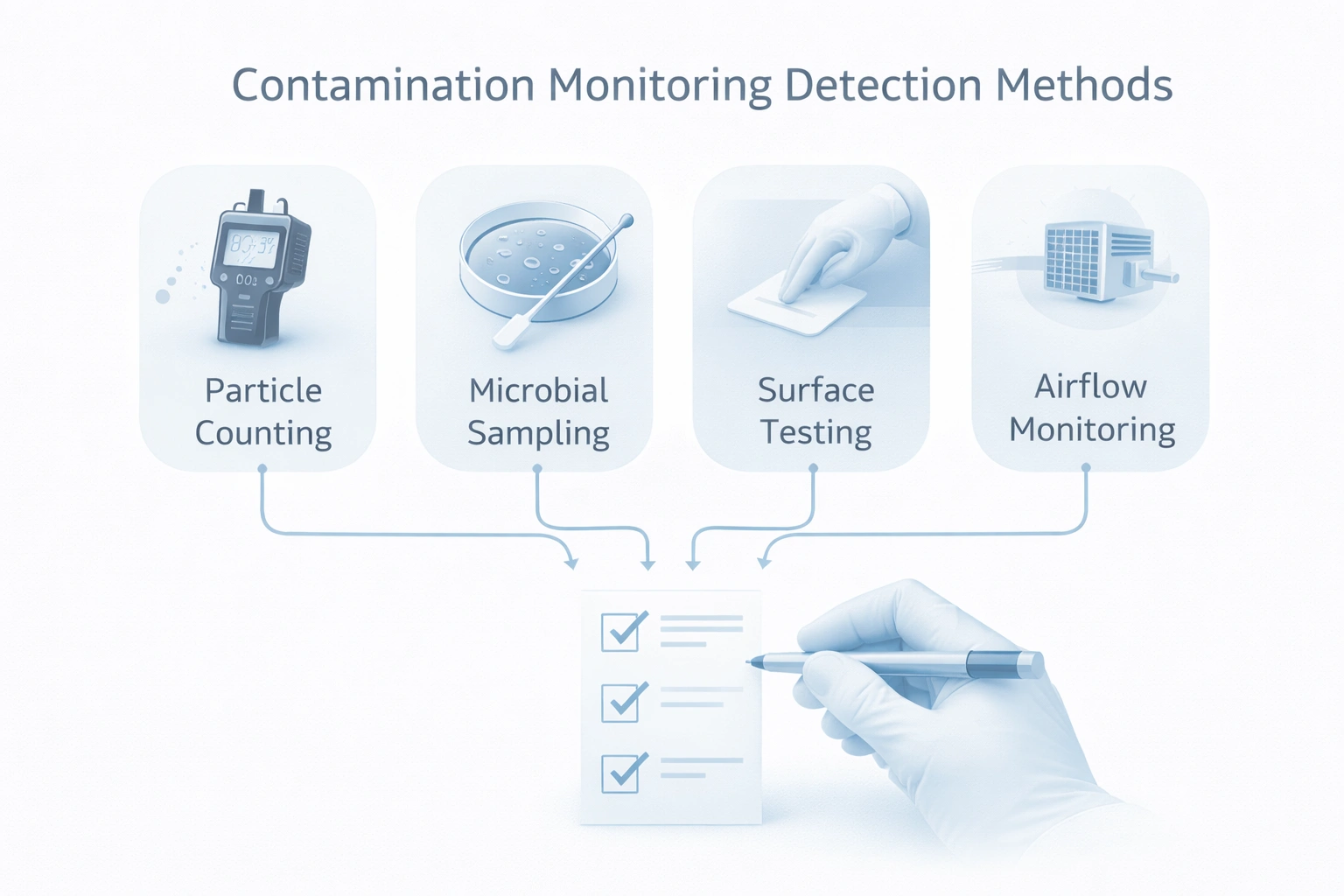
Maintenance Program Framework
Unu el la plej fortaj partoj de via originala artikolo estas la MIDPOSI-Prizorga Matrico. Ĝi mapas prizorgajn agadojn al poluado-riskaj punktoj kaj asignas frekvencon kaj KPI-atendojn. Ĉi tio estas multe pli forta ol trakti prizorgadon kiel ĝeneralan kontrolon ĉar ĝi ligas penadon rekte al poluado-risko. :contentReference[oaicite:3]{index=3}
| Metriko | Celo | Kial gravas |
|---|---|---|
| Scheduled maintenance completion | 100% | Shows discipline and program control |
| Preventive maintenance compliance | 100% | Reduces emergency failures |
| Emergency maintenance events | < 5/year | Indicates preventive program maturity |
| Maintenance documentation | 100% | Critical for GMP and audit defense |
| Downtime | < 2% | Reflects operational efficiency |
| Maintenance cost vs budget | ≤105% | Supports sustainable operations |
Daily Maintenance Procedures
Daily maintenance should focus on the most sensitive operating conditions: visible cleanliness, pressure differential, environmental status, and immediate equipment functionality. This is where drift is noticed first.
Daily checks should include
- Visual inspection of walls, ceilings, floors, windows, doors, and gaskets
- Premo diferenciala konfirmo
- Temperature and humidity confirmation
- Particle count or environmental status review where applicable
- Equipment surface condition and basic function check
Daily maintenance failure signals
- Pressure differential out of range
- Visible residue or damage on surfaces
- Gasket deterioration
- Unexpected particulate increase
- Unexplained airflow or equipment changes
Daily maintenance should also verify completion of surface cleaning tasks. In practice, this connects directly to your Purĉambra Purigado kaj Sanigigo SOP.
Weekly Maintenance Procedures
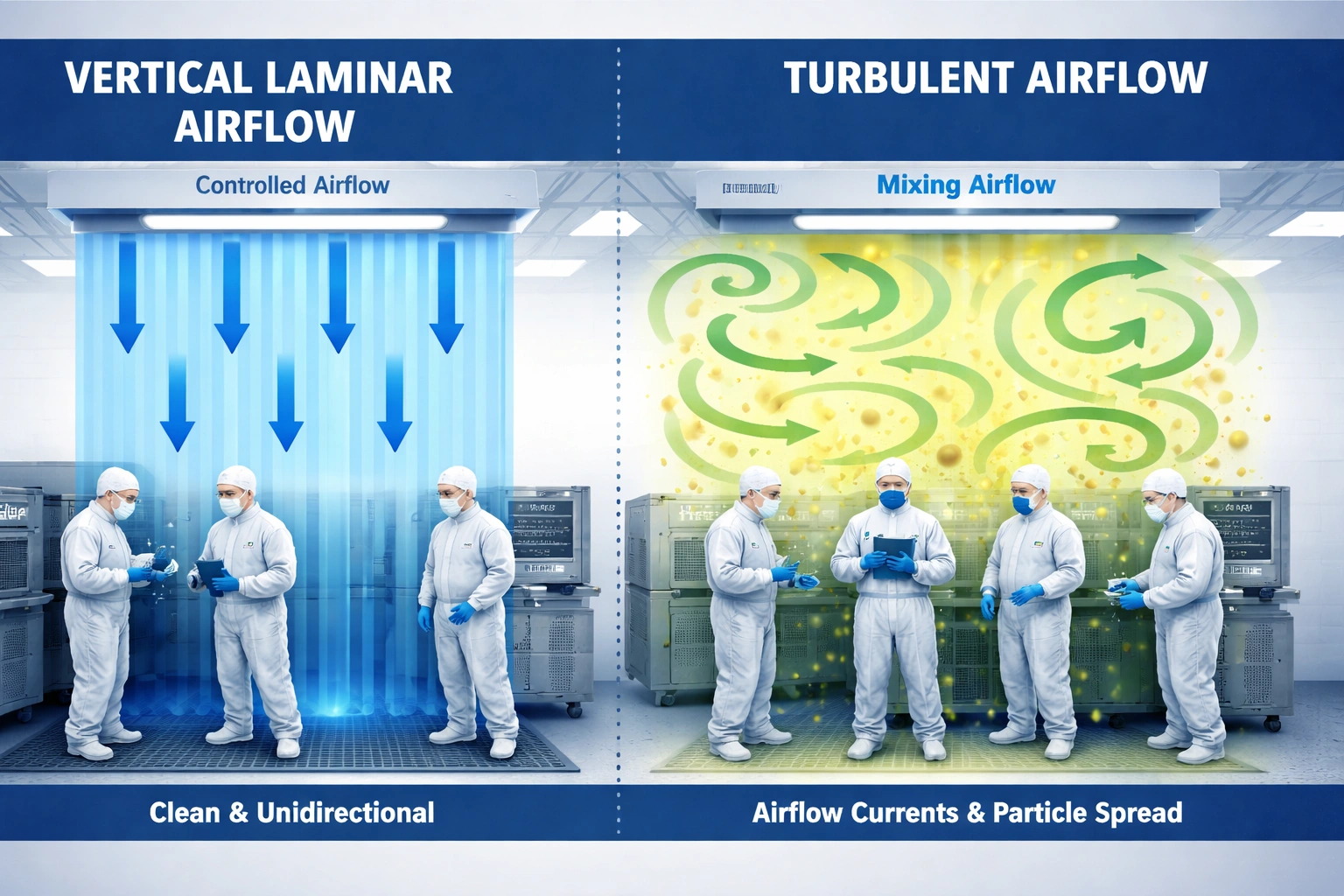
Weekly maintenance should focus on the systems that hold stable conditions over time: HEPA condition checks, pressure differential trend review, airflow uniformity, gasket integrity, and airflow visualization where needed.
| Weekly task | Celo | Typical acceptance point |
|---|---|---|
| HEPA filter inspection | Detect visible damage or loading issues | No damage, no abnormal condition |
| Premo diferenciala konfirmo | Protect room cascade integrity | Within approved range |
| Airflow uniformity check | Detect drift in supply performance | Within defined variation limit |
| Gasket and seal inspection | Prevent leakage and pressure loss | No leakage or deterioration |
| Airflow visualization review | Detect turbulence or short-circuit flow | Expected flow behavior maintained |
Monthly Maintenance Procedures
Monthly maintenance should move beyond observation into verification. This includes HEPA integrity testing, particulate verification, calibration review, and broader filter condition assessment.
HEPA integrity testing
Use an approved leak test method and confirm leakage remains below the acceptance threshold.
Particle count verification
Confirm room performance remains aligned with its ISO class or internal operational target.
Calibration verification
Ensure particle counters, airflow meters, pressure sensors, temperature sensors, and humidity sensors remain current and controlled.
Filter condition review
Use pressure trend and visible assessment to decide whether replacement planning should begin.
Quarterly Maintenance Procedures
Quarterly maintenance is the time for broader system review: AHU condition, ductwork, terminal units, controls, BMS integration, replacement planning, and requalification support activities.
| Quarterly focus | Kial gravas |
|---|---|
| Comprehensive system inspection | Checks for hidden deterioration across HVAC and room-support systems |
| HEPA replacement planning | Prevents reactive replacement after major drift |
| System requalification support | Links maintenance status to ongoing qualified state |
| Maintenance KPI review | Shows whether the maintenance program is actually working |
This is also the point where maintenance should be connected with IQ / OQ / PQ qualification logic, because maintenance drift and qualification drift are often linked.
HVAC System Maintenance
HVAC performance is one of the strongest predictors of cleanroom stability. If airflow, filtration, pressure, or control instrumentation drift, contamination risk increases even if surface cleaning remains consistent.
| System component | Task | Ofteco | Akceptaj kriterioj |
|---|---|---|---|
| AHU | Filter inspection / replacement review | Monata | No visible damage, acceptable pressure drop |
| AHU | Coil cleaning | Kvaronjara | No debris buildup, unrestricted airflow |
| Fan / motor | Belt and lubrication checks | Monthly / Quarterly | Operational and within maintenance spec |
| HEPA filters | Integrity testing | Monthly or risk-based | Leakage below acceptance limit |
| Controls / sensors | Calibration & setpoint verification | Monthly / Quarterly | Within approved range and calibration status current |
Surface Maintenance
Surface maintenance is not just cleaning frequency. It includes validating that the cleaning method, materials, chemistry, and execution actually keep surfaces within an acceptable contamination state.
Surface maintenance priorities
- Floors in high-traffic zones
- Walls and corners prone to missed cleaning
- Equipment surfaces and workstations
- Gowning areas and pass-through points
Validation methods
- Vida inspektado
- Particle count verification
- Viable monitoring where applicable
- Trend review across routine cleaning records
This section should be tightly linked to your Sterilaj Purĉambraj Mopoj por Asepsa Pretigo kaj Purĉambra Purigado kaj Sanigigo SOP, because maintenance effectiveness depends heavily on the mop system, chemistry, and execution standard.
Dokumentado & Rekordoj
Maintenance that is not documented is not defensible. Daily logs, weekly inspections, monthly verification records, calibration certificates, deviation reports, and CAPA records all need to be complete, current, and reviewable.
| Record type | Typical retention | Kial gravas |
|---|---|---|
| Daily maintenance logs | 2+ jaroj | Supports routine control evidence |
| Weekly / monthly maintenance logs | 3–5+ years | Shows preventive maintenance discipline |
| Filter test records | 5+ years | Critical for HEPA integrity history |
| Kalibraj atestiloj | 5+ years | Supports validity of all measured values |
| Deviation / CAPA records | 5+ years | Shows investigation and correction maturity |
Need Help Strengthening Cleanroom Maintenance Control?
Get practical guidance on maintenance structure, HEPA integrity checks, surface control, documentation systems, and contamination-prevention workflows that are easier to manage and defend.
- Maintenance matrix design support
- Surface cleaning workflow guidance
- Documentation and audit-readiness improvement
Oftaj Demandoj
How often should HEPA filters be tested for integrity?
Integrity testing frequency depends on room criticality and site standards, but monthly or risk-based intervals are common in higher-grade environments, with additional testing after maintenance or modifications.
What is the recommended HEPA filter replacement schedule?
Replacement should be based on pressure drop trend, service life, failed integrity testing, contamination events, or physical damage—not on arbitrary calendar replacement alone.
How do I verify maintenance effectiveness?
Use environmental monitoring, visual inspection, airflow and pressure verification, filter integrity testing, and KPI trend review to confirm the maintenance program is working.
What documentation is required for cleanroom maintenance?
At minimum: scheduled maintenance records, test records, calibration status, deviations, corrective actions, and evidence of review and approval.
How do I balance preventive maintenance with production requirements?
Plan maintenance during downtime where possible, sequence work by zone criticality, coordinate with production, and use predictive indicators to avoid disruptive emergency intervention.
What are the most common cleanroom maintenance failures?
Common failures include missing HEPA integrity checks, unmonitored pressure drift, gasket deterioration, overdue calibration, and incomplete documentation.