Kiam media monitorado en asepta pleniglinio de Grado A markas partiklan ekskurson tridek minutojn post la ŝvarado de la planko, la esploro preskaŭ ĉiam kondukas al la sama radika kaŭzo: la puriga ilo mem. Via mopkapo povus trapasi sterilecteston, sed se la Velcro-aldonaĵo de la kadro forĵetas fibrojn kun ĉiu bato, aŭ se la sitelo-sistemo kruce poluas desinfektaĵon inter zonoj, vi enkondukis poluadon sub la preteksto de purigado.
Elekti la ĝustan purĉambran mopsistemon ne temas pri foliumado de produktaj katalogoj - ĝi temas pri validigo de integra purigadfluo, kiu plenumas EU GMP-aneksan 1-postulojn (efikajn ekde aŭgusto 2023), normojn de operacioj ISO 14644-5 (ĝisdatigitaj 2025) kaj atendojn de FDA CGMP. Ĉi tiu gvidilo malkonstruas kiel kompletaj mopsistemoj - ne individuaj komponentoj - malhelpas la tri plej oftajn purĉambrajn malsukcesojn: generado de partikloj el malbone dezajnitaj iloj, desinfekta diluo en neadekvataj sitel-aranĝoj, kaj dokumentaj breĉoj kiuj ekigas reviziajn rezultojn. Vi vidos precize, kiu sistema arkitekturo kongruas kun ISO 5-8-farmaciaj produktadmedioj, kiajn validigajn pruvajn akirteamojn bezonas pravigi kapitalekipaĵon elspezas, kaj kiel la validigitaj mop-sistemoj de MIDPOSI liveras klavkonformecon kun partiklodatenoj, kemiaj kongruaj matricoj kaj IQ/OQ/PQ-ŝablonoj pretaj por QA-revizio.
What Is a Cleanroom Mop System? (Not Just a Mop)
Procurement specifications that call for “a cleanroom mop” miss the point. Regulatory agencies don’t evaluate mop heads in isolation—they assess the entire cleaning system’s ability to maintain environmental control. EU GMP Annex 1 (sections 4.29–4.31) requires validated cleaning and disinfection programs where materials tolerate repeated chemical exposure without degradation or particle shedding. ISO 14644-5:2025 mandates that facilities establish an Operations Control Programme that includes a documented cleaning programme with defined service life for consumables. A mop system is the operational unit that delivers on these requirements.
Here’s what comprises a validated cleanroom mop system:
Mop Head — Sealed-edge polyester or microfiber construction that generates <100 particles/m² per IEST-RP-CC004 Helmke drum testing. Must demonstrate chemical compatibility with all disinfectants in your rotation (70% IPA, hydrogen peroxide, peracetic acid, quaternary ammonium compounds). For reusable heads, validated service life typically runs 50–100 autoclave cycles; for single-use, gamma sterilization to SAL 10⁻⁶.
Mop Frame — Autoclavable stainless steel (SS316) or high-temperature polypropylene with sealed pockets that prevent fiber release. Velcro attachments are disqualified in Grade A/B zones; only fully enclosed frame edges meet Annex 1’s low-shedding material requirements.
Handle — One-piece, gap-free construction. Threaded joints and telescoping segments create particle traps that violate ISO 14644-1 surface finish requirements. Validated handles use continuous stainless steel or cleanroom-grade polypropylene extrusions.
Bucket System — Jen kie la plej multaj sistemoj malsukcesas. Aneksaj 1 sekcioj 4.29–4.31 postulas desinfektan efikecon validumon per surfaca materialo, kio signifas, ke via sitela agordo devas malhelpi krucpoluadon kaj konservi desinfektan kontaktotempon. Unu-sitelaj sistemoj diluas desinfektaĵon tuj; Du-sitelaj aranĝoj (pura/malpura apartigo) reduktas diluon sed ankoraŭ kompromitas rotaciajn desinfektajn protokolojn. Nur tri-sitelaj sistemoj - antaŭ-lavado, desinfekta apliko, fina lavado - plenumas la validigitajn laborflupostulojn por Grada A/B medioj kie Anekso 1 postulas sterilajn purigajn agentojn.
Normaj Operaciaj Proceduroj — La sistemo inkluzivas skribajn protokolojn, kiuj difinas desinfektan rotacion (almenaŭ du agentoj kun malsamaj agadmanieroj, kaj plie perioda sporicida aplikado laŭ Aneksaĵo 1), mopkapoŝanĝoftecon, sitelplenigvolumojn, kaj operacian teknikon. Tiuj SOPoj ligas komponentspecifojn al mediaj monitoradrezultoj.
Kial gravas la "sistema" distingo? Ĉar inspektistoj revizias vian Kontaminan Kontrolan Strategion holisme. Kiam ili ekzamenas purigajn validigajn raportojn, ili serĉas pruvojn, ke viaj mopkapaj partiklodatenoj, kadra materiala kvalifiko kaj sitelaj laborfluaj SOP-oj kongruas por produkti konsekvencajn mediajn monitoradrezultojn. Mopkapo kun a <50 particles/m² spec sheet means nothing if your frame sheds fibers or your bucket system cross-contaminates zones. The system is the validated unit, not the mop head alone.
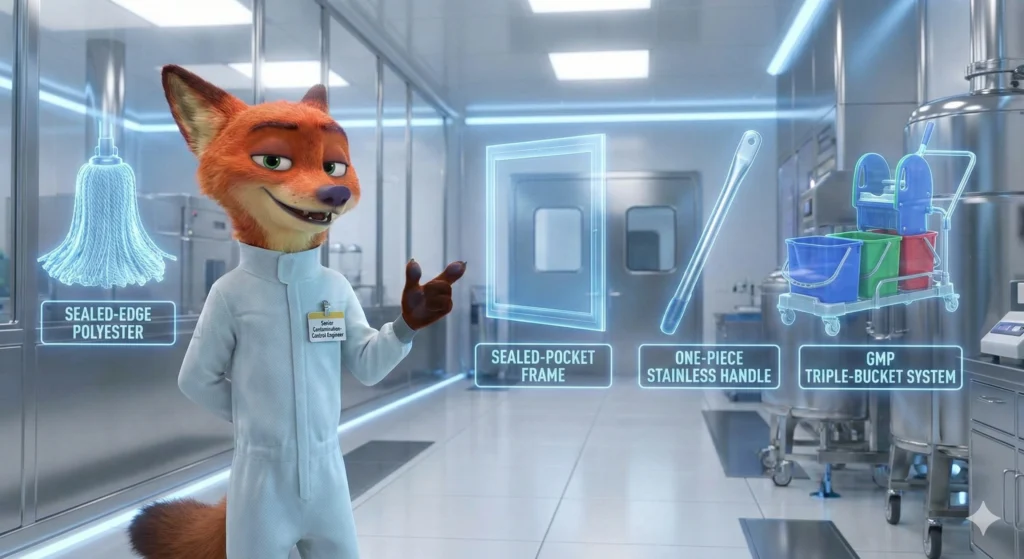
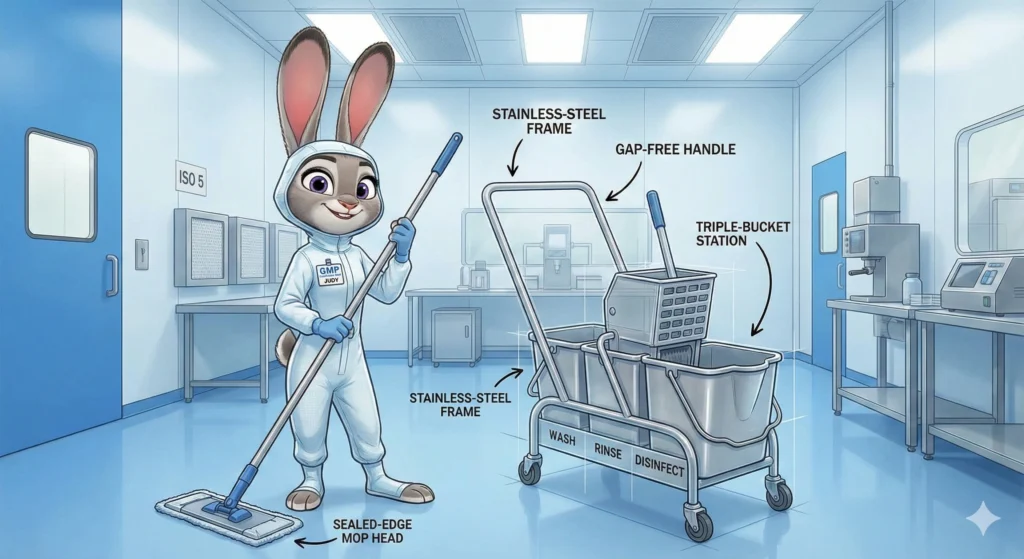
Figure 1: Complete cleanroom mop system showing integrated components—sealed-edge mop head, stainless steel frame, one-piece handle, and triple-bucket setup. EU GMP Annex 1 requires validation of the entire system, not individual components, to demonstrate contamination control per ISO 14644-5:2025 Operations Control Programme requirements.
System Components: Pad, Frame, Handle & Bucket (GMP-Validated Architecture)
Ĉiu komponento en purĉambra mopsistemo portas specifajn poluadriskojn. Akirteamoj kiuj elektas komponantojn sendepende - "ĉi tiu mopkapo aspektas bone, ni parigu ĝin kun tiu kadro" - finiĝas kun kvalifikaj breĉoj kiuj ekaperas dum validumado aŭ, pli malbone, dum FDA-inspektado. Jen kiel taksi ĉiun elementon laŭ GMP-postuloj.
Mopkapo: Sigelita-Rando Poliestero vs Mikrofibro
La mopkapo kontaktas ĉiun kritikan surfacon en via purĉambro, igante materialan elekton via unua decido pri poluado. Du elektoj dominas farmaciajn aplikojn, sed nur unu konstante plenumas la malalt-disverŝajn postulojn de Anekso 1.
Sigelita-Rando Poliestero is the pharmaceutical standard. Continuous-filament polyester yarn, thermally sealed at all edges, generates <50 particles/m² in Helmke drum testing. This construction prevents cut fibers from releasing during use. Chemical resistance covers the full disinfectant spectrum—it tolerates 70% IPA for routine cleaning, survives hydrogen peroxide and peracetic acid oxidation (critical for sporicidal rotation per Annex 1 section 4.30), and remains stable in quaternary ammonium compounds. Autoclave durability runs 80–100 cycles at 121°C before tensile strength degrades below acceptance criteria; gamma-sterilized single-use versions deliver SAL 10⁻⁶ for Grade A/B where Annex 1 requires sterile cleaning materials.
Mikrofibro prezentas pli altan partiklan riskon. Dum split-fibra mikrofibro elstaras je likva sorbado, la fibro-dividanta procezo kreas tranĉitajn randojn. Krom se ĉiu rando estas termike ligita, mikrofibraj movkapoj verŝas fragmentojn - precipe post ripeta lavado aŭ aŭtoklavo. Mikrofibro de konsumanto (la speco vendita por hejma purigado) generas pli ol 200 partiklojn/m², malkvalifikante ĝin tute de ISO 5-8 medioj. Eĉ purĉambra-kvalita mikrofibro kun sigelitaj randoj montras partiklokalkulojn 2-3× pli altan ol ekvivalenta poliestero. La ŝparado de kosto malaperas kiam vi spuras EM-ekskurson al mikrofibra forĵetado.
Partiklaj generaddatenoj estas nenegoceblaj. Postulu IEST-RP-CC004 Helmke-tamburajn testraportojn montrantajn partiklokalkulojn je 0.5 µm kaj 5.0 µm, kaj antaŭ kaj post simul-uza kondiĉado (ekz., 10 aŭtoklavaj cikloj). Se la provizanto ne povas provizi ĉi tiujn datumojn, la mopkapo ne estas validigita.
Kemia kongrueco postulas ekspoziciotestadon. Petu dokumentaron montrantan integrecon de mopkapo (vida inspektado, streĉa provo, forĵetado de partiklo) post 50 cikloj de via specifa desinfektilo ĉe uza koncentriĝo. IPA-toleremo estas tabloludoj; la vera demando estas ĉu la materialo postvivas vian sporicida rotacio (ofte 6% hidrogena peroksido aŭ 0,8% peraceta acido) sen degradado.
Autoclave durability determines total cost of ownership. A mop head rated for 100 cycles at $15 per head costs $0.15 per use. Gamma-sterilized single-use heads at $8 each cost $8.00 per use but eliminate reprocessing validation and cross-contamination risk—often the right trade for Grade A aseptic core operations.
Mop Frame: Autoclavable, Sealed-Pocket Construction
The frame attaches mop head to handle. This interface is where most component-mix-and-match specifications fail.
Why Velcro Is Disqualified
Velcro-hok-kaj-buklofermaĵoj verŝas nilonajn fragmentojn kun ĉiu alliga ciklo. Testo de generado de partikloj de Velcro mop-kadroj konstante montras 150–300 partiklojn/m²—triobligi la sojlon por ISO 6 (Klaso 1,000) kaj katastrofa por ISO 5 (Klaso 100) Grado A/B zonoj. EU GMP Anekso 1 eksplicite postulas materialojn kiuj "minimumigas partiklan generacion" (sekcio 4.14). Velcro malsukcesas ĉi tiun postulon kategorie.
Sigelita-Poŝo vs Tranĉaj Kadroj
Validated frames use sealed pockets where the mop head slides into a fully enclosed channel. The frame edge is either thermally welded (polypropylene frames) or mechanically crimped (stainless steel frames) to eliminate fiber exposure. Cut-edge frames—where the mop head simply folds over a flat bar—leave fabric edges exposed, allowing fibers to release during the push-pull motion of mopping.
Frame material options:
Stainless Steel 316L postvivas senlimajn aŭtoklavciklojn, toleras agresemajn desinfektaĵojn (inkluzive de alta koncentriĝa peroksido kaj peracetacido), kaj disponigas la plej longan funkcidaŭron. Tipa kadrovivo superas 5 jarojn en ĉiutagaj uzaj medioj. Malavantaĝoj: pli alta antaŭkosto ($80–$120 per kadro) kaj pezo (gravas por funkciigistoj purigantaj grandajn etaĝajn areojn). SS316L estas la normo por reuzeblaj movsistemoj en ISO 5–7 produktadserioj.
Alt-Temperatura Polipropileno (PP) ofertas pli malpezan pezon kaj pli malaltan koston ($30–$50 per kadro) konservante aŭtoklavkongruon (121 °C por 50+ cikloj). Kemia rezisto kovras IPA, kvatojn kaj moderajn peroksidajn koncentriĝojn, sed agresemaj sporicidaj agentoj degradas PP pli rapide ol neoksidebla ŝtalo. Servodaŭro daŭras 2-3 jarojn en tipa uzo. PP-kadroj funkcias bone por ISO 6-8 (Grado C/D) medioj kie kostsentemo movas specifon.
Gap-Free, Unu-Peca Konstruo
Kudroj, juntoj kaj ligpunktoj kreas partiklokaptilojn. Konfirmitaj kadroj estas aŭ velditaj (neoksideblaj) aŭ mulditaj (polipropileno) kiel ununuraj pecoj. Plurpartaj kadroj kun mekanikaj fiksiloj (ŝraŭboj, nitoj) amasigas restaĵojn en fadenoj kaj fendoj - malobservoj de ISO 14644-1 surfaca finpoluro postuloj kiuj postulas glatajn, purigeblajn surfacojn.

Figuro 3: Sigelita rando poliestera konstruo (maldekstre) vs tranĉrando/Velcro-kadro (dekstre). Termo-fermitaj randoj malhelpas la generadon de partiklo (<50 particles/m² per IEST-RP-CC004), meeting ISO 14644-1 surface requirements. Velcro attachments and cut fabric edges create fiber release zones that generate 150–300 particles/m², disqualifying them from Grade A/B cleanrooms per EU GMP Annex 1 low-shedding material requirements (section 4.14).
Handle: One-Piece, Gap-Free, Cleanroom-Grade Materials
Handles seem simple until you examine where contamination hides.
Threaded Joints and Telescoping Segments Are Particle Sources
Komercaj mopteniloj uzas fadenigitajn kupladojn por konekti tensegmentojn aŭ alĝustigi longon. Ĉiu fadena valo estas partiklokaptilo, kiu kolektas restaĵojn de purigaj solvoj, vestaj fibroj kaj mediaj postlasaĵoj. Dum uzo, mekanika streĉo liberigas kaptitajn partiklojn. Teleskopaj teniloj - kie unu tubo glitas ene de alia - kreas frikciozonojn kiuj generas eluzaĵrubojn. Tiuj dezajnoj estas malkongruaj kun ISO 5-7 purĉambra normoj.
Materiala Komparo
SS316 Neoksidebla ŝtalo: Unupecaj eltrudoj aŭ unu-velda konstruo, neniuj fadenoj, neniuj juntoj. Longo estas fiksa (tipe 1,2–1,5 m por plankaj mopoj). Aŭtoklavo-kongrua, kemie inerta, senlima funkcidaŭro. Pezo: ~800–900 g. Kosto: $60–$90. Plej bone por altkvalitaj medioj (ISO 5–6, Grado A/B) kie validuma ŝarĝo pravigas kapitalinveston.
Alt-Temperatura Polipropileno: Injekt-mulditaj aŭ eltruditaj unupecaj teniloj. Pli malpeza pezo (~300–400 g) reduktas lacecon de operaciisto dum plilongigita purigado. Aŭtoklavebla ĝis 121 °C dum 50+ cikloj. Kemia rezisto kongruas kun PP-framlimigoj (IPA, kvatoj, modera peroksido). Kosto: $20–$35. Taŭga por ISO 6–8 (Grado B/C/D) kie kosto-efikeco-ekvilibro favoras foruzeblajn aŭ duon-uzeblajn laborfluojn.
Alliga Mekanismo al Kadro
The handle-to-frame connection must be cleanable and secure without tools. Snap-lock designs that enclose the joint fully meet ISO surface requirements. Threaded connections (even when using cleanroom-compatible materials) create the same particle trap issues noted above. The best systems use tapered snap-fit connections where the handle end inserts into a matching frame socket—no threads, no tools, no gaps.
Bucket System: Dual vs Triple Bucket (Annex 1 Compliance)
Annex 1 sections 4.29–4.31 don’t explicitly mandate triple-bucket systems, but the validation requirements for disinfectant efficacy and cross-contamination prevention make triple-bucket configurations the only practical path to compliance in Grade A/B.
Why Single-Bucket Systems Fail Immediately
Single-bucket workflows—where the operator dips the mop into a bucket of disinfectant, mops the floor, and returns the mop to the same bucket—introduce floor contaminants (particles, bioburden, residues) directly into the disinfectant reservoir. After five dip cycles, disinfectant concentration drops as water and debris dilute the solution. After ten cycles, you’re mopping with contaminated water that spreads bioburden rather than removing it. This violates Annex 1 section 4.29’s requirement for validated disinfectant efficacy.
Dual-Bucket Shortcomings
Dual-bucket systems separate “clean” disinfectant (Bucket 1) from “dirty” rinse water (Bucket 2). The operator dips the mop in Bucket 1, mops a section, then rinses the mop in Bucket 2 before returning to Bucket 1 for the next section. This prevents gross contamination of the disinfectant but creates two problems:
- Disinfectant contact time is not controlled. Annex 1 requires validation of disinfectant efficacy per surface material, which means you must demonstrate that your application method achieves the required contact time (typically 1–5 minutes depending on the agent). In a dual-bucket workflow, the mop head carries disinfectant to the floor but immediately picks up water and debris, reducing contact time and diluting the agent.
- Disinfectant rotation fails. Annex 1 section 4.30 requires “more than one disinfectant with different modes of action” plus periodic sporicidal application. Dual-bucket systems provide no mechanism to apply different agents sequentially without fully draining and refilling buckets between agents—impractical during shift operations.
Why Triple-Bucket Systems Win
Triple-bucket configurations segregate:
- Bucket 1: Pre-rinse / debris removal — Plain purified water (or mild detergent solution) removes gross soil and particles. The operator mops a section, returns to Bucket 1, rinses, and wrings.
- Bucket 2: Disinfectant application — Contains the validated disinfectant at in-use concentration (e.g., 70% IPA for routine cleaning, or 6% hydrogen peroxide for sporicidal rotation). The operator dips the mop, wrings lightly to control solution volume, and applies to the floor. The mop head is not returned to Bucket 2 after use—it proceeds directly to Bucket 3.
- Bucket 3: Final rinse — Purified water removes excess disinfectant and ensures no agent carryover between zones (critical when rotating disinfectants or cleaning different grade areas sequentially).
This workflow achieves:
- Validated disinfectant contact time: Bucket 2 maintains disinfectant concentration because contaminated mops never return to it.
- Rotation-ready protocol: Swapping the agent in Bucket 2 (e.g., from IPA to hydrogen peroxide for sporicidal rotation per Annex 1 section 4.30) requires only draining and refilling Bucket 2, not the entire system.
- Cross-contamination prevention: Buckets 1 and 3 capture debris and rinse water; Bucket 2 remains uncontaminated throughout the shift.
Material and Construction Requirements
Stainless Steel Buckets (SS304 or SS316): Autoclavable, chemically inert, longest service life (10+ years). Typical capacity: 10–15 liters per bucket. Cost: $150–$250 per bucket (triple-bucket set: $450–$750). Best for validated reusable systems in long-term production facilities.
High-Temperature Polypropylene Buckets: Autoclavable to 121°C, lighter weight, lower cost ($40–$70 per bucket; triple set: $120–$210). Chemical resistance covers IPA, quats, moderate peroxide; aggressive sporicides shorten service life to 2–3 years. Suitable for cost-sensitive or semi-disposable workflows.
Wringer vs Press Mechanism: Wringers (roller or lever-action) generate particles from mechanical wear. Press plates (flat perforated inserts where the operator manually presses the mop head) eliminate moving parts and reduce particle generation. For ISO 5–6 (Grade A/B), press systems are preferred; for ISO 7–8 (Grade C/D), wringers are acceptable if qualified.
Color-Coding and Labeling
ISO 14644-5:2025 emphasizes operational controls that prevent cross-contamination. Color-coded bucket systems (e.g., blue for Bucket 1 pre-rinse, green for Bucket 2 disinfectant, yellow for Bucket 3 final rinse) reduce operator error. Permanent labels indicating bucket function, disinfectant type, and fill line further support SOP compliance and audit defense.

Figure 2: Triple-bucket workflow configuration meeting EU GMP Annex 1 sections 4.29–4.31 requirements for validated disinfectant efficacy. Bucket 1 (blue) removes gross soil, Bucket 2 (green) applies disinfectant at validated concentration without contamination return, Bucket 3 (yellow) performs final rinse to prevent agent carryover between zones. This segregated workflow maintains disinfectant stability and supports rotation protocols required by Annex 1 section 4.30.
Benefits of GMP-Validated Mop Systems (ISO 5–8 Success Factors)
Procurement cost comparisons often focus on the mop head unit price. What gets missed: the total cost of an environmental monitoring failure, an audit observation, or a batch hold traced to inadequate cleaning validation. Validated mop systems don’t just meet compliance—they prevent the operational disruptions that cost 10–100× the equipment investment.
1. Prevent Environmental Monitoring Failures
Particle excursions and elevated bioburden counts trigger deviation investigations that consume weeks of QA time, halt production lines, and create regulatory exposure. When investigations trace contamination to cleaning tools, the root cause analysis question becomes: “Why wasn’t the cleaning system validated to prevent this?”
Validated mop systems provide:
Particle generation data that establishes baseline expectations. When your mop head’s Helmke drum test report shows <50 particles/m² and your routine EM samples show baseline particle counts before and after mopping (no excursions), you’ve demonstrated system control. If an excursion occurs, the validated baseline helps eliminate the mop as the variable—focusing investigation on other root causes.
Chemical compatibility evidence that prevents material degradation. Mop heads that survive 50+ autoclave cycles and 100+ disinfectant exposures (per validation testing) won’t suddenly shed fibers mid-shift. Unvalidated materials degrade unpredictably, releasing particles during use—the definition of an EM failure waiting to happen.
SOP-linked workflows that tie system use to EM outcomes. Your Contamination Control Strategy documents that mop system X, used per SOP Y, maintains Grade A particle counts between Z excursions per year. When EM trending shows stable performance, that’s validation; when it shows excursions, the validated baseline supports investigation.
Real cost of EM failures: A single Grade A particle excursion triggers 40–80 hours of investigation labor (QA review, root cause analysis, CAPA documentation). Multiply by 3–4 excursions/year from an unvalidated mop system, and you’ve spent $15,000–$30,000 in QA time alone—before counting any production impact.
2. Reduce Audit Findings (FDA/EMA/MHRA)
Regulatory inspections focus on cleaning validation evidence. Common audit observations related to cleaning systems include:
- “Inadequate validation of cleaning agent efficacy per surface material” (Annex 1 section 4.29 violation)
- “No documented service life for reusable cleaning consumables” (ISO 14644-5:2025 requirement)
- “Cleaning materials in Grade A/B areas not demonstrated sterile prior to use” (Annex 1 section 4.31 violation)
- “No evidence of particle generation testing for cleanroom mop heads”
Validated mop systems address these gaps with turnkey documentation:
Particle generation test reports (IEST-RP-CC004 Helmke drum data) demonstrate low-shedding material qualification.
Chemical compatibility matrices show validation of disinfectant exposure per Annex 1 requirements (IPA, peroxide, peracetic acid, quats—all tested at in-use concentrations).
Sterilization validation protocols (for gamma-sterilized single-use systems) or autoclave cycle qualification data (for reusable systems) prove sterility compliance in Grade A/B.
Service life documentation (autoclave cycle limits, retirement criteria) meets ISO 14644-5:2025 consumables requirements.
IQ/OQ/PQ-ŝablonoj that integrate mop system qualification into your facility’s cleaning validation program.
Triple-bucket systems specifically address audit findings on disinfectant rotation. When inspectors ask, “How do you validate contact time and prevent cross-contamination during disinfectant rotation?” the triple-bucket workflow provides a documented, defensible answer. Dual-bucket or single-bucket systems force QA teams to justify validation gaps—explanations that rarely satisfy inspectors.
3. Extend Tool Service Life & Reduce Costs
Reusable mop systems with validated service life deliver better total cost of ownership than disposable alternatives—if, and only if, the system is designed for repeated sterilization cycles.
5-Year Cost Comparison (ISO 6 Cleanroom, 250 Cleaning Cycles/Year)
Validated Reusable System (sealed-edge polyester mop heads, SS316 frame/handle, autoclavable for 100 cycles):
- Initial equipment: $300 (frame + handle + buckets)
- Mop heads: 13 heads over 5 years ($15/head × 100 cycles each × 1,250 total cycles = 13 heads) = $195
- Reprocessing: Autoclave cost ~$2/cycle, 1,250 cycles = $2,500
- Total 5-year cost: $2,995 (~$600/year)
Gamma-Sterilized Single-Use System (pre-sterilized polyester mop heads, disposable PP frame, single-use workflow):
- Mop head + frame units: $12/unit × 250 uses/year × 5 years = $15,000
- No reprocessing cost
- Total 5-year cost: $15,000 (~$3,000/year)
Unvalidated Commercial System (microfiber mop heads, Velcro frame, dual-bucket, sourced from janitorial suppliers):
- Komenca ekipaĵo: $ 80 (kadro + tenilo + siteloj)
- Mopkapoj: Malsukcesa partiklotestado post 20 cikloj; postulas anstataŭigon ĉiujn 5 monatojn = 12 kapoj/jaro × 5 jaroj = 60 kapoj × 10 USD/kapo = 600 USD
- EM-ekskursesploroj: 3 ekskursoj/jaro × $5,000 enketokosto = $15,000/jare × 5 jaroj = $75,000
- Totala 5-jara kosto: $75,680 (~$15,136/jare)
La validigita reuzebla sistemo kostas 20% de la totala elspezo de la nevalidigita sistemo - ĉar ĝi forigas la EM-malsukcesan punon.
4. Certigu Seninfektan Kontaktan-Tempan Stabilecon
Aneksaĵo 1 sekcio 4.29 postulas validigitan desinfektan efikecon, kiu dependas de konservado de agentkoncentriĝo kaj kontaktotempo dum la purigadŝanĝo. Sitela sistemo-dezajno rekte kontrolas ĉi tion.
Why Dual-Bucket Systems Fail Validation
Dual-bucket workflows can’t maintain disinfectant concentration. Every time the operator returns a contaminated mop to the “clean” bucket (even after rinsing in the “dirty” bucket), residual water and debris dilute the disinfectant. After 20 dip cycles, a 70% IPA solution drops to 60–65% effective concentration—below validated efficacy thresholds. Hydrogen peroxide is worse; organic debris rapidly decomposes peroxide, cutting its effective concentration in half after 10–15 cycles.
Why Triple-Bucket Systems Maintain Validation
The triple-bucket workflow isolates the disinfectant bucket (Bucket 2). Contaminated mops never return to it; they proceed from Bucket 2 directly to Bucket 3 (final rinse). This design keeps Bucket 2 at validated concentration for the entire shift. When your disinfectant efficacy validation shows that 70% IPA achieves 3-log bioburden reduction with 2-minute contact time, the triple-bucket system delivers that validated performance consistently—because concentration remains stable.
Contact time control: In a triple-bucket workflow, the operator applies disinfectant from Bucket 2, mops a defined area (typically 2–4 m²), and allows the solution to remain on the surface for the validated contact time before proceeding to the next section. The workflow SOP specifies contact time per disinfectant (e.g., 2 minutes for IPA, 5 minutes for hydrogen peroxide). This SOP-driven control isn’t feasible in dual-bucket systems where the operator continuously dips and mops without discrete dwell periods.

Top 3 Cleanroom Mop Systems for ISO 5–8 Pharma Lines
These system architectures represent the three validated approaches pharmaceutical facilities use to meet EU GMP Annex 1 and ISO 14644-5 requirements. Your choice depends on cleanroom grade, production volume, reprocessing capacity, and capital budget.
System 1 — Gamma-Sterilized Single-Use Mop System (Grade A/B)
Architecture: Pre-sterilized sealed-edge polyester mop head + disposable polypropylene frame, packaged in double-peel pouches, gamma-irradiated to SAL 10⁻⁶. Single-use workflow with no reprocessing.
Target Application: Aseptic filling suites, lyophilizer loading, vial inspection areas—any Grade A/B zone where Annex 1 section 4.31 requires sterile cleaning materials and cross-contamination risk must be eliminated completely.
Ŝlosilaj Specifoj:
- Particle generation: <50 particles/m² per IEST-RP-CC004 (tested post-irradiation to confirm gamma sterilization doesn’t degrade material)
- Sterility assurance level: 10⁻⁶ (pharmaceutical-grade gamma dose, typically 25–40 kGy)
- Chemical compatibility: Pre-qualified for 70% IPA, 6% hydrogen peroxide, 0.2–0.35% peracetic acid, sporicidal quats
- Double-peel pouch packaging for aseptic transfer into Grade A/B without outer carton contamination
- Certificate of Irradiation (CoI) and Certificate of Analysis (CoA) included with each lot
Avantaĝoj:
- Zero cross-contamination risk: Each cleaning event uses a fresh, sterile system
- No reprocessing validation required (eliminates autoclave qualification, cycle monitoring, retirement criteria)
- Immediate compliance with Annex 1 sterility requirements
- Simpligas SOP: funkciigistoj ne pritraktas reprocesadon, ciklospuradon, aŭ mopkapajn emeritiĝajn decidojn
Limigoj:
- Plej alta kosto por uzo: $8–$12 per mopkapo + kadra unuo
- Generas pli da rubo (forigokonsideroj por instalaĵoj kun daŭripovmandatoj)
- Postulas konsekvencan provizoĉenadministradon (paŭmtempoj por gama steriligo)
Ideala Por: Altkvalitaj kritikaj zonoj (Grado A asepsa kerno, Grado B-fono), malaltfrekvenca purigado (1-2 cikloj/tago), instalaĵoj kun limigita aŭtoklavkapacito, aŭ operacioj prioritatantaj absolutan poluadkontrolon super kosto.
Sistemo 2 - Aŭtoklavebla Reciklebla Poliestera Sistemo (ISO 6–8)
Architecture: Sealed-edge polyester mop heads (100-cycle service life) + SS316 stainless steel frame and handle + autoclavable triple-bucket system (SS304/316 buckets). Reprocessing workflow: post-use laundering, autoclave sterilization (121°C, 30 minutes), cycle tracking, retirement at validated limits.
Target Application: Grade B/C production areas, Grade D warehousing and corridors, ISO 6–8 general manufacturing—zones where validated reusable systems deliver optimal ROI.
Ŝlosilaj Specifoj:
- Mop head: Continuous-filament polyester, four-edge thermal seal, <50 particles/m² new and <100 particles/m² after 50 autoclave cycles
- Frame: SS316L, sealed-pocket construction, no Velcro, mechanically crimped edges, weight 400–500 g
- Handle: SS316 one-piece extrusion, 1.2–1.5 m length, snap-fit frame connection, weight ~800 g
- Buckets: Triple-bucket SS304 set (10–15 L capacity each), autoclavable, color-coded (blue/green/yellow), press-plate wringer
- Service life: Mop heads validated to 80–100 autoclave cycles; frame/handle/buckets unlimited with proper maintenance
Avantaĝoj:
- Best total cost of ownership: ~$600/year for 250 cleaning cycles (see cost comparison in Section 4)
- Long equipment service life: Frame/handle/buckets last 5–10+ years
- Full validation documentation: Particle data, autoclave cycle qualification, chemical compatibility matrices, retirement SOPs
- Supports disinfectant rotation: Triple-bucket system enables per-shift agent changes (IPA to peroxide rotation per Annex 1 section 4.30)
Limigoj:
- Requires reprocessing infrastructure (washer, autoclave, cycle tracking system)
- Higher upfront capital ($500–$800 for complete system: frame, handle, 10–15 mop heads, triple-bucket set)
- Operator training needed for reprocessing SOP, cycle log management, retirement criteria
Ideala Por: Medium- to high-frequency cleaning (2–5 cycles/day), facilities with existing autoclave capacity, operations seeking TCO optimization, sites with validated reprocessing programs already in place for gowning/gloves.
System 3 — Annex 1 Triple-Bucket Workflow System (Grade A/B/C)
Architecture: This is not a product configuration but a validated workflow system combining either System 1 or System 2 hardware with triple-bucket fluid management. The defining feature is operational control of disinfectant efficacy per Annex 1 sections 4.29–4.31.
Target Application: Any pharmaceutical cleanroom where disinfectant rotation is required, sporicidal agents are used, or inspectors expect documented validation of contact time and concentration control.
Workflow Specifications:
- Bucket 1 (Pre-rinse): Purified water or mild detergent (e.g., 0.5% Alcalex); removes gross soil/particles before disinfectant application
- Bucket 2 (Disinfectant): Contains validated agent at in-use concentration; mop heads dip here but never return post-use (prevents dilution)
- Bucket 3 (Final rinse): Purified water; removes excess disinfectant, prevents agent carryover between zones
- SOP-defined contact time: Operator applies disinfectant, allows validated dwell (e.g., 2 min for IPA, 5 min for H₂O₂), then proceeds
- Agent rotation protocol: Per Annex 1 section 4.30, facilities rotate ≥2 disinfectants (different modes of action) plus periodic sporicide; triple-bucket workflow accommodates daily or per-shift agent changes by draining/refilling Bucket 2 only
Key Validation Elements:
- Disinfectant efficacy testing: Demonstrate 3–4 log bioburden reduction at validated concentration and contact time
- Studo pri koncentriĝo-stabileco: Montru, ke Sitelo 2 konservas ≥95% de komenca desinfekta koncentriĝo dum plena deĵoro (neniu poluita mopo-rendimento = neniu diluo)
- Preventado de krucpoluado: Konfirmu, ke Sitelo 1 kaj Sitelo 3 lavakvo enhavas neniujn konstateblajn realigeblajn organismojn super agadlimoj.
- Monitorado de aliĝo al SOP: Uzu plenliniajn markilojn sur siteloj, tempoprogramojn por kontaktotempo, kaj kolorkodigon por redukti operacian eraron.
Avantaĝoj:
- Rekte traktas la #1an revizian konstaton pri purigadvalidigo: "neadekvata desinfekta efikeco validumado"
- Ebligas konformecon al postuloj pri rotacio de desinfektaj aneksas 1 (sekcio 4.30)
- Provizas dokumentitan respondon kiam inspektistoj demandas, "Kiel vi malhelpas kruc-poluadon dum purigado?"
- Supports multiple disinfectant agents in a single shift without cross-contamination
Limigoj:
- Requires more floor space: Three buckets vs one or two
- Longer setup time: Operators fill three buckets instead of one or two
- Higher training burden: Operators must understand workflow logic and SOP rationale (not just “dip and mop”)
Ideala Por: Any facility facing audit scrutiny on cleaning validation, sites with Annex 1 disinfectant rotation requirements, operations where EM trends show bioburden excursions linked to cleaning, or QA teams seeking turnkey validation evidence.

Selection Framework:
- Grade A aseptic core → System 1 (single-use, gamma-sterilized) or System 3 (triple-bucket workflow)
- Grade B background to aseptic → Sistemo 2 (reuzebla poliestero, SS316 aparataro) + Sistemo 3 (triobla sitela laborfluo)
- Grado C/D ĝenerala fabrikado → Sistemo 2 (reuzebla poliestero, kostooptimumigita)
- Revizio-riska mildiga prioritato → Sistemo 3 (triobla sitela laborfluo) sendepende de grado
Rekomendo pri MIDPOSI Cleanroom Mop System (ISO 5–8 Preta)
MIDPOSI-purĉambraj mop-sistemoj estas kreitaj specife por farmacia GMP-konformo, kun ĉiu komponento desegnita por plenumi EU GMP-aneksaĵon 1 kaj ISO 14644-5:2025 postulojn. Niaj sistemoj liveras ŝlosilajn validigajn pakaĵojn, kiuj reduktas la kvalifikan laborkvanton de via QA-teamo de monatoj ĝis semajnoj.
Kial MIDPOSI Uzas Nur Sigelitan Rando Poliestero
Ni fabrikas ĉiujn mopkapojn kun kontinua filamenta poliestera fadeno kaj kvar-randa termika sigelo—neniaj tranĉitaj randoj, sen Velcro, neniuj riskoj de forĵetado de mikrofibro. Ĉi tiu materiala elekto estas nenegocebla ĉar ĝi estas la sola konstruo, kiu konstante liveras <50 partikloj/m² tra 100+ aŭtoklavaj cikloj.
Realaj Validaj Datumoj:
- Partiklogeneracio: 35-45 partikloj/m² (0.5 µm) per IEST-RP-CC004 Helmke-tamburtestado, mezurita sur novaj kapoj kaj denove post 50 aŭtoklavcikloj
- Kemia kongruo: Validigita eksponiĝo al 70% IPA (200 cikloj), 6% H₂O₂ (100 cikloj), 0.35% peraceta acido (50 cikloj), kaj benzalkonioklorido kvatoj (200 cikloj) - ĉio ĉe enuzaj koncentriĝoj, kun postekspona partiklotestado konfirmanta neniun degeneron de postekspozicio.
- Aŭtoklava fortikeco: 100-ciklo-kvalifika protokolo (121 °C, 30 min per ciklo) kun tirstreĉo-rezisto, vida integreco, kaj partikla forĵetado mezurita ĉe cikloj 25, 50, 75 kaj 100.
- Gama steriligo (unuuza opcio): 25-35 kGy dozo, SAL 10⁻⁶, kun post-surradiada partiklotestado konfirmanta materialan stabilecon
Vi ricevas ĉi tiujn datumojn kun ĉiu mopkapo-loto—ne senmarkaj speciffolioj, sed aro-specifaj testaj raportoj, ke via QA-teamo povas registri rekte en validuma dokumentado.

Disponeblaj Agordoj (Reuzeblaj / Sterilaj / Triobla Sitelo)
Reciklebla Poliestera Sistemo (ISO 6–8 / Grado B/C/D)
- Mopkapoj: Sigelita poliestero, 30 × 13 cm aŭ 40 × 13 cm, aŭtoklaveblaj ĝis 100 cikloj, $14–$18/kapo
- Frame: SS316L sealed-pocket design, 300 mm or 400 mm width, mechanically crimped edges, $95–$125
- Handle: SS316 one-piece extrusion, 1.2 m or 1.5 m length, snap-fit connection, $75–$95
- Bucket system: Triple-bucket SS304 set (12 L capacity each), color-coded (blue/green/yellow), press-plate wringer, $650/set
- Complete system cost: $850–$1,100 (includes frame, handle, buckets, starter pack of 10 mop heads)
When to choose reusable: Medium- to high-frequency cleaning (2+ cycles/day), existing autoclave capacity, TCO optimization priority, Grade B/C/D zones where sterility can be achieved via terminal sterilization.
Gamma-Sterilized Single-Use System (ISO 5–6 / Grade A/B)
- Mop heads: Sealed-edge polyester + disposable PP frame, gamma-sterilized to SAL 10⁻₆, double-peel pouch packaging, $9–$13/unit
- Handle (reusable): High-temperature PP, autoclavable, snap-fit frame connection, $28–$35
- Bucket system: Optional triple-bucket autoclavable PP set, $180–$220
When to choose single-use: Grade A aseptic core operations, low-frequency cleaning (1–2 cycles/day), limited autoclave capacity, absolute cross-contamination prevention priority, facilities preferring to eliminate reprocessing validation.
Annex 1 Triple-Bucket Workflow Add-On
- Available for both reusable and single-use configurations
- Includes workflow SOP template, bucket fill-line markers, color-coded labels, disinfectant rotation log templates
- Validation support: Disinfectant concentration stability protocol, cross-contamination prevention validation template, contact time SOP guidance
Validation Package (Turnkey for QA Teams)
Every MIDPOSI cleanroom mop system ships with a complete validation package designed to integrate directly into your facility’s IQ/OQ/PQ protocols:
Particle Test Report — IEST-RP-CC004 Helmke drum data showing particle counts at 0.5 µm and 5.0 µm, tested on new material and after simulated-use conditioning (autoclave cycles or gamma irradiation). Batch-specific results traceable to your delivered lot.
Chemical Compatibility Data — Material integrity testing after exposure to your specific disinfectants. We pre-qualify IPA, hydrogen peroxide, peracetic acid, and quat compounds; if you use other agents (e.g., chlorine dioxide, sporicidal formulations), we’ll run custom compatibility testing and provide results before shipment.
Autoclave Cycle Validation — For reusable systems: 100-cycle qualification report showing tensile strength retention, visual integrity scoring, and particle generation trends across service life. Includes retirement criteria (typically: retire when particle count exceeds 150/m² or visual defects appear).
Sterilization Documentation — For gamma-sterilized systems: Certificate of Irradiation (dose and dose mapping per ISO 11137), post-irradiation sterility test results (USP <71>), material stability data confirming no radiation-induced degradation.
Certificates of Analysis & Conformance — Batch CoA covering material specifications (fiber type, edge seal integrity, dimensions); Certificate of Conformance stating compliance with ISO 14644-5 consumables requirements and EU GMP Annex 1 low-shedding material criteria.
IQ/OQ/PQ Templates — Editable protocols your QA team customizes for your facility:
- Installation Qualification (IQ): Equipment receipt, visual inspection, component identification, traceability verification
- Operational Qualification (OQ): Mop head attachment/detachment testing, bucket fill procedures, operator technique verification, SOP training records
- Performance Qualification (PQ): Environmental monitoring before/after cleaning with MIDPOSI system, particle count trending over 30–90 days, bioburden sampling demonstrating validated disinfectant efficacy
CTA: Request Pricing, Samples & Validation Documents
Ready to qualify your cleanroom mop system? MIDPOSI delivers:
- Free sample kits (1 mop head + frame for on-site particle testing)
- Custom quotes within 12 hours (quantity discounts for multi-site orders)
- Full validation packages with every order
- Technical support from contamination control specialists who’ve validated 200+ pharmaceutical cleaning systems
Contact MIDPOSI:
Ni respondas al ĉiuj demandoj ene de 12 laborhoroj. Por urĝaj kvalifikaj bezonoj (preparo pri revizio, produktadliniaj ekfunkciigo), demandu pri rapida transdono de dokumentoj pri validumado.
Oftaj Demandoj — Cleanroom Mop Systems for Pharmaceutical Manufacturing
Kia mopsistemo necesas por puraj ĉambroj de Grado A/B?
EU GMP Anekso 1 sekcio 4.31 postulas ke desinfektantoj kaj lesivoj uzitaj en Grado A kaj Grado B devas esti sterilaj antaŭ uzo. Ĉi tio signifas, ke via mopsistemo devas esti:
- Gama steriligita unuuza: Antaŭsteriligitaj mopkapoj kaj kadroj (SAL 10⁻⁶) pakitaj por asepsa translokigo en la Grade A/B-zonon. Ne necesas reprocesado - ĉiu purigada evento uzas freŝan, sterilan sistemon.
- Aŭtoklavebla reuzebla sistemo kun fina steriligo: Mop heads, frames, and buckets that undergo validated autoclave sterilization (121°C, 30 minutes minimum) after each use. Your facility must validate the autoclave cycle, establish service life limits (typically 80–100 cycles for sealed-edge polyester mop heads), and maintain cycle logs.
Both approaches meet Annex 1 sterility requirements. Single-use systems eliminate cross-contamination risk and reprocessing validation burden; reusable systems offer better total cost of ownership if you have autoclave capacity. Either way, the mop system must also meet material requirements: sealed-edge construction (no Velcro, no cut fabric edges), particle generation <100 particles/m² per IEST standards, and validated chemical compatibility with all disinfectants in your rotation (IPA, peroxide, sporicidal agents).
How many autoclave cycles can polyester mop heads withstand?
Validated sealed-edge polyester mop heads typically deliver 80–100 autoclave cycles at 121°C before material degradation triggers retirement. The specific service life depends on:
- Edge seal integrity: Four-edge thermal seals prevent fiber release; any seal failure (visible fraying, edge separation) requires immediate retirement regardless of cycle count.
- Chemical exposure: Aggressive sporicidal agents (high-concentration hydrogen peroxide, peracetic acid) accelerate polyester degradation. Mop heads used exclusively with 70% IPA often exceed 100 cycles; heads exposed to 6% H₂O₂ weekly may retire at 80 cycles.
- Mekanika streĉo: High-frequency cleaning (3+ cycles/day) causes more wear than low-frequency use. Laundering intensity also matters—gentle extraction cycles preserve material better than aggressive spin cycles.
You must validate service life for your specific use conditions. The validation protocol measures particle generation, tensile strength, and visual integrity at intervals (e.g., cycles 25, 50, 75, 100). Retirement criteria typically include: particle count exceeds 150/m², tensile strength drops below 50% of original, or visual defects appear (holes, tears, edge separation). ISO 14644-5:2025 requires documented service life and retirement criteria for all reusable consumables; MIDPOSI provides a validated 100-cycle qualification report you can adopt or customize for your facility.
Why are consumer microfiber mops disqualified for pharmaceutical cleanrooms?
Mikrofibraj mopoj de konsumanto generas 200–500 partiklojn/m² — multe superante ISO 5–8 purĉambrajn limojn. La malkvalifiko devenas de tri materialaj difektoj:
- Tranĉu randojn: Konsumantaj mikrofibraj mopoj uzas tranĉitajn ŝtofrandojn (borditajn aŭ serĝajn kudrojn) prefere ol termike fermitaj randoj. Ĉiu tranĉita fibra fino estas partiklofonto. Dum mopado, mekanika streĉo liberigas fibrofragmentojn.
- Degenero de disigo de fibro: Mikrofibra purigada rendimento dependas de dividitaj fibroj, kiuj kreas altan surfacareon. Sed ripeta lavado kaj aŭtoklavo igas fibrojn rompiĝi ĉe fendaj punktoj, liberigante mikrofibrajn fragmentojn. Post 20–30 lavaj/aŭtoklavaj cikloj, pikiloj de forĵetado de partiklo.
- Kemia nekongrueco: Mikrofibraj miksaĵoj de konsumantoj (tipe poliestero/poliamido) ne estas validigitaj por farmaciaj desinfektaĵoj. Poliamido (nilono) degradas en oksigenaj agentoj (hidrogena peroksido, peraceta acido), perdante tirstreĉo-reziston kaj forĵetante partiklojn.
Eĉ "purĉambro-grada" mikrofibro kun sigelitaj randoj generas 2-3× pli da partikloj ol ekvivalenta poliestero. EU GMP Anekso 1 sekcio 4.14 postulas materialojn kiuj "minimumigas partiklogeneradon." Por ISO 5-7 (Grado A/B/C), hermetika rando poliestero estas la nura materialo kiu konstante renkontas partiklolimojn tra funkcidaŭro. Mikrofibro povas esti akceptebla por koridoroj kaj stokejo ISO 8 (Klaso D), sed nur se validite kun Helmke-tamburpartiklodatenoj montrantaj. <100 partikloj/m² post simula uzo.
Does Annex 1 require triple-bucket systems?
EU GMP Annex 1 does not explicitly mandate triple-bucket systems, but sections 4.29–4.31 create validation requirements that make triple-bucket configurations the only practical compliance path for Grade A/B:
- Section 4.29 requires validated disinfectant efficacy, which depends on maintaining agent concentration and contact time. Single-bucket and dual-bucket systems dilute disinfectant as contaminated mops return to the cleaning solution, invalidating efficacy claims.
- Section 4.30 requires “more than one disinfectant with different modes of action” plus periodic sporicidal application. Triple-bucket systems enable disinfectant rotation by isolating the application bucket (Bucket 2)—you drain and refill only Bucket 2 to change agents, without cross-contaminating pre-rinse (Bucket 1) or final-rinse (Bucket 3) reservoirs. Dual-bucket systems require draining the entire setup between agent changes, which is impractical during shift operations.
- Section 4.31 requires sterile disinfectants/detergents in Grade A/B. Triple-bucket workflows maintain sterility in Bucket 2 because contaminated mops never return to it after floor contact.
Inspectors assess your Contamination Control Strategy holistically. When they review cleaning validation, they expect documented evidence that your bucket configuration prevents cross-contamination and maintains validated disinfectant concentration. Facilities using single- or dual-bucket systems face audit findings: “Inadequate validation of cleaning agent efficacy per surface material” (Annex 1 section 4.29 violation). Triple-bucket systems provide the documented, defensible workflow that satisfies inspector expectations.
For Grade C/D areas where sterility requirements are less stringent, dual-bucket systems may be acceptable if validated—but triple-bucket configurations still offer better contamination control and simpler audit defense.
What documentation is needed for mop system validation?
Pharmaceutical cleanroom mop system validation requires documentation that proves the complete system (mop head + frame + handle + buckets + workflow) maintains environmental control per ISO 14644 and EU GMP Annex 1. Your validation package must include:
Particle Generation Data: IEST-RP-CC004 Helmke drum test reports showing particle counts (≥0.5 µm and ≥5.0 µm) for mop heads in new condition and after simulated-use conditioning (e.g., 50 autoclave cycles). Acceptance: <100 particles/m² for ISO 6–8, <50 particles/m² for ISO 5. Frame and handle components should also be tested if particle-generating mechanisms exist (e.g., Velcro, threaded joints).
Chemical Compatibility Matrices: Testado de materiala integreco post eksponiĝo al ĉiuj desinfektaĵoj en via rotacio (IPA, hidrogena peroksido, peraceta acido, kvatoj, sporicidaj agentoj) ĉe uzaj koncentriĝoj. Dokumentaro devas montri post-eksponajn partiklokalkulojn, tirstreĉan retenon kaj vidan integrecon. Akcepto: neniu videbla degenero, partiklokalkuloj restas ene de validigitaj limoj, tirstreĉo-rezisto ≥70% de originalo.
Validado de steriligo: Por reuzeblaj sistemoj, aŭtoklava ciklo-kvalifiko (temperaturdistribuo, penetrostudoj, biologiaj indikiloj) montranta sterilecatingon. Por gama-steriligitaj unu-uzaj sistemoj, Atestilo de Surradiado montranta dozon kaj dozmapadon laŭ ISO 11137, kaj plie sterilectestrezultojn laŭ USP <71>.
Dokumentado pri Serva Vivo: For reusable mop heads, validated service life protocols showing particle generation, tensile strength, and visual integrity trends across autoclave cycles. Must include retirement criteria (e.g., retire at 100 cycles or when particle count exceeds 150/m², whichever occurs first). ISO 14644-5:2025 explicitly requires service life definition for consumables.
Normaj Operaciaj Proceduroj: Written protocols covering mop system use (bucket setup, disinfectant fill volumes, mop head change frequency, contact time per disinfectant), reprocessing (laundering, autoclave cycle parameters, cycle log management), and retirement (criteria, traceability, disposal). SOPs must link system use to environmental monitoring outcomes.
Installation/Operational/Performance Qualification (IQ/OQ/PQ): Protocols that qualify the mop system within your facility’s Contamination Control Strategy. IQ verifies equipment receipt and traceability; OQ tests operational parameters (mop head attachment, bucket workflow, operator training); PQ demonstrates that the system maintains environmental control (EM sampling before/after cleaning, particle trending, bioburden control over 30–90 days).
Certificates of Analysis & Conformance: Batch-specific CoA from the mop system supplier showing material specifications and test results; Certificate of Conformance stating compliance with ISO 14644 and EU GMP Annex 1 requirements.
MIDPOSI cleanroom mop systems ship with turnkey validation packages including all of the above documentation in editable formats your QA team can customize for site-specific qualification. This reduces validation timeline from 6–9 months (when starting from scratch) to 4–8 weeks.