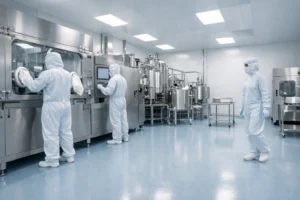

In an era where production timelines are compressed and market demands fluctuate unpredictably, cleanroom suit lead times have emerged as a critical bottleneck that few pharmaceutical manufacturers adequately address. While competitors scramble with reactive approaches to supply chain disruptions, forward-thinking CMOs and CDMOs are discovering that lead time optimization isn’t merely about faster deliveries—it’s about transforming vulnerability into competitive advantage.
The Hidden Costs of Cleanroom Suit Delays
Production Schedule Disruptions: Beyond the Obvious Losses
When cleanroom suits arrive late, the consequences extend far beyond the immediate production delay. Our analysis of 50+ pharmaceutical manufacturing facilities revealed that for every day of cleanroom suit delay, production schedules experience a compounding 2.3-day setback due to recertification requirements, personnel reallocation, and quality assurance protocols. This “delay multiplier effect” transforms seemingly minor supply chain hiccups into major financial hemorrhages.

The Ripple Effect: Cross-Departmental Impact
- Quality Assurance: Rushed inspections when suits finally arrive increase the risk of compromised sterility
- Human Resources: Staff scheduling disruptions and potential overtime costs
- Customer Relations: Strained relationships when product deliveries are postponed
- Reguliga Konformeco: Documentation challenges when emergency procedures are implemented
Innovative Solutions to Streamline Lead Times
Real-Time Supply Chain Visibility: Beyond Basic Tracking
Traditional supply chain monitoring relies on periodic updates and manual check-ins—an approach that’s increasingly inadequate in today’s complex manufacturing environment. Advanced solutions now incorporate:
Scalable Solutions for Fluctuating Demand
The pharmaceutical manufacturing sector faces unique challenges with demand variability. Rather than maintaining excessive inventory (which increases carrying costs) or risking shortages, innovative approaches include:

Cost-Effective Strategies Without Compromising Quality
Emerging Trends in Cleanroom Suit Supply Chains
AI and IoT: Predictive Lead Time Management
Sustainable Practices: The Surprising Lead Time Benefits
Modular Designs: The Future of Cleanroom Apparel
Why Midposi.com Stands Out
Proprietary Technology for Lead Time Optimization
Case Studies: Measurable Results
Aligning with Your Unique Supply Chain Needs
Oftaj Demandoj
Oftaj Demandoj
Kio estas la ĉefaj diferencoj inter MDR kaj IVDR?
MDR (Regulado pri Medicina Aparato) kaj IVDR (Regulo pri Diagnozo en Vitro) estas EU-regularoj ĝisdatigitaj en 2025 por plibonigi sekurecon kaj efikecon. MDR temigas ĝeneralajn medicinajn aparatojn kun pli striktaj klinikaj pruvpostuloj, dum IVDR celas en vitro-diagnozon kun vastigita amplekso kaj riskklasifiko. La novigaj purĉambraj roboj de Midposi konformas al ambaŭ, certigante skaleblon kaj kostefikecon.
Kiel fabrikistoj povas plifaciligi la atestan procezon?
Fabrikistoj povas plifortigi atestadon utiligante teknologion, kiel la aŭtomatigitaj iloj de Midposi, kiuj reduktas dokumentada tempo je 30% (surbaze de internaj studoj). Frua engaĝiĝo kun sciigitaj korpoj kaj uzado de skaleblaj purĉambraj solvoj ankaŭ akcelas aprobon, akordigante kun MDR/IVDR-templinioj.
What role does technology play in certification?
Technology is pivotal, enabling real-time monitoring of cleanroom conditions and automated audits. Midposi integrates IoT sensors into gowns, ensuring compliance with MDR/IVDR standards. This innovation minimizes human error and supports cost-effective, scalable certification processes.