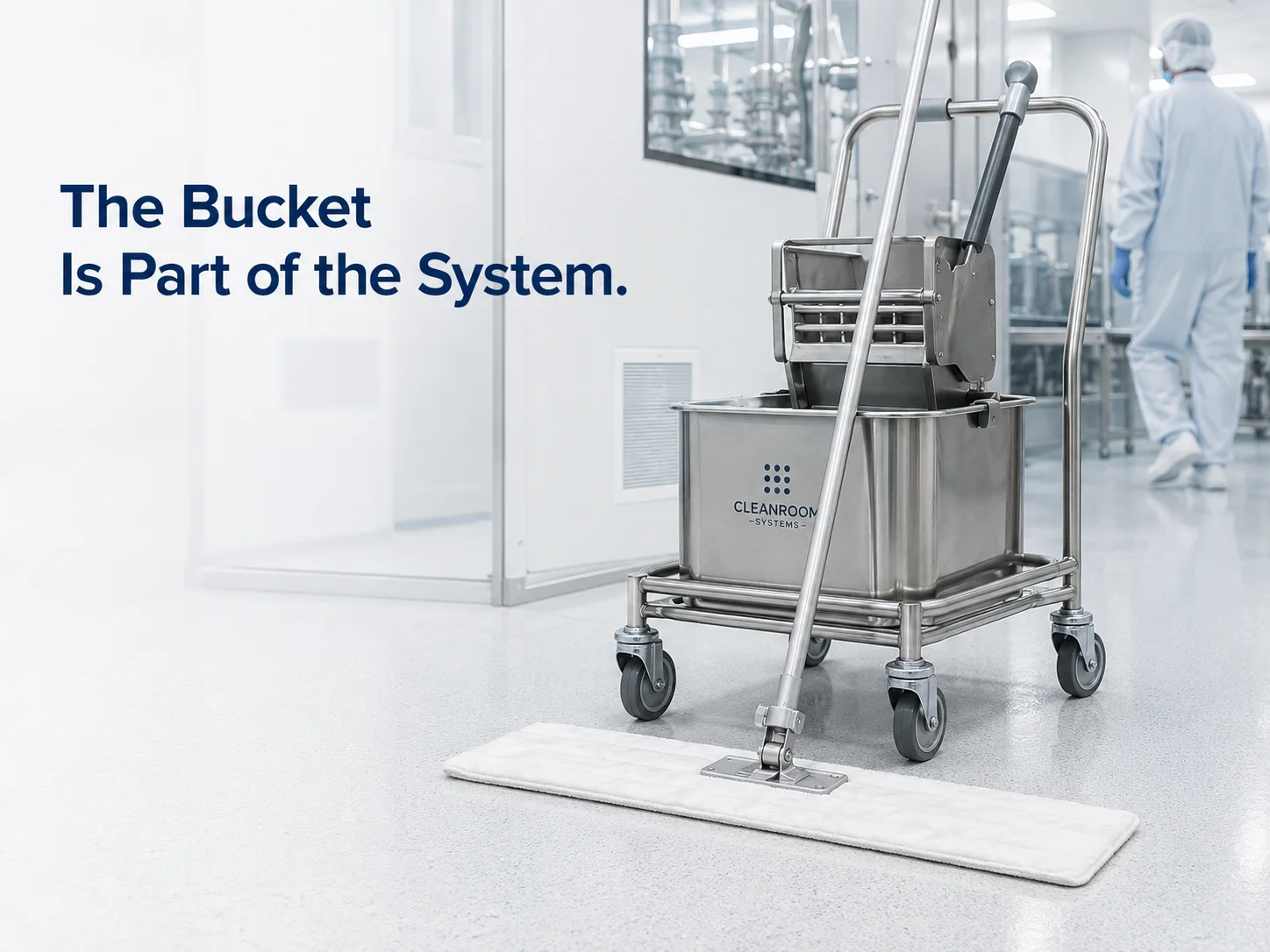
El cubo y el escurridor para fregona de sala blanca son el cuarto componente de un sistema completo de fregona y el que con más frecuencia se pasa por alto en las especificaciones de adquisición. Si bien los cabezales, marcos y mangos de los trapeadores reciben una evaluación estructurada, el balde y el escurridor a menudo se tratan como accesorios de limpieza genéricos. Se trata de un error de especificación con consecuencias operativas: falta de coincidencia dimensional con el marco del trapeador, desprendimiento de partículas de materiales incompatibles del cubo y un sistema de gestión de soluciones no validado que socava la consistencia de la limpieza. Esta guía proporciona los criterios de selección para evaluar los sistemas de cubeta y escurridor con el mismo rigor que se aplica a los otros tres componentes.
Tres criterios distinguen un balde y un escurridor aptos para salas blancas de un balde de limpieza de uso general: material (acero inoxidable o polímero validado compatible con salas blancas, no plástico sin tratar que arroje partículas), compatibilidad dimensional (la abertura del escurridor debe coincidir con el ancho del marco del trapeador y la profundidad del balde debe adaptarse a la geometría del marco), y capacidad de gestión de soluciones (El sistema debe admitir la preparación, la frecuencia de cambio y la eliminación de la solución validada; no queda a discreción del operador). Un depósito que no cumple cualquiera de estos tres criterios introduce una variable no validada en un protocolo de limpieza que, de otro modo, está documentado y controlado.
| Característica | Cubo de limpieza | Cucharón apto para salas limpias |
|---|---|---|
| Material | Plástico sin tratar (PE, PP): puede desprender partículas, absorber productos químicos y albergar contaminación en los poros de la superficie. | Acero inoxidable 304/316 o polímero validado para salas limpias: superficie lisa, que no se desprende y químicamente resistente |
| Compatibilidad con escurridor | Abertura genérica: puede no coincidir con el ancho del marco del trapeador para sala blanca. Presión desigual durante el escurrido. | Abertura del escurridor adaptada al ancho específico del marco. Distribución uniforme de la presión en el cabezal del trapeador durante la eliminación de la solución. |
| Gestión de soluciones | Sin marcas de volumen. El cambio de solución queda a discreción del operador. | Marcas de volumen graduado. Capacidad definida adaptada a la cobertura del área de limpieza. Opción de doble cubeta para separación de limpio/sucio. |
| Acabado superficial | Rugoso o texturizado: alberga residuos, difíciles de validar como limpios. | Suave y sin grietas. Rugosidad superficial definida (valor Ra). Limpiable y visualmente inspeccionable. |
| Documentación | Ninguno | Certificado de material, especificaciones dimensionales, documentación de acabado superficial, declaración de compatibilidad química. |
Para conocer un argumento más amplio a nivel de sistema sobre por qué es importante la compatibilidad de los componentes, incluidas las interfaces entre el cabezal y el marco y entre el mango y el marco, consulte la Por qué es importante el sistema completo de fregado para salas blancas guía. Para obtener una descripción general fundamental, consulte la Descripción general del sistema de trapeador para sala limpia.
Un balde de limpieza de uso general utilizado en una sala limpia no sólo es subóptimo: introduce activamente vectores de contaminación que el resto del protocolo de limpieza está diseñado para controlar. Los siguientes cuatro modos de falla describen por qué es importante la especificación de un depósito.
Los baldes de plástico sin tratar tienen una microtextura superficial que libera partículas cuando se agitan, y un balde que contiene una solución limpiadora se agita constantemente durante su uso. La superficie plástica también se desgasta con el tiempo, generando partículas adicionales. En una sala limpia de Grado B donde se monitorean los recuentos de partículas, un balde que desprende partículas puede ser la fuente de una excursión de monitoreo ambiental que desencadena una investigación, y el balde rara vez es la primera variable examinada.
Algunos plásticos se degradan cuando se exponen a desinfectantes oxidantes (peróxido de hidrógeno, ácido peracético) durante un contacto prolongado. Un balde que contiene una solución esporicida para un turno de 8 horas puede experimentar una degradación de la superficie que no es visible pero que libera subproductos químicos en la solución de limpieza, alterando la concentración efectiva del desinfectante y potencialmente dejando residuos en las superficies limpias.
Las superficies de plástico porosas o texturizadas albergan residuos en grietas microscópicas. Cuando el balde se “limpia” entre usos, la inspección visual puede mostrar una superficie limpia, pero las pruebas con hisopo pueden revelar residuos de desinfectante, agente de limpieza o contaminación microbiana en los poros de la superficie. Un balde que no se puede validar como limpio entre usos no es una herramienta compatible con salas blancas.
Un auditor que revisa el protocolo de limpieza pregunta: "¿Cuál es la especificación del contenedor de solución de limpieza?" Si la respuesta es “un balde de limpieza estándar” (sin especificación de materiales, sin documentación dimensional, sin validación de capacidad de limpieza), el auditor ha identificado una brecha en el programa de control de la contaminación. Esta única pregunta puede derivar en una revisión más amplia de todos los consumibles de limpieza no validados. Para conocer los requisitos de herramientas específicos de grado GMP, consulte la Guía de selección de grados de trapeador para salas blancas GMP.
| Material | Calificación | Idoneidad para salas blancas | Consideraciones clave |
|---|---|---|---|
| Acero inoxidable 316 | De primera calidad | Grado A/B/C/D | Máxima resistencia química (el contenido de molibdeno resiste las picaduras de cloruro). Esterilizable en autoclave. Superficie lisa que no se desprende. Costo más alto. Preferido para ambientes asépticos de Grado A/B donde la exposición química es más agresiva. |
| Acero inoxidable 304 | Estándar | Grado C/D; Grado A/B evaluado caso por caso | Buena resistencia química para la mayoría de los desinfectantes para salas blancas. Esterilizable en autoclave. Más rentable que el 316. Puede ser susceptible a las picaduras de cloruro con una exposición prolongada a desinfectantes a base de cloro (que generalmente deben evitarse en la limpieza de salas blancas de todos modos). |
| Polipropileno / HDPE | Aceptable (si está validado) | Grado C/D (con validación del proveedor) | Peso más ligero que el acero inoxidable. Menor costo. Se debe verificar que no haya desprendimiento de partículas para el grado específico. Se debe validar la compatibilidad química con los desinfectantes específicos de la instalación. No apto para autoclave: limita las opciones de esterilización. La condición de la superficie se degrada con el tiempo; Vida útil más corta que el acero inoxidable. |
| Acero Galvanizado / Pintado | No aceptable | No utilizar en ninguna sala limpia. | El revestimiento de zinc (galvanizado) se corroe con los desinfectantes comunes. Los desconchones de pintura se convierten en contaminación por partículas. No se puede validar que la superficie sea compatible con salas blancas. |
El acero inoxidable es el material preferido para los sistemas de cubetas y escurridores de salas blancas en entornos GMP. La prima del material sobre el plástico se justifica por: vida útil más larga (el acero inoxidable no se degrada con la exposición química repetida), esterilizabilidad en autoclave (admite la esterilización interna si es necesario) y acabado superficial documentable (los valores Ra se pueden especificar y verificar). Para las zonas de soporte de Grado C/D donde el costo es una limitación principal y la exposición a productos químicos es menos agresiva, se pueden evaluar polímeros validados de grado de sala limpia como una alternativa, siempre que el proveedor pueda documentar el rendimiento de eliminación de partículas y la compatibilidad química.
El escurridor controla cuánta solución se elimina del cabezal del trapeador antes de cada pasada y, por lo tanto, cuánta solución se aplica al piso. Esto afecta directamente el tiempo de contacto del desinfectante, el tiempo de secado del piso y la consistencia de la limpieza. El tipo de escurridor debe seleccionarse según los requisitos del protocolo de limpieza, no según la disponibilidad.
| Tipo | Cómo funciona | Mejor para | Limitaciones |
|---|---|---|---|
| tipo prensa | El operador presiona el cabezal del trapeador (aún en el marco) contra una placa plana o curva. La solución se exprime mediante presión mecánica. | Uso ligero a moderado. Instalaciones con requisitos de gestión de soluciones sencillas. Menor mantenimiento: pocas piezas móviles. | La consistencia de la eliminación de la solución depende de la técnica del operador: la presión aplicada varía entre operadores y durante un turno. Menos consistente que el tipo rodillo. |
| tipo rodillo | El cabezal del trapeador pasa entre dos rodillos que exprimen la solución mientras el operador pasa el trapeador. | Instalaciones que requieren una eliminación constante de soluciones entre operadores y turnos. Programas de limpieza de mayor volumen. | Más piezas móviles: los rodillos y los cojinetes requieren mantenimiento. La presión del rodillo debe calibrarse y verificarse periódicamente. Mayor costo inicial que el tipo prensa. |
| Manos libres / Con pedal | El operador activa el escurridor con el pedal, manteniendo las manos alejadas de la solución. El cabezal de la fregona se presiona o enrolla mecánicamente. | Entornos asépticos de grado A/B donde se debe minimizar el contacto del operador con la solución de limpieza. Instalaciones con estrictos protocolos de higiene del personal. | Mayor complejidad. El enlace mecánico entre el pedal y el escurridor requiere mantenimiento. Mayor costo. Puede que no sea necesario para entornos de grado C/D. |
El ancho de la abertura del escurridor debe coincidir con el ancho del marco del trapeador. Una abertura del escurridor demasiado estrecha no aceptará el marco; el operador no podrá escurrir el cabezal del trapeador en absoluto. Una abertura del escurridor demasiado ancha aplica una presión desigual: el centro del cabezal del trapeador se escurre más que los bordes, lo que deja un exceso de solución en los extremos del marco, lo que genera una humedad inconsistente en el piso y un tiempo de contacto variable con el desinfectante. Antes de especificar un escurridor, verifique el ancho del marco desde la Tipos de marcos de trapeador para sala blanca especificación y confirme que la abertura del escurridor se adapta a ese ancho con el cabezal del trapeador montado.
Un sistema de un solo cubo contiene un depósito de solución de limpieza. A medida que el operador trapea, la solución se contamina progresivamente con residuos del piso. Hacia el final de la sesión de limpieza, el operador aplica una solución cada vez más contaminada a las superficies, lo que puede dejar residuos y reducir la eficacia de la limpieza. Un sistema de dos cubos separa la solución limpia (un cubo) de la sucia (el otro cubo, en el que drena el escurridor). El cabezal del trapeador se enjuaga en el balde de solución sucia, se escurre y luego se vuelve a cargar con una solución limpia del segundo balde. Se prefieren los sistemas de doble cubeta para la limpieza GMP porque mantienen la calidad de la solución durante toda la sesión de limpieza.
La capacidad del cucharón debe calcularse en función de la cobertura del área de limpieza y la tasa de aplicación de la solución, no seleccionada por el tamaño aproximado. Una fórmula general:
Volumen de solución requerido por cambio = área de limpieza (m²) × tasa de aplicación de solución (L/m²)
La tasa de aplicación de la solución depende del material del cabezal del trapeador, el tipo de desinfectante y el tiempo de contacto requerido, y debe establecerse durante la validación de la limpieza. La capacidad del cucharón debe acomodar este volumen más un margen de trabajo (normalmente +20%) para evitar que el operador se quede sin solución antes de completar el área de limpieza designada. Si el balde es demasiado pequeño, el operador debe interrumpir la limpieza para volver a llenarlo, lo que introduce una desviación en el proceso. Si el depósito es demasiado grande, es posible que la solución no se utilice más allá de su vida útil validada.
El POE de limpieza debe definir cuándo se cambia la solución, no dejarlo a discreción del operador. Los desencadenantes validados incluyen: después de un área definida (m²), después de un número definido de habitaciones, cuando se observa suciedad visible o en un intervalo de tiempo definido (si la solución tiene una vida útil validada). El balde debe tener marcas de volumen graduadas para respaldar la verificación de la preparación de la solución: el operador llena hasta una marca definida, no “aproximadamente esta cantidad”.
Almacenamiento de cubo, escurridor y mango de fregona integrado en un carro de acero inoxidable. El operador empuja una unidad a través del área de limpieza, sin tener que regresar a un cucharón estacionario. Los cabezales de fregona se transportan en el carro para su cambio.
Balde y escurridor como unidades estacionarias. El operador regresa a la ubicación del cubo para escurrir y recargar el cabezal del trapeador.
The decision between trolley-mounted and standalone depends on: floor area per cleaning zone, number of zones per shift, operator count, and corridor accessibility. Large facilities with open production suites benefit from trolley systems. Multi-room facilities with tight corridors may find standalone buckets more practical per room.
The bucket and wringer — like any other cleanroom tool — should be supported by documentation that demonstrates fitness for purpose in a GMP environment. The following documentation should be requested from the supplier:
Para obtener el marco completo de documentación del proveedor que cubre todos los componentes del sistema de trapeador, consulte la Documentos de validación de fregona para salas blancas. guía.
Una instalación especifica los cabezales y marcos de los trapeadores para salas blancas de un proveedor calificado y compra el balde de un catálogo de suministros de limpieza. El cubo arroja partículas, el plástico es incompatible con el desinfectante esporicida y la abertura del escurridor no coincide con el ancho del marco. El cabezal de fregona más cuidadosamente especificado en el protocolo de limpieza más rigurosamente validado se ve socavado por un balde no validado.
Corrección: Especifique el balde y el escurridor como parte de la adquisición del sistema de trapeador, no como una compra de limpieza por separado. Si el proveedor del trapeador no ofrece sistemas de cubeta/escurridor, evalúe alternativas aptas para salas blancas con especificaciones de materiales documentadas y compatibilidad dimensional.
El cubo está ordenado. El marco está ordenado. Nadie verificó que el marco pase por la abertura del escurridor. El operador descubre esto el primer día de uso y fuerza el marco (dañando el cabezal del trapeador o el escurridor) o se salta el paso de escurrido (aplicando el exceso de solución al piso). Ambos resultados son desviaciones del protocolo.
Corrección: Antes de adquirirlo, verifique el ancho de la abertura del escurridor con el ancho del marco con el cabezal del trapeador montado. Documente esta verificación. Si el proveedor del sistema de trapeador ofrece un balde/escurridor compatible, esta verificación es responsabilidad del proveedor; confirme que esté incluida en las especificaciones del sistema.
La especificación de adquisición dice "cubo y escurridor" sin mencionar el tipo de escurridor. El proveedor ofrece la opción más económica: un escurridor básico tipo prensa. El protocolo de limpieza de la instalación requiere una eliminación constante de la solución durante un tiempo de contacto validado con el desinfectante. El escurridor tipo prensa produce resultados variables dependiendo de la técnica del operador: algunos operadores presionan más fuerte que otros, y el mismo operador presiona de manera diferente al principio y al final de un turno. El tiempo de contacto validado supone una aplicación constante de la solución, que el escurridor especificado no ofrece.
Corrección: Specify the wringer type (press, roller, or hands-free) in the procurement document. If the cleaning protocol requires validated solution removal consistency, a roller-type wringer provides more reproducible results than press-type. Match the wringer type to the protocol’s requirements, not to the lowest-cost option.
Los cabezales de fregona llegan con COA, certificados de materiales y documentación de esterilidad. El cubo llega con un albarán. Durante una auditoría, el paquete de documentación de la herramienta de limpieza está completo para los cabezales, marcos y mangos, y vacío para el balde y el escurridor. El auditor pregunta: "¿De qué está hecho este cubo? ¿Es compatible con sus desinfectantes? ¿Se ha validado su capacidad de limpieza?" Las respuestas no están documentadas.
Corrección: Solicite certificación de materiales, especificaciones dimensionales y documentación de compatibilidad química para el balde y el escurridor; el mismo estándar de documentación se aplica a los demás componentes del sistema de trapeador. Incluya estos documentos en la carpeta de documentación de la herramienta de limpieza.
Los baldes de limpieza de uso general generalmente están hechos de plásticos sin tratar que desprenden partículas cuando se agitan, pueden ser químicamente incompatibles con los desinfectantes para salas blancas, tienen superficies porosas que albergan contaminación y carecen de las especificaciones dimensionales necesarias para verificar la compatibilidad con el marco del trapeador. En un entorno GMP, cada herramienta que entra en contacto con la solución de limpieza o la superficie limpia es parte del protocolo de limpieza validado: un balde no validado introduce una variable no controlada.
Acero inoxidable: 316 para entornos de Grado A/B con la exposición química más agresiva, 304 para entornos de Grado C/D. El acero inoxidable proporciona una superficie lisa que no desprende partículas, resistencia química a los desinfectantes comunes para salas blancas, esterilizabilidad en autoclave y acabado superficial documentable (valores Ra). Los polímeros validados para salas blancas (polipropileno, HDPE) se pueden evaluar para zonas de grado C/D donde el costo es una limitación principal, siempre que el proveedor pueda documentar el rendimiento de eliminación de partículas y la compatibilidad química.
Si la abertura del escurridor es demasiado estrecha, no se podrá insertar el marco y no se podrá escurrir el cabezal de la fregona. Si la abertura del escurridor es demasiado ancha, la presión es desigual: el centro del cabezal del trapeador se escurre más que los bordes, lo que genera una aplicación inconsistente de la solución y un tiempo de contacto variable con el desinfectante en toda la superficie del piso. El ancho de la abertura del escurridor debe verificarse con el ancho del marco antes de la compra. La especificación debe provenir del proveedor del sistema de trapeador como un conjunto combinado, no de mediciones independientes.
Se prefieren los sistemas de dos cubos para la limpieza GMP. Separan la solución limpia de la sucia: el cabezal del trapeador se enjuaga en el balde para la solución sucia, se escurre y se vuelve a cargar con la solución limpia del segundo balde. Esto mantiene la calidad de la solución durante toda la sesión de limpieza y evita la aplicación progresiva de una solución cada vez más contaminada a las superficies limpiadas. Los sistemas de un solo cubo pueden ser aceptables para la limpieza de áreas pequeñas con cambios frecuentes de solución, pero la frecuencia de cambio de solución debe definirse y validarse, no dejarse a discreción del operador.
La capacidad del cucharón debe calcularse como: área de limpieza (m²) × tasa de aplicación de solución (L/m²) + 20% de margen de trabajo. La tasa de aplicación de la solución depende del material del cabezal del trapeador, el tipo de desinfectante y el tiempo de contacto requerido, y debe establecerse durante la validación de la limpieza. El balde debe contener suficiente solución para completar el área de limpieza designada sin necesidad de volver a llenarlo. Los cubos de tamaño insuficiente obligan a rellenarlos a mitad de la limpieza (desviación del proceso). Los cubos de gran tamaño pueden provocar que la solución permanezca sin utilizarse más allá de su vida útil validada.
Los sistemas montados en carro son mejores para la limpieza de áreas grandes (pasillos, salas de producción) donde la reducción de los viajes del operador mejora la productividad. Los cubos independientes son mejores para la limpieza de áreas pequeñas o zonas específicas (habitaciones individuales) donde un carro no sería práctico o donde los cubos dedicados por zona reducen el riesgo de contaminación cruzada. La decisión depende del área de piso por zona, el número de operadores y la accesibilidad del corredor.
Los cubos y escurridores de acero inoxidable se pueden esterilizar en autoclave; esta es una de las ventajas del acero inoxidable sobre las alternativas de polímeros. El proveedor debe confirmar la compatibilidad del autoclave, incluida la temperatura máxima y el tipo de ciclo. Los cubos de polímero generalmente no se pueden esterilizar en autoclave; pueden deformarse o degradarse a las temperaturas del autoclave. Si se requiere la esterilización interna de los equipos de limpieza, el acero inoxidable es el material adecuado.
At minimum: material certification (mill test report or composition statement for stainless steel), dimensional specifications (capacity, wringer opening width, overall dimensions), surface finish documentation (Ra value for stainless steel), chemical compatibility statement with common cleanroom disinfectants, and autoclave compatibility confirmation if sterilization is required. This documentation should be included in the cleaning tool documentation binder alongside the documentation for mop heads, frames, and handles.
Especifique las dimensiones del marco de su trapeador, los grados de la sala blanca y los requisitos de administración de la solución de limpieza. MIDPOSI proporciona recomendaciones de escurridores y baldes de acero inoxidable aptos para salas blancas con certificaciones de materiales para la documentación de auditoría.
La disponibilidad de la documentación puede variar según la configuración del producto. Documentación técnica estándar proporcionada con cada consulta.
{
“@contexto”: “https://schema.org”,
“@gráfico”: [
{
“@tipo”: “Artículo”,
“headline”: “Cleanroom Mop Bucket and Wringer Systems — A Selection Guide for GMP Facilities”,
"description": "Cómo seleccionar sistemas de cubo de trapeador y escurridor para salas blancas. Abarca materiales de acero inoxidable, tipos de escurridor, compatibilidad de marcos, planificación de capacidad y documentación de validación para instalaciones GMP".,
“autor”: { “@tipo”: “Organización”, “nombre”: “MIDPOSI” },
“editor”: { “@tipo”: “Organización”, “nombre”: “MIDPOSI”, “url”: “https://midposi.com/” },
“fecha de publicación”: “{{DATE_PUBLISHED_PENDING}}”,
“fechaModificada”: “{{DATE_MODIFIED_PENDING}}”,
“mainEntityOfPage”: { “@type”: “WebPage”, “@id”: “https://midposi.com/cleanroom-mop-bucket-wringer-selection-guide/” },
“imagen”: “https://midposi.com/wp-content/uploads/2026/02/cleanroom-mop-system-stainless-steel-trolley.webp”,
“ArtículoSección”: “Componentes del sistema de trapeador para salas blancas”,
“palabras clave”: “escurridor de cubeta para trapeador para sala limpia, cubeta para sala limpia de acero inoxidable, cubeta de limpieza GMP, sistema de escurridor para sala limpia”
},
{
“@tipo”: “Página de preguntas frecuentes”,
“entidad principal”: [
{ “@type”: “Pregunta”, “name”: “¿Por qué no se puede usar un balde de limpieza de uso general en una sala limpia GMP?”, “acceptedAnswer”: { “@type”: “Respuesta”, “text”: “Los baldes de limpieza de uso general generalmente están hechos de plásticos sin tratar que desprenden partículas, pueden ser químicamente incompatibles con los desinfectantes de salas blancas, tienen superficies porosas y carecen de especificaciones dimensionales. Un balde no validado introduce un variable no controlada en el protocolo de limpieza validado”. } },
{ “@type”: “Question”, “name”: “What is the preferred material for cleanroom bucket and wringer systems?”, “acceptedAnswer”: { “@type”: “Answer”, “text”: “Stainless steel — 316 for Grade A/B, 304 for Grade C/D. Provides smooth, non-shedding surface, chemical resistance, autoclavability, and documentable surface finish. Validated cleanroom-grade polymers may be evaluated for Grade C/D where cost is a primary constraint.” } },
{ “@type”: “Question”, “name”: “How does wringer-to-frame compatibility affect cleaning workflow?”, “acceptedAnswer”: { “@type”: “Answer”, “text”: “A wringer opening too narrow prevents frame insertion. Too wide creates uneven pressure and inconsistent solution application. The wringer opening width must be verified against frame width before procurement — ideally as a matched set from the mop system supplier.” } },
{ “@type”: “Pregunta”, “name”: “Cucharón único o doble: ¿cuál es apropiado para la limpieza GMP?”, “acceptedAnswer”: { “@type”: “Respuesta”, “text”: “Se prefieren los sistemas de dos cucharones para la limpieza GMP. Separan la solución limpia y sucia, manteniendo la calidad de la solución durante toda la sesión. El uso de un solo cucharón puede ser aceptable para la limpieza de áreas pequeñas con cambios frecuentes y validados de solución”. } },
{ “@type”: “Question”, “name”: “How is bucket capacity determined for a specific cleaning area?”, “acceptedAnswer”: { “@type”: “Answer”, “text”: “Capacity = cleaning area (m²) × solution application rate (L/m²) + 20% margin. The application rate depends on mop material, disinfectant type, and contact time — established during cleaning validation. The bucket must hold enough solution to complete the designated area without refilling.” } },
{ “@type”: “Question”, “name”: “Trolley-mounted or standalone bucket — when does each make sense?”, “acceptedAnswer”: { “@type”: “Answer”, “text”: “Trolley-mounted: large-area cleaning where reducing operator trips improves productivity. Standalone: small-area or zone-specific cleaning where trolleys are impractical or dedicated buckets per zone reduce cross-contamination risk.” } },
{ “@type”: “Question”, “name”: “Can bucket and wringer systems be autoclaved?”, “acceptedAnswer”: { “@type”: “Answer”, “text”: “Stainless steel buckets and wringers can be autoclaved — confirmed by supplier for specific temperature and cycle type. Polymer buckets are generally not autoclavable and may warp or degrade at autoclave temperatures.” } },
{ “@type”: “Question”, “name”: “What documentation should a bucket/wringer supplier provide?”, “acceptedAnswer”: { “@type”: “Answer”, “text”: “Material certification, dimensional specifications (capacity, wringer width, overall dimensions), surface finish documentation (Ra value for stainless steel), chemical compatibility statement, and autoclave compatibility confirmation if required.” } }
]
},
{
“@tipo”: “Lista de rutas de navegación”,
“itemListElement”: [
{ “@tipo”: “ListItem”, “posición”: 1, “nombre”: “Inicio”, “artículo”: “https://midposi.com/” },
{ “@tipo”: “ListItem”, “posición”: 2, “nombre”: “Blog”, “elemento”: “https://midposi.com/blog/” },
{ “@type”: “ListItem”, “position”: 3, “name”: “Cleanroom Mop Bucket and Wringer Guide”, “item”: “https://midposi.com/cleanroom-mop-bucket-wringer-selection-guide/” }
]
}
]
}