...

Pharmaceutical Cleanroom Mop Selection for GMP Environments

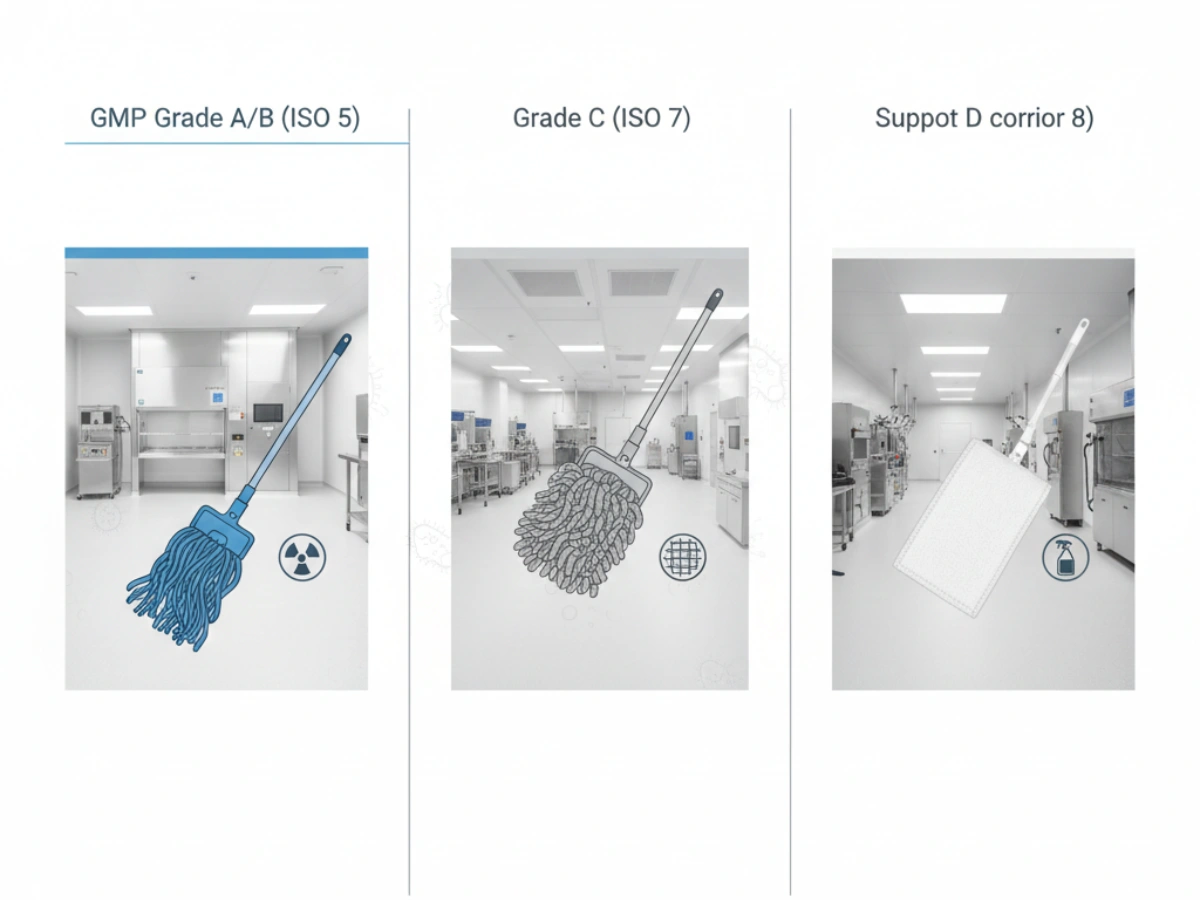
In pharmaceutical manufacturing, the selection of cleaning and disinfection tools is a regulated technical decision with direct implications for sterility assurance. Under Good Manufacturing Practice (GMP), cleanroom mops are not treated as general housekeeping items; they are classified as controlled consumables that interact with critical surfaces and must therefore be qualified, validated, and managed within the site’s quality system.

With the revision of EU GMP Annex 1, regulatory focus has shifted decisively toward a structured and documented Estrategia de control de la contaminación (CAC). Cleaning tools now sit squarely within this framework. This article outlines the regulatory rationale and technical considerations for cleanroom mop selection across GMP grades, with the objective of supporting audit readiness, microbial control, and risk-based decision making.

1. Why Cleanroom Mops Are Critical Under EU GMP Annex 1

EU GMP Annex 1 explicitly requires manufacturers to identify all potential sources of contamination and define appropriate control measures. Cleanroom mops represent a unique risk category because they are deliberately brought into contact with critical surfaces and are repeatedly handled by operators during routine operations.

Bioburden and Cross-Contamination Risks

Inadequately qualified mops may shed fibers that act as carriers for microorganisms or fail to deliver disinfectants uniformly at the validated concentration and contact time. Either scenario undermines the effectiveness of the cleaning process and weakens the integrity of the CCS.

Surface Contact and Operator Transfer

Mops are frequently moved across functional zones. If construction, ergonomics, or transfer controls are insufficient, routine cleaning activities can become vectors for contamination rather than mitigation measures. Selection should therefore align with documented risk assessments and the broader GMP Cleanroom Mop qualification logic.

3. Packaging and Aseptic Transfer: Why Double or Triple Bagging Matters

Material transfer is a frequent inspection focus. Cleaning tools must cross multiple cleanliness zones without introducing uncontrolled contamination.

Triple-bag sterile cleanroom mop packaging illustrating staged aseptic transfer through GMP airlocks
Multi-layer packaging enables controlled transfer into Grade B/A areas without compromising sterility.
  • Outer bag removal in unclassified or Grade D areas
  • Intermediate bag removal in Grade C or airlock
  • Inner sterile bag opened only in Grade B/A
QA distinction: “Sterile packaged” does not equal “sterility validated.” Only products supported by validated processes (e.g. ISO 11137) should be used in Grade A/B. See Sterile & Aseptic Cleanroom Mop.

4. Documentation Required for GMP Mop Qualification

  • Batch-specific COA: particulates, NVR, absorbency.
  • Sterilization certificate: dose range and validated cycle.
  • Change control: mandatory notification of process or material changes.
  • Batch traceability: finished mop → raw material → sterilization run.

These elements form the foundation of supplier qualification under GMP Cleanroom Mop expectations.

5. Common GMP Audit Risks Related to Mop Selection

  • Use of generic data sheets instead of batch-specific COAs
  • Incorrect sterility mapping in Grade A/B areas
  • Single-bag packaging requiring manual decontamination
These findings often indicate broader weaknesses in supplier qualification and CCS execution rather than isolated procedural errors.

Conclusión

Cleanroom mop selection in pharmaceutical environments is a technical, risk-based decision embedded within the site’s Contamination Control Strategy. It must reflect GMP grade requirements, validated aseptic transfer practices, and the robustness of supplier quality systems.

By prioritizing qualification, documentation, and audit readiness over unit cost, QA and Validation teams ensure that cleaning activities support, rather than jeopardize, regulatory compliance. Supplier qualification should therefore precede procurement, ensuring that every cleaning tool is demonstrably fit for purpose under modern GMP and Annex 1 expectations.

Pida una cotización rápida

Nos comunicaremos con usted dentro de 1 día hábil, preste atención al correo electrónico con el sufijo “@midposi.com”.

¡Es gratis!

《9 trampas mortales en el abastecimiento de prendas para salas limpias en China》

libro electronico 400
22

Pida una cotización rápida

Nos comunicaremos con usted dentro de 1 día hábil, preste atención al correo electrónico con el sufijo “*@midposi.com”.

Seraphinite AcceleratorOptimized by Seraphinite Accelerator
Turns on site high speed to be attractive for people and search engines.