Gestión del ciclo de vida de validación de salas limpias: una guía completa
Understand the full cleanroom validation lifecycle from DQ, IQ, OQ, and PQ through ongoing verification, requalification, and change control for GMP and ISO environments.

Respuesta del fragmento destacado
Cleanroom validation lifecycle management covers the complete control framework from design qualification through ongoing performance verification. It helps manufacturers maintain GMP and ISO compliance, reduce contamination risk, and keep cleanroom performance documented throughout the facility’s operational life.
Conclusiones clave
- La validación de la sala limpia es un proceso de ciclo de vida, no un evento de calificación único.
- DQ, IQ, OQ y PQ verifican cada uno diferentes aspectos de la preparación y el control de la sala limpia.
- La verificación continua y el análisis de tendencias son esenciales para mantener el estado validado.
- La recalificación debe ser provocada por el cronograma, los eventos y la variación del desempeño.
- Un fuerte control de cambios protege la integridad de la validación y la calidad del producto.
Introducción
Cleanroom validation is a continuous lifecycle that extends beyond initial IQ, OQ, and PQ certification. Ongoing performance verification and periodic requalification are essential to maintain compliance and ensure product quality throughout the cleanroom’s operational life.
Many regulatory findings stem from weak lifecycle control, including inadequate requalification, incomplete documentation, poor trend analysis, and ineffective change control. A lifecycle-based validation approach helps close these gaps and strengthen GMP inspection readiness.
Descripción general del ciclo de vida de validación
The cleanroom validation lifecycle includes initial validation, ongoing verification, and long-term maintenance of the validated state. In practical terms, this means building a system that not only qualifies the room at the beginning, but also keeps it under control over time.
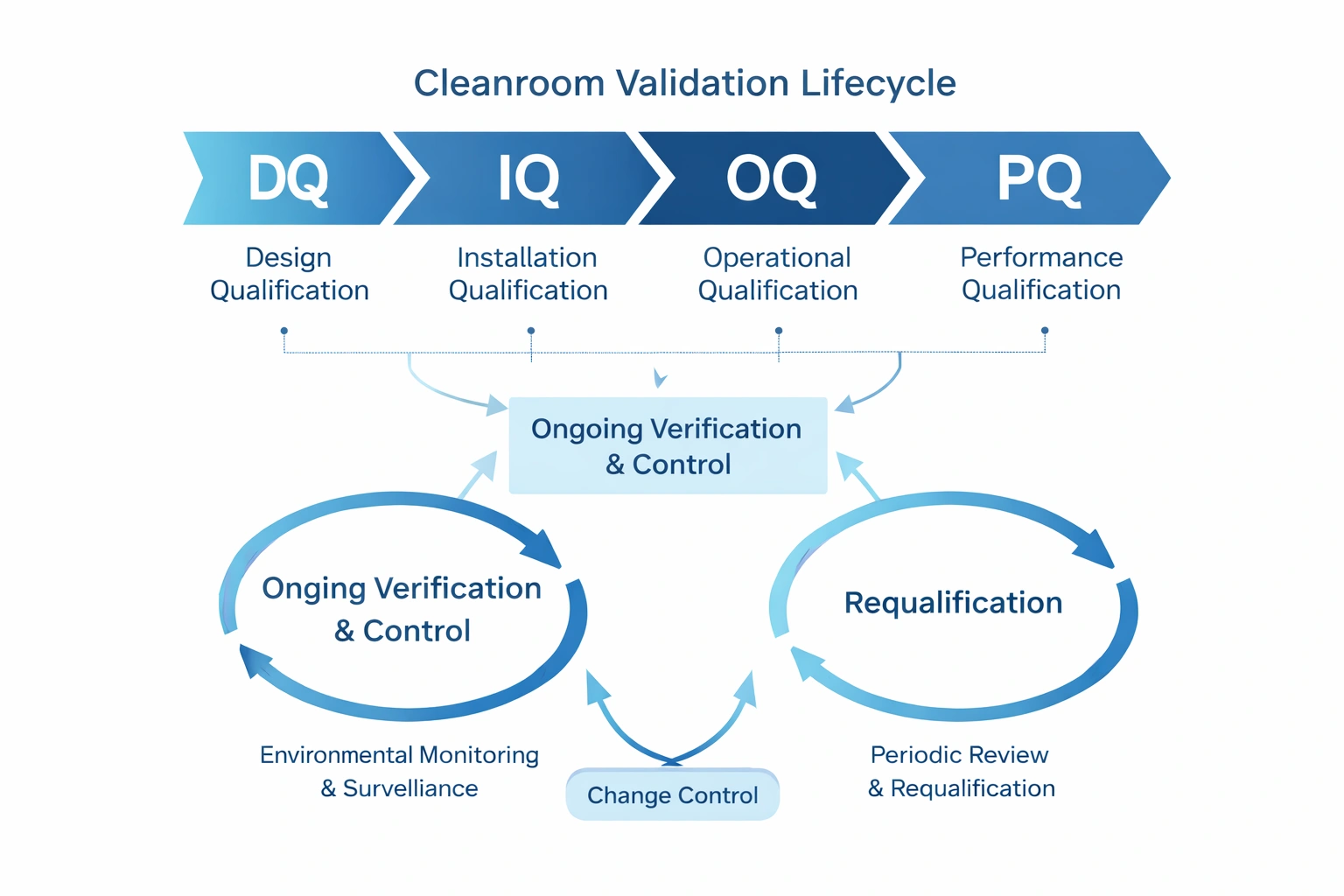
Validación inicial
DQ, IQ, OQ, PQ y versión inicial para su uso.
Verificación continua
Monitoreo ambiental, análisis, revisión y control de tendencias.
Recalificación & Cambiar
La recalificación y la evaluación de cambios mantienen la integridad del ciclo de vida.
| Fase | Duración típica | Desencadenar | Dueño |
|---|---|---|---|
| DQ | 2 a 4 semanas | Inicio de nuevo proyecto | Ingeniería |
| coeficiente intelectual | 2 a 4 semanas | Construcción completa | Instalaciones |
| OQ | 4 a 8 semanas | coeficiente intelectual completo | Validación |
| PQ | 3 a 6 meses | OQ completa | Validación |
| Verificación continua | En curso | Certificación inicial completa | control de calidad |
| Recalificación | 2 a 4 semanas | Evento anual o desencadenante | Validación |
Calificación de diseño (DQ)
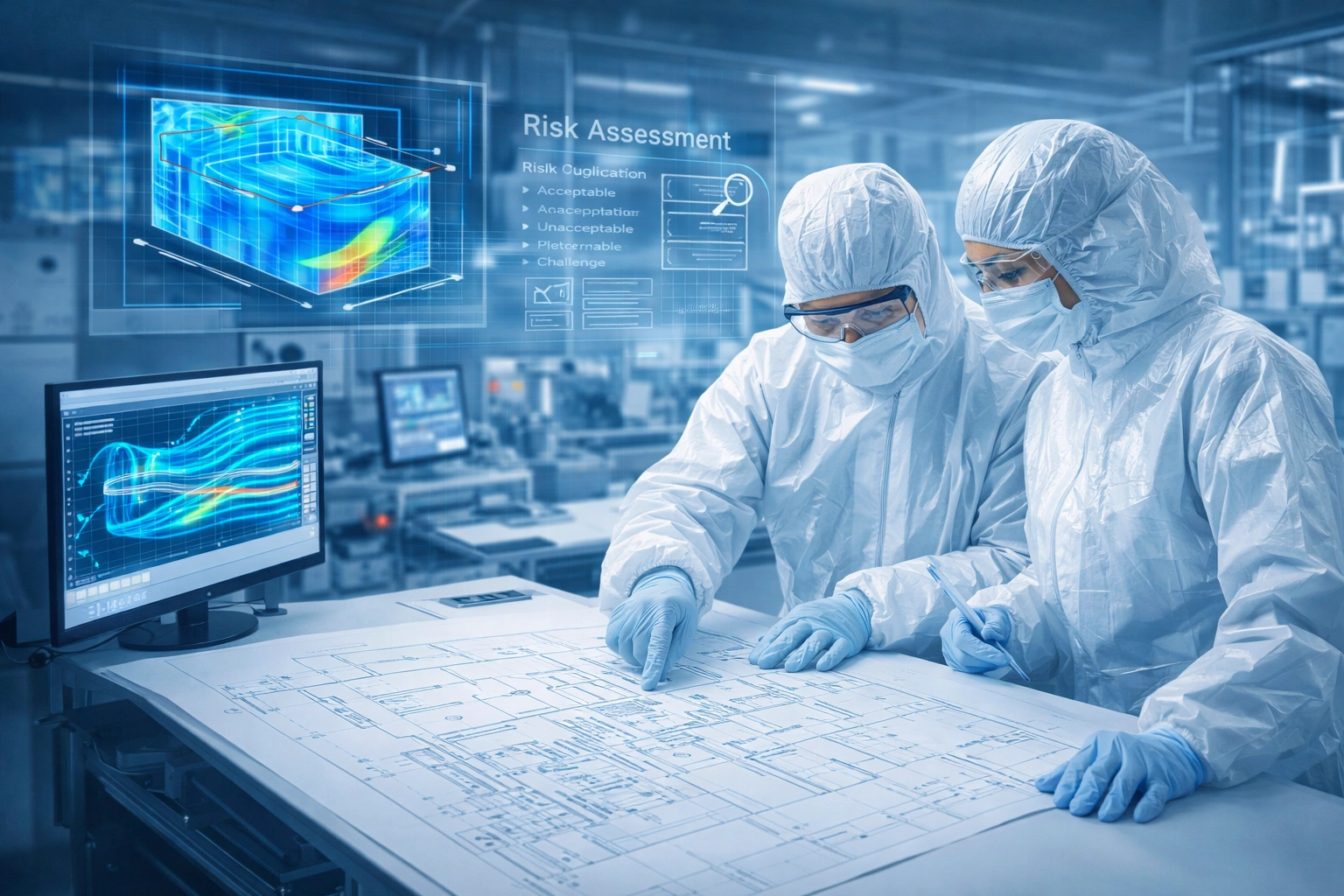
Design Qualification verifies that the cleanroom design meets user requirements and is suitable for the intended process, cleanliness class, and contamination control strategy.
Enfoque DQ
- Especificación de requisitos del usuario (URS)
- Especificación de diseño funcional (FDS)
- Evaluación de riesgos y revisión de la contaminación.
- Revisión del diseño de las partes interesadas
- Aprobación DQ documentada
Preguntas clave
- ¿El diseño cumple con los requisitos del usuario previsto?
- ¿Puede el sistema alcanzar el grado de limpieza objetivo?
- ¿Se identifican y mitigan los principales riesgos de contaminación?
- ¿La documentación de diseño está completa y es revisable?
Calificación de instalación (IQ)
IQ provides documented verification that the cleanroom and its supporting systems have been installed according to design specifications, approved drawings, and utility requirements.
Paquete de documentación IQ
- protocolo de coeficiente intelectual
- Dibujos conforme a obra
- Registros de instalación
- Registros de conexión de servicios públicos
- Certificados de calibración
- Informe resumido de coeficiente intelectual
Enfoque de aceptación del coeficiente intelectual
- Instalado según las especificaciones aprobadas.
- Utilidades conectadas y funcionales.
- Instrumentación crítica calibrada
- Documentación completa y rastreable.
- Se pasaron todas las comprobaciones de instalación requeridas.
Calificación operativa (OQ)
OQ demonstrates that the cleanroom operates within predetermined limits under anticipated operating conditions. Typical OQ activities include airflow, pressure, particle, temperature, humidity, alarm, and interlock verification.
| Criterio | Requisito típico | Enfoque de aceptación |
|---|---|---|
| Velocidad del flujo de aire | Dentro del rango especificado | Todas las ubicaciones críticas dentro del alcance |
| Uniformidad del flujo de aire | ±20% de la media | Perfil estable y repetible |
| Diferencial de presión | Dentro de la cascada objetivo | Se mantienen todas las relaciones de presión. |
| Recuento de partículas | Cumple con la clase ISO | Clasificación en reposo lograda |
| Temperatura/HR | Dentro de la banda de consigna | El entorno sigue siendo controlable |
Calificación de desempeño (PQ)
PQ verifies that the cleanroom performs effectively and reproducibly under normal operating conditions with actual personnel activity, process simulation, and product-related contamination risk.

Periodo 1
Verificación de referencia en condiciones controladas y de baja actividad.
Periodo 2
Simulación de procesos de rutina con seguimiento alineado al plan EM.
Periodo 3
Verificación de rendimiento extendida o en el peor de los casos para mayor coherencia.
Verificación continua
Ongoing verification is what keeps the validated state alive after release. It typically includes environmental monitoring, continuous parameter monitoring, periodic trend analysis, deviation review, and assessment of whether requalification is needed.
Actividades típicas
- Monitoreo ambiental según plan aprobado
- Revisión de presión, temperatura y humedad.
- Análisis de tendencias trimestrales o periódicos
- Revisión de la preparación para la auditoría
- Seguimiento de recalificación
Por qué es importante
- Detecta tempranamente la variación del rendimiento
- Apoya CAPA y la reducción de riesgos
- Fortalece la preparación para la inspección GMP
- Proporciona evidencia de control continuo.
Estrategia de recalificación
Requalification should be based not only on a schedule, but also on change events and performance signals. A robust strategy combines annual review with event-based and trend-based triggers.
Activadores programados
Ciclo de revisión anual e intervalos de calificación definidos por SOP.
Activadores de eventos
Mantenimiento mayor, reemplazo de HEPA, modificaciones de HVAC, cambios de procesos.
Activadores de rendimiento
Excursiones repetidas, tasas de alerta crecientes, deterioro inexplicable, deriva.
Control de cambios
Change control protects validation integrity by ensuring each relevant modification is assessed before implementation. The goal is to determine whether the change has no validation impact, requires partial requalification, or requires expanded requalification.
Registros de control de cambios requeridos
- Solicitud de cambio
- Evaluación de impacto
- Revisión de riesgos
- Recalificación del plan
- Evidencia de aprobación e implementación
- Registros de validación actualizados
Resultados típicos
- Sin impacto, no se necesita recalificación
- Impacto menor: se requiere calificación enfocada
- Impacto importante: se requiere recalificación total o ampliada
Preguntas frecuentes
¿Con qué frecuencia se debe realizar la recalificación de las salas blancas?
Annual review is common, but requalification should also be triggered by significant maintenance, process changes, major modifications, repeated excursions, or evidence of performance degradation.
¿Cuál es la diferencia entre validación inicial y recalificación?
Initial validation establishes the original validated state through DQ, IQ, OQ, and PQ. Requalification confirms that the validated state remains acceptable after time, use, or change.
¿Cómo puedo determinar si un cambio requiere recalificación?
Review whether the change affects airflow, pressure cascade, filtration, environmental control, process conditions, contamination risk, or documentation status. The higher the impact, the broader the scope.
¿Qué documentación se requiere para la gestión del ciclo de vida de validación?
Typical records include DQ, IQ, OQ, and PQ protocols and reports, environmental monitoring records, trend analyses, requalification files, change control records, and approval evidence.
¿Por qué es importante la gestión del ciclo de vida de validación para la calidad del producto?
Because cleanroom control is not static. Lifecycle management helps maintain the validated state, detect drift early, reduce contamination risk, and support consistent product quality.