
Introduction
Cleanroom gowning procedures are one of the most important personnel contamination-control measures in pharmaceutical manufacturing. Annex 1 (2022 revision) made gowning expectations more explicit by requiring formal gowning qualification, ongoing monitoring, and tighter controls over entry to Grade A environments. :contentReference[oaicite:2]{index=2}
Your original article correctly emphasizes that gowning failures are among the top contamination sources in cleanroom operations. A strong gowning program should not only define what PPE to wear, but also how to wear it, how to qualify personnel, how to monitor compliance, and how to prevent contamination during de-gowning. :contentReference[oaicite:3]{index=3}
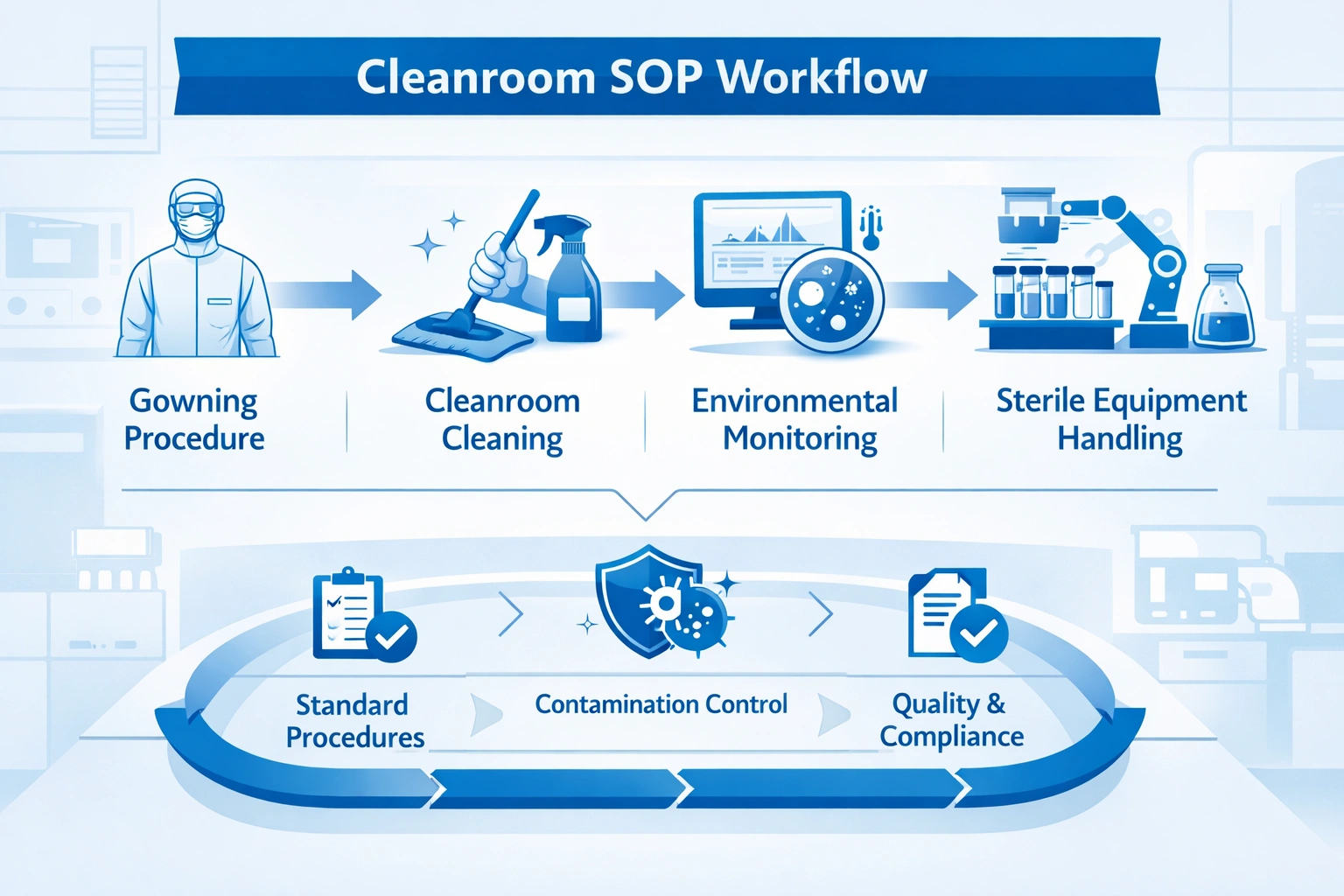
Regulatory Requirements
Annex 1 expects grade-specific gowning controls and requires that gowning for Grade A areas be formally qualified. Personnel must demonstrate that they can gown correctly and repeatedly without creating unacceptable microbiological contamination. :contentReference[oaicite:4]{index=4}
| Grade | Requirement focus | Practical meaning |
|---|---|---|
| Grade A (ISO 5) | Qualified sterile gowning | Full sterile PPE and formal qualification before entry |
| Grade B (ISO 7) | Full non-sterile gowning | Coverall, hood, gloves, and shoe covers with visual control |
| Grade C / D | Clean room attire | Basic cleanroom clothing appropriate to zone risk |
| All grades | Training, procedures, monitoring | Documented SOPs, training, and compliance review required |
Gowning Requirements by Grade
Grade A (ISO 5)
Required sterile PPE
- Sterile bouffant cap or full hair cover
- Sterile face mask
- Sterile goggles or eye protection
- Sterile hood
- Sterile coveralls
- Sterile gloves
- Sterile shoe covers / over-shoes
Control objective
- No exposed skin
- No exposed hair
- No PPE gaps at neck, wrists, or ankles
- Fit sufficient to allow movement without opening barriers
Grade B (ISO 7)
Grade B typically requires non-sterile full-body gowning including coveralls, hood, gloves, and shoe covers. The control objective is still full coverage, but sterility expectations are lower than Grade A.
Grade C / D (ISO 8 / 9)
Grade C and D generally require clean room attire appropriate to contamination risk, such as hair cover, lab coat or smock, gloves, and dedicated footwear or shoe covers.
Gowning Procedure Steps
Your original article provides a strong Grade A step sequence. For publication, the most important thing is to make the logic clear: preparation first, then head and face coverage, then body coverage, then gloves and footwear, followed by final visual inspection. :contentReference[oaicite:5]{index=5}
Step 1: Preparation
Remove jewelry, watches, cosmetics, and personal items. Perform hand washing and dry hands thoroughly before touching PPE.
Step 2: Head coverage
Don hair cover and hood so that all hair and neck areas are protected with no loose strands exposed.
Step 3: Eye and face protection
Apply mask and goggles correctly so the barrier remains complete and does not create gaps with the hood.
Step 4: Body coverage
Don coveralls with correct fit. The garment should provide full coverage without being so loose that it creates risk or so tight that it tears.
Step 5: Gloves
Sanitize hands, don sterile gloves, and ensure the glove overlaps the garment cuff with no exposed skin.
Step 6: Footwear
Don sterile shoe covers or over-shoes and verify complete coverage and safe fit.
Step 7: Final check
Supervisor or trained reviewer verifies no exposed skin, no PPE gaps, and correct fit before entry into the zone.
Gowning Qualification
Annex 1 requires that personnel entering Grade A environments demonstrate successful gowning qualification. Your original article correctly states that 3 consecutive tests with fully acceptable results are required before personnel may enter Grade A areas. :contentReference[oaicite:6]{index=6}
| Grade | Test type | Samples | Acceptance criteria |
|---|---|---|---|
| Grade A (ISO 5) | Settle plates | 3 per person | 0 CFU per plate |
| Grade A (ISO 5) | Finger imprint pads | 5 per person | 0 CFU per pad |
| Grade B (ISO 7) | Settle plates | 3 per person | ≤ 1 CFU per plate |
| Grade C (ISO 8) | Settle plates | 1 per person | ≤ 5 CFU per plate |
| Grade D (ISO 9) | Settle plates | 1 per person | ≤ 10 CFU per plate |
De-gowning Procedures
De-gowning is often treated as a lower-risk activity, but your original article correctly shows that it can become a cross-contamination event if PPE is removed incorrectly. The basic principle is controlled removal inside-out, with waste segregation and hand washing at the end. :contentReference[oaicite:7]{index=7}
Best-practice sequence
- Exit into designated de-gowning area
- Remove shoe covers
- Remove gloves
- Remove coverall inside-out
- Remove hood and hair cover inside-out
- Perform hand washing
Why de-gowning fails
- Touching face or exposed skin during removal
- Improper waste handling
- Removing PPE in the wrong order
- Pulling garments in a way that spreads contamination
Gowning Monitoring
A compliant gowning system requires more than initial training. It requires continuous visual oversight, periodic microbiological testing, and annual requalification. This is one of the strongest compliance sections in your original article and should remain central in the published version. :contentReference[oaicite:8]{index=8}

| Monitoring point | Frequency | Expectation |
|---|---|---|
| Hair coverage | Every entry | No hair exposed |
| Fit and gaps | Every entry | No visible openings |
| Tears / damage | Every entry | No damage to PPE |
| Glove integrity | Every entry | No tears or holes |
| Microbiological testing | Periodic / quarterly | Within zone-specific criteria |
| Requalification | Annually | Current and approved |
Common Issues & Remediation
Your original article identifies the most common gowning failures clearly: hair exposure, PPE gaps, torn gloves, contaminated PPE, and poor fit. These are exactly the kinds of issues that should drive retraining, size review, and tighter supervision. :contentReference[oaicite:9]{index=9}
| Issue | Typical root cause | Recommended remediation |
|---|---|---|
| Hair exposed | Incorrect hair cover or hood placement | Retraining and supervisor verification |
| PPE gaps | Wrong size or poor fit | Re-size garments and repeat fit check |
| Torn gloves | Wrong glove size or weak handling practice | Replace gloves and retrain technique |
| Contaminated PPE | Reuse of single-use items or poor storage | Enforce single-use policy and storage control |
| Microbiological failure | Technique or environment-related contamination | Root-cause review, retraining, requalification |
Need Help Building an Annex 1 Gowning System?
Get practical guidance on gowning SOP structure, qualification design, compliance monitoring, and contamination-risk reduction for controlled environments.
- Annex 1-aligned gowning workflow guidance
- Qualification and retraining logic
- Monitoring and audit-readiness improvement
Questions fréquemment posées
How long is gowning qualification valid?
Initial qualification is typically valid for 1 year, with annual requalification required under Annex 1. Earlier requalification may be triggered by procedure change, contamination events, or extended personnel absence.
Can sterile gowning PPE be reused?
No. Grade A sterile gowning PPE should be treated as single-use to protect sterility assurance and reduce cross-contamination risk.
What happens if personnel fail gowning qualification?
Personnel should be retrained, root cause reviewed, and re-tested. They should not enter Grade A areas until qualification is successfully completed.
How do I choose the correct PPE size?
Size should be selected to ensure full coverage without tears, excessive looseness, or movement-related gaps. Initial fit verification is essential.
Can I wear jewelry or cosmetics in a cleanroom?
No. Jewelry, cosmetics, and personal items are major contamination sources and should not be taken into controlled cleanroom areas.
How do I monitor gowning compliance?
Use visual inspection at every entry, periodic microbiological testing, annual requalification, and environmental monitoring trend review where appropriate.
Recommended Internal Links
- Comment se préparer à un audit de salle blanche BPF — for gowning records, compliance evidence, and audit preparation
- Emplacements de surveillance environnementale dans les salles blanches GMP — for monitoring the effectiveness of gowning and personnel control
- Sterile Cleanroom Mops for Aseptic Processing — for sterile consumables used in Grade A environments
- Cleanroom Maintenance Best Practices — for maintaining gowning rooms and controlled change areas
- Cleanroom Cleaning and Sanitization SOP — for linking gowning with broader contamination-control workflows