What Does Cleanroom IQ OQ PQ Actually Mean?
Cleanroom qualification is the structured process used to prove that a cleanroom and its supporting systems are suitable for intended use. The three most recognized stages are IQ, OQ, and PQ.
In practice, these stages are not just paperwork milestones. They form the evidence chain that links design intent, installation status, operational controls, and routine performance. Without that chain, a cleanroom may appear functional but remain weak from a GMP or audit perspective.
IQ = Installation Qualification
- Confirms systems were installed correctly
- Checks drawings, materials, and components
- Verifies utilities, labeling, and documentation
OQ = Operational Qualification
- Tests the cleanroom under defined operating limits
- Verifies alarms, airflow, pressure, recovery, and controls
- Shows the system behaves as intended
PQ = Performance Qualification
- Demonstrates consistent real-world performance
- Links qualification to actual process conditions
- Supports routine production or operation readiness
Why it matters
- Builds GMP compliance evidence
- Reduces contamination-control uncertainty
- Improves audit defensibility and change control
Why Cleanroom Qualification Matters for GMP Compliance
A cleanroom is not qualified simply because it was built according to specification. It must be shown, with documented evidence, to operate and perform in a controlled, repeatable way. This is especially important in regulated environments where contamination risk, process consistency, and data integrity all matter.
Qualification also protects the business side of operations. A weak validation framework can delay product release, increase deviation investigations, create repeated rework, and undermine procurement decisions. On the other hand, a strong qualification strategy helps standardize equipment selection, SOP execution, environmental monitoring, and cleaning system design.
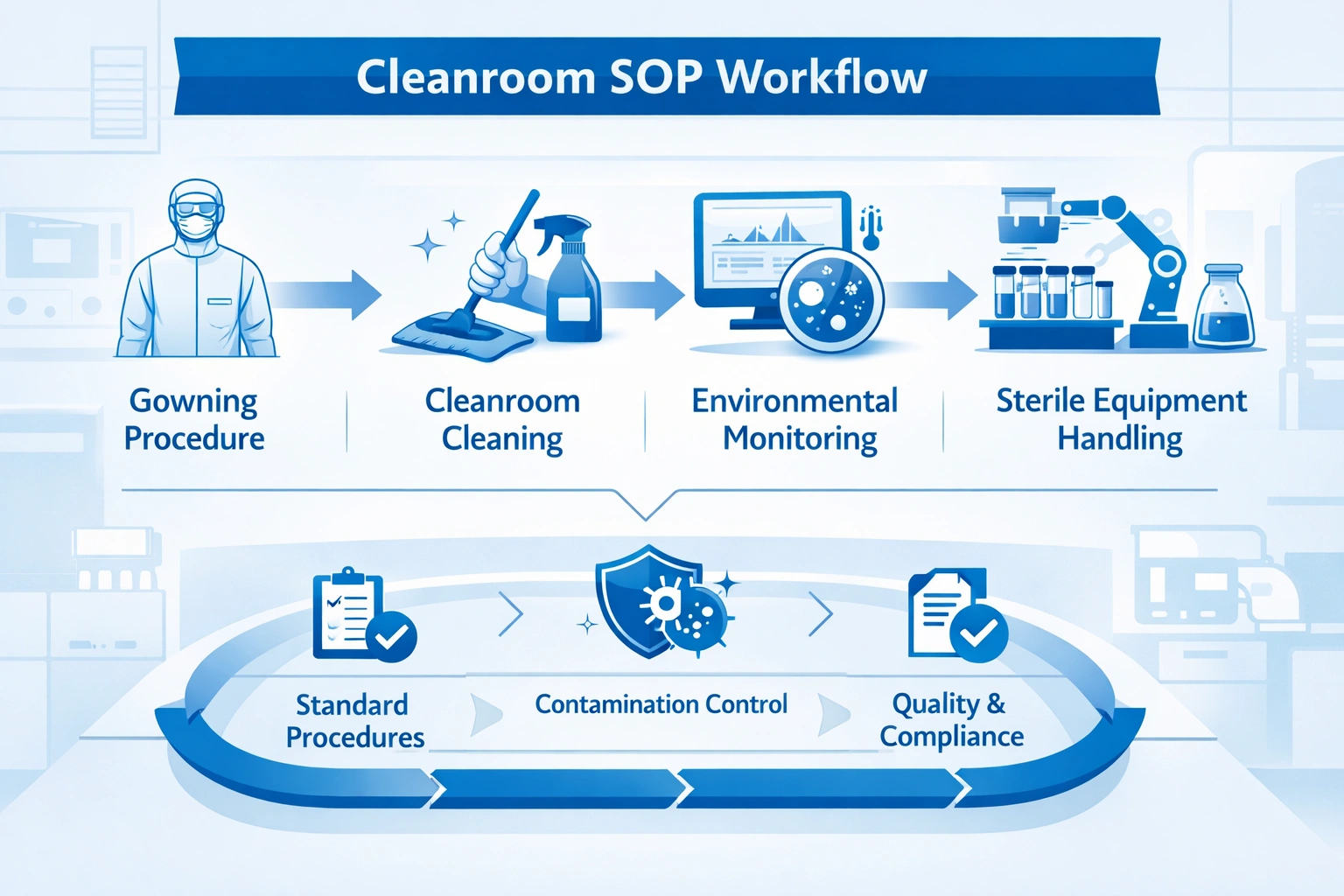
That is why this topic should connect directly with your cleanroom qualification validation SOP template, your FDA cGMP cleanroom validation checklist, and your EU GMP Annex 1 SOP documentation strategy.
Installation Qualification (IQ): Proving the Cleanroom Was Installed Correctly
IQ is the stage where the team confirms the cleanroom and its associated systems match approved design requirements. This includes room construction elements, utilities, HVAC components, HEPA or ULPA filtration setup, instruments, labeling, equipment lists, approved materials, and document traceability.
Typical IQ scope includes:
Design and document review
Approved drawings, specifications, equipment manuals, and material certificates should match the installed condition.
Component verification
Confirm critical components such as air handling units, filters, pressure gauges, doors, pass-throughs, and monitoring devices are correctly installed.
Utility and service confirmation
Validate required electrical, compressed air, water, gas, or control interfaces are correctly connected and identified.
Calibration and identification status
Ensure instruments requiring calibration are identified and controlled before operational testing begins.
IQ is often undervalued, but weak IQ creates downstream failures in OQ and PQ. If the installed condition is not documented properly, later performance results become harder to interpret and defend.
Operational Qualification (OQ): Verifying the Cleanroom Operates Within Defined Limits
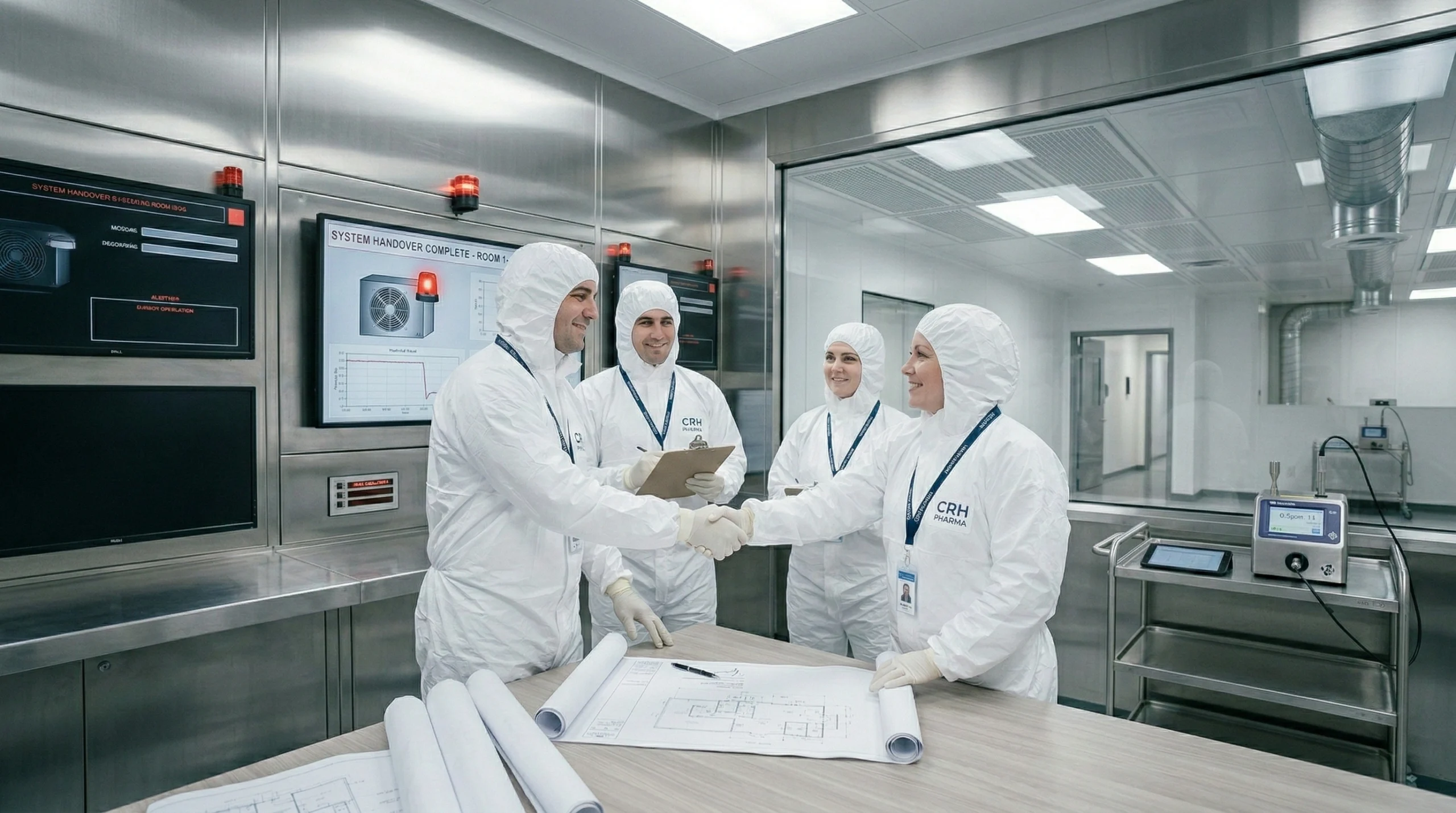
OQ confirms the cleanroom functions as intended under controlled operating conditions. This is where teams test alarms, airflow behavior, pressure differentials, temperature and humidity ranges, air change performance, recovery, and other operating parameters.
The purpose of OQ is not merely to collect numbers. It is to prove that control systems, room behavior, and operating limits are defined, understood, and repeatable.
Common OQ test areas
- Airflow velocity and airflow visualization
- Pressure differential verification
- Temperature and humidity mapping
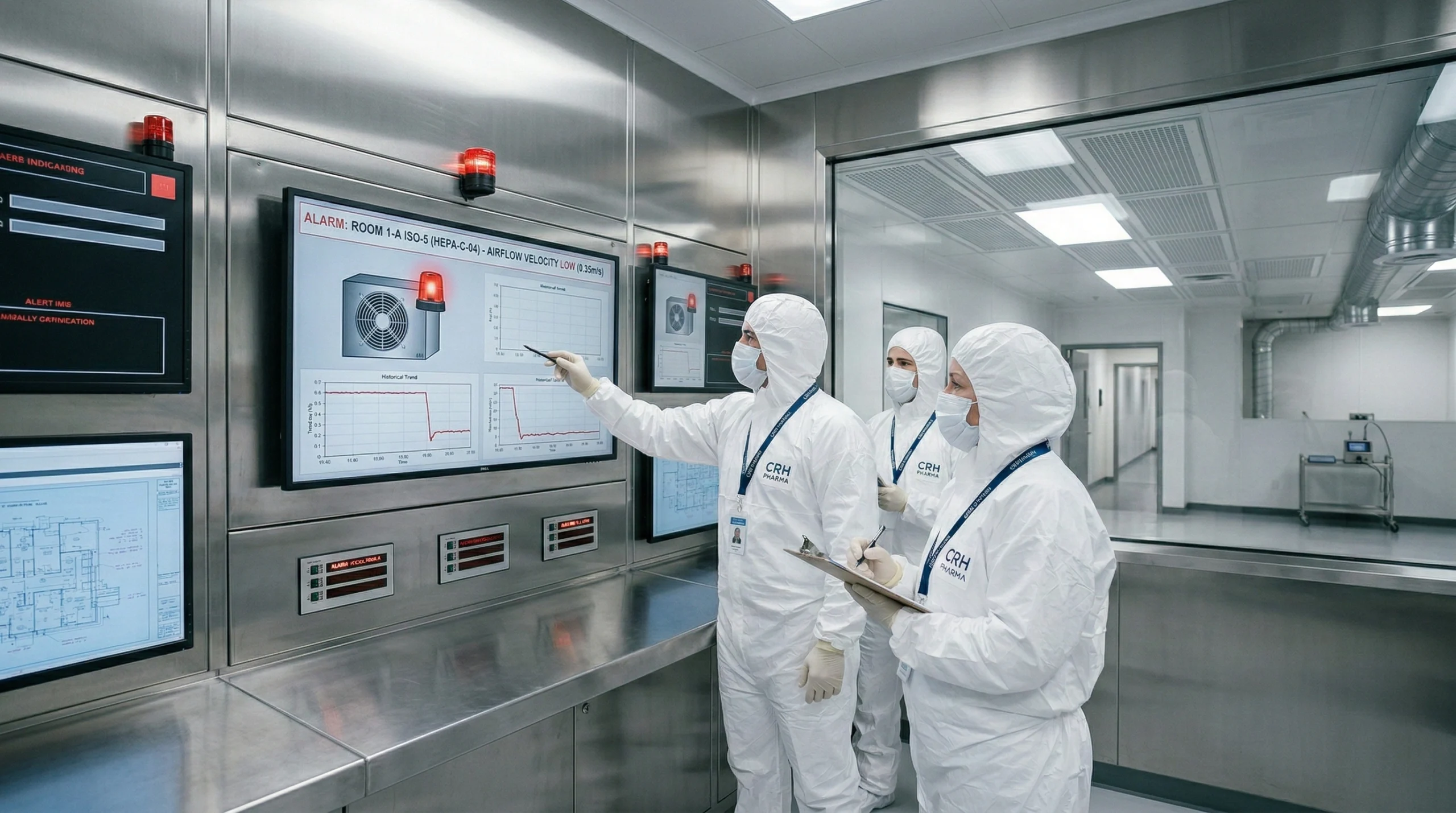
- Alarm challenge tests and response verification
- Recovery time after operational disturbance
- Environmental monitoring strategy alignment
OQ should be closely connected to your risk-based cleanroom environmental monitoring strategy, because routine monitoring logic becomes far stronger when it is built on verified operational behavior rather than assumption.

Performance Qualification (PQ): Demonstrating Reliable Real-World Performance
PQ is the stage where the team proves the cleanroom can consistently support intended use during routine operation. Unlike IQ and OQ, which are often more structured around design and system limits, PQ focuses on actual operating performance, including personnel, workflows, cleaning practices, environmental monitoring trends, and process interaction.
In many regulated facilities, PQ is where the cleanroom becomes genuinely meaningful from a compliance standpoint. It shows that the room does not just operate in theory, but performs reliably in the presence of people, materials, interventions, and routine demand.
PQ usually considers:
- Routine environmental monitoring performance
- Operator gowning and behavior controls
- Cleaning and sanitization effectiveness
- Typical production or process loads
- Trend consistency over time
- Deviation and excursion response maturity
PQ naturally links to cleanroom cleaning SOP, alert and excursion response workflows, and GMP audit preparation.
IQ OQ PQ Qualification Matrix
The table below helps teams quickly separate what belongs in each phase. This is useful for protocol writing, project planning, and avoiding the common mistake of mixing installation evidence with real operational evidence.
| Qualification Stage | Main Objective | Typical Evidence | Key Risk if Weak |
|---|---|---|---|
| IQ | Confirm correct installation | Drawings, equipment lists, certificates, utility checks, labeling, calibration status | Later results may be hard to trust or defend |
| OQ | Verify correct operation within defined limits | Airflow, pressure, alarm, recovery, temp/humidity, control challenge data | Operational conditions remain poorly understood |
| PQ | Demonstrate reliable routine performance | Trend data, workflow evidence, EM outcomes, cleaning effectiveness, ongoing consistency | Real-world compliance risk remains hidden until deviations occur |
How Qualification Connects to Cleaning Systems and Consumable Selection
Qualification does not stop at air handling and room classification. In actual GMP operation, routine performance is shaped by the details: how operators gown, how surfaces are cleaned, which mop systems are used, whether consumables are traceable, and whether SOP execution is consistent.
This is where procurement and contamination-control choices become validation-relevant. A cleanroom may pass formal tests, but still struggle in PQ or ongoing monitoring if routine cleaning materials generate lint, leave residues, or lack documentation support.
Qualification-relevant consumable factors
- Low-lint and cleanroom-compatible construction
- Material consistency and lot control
- Sterility or sterilization route where needed
- Traceable documentation and COA support
Common downstream effect
- Better cleaning reproducibility
- Stronger investigation support
- Fewer unexplained excursions
- More defensible PQ and trend review
Common IQ OQ PQ Qualification Mistakes
1. Treating IQ, OQ, and PQ as paperwork only
When qualification is approached only as a documentation exercise, real operational risks remain hidden until deviations or audits expose them.
2. Mixing stage objectives
Teams often try to prove routine performance during OQ or use PQ data to compensate for weak IQ. Each stage should answer a different question.
3. Ignoring environmental monitoring logic
Qualification is much weaker if monitoring locations and alert/action logic are not connected to actual room behavior and risk.
4. Overlooking cleaning and operator behavior
PQ is not only about equipment. It must reflect how the room performs with people, interventions, materials, and routine cleaning execution.
5. Weak audit traceability
If protocols, raw data, deviations, approvals, and SOP references are not linked clearly, qualification can become difficult to defend during inspection.
Need Validation-Friendly Cleanroom Consumables or Mop Systems?
Midposi supports cleanroom operators, QA teams, and procurement groups that need products aligned with contamination control, documentation readiness, and repeatable cleaning execution.
- Cleanroom mop systems designed for controlled cleaning workflows
- Consumable recommendations that fit qualification and SOP logic
- Support for audit-minded buyers and validation-oriented projects
Recommended Internal Links for This Article
To strengthen topic authority and improve both user depth and Google understanding, this article should be tightly connected to your validation, compliance, SOP, audit, and contamination-control cluster pages. Those page URLs already exist in your uploaded site list. :contentReference[oaicite:2]{index=2}
- Cleanroom Qualification Validation SOP Template — use when discussing protocol structure and lifecycle documentation.
- FDA cGMP Cleanroom Validation Checklist — use when discussing audit-proof evidence and compliance review.
- EU GMP Annex 1 Cleanroom SOP Documentation — use when discussing documentation control and regulatory expectations.
- Risk-Based Cleanroom Environmental Monitoring SOP Guide — use when discussing OQ/PQ monitoring logic.
- How to Prepare for a GMP Cleanroom Audit — use when discussing qualification defensibility.
- Cleanroom Cleaning SOP — use when discussing PQ, routine operation, and cleaning execution.
- Cleanroom Contamination Control Guide — use when discussing why qualification matters beyond paperwork.
Suggested anchor text mix: “cleanroom qualification SOP”, “FDA cGMP cleanroom validation checklist”, “Annex 1 documentation”, “environmental monitoring SOP”, “GMP cleanroom audit”, “cleanroom cleaning SOP”.
Questions fréquemment posées
What is the difference between IQ, OQ, and PQ in cleanroom qualification?
IQ verifies correct installation, OQ verifies correct operation within predefined limits, and PQ demonstrates reliable performance during real routine use.
Why is IQ OQ PQ important for GMP cleanrooms?
It provides the documented evidence that the cleanroom is installed correctly, operates properly, and consistently supports intended use, which is essential for compliance and audit readiness.
Does cleanroom qualification include environmental monitoring and cleaning?
Yes. Especially during OQ and PQ, environmental monitoring strategy, operator behavior, and cleaning effectiveness are all highly relevant to proving controlled routine performance.
Can a cleanroom pass installation checks but still fail performance qualification?
Yes. A room may be installed correctly and operate within technical limits, yet still underperform in routine use due to workflow issues, interventions, poor cleaning execution, or unstable monitoring trends.