A practical buyer guide for selecting mop covers, frames, handles, bucket workflows, disinfectant compatibility, and QA documentation support for pharmaceutical, ISO, laboratory, medical device, electronics, and controlled-environment cleaning.

To choose a cleanroom mop system, buyers should evaluate the cleanroom class, cleaning area, mop cover material, frame and handle compatibility, disposable or reusable workflow, bucket system, disinfectant compatibility, and required QA documentation.
A cleanroom mop system should not be selected by mop cover price alone. In GMP, ISO, pharmaceutical, and controlled environments, the mop cover, frame, handle, fluid-management workflow, and SOP should work together.
Use this practical process before approving a cleanroom mop system for routine cleaning, disinfection, wall and ceiling cleaning, or GMP support-area cleaning.
Confirm whether the mop will be used in ISO cleanrooms, GMP facilities, laboratories, or controlled production spaces.
Compare microfiber, polyester, disposable, and reusable mop cover options based on the cleaning task.
Select a compatible flat mop frame and cleanroom handle for floors, walls, ceilings, and operator ergonomics.
Balance contamination-risk reduction, lifecycle control, reprocessing needs, and operating cost.
Choose single, dual, triple-bucket, or pre-wetted workflows based on contamination-control requirements.
Confirm compatibility with IPA, quats, hydrogen peroxide, bleach, or other facility cleaning agents.
Ask for specifications, material data, packaging information, lot traceability, and compatibility guidance.
Before choosing a cleanroom mop system, define where the mop will be used and what risk level the cleaning task carries.
Pharmaceutical and GMP facilities should evaluate mop selection based on room grade, cleaning SOP, disinfectant program, and QA documentation needs.
View GMP Mop Guide →ISO cleanrooms often require low-lint mop systems for routine floor, wall, ceiling, and support-area cleaning.
Corridors, gowning areas, laboratories, and production support rooms may need different mop materials or workflow controls.
Mop cover material affects residue pickup, lint control, chemical compatibility, surface contact, and cleaning workflow.
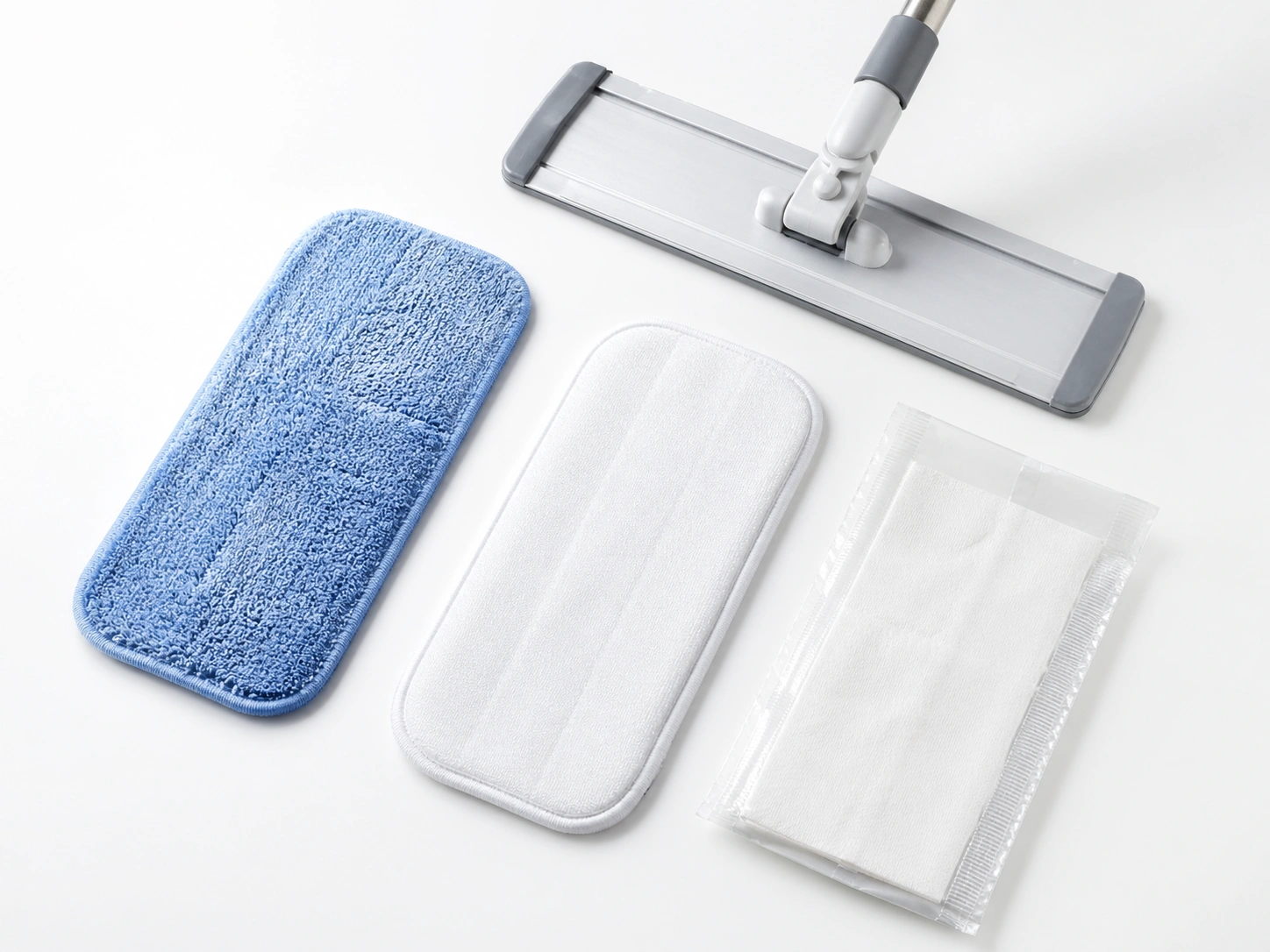
| Material / Type | Idéal pour | Key Consideration | Related MIDPOSI Resource |
|---|---|---|---|
| Microfiber mop cover | Residue pickup, routine floor cleaning, wall and ceiling cleaning | Confirm low-lint construction and chemical compatibility | Vadrouille en microfibre pour salle blanche |
| Polyester mop cover | Low-lint GMP cleaning and higher-control workflows | Check chemical compatibility and edge construction | Système de vadrouille pour salle blanche |
| Disposable mop cover | Reducing reuse-related contamination concerns | Confirm packaging, traceability, and use cycle | Vadrouilles jetables pour salles blanches |
| Reusable mop cover | Cost control in routine cleaning areas | Requires lifecycle, reprocessing, and storage controls | Système de vadrouille pour salle blanche |
A mop cover should not be selected alone. It must fit the frame, handle, cleaning surface, and operator workflow.
The frame should match the mop cover and provide stable contact on cleanroom floors, walls, and smooth panels.
The mop cover should attach securely without creating loose edges, uneven contact, or unnecessary friction.
Handle length should match floor cleaning, wall cleaning, ceiling cleaning, and operator ergonomics.
Good surface contact improves cleaning coverage and helps reduce missed areas during routine mopping.
Disposable and reusable mop systems each have advantages. The right choice depends on contamination-control goals, cost structure, lifecycle control, and internal SOP requirements.
| Facteur | Vadrouille jetable pour salle blanche | Vadrouille réutilisable pour salle blanche |
|---|---|---|
| Contamination-control concern | Aide à réduire les problèmes de contamination liés à la réutilisation | Depends on washing, sterilization, inspection, and storage control |
| Structure des coûts | Coût des consommables par utilisation plus élevé | Lower long-term use cost when lifecycle is controlled |
| Charge de travail de validation | May simplify reuse and lifecycle concerns | Requires reuse tracking and reprocessing controls |
| Meilleur ajustement | High-control areas, simplified tool control, sterile-area support | Routine cleaning areas with well-managed reprocessing |
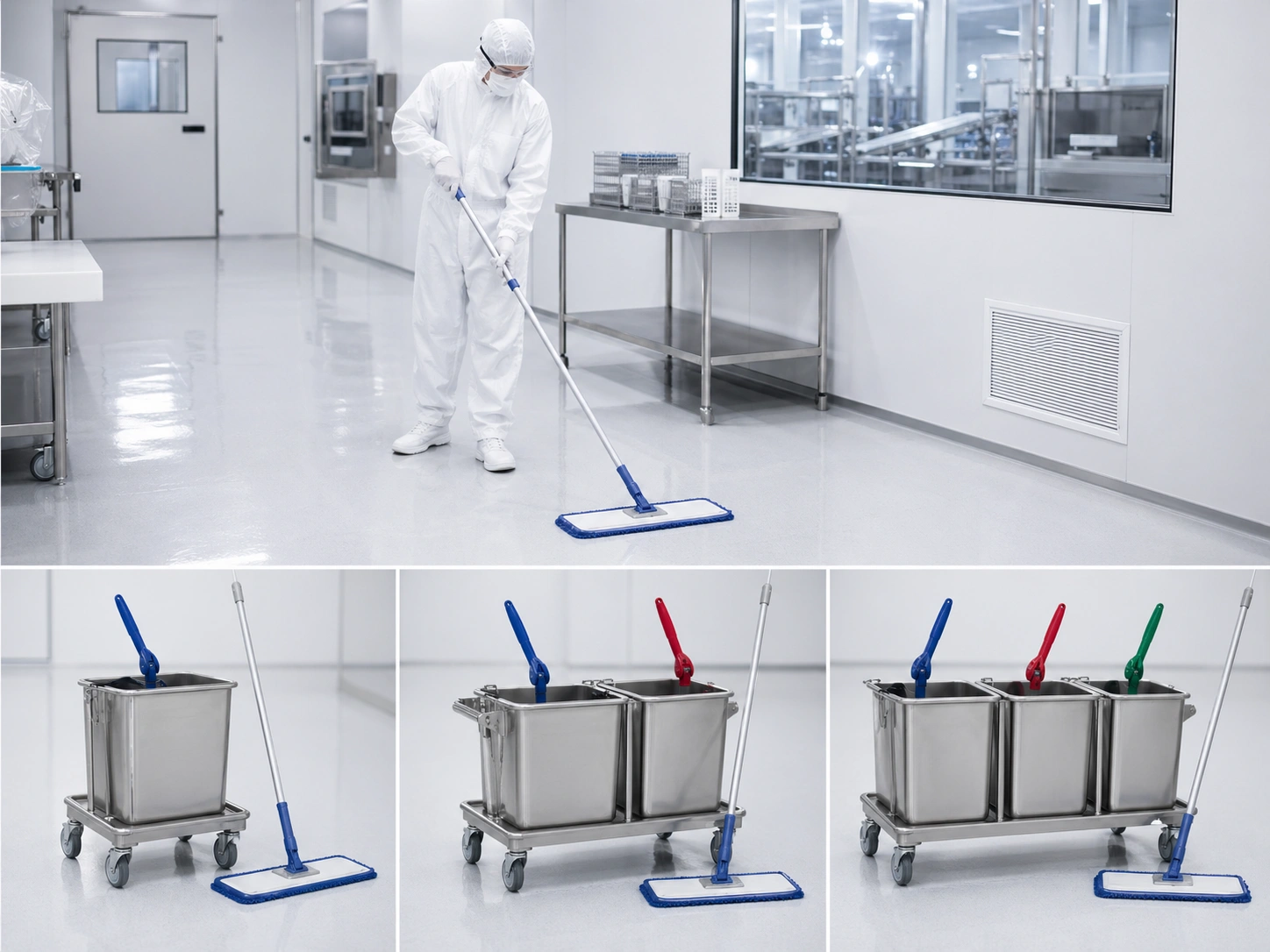
Bucket workflow affects disinfectant preparation, cleaning sequence, rinse control, and waste separation.
| Flux de travail du compartiment | Idéal pour | Control Value |
|---|---|---|
| Single bucket | Zones de support à faible risque | Simple setup, but limited fluid separation |
| Dual bucket | Nettoyage de routine des salles blanches ISO | Separates fresh solution and rinse or waste fluid |
| Triple bucket | Higher-control GMP workflows | Stronger separation of fresh solution, rinse fluid, and waste fluid |
| Pre-wetted mop workflow | Simplified preparation and defined wetting control | Reduces onsite solution preparation steps when properly managed |
Cleanroom mop materials should be compatible with the cleaning agents used in your facility. Compatibility should be confirmed through supplier information and facility-specific testing or review.
70% IPA or similar alcohol-based agents are commonly used in controlled environments. Mop materials should not degrade or shed abnormally after exposure.
Quaternary ammonium compounds, peroxide-based agents, or other disinfectants should be checked against mop cover and frame materials.
Bleach or sodium hypochlorite may be used in some rotational programs. Confirm material stability before approval.
Documentation helps procurement, QA, validation, and cleanroom operations teams evaluate whether the mop system fits the facility’s cleaning program.

Use this matrix as a quick decision tool for matching facility needs to cleanroom mop system direction.
| Facility Need | Direction recommandée | Related Resource |
|---|---|---|
| GMP pharmaceutical cleaning | Low-lint mop system with documentation support | Vadrouille pour salle blanche pour installation GMP |
| ISO routine cleaning | Microfiber or polyester mop system depending on area and SOP | Vadrouille en microfibre pour salle blanche |
| High-control area | Disposable or sterile-qualified mop option if required by facility SOP | Vadrouilles jetables pour salles blanches |
| Nettoyage des murs et plafonds | Flat mop frame with extended cleanroom handle | Système de vadrouille pour salle blanche |
| Contrôle des coûts | Reusable system with lifecycle and reprocessing control | Système de vadrouille pour salle blanche |
| Contrôle de la contamination croisée | Disposable cover, color-coded zoning, or dual/triple-bucket workflow | Ask MIDPOSI for guidance |
Tell us your cleanroom class, application area, mop material preference, bucket workflow, disinfectant program, and documentation requirements. MIDPOSI can help recommend a suitable cleanroom mop system for your facility.
Avoid these common procurement mistakes when selecting cleanroom mop systems for GMP, ISO, pharmaceutical, or controlled environments.
Mop covers should be checked with compatible frames, handles, bucket workflow, and cleaning SOP.
General cleaning mops are not designed for cleanroom low-lint performance, QA review, or controlled-environment procedures.
Mop materials should be reviewed against the facility’s actual disinfectant and cleaning agent program.
Different zones may require different mop covers, buckets, handles, or replacement frequencies.
Cleanroom mop systems should support the full cleaning area, not only floor cleaning.
Low unit cost can become expensive if the mop system lacks compatibility, documentation, or proper workflow fit.
MIDPOSI recommends choosing cleanroom mop systems based on application area, cleanroom class, material compatibility, bucket workflow, and documentation requirements rather than selecting mop covers by price alone.
Choose a low-lint mop system with documentation support and workflow control.
View GMP Mop Guide →Choose disposable mop covers when reuse-related contamination concerns need to be reduced.
Voir le guide des vadrouilles jetables →Choose microfiber or polyester mop covers based on residue pickup and low-lint requirements.
Voir le guide de la vadrouille en microfibre →Review mop covers, frames, handles, bucket options, and workflow together as one system.
View Mop System Guide →These answers are written for purchasing managers, QA teams, cleanroom supervisors, validation engineers, and contamination-control buyers.
Choose a cleanroom mop system by evaluating the cleanroom class, cleaning area, mop cover material, frame and handle compatibility, disposable or reusable workflow, bucket system, disinfectant compatibility, and QA documentation requirements.
Cleanrooms commonly use low-lint flat mop systems with cleanroom-compatible mop covers, frames, handles, and controlled cleaning workflows. The right mop depends on the cleanroom class, surface type, and internal SOP.
GMP facilities often use low-lint cleanroom mop systems with compatible frames, cleanroom handles, controlled bucket workflows, and documentation support for QA review.
Disposable cleanroom mops can help reduce reuse-related contamination concerns and simplify workflow control. Reusable mop systems may be suitable when washing, sterilization, storage, and lifecycle controls are well managed.
Microfiber may be suitable for cleanroom mopping when the mop cover is designed for low-lint performance, cleanroom compatibility, chemical compatibility, and the facility’s internal cleaning SOP.
The best bucket system depends on the facility’s contamination-control strategy. Dual and triple-bucket workflows are often used when stronger separation of fresh solution, rinse fluid, and waste fluid is required.
Yes. Flat mop systems with suitable mop covers and extended cleanroom handles can be used for walls, ceilings, upper surfaces, and smooth cleanroom panels.
Buyers should request product specifications, material information, frame compatibility, packaging details, lot traceability, chemical compatibility guidance, cleanroom-use statements, and sterility information if applicable.
Share your cleanroom class, facility type, cleaning area, mop material preference, bucket workflow, and documentation needs. MIDPOSI can help recommend a suitable mop system for GMP, ISO, pharmaceutical, laboratory, and controlled-environment cleaning.