How to Choose the Right Fabric for Cleanroom Apparel
As you decide on the right cleanroom apparel for your controlled environment application, have you ever wondered about the fabric? What are the fabrics available for cleanroom apparel? Various types of fabrics are used in the construction of garments and accessories to be worn in cleanrooms and other controlled environment areas. Fabric selection is based on the specific degree of contamination control required in the area and other factors, including cost, comfort, and durability.
Characteristics of fabrics, threads (continuous filament polyester fibers), and other materials used in apparel and accessories may affect the performance of the gowning system. There are three types of fabrics that can be used in the construction of cleanroom garments:
| Fabric Type | Key Characteristics | Typical Applications |
|---|---|---|
| Woven | Durable, tight weave, formed by interlacing warp and weft threads; often 100% continuous filament polyester | Reusable cleanroom garments, body coverings, head coverings, footwear for all cleanroom classifications |
| Knitted | Stretch, flexibility, lightness; does not provide stable filtration | Not recommended for cleanroom body-covering garments |
| Nonwoven | Engineered from staple or continuous fibers bonded by chemical, mechanical, or thermal processes; single-use or limited-life | Disposable coveralls, face masks, shoe covers, bouffant caps |
Each type of fabric has specific advantages and disadvantages and is available in a variety of forms. Fabrics chosen for evaluation should be cleanable by available methods and should be compatible with the chosen sterilization technology. Fabrics containing natural fibers, such as cotton, linen, and wool are noncompatible cleanroom fabrics. They shed particles and fibers and should not be used.
Woven Fabrics
a) Woven Fabric Overview
Woven fabric is any textile formed by weaving. Woven fabrics used in cleanrooms are normally made from 100% filament polyester or polyester carbon composite fibers to minimize particle shedding and are often used as reusable cleanroom garments, including body coverings, head coverings, and footwear, for use in all classifications of controlled environments.
Woven fabrics are often created on a loom and made of many threads woven on a warp and a weft. Technically, a woven fabric is any fabric made by interlacing two or more threads at right angles to one another. Woven fabrics are generally more durable. The float of a fabric is determined during weaving. This characteristic is the result of crossing a given number of consecutive vertical strands of yarn with another number of consecutive horizontal strands of yarn (e.g., 1×1, 2×1, 2×2, 3×2, etc.). The float can produce a visual pattern known as the weave design.
The weave design not only affects the way a fabric looks but also affects the physical properties of the fabric. Weave design, yarn density, and filament selection play a critical role in determining the following properties of a fabric:
- Thickness
- Weight
- Flexibility and drape
- Hand (feel to the touch)
- Filtering and barrier properties
- Comfort
- Strength and durability
b) Types of Weave Designs and Fabrics
NOTE: Although calendering reduces air permeability, experience has shown a small decrease in moisture vapor transmission rate (MVTR) due to calendering when comparing MVTR of the same fabric before and after calendering.
1) Plain Weave Fabric (Taffeta)
All woven fabric is made using a loom to weave many individual threads (the vertical warp threads and the horizontal weft threads) into a larger whole. The way these threads are woven together determines the fabric’s structure and durability. The simplest and most common type of weave is known as “plain weave”. The most basic of weave designs, in which yarns pass over and under adjacent yarns in a 1×1 float pattern. A plain weave is capable of being the tightest, lightest, and thinnest of the fabric weaves. Even tighter weaves may be attained through calendering.
2) Twill Weave Fabric
Twill weave (also known as twill fabric): the threads in a twill weave run in a ribbed diagonal pattern. When weaving twill, the weft thread (the horizontal thread) is woven over one or more warp threads (the vertical thread held taut on a loom) and then under one or more warp threads. The fabric surface usually exhibits a diagonal pattern. Common twill floats are 2×1, 2×2, and 3×2. Longer floats typically allow the fabric to be more flexible and therefore softer to the touch, but usually also cause the fabric to be thicker and have greater permeability. A herringbone weave is a twill variation. Twill and other loosely constructed woven fabrics are recommended for less critical environments.
3) Calendered Fabric
A woven fabric may be calendered by being pressed under high heat and pressure in order to soften and flatten the filaments. The calendering process reduces the space between the filaments, thereby reducing pore size, increasing filtration efficiency, and decreasing permeability. The resultant reduction in permeability, i.e., moisture vapor transmission rate (MVTR), should be assessed since it may cause discomfort to those wearing the garments.
NOTE: Calendered fabric and laminated fabric are typically used in more critical environments.
c) Special Treatments
In controlled environments where electrostatic discharge (ESD) is a concern, woven fabrics may contain conductive or static-dissipative monofilament or multifilament yarns in a stripe or grid pattern. In some instances, woven fabrics may also contain durable, topical chemical finishes designed to provide splash protection, improve soil release, reduce static, and control microbial growth.
The end-user must thoroughly evaluate the relative advantages and potential disadvantages of the various treatments or fabric modifications to ensure a selected treatment or modification will not adversely affect the user’s product or process.
Knitted Fabrics
Knitted fabrics are not normally used in cleanrooms. Knit fabrics are generally characterized by their stretch, flexibility, and lightness. However, the innate characteristics of knit fabrics do not provide a stable filtration medium for body-covering garments. Accordingly, knit fabrics are not recommended for use in cleanrooms.
Nonwoven Fabrics
The third fabric type used in the construction of cleanroom garment systems is nonwoven fabric. Nonwoven fabric is a fabric-like material made from staple fiber (short) and long fibers (continuous long), bonded together by chemical, mechanical, heat, or solvent treatment. The term is used in the textile manufacturing industry to denote fabrics, such as felt, which are neither woven nor knitted. Some nonwoven materials lack sufficient strength unless densified or reinforced by a backing. Nonwoven fabrics are engineered fabrics that may be single-use, have a limited life, or be very durable. Nonwoven fabrics provide specific functions such as absorbency, liquid repellence, resilience, stretch, softness, strength, flame retardancy, washability, cushioning, thermal insulation, acoustic insulation, filtration, use as a bacterial barrier, and sterility.
a) Types of Nonwoven Fabrics and Their Uses
1) Spunbond (Thermal Bond)
A commonly available nonwoven fabric typically made from polypropylene in a relatively open structure and used in bouffant caps, shoe covers, etc. Due to the structure of spun-bond or thermal bond fabrics, this type of nonwoven fabric does not demonstrate high barrier performance, i.e., high filtration efficiency and splash resistance. Spunbond and thermal bond nonwovens have limited use in the critical environments of the electronics, biotech, and pharmaceutical industries. They may provide sufficient barrier properties for some types of medical device manufacturers and other areas where lesser barrier properties are adequate. Spunbond fabrics are made from continuous filaments, which increase strength and reduce lint propagation.
2) Flash Spun
A nonwoven fabric made of high-density polyethylene continuous fibers and used for overalls and aprons. Flash spun nonwovens have barrier properties and are splash-resistant to water. Flash spun nonwoven fabric is the most common fabric for disposable cleanroom garments.
3) Meltblown
A nonwoven fabric made from continuous polypropylene microfibers and used in composite structures of many types of facemasks because of its high filtration efficiency and repellency. Meltblown nonwoven fabric does not have adequate strength to be used alone for garments.
4) Spunbond/Meltblown/Spunbond (SMS)
A laminate (sandwich) structure made from polypropylene continuous fibers and used in coveralls, aprons, etc. SMS fabrics offer barrier properties and comfort and can be used in areas where improved barrier properties are required.
5) Film Laminate
A spunbond layer laminated to nonporous films. This laminate demonstrates particle, blood, and chemical barrier characteristics, but often lacks air and moisture permeability.
6) Microporous Film Laminate
A laminate made from a spunbond layer and microporous film for improved barrier properties. This laminate is splash-resistant and is a blood barrier. Microporous film laminate is optimal for use in surgical areas and critical environments.
c) Special Treatments
Many nonwovens can be sterilized by a variety of techniques and treated for antistatic properties.
d) Effects of Processing
Cleanroom garments made of spun-bonded polyolefin are usually intended for limited use (considered to be disposable). Spunbonded polyolefin garments should be laundered and processed prior to use; however, repeated laundering is not recommended. In addition, spun-bonded polyolefin garments are not compatible with repeated ionizing radiation sterilization techniques because the degradation of physical properties is too great; repeated ionizing radiation results in unacceptable garment degradation as well as fabric deterioration. Accumulated ionizing radiation sterilization of no greater than approximately 50 kGy for disposable (one-time-use) garments has been found to be acceptable. Fabrics made of spun-bonded polyolefins may be stabilized with the use of certain additives included during the fiber-forming process in order to provide greater compatibility with the repeated ionizing radiation sterilization process.
Fabric Material Science: From Garments to Cleanroom Mop Systems
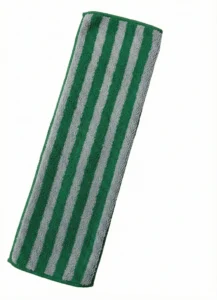
Many of the material properties discussed above — continuous filament polyester construction, particle shedding resistance, chemical compatibility, and sterilization tolerance — are equally relevant when selecting cleanroom cleaning tools. The same polyester and microfiber materials that determine garment performance also define how a cleanroom mop head performs under GMP cleaning protocols:
- Continuous filament polyester — used in woven cleanroom garments for low-linting performance — is the same material construction used in high-grade cleanroom mop heads designed for Grade A/B environments.
- Microfiber (polyester/polyamide blend) — used in nonwoven garment layers for filtration — behaves differently in cleanroom mop applications, where its split-fiber structure provides higher absorbency but requires more careful wash and autoclave protocol management.
- Disposable vs reusable logic — the same decision framework that governs whether a garment is specified as single-use or autoclavable applies to cleanroom mop selection: facility grade, contamination risk, and validated sterility requirements drive the choice.
Selecting the right fabric for cleanroom apparel is one dimension of contamination control. Selecting the right materials for cleanroom mop systems is the other — and the material science foundation is the same.
Frequently Asked Questions
What is the best fabric for GMP cleanroom apparel?
For reusable GMP cleanroom garments, 100% continuous filament polyester woven fabric is the most widely specified option. It provides low particle shedding, compatibility with autoclave sterilization, and good durability across multiple wash cycles. For disposable applications, SMS (spunbond/meltblown/spunbond) polypropylene laminates offer a balance of barrier properties, comfort, and cost-effectiveness. The “best” fabric depends on the cleanroom grade, sterilization method, whether the garment is reusable or disposable, and the specific contamination control requirements of the process. No single fabric type is optimal for every GMP application.
Is polyester or microfiber better for cleanroom garments?
For cleanroom garments, continuous filament polyester woven fabric is generally preferred over microfiber for body-covering applications. The tight weave structure provides stable filtration and low particle shedding. Microfiber (polyester/polyamide blend) is less common in cleanroom garments because its split-fiber structure can trap and release particles. However, microfiber excels in cleanroom cleaning tools such as mop heads, where its absorbency and particle-trapping properties are advantageous for floor and surface cleaning. The material choice should follow the application: woven polyester for garments, microfiber for cleaning tools.
How does fabric choice affect cleanroom contamination control?
Fabric choice directly affects contamination control in three ways: (1) particle shedding — woven continuous filament polyester sheds fewer particles than spunbond or knit fabrics; (2) filtration efficiency — tighter weaves and calendered fabrics provide better barrier between the operator and the cleanroom environment; (3) sterilizability — the fabric must be compatible with the facility’s sterilization method (autoclave, gamma irradiation, EtO) without degrading. A fabric that sheds particles, provides inadequate filtration, or degrades during sterilization undermines the entire contamination control strategy — whether in garments or in cleaning tools such as mop heads.
What documentation should accompany cleanroom apparel fabric?
Suppliers should provide: material composition statement, particle shedding or Helmke drum test data, sterilization compatibility documentation, and Certificate of Analysis (COA) per batch. For GMP Grade A/B environments, additional documentation may include Certificate of Sterility, Certificate of Irradiation (for gamma-sterilized products), and biocompatibility test data. This documentation requirement parallels what buyers should request for cleanroom mop validation documents — the principle of documented material qualification applies equally to garments and cleaning tools.
How often should cleanroom garments be replaced?
Reusable cleanroom garments should be replaced when visual inspection identifies fabric degradation: thinning, fraying, loss of ESD grid continuity, or compromised seam integrity. Most facilities implement a cycle-count-based monitoring program and retire garments after a validated number of wash/sterilization cycles. This lifecycle management approach is similar to cleanroom mop maintenance and longevity management — structured inspection with documented retirement criteria is the standard for all cleanroom consumables, whether garments or mop heads.
Material Selection for Garments Is One Dimension. Cleaning Tools Are the Other.
Choosing the right fabric for cleanroom apparel is a critical decision — and the same material science rigor applies to selecting cleanroom mop systems for GMP and ISO environments. Explore MIDPOSI’s White Cleanroom Mop Series, engineered with continuous filament polyester knit, sealed edges, and validated construction designed for controlled-environment cleaning.
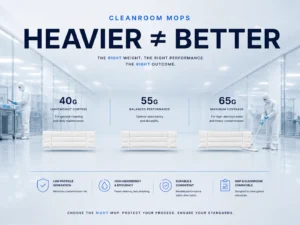
Cleanroom mop systems available in 40g, 55g, and 65g weights — sterile and non-sterile configurations — with material certification and batch traceability documentation.