Il secchio e lo strizzatoio per camera bianca sono il quarto componente di un sistema di pulizia completo e quello più spesso trascurato nelle specifiche di approvvigionamento. Mentre le teste, i telai e i manici dello spazzolone ricevono una valutazione strutturata, il secchio e lo strizzatoio sono spesso trattati come accessori generici per le pulizie. Si tratta di un errore di specifica con conseguenze operative: mancata corrispondenza dimensionale con il telaio del mop, perdita di particelle da materiali incompatibili del secchio e un sistema di gestione della soluzione non convalidato che compromette la coerenza della pulizia. Questa guida fornisce i criteri di selezione per valutare i sistemi secchio e strizzatore con lo stesso rigore applicato agli altri tre componenti.
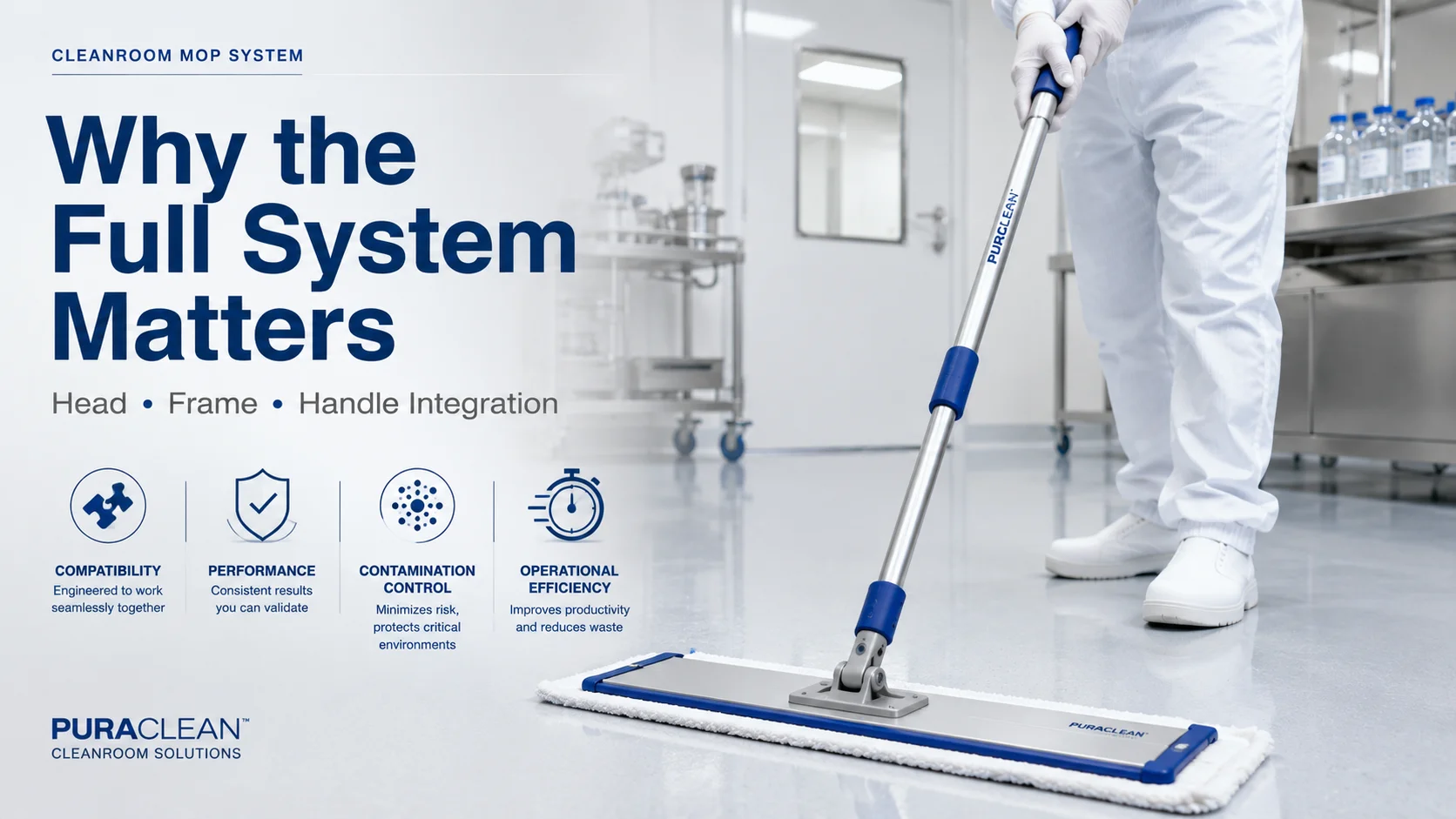
Tre criteri distinguono un secchio e uno strizzatoio per camere bianche da un secchio per pulizie generiche: materiale (acciaio inossidabile o polimero convalidato compatibile con le camere bianche, non plastica non trattata che rilascia particelle), compatibilità dimensionale (l'apertura dello strizzatoio deve corrispondere alla larghezza del telaio del mocio e la profondità del secchio deve adattarsi alla geometria del telaio) e capacità di gestione della soluzione (il sistema deve supportare la preparazione della soluzione convalidata, la frequenza di sostituzione e lo smaltimento, non lasciati alla discrezione dell'operatore). Un secchio che non soddisfa uno qualsiasi di questi tre criteri introduce una variabile non convalidata in un protocollo di pulizia altrimenti documentato e controllato.
| Caratteristica | Secchio delle pulizie | Secchio per camere bianche |
|---|---|---|
| Materiale | Plastica non trattata (PE, PP): può rilasciare particelle, assorbire sostanze chimiche e ospitare contaminanti nei pori della superficie | Acciaio inossidabile 304/316 o polimero convalidato per camera bianca: superficie liscia, senza dispersione e resistente agli agenti chimici |
| Compatibilità con lo strizzatoio | Apertura generica: potrebbe non corrispondere alla larghezza del telaio del mop per camera bianca. Pressione irregolare durante la strizzatura. | Apertura dello strizzatoio adattata alla larghezza specifica del telaio. Distribuzione uniforme della pressione sulla testa del panno durante la rimozione della soluzione. |
| Gestione della soluzione | Nessuna indicazione del volume. Il cambio della soluzione è lasciato alla discrezione dell'operatore. | Contrassegni del volume graduato. Capacità definita abbinata alla copertura dell'area di pulizia. Opzione a doppio secchio per la separazione pulito/sporco. |
| Finitura superficiale | Ruvido o strutturato: contiene residui, difficili da convalidare come puliti | Liscio, senza fessure. Rugosità superficiale definita (valore Ra). Pulibile e visivamente ispezionabile. |
| Documentazione | Nessuno | Certificato dei materiali, specifiche dimensionali, documentazione sulla finitura superficiale, dichiarazione di compatibilità chimica |
Per un argomento più ampio a livello di sistema sul motivo per cui la compatibilità dei componenti è importante, comprese le interfacce head-to-frame e handle-to-frame, consultare la sezione perché è importante il sistema di pulizia completo per camere bianche guida. Per una panoramica fondamentale, vedere Panoramica del sistema di pulizia per camere bianche.
Un secchio per pulizie generico utilizzato in una camera bianca non solo non è ottimale, ma introduce attivamente vettori di contaminazione che il resto del protocollo di pulizia è progettato per controllare. Le seguenti quattro modalità di errore descrivono perché è importante la specifica del bucket.
I secchi di plastica non trattati hanno una microstruttura superficiale che rilascia particelle quando agitati e un secchio contenente una soluzione detergente viene costantemente agitato durante l'uso. Inoltre, la superficie plastica si abrade nel tempo, generando ulteriori particelle. In una camera bianca di grado B in cui viene monitorato il conteggio delle particelle, un secchio che rilascia particelle può essere la fonte di un'escursione di monitoraggio ambientale che innesca un'indagine - e il secchio è raramente la prima variabile esaminata.
Alcune plastiche si degradano se esposte a disinfettanti ossidanti (perossido di idrogeno, acido peracetico) per un contatto prolungato. Un secchio che contiene una soluzione sporicida per un turno di 8 ore può subire un degrado della superficie che non è visibile ma rilascia sottoprodotti chimici nella soluzione detergente, alterando la concentrazione effettiva del disinfettante e lasciando potenzialmente residui sulle superfici pulite.
Le superfici in plastica porose o strutturate ospitano residui in fessure microscopiche. Quando il secchio viene “pulito” tra un utilizzo e l’altro, l’ispezione visiva può mostrare una superficie pulita, ma i test con tampone possono rivelare residui di disinfettante, detergente o contaminazione microbica nei pori della superficie. Un secchio che non può essere convalidato come pulito tra un utilizzo e l'altro non è uno strumento compatibile con le camere bianche.
Un auditor che esamina il protocollo di pulizia chiede: “Quali sono le specifiche per il contenitore della soluzione detergente?” Se la risposta è “un secchio standard per le pulizie” – senza specifica dei materiali, senza documentazione dimensionale, senza convalida della pulibilità – l’auditor ha identificato una lacuna nel programma di controllo della contaminazione. Questa singola domanda può degenerare in una revisione più ampia di tutti i materiali di consumo per la pulizia non convalidati. Per i requisiti degli strumenti specifici del grado GMP, consultare Guida alla selezione della qualità dei panni per camere bianche GMP.
| Materiale | Grado | Idoneità alle camere bianche | Considerazioni chiave |
|---|---|---|---|
| Acciaio inossidabile 316 | Premio | Grado A/B/C/D | Massima resistenza chimica (il contenuto di molibdeno resiste alla vaiolatura del cloruro). Autoclavabile. Superficie liscia e senza pelucchi. Costo più alto. Preferito per ambienti asettici di grado A/B in cui l'esposizione chimica è più aggressiva. |
| Acciaio inossidabile 304 | Standard | Grado C/D; Grado A/B valutato caso per caso | Buona resistenza chimica per la maggior parte dei disinfettanti per camere bianche. Autoclavabile. Più economico del 316. Può essere soggetto alla vaiolatura del cloruro in caso di esposizione prolungata a disinfettanti a base di cloro (che generalmente dovrebbero essere evitati comunque nella pulizia delle camere bianche). |
| Polipropilene/HDPE | Accettabile (se convalidato) | Grado C/D (con convalida del fornitore) | Lighter weight than stainless steel. Lower cost. Must be verified particle-shedding-free for the specific grade. Chemical compatibility must be validated with the facility’s specific disinfectants. Not autoclavable — limits sterilization options. Surface condition degrades over time; lifespan shorter than stainless steel. |
| Galvanized / Painted Steel | Not Acceptable | Do not use in any cleanroom | Zinc coating (galvanized) corrodes with common disinfectants. Paint chips become particulate contamination. Surface cannot be validated cleanroom-compatible. |
L'acciaio inossidabile è il materiale preferito per i sistemi di secchi e strizzatori per camere bianche in ambienti GMP. Il vantaggio del materiale rispetto alla plastica è giustificato da: maggiore durata (l'acciaio inossidabile non si degrada con l'esposizione chimica ripetuta), autoclavabilità (supporta la sterilizzazione interna se richiesta) e finitura superficiale documentabile (i valori Ra possono essere specificati e verificati). Per le zone di supporto di grado C/D in cui il costo è un vincolo primario e l'esposizione chimica è meno aggressiva, i polimeri convalidati per camera bianca possono essere valutati come alternativa, a condizione che il fornitore possa documentare le prestazioni di distacco delle particelle e la compatibilità chimica.
Lo strizzatoio controlla la quantità di soluzione rimossa dalla testa del panno prima di ogni passaggio e quindi la quantità di soluzione applicata sul pavimento. Ciò influisce direttamente sul tempo di contatto del disinfettante, sul tempo di asciugatura del pavimento e sulla consistenza della pulizia. Il tipo di strizzatore deve essere selezionato in base ai requisiti del protocollo di pulizia, non alla disponibilità.
| Tipo | Come funziona | Ideale per | Limitazioni |
|---|---|---|---|
| Tipo di stampa | L'operatore preme la testa del mocio (sempre sul telaio) contro una piastra piana o curva. La soluzione viene espulsa mediante pressione meccanica. | Utilizzo da leggero a moderato. Strutture con requisiti di gestione della soluzione semplici. Manutenzione ridotta: poche parti mobili. | La consistenza della rimozione della soluzione dipende dalla tecnica dell'operatore: la pressione applicata varia da operatore a operatore e nel corso di un turno. Meno consistente del tipo a rullo. |
| Tipo a rullo | La testa del panno passa tra due rulli che spremono la soluzione mentre l'operatore tira il panno. | Strutture che richiedono una rimozione coerente delle soluzioni da parte di operatori e turni. Programmi di pulizia a volume maggiore. | Più parti mobili: rulli e cuscinetti richiedono manutenzione. La pressione dei rulli deve essere calibrata e verificata periodicamente. Costo iniziale più elevato rispetto al tipo a pressa. |
| A mani libere/a pedale | L'operatore attiva lo strizzatore tramite il pedale, tenendo le mani lontane dalla soluzione. La testa del mocio viene pressata o arrotolata meccanicamente. | Ambienti asettici di grado A/B in cui il contatto dell'operatore con la soluzione detergente deve essere ridotto al minimo. Strutture con rigorosi protocolli di igiene del personale. | Massima complessità. Il collegamento meccanico tra pedale e strizzatore richiede manutenzione. Costo più elevato. Potrebbe non essere necessario per gli ambienti di grado C/D. |
La larghezza dell'apertura dello strizzatoio deve corrispondere alla larghezza del telaio del mocio. Un'apertura dello strizzatoio troppo stretta non accetterà il telaio: l'operatore non potrà affatto strizzare la testa del panno. Un'apertura dello strizzatoio troppo ampia esercita una pressione non uniforme: il centro della testa del mop viene strizzato più dei bordi, lasciando una soluzione in eccesso alle estremità del telaio che crea un'umidità incoerente del pavimento e un tempo di contatto del disinfettante variabile. Prima di specificare uno strizzatoio, verificare la larghezza del telaio dal tipi di telai per mop per camere bianche specifiche e verificare che l'apertura dello strizzatore sia adatta a quella larghezza con la testa del mop montata.
Un sistema a secchio singolo contiene un serbatoio di soluzione detergente. Man mano che l'operatore pulisce la soluzione si contamina progressivamente con i residui del pavimento. Verso la fine della sessione di pulizia, l'operatore applica sulle superfici una soluzione sempre più contaminata, che può lasciare residui e ridurre l'efficacia della pulizia. Un sistema a doppio secchio separa la soluzione pulita (un secchio) dalla soluzione sporca (l'altro secchio, nel quale scarica lo strizzatore). La testina dello spazzolone viene sciacquata nel secchio della soluzione sporca, strizzata e quindi ricaricata con la soluzione pulita dal secondo secchio. I sistemi a doppio secchio sono preferiti per la pulizia GMP perché mantengono la qualità della soluzione durante tutta la sessione di pulizia.
La capacità del secchio deve essere calcolata in base alla copertura dell'area da pulire e al tasso di applicazione della soluzione, non selezionata in base alla dimensione approssimativa. Una formula generale:
Volume di soluzione richiesto per cambio = area di pulizia (m²) × tasso di applicazione della soluzione (L/m²)
La velocità di applicazione della soluzione dipende dal materiale della testina del panno, dal tipo di disinfettante e dal tempo di contatto richiesto e deve essere stabilita durante la convalida della pulizia. La capacità del secchio deve contenere questo volume più un margine di lavoro (tipicamente +20%) per evitare che l'operatore rimanga senza soluzione prima di completare l'area di pulizia designata. Se il secchio è troppo piccolo, l'operatore deve interrompere la pulizia per riempirlo, il che introduce una deviazione del processo. Se il secchio è troppo grande, la soluzione potrebbe rimanere inutilizzata oltre la sua durata d'uso convalidata.
The cleaning SOP must define when the solution is changed — not leave it to operator discretion. Validated triggers include: after a defined area (m²), after a defined number of rooms, when visible soiling is observed, or at a defined time interval (if the solution has a validated use-life). The bucket should have graduated volume markings to support solution preparation verification — the operator fills to a defined mark, not “about this much.”
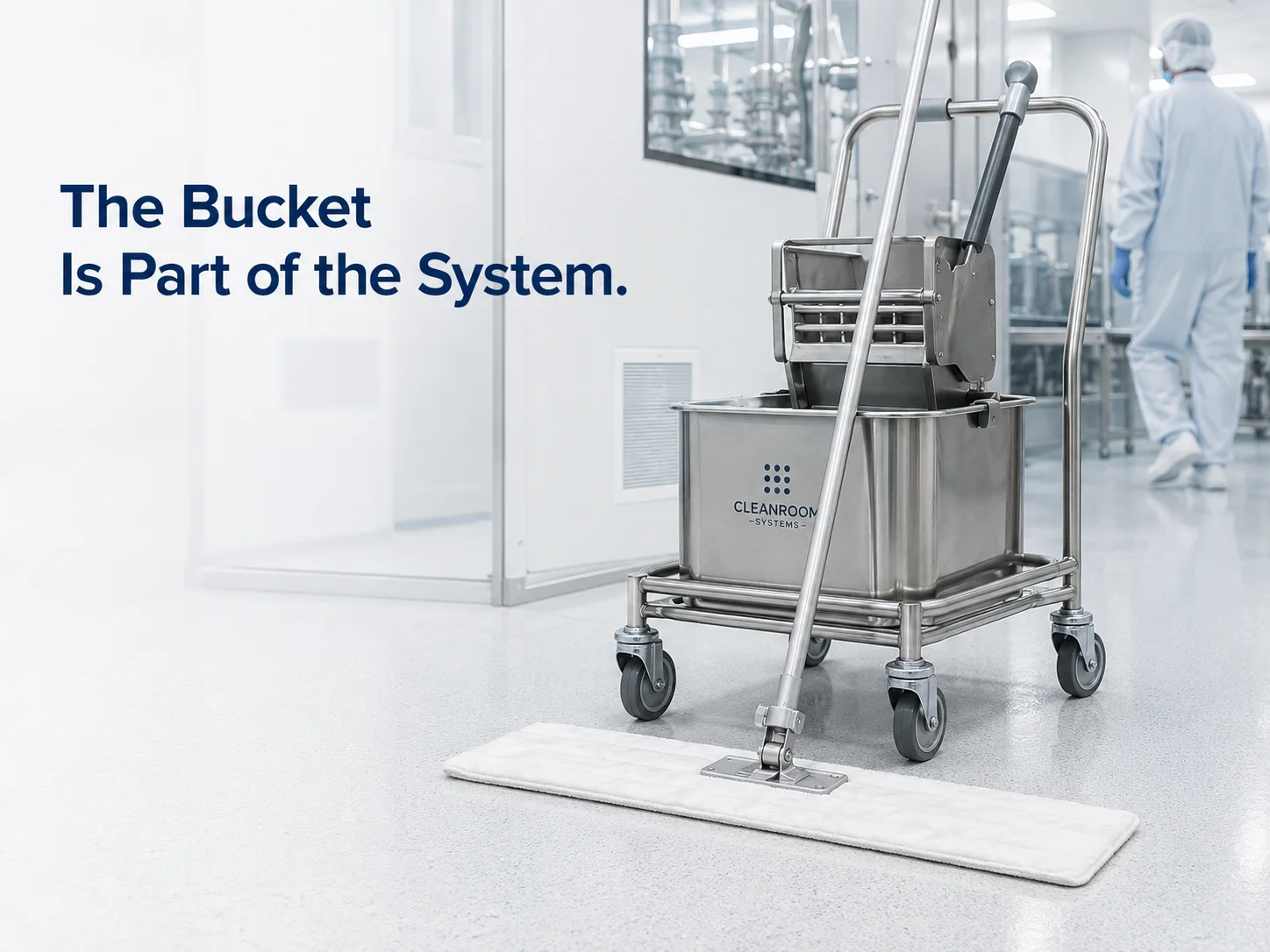
Bucket, wringer, and mop handle storage integrated on a stainless steel cart. The operator pushes one unit through the cleaning area — no trips back to a stationary bucket. Mop heads are carried on the trolley for change-out.
Bucket and wringer as stationary units. The operator returns to the bucket location to wring and reload the mop head.
La decisione tra montato su carrello e autonomo dipende da: superficie per zona di pulizia, numero di zone per turno, numero di operatori e accessibilità del corridoio. Grandi strutture con suite di produzione aperte beneficiano dei sistemi a carrello. Le strutture multi-room con corridoi stretti potrebbero trovare secchi indipendenti più pratici per camera.
Il secchio e lo strizzatoio, come qualsiasi altro strumento per camera bianca, dovrebbero essere supportati da documentazione che dimostri l'idoneità allo scopo in un ambiente GMP. Al fornitore dovrà essere richiesta la seguente documentazione:
Per il quadro completo della documentazione del fornitore che copre tutti i componenti del sistema di pulizia, consultare il documenti di convalida del panno per camera bianca guida.
A facility specifies cleanroom mop heads and frames from a qualified supplier — and buys the bucket from a janitorial supply catalog. The bucket sheds particles, the plastic is incompatible with the sporicidal disinfectant, and the wringer opening does not match the frame width. The most carefully specified mop head in the most rigorously validated cleaning protocol is undermined by an unvalidated bucket.
Correzione: Specify the bucket and wringer as part of the mop system procurement — not as a separate janitorial purchase. If the mop supplier does not offer bucket/wringer systems, evaluate cleanroom-grade alternatives with documented material specifications and dimensional compatibility.
The bucket is ordered. The frame is ordered. No one verified that the frame fits through the wringer opening. The operator discovers this on the first day of use — and either forces the frame through (damaging the mop head or wringer) or skips the wringing step (applying excess solution to the floor). Both outcomes are protocol deviations.
Correzione: Before procurement, verify the wringer opening width against the frame width with the mop head mounted. Document this verification. If the mop system supplier offers a matched bucket/wringer, this verification is the supplier’s responsibility — confirm it is included in the system specification.
The procurement specification says “bucket and wringer” with no mention of wringer type. The supplier provides the least expensive option — a basic press-type wringer. The facility’s cleaning protocol requires consistent solution removal for validated disinfectant contact time. The press-type wringer produces variable results depending on operator technique — some operators press harder than others, and the same operator presses differently at the beginning and end of a shift. The validated contact time assumes consistent solution application, which the specified wringer does not deliver.
Correzione: Specify the wringer type (press, roller, or hands-free) in the procurement document. If the cleaning protocol requires validated solution removal consistency, a roller-type wringer provides more reproducible results than press-type. Match the wringer type to the protocol’s requirements, not to the lowest-cost option.
The mop heads arrive with COA, material certificates, and sterility documentation. The bucket arrives with a packing slip. During an audit, the cleaning tool documentation package is complete for heads, frames, and handles — and empty for the bucket and wringer. The auditor asks: “What is this bucket made of? Is it compatible with your disinfectants? Has its cleanability been validated?” The answers are not documented.
Correzione: Request material certification, dimensional specifications, and chemical compatibility documentation for the bucket and wringer — the same documentation standard applied to the other mop system components. Include these documents in the cleaning tool documentation binder.
General-purpose janitorial buckets are typically made from untreated plastics that shed particles when agitated, may be chemically incompatible with cleanroom disinfectants, have porous surfaces that harbor contamination, and lack the dimensional specifications needed to verify compatibility with the mop frame. In a GMP environment, every tool that contacts the cleaning solution or the cleaned surface is part of the validated cleaning protocol — an unvalidated bucket introduces an uncontrolled variable.
Stainless steel — 316 for Grade A/B environments with the most aggressive chemical exposure, 304 for Grade C/D environments. Stainless steel provides a smooth, non-particle-shedding surface, chemical resistance to common cleanroom disinfectants, autoclavability, and documentable surface finish (Ra values). Validated cleanroom-grade polymers (polypropylene, HDPE) may be evaluated for Grade C/D zones where cost is a primary constraint, provided the supplier can document particle shedding performance and chemical compatibility.
If the wringer opening is too narrow, the frame cannot be inserted — the mop head cannot be wrung. If the wringer opening is too wide, pressure is uneven — the center of the mop head is wrung more than the edges, creating inconsistent solution application and variable disinfectant contact time across the floor surface. The wringer opening width must be verified against the frame width before procurement. The specification should come from the mop system supplier as a matched set, not from independent measurement.
Dual-bucket systems are preferred for GMP cleaning. They separate clean solution from dirty solution — the mop head is rinsed in the dirty-solution bucket, wrung, and re-loaded with clean solution from the second bucket. This maintains solution quality throughout the cleaning session and prevents the progressive application of increasingly contaminated solution to cleaned surfaces. Single-bucket systems may be acceptable for small-area cleaning with frequent solution changes, but the solution change frequency must be defined and validated — not left to operator discretion.
Bucket capacity should be calculated as: cleaning area (m²) × solution application rate (L/m²) + 20% working margin. The solution application rate depends on the mop head material, disinfectant type, and required contact time — and should be established during cleaning validation. The bucket must hold enough solution to complete the designated cleaning area without refilling. Undersized buckets force mid-cleaning refills (process deviation). Oversized buckets may result in solution sitting unused beyond its validated use-life.
Trolley-mounted systems are best for large-area cleaning (corridors, production suites) where reducing operator trips improves productivity. Standalone buckets are best for small-area or zone-specific cleaning (individual rooms) where a trolley would be impractical or where dedicated buckets per zone reduce cross-contamination risk. The decision depends on floor area per zone, operator count, and corridor accessibility.
Stainless steel buckets and wringers can be autoclaved — this is one of the advantages of stainless steel over polymer alternatives. The autoclave compatibility should be confirmed by the supplier, including maximum temperature and cycle type. Polymer buckets are generally not autoclavable — they may warp or degrade at autoclave temperatures. If in-house sterilization of cleaning equipment is required, stainless steel is the appropriate material choice.
At minimum: material certification (mill test report or composition statement for stainless steel), dimensional specifications (capacity, wringer opening width, overall dimensions), surface finish documentation (Ra value for stainless steel), chemical compatibility statement with common cleanroom disinfectants, and autoclave compatibility confirmation if sterilization is required. This documentation should be included in the cleaning tool documentation binder alongside the documentation for mop heads, frames, and handles.
Specify your mop frame dimensions, cleanroom grades, and cleaning solution management requirements. MIDPOSI provides cleanroom-grade stainless steel bucket and wringer recommendations with material certifications for audit documentation.
La disponibilità della documentazione può variare in base alla configurazione del prodotto. Documentazione tecnica standard fornita con ogni richiesta.
{
“@contesto”: “https://schema.org”,
“@grafico”: [
{
“@tipo”: “Articolo”,
“headline”: “Cleanroom Mop Bucket and Wringer Systems — A Selection Guide for GMP Facilities”,
“description”: “How to select cleanroom mop bucket and wringer systems. Covers stainless steel materials, wringer types, frame compatibility, capacity planning, and validation documentation for GMP facilities.”,
“autore”: { “@type”: “Organizzazione”, “nome”: “MIDPOSI” },
“editore”: { “@type”: “Organizzazione”, “nome”: “MIDPOSI”, “url”: “https://midposi.com/” },
“datePublished”: “{{DATE_PUBLISHED_PENDING}}”,
“dateModified”: “{{DATE_MODIFIED_PENDING}}”,
“mainEntityOfPage”: { “@type”: “WebPage”, “@id”: “https://midposi.com/cleanroom-mop-bucket-wringer-selection-guide/” },
“image”: “https://midposi.com/wp-content/uploads/2026/02/cleanroom-mop-system-stainless-steel-trolley.webp”,
“articleSection”: “Cleanroom Mop System Components”,
“keywords”: “cleanroom mop bucket wringer, stainless steel cleanroom bucket, GMP cleaning bucket, cleanroom wringer system”
},
{
“@tipo”: “PaginaFAQ”,
“Entitàprincipale”: [
{ “@type”: “Question”, “name”: “Why can’t a general-purpose janitorial bucket be used in a GMP cleanroom?”, “acceptedAnswer”: { “@type”: “Answer”, “text”: “General-purpose janitorial buckets are typically made from untreated plastics that shed particles, may be chemically incompatible with cleanroom disinfectants, have porous surfaces, and lack dimensional specifications. An unvalidated bucket introduces an uncontrolled variable into the validated cleaning protocol.” } },
{ “@type”: “Question”, “name”: “What is the preferred material for cleanroom bucket and wringer systems?”, “acceptedAnswer”: { “@type”: “Answer”, “text”: “Stainless steel — 316 for Grade A/B, 304 for Grade C/D. Provides smooth, non-shedding surface, chemical resistance, autoclavability, and documentable surface finish. Validated cleanroom-grade polymers may be evaluated for Grade C/D where cost is a primary constraint.” } },
{ “@type”: “Question”, “name”: “How does wringer-to-frame compatibility affect cleaning workflow?”, “acceptedAnswer”: { “@type”: “Answer”, “text”: “A wringer opening too narrow prevents frame insertion. Too wide creates uneven pressure and inconsistent solution application. The wringer opening width must be verified against frame width before procurement — ideally as a matched set from the mop system supplier.” } },
{ “@type”: “Question”, “name”: “Single-bucket or dual-bucket — which is appropriate for GMP cleaning?”, “acceptedAnswer”: { “@type”: “Answer”, “text”: “Dual-bucket systems are preferred for GMP cleaning. They separate clean and dirty solution, maintaining solution quality throughout the session. Single-bucket may be acceptable for small-area cleaning with frequent, validated solution changes.” } },
{ “@type”: “Question”, “name”: “How is bucket capacity determined for a specific cleaning area?”, “acceptedAnswer”: { “@type”: “Answer”, “text”: “Capacity = cleaning area (m²) × solution application rate (L/m²) + 20% margin. The application rate depends on mop material, disinfectant type, and contact time — established during cleaning validation. The bucket must hold enough solution to complete the designated area without refilling.” } },
{ “@type”: “Question”, “name”: “Trolley-mounted or standalone bucket — when does each make sense?”, “acceptedAnswer”: { “@type”: “Answer”, “text”: “Trolley-mounted: large-area cleaning where reducing operator trips improves productivity. Standalone: small-area or zone-specific cleaning where trolleys are impractical or dedicated buckets per zone reduce cross-contamination risk.” } },
{ “@type”: “Question”, “name”: “Can bucket and wringer systems be autoclaved?”, “acceptedAnswer”: { “@type”: “Answer”, “text”: “Stainless steel buckets and wringers can be autoclaved — confirmed by supplier for specific temperature and cycle type. Polymer buckets are generally not autoclavable and may warp or degrade at autoclave temperatures.” } },
{ “@type”: “Question”, “name”: “What documentation should a bucket/wringer supplier provide?”, “acceptedAnswer”: { “@type”: “Answer”, “text”: “Material certification, dimensional specifications (capacity, wringer width, overall dimensions), surface finish documentation (Ra value for stainless steel), chemical compatibility statement, and autoclave compatibility confirmation if required.” } }
]
},
{
“@tipo”: “Elenco breadcrumb”,
“ElementoElencoArticoli”: [
{ “@type”: “ListItem”, “position”: 1, “name”: “Home”, “item”: “https://midposi.com/” },
{ “@type”: “ListItem”, “position”: 2, “name”: “Blog”, “item”: “https://midposi.com/blog/” },
{ “@type”: “ListItem”, “position”: 3, “name”: “Cleanroom Mop Bucket and Wringer Guide”, “item”: “https://midposi.com/cleanroom-mop-bucket-wringer-selection-guide/” }
]
}
]
}