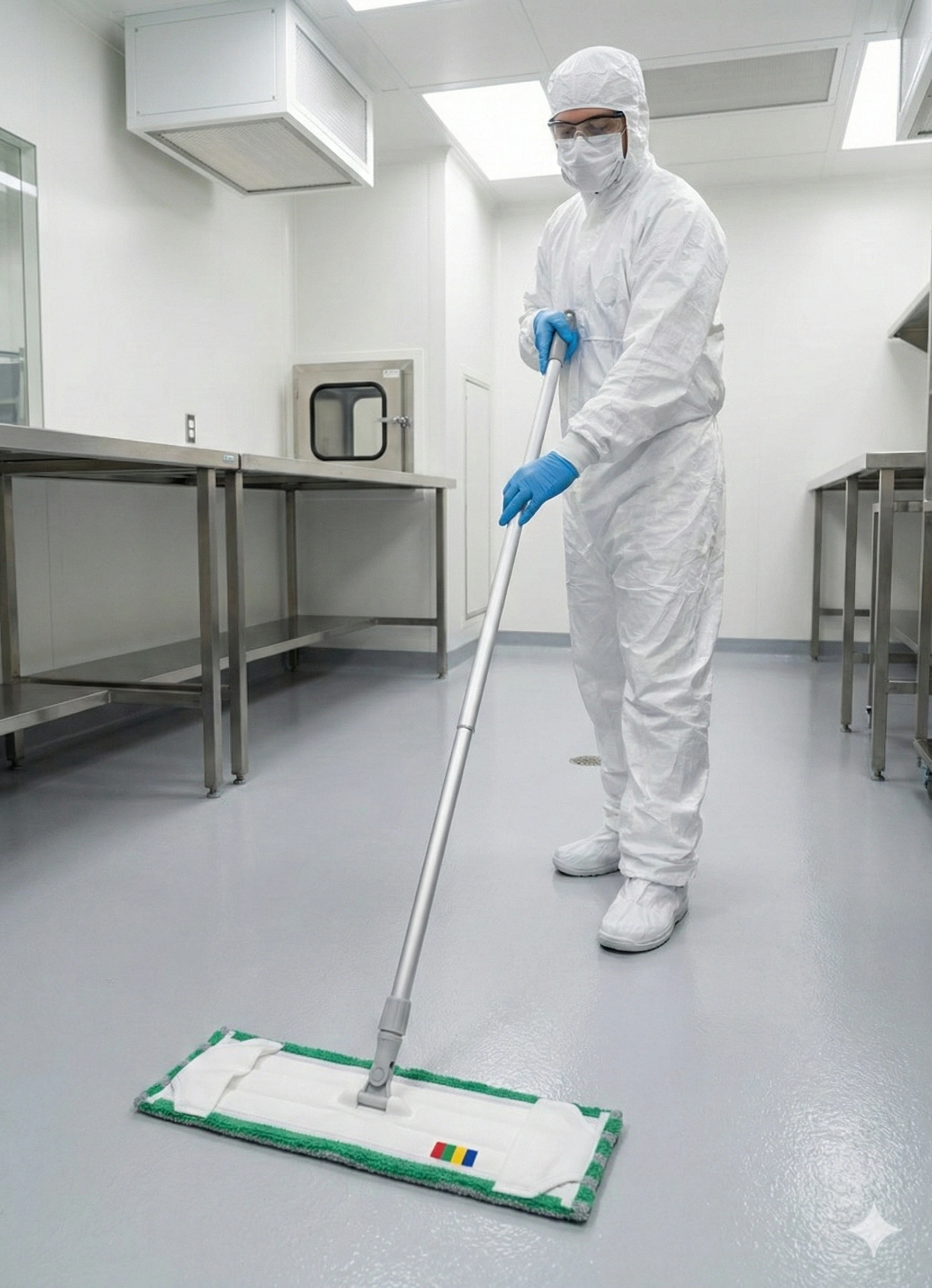
Cleanroom mop storage is one of the most frequently overlooked variables in contamination control programs. A mop that was validated as clean at the point of use can become a contamination source during storage — through residual moisture, contact with other mops, or exposure to an unclassified environment. This guide establishes a structured storage protocol that a QA lead, cleaning supervisor, or facility manager can adopt and document.
The three rules of cleanroom mop storage summarize the minimum requirements for preventing contamination between mop uses. Facilities that follow all three rules reduce the likelihood that a stored mop becomes an undocumented contamination vector.
A damp mop in an enclosed space — a sealed bag, a drawer, or a closed container — creates conditions that support microbial growth. Within hours in a warm staging area, residual moisture turns a stored mop into an incubator. Drying must be verified, not assumed.
Stacking compresses mop fabric, creates surface-to-surface contact between mop heads, blocks air circulation, and hides visible contamination. Individual hanging on stainless steel hooks with adequate spacing preserves fabric integrity and enables visual inspection.
A mop designated for a GMP Grade B cleanroom cannot be stored in an unclassified maintenance closet. The storage environment must meet or exceed the classification of the zone where the mop will be used. If the storage area is unclassified, the mop’s zone-readiness is no longer defensible.
| Storage Mistake | Conseguenza | Correction |
|---|---|---|
| Storing damp mops in sealed bags | Microbial growth within hours; sterility label becomes meaningless | Dry completely, verify, store only fully dried mops in breathable containers |
| Stacking mop heads on shelves | Fabric compression; cross-contact between mops; hidden contamination | Hang individually on stainless steel hooks; maintain minimum spacing |
| Storing Grade B mops in unclassified room | Mop surface particle load increases; zone-readiness cannot be demonstrated | Classify storage area to match or exceed target zone grade |
| No date or batch label on stored mops | No FIFO control; mops used past validated storage duration | Label each mop batch with sterilization/laundering date and max storage date |
| Using painted or coated hooks | Hook coating degrades, sheds particles onto stored mop fabric | Use 316L stainless steel hooks only |
Of the three storage rules, the drying requirement is the most frequently violated — and the most consequential. A mop that appears dry to casual observation may still retain moisture in the inner fabric layers, particularly with heavier mop head weights that have more material volume.
Residual moisture in a stored mop creates a microenvironment that supports the growth of bacteria and fungi. In a sealed container at ambient staging-area temperature (typically 18–25 °C), microbial proliferation can begin within 4–8 hours. Once established, contamination is invisible — the mop looks clean but is no longer suitable for controlled-environment use.
This risk is amplified in reusable mop programs where mops are laundered in-house. If the laundry process does not include a verified drying step, or if mops are bagged immediately after wash before complete drying, the storage period becomes a contamination accumulation period rather than a contamination-free holding interval.
| Verification Level | Metodo | When Required | Documentazione |
|---|---|---|---|
| Level 1 — Visual | No visible moisture, no water droplets, no dark/wet patches on fabric | Minimum for all non-sterile reusable mop programs | Record “Dry — Visual Check Passed” on mop maintenance log |
| Level 2 — Tactile | Fabric feels dry to gloved touch; no cool or damp sensation when pressed | Recommended for GMP Grade B/C mops; minimum for sterilized mops post-autoclave | Record “Dry — Tactile Check Passed” on mop maintenance log |
| Level 3 — Instrumental | Moisture meter or gravimetric verification per facility SOP | Grade A / aseptic processing zones; where formal moisture acceptance criteria exist | Record moisture reading and acceptance criterion reference |
Mops should be dried in a controlled environment that matches or exceeds the cleanliness classification of the target zone. Drying in an unclassified utility room or corridor introduces airborne particulate contamination to the fabric surface before storage even begins. Low-temperature tumble drying (where compatible with the mop material) or controlled-environment air drying are the preferred methods.
For additional detail on material-specific wash and dry parameters, see the Guida alla manutenzione e alla longevità del mop per camere bianche, which covers laundering temperature limits, detergent selection, and drying cycle limits for polyester and microfiber mop heads.
Drying verification should be documented as part of the mop maintenance log, not as a separate record. The log entry for each batch should include: date of laundering, drying method, verification level, verification result, and initials of the person performing the check. This creates a traceable record that can be presented during a GMP audit or cleaning validation review.
The physical configuration of mop storage determines whether contamination can spread between stored mops. The two fundamental options — hanging and stacking — produce fundamentally different contamination-control outcomes.
The hook material matters. Painted, coated, or galvanized hooks degrade over time through repeated contact with mop fabric and exposure to cleaning agents and disinfectants. Degraded coatings shed particles directly onto stored mop heads.
| Specifica | Requisito | Motivazione |
|---|---|---|
| Hook material | 316L stainless steel | Non-shedding, autoclavable, corrosion-resistant to cleaning chemicals |
| Hook finish | Smooth, passivated | No coating to degrade; no crevices for particle accumulation |
| Minimum spacing between hooks | 5 cm (center to center) | Prevents contact between adjacent mop heads; allows air circulation |
| Hook configuration | Single hook per mop; no multi-mop hangers or clips | Prevents contact between mops; each mop independently inspectable |
| Rack construction | Stainless steel frame; wall-mounted or freestanding | Cleanable surface; resists corrosion from cleaning agents |
Selecting the right storage container requires understanding the difference between three container types, each with different protective properties and appropriate use cases.
| Tipo di contenitore | Air Circulation | Particulate Barrier | Sterility Barrier | Uso appropriato |
|---|---|---|---|---|
| Borsa in tessuto traspirante (per camera bianca) | SÌ | SÌ | NO | Short-to-medium-term storage of non-sterile mops in classified staging areas. Allows air exchange while providing particulate protection. |
| Busta di plastica sigillata | NO | SÌ | Yes (when integrity is maintained) | Transport of sterilized mops into cleanroom; short-term storage of sterile mops within validated shelf life. Never use for damp mops. |
| Porta ganci in acciaio inox (aperto) | Maximum | No (relies on room environment) | NO | Drying and storage inside a classified cleanroom or controlled staging area. Best for inspection visibility. Rack environment must match mop zone grade. |
The grade of the storage environment must be at least as high as the target zone the mop is designated for. For GMP facilities, the rule is straightforward:
| Mop Target Zone | Minimum Storage Environment | Motivazione |
|---|---|---|
| GMP Grade A / ISO 5 | Grade B / ISO 7 (minimum); Grade A staging preferred | Sterile mops: storage environment must not compromise sterile packaging integrity |
| GMP Grade B / ISO 7 | Grade C / ISO 8 (minimum); Grade B staging preferred | Grade B mops stored in Grade D acquire surface particle load that defeats zone-readiness |
| GMP Grade C / ISO 8 | Grade D / ISO 9 controlled area (minimum) | Unclassified storage for Grade C mops creates an undocumented contamination gap |
| GMP Grade D | Controlled, clean, non-classified area (minimum) | Storage area should still have documented cleaning and environmental monitoring |
For a complete mapping of mop types to GMP grades, see the Guida alla selezione della qualità dei panni per camere bianche GMP, which covers sterility, material, and packaging requirements for each grade.
Facilities should establish and document maximum storage durations based on their environmental monitoring data and risk assessment. Default recommendation:
First-in-first-out (FIFO) rotation prevents mops from exceeding validated storage durations simply because older batches are buried behind newer ones. Without a FIFO system, the oldest mops in storage accumulate time — and contamination risk — because they are never the first to be retrieved.
Each mop or mop batch entering storage should carry a label with at minimum:
On a stainless steel hook rack, position hooks so that the oldest batch (earliest storage entry date) occupies the most accessible position. Rack labels or color-coded indicators can mark batch age visually. For mops stored in bags, organize storage shelving so that older bags are at the front and newer bags are placed behind.
When color-coded mop systems are in use, FIFO rotation should be managed independently per color zone. A red mop for the fill-finish area should not be rotated into the buffer zone’s blue mop inventory. See the cleanroom mop color-coding guide for zone-segregated inventory management.
Mops that exceed their maximum storage duration should not be used without re-processing. The protocol is:
The following four storage mistakes are among the most common findings during GMP cleaning audits and supplier qualification reviews.
Che succede: A freshly laundered mop, still slightly damp, is placed into a sealed plastic bag and labeled “Clean.” Within hours, the sealed bag becomes a humid chamber. Microbial growth begins on the fabric surface. The mop is retrieved for use with no visible indication of contamination.
Correzione: Verify drying at the appropriate level before bagging. If using sealed bags for transport, the mop inside must be fully dry. If the bag shows any internal condensation, the mop must be re-laundered and re-dried.
Che succede: Mops designated for Grade B and Grade D zones are stored on the same rack, in the same room. The Grade D environment controls the storage condition. Grade B mops acquire surface particulate at Grade D levels before they enter the Grade B zone.
Correzione: Segregate storage by zone classification. If physical segregation is not possible, store all mops in the environment that matches the highest-grade zone served, not the lowest.
Che succede: Mops are laundered, placed in storage, and retrieved for use — but no date is recorded at any point. A mop that has been in storage for 90 days looks identical to one stored for 3 days. During an audit, the facility cannot demonstrate that stored mops have not exceeded a validated storage period.
Correzione: Implement batch labeling as described in H2-5. The label must be visible without handling the mop. Digital tracking is preferred for multi-shift operations, but a paper-based log is acceptable if consistently maintained.
Che succede: The facility installs a painted metal rack or rubber-coated hooks because they are cheaper than stainless steel. Over months of use, the paint cracks, the rubber degrades, and particulates shed directly onto stored mop fabric. The mops pass laundering and drying checks but arrive in the cleanroom with adhered foreign particles.
Correzione: Use only 316L stainless steel for hooks, racks, and any surface that contacts or is positioned above stored mop heads. The cost difference between a painted rack and a stainless steel rack is negligible compared to the cost of an audit finding or a batch investigation.
Storage is one component of the full mop lifecycle. For the broader perspective — from selection through use, maintenance, and replacement — see the Panoramica del sistema di pulizia per camere bianche.
Only if the mop is fully dry and the plastic tote is cleanroom-grade with a validated closure. Even then, the tote interior must be monitored for condensation. A sealed tote with a slightly damp mop becomes a microbial growth chamber. For non-sterile mops, a breathable fabric bag or open stainless steel rack is generally the lower-risk option.
The default recommendation is 30 days maximum between laundering and use, supported by documented environmental monitoring data. Facilities may extend this if they can demonstrate — through EM trending — that no detectable increase in bioburden or particulate load occurs over longer storage periods in their specific storage environment.
Yes. The shelf life is determined by the sterilization method and packaging integrity validation. Autoclave-sterilized mops in validated sealed packaging typically carry a 6–12 month shelf life. Gamma-irradiated mops may have different durations depending on the irradiation dose and packaging material validation. Sterile mop storage shelf life is method-specific and should be documented per batch.
Hang each mop head individually on a dedicated 316L stainless steel hook. Minimum 5 cm spacing between hooks (center to center) to prevent contact between adjacent mops. The hook should support the mop at the attachment pocket or frame interface — not compress the fabric. Hang mops vertically so that gravity assists air circulation, not flat against a wall where one side receives no airflow.
This is not recommended, even with sealed bags. The external surface of the sealed bag accumulates particulate from the unclassified environment. When the bag is opened at the point of use, particles from the bag exterior can transfer to the mop or to gloves handling the mop. Storage environments should match or exceed the mop’s target zone classification.
Three verification levels apply: Level 1 (visual — no visible moisture), Level 2 (tactile — fabric feels dry to gloved touch), and Level 3 (instrumental — moisture meter or gravimetric verification). Level 1 is the minimum for non-sterile mops. Level 2 is recommended for GMP Grade B/C mops. Level 3 is appropriate for aseptic processing zones. Document the verification result in the mop maintenance log.
Yes. Storage is a component of the mop lifecycle and should be addressed in the facility’s cleaning SOP or a dedicated mop management SOP. The SOP should specify: storage environment classification, drying verification method, hanging configuration, container type, batch labeling requirements, maximum storage duration, FIFO rotation procedure, and the protocol for mops that exceed storage duration.
Disposable mops should be stored in their original manufacturer packaging until the point of use. Once the packaging is opened, the mop should be used immediately — disposable mops are not designed for post-opening storage. If a sterile disposable mop package is opened but not used, the mop should be discarded, not returned to storage, as the sterility barrier has been broken.
A well-designed cleanroom mop system supports proper storage from day one — with materials that dry efficiently, configurations that hang correctly, and documentation that supports your storage SOP. Speak with MIDPOSI to evaluate mop options that fit your storage environment and workflow.
Designed for structured cleanroom cleaning programs — supporting procurement, QA, and operations teams.