A flat mop is a single cleaning tool. A cleanroom mop system is an integrated assembly of head, frame, handle, and bucket/wringer designed to work as a unified cleaning platform. This comparison is not about brands or materials—it is about product format architecture and the operational, compliance, and procurement implications of choosing one over the other.
The choice between a sistema di pulizia per camere bianche and a standalone flat mop is fundamentally a decision about integration versus independence. An integrated mop system locks in component compatibility, simplifies SOP documentation, and reduces procurement fragmentation—at the cost of higher initial specification effort. A standalone flat mop offers purchasing simplicity and replacement flexibility—at the cost of compatibility risk, documentation gaps, and higher operational coordination burden when components are sourced independently.
| Decision Dimension | Integrated Mop System | Standalone Flat Mop |
|---|---|---|
| Component Compatibility | Guaranteed — all components designed to work together | User must verify and manage |
| Cross-Contamination Control | System-level design supports zone segregation | Depends on user protocol discipline |
| Documentazione SOP | Single-system specification = cleaner documentation | Multiple part numbers per cleaning line item |
| Procurement Complexity | One supplier, one system specification | Potentially multiple suppliers, multiple SKUs |
| Replacement Flexibility | Locked to system family | Each component independently replaceable |
| Initial Setup Effort | Higher — system selection and trial required | Lower — buy and deploy |
| Audit Trail Clarity | One system document set | Fragmented across component sources |
La risposta breve: If your facility operates in GMP Grade A/B or ISO 5–6 environments and values documentation simplicity and component compatibility, an integrated mop system typically provides stronger operational control. If your facility operates in Grade C/D or ISO 7–8 environments with simpler cleaning protocols and you prioritize initial purchasing simplicity, a standalone flat mop may suffice—provided you have the internal processes to manage component compatibility and documentation.
A cleanroom mop system is the integrated assembly of a cleanroom-grade mop head, a compatible frame, a purpose-designed handle, and (for wet cleaning protocols) a bucket and wringer system. Unlike a standalone flat mop—which is essentially a mop head that the user pairs with whatever frame and handle are available—the system approach treats cleaning as an end-to-end tooling platform where each component is specified, tested, and documented to work with the others.

The key distinction is that in a system, component compatibility is designed in, not improvised after purchase. The mop head pocket dimensions match the frame width. The frame attachment mechanism is engineered for the specific handle connector. The bucket and wringer dimensions accommodate the mop head size and frame geometry. When any single component is changed, the system-level performance can be affected—which is why the system concept matters for controlled-environment cleaning where repeatability and documentation are essential.
For a deeper definition of what constitutes a cleanroom mop system, including component-by-component breakdown and GMP relevance, see our Panoramica del sistema di pulizia per camere bianche. For the flat mop format specifically, see our cleanroom flat mop system overview.
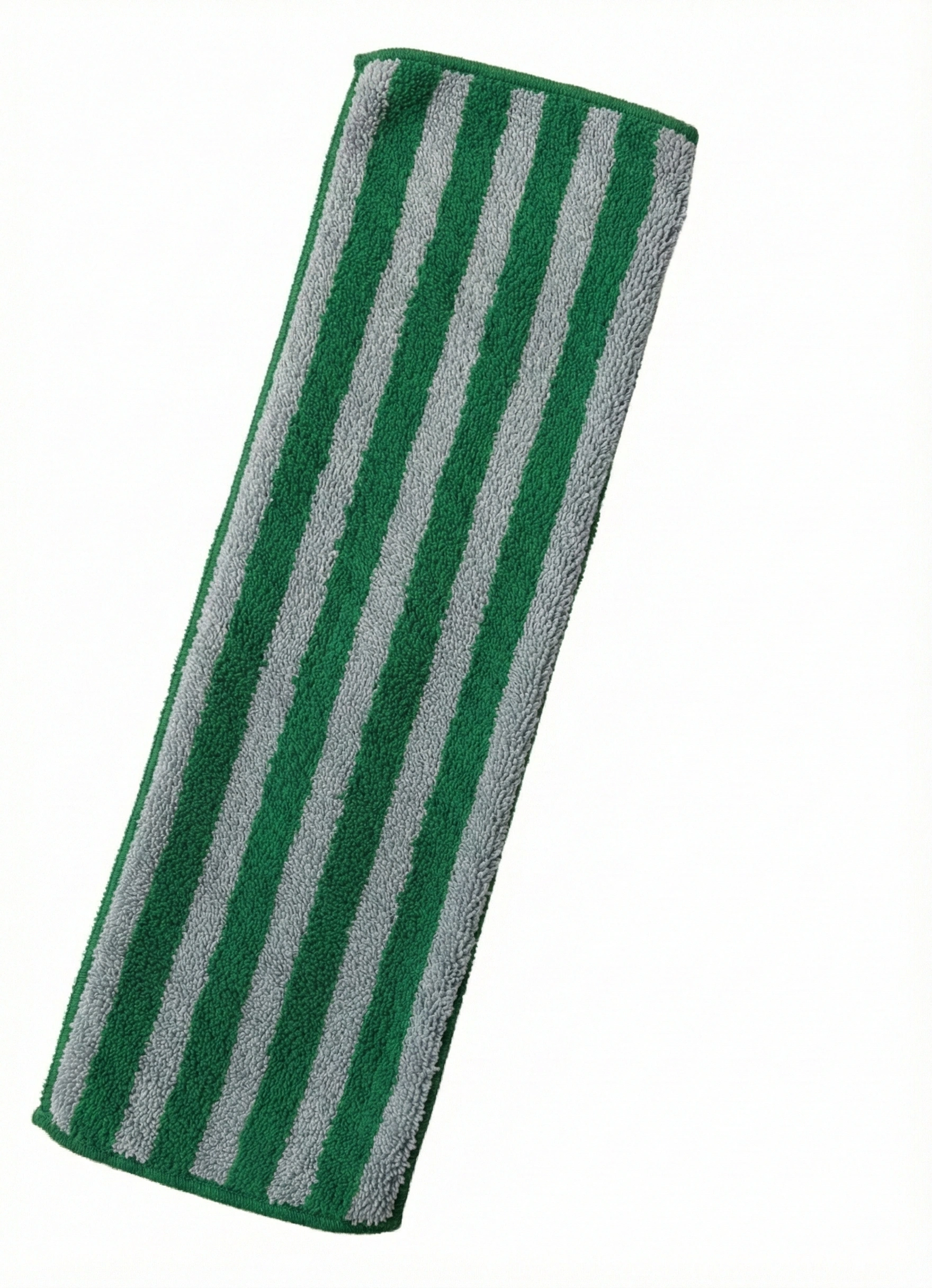
A flat mop, in the cleanroom context, is a rectangular mop head designed to attach to a flat frame and handle. It is the working surface that contacts the floor, wall, or ceiling during cleaning. The flat mop head is typically a textile pad—polyester knit or microfiber—with a pocket or strap system for mounting to a frame.
When purchased as a standalone product (not as part of a system), the flat mop arrives as a mop head only. The buyer is responsible for sourcing the frame, handle, and bucket/wringer separately—from the same supplier or from different suppliers. This gives the buyer maximum freedom but also maximum responsibility for compatibility verification.
This is not to say standalone flat mops are inherently problematic. Many facilities use standalone flat mops effectively. The point is that the standalone approach shifts compatibility verification and documentation assembly from the supplier to the buyer. For some facilities, this additional coordination burden is manageable. For others, particularly those operating under regulatory scrutiny, the system approach removes variables that can complicate audits and SOP management.
The following five dimensions represent the areas where the choice between an integrated system and standalone flat mops creates operational differences. Each dimension is weighted differently depending on your facility type, regulatory environment, and internal capability.
The mop head pocket dimensions, frame width and mounting mechanism, handle connector type, and bucket/wringer dimensions are engineered as a matched set. The supplier validates that all components work together at the dimensional and functional level before the system is specified. When it is time to reorder, the buyer references one system specification rather than multiple individual part numbers.
This matters because incompatibility is invisible until it causes problems: a mop head that slips off the frame mid-cleaning, a handle that does not lock securely to the frame, or a bucket that is too narrow for the frame to fit into the wringer mechanism. In a cleanroom context, these failures represent contamination events as well as productivity losses.
When components are purchased independently, the buyer becomes the compatibility manager. A flat mop head from one source must be verified to fit the frame from another source, which must in turn fit the handle from a third source. Dimensional tolerances, material compatibilities, and attachment mechanisms must all be cross-checked.
In pratica, i team di approvvigionamento spesso scelgono un unico fornitore per tutti i componenti anche quando acquistano i panni, creando di fatto un sistema. La differenza è questa con i panni piani indipendenti, la verifica della compatibilità è responsabilità dell’acquirente, non garanzia del fornitore.
Quando questa dimensione è decisiva: Le strutture con limitate capacità di valutazione tecnica interna, o quelle in cui i guasti degli strumenti di pulizia comportano un elevato rischio di contaminazione, beneficiano della garanzia di compatibilità integrata dell’approccio di sistema. Vedere Tipi e selezione di teste di pulizia per camere bianche per comprendere come il design della testa interagisce con la compatibilità del telaio.
Un sistema integrato consente segregazione delle zone a livello di sistema. A facility can specify one complete system for Grade A/B zones, a different system (or color-coded variant of the same system) for Grade C zones, and yet another for Grade D support areas. Because each system is a matched set, there is no risk that a frame from one zone inadvertently carries a mop head from another zone’s system.
System-level color-coding—where the mop head, frame, and handle are all color-matched—provides a visual cross-contamination control layer that is harder to achieve with independently sourced components from multiple suppliers.
Zone segregation with standalone components relies entirely on operating procedure discipline. Una testa piatta acquistata per una zona di Grado A può adattarsi fisicamente a un telaio utilizzato in una zona di Grado C se l'operatore non segue le procedure di conservazione e utilizzo dei componenti specifiche della zona. La codifica a colori può essere implementata con i panni piatti, ma richiede la possibilità di reperire componenti con colori abbinati da potenzialmente più fornitori, rendendo l'approvvigionamento più complesso.
Il rischio di contaminazione incrociata in un approccio autonomo con la scopa piatta è gestito dalla SOP, non dalla progettazione del sistema. Ciò è realizzabile ma richiede controlli procedurali più forti e formazione degli operatori.
Quando questa dimensione è decisiva: Gli impianti farmaceutici multiprodotto, le attività che trattano composti potenti e gli impianti in cui la contaminazione da zona a zona costituisce una preoccupazione normativa primaria traggono vantaggio dalla capacità di segregazione integrata dell'approccio sistemico.
When an entire mop system is specified as a single unit, the cleaning SOP references one system identifier, not four to six individual part numbers. This simplifies SOP authorship, operator training, and audit review. An auditor reviewing a cleaning SOP sees: “Use Mop System X for Zone Y”—clear, traceable, and linked to a single set of validation documents.
If the system specification changes (e.g., a new mop head material is adopted), the SOP update references the system change—one update, one document revision, one training update.
A standalone flat mop approach typically results in a cleaning SOP that lists separate part numbers for the mop head, frame, handle, and bucket. If these come from different suppliers, the SOP must also reference multiple supplier document sets. When any single component changes, the SOP must be updated. When multiple components change at different times, SOP revision tracking becomes more complex.
This added complexity is manageable but represents incremental effort in SOP management, operator training, and audit preparation.
Quando questa dimensione è decisiva: Facilities with frequent SOP review cycles, lean QA teams, or regulatory environments where documentation completeness is heavily scrutinized will find the system approach’s documentation simplicity a meaningful operational advantage.
Procurement operates at the system level. The buyer qualifies one supplier for the complete system. Reordering is a single action referencing the system specification. Inventory management tracks mop heads as consumables within a known system context.
The trade-off is supplier lock-in. The system components are designed to work together, and switching any component supplier may require re-validating the entire system. This reduces supplier flexibility in exchange for procurement simplicity.
Procurement can optimize each component independently. Mop heads from Supplier A, frames from Supplier B, handles from Supplier C—each selected on its own merits. This provides maximum supplier flexibility and the ability to switch any component supplier without affecting others.
The trade-off is procurement complexity. Each component requires its own supplier qualification, its own PO process, and its own inventory tracking. An audit that touches cleaning tools may need to review documentation from multiple suppliers rather than one.
Quando questa dimensione è decisiva: Facilities with lean procurement teams or those seeking to consolidate supplier relationships for audit efficiency typically prefer the system approach. Facilities with established multi-vendor procurement processes and the internal capability to manage component compatibility may find standalone flat mops workable.
The system approach often carries a higher per-unit component cost at the specification stage but a lower operational overhead cost over time. The cost advantage emerges from:
These operational savings are real but often unquantified in a simple purchase-price comparison.
Standalone flat mops may have a lower per-unit purchase price because the buyer can source each component from the most cost-competitive supplier. Mop heads—the highest-volume consumable—can be priced competitively when they are not bundled into a system specification.
The hidden cost components include: compatibility verification labor, fragmented documentation management, increased SOP revision frequency when components change independently, and the operational cost of a component mismatch event. These costs are real but often absorbed into general operational overhead and not attributed to the cleaning tool procurement model.
Quando questa dimensione è decisiva: A pure purchase-price comparison favors standalone flat mops. A total-cost-of-ownership comparison that includes documentation, compatibility management, and mismatch risk often favors the system approach—particularly in regulated environments where documentation and audit-readiness carry real operational cost.
| Dimensione | Integrated Mop System | Standalone Flat Mop |
|---|---|---|
| Component Compatibility | Guaranteed by design | User-managed |
| Cross-Contamination Control | System-level zone segregation | SOP-dependent |
| Documentazione SOP | One system reference | Multiple part numbers |
| Procurement Complexity | Single-source simplicity | Multi-source flexibility |
| Costo totale di proprietà | Lower operational overhead | Prezzo unitario più basso |
The choice between an integrated mop system and standalone flat mops is not made in a vacuum—it is made in the context of your facility’s cleanroom classification, regulatory framework, and cleaning protocol requirements. The following recommendations are structured by GMP Grade and ISO Class.
| Facility Grade | Classe ISO | Recommended Format | Motivazione |
|---|---|---|---|
| GMP Grade A | ISO5 | Integrated System | Aseptic filling zones require maximum documentation control, minimum operator intervention variability, and validated component compatibility. The system approach aligns with Annex 1 expectations for documented, integrated contamination control strategies. |
| GMP Grade B | ISO 5 (at rest) / ISO 7 (in operation) | Integrated System | Background to Grade A zones. Cleaning tools used in Grade B directly influence Grade A environment risk. System-level documentation and compatibility reduce variables that could affect Grade A zone integrity. |
| GMP Grade C | ISO 7 (at rest) / ISO 8 (in operation) | System Preferred; Flat Mop Evaluable | Less stringent contamination control requirements. Standalone flat mops can be used if the facility has established SOPs and compatibility verification processes. The system approach still offers documentation advantages but is not a strict requirement. |
| GMP Grado D | ISO 8 (at rest) | Flat Mop Evaluable; System Optional | Standalone flat mops are widely used in Grade D environments where cleaning tool compatibility risk is lower and procurement simplicity may be prioritized. The system approach is not required but may still be chosen for consistency with higher-grade zones. |
These recommendations are directional, not prescriptive. A facility operating exclusively in Grade C/D with well-established SOPs and internal technical evaluation capability can use standalone flat mops effectively. Conversely, a facility operating across Grade A through D may standardize on an integrated system for all zones to maintain documentation consistency. For facility-specific guidance on GMP cleaning tool selection, see our article on Mop per camere bianche per strutture GMP.
Not every facility needs to commit exclusively to one format across all zones. A hybrid approach—integrated system for critical zones, standalone flat mops for support zones—is a practical model used by many multi-grade facilities.
Grade A/B, aseptic filling, sterile manufacturing areas where documentation completeness and component compatibility are non-negotiable. Use an integrated mop system with system-level specification, one supplier, and one document set.
Grade C/D, non-classified support areas, warehouse ante-rooms, and gowning areas where cleaning frequency is high, protocols are less stringent, and procurement simplicity is valued. Use standalone flat mops.
The following five mistakes are patterns observed when procurement and facility teams evaluate these two product formats. Recognizing them early helps avoid decisions that look reasonable on paper but create operational friction after implementation.
Standalone flat mops typically have a lower per-unit purchase price. But a unit-cost-only comparison ignores SOP management labor, compatibility verification effort, audit preparation time, and the cost of a component mismatch failure. These operational costs are real and should be part of the format selection decision.
Not all flat mops fit all frames. Pocket dimensions, strap configurations, and material thicknesses vary across manufacturers. Assuming any flat mop will work with any frame is the most common source of component mismatch failures in facilities using a standalone flat mop approach.
Many facilities operate across multiple cleanroom grades. Applying one format decision to all zones—either “all system” or “all flat mop”—can result in over-specifying support zones or under-specifying critical zones.
The term “system” does not equate to “expensive” and “flat mop” does not equate to “cheap.” A well-specified cleanroom flat mop from a qualified supplier using validated materials can cost more than a basic integrated system from a general supplier. The format decision should be based on operational fit, not price tier assumptions.
When components come from multiple suppliers, the audit documentation package is fragmented across those suppliers. During an audit, procurement records referencing three or four different suppliers for cleaning tool components require more time to assemble and present coherently than a single-supplier system specification.
Choosing between an integrated system and standalone flat mops is the format-level decision. Once this decision is made, several other selection dimensions remain. These related decisions are covered in separate articles designed to guide the next stage of your evaluation:
Once you have decided on the system approach, this guide walks through the full evaluation framework—material selection, sterility options, head weight, and supplier qualification.
If you are at an earlier stage of the buying journey, understanding the fundamental differences between cleanroom-grade and regular mops is essential context for any format decision.
Differenze tra il mocio per camera bianca e il mocio normale →
A grade-by-grade selection framework covering material, sterility, and documentation requirements for GMP Grade A/B/C/D facilities.
Un mocio piatto è un unico strumento di pulizia: una testa del mocio che si attacca a un telaio. Un sistema di pulizia per camera bianca è un insieme integrato di testa, telaio, manico e secchio/strizzatore in cui tutti i componenti sono specificati, testati e documentati per funzionare insieme come una piattaforma di pulizia unificata. L'approccio sistemico garantisce la compatibilità dei componenti; l'approccio autonomo con la scopa piatta richiede che l'acquirente gestisca la compatibilità.
Non in tutti i casi. Per le camere bianche GMP di grado A/B e ISO 5-6 con requisiti di documentazione rigorosi, l'approccio del sistema integrato fornisce in genere un controllo operativo più forte e una preparazione dell'audit più semplice. Per ambienti di grado C/D o ISO 7-8 con elevata frequenza di pulizia e requisiti di documentazione meno rigorosi, i panni piatti autonomi possono rappresentare una scelta pratica se la struttura ha stabilito processi di verifica della compatibilità dei componenti.
Technically yes, but this introduces compatibility risk. The mop head pocket dimensions, strap configuration, and material thickness must be verified against the frame dimensions and attachment mechanism. In a cleanroom context, a component mismatch that causes the mop head to detach during cleaning is a contamination event, not just an inconvenience. If using multi-supplier components, perform dimensional compatibility verification and document the results before deploying the combination in production cleaning.
On a per-unit purchase price basis, standalone flat mops typically cost less. However, the integrated system approach often has a lower total cost of ownership when operational factors are included: reduced SOP management labor, lower compatibility verification effort, faster audit preparation, and avoidance of component mismatch failures. For a complete cost picture, include these operational costs in the comparison, not just the invoice price.
Un sistema integrato in genere significa che i componenti provengono da un unico fornitore, il che crea un certo grado di dipendenza dal fornitore. Tuttavia, molti fornitori offrono sistemi con opzioni di componenti modulari (diversi pesi della testa, materiali del telaio, lunghezze delle maniglie) all'interno della stessa famiglia di sistemi. Se la flessibilità del fornitore è una priorità, l’approccio autonomo dello spazzolone offre maggiore indipendenza ma richiede una maggiore gestione interna della compatibilità e della documentazione.
Un aggiornamento nella classificazione delle camere bianche è un fattore appropriato per rivalutare il formato dello strumento di pulizia. Se si passa dal Grado D al Grado C, i panni piatti autonomi possono rimanere utilizzabili se si rafforzano le procedure operative standard e le pratiche di documentazione. Se si passa al Grado B, l'approccio del sistema integrato diventa fortemente raccomandato a causa della maggiore documentazione e delle aspettative di controllo della contaminazione. Un approccio comune è una transizione graduale – un sistema dapprima per le nuove zone di grado più elevato, mentre i mop piatti autonomi vengono mantenuti per le zone esistenti di grado inferiore.
Con un sistema integrato, la documentazione dello strumento di pulizia fa riferimento a un fornitore, a una specifica e a una serie di documenti di convalida. Con i mop piatti indipendenti provenienti da più fornitori, un revisore può richiedere la documentazione a ciascun fornitore di componenti. L’approccio sistemico generalmente si traduce in una preparazione dell’audit più rapida e più pulita perché la documentazione è consolidata fin dalla progettazione. Se si utilizzano panni piatti autonomi, preparare un raccoglitore di documentazione consolidato che centralizzi tutti i certificati dei fornitori in un unico riferimento pronto per l'audit.
SÌ. Un approccio ibrido è comune nelle strutture multigrado. Utilizza un sistema integrato per le zone critiche (grado A/B, ISO 5-6) dove i requisiti di documentazione e compatibilità sono più elevati e mop piatti autonomi per le zone di supporto (grado C/D, ISO 7-8) dove i protocolli sono meno rigorosi. La chiave è una chiara documentazione SOP che distingua quali strumenti di pulizia vengono utilizzati in quali zone e perché sono stati scelti formati diversi.
Whether you are comparing product formats, upgrading from standalone flat mops, or specifying a new cleanroom cleaning platform, MIDPOSI’s White Cleanroom Mop Series offers integrated systems with documented component compatibility, material certification packages, and format options designed for GMP and ISO cleanroom operations.
System specifications backed by material certificates, sterility documentation, and batch traceability records for your cleanroom qualification process.
Un sistema di pulizia per camera bianca è un insieme integrato di copertura, telaio, manico e secchio/strizzatore progettato per funzionare come un'unità coordinata. Uno spazzolone piatto è un singolo componente, la testa dello spazzolone, che può far parte o meno di un sistema validato. Le strutture per camere bianche in genere valutano il sistema completo per la compatibilità e la coerenza del controllo della contaminazione.
Un sistema di pulizia dedicato viene spesso valutato quando la SOP della struttura richiede risultati di pulizia coerenti, compatibilità dei componenti convalidata e tracciabilità documentata. I singoli panni piatti possono essere utilizzati nelle zone di supporto di livello inferiore dove la validazione a livello di sistema non è specificata dalla strategia di controllo della contaminazione della struttura.
I sistemi di spazzolone piatto con coperture sterili e componenti convalidati possono essere valutati per aree di Grado A/B a seconda della SOP della struttura e della valutazione del rischio. La configurazione del sistema, compresi lo stato di sterilità, il materiale e la compatibilità del telaio, dovrebbe supportare il protocollo di pulizia specificato per l'area.
La combinazione di marche di coperture e telai per mop deve essere valutata attentamente. La compatibilità dei componenti, incluso il tipo di attacco (tasca, velcro, clip), dimensioni e distribuzione della pressione, può influire sulla consistenza della pulizia. Le strutture dovrebbero confermare la compatibilità prima di mescolare componenti di fornitori diversi.
MIDPOSI offre coperture, telai, maniglie e sistemi di secchi per spazzole per camere bianche che possono essere valutati come sistemi integrati o componenti singoli in base ai requisiti della vostra struttura. Si consiglia la valutazione del campione prima dell'approvvigionamento.