Cleaning / GMP Contamination Control

クリーンルーム清掃 SOP: GMP 清掃、消毒戦略、および検証ガイド

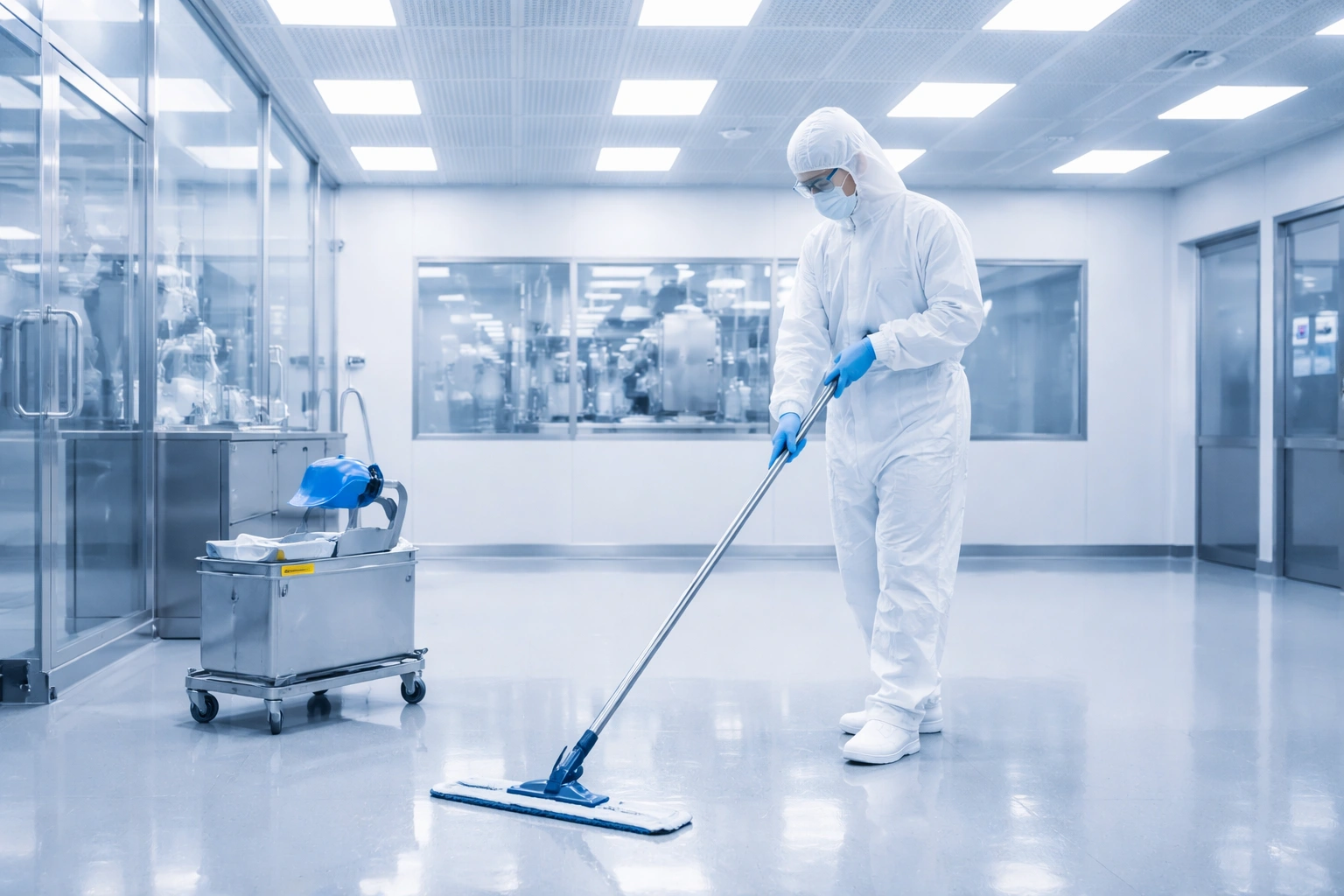
Cleanroom cleaning is a controlled GMP activity used to remove particles, residues, and microbial contamination from floors, walls, equipment, and critical surfaces. A strong cleaning SOP defines frequency by grade, disinfectant strategy, operator technique, and validation methods to maintain contamination control.

注目のスニペット

Cleanroom cleaning SOP is a GMP-controlled procedure that defines how surfaces, equipment, and critical zones are cleaned, disinfected, and validated to maintain contamination control. It includes cleaning frequency by ISO grade, disinfectant selection, two-pass cleaning methods, and validation through visual inspection, surface sampling, and environmental monitoring.

クイック意思決定ガイド

  • If your cleanroom shows recurring EM excursions, cleaning effectiveness is likely insufficient or inconsistent.
  • If disinfectant rotation is not defined, microbial resistance risk increases and validation strength decreases.
  • If cleaning is performed but not verified, GMP compliance is incomplete because effectiveness has not been proven.
  • If operators use inconsistent mopping or wiping techniques, contamination variability and surface residue risk increase.
  • If cleaning logs exist but lack traceability, audit readiness is weak even when cleaning appears routine.
Cleanroom cleaning is not a routine task — it is the final barrier between contamination risk and product safety.

Why Cleanroom Cleaning Is a Core Contamination Control Step

Particles, residues, fibers, and microorganisms accumulate on cleanroom surfaces through personnel movement, material transfer, airflow disturbance, and routine operations. If these residues are not removed through a controlled cleaning process, they become persistent contamination sources that can affect product quality, environmental monitoring trends, and audit readiness.

That is why GMP cleaning SOPs must do more than assign a frequency. They must define cleaning method, disinfectant selection, operator technique, validation logic, and documentation. A good SOP also connects directly with 環境モニタリング人材育成gowning discipline、 そして エアフロー性能.

Cleaning Objective なぜそれが重要なのか 弱い場合のリスク
Particle removal Reduces surface-to-air and surface-to-product contamination transfer ISO class instability and visible residue
Microbial reduction Controls viable contamination on contact surfaces and equipment EM excursions and product contamination risk
Residue control Prevents disinfectant buildup and material incompatibility Chemical residue, staining, sticky surfaces
Technique standardization Improves repeatability across operators and shifts Variable cleaning performance
検証 Proves that cleaning is effective, not just performed Weak GMP defensibility

Cleaning and Disinfection Strategy by Grade

Cleaning programs should reflect room classification, exposure risk, intervention frequency, and microbial control needs. A Grade A zone used in aseptic processing requires a much more aggressive and validated strategy than a Grade D support space.

学年 リスクレベル Cleaning Frequency Sanitization / Disinfection
ISO 5 (Grade A) Critical aseptic Every operation / high frequency surface control Every operation
ISO 7 (Grade B) Background aseptic 毎日 毎日
ISO 8 (Grade C) Controlled area Daily to weekly based on use Weekly or defined rotation
ISO 9 (Grade D) Support area Daily routine cleaning Weekly or risk-based
実用的な原則: cleaning frequency alone is not enough. The real control point is whether the method, chemistry, and validation match the contamination risk of the specific zone.

GMP対応のクリーンルームサポートが必要ですか?

クリーンルーム用衣類や汚染管理製品のサポートなど、製薬および管理された環境向けに設計された Midposi ソリューションをご覧ください。

Two-Pass Cleaning Method for GMP Cleanrooms

In higher-grade environments, a two-pass method is often preferred because it separates chemical application from residue removal. This reduces the risk of incomplete disinfection, sticky surface buildup, and uneven finishing.

Pass 1: Disinfection Cleaning

  • Apply validated disinfectant to the wipe or mop system
  • Use unidirectional or figure-8 motion based on SOP
  • Maintain defined contact time
  • Cover the area systematically without random overlap

Pass 2: Residue Removal / Final Clean

  • Use sterile WFI or approved rinse medium where required
  • Remove residual chemistry from the surface
  • Reduce the risk of buildup on equipment and floors
  • Allow the area to dry and confirm clean finish

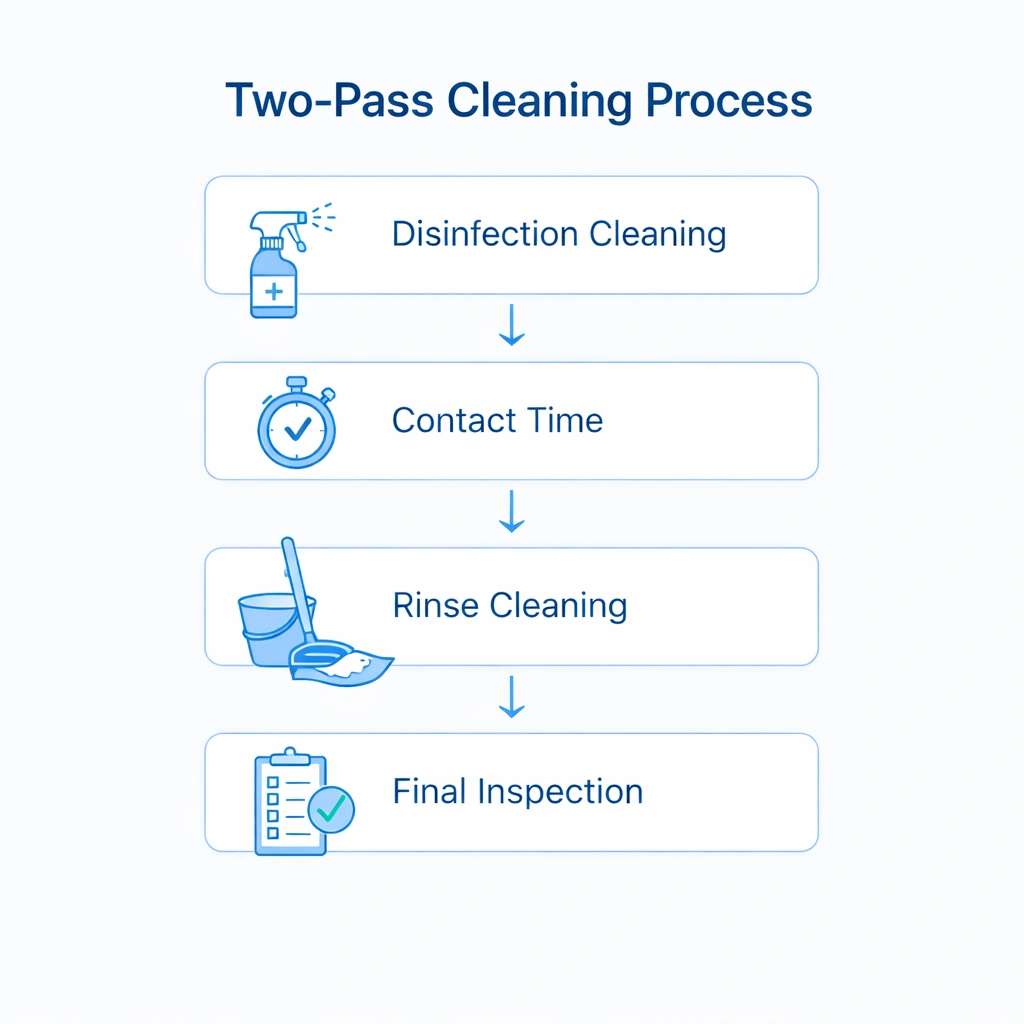
Visual Explanation: Two-Pass Cleaning SOP

A validated cleaning workflow should clearly show sequence, chemistry use, contact time, rinse logic, and final verification steps.

Two-pass cleanroom cleaning SOP flowchart

Disinfectant Selection and Rotation Strategy

A disinfectant program should be validated for efficacy, material compatibility, residue profile, and operational fit. One of the most common weaknesses in cleanroom programs is over-reliance on a single chemistry without a structured rotation strategy.

Disinfectant Consideration なぜそれが重要なのか
Efficacy profile Must be suitable for expected microbial challenges
Contact time Short contact times may reduce real-world effectiveness
Residue behavior Some chemistries leave visible or invisible surface residue
材料の適合性 Critical for floors, stainless surfaces, windows, and equipment
Rotation strategy Helps strengthen microbial control over time

Common program weaknesses include using only IPA, failing to verify contact time in practice, and not linking disinfectant selection to validation data.

Cleaning Validation Framework

Cleaning is only defensible in GMP when effectiveness is verified. This is where many programs fail: the room may be cleaned on schedule, but there is no structured proof that the cleaning activity actually reduced contamination risk.

MIDPOSI Cleaning Validation Framework

  • Visual inspection for residue, streaking, and visible contamination
  • Surface microbiological testing using defined sampling points
  • Environmental monitoring confirmation where relevant
  • Trend review across shifts, rooms, and operators

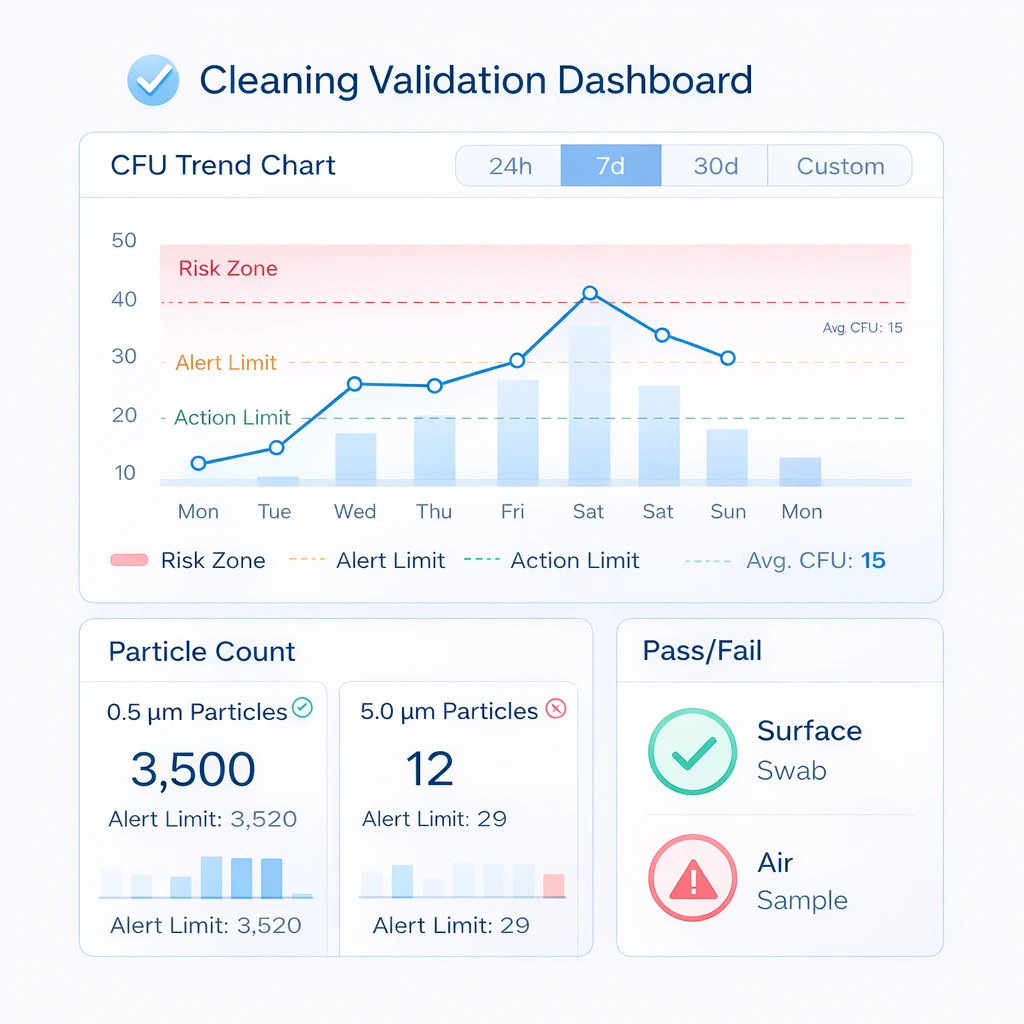
Visual Explanation: Cleaning Validation Dashboard

A validation dashboard should combine microbial results, post-cleaning particle data, pass/fail status, and recurring trend signals for QA review.

Cleanroom cleaning validation dashboard
Validation Method 目的 Why It Adds Value
目視検査 Immediate surface confirmation Fast, practical first-line check
Surface sampling Microbial control verification Confirms whether contamination has been reduced
Environmental monitoring review System-level effectiveness Shows whether cleaning supports wider contamination control

Common Cleanroom Cleaning Failures

Most cleaning failures are not caused by missing SOPs. They are caused by weak execution, poor standardization, or lack of validation.

Visual Explanation: Correct vs Incorrect Cleaning Practice

A clear side-by-side view helps operators understand how controlled, unidirectional technique differs from poor posture, random wiping, and incomplete surface coverage.

Correct versus incorrect cleanroom cleaning practice
Common Failure Why It Happens Resulting Risk
Inconsistent technique Operators are not trained to one repeatable method Uneven cleaning performance
Wrong disinfectant use Incorrect dilution, contact time, or rotation Reduced microbial effectiveness
No validation Cleaning is recorded but not verified Weak GMP defensibility
Poor documentation Logs lack time, batch, area, or operator traceability Audit findings and weak investigation support
No link to EM Cleaning program is not reviewed against monitoring trends Recurring excursions without effective correction
Validated Cleaning Logic
製薬 / バイオテクノロジー対応
Technique-Focused
Audit-Ready Documentation

Documentation and Training Requirements

A GMP cleaning system should never rely on memory or habit. It should be fully supported by documented SOPs, cleaning logs, disinfectant preparation records, validation records, and training documentation.

Documentation should typically include:

  • Cleaning logs by area, date, time, and operator
  • Disinfectant preparation and expiry records
  • Validation results and investigation follow-up
  • Operator training and requalification records

トレーニングでは、化学的性質や頻度だけでなく、動きの規律、拭き取りまたはモップのテクニック、残留物の認識、検証が失敗した場合のエスカレーション ルールもカバーする必要があります。

GMPクリーンルームサポート

Midposi でより強力なクリーンルーム清掃プログラムを構築する

Explore GMP-focused cleanroom solutions designed to support contamination control, audit readiness, and more consistent cleanroom operations in pharmaceutical and controlled manufacturing environments.

GMP重視 製薬 / バイオテクノロジー対応 監査対応サポート

よくある質問

クリーンルームにおける洗浄と消毒の違いは何ですか?

洗浄により、粒子、残留物、目に見える汚染が除去されます。消毒は、検証済みの化学薬品を使用して微生物の負担を軽減します。リスクの高い環境では、両方が 1 つの制御された汚染管理プロセスの一部として必要となります。

Why is a two-pass cleaning method used in GMP cleanrooms?

A two-pass method separates disinfectant application from final residue removal. This improves consistency, reduces buildup, and supports cleaner surface finish in higher-grade environments.

How often should a cleanroom be cleaned?

Frequency depends on room grade, activity level, and contamination risk. Higher-grade and critical process zones generally require more frequent and more tightly controlled cleaning than support areas.

How do you validate cleanroom cleaning effectiveness?

Typical validation includes visual inspection, defined surface sampling, and review of related environmental monitoring results. Together, these provide stronger evidence than logging alone.

Can one disinfectant be used for all cleanroom situations?

Usually no. Disinfectant strategy should consider efficacy, contact time, residue profile, material compatibility, and whether a rotation approach is required for the environment.

Why do cleaning programs fail even when SOPs exist?

Common reasons include inconsistent operator technique, poor training, weak documentation, incorrect disinfectant use, and lack of validation or trend review.

How does cleaning connect to environmental monitoring?

Recurring EM excursions often indicate that cleaning frequency, chemistry, technique, or validation may not be sufficient. EM data is one of the most useful ways to assess whether a cleaning program is working.

What do auditors usually expect to see in a cleaning SOP program?

Auditors typically expect clear procedures, defined frequencies, validated disinfectant use, operator training records, cleaning logs, and evidence that cleaning effectiveness is reviewed and verified.

MP

ミッドポジについて

Midposi focuses on cleanroom contamination control solutions for pharmaceutical, biotech, and controlled manufacturing environments. Our content is developed to help QA teams, production managers, and cleanroom professionals improve contamination prevention, operational consistency, and audit readiness.

それは無料です!

クリーンルーム衣類調達の 9 つの間違いを回避する

22

クイック見積もりを依頼する

1営業日以内にご連絡いたします。末尾が次のメールに注意してください 「@midposi.com」.

クイック見積もりを依頼する

1営業日以内にご連絡いたします。末尾が次のメールに注意してください 「*@midposi.com」.