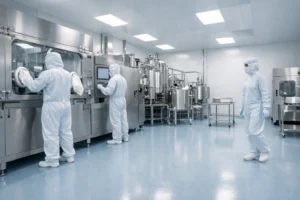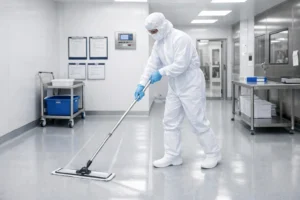
The cleanroom mop head isn’t just the business end of your cleaning tool—it’s the critical interface between contamination control and regulatory compliance. Pick the wrong material and you’ll see environmental monitoring failures, audit findings, and potential batch rejections. Choose correctly and you’ve got a validated component in your contamination control strategy that performs reliably across hundreds of sterilization cycles. This guide decodes the material science behind polyester sealed-edge, microfiber multi-layer, foam-core, and melt-blown nonwoven mop heads, explaining how fiber construction, edge treatment, and chemical compatibility determine particle generation rates, sterilization durability, and total cost of ownership. Whether you’re qualifying equipment for ISO Class 5 aseptic processing or optimizing Class 8 support-area cleaning protocols, you’ll find the technical specifications and decision frameworks to match mop head material to your facility’s contamination control requirements.
What Is a Cleanroom Mop Head? (ISO & GMP Definition)
A cleanroom mop head is a low-lint, validated cleaning substrate designed to remove particulate and microbial contamination from classified surfaces without introducing additional particles or viable organisms. Unlike conventional janitorial mops—which shed fibers, trap contaminants in open weaves, and degrade under industrial disinfectants—cleanroom mop heads use engineered materials (continuous-filament polyester, sealed-edge microfiber, closed-cell foam, or melt-blown nonwoven) that meet quantified particle generation limits and survive repeated sterilization cycles. EU GMP Annex 1 requires that “materials used in cleanrooms should be selected to minimize particle generation and be suitable for repeated application of disinfecting agents and sporicidal agents.” ISO 14644-14 provides the test methodology: mop heads undergo particle generation testing under simulated use conditions (mechanical stress, wet mopping motions) with acceptance criteria tied to the target ISO classification (Class 5 areas permit only 3,520 particles ≥0.5 µm/m³; Class 8 tolerates 3,520,000).
How Cleanroom Mop Heads Differ from Standard Mops
Standard janitorial mops fail cleanroom qualification on three fronts. First, particle generation: cotton-loop and cut-end string mops shed thousands of fibers per stroke—acceptable in an office break room, catastrophic in an aseptic processing suite where a single batch of contaminated product can trigger FDA warning letters. Cleanroom mop heads use continuous-filament construction (no cut ends to fray) and sealed edges (ultrasonic welding, laser cutting, thermal bonding) to eliminate fiber release.
Second, microbial harboring: conventional mops have open yarn loops and absorbent cores that trap bioburden, resist complete disinfection, and recontaminate surfaces during subsequent mopping. Cleanroom designs use smooth, non-porous materials or tightly knitted structures that release captured particles during laundering and don’t provide niches for microbial growth.
Third, chemical durability: standard mops deteriorate under pharmaceutical-grade disinfectants (70% isopropyl alcohol, 3–6% hydrogen peroxide, 500–5000 ppm sodium hypochlorite). Fibers lose tensile strength, edges unravel, and particle shedding accelerates—exactly what environmental monitoring will catch. Cleanroom mop heads undergo ASTM D543 chemical resistance testing to verify dimensional stability, color retention, and fiber integrity across 50–200 exposure cycles.
ISO 14644 & EU GMP Requirements That Affect Mop Heads
ISO 14644-14 defines particle generation testing protocols: cleanroom consumables (including mop heads) undergo mechanical stress simulations (wiping motions, abrasion) while particle counters sample the local environment at 0.5 µm and 5 µm size channels. The mop head passes if particle concentrations remain below the target ISO class limits during simulated operational conditions. For ISO Class 5 (Grade A/B pharmaceutical aseptic processing), this means near-zero shedding—fewer than 10 particles ≥0.5 µm per stroke under test conditions. Class 7 and 8 support areas accept slightly higher generation but still require low-lint materials with documented test data.
EU GMP Annex 1 (2022 revision) adds sterility and validation requirements. Grade A and Grade B zones require sterile disinfectants and cleaning tools prior to use—your mop head must either be pre-sterilized (gamma radiation, ethylene oxide gas, autoclave) with Sterility Assurance Level (SAL) 10⁻⁶ documentation, or laundered and autoclaved in-house per validated protocols. The regulation also mandates validated cleaning processes that “remove residues which may inhibit the disinfection process” and validated disinfection effectiveness using “more than one type of disinfectant” with “periodic use of a sporicidal agent.” Translation: your mop head material must survive aggressive chemical rotation (alcohols, peroxides, hypochlorites, quaternary ammonium compounds) without degrading or shedding particles. ਬੁਨਿਆਦੀ ਗੰਦਗੀ ਨਿਯੰਤਰਣ ਸਿਧਾਂਤਾਂ ਲਈ, start with understanding how ISO class limits drive equipment specifications.
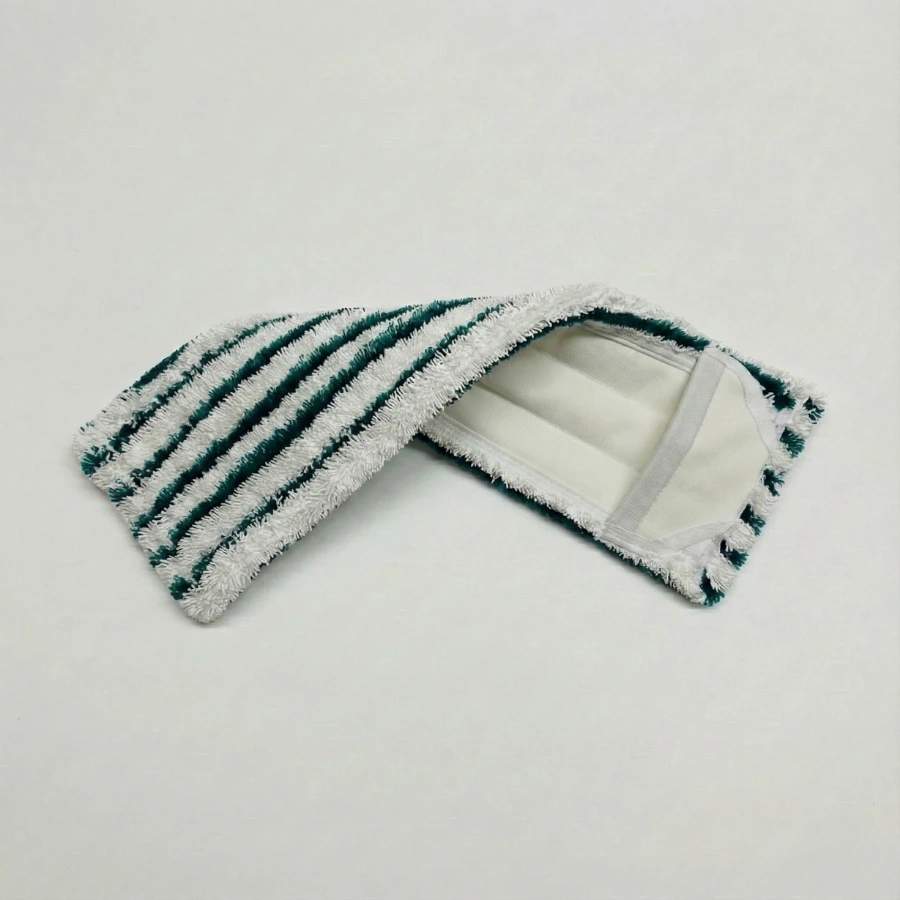
Why Mop Head Material Matters
Mop head material determines four performance characteristics that directly impact environmental monitoring compliance, validation workload, and total cost of ownership: particle generation rates, chemical compatibility, sterilization resistance, and absorbency efficiency. These aren’t abstract specifications—they’re the difference between passing an FDA inspection and receiving a 483 observation for “inadequate cleaning equipment qualification.”
Particle Generation (ISO 14644-14)
Particle generation is the primary failure mode for cleanroom mop heads. Every fiber junction, cut edge, and mechanical stress point is a potential particle source. Continuous-filament polyester knit releases fewer than 10 particles ≥0.5 µm per square meter of mopped surface under ISO 14644-14 test conditions; cut-pile cotton can release 10,000+ particles in the same area. The construction method matters: ultrasonic-welded sealed edges eliminate the frayed borders where conventional mops shed fibers; laser-cut microfiber prevents edge unraveling; heat-bonded nonwoven webs distribute stress across fiber-to-fiber bond points rather than concentrating it at seams.
Fiber diameter drives particle capture and shedding dynamics. Microfiber (defined as <1 denier, roughly 10 µm diameter) has higher surface area per gram than standard polyester (2–5 denier, 20–50 µm), improving particle pickup—but only if the fiber structure remains intact. Split microfiber (with star-shaped cross-sections creating capillary channels) captures particles more effectively than round monofilament but is more vulnerable to mechanical damage during laundering. Polyester continuous filament balances durability with performance: thicker than microfiber but still low-lint when properly knitted, and more resistant to abrasion across 150+ autoclave cycles.
Chemical Compatibility with Disinfectants
Pharmaceutical contamination control strategies rotate multiple disinfectant chemistries to prevent microbial resistance: 70% isopropyl alcohol (bactericidal, fast-evaporating), 3–6% hydrogen peroxide (sporicidal, oxidizing), 500–5000 ppm sodium hypochlorite (broad-spectrum, corrosive), and quaternary ammonium compounds (residual activity, lower toxicity). Your mop head must survive all of them without fiber degradation, color fading, or dimensional change.
Polyester and polyamide (nylon) show excellent resistance to alcohols and quats but vary in oxidizer tolerance. Polyester withstands moderate hydrogen peroxide concentrations (up to 6%) and low-concentration bleach (500–1000 ppm) across 100+ cycles; higher bleach levels (>1%) accelerate yellowing and tensile strength loss. Polyamide degrades faster under oxidizers—a critical consideration for facilities using aggressive sporicidal protocols. Polyurethane foam resists alcohols well but shows reduced cycle life under sustained peroxide or bleach exposure (typically 20–50 cycles before visible deterioration versus 100–200 for polyester knit). Melt-blown polypropylene nonwovens handle most disinfectants but are often specified as single-use to avoid validation complexity.
ASTM D543 provides the test framework: expose mop head materials to your facility’s disinfectant concentrations at working temperatures for defined durations (simulating 50–200 use cycles), then measure changes in mass, dimensions, tensile strength, and visual appearance. Acceptance criteria should define maximum allowable degradation before replacement—typically <5% mass change, <2% dimensional change, and no delamination or fiber pull-out.
Sterilization Resistance (Autoclave / Gamma / EO)
Sterilization method compatibility determines whether your mop head can enter Grade A/B aseptic zones or remains limited to Grade C/D support areas. Autoclavable mop heads survive repeated 121°C steam cycles (30 minutes minimum) without shrinkage, fiber melting, or seam separation—polyester and certain polyamides excel here, with qualified cycle lives of 100–200 autoclave runs. Microfiber blends (polyester/polyamide) show variable performance; some shrink 3–5% after 50 cycles, requiring dimensional qualification and maximum-cycle limits in your validation protocol.
Gamma radiation sterilization (25–40 kGy dose to achieve SAL 10⁻⁶) suits single-use disposable mop heads or initial sterilization of reusable systems before first use. Polyester, polyamide, and polypropylene tolerate gamma doses without significant strength loss. Ethylene oxide (EO) gas sterilization works for temperature-sensitive materials but requires EO residual testing and aeration periods—less common for mop heads given autoclave availability in most GMP facilities.
Foam-core mop heads present a sterilization trade-off: polyurethane foam survives autoclaving but shows accelerated compression set (permanent thickness reduction) after 20–30 cycles, reducing fluid-holding capacity and mopping efficiency. Many foam-core products are supplied pre-sterilized (gamma or EO) as single-use consumables to avoid in-house autoclave validation complexity.
ਸਮਾਈ & Coverage Efficiency
Absorbency determines how much disinfectant solution the mop head holds and distributes across the target surface. Higher absorbency reduces the number of dipping cycles (fewer interruptions, faster cleaning), ensures consistent disinfectant contact time, and prevents streaking from inadequate fluid coverage. Microfiber leads in absorbency (6–8× its dry weight) thanks to capillary action in split-fiber channels. Polyester knit follows at 4–6×, and polyurethane foam ranges 5–7× depending on cell structure. Melt-blown nonwovens typically achieve 3–5× but are often pre-saturated by the manufacturer to ensure consistent disinfectant loading.
Coverage efficiency—the floor area cleaned per mop head before saturation or visible soiling—affects per-use cost and operator productivity. A double-sided polyester mop head (flip when one side is soiled) covers 50–100 m² before replacement; a single-use foam pad might handle 20–30 m². For large-area cleanrooms (pharmaceutical packaging suites, medical device assembly zones), higher absorbency and coverage translate directly to reduced mop head consumption and lower TCO.

Figure 1: Microscopic comparison of the four main cleanroom mop head material types. Panel 1 shows polyester sealed-edge construction with continuous filament weave and tight knit density that minimizes particle generation. Panel 2 displays microfiber multi-layer structure with ultra-fine split fibers (<1 denier) creating capillary channels for superior absorbency. Panel 3 reveals foam-core open-cell polyurethane structure providing controlled disinfectant release. Panel 4 illustrates melt-blown nonwoven random fiber web (1-5 µm diameter) with heat-bonded junctions. Understanding these structural differences is critical for matching mop head material to ISO classification requirements and disinfectant protocols.
The 4 Main Types of Cleanroom Mop Heads
Polyester Sealed-Edge Mop Heads
Polyester sealed-edge mop heads use continuous-filament polyester yarn (no cut ends) knitted into flat-pad or tubular-mop configurations, with edges sealed via ultrasonic welding, laser cutting, or thermal bonding to prevent fraying. This construction eliminates the primary particle source in conventional mops—exposed cut fibers that shed under mechanical stress. The continuous filament structure distributes tension across the entire knit rather than concentrating it at termination points, allowing these mops to survive 100–200 autoclave cycles without edge delamination or fiber pull-out.
ISO Class Suitability: ISO Class 3–8 (vendor data varies; best performers validated for Class 5–7). Polyester sealed-edge mops meet pharmaceutical Grade C/D requirements and many Grade B applications when properly laundered and autoclaved. They’re the workhorse of medical device cleanrooms, pharmaceutical packaging areas, and electronics assembly zones.
Sterilization Capability: Fully autoclavable at 121°C for 30 minutes, with qualified cycle life typically 150–200 runs before dimensional changes exceed acceptance criteria (<2% shrinkage). Compatible with gamma radiation sterilization (25–40 kGy) for single-use sterile variants. Some vendors supply pre-sterilized polyester mops with SAL 10⁻⁶ documentation for facilities without in-house autoclave capacity.
Pros: Longest cycle life among reusable mop heads (150–200 autoclave cycles = lowest per-use cost at scale). Excellent chemical resistance to alcohols, peroxides (up to 6%), and moderate bleach concentrations (500–1000 ppm). Sealed edges eliminate fiber shedding—critical for ISO Class 5–7 particle control. Available in multiple knit patterns (herringbone, plain weave, looped edges) to optimize fluid distribution or particle capture. Strong mechanical durability under repeated laundering and abrasion.
Cons: Lower absorbency than microfiber (4–6× vs. 6–8×), requiring more frequent dipping for large-area mopping. Not pre-sterilized unless specified—requires in-house autoclave validation for Grade A/B use. Degrades faster under high-concentration bleach (>1% sodium hypochlorite) compared to polypropylene nonwoven. Knit construction can trap small particles in yarn interstices if not thoroughly laundered between uses.
Microfiber Multi-Layer Mop Heads
Microfiber mop heads use ultra-fine synthetic fibers (<1 denier, typically 10 µm diameter) in split or non-split configurations, often layered or laminated to balance particle capture with durability. Split microfiber—with star-shaped or wedge-shaped cross-sections creating capillary channels—excels at particle pickup: the channels trap particles mechanically and hold fluid via capillary action, achieving 6–8× absorbency. Non-split microfiber uses round monofilament and shows better abrasion resistance but lower fluid loading. Many cleanroom microfiber mops use a polyester/polyamide blend (80/20 or 70/30) to balance cleanability with chemical resistance.
Particle Performance: Superior particle capture compared to standard polyester thanks to higher surface area per gram and split-fiber channel mechanics. Under ISO 14644-14 testing, properly constructed sealed-edge microfiber releases <10 particles ≥0.5 µm per stroke—suitable for ISO Class 5–7 when edges are laser-cut or ultrasonically sealed. However, split microfiber is more vulnerable to mechanical damage during aggressive laundering; cycle life drops to 50–100 autoclave runs before fiber structure degrades and particle generation increases.
Fluid Loading: Highest absorbency among woven mop head types (6–8× dry weight), reducing dipping frequency and improving coverage efficiency. The capillary channels distribute disinfectant evenly across the mop surface, ensuring consistent contact time and reducing streaking—important for sporicidal agent application where contact time validation is critical.
Common Use Cases: ISO Class 5–7 pharmaceutical cleanrooms where high particle capture efficiency justifies shorter cycle life (aseptic processing support areas, isolator interiors, gowning room walls/ceilings). Medical device cleanrooms with moderate disinfectant protocols (IPA, quats, low-concentration peroxide). Facilities prioritizing single-pass cleaning efficiency over maximum reusable cycle count. Often specified for critical surface wiping (equipment exteriors, pass-through chambers) where particle capture matters more than durability.
ਸੀਮਾਵਾਂ: Shorter cycle life than polyester knit (50–100 autoclave cycles typical; some shrink 3–5% after 50 runs). Split microfiber degrades faster under aggressive oxidizers (high-concentration peroxide, bleach)—polyamide component is particularly vulnerable. More expensive per unit than polyester sealed-edge. Requires careful laundry protocols to avoid fiber damage (low mechanical agitation, no fabric softeners, moderate temperatures).
Foam-Core Mop Heads
Foam-core mop heads use polyurethane or polyether foam substrates, often laminated with a thin microfiber or polyester outer layer for abrasion protection. The open-cell foam structure absorbs disinfectant solution and releases it gradually during mopping, providing even fluid distribution without pooling or streaking. This “controlled release” characteristic makes foam cores popular for sporicidal agent application where consistent surface contact time is essential for validation. Many vendors supply foam-core mops as single-use pre-sterilized consumables to sidestep the foam’s limited autoclave cycle life.
Even Disinfectant Release: The open-cell structure acts as a fluid reservoir, delivering consistent disinfectant coverage across the mopped surface. Unlike woven materials that can oversaturate in some areas and underlayer in others, foam maintains uniform fluid distribution—critical for validating sporicidal contact time per EU GMP Annex 1 requirements.
Sterile Disposable Option: Foam-core mops are commonly supplied pre-sterilized (gamma radiation or EO gas, SAL 10⁻⁶ documentation) as single-use consumables. This eliminates in-house autoclave validation workload and cross-contamination risk between batches—attractive for clinical trial manufacturers, multi-product facilities requiring batch segregation, and small biotech operations without validated laundry infrastructure. Vendors often package them in sealed sterile pouches pre-saturated with disinfectant (IPA, quat solutions) for turnkey Grade A/B use.
TCO Considerations: Foam-core disposables cost $10–$15 per unit versus $2–$4 per laundered cycle for reusable polyester—the 3–5× cost premium buys sterility assurance and eliminates validation overhead. For low-volume operations (small-batch manufacturing, R&D cleanrooms, pilot facilities), the higher per-use cost is offset by avoided laundry capital investment and QA validation labor. For high-volume production (multiple daily cleaning cycles, large floor areas), reusable polyester or microfiber delivers better TCO.
Reusable foam-core mops (autoclaved in-house) show compression set after 20–30 cycles—the foam loses thickness permanently, reducing fluid capacity and mopping efficiency. Chemical resistance is moderate: excellent with alcohols and quats, but hydrogen peroxide (>3%) and bleach (>500 ppm) accelerate foam degradation. Facilities using aggressive sporicidal rotation should specify single-use foam or switch to polyester knit for support areas.
Melt-Blown Nonwoven Mop Heads
Melt-blown nonwoven mop heads use polypropylene or polyester fibers extruded at high temperature and blown into ultra-fine random webs (fiber diameter 1–5 µm), then heat-bonded without weaving or knitting. The resulting material is lightweight, low-lint (no yarn structure to unravel), and inexpensive to manufacture—making it ideal for single-use GMP workflows. Melt-blown nonwovens dominate in electronics cleanrooms (semiconductor fabs, disk drive assembly) and are increasingly adopted in pharmaceutical packaging areas where disposable workflows reduce cross-contamination risk.
Single-Use GMP Workflows: Melt-blown nonwoven mops eliminate the validation complexity of reusable systems: no laundry qualification, no autoclave cycle-life studies, no cross-contamination risk between product batches or manufacturing campaigns. Use once, discard, open a fresh sterile mop for the next cleaning cycle. This workflow suits contract manufacturers handling multiple API families, facilities with frequent product changeovers, and operations where cleaning validation burden outweighs consumable cost.
Compatibility with Sporicidal Agents: Polypropylene-based melt-blown nonwovens show excellent chemical resistance to alcohols, peroxides, hypochlorites, and phenolics—better than polyester or polyamide in sustained bleach exposure. The fiber-to-fiber heat-bonded structure distributes chemical stress without seams or stitching that could fail under aggressive disinfectants. However, the thin material (typically 40–80 gsm) degrades rapidly with mechanical abrasion; these mops are specified for single-use only.
ਲਾਗਤ & Risk Trade-offs: Per-unit cost is low ($3–$8 for pre-sterilized nonwoven mops) but still 2–4× higher than per-cycle cost of reusable polyester at scale. The trade-off calculation hinges on validation workload: if your QA team spends $5,000–$10,000 qualifying and requalifying a reusable mop system (particle generation testing, autoclave validation, laundry protocol, periodic requalification), single-use nonwovens pay back quickly. Conversely, a facility mopping 50+ areas twice daily (36,500 mop heads/year) faces $110,000–$290,000 annual consumable cost with disposables versus $15,000–$30,000 for reusables—TCO favors reusable systems at high volume.
Particle generation performance varies with manufacturing quality. Premium melt-blown nonwovens (tight fiber web, uniform bonding) achieve ISO Class 5–7 validation; lower-cost variants may only qualify for Class 8 support areas. Demand ISO 14644-14 test data from vendors and verify particle generation acceptance criteria match your target classification.

Figure 2: Decision tree for matching cleanroom mop head material to ISO classification requirements. ISO Class 5 (Grade A/B aseptic processing) demands sealed-edge polyester or microfiber with validated sterility assurance and <10 particles ≥0.5 µm per stroke. Class 6 accepts broader options including premium nonwovens while maintaining low-lint requirements. Class 7 permits all four material types with focus on chemical compatibility. Class 8 allows full material selection with TCO optimization priority. Use this framework to narrow material options based on your facility’s most restrictive ISO class, then apply disinfectant compatibility and sterilization method criteria for final selection.
How to Select the Right Cleanroom Mop Head (GMP Decision Guide)
Match by ISO Class (ISO 5, 6, 7, 8)
ISO Class 5 (Grade A/B pharmaceutical aseptic processing): Requires near-zero particle generation and validated sterility assurance. Specify sealed-edge polyester or sealed-edge microfiber with documented ISO 14644-14 test data showing <10 particles ≥0.5 µm per stroke. Pre-sterilized options (gamma, EO, or autoclave with SAL 10⁻⁶) eliminate in-house sterilization validation workload. Foam-core disposables work if supplied sterile and pre-saturated; avoid reusable foam due to compression set degradation. Melt-blown nonwovens qualify only if vendor provides Class 5 validation documentation.
ISO Class 6 (Grade B background areas, Grade C critical zones): Accepts both sealed-edge polyester and microfiber, plus high-quality foam-core and premium melt-blown nonwovens. Sterilization can be in-house autoclave (reusables) or vendor-supplied sterile consumables. Particle generation limits are less stringent than Class 5 but still require low-lint construction and sealed edges. This is the sweet spot for reusable polyester: validated performance, strong TCO, manageable autoclave cycle life.
ISO Class 7 (Grade C support areas, medical device assembly): Broadest material options. Polyester sealed-edge, microfiber, foam-core (reusable or disposable), and melt-blown nonwovens all perform adequately with proper edge treatment. Disinfection (thorough chemical treatment) may suffice in place of sterilization depending on facility contamination control strategy, though many pharmaceutical operations still autoclave all cleaning tools. Focus on chemical compatibility and cycle life rather than absolute particle generation minimums.
ISO Class 8 (pharmaceutical packaging, gowning rooms, airlocks): All four mop head types suitable. This is where TCO optimization matters most: high-volume daily mopping makes reusable polyester economically attractive ($2–$4 per cycle vs. $8–$15 per disposable). Melt-blown nonwovens work well for facilities prioritizing simplified workflows over per-use cost. Foam-core disposables may be over-specified (paying for sterility assurance you don’t need); reserve for batch-segregation scenarios or facilities without laundry infrastructure.

Match by Disinfectant Program
Alcohol-heavy protocols (70% IPA as primary disinfectant): All four material types show excellent IPA compatibility. Choose based on other factors (ISO class, sterilization method, TCO). Polyester and melt-blown nonwoven offer best long-term durability; microfiber and foam handle IPA well but may degrade faster under mechanical stress.
Peroxide-based sporicidal rotation (3–6% H₂O₂): Polyester sealed-edge excels (stable across 100+ cycles at 6% H₂O₂). Microfiber suitable if peroxide concentration stays ≤3% and cycle life expectations are modest (50–100 cycles). Foam-core degrades faster; limit to ≤3% peroxide or specify single-use. Polypropylene melt-blown nonwovens show excellent peroxide resistance but are typically single-use anyway.
Bleach (sodium hypochlorite) protocols (500–5000 ppm): Polypropylene melt-blown nonwoven shows best chemical resistance but is single-use. Polyester tolerates 500–1000 ppm across 100+ cycles; higher concentrations (>1%) cause yellowing and accelerated degradation. Microfiber (especially polyamide-blend) degrades quickly under bleach; avoid for facilities with >1000 ppm protocols. Foam-core limited to ≤500 ppm or single-use.
ਕੁਆਟਰਨਰੀ ਅਮੋਨੀਅਮ ਮਿਸ਼ਰਣ (ਕਵਾਟਸ): All material types compatible. Quats are gentler than oxidizers; choose based on ISO class and TCO rather than chemical resistance concerns. Note: quats can adsorb to cellulosic materials; stick with synthetic polyester/polypropylene cleanroom mop heads to avoid disinfectant binding that reduces effectiveness.
Multi-disinfectant rotation (Annex 1 compliance): Polyester sealed-edge handles the broadest chemical rotation without degradation. Specify polyester for facilities rotating IPA, moderate peroxide, low-concentration bleach, and quats. Microfiber acceptable if bleach is low-concentration or infrequent. Foam-core and melt-blown nonwoven work as single-use consumables (one mop per disinfectant type if needed) but higher cost.
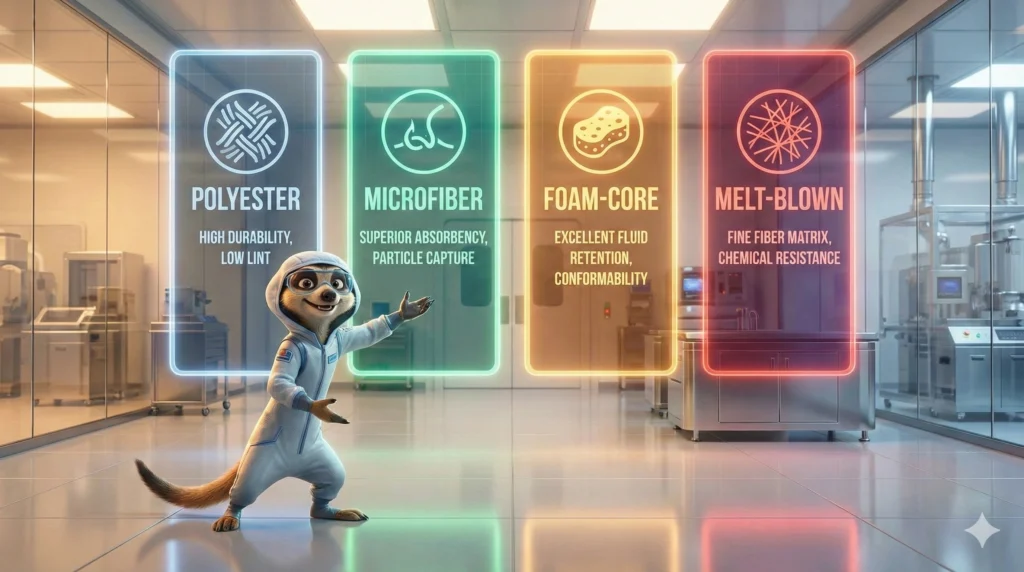
Match by Sterilization Method (Autoclave, Gamma, EO, Chemical)
Autoclave (121°C steam, in-house processing): Polyester sealed-edge is the gold standard (150–200 qualified cycles). Microfiber acceptable (50–100 cycles; verify dimensional stability in qualification studies). Foam-core limited (20–30 cycles before compression set). Melt-blown nonwoven not typically autoclaved (specified as single-use).
Gamma radiation (vendor-supplied sterile): All four material types tolerate 25–40 kGy gamma sterilization without significant degradation. Common for single-use consumables: sterile foam-core, sterile melt-blown nonwoven, sterile polyester (initial sterilization for reusable systems). Vendor must provide dose-audit records and SAL 10⁻⁶ documentation.
Ethylene oxide gas (EO): Suitable for temperature-sensitive foam-core materials that can’t withstand repeated autoclaving. Less common for mop heads given autoclave prevalence in pharmaceutical facilities. Requires EO residual testing and aeration periods; adds lead time and complexity compared to autoclave. Specify only if autoclave unavailable or foam material can’t survive steam.
Chemical disinfection only (no terminal sterilization): Acceptable for ISO Class 7–8 support areas where contamination control strategy permits thoroughly disinfected (not sterile) cleaning tools. All material types work; choose based on absorbency, coverage, and TCO. Not acceptable for Grade A/B aseptic zones per EU GMP Annex 1.
Match by Frequency of Use & TCO
High-volume facilities (multiple daily cleaning cycles, large floor areas): Reusable polyester sealed-edge delivers lowest TCO. Calculate annual mop head consumption (areas × mopping frequency × 365 days), then compare: polyester at $2–$4 per cycle (150–200 cycle life) versus disposables at $8–$15 per use. A facility mopping 20 areas twice daily consumes 14,600 mop heads/year—reusable polyester costs $29,000–$58,000 annually; disposables cost $117,000–$219,000. The $60,000–$160,000 savings justifies laundry and autoclave validation investment.
Low-volume facilities (small-batch, R&D, pilot operations): Single-use foam-core or melt-blown nonwoven eliminates validation overhead. If you’re mopping 5 areas daily (1,825 mop heads/year), disposables cost $14,600–$27,375 annually—manageable. The avoided cost of laundry infrastructure, autoclave validation, and QA labor may exceed the consumable premium.
Frequent change-out SOPs (per-batch, per-shift replacement): Favor low per-unit cost single-use options. Melt-blown nonwoven ($3–$8) offers better economics than foam-core disposables ($10–$15) for facilities changing mops every shift regardless of wear. Alternatively, implement double-sided reusable polyester (flip when one side soils) to reduce change-out frequency without increasing per-use cost.
Multi-product manufacturers (batch segregation required): Single-use consumables (foam-core, melt-blown nonwoven) eliminate cross-contamination risk and simplify cleaning validation. Reusable systems require validated cleaning-between-campaigns protocols and dedicated mop inventories per product family—the validation and inventory complexity often exceeds the disposable cost premium. For complete mop system selection guidance, see buyer’s guide comparing integrated mop systems.

When to Replace a Mop Head
Mop head replacement isn’t guesswork—it’s a validated decision based on visual inspection criteria, cycle count limits, and environmental monitoring trends. Replace too early and you waste budget on unnecessary consumables; replace too late and you risk particle generation excursions, EM failures, and audit findings.
Signs of Fiber Degradation
Visual inspection catches most degradation before it triggers particle generation. Check mop heads after every laundry/autoclave cycle (reusables) or before use (pre-sterilized disposables). Replace immediately if you observe: edge fraying or unsealing (sealed edges separate, exposing cut fiber ends), fiber pilling or fuzzing (indicates mechanical breakdown of continuous filament structure), delamination (foam core separates from outer layer, microfiber layers peel apart), seam separation (stitching or bonding fails at mop head perimeter), or color fading beyond acceptance criteria (often correlates with chemical degradation and reduced tensile strength).
For polyester and microfiber, run your gloved hand across the mop surface—if fibers pull free or feel loose, the material has reached end of life. For foam-core, squeeze to check for permanent compression (foam doesn’t spring back fully). For melt-blown nonwoven, look for tearing or thin spots where material translucence increases.
Loss of Absorbency
Absorbency degradation signals that the mop head can no longer distribute disinfectant effectively. Test by weighing the mop head dry, saturating in distilled water, gently squeezing excess, and reweighing. Compare to baseline absorbency from qualification studies. Replace when absorbency drops below 80% of qualified baseline—typically this occurs at 60–80% of maximum cycle life for polyester knit, earlier for foam-core (50–60% of cycle life) due to compression set.
Operational signs of absorbency loss include increased dipping frequency to maintain surface wetness, visible dry streaking during mopping (disinfectant coverage insufficient), and reduced coverage area before the mop feels “used up.” Document these observations in cleaning logs; patterns of early absorbency loss may indicate that your disinfectant concentration or autoclave parameters are exceeding the mop material’s qualified limits.
Autoclave Cycle Life Limits
Every reusable mop head has a maximum qualified autoclave cycle count beyond which dimensional stability, particle generation, and sterility assurance can’t be guaranteed. Polyester sealed-edge: 150–200 cycles typical. Microfiber: 50–100 cycles (higher end for polyester-rich blends, lower for polyamide-heavy). Foam-core reusable: 20–30 cycles before compression set exceeds acceptance. Melt-blown nonwoven: not qualified for autoclaving (single-use only).
Implement a tracking system—individual mop head serial numbers or batch identifiers with cycle count logs. Replace mops at 80% of maximum qualified cycle life as a safety margin; don’t push to the absolute limit. For example, a polyester mop qualified for 200 cycles should be retired at 160 cycles even if visual inspection looks acceptable. The last 20% of cycle life is where particle generation risk accelerates.
EM Deviations or Increased Particle Shedding
Environmental monitoring excursions are the ultimate replacement trigger. If particle counts increase in areas immediately after mopping, or if trends show rising non-viable particle concentrations correlating with cleaning schedules, investigate your mop heads first. Pull samples from current inventory, run ISO 14644-14 particle generation testing (or send to a qualified lab), and compare results to initial qualification data. If particle generation has increased beyond acceptance criteria, replace the entire mop head inventory lot and investigate root cause—likely either exceeded cycle life limits, chemical degradation from disinfectant exposure, or inadequate laundering removing residual particles.
For facilities with robust CCS and trending systems, set alert thresholds: if particle counts in a specific area exceed 50% of the ISO class limit for two consecutive monitoring events post-cleaning, quarantine all mop heads used in that area and perform particle generation requalification testing. This proactive approach prevents actual EM failures and batch impact. For detailed material performance comparisons, see microfiber versus polyester analysis.
Cleanroom Mop Head Comparison Table
| ਸਮੱਗਰੀ ਦੀ ਕਿਸਮ | ISO Class Suitability | ਕਣ ਉਤਪੰਨ | Autoclave Cycle Life | ਰਸਾਇਣਕ ਪ੍ਰਤੀਰੋਧ | ਸਮਾਈ | Per-Use Cost | Best Use Case |
| ਪੋਲੀਸਟਰ ਸੀਲਡ-ਐਜ | Class 3–8 (validated 5–7) | <10 particles ≥0.5 µm | 150–200 cycles | Excellent (IPA, moderate peroxide/bleach) | 4–6× | $2–$4 | High-volume facilities, Grade C/D areas, best TCO at scale |
| Microfiber Multi-Layer | Class 5–7 | <10 particles ≥0.5 µm | 50–100 cycles | Good (IPA, quats); limited bleach tolerance | 6–8× | $4–$8 | Critical surface wiping, aseptic processing support areas, high particle capture |
| Foam-Core (Disposable) | Class 5–8 | <20 particles ≥0.5 µm | 20–30 cycles (reusable) | Moderate (IPA, quats); degrades under peroxide/bleach | 5–7× | $10–$15 | Low-volume facilities, batch segregation, turnkey sterile consumables |
| Melt-Blown Nonwoven | Class 5–8 (quality-dependent) | Variable by vendor | Single-use only | Excellent (all disinfectants, esp. bleach) | 3–5× | $3–$8 | Single-use workflows, multi-product manufacturers, simplified validation |
How to use this table: Start with your ISO class requirement (column 2) to eliminate incompatible options. Verify particle generation acceptance (column 3) matches your qualification criteria. If reusable, confirm autoclave cycle life (column 4) justifies validation investment. Match chemical resistance (column 5) to your disinfectant rotation. Calculate 12-month TCO using per-use cost (column 7) and annual volume. Reference “Best Use Case” (column 8) to confirm the material fits your operational model.
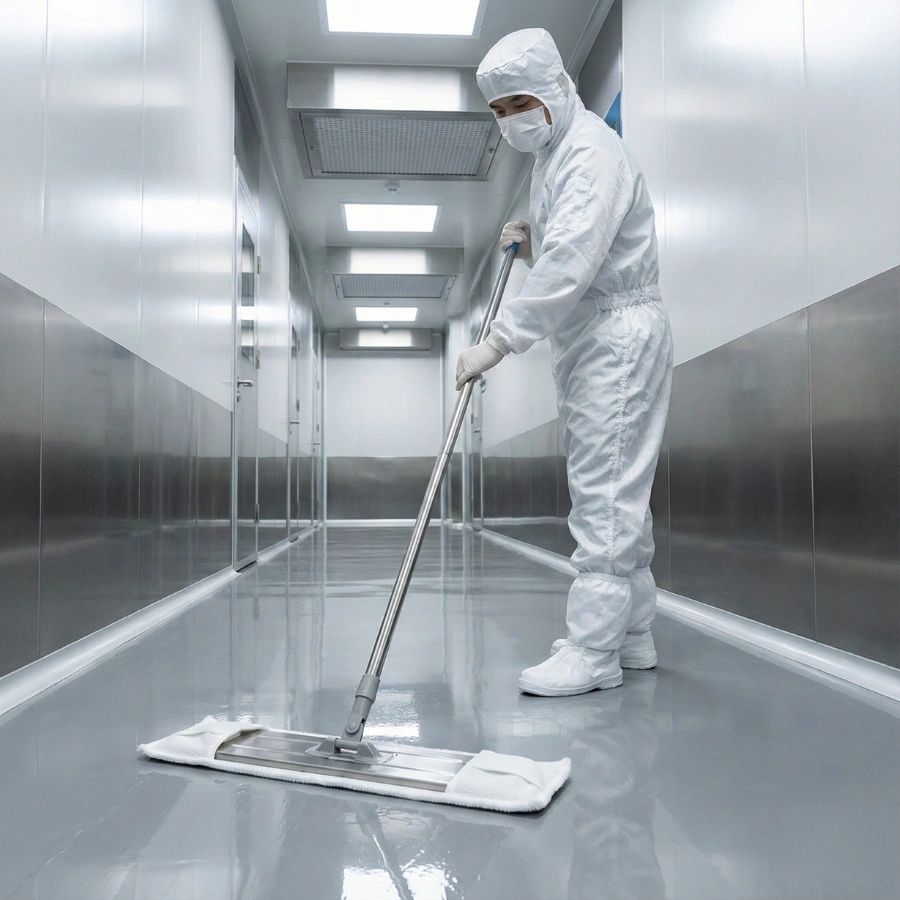
MIDPOSI Cleanroom Mop Head Options (GMP-Ready)
MIDPOSI supplies polyester sealed-edge and microfiber cleanroom mop heads engineered for ISO Class 5–8 pharmaceutical and medical device applications. The polyester line uses continuous-filament yarn with ultrasonic-sealed edges, delivering particle generation performance suitable for Grade C/D pharmaceutical manufacturing and medical device assembly cleanrooms. Qualified autoclave cycle life ranges 150–200 runs at 121°C, providing strong TCO for high-volume facilities. Chemical compatibility testing confirms stability across IPA, hydrogen peroxide (up to 6%), and moderate bleach concentrations (500–1000 ppm)—suitable for multi-disinfectant rotation protocols per EU GMP Annex 1.
The microfiber option uses split-fiber polyester/polyamide blend with laser-cut edges, targeting applications where particle capture efficiency justifies shorter cycle life (50–100 autoclave runs). Absorbency reaches 6–8× dry weight, reducing dipping frequency and improving coverage in large-area cleanrooms. MIDPOSI provides certificates of conformance, material safety data sheets, and particle generation test summaries upon request—documentation that supports equipment qualification protocols and closes out audit observations.
Both product lines are available in multiple sizes (small/medium/large pads, tubular mop configurations) and can be supplied laundered and packaged in controlled environments to reduce incoming particle burden. For facilities requiring pre-sterilized consumables, gamma-sterilized variants (SAL 10⁻⁶) are available with dose-audit documentation. MIDPOSI’s manufacturing and supply chain serve pharmaceutical, medical device, and electronics cleanroom markets across North America, Europe, and Asia—providing reliable sourcing for both new facility startups and ongoing production supply.
When evaluating MIDPOSI against other vendors, apply the same objective criteria: request ISO 14644-14 particle generation test reports, ASTM D543 chemical compatibility data for your specific disinfectant concentrations, autoclave validation cycle-life studies, and sterility assurance documentation (if applicable). Compare per-use TCO calculations using your facility’s actual consumption data, not vendor-provided “typical use” assumptions. MIDPOSI positions as a mid-market option balancing technical performance with cost efficiency—competitive for facilities seeking validated GMP-grade mop heads without premium-tier consumable pricing.