ਕਲੀਨਰੂਮ ਮੋਪ ਸਿਸਟਮ - ਸੰਪੂਰਨ ਖਰੀਦਦਾਰ ਮੁਲਾਂਕਣ ਫਰੇਮਵਰਕ
A structured 5-criteria methodology for procurement managers, QA/Validation leads, facility managers, and cleanroom distributors evaluating cleanroom mop systems across suppliers, standards, and facility requirements.

Quick Answer — How Should Buyers Evaluate a Cleanroom Mop System?
Cleanroom mop system evaluation is the structured process of assessing a mop system across five interconnected criteria before making a procurement decision:
- System Components & ਅਨੁਕੂਲਤਾ — Are the mop head, frame, handle, and bucket/wringer designed as an integrated system?
- Material Performance & ਕਲੀਨਰੂਮ ਅਨੁਕੂਲਤਾ — Does the material meet the particle, absorbency, and durability requirements of your cleanroom grade?
- Sterility, Packaging & ਗੰਦਗੀ ਕੰਟਰੋਲ — For sterile environments, does the packaging and aseptic transfer process protect sterility through to the point of use?
- ਰੈਗੂਲੇਟਰੀ ਦਸਤਾਵੇਜ਼ & Validation Readiness — Does the supplier provide the documentation package needed for audit and compliance?
- Supplier Capability & Long-Term Reliability — Does the supplier have the manufacturing quality, technical support, and supply chain stability to support long-term procurement?
Evaluating across all five criteria — rather than defaulting to price or a single specification — produces a defensible, audit-ready procurement decision. The following framework helps buyers structure that evaluation systematically.
Why a Structured Evaluation Framework Matters for Cleanroom Mop Procurement
Most cleanroom mop procurement begins with a specification sheet — material type, weight, dimensions. But the decision rarely ends there. Without a structured framework, procurement teams risk:
Specification Drift
Evaluating components in isolation — a mop head from one supplier, a frame from another — without verifying system-wide compatibility can produce a cleaning system that does not function as intended.
Audit Exposure
Selecting a mop system without verifying the documentation package — COA, sterility certificates, material certifications — can create compliance gaps that surface during regulatory audits.
Hidden Total Cost
A lower unit price may conceal higher costs from more frequent changes, staff retraining for incompatible components, or non-compliance events that require investigation and corrective action.
A structured framework transforms the procurement process from reactive — “we need cleanroom mops, let’s compare prices” — to strategic — “we need a cleanroom mop system that performs across our facility grades, meets our documentation requirements, and comes from a supplier we can rely on.”
The five-criteria framework below is designed to be supplier-agnostic: it can be applied to any cleanroom mop system evaluation, regardless of which supplier is being assessed. Its purpose is to give buyers a reproducible methodology, not to steer toward a specific product.
The Five-Criteria Cleanroom Mop System Evaluation Framework
Each criterion below includes the key questions buyers should ask, what to look for in supplier responses, and how to weigh the criterion for different facility types. Work through all five in order — the criteria are interconnected, and skipping any one can create blind spots in the evaluation.
1 System Components & ਅਨੁਕੂਲਤਾ
A cleanroom mop is not a standalone product. It operates as part of an assembly — mop head attached to a frame, connected to a handle, used with a bucket and wringer system. Evaluating the components as an integrated system is the foundational first step.
Key Evaluation Questions
- Are the mop head, frame, and handle designed to work together, or are they independently sourced components that may have compatibility gaps?
- What attachment type does the mop head use (pocket, Velcro, screw, clip), and is the frame compatible with that attachment?
- Does the handle length and grip design suit the cleaning zone layout and operator height range?
- Will the mop head fit the existing bucket and wringer system, or does the evaluation need to extend to the full wetting/wringing assembly?
- If the facility uses multiple mop types (e.g., floor mop and wall/ceiling mop), do they share a common frame and handle system?
ਦ cleanroom mop system overview provides additional context on how system thinking applies across cleanroom grades. For deeper component-level detail, see guidance on cleanroom mop head types and selection, cleanroom mop frame types, ਅਤੇ cleanroom mop handle selection.
2 Material Performance & ਕਲੀਨਰੂਮ ਅਨੁਕੂਲਤਾ
Once system compatibility is confirmed, evaluate the mop head material itself. Material performance directly affects cleaning efficacy, particle control, and the mop’s suitability for your cleanroom classification.
Key Evaluation Questions
- What material is the mop head made of — polyester knit, microfiber, or another fabric? What are the particle generation characteristics of that material in the context of your cleanroom grade?
- What is the mop head weight (40g, 55g, 65g, or other), and how does weight affect absorbency, coverage per mopping session, and operator handling for your specific cleaning zone?
- Is the fabric continuous filament or staple fiber? Continuous filament construction may help limit fiber release, which can be relevant for particle-sensitive environments.
- Has the material been tested for compatibility with the cleaning agents and disinfectants used in your protocol?
- Does the material’s durability support the change frequency required by your SOP?
For a detailed comparison of how mop head weight affects absorbency, coverage, and operator handling across 40g, 55g, and 65g options, see the Cleanroom Mop Head Weight Guide — a companion piece that covers weight selection in depth.
3 Sterility, Packaging & ਗੰਦਗੀ ਕੰਟਰੋਲ
For facilities operating under GMP Grade A/B or ISO 5 conditions, sterility and contamination control are not optional — they are the primary evaluation dimension. Even for lower-grade facilities, how the supplier manages packaging and potential contamination risk provides insight into overall quality discipline.
Key Evaluation Questions
- Does the facility require sterile or non-sterile mop heads? If sterile, is sterility validated to the appropriate standard, and is batch-level sterility certification provided?
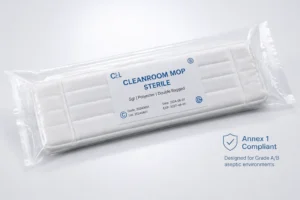
- How are sterile mop heads packaged — single-bagged, double-bagged, or another configuration? Does the packaging configuration support the facility’s aseptic transfer procedure?
- Is the packaging integrity validated? Can the supplier provide evidence of seal integrity and protection during transport?
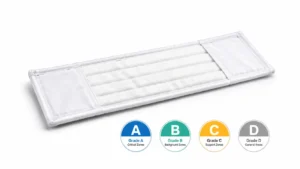
- For multi-zone facilities, does the supplier offer color-coded mop heads to support visual zone differentiation and cross-contamination prevention?
- Does the supplier provide clear guidance on how sterile mop heads should be introduced into classified areas?
Additional detail is available in the following articles: sterile cleanroom mop options, cleanroom mop selection for GMP facility cleaning, ਅਤੇ double-bagged sterile cleanroom mop packaging.
4 ਰੈਗੂਲੇਟਰੀ ਦਸਤਾਵੇਜ਼ & Validation Readiness
A cleanroom mop system is only as good as the documentation that supports it. In regulated environments — pharmaceutical manufacturing, medical device production — the documentation package is often the determining factor in supplier approval. Buyers should evaluate whether the supplier’s documentation is sufficient to support their facility’s audit and compliance obligations.
Key Evaluation Questions
- What documentation is provided as standard with each shipment? At minimum, buyers should expect: Certificate of Analysis (COA), material certification, and for sterile products, batch-level Certificate of Sterility.
- Does the Certificate of Conformance reference specific batch or lot numbers, enabling traceability from the mop head back to its production record?
- Are particle test results available for the specific mop head material and construction, and do the reported levels align with the facility’s cleanroom classification?
- Can the supplier provide documentation that supports ISO 14644 compliance assessment for particle cleanliness?
- Is batch traceability data maintained, and for how long? Can the supplier trace a specific batch of mop heads back to raw material lots, production dates, and sterilization cycles?
See the cleanroom mop validation documents resource for a more detailed walkthrough of what each document type covers and how to review it as part of a supplier evaluation.
5 Supplier Capability & Long-Term Reliability
Supply continuity, quality consistency, and technical support availability are as important as product specifications. A mop head that meets every technical criterion is of limited value if the supplier cannot deliver it consistently or support it over time.
Key Evaluation Questions
- What quality management system does the supplier operate under? Can they describe their quality control process for incoming materials, in-process inspection, and final release?
- What is the supplier’s typical lead time, and what is their documented process for managing supply disruptions or urgent orders?
- Does the supplier maintain safety stock or buffer inventory to absorb demand fluctuations without interrupting deliveries?
- Is technical support available for application questions, protocol design, or troubleshooting? What is the typical response time?
- Can the supplier provide reference information from facilities with similar cleanroom grades and protocols?
- What is the supplier’s process for communicating specification changes, material changes, or manufacturing process changes that could affect the supplied product?
For a structured approach to assessing supplier quality and capability, see the guide on ਫਾਰਮਾਸਿਊਟੀਕਲ ਕਲੀਨਰੂਮ ਮੋਪ ਸਪਲਾਇਰ ਨੂੰ ਕਿਵੇਂ ਯੋਗ ਬਣਾਇਆ ਜਾਵੇ.
Key Evaluation Criteria at a Glance
The table below summarizes the five criteria as a quick-reference evaluation tool. Use it as a starting point when comparing suppliers — each row represents a dimension that should be assessed with supplier-specific evidence.
| Evaluation Criterion | What to Look For | Red Flags | Weight |
|---|---|---|---|
| 1. System Components & ਅਨੁਕੂਲਤਾ | Integrated head/frame/handle assembly; compatible with existing bucket/wringer; documented attachment standards | Head sold without frame compatibility data; no wet-operation demonstration available | ਨਾਜ਼ੁਕ |
| 2. Material Performance | Material certification available; particle test data provided; chemical compatibility documented | No particle data for the specific material; material type not clearly specified | ਨਾਜ਼ੁਕ |
| 3. Sterility & ਪੈਕੇਜਿੰਗ | Batch-specific sterility certificates; validated packaging integrity; clear aseptic transfer guidance | Generic (non-batch-specific) sterility claims; no packaging validation evidence | ਉੱਚ |
| 4. Documentation | COA, CoC, CoS, material certs provided as standard; batch traceability maintained; ISO 14644-relevant data available | Documentation only provided on request; traceability gaps; incomplete certificate information | ਉੱਚ |
| 5. Supplier Capability | Documented QMS; consistent lead time; technical support available; change notification process in place | No QMS description; frequent lead time variability; no technical support contact | ਦਰਮਿਆਨਾ |
Weight designations are general guidance. For sterile manufacturing facilities (GMP Grade A/B), Criterion 3 and Criterion 4 should be elevated to Critical. For lower-grade facilities using non-sterile mops, Criterion 3 may be weighted lower. Adjust weightings based on your facility’s regulatory framework and risk profile.
Supplier Evaluation Checklist — 10 Questions to Ask Before Approving a Cleanroom Mop System
Use this checklist as a structured discussion guide when engaging with cleanroom mop suppliers. Document answers for each question — they form the basis of your evaluation record.
-
Are the mop head, frame, and handle designed as an integrated system, or are they independently sourced components?An integrated system reduces compatibility risk. If components are sourced independently, ask for documented compatibility verification between each component pair.
-
What material certification and particle test data does the supplier provide for the specific mop head material?Request data that is specific to the mop head you are evaluating — not general material brochures. The data should reference the material type, test method, and results.
-
Does the supplier offer both sterile and non-sterile configurations, and are they available in the weight classes (40g, 55g, 65g) your facility requires?Even if only one configuration is needed today, understanding the full range helps assess whether the supplier can accommodate future protocol changes without requiring a supplier change.
-
What packaging and aseptic transfer documentation is provided for sterile products?For sterile mop heads, ask for packaging validation data and documented aseptic transfer procedures. Generic claims of “sterile packaging” without evidence should be treated as a red flag.
-
Is batch-level traceability available, and how far back does the traceability record extend?Confirm that each batch or lot of mop heads can be traced to production date, raw material lots, and (for sterile products) sterilization cycle. Traceability duration should align with regulatory retention requirements applicable to your facility.
-
Does the supplier operate from a controlled manufacturing environment? How is quality managed through production?Ask how the supplier controls particle contamination, material handling, and finished product inspection in their production process. The response quality reveals as much as the content.
-
What documentation does the supplier include as standard with each shipment — COA, Certificate of Sterility, Certificate of Conformance, material certifications?Standard documentation indicates mature quality systems. Documentation that must be separately requested for each shipment may indicate inconsistent documentation management.
-
Can the supplier share reference information or application examples from facilities with similar cleanroom grades and protocols?While specific customer names may be confidential, a supplier with relevant experience should be able to describe application scenarios that map to your facility type.
-
What is the confirmed lead time, and what is the supplier’s process for managing supply continuity and responding to urgent demands?Ask about buffer stock, production capacity, and contingency planning — not just the standard lead time under normal conditions.
-
Has the evaluation included an in-house trial using the actual mop system, under your facility’s actual cleaning protocol, with documented operator feedback?No amount of documentation replaces a hands-on trial. Run the mop system through your cleaning SOP, collect structured operator feedback, and document results against your acceptance criteria before finalizing the procurement specification.
Common Buyer Evaluation Mistakes
From Evaluation to Decision — Next Steps After Completing the Framework
After working through the five criteria and completing the supplier evaluation checklist, the next step is synthesizing the findings into a procurement decision. The following decision workflow can help:
Document the Evaluation for Internal ApprovalCreate an evaluation summary that covers all five criteria, the supplier’s responses to the 10 checklist questions, trial results, and a recommendation with supporting rationale. This document serves as the procurement justification and also as audit evidence showing that supplier selection followed a structured, criteria-based process.
For additional guidance on mop system selection and weight optimization, see the how to choose a cleanroom mop system guide and the companion article on Cleanroom Mop Head Weight Guide.
ਅਕਸਰ ਪੁੱਛੇ ਜਾਂਦੇ ਸਵਾਲ
What is a cleanroom mop system evaluation framework?
A cleanroom mop system evaluation framework is a structured methodology covering five criteria — system components, material performance, sterility and packaging, documentation, and supplier capability — that helps procurement and QA teams compare cleanroom mop suppliers on consistent, defensible terms. Rather than comparing price or a single specification in isolation, the framework ensures all relevant dimensions are assessed before a procurement decision is made.
Which is more important — mop head material or system compatibility?
Both are important, but system compatibility is foundational. Even the best mop head material cannot perform if the head does not fit the frame, the handle cannot control it, or the bucket system cannot wet and wring it effectively. The recommended approach is to evaluate as a system first, confirming that the components work together as intended, then optimize material specifications within the compatible system.
What is the minimum documentation a cleanroom mop supplier should provide?
At minimum, buyers should expect: Certificate of Analysis (COA), material certification specifying fabric composition and construction type, Certificate of Conformance referencing the supplied lot or batch, and for sterile products, a batch-level Certificate of Sterility indicating the sterilization method and sterility assurance level. For particle-sensitive environments, particle test data for the specific mop head material should also be available.
Does the evaluation framework change for sterile versus non-sterile mops?
The core five-criterion framework applies to both sterile and non-sterile evaluations. Sterile mop evaluation places additional weight on Criterion 3 (Sterility & Packaging) and Criterion 4 (Documentation). Buyers evaluating sterile mops should ensure packaging integrity validation, documented aseptic transfer procedures, and batch-level sterility traceability are included in the evaluation scope. These elements may be less critical for non-sterile evaluations but should still be acknowledged in the evaluation record.
How long should an in-house mop system trial last?
Trial duration depends on protocol complexity, but should include at minimum: multiple cleaning cycles under actual protocol conditions, structured operator feedback collection across different shifts or operators, documented visual inspection results from cleaned surfaces, and particle or microbiological data if the facility grade requires it. A 2-4 week trial conducted across representative facility zones is common practice for cleanroom mop system evaluation.
Should buyers evaluate one supplier at a time or run a comparative evaluation?
Comparative evaluation is recommended but must use the same criteria and test conditions for all suppliers. The five-criteria framework provides a standardized comparison baseline. For each supplier, document findings against each criterion. An evaluation record that shows consistent criteria applied to multiple suppliers is more defensible in an audit than one that evaluated suppliers using different yardsticks.
What if a supplier cannot provide certain documentation?
View documentation gaps as risk indicators rather than automatic disqualifications. For GMP-regulated facilities, missing sterility validation or material certification for sterile products is typically disqualifying because the documentation is required for compliance. For lower-grade facilities, assess whether the missing document affects protocol integrity or regulatory standing. Any accepted documentation gap should be recorded with a justification rationale in the evaluation record.
Ready to Evaluate Cleanroom Mop Systems with a Structured Framework?
MIDPOSI provides complete cleanroom mop systems — heads, frames, handles, and bucket/wringer solutions — supported by validation documentation for GMP and ISO-controlled environments. Apply the 5-criteria framework to your evaluation and contact us for technical consultation, documentation review, or sample requests.

Complete cleanroom mop systems with documentation packages available for evaluation and audit review.