

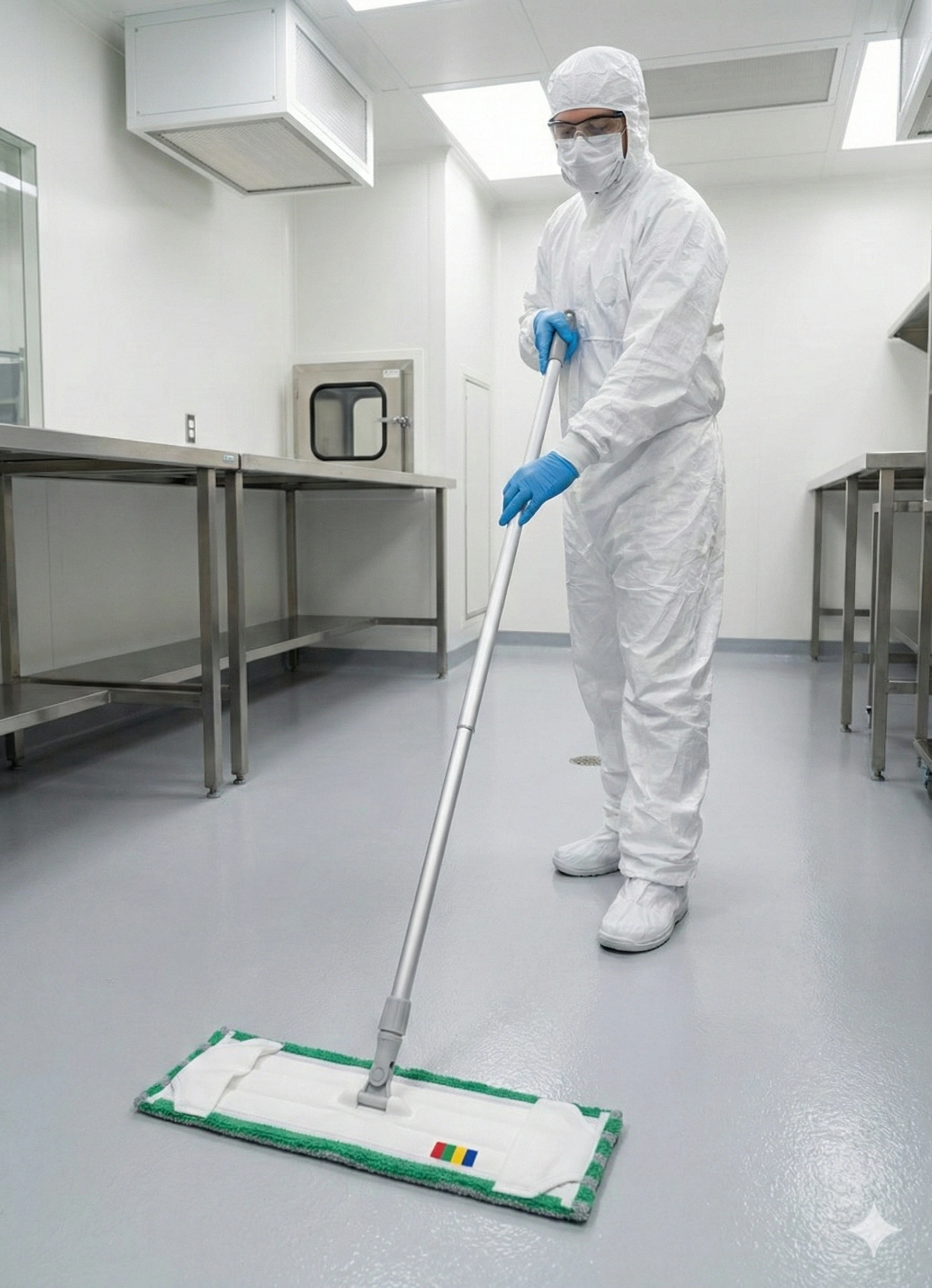
A reusable cleanroom mop program depends on a documented, repeatable reprocessing workflow. Laundering alone does not make a mop ready for reuse. Sterilization alone does not replace inspection. Storage alone does not replace tracking. This guide consolidates all six stages of the reprocessing cycle — launder, dry, sterilize, inspect, store, document — into one end-to-end reference with decision gates at every stage.
A cleanroom mop reprocessing workflow has six sequential stages. Each stage includes a decision gate — the mop either passes and proceeds to the next stage, or fails and is retired from service. Skipping or combining stages creates unvalidated gaps in the reprocessing cycle.
Wash with validated parameters: temperature, detergent, cycle duration — material-specific.
Low-temperature tumble dry or controlled-environment air dry. Verify dryness before proceeding.
Autoclave at validated parameters. Record cycle number. Mop reaches maximum cycle limit → retire.
Visual inspection against checklist. Pass → proceed to store. Fail → retire and document.
Environment-matched, hung individually, batch-labeled. FIFO rotation. Do not exceed max storage duration.
Record all stage outcomes per batch. Maintain cycle log, inspection log, and retirement log.
| Stage | Key Decision | Go Criterion | No-Go Criterion |
|---|---|---|---|
| 1. Launder | Wash complete at validated parameters? | Cycle ran within specified temperature, detergent, and duration range | Cycle deviation; mop may require re-wash or evaluation |
| 2. Dry | Mop completely dry? | Visual + tactile verification passed; no residual moisture | Damp; return to dryer or air-dry until fully dry |
| 3. Sterilize | Autoclave cycle validated + within cycle limit? | Cycle parameters met; mop cycle count below maximum limit | Cycle deviation or cycle count equals/exceeds maximum; retire mop |
| 4. Inspect | Inspection checklist passed? | No visible fabric damage, discoloration, seam failure, or contamination | Any inspection failure observed → retire mop from service |
| 5. Store | Storage conditions met? | Environment grade matches target zone; hung individually; within max storage duration | Storage environment inadequate; storage duration exceeded → re-process before use |
| 6. Document | All records complete? | Cycle log, inspection log, storage log all current and complete per batch | Missing records → do not issue mop until documentation gap closed |
The first two stages of reprocessing prepare the mop for sterilization by removing soil, chemical residue, and moisture. These stages are the most frequently underestimated — a mop that passes visual inspection after washing but still carries detergent residue will not sterilize effectively.
Laundering parameters are material-specific. Polyester cleanroom mops and microfiber cleanroom mops have different temperature and detergent tolerances.
| ਪੈਰਾਮੀਟਰ | Polyester Mop | Microfiber Mop |
|---|---|---|
| Wash temperature | Up to 90 °C (validated per material specification) | Typically 60–70 °C maximum (check material specification — microfiber degrades at higher temperatures) |
| Detergent | Non-ionic, low-residue; pH-neutral preferred | Non-ionic, non-alkaline; pH-neutral required — alkaline detergents damage microfiber structure |
| Rinse cycles | Minimum 2 rinse cycles to remove detergent residue | Minimum 2–3 rinse cycles — microfiber holds more detergent than polyester |
| Wash cycle duration | Per validated SOP; typically 30–60 minutes at temperature | Per validated SOP; typically 20–40 minutes at temperature |
| Water quality | Deionized or purified water recommended for GMP Grade A/B mops | Same — final rinse with DI/purified water recommended |
Two methods are common in GMP reprocessing workflows:
Drying verification is mandatory before proceeding to sterilization. A mop that is damp entering the autoclave will not achieve the validated sterilization parameters because moisture affects heat penetration and cycle performance. See the cleanroom mop maintenance and longevity guide for additional laundering detail, including detergent selection guidance and frequency optimization.
Sterilization in a reusable mop reprocessing workflow typically uses autoclave (steam sterilization). Gamma irradiation and ethylene oxide (EtO) are alternative methods, but autoclave is the most common for in-house reprocessing of reusable cleanroom mops because the equipment is already available in most GMP facilities.
| ਪੈਰਾਮੀਟਰ | Typical Range | ਨੋਟਸ |
|---|---|---|
| ਤਾਪਮਾਨ | 121 °C (250 °F) standard gravity cycle | May use 134 °C for shorter cycle — must be validated for mop material |
| Exposure time | 15–30 minutes at 121 °C (material-dependent) | Verify against mop manufacturer’s material specification |
| ਪੈਕੇਜਿੰਗ | Sterilization wrap or validated reusable container | Packaging must allow steam penetration; mop must not be compressed during sterilization |
| Drying phase | Post-cycle vacuum drying recommended | Reduces moisture retained after autoclave; reduces post-sterilization drying time |
For a complete comparison of sterilization methods — including gamma irradiation and EtO as alternatives to autoclave — see the cleanroom mop sterilization methods guide. That article covers method selection criteria, SAL requirements, and packaging considerations for each method.
Cycle count tracking is what distinguishes reprocessing from standalone sterilization. A cleanroom mop that is laundered and autoclaved repeatedly has a finite service life. Each autoclave cycle subjects the polyester fabric to thermal and mechanical stress — fiber structure degrades incrementally with each cycle. Without cycle counting, the facility has no objective trigger for retirement.
At the end of the validated cycle life, the mop should be retired from cleanroom use regardless of visual appearance. The cycle limit exists because the degradation that matters — fiber breakage at the microscopic level — is not visible to the human eye until particle shedding has already increased.
Cycle count limits, like all reprocessing parameters, must be appropriate for the GMP grade of the zone where the mop is used. A mop used in a Grade A/B aseptic processing area may have a lower maximum cycle count than the same mop used in Grade C, because the Grade A/B particle limit tolerates less fabric degradation. For the full grade-by-grade selection logic, see the GMP ਕਲੀਨਰੂਮ ਮੋਪ ਗ੍ਰੇਡ ਚੋਣ ਗਾਈਡ.
Visual inspection is the decision gate between reprocessing and reuse. A mop that passes inspection proceeds to storage and issue. A mop that fails inspection is retired from service. There is no intermediate state — “marginal” is not an acceptable inspection result for a cleanroom mop that will be used in a GMP environment.
| # | Inspection Point | Pass Condition | Fail (Retire) |
|---|---|---|---|
| 1 | Fabric surface integrity | No holes, tears, thinning, or abrasion visible on mop fabric surface | Any fabric damage — hole, tear, worn-through area, or visible thinning |
| 2 | Seam integrity | All seams intact; no loose threads; edge binding secure; stitching complete around full perimeter | Broken stitching, loose thread longer than 5 mm, edge binding separation, or exposed raw edge |
| 3 | Pocket/frame attachment | Pocket intact; no separation from mop body; attachment points secure | Pocket tearing away from mop body; frame attachment point failure; elastic degradation |
| 4 | Discoloration | Fabric color consistent with original; no localized discoloration, staining, or chemical residue marks | Persistent staining not removed by laundering; chemical discoloration suggesting material degradation |
| 5 | Foreign material | No visible foreign particles, fibers from other mops, or contamination adhered to fabric surface | Any visible foreign material that does not remove with a single lint-roller pass |
| 6 | Sterilization packaging integrity | Packaging intact; no tears, holes, or seal failures; sterility indicator confirms cycle exposure | Packaging breach, seal open, sterility indicator negative or missing |
All six inspection points pass. Mop is approved for storage and subsequent issue. Record “Inspection Passed” with initials and date in mop batch log.
Any inspection point fails. Mop is removed from circulation. Record retirement: mop batch ID, inspection point(s) failed, date, and initials. Retired mops should be physically separated from active inventory — stored in a designated “retired/condemned” area or immediately discarded according to facility SOP.
The inspection checklist in this section is a condensed version of the broader maintenance inspection framework. For additional detail on what to inspect between uses — and how inspection fits into the full mop lifecycle — refer to the cleanroom mop maintenance and longevity guide.
Storage is the transitional stage between reprocessing and issue. A mop that has passed inspection must be stored in conditions that preserve its reprocessed state. Storage rules for reprocessed mops follow the same principles as all cleanroom mop storage:
For a comprehensive treatment of storage protocol — including container type comparison, storage environment grading, and expired-storage handling — see the cleanroom mop storage and handling guide.
Documentation is the final stage but it runs in parallel with every other stage. A reprocessing workflow that produces clean mops but no records will fail a GMP audit. The following log template defines the minimum fields that should be maintained per mop batch.
| ਖੇਤਰ | ਵਰਣਨ | Stage |
|---|---|---|
| Mop Batch ID | Unique identifier linking to procurement record and target zone | All |
| Laundering Date | Date of most recent wash cycle | 1 |
| Wash Cycle Parameters | Temperature, detergent, duration, rinse cycles — or reference to validated wash SOP | 1 |
| Drying Verification Result | Pass/Fail, verification method (visual/tactile/instrumental), initials | 2 |
| Current Cycle Count | Current autoclave cycle number for this batch | 3 |
| Maximum Cycle Count | Validated maximum cycles for this mop material | 3 |
| Sterilization Cycle Parameters | Temperature, exposure time, cycle result (Pass/Fail), sterility indicator result | 3 |
| Inspection Result | Pass/Fail, inspection points checked, initials | 4 |
| Storage Entry Date | Date mop was placed in storage after processing | 5 |
| Maximum Storage Date | Calculated as Storage Entry Date + validated storage duration | 5 |
| Retirement Record (if applicable) | Date of retirement, reason (inspection failure / cycle limit reached / storage duration exceeded), initials | 4 |
A cleanroom mop should be retired from service under any of the following conditions. Retirement must be documented with the reason, date, and handling (discarded or removed from cleanroom inventory).
The following decision tree maps the complete reprocessing workflow from post-use mop through to reuse or retirement. This is the unique consolidated deliverable of this guide — a stage-by-stage flow that connects the six stages into a single, auditable decision sequence.
Mop has been used in cleanroom. Return to reprocessing area via defined material flow path.
Wash with validated parameters (material-specific temperature, detergent, duration, rinse cycles).
Low-temp tumble dry (<= 60 °C polyester / <= 50 °C microfiber) or controlled-environment air dry. Verify dryness.
Quick check for visible damage post-wash. No damage visible?
Document retirement reason. Remove from service.
Autoclave at validated parameters. Check: cycle count < maximum?
Cycle parameters valid? Cycle count below max?
Cycle deviation or cycle limit reached. Document retirement.
Complete inspection checklist (6 points). All pass?
All 6 inspection points passed?
Inspection failure. Document failed points. Remove from service.
Environment-matched, hung individually, batch-labeled, FIFO rotation.
Record all stage outcomes. Update cycle log, inspection log, storage log.
Mop is reprocessed, documented, and ready for controlled-environment use.
Note: This decision tree illustrates the full 6-stage reprocessing workflow for reusable cleanroom mops. Disposable sterile mops follow a different path — they are single-use and are disposed of after contamination exposure, not reprocessed. For facilities that mix reusable and disposable mops in the same cleaning program, the reprocessing workflow applies only to the reusable component.
The following four mistakes are among the most common in reusable cleanroom mop programs. Each represents a gap between what the facility believes its reprocessing workflow achieves and what a thorough audit or investigation would reveal.
What happens: Mops are autoclaved repeatedly with no record of how many cycles have accumulated. The facility relies on visual appearance to judge whether a mop is still fit for use. Microscopic fiber degradation accumulates cycle after cycle — particle shedding increases — but nobody notices because nobody is counting.
Correction: Implement cycle count tracking as described in Stage 3. The maximum cycle count must be obtained from the mop supplier’s material validation data. Once the count is reached, retire the mop — visual appearance is not the criterion.
What happens: The autoclave cycle completes, the sterility indicator confirms exposure, and the mop is moved directly to storage without visual inspection. The assumption is that if the autoclave cycle passed, the mop is fit for use. A seam that failed during sterilization, packaging that tore during handling, or a sterilization artifact on the fabric surface — all go undetected.
Correction: Inspection (Stage 4) is the mandatory decision gate between sterilization and storage. Every mop is inspected. No exceptions.
What happens: The facility uses one wash cycle — same temperature, same detergent — for polyester mops, microfiber mops, and any other reusable mop type. Polyester tolerates 90 °C; microfiber degrades above 70 °C. The microfiber mops are progressively damaged with each wash, reducing their particle-capture efficiency and shortening their service life.
Correction: Material-specific wash parameters. If polyester and microfiber mops are washed in the same machine, they must be washed in separate cycles with different parameters. The SOP must specify which parameter set applies to which mop material.
What happens: Mops that fail inspection or reach their cycle limit are simply discarded. No record is made. During an audit, the facility cannot demonstrate that retirement is criteria-based rather than arbitrary. If a batch contamination investigation traces back to the mop program, the absence of retirement records means there is no documented evidence that mops were removed from service before they became a contamination risk.
Correction: Every retired mop generates a retirement record: mop batch ID, date, reason for retirement (inspection point failed / cycle count reached / storage expired), and initials. These records should be part of the mop batch log maintained under Stage 6 documentation.
Reprocessing is a team activity. The operators who perform laundering, sterilization, and inspection must be trained on the full workflow — not just their individual stage. See the cleanroom mop operator training checklist for a training framework that can be extended to cover all six reprocessing stages. For the broader context of how reprocessing fits into the complete mop lifecycle, see the ਕਲੀਨਰੂਮ ਮੋਪ ਸਿਸਟਮ ਦੀ ਸੰਖੇਪ ਜਾਣਕਾਰੀ.
The maximum autoclave cycle count is material-specific and should be obtained from the mop supplier’s material qualification documentation. Polyester cleanroom mops are typically validated for a specific number of cycles — there is no universal number. The facility must record each cycle and retire the mop when the validated maximum is reached, regardless of visual appearance at that point.
No. Laundering removes soil and chemical residue. Sterilization inactivates microorganisms. These are distinct processes with different parameters, different equipment, and different verification requirements. An autoclave is not a washing machine — it does not remove physical contamination. A mop that is autoclaved without laundering will have sterilized soil on its surface, which is not acceptable for cleanroom use.
Retire the mop from service immediately. Do not attempt to repair a failed mop — stitching a torn seam or trimming a loose thread introduces uncontrolled variables (thread material, stitching quality) that were not part of the original mop specification. Document the retirement: batch ID, inspection point(s) failed, date, and initials. Physically separate retired mops from active inventory.
Yes. Even if the mop is sealed in validated sterile packaging, the storage environment should match or exceed the classification of the zone where the mop will be used. The exterior of the sterile packaging accumulates particles from the storage environment, which transfer to gloves and surfaces when the package is opened at the point of use. A higher classification storage environment minimizes this transfer risk.
Assign a unique batch ID to each mop or group of mops that enter the reprocessing program. Use a log — paper-based for small inventories, spreadsheet or digital system for larger ones — that records the batch ID, current cycle count, and maximum cycle count. Each time a batch is sterilized, increment the cycle count on the log. The system does not need to be complex; it needs to be consistently maintained.
This is not recommended. Non-cleanroom cleaning tools introduce contamination — fibers, chemicals, bioburden — that the cleanroom mop laundry equipment is not validated to remove to cleanroom levels. Dedicated cleanroom mop laundry equipment reduces cross-contamination risk and simplifies validation. If shared equipment is unavoidable, a validated cleaning and changeover procedure between non-cleanroom and cleanroom loads is required.
At minimum: mop batch IDs and traceability records, laundering parameter logs, drying verification records, sterilization cycle logs with cycle count tracking, visual inspection results per batch, storage entry and duration records, and retirement records with documented reasons. All records should be signed/initialed and dated. The documentation package should allow an auditor to trace any mop batch from procurement through each reprocessing cycle to retirement.
No. Disposable cleanroom mops are designed for single use. They are not laundered, sterilized, inspected, or stored for reuse. After use in the cleanroom, a disposable mop is discarded per facility waste management SOP. The reprocessing workflow described in this guide applies exclusively to reusable cleanroom mops — typically polyester mops rated for a validated number of wash and autoclave cycles.
A well-designed mop system supports every stage of the reprocessing workflow — from material that withstands validated wash and autoclave cycles, to documentation packages that support GMP traceability. Speak with MIDPOSI to evaluate mop options that align with your reprocessing requirements and cycle tracking needs.
Designed for structured cleanroom cleaning programs — supporting reprocessing, traceability, and lifecycle management for GMP facilities.



 Optimized by Seraphinite Accelerator