
Por que o monitoramento ambiental é importante em salas limpas GMP
Mesmo salas limpas bem concebidas com sistemas HVAC robustos, programas de limpeza validados e pessoal treinado não podem ser consideradas como permanecendo sob controlo sem evidências. O monitoramento ambiental fornece essa evidência, mostrando se os níveis de contaminação permanecem dentro das expectativas definidas durante a operação de rotina.
Um programa EM eficaz apoia o controle microbiano, o controle de partículas, a prontidão da investigação, a compreensão do processo e a melhoria contínua. Também cria uma ligação direta entre a classificação dos quartos, bata pessoal, treinamento de pessoal, visualização do fluxo de ar, ciclo de vida de validação, e eficácia de limpeza.
| Componente EM | O que mede | Por que é importante |
|---|---|---|
| Monitoramento de partículas | Níveis de partículas transportadas pelo ar não viáveis | Ajuda a verificar a limpeza do ar e o desempenho do HVAC |
| Amostragem de ar ativa | Microrganismos aéreos viáveis | Detecta risco de contaminação microbiana no ar ambiente |
| Assentar pratos | Consequências viáveis passivas ao longo do tempo | Útil para avaliar a exposição durante as operações |
| Placas de contato/cotonetes | Contaminação microbiana de superfície | Mostra eficácia da limpeza e disciplina de toque |
| Revisão de tendências | Padrões recorrentes entre horários e fusos horários | Oferece suporte à detecção de riscos antes que ocorram falhas maiores |
Monitoramento viável versus não viável
O monitoramento ambiental geralmente inclui métodos viáveis e não viáveis. Eles estão relacionados, mas não são intercambiáveis. Uma sala pode atender às expectativas de partículas e ainda apresentar risco microbiano, especialmente se o comportamento do pessoal, as práticas de limpeza ou os controles de intervenção forem fracos.
| Tipo de monitoramento | Exemplos | Uso principal |
|---|---|---|
| Monitoramento inviável | Contadores de partículas, testes de partículas transportadas pelo ar | Verifica a classificação do ar em salas limpas e o controle dinâmico |
| Monitoramento viável | Amostradores de ar ativos, placas de assentamento, placas de contato, cotonetes | Detecta riscos de contaminação microbiológica |
Precisa de suporte para salas limpas preparadas para GMP?
A Midposi apoia programas de controle de contaminação com roupas para salas limpas e soluções de produtos com foco em GMP projetadas para ambientes farmacêuticos e controlados.
Métodos comuns de amostragem EM em salas limpas
Os métodos de amostragem devem ser selecionados com base na classificação da sala, no nível de atividade, na exposição do produto, na frequência da intervenção e nas necessidades de investigação. Bons programas definem não apenas o que é amostrado, mas também porque cada método é apropriado.
Os métodos típicos incluem:
- Contadores de partículas para monitoramento aéreo inviável em tempo real
- Amostradores de ar ativos para monitoramento aéreo viável
- Placas de assentamento para monitoramento passivo viável durante as operações
- Placas de contato para equipamentos, paredes, superfícies de trabalho e luvas
- Esfregar para superfícies irregulares ou de difícil contato
Explicação Visual: Estratégia de Amostragem EM
Um mapa de monitorização ambiental forte deve mostrar quais os métodos utilizados em zonas críticas, áreas de apoio, pontos de contacto de pessoal e locais de intervenção dinâmica.
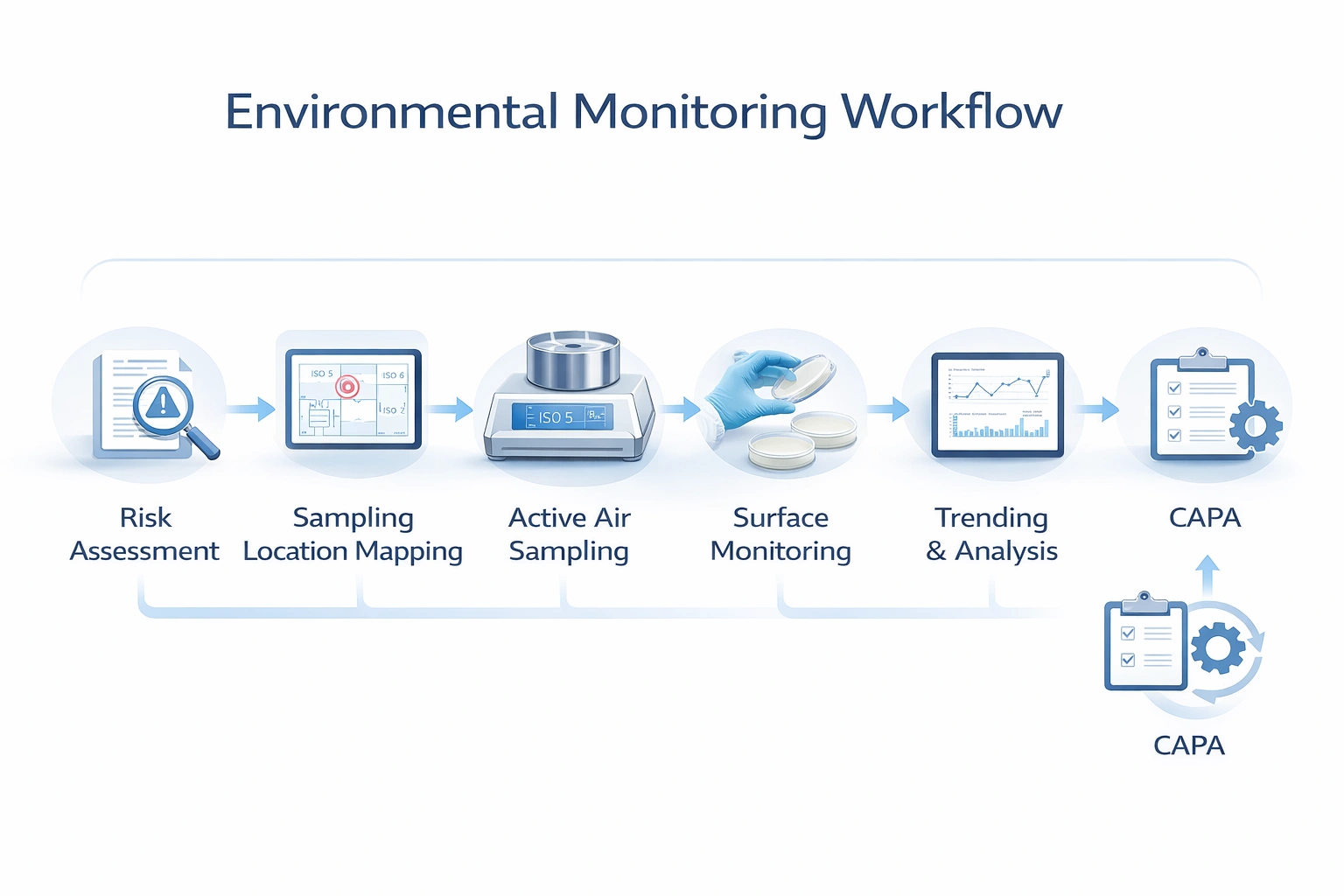
Como definir locais EM e frequência de amostragem
Os locais de monitoramento nunca devem ser aleatórios. Devem refletir o risco de contaminação, os caminhos críticos do fluxo de ar, as zonas de intervenção, a presença do operador, o fluxo de materiais e os padrões históricos de eventos.
Os locais de amostragem de alto valor geralmente incluem:
- Pontos críticos de processamento
- Zonas abertas de exposição do produto
- Pontas dos dedos e mangas das luvas
- Superfícies de equipamentos perto de locais de intervenção
- Escotilhas de transferência e pontos de entrada de materiais
- Áreas com histórico de excursões anteriores
- Defina a justificativa para cada local fixo
- Diferencie entre monitoramento em repouso e operacional
- Use maior intensidade de amostragem em áreas críticas ou de alta intervenção
- Revise a relevância do local após alterações de layout, equipamento ou processo
Limites de alerta versus limites de ação
Uma das partes mais mal compreendidas do monitoramento ambiental é a diferença entre limites de alerta e limites de ação. Os limites de alerta são avisos antecipados de que as condições podem estar mudando. Os limites de ação indicam um desvio mais sério que requer investigação e resposta definidas.
| Tipo de limite | Propósito | Resposta Típica |
|---|---|---|
| Limite de alerta | Sinaliza uma mudança incomum ou tendência adversa | Revise os dados recentes, confirme a repetibilidade, avalie os fatores contribuintes |
| Limite de ação | Indica excursão significativa ou falha de controle | Iniciar investigação formal, definir CAPA, avaliar o impacto do produto e do processo |
Limites bem concebidos devem basear-se no risco e ser apoiados por dados históricos, classificação de salas, criticidade do processo e expectativas regulamentares. Limites copiados de outro site sem justificativa geralmente criam uma lógica de controle fraca.
Tendências, Investigação e CAPA
A recolha de dados EM não é suficiente. O verdadeiro valor de um sistema de monitorização advém da sua capacidade de identificar padrões, desencadear investigações atempadas e apoiar decisões CAPA. A análise de tendências deve ir além de excursões isoladas e questionar se os sinais repetidos apontam para fraquezas estruturais.
A revisão de tendências geralmente avalia:
- Eventos repetidos por local
- Padrões relacionados ao turno ou ao pessoal
- Frequência de limpeza e recorrência de contaminação
- Diferenças entre estados de ambiente e tipos de campanha
- Mudanças sazonais ou operacionais na recuperação microbiana
Explicação visual: painel de tendências EM
Um painel de dados pode ajudar as equipes de controle de qualidade a recuperar tendências por sala, zona, método, atividade do operador e turno. Isso torna a investigação mais direcionada e baseada em evidências.

Falhas comuns de monitoramento ambiental
Muitos programas de GR fracos falham não porque a amostragem esteja ausente, mas porque a estratégia, a interpretação e o acompanhamento são fracos.
Explicação visual: prática EM correta versus fraca
Uma comparação clara pode mostrar a diferença entre a monitorização baseada no risco com caminhos de investigação definidos e programas de amostragem genéricos com fraca qualidade de resposta.

| Prática Fraca | Por que é arriscado | Melhor abordagem |
|---|---|---|
| Amostragem sem justificativa | Os locais podem perder os pontos de maior risco | Use a seleção de locais baseada em risco vinculada ao processo e ao fluxo de ar |
| Reagindo apenas aos limites de ação | Perde os primeiros sinais de deterioração | Revise tendências em nível de alerta e sinais recorrentes |
| Investigação mínima após excursão | As causas profundas permanecem sem solução | Vincule a revisão da excursão ao pessoal, fluxo de ar, limpeza e fatores de processo |
| Nenhum link para treinamento ou comportamento | Os padrões dos fatores humanos permanecem ocultos | Revisão cruzada de dados EM com vestimentas, treinamento e intervenções |
O que os auditores normalmente procuram em um programa EM
Durante a inspeção, os auditores raramente se concentram apenas nas contagens brutas. Eles analisam se todo o sistema de monitorização é justificado, controlado e exequível. Isso inclui a seleção do local, a lógica da frequência, a definição de limites, a qualidade da investigação e o acompanhamento da CAPA.
Os auditores frequentemente solicitam:
- POPs do programa EM e mapas de amostragem
- Justificativa de alerta e limite de ação
- Relatórios de tendências por sala ou campanha
- Investigações de excursão e registros CAPA
- Evidências que ligam o EM à estratégia de controle de contaminação
- Correlação com treinamento, limpeza, fluxo de ar e controle de intervenção
Modelo de melhores práticas para um programa EM de alto desempenho
Os sistemas de monitorização ambiental mais fortes partilham várias características:
- Desenho de amostragem baseado em risco
- Distinção clara entre objetivos viáveis e inviáveis
- Alerta definido e lógica de ação
- Revisão de tendências de rotina, não apenas revisão de eventos
- Investigação multifuncional envolvendo controle de qualidade, operações e microbiologia
- Ligação direta a treinamento de pessoal, limpeza, desempenho do fluxo de ar, e prontidão para auditoria
A monitorização ambiental funciona melhor quando faz parte de um sistema de conhecimento mais amplo sobre controlo de contaminação, em vez de ser uma actividade microbiológica autónoma.
Support a Stronger Environmental Monitoring Program
Explore GMP-focused cleanroom solutions designed to support contamination control, audit readiness, and more consistent cleanroom operations in pharmaceutical and controlled manufacturing environments.
perguntas frequentes
O que é monitoramento ambiental em uma sala limpa?
O monitoramento ambiental é um programa de BPF usado para detectar, tendências e investigar contaminações viáveis e não viáveis em ambientes controlados.
Qual é a diferença entre monitoramento viável e não viável?
O monitoramento inviável mede partículas transportadas pelo ar, enquanto o monitoramento viável detecta microorganismos por meio de métodos como amostragem ativa de ar, placas de sedimentação e amostragem de superfície.
Por que os limites de alerta e ação são importantes?
Os limites de alerta indicam um desvio precoce, enquanto os limites de ação sinalizam uma excursão mais séria que requer investigação e resposta documentada.
Como devem ser escolhidos os locais de amostragem EM?
As localizações devem ser baseadas em riscos e ligadas a pontos críticos do processo, comportamento do fluxo de ar, atividade do pessoal, zonas de intervenção e padrões históricos de excursão.
Qual é geralmente a aparência de um programa EM fraco?
Programas fracos muitas vezes coletam amostras sem justificativa, não conseguem tendências de dados de forma eficaz, investigam mal e não conectam os resultados à limpeza, comportamento ou controles de processo.
O monitoramento ambiental substitui a classificação dos ambientes?
Não. A classificação das salas e o monitoramento ambiental estão relacionados, mas são diferentes. A classificação define a limpeza esperada, enquanto o EM verifica se o controle permanece eficaz durante o uso.
Como o EM se conecta ao treinamento de pessoal?
O comportamento humano muitas vezes afeta os resultados do ME. Excursões repetidas podem apontar para problemas de vestimenta, movimento, intervenção ou disciplina asséptica que exigem reciclagem.
O que os auditores esperam de um programa EM?
Os auditores normalmente esperam uma lógica de amostragem clara, análise de tendências, lógica de alerta e limite de ação, qualidade da investigação, acompanhamento da CAPA e ligação à estratégia de controle de contaminação.