Uma comparação técnica baseada em evidências das duas principais tecnologias de tecido para esfregões para salas limpas. Abrange mecanismos de geração de partículas, absorção, compatibilidade química, durabilidade, custo do ciclo de vida e uma estrutura de decisão baseada no nível da instalação para líderes de controle de qualidade, equipes de compras e gerentes de instalações de salas limpas.
A escolha entre esfregões para salas limpas de microfibra e poliéster é não é uma simples decisão “um é melhor”. Depende da classificação ISO/GMP da sala limpa, dos produtos químicos de limpeza utilizados, do limite aceitável de geração de partículas e se a instalação prioriza a absorção e a eficiência de limpeza ou o controle de partículas e a resistência química.
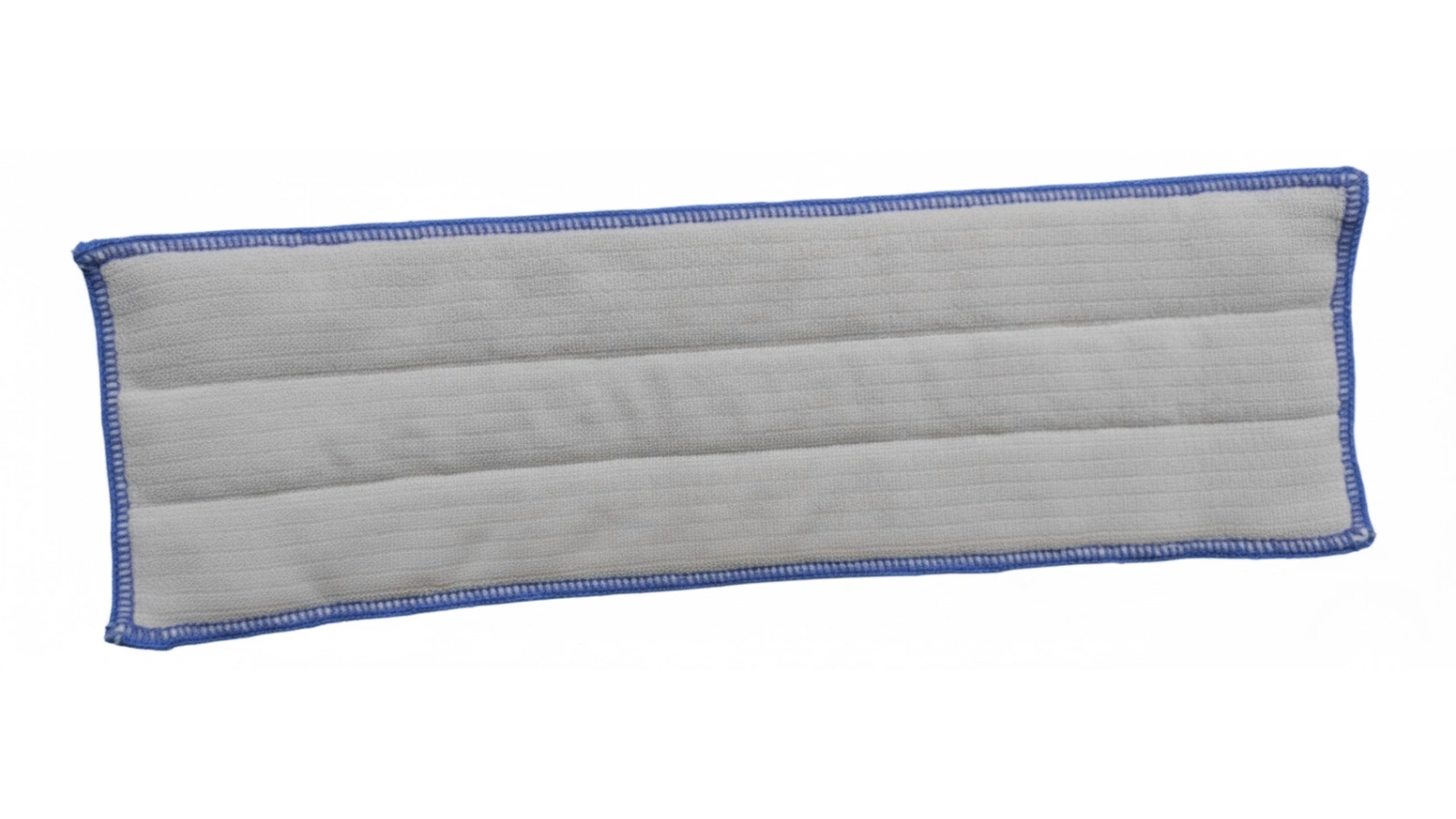
UM material sintético monocomponente feito de filamentos contínuos de poliéster tricotados em uma estrutura de tecido multicamadas. Selado nas bordas por meio de métodos de corte a laser, ultrassônico ou de vedação térmica para evitar a liberação de fibra no perímetro.
Normalmente a escolha mais apropriada quando: A instalação opera em ISO 5–6/GMP Grau A–B, usa desinfetantes oxidantes agressivos, requer autoclavagem repetida em um programa reutilizável ou o controle de partículas é a preocupação dominante de contaminação.
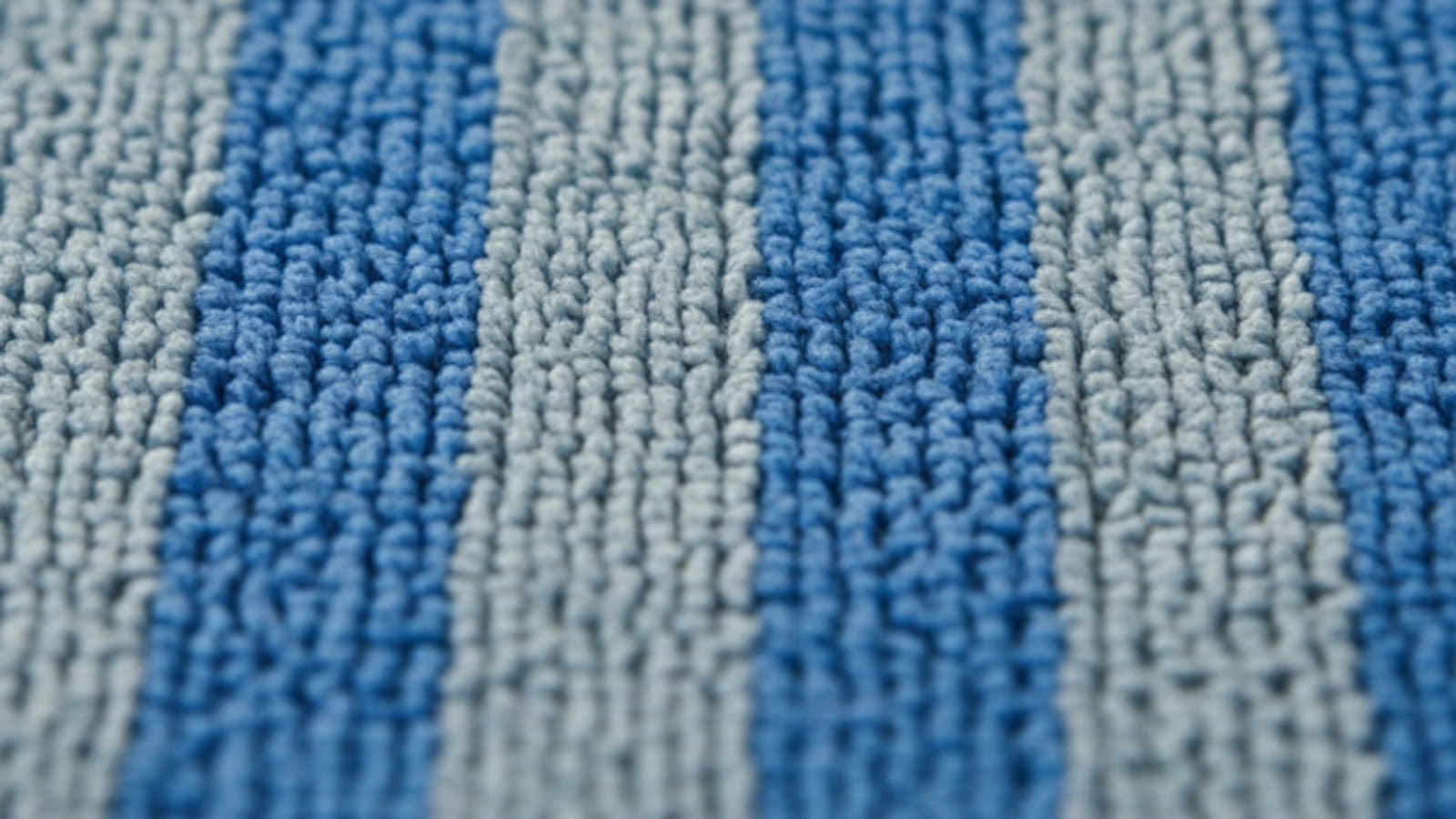
Um mistura de fibra sintética ultrafina (normalmente poliéster/poliamida), fabricado pela divisão de filamentos únicos em múltiplos microfilamentos em forma de cunha. Isso cria alta área superficial e ação capilar para captura de líquidos e partículas.
Normalmente a escolha mais apropriada quando: A instalação opera em ISO 7–8 / GMP Grau C–D, a eficácia da limpeza e a remoção de resíduos são as prioridades, a química de limpeza é suave ou as aplicações descartáveis de uso único são preferidas quando se deseja o máximo poder de limpeza por uso.
A resposta curta: O poliéster (especialmente a malha de filamentos contínuos com bordas seladas) normalmente gera menos partículas e oferece maior compatibilidade química—tornando-a a recomendação mais comum para ISO 5–6/GMP Grau A–Ambientes B. A microfibra (construção com filamento dividido) normalmente fornece maior absorção e captura mecânica superior de partículas—tornando-o um forte desempenho em ISO 7–8 / GMP Grau C–D ambientes onde a eficácia da limpeza pode ter prioridade sobre os requisitos de partículas ultrabaixas. Ambos os materiais permanecem relevantes nas operações modernas de salas limpas; a escolha certa é específica da instalação.
As diferenças de desempenho entre esfregões para salas limpas de microfibra e poliéster originam-se no nível da fibra. Compreender como cada material é construído fornece a base para avaliar a geração de partículas, absorção, compatibilidade química e durabilidade—em vez de confiar nas afirmações de marketing do fornecedor.
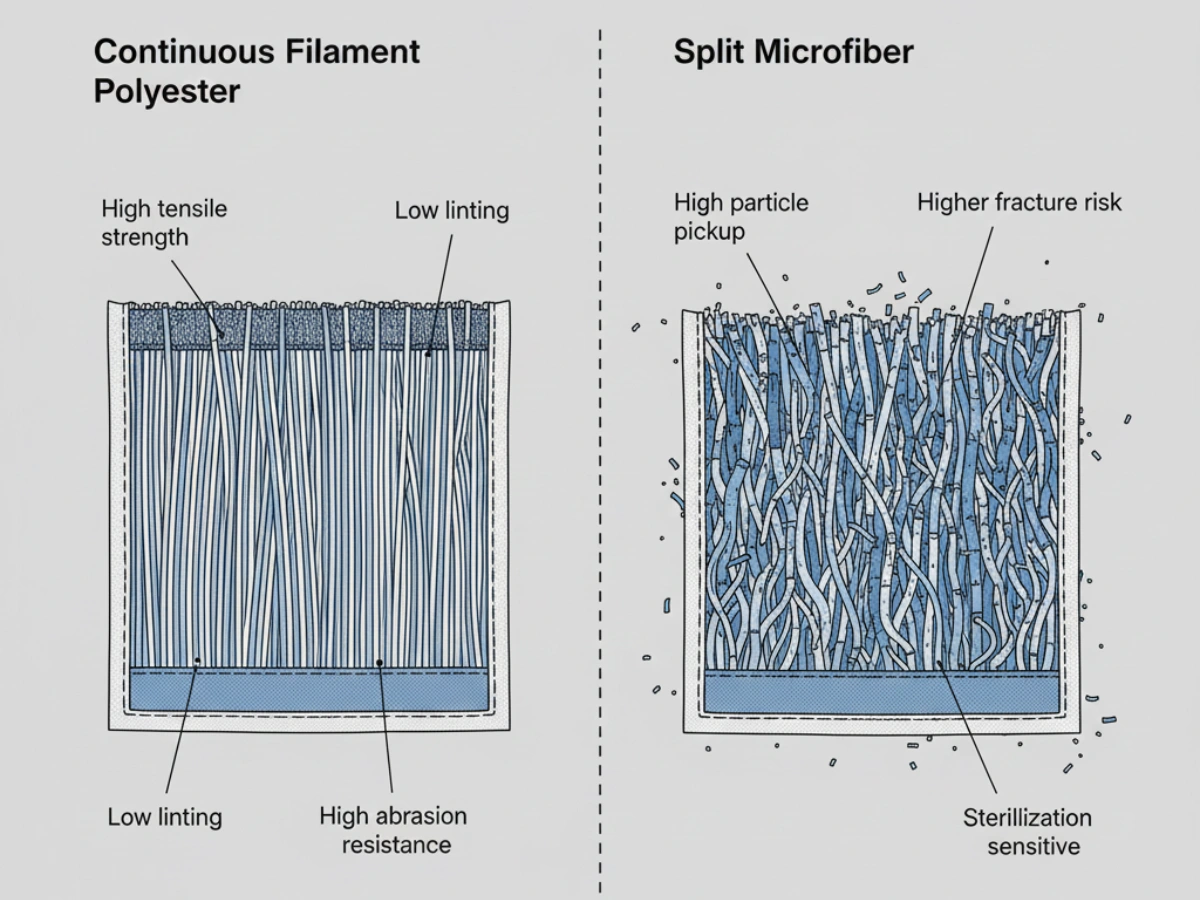
Os esfregões de poliéster para salas limpas são construídos a partir de poliéster de filamento contínuo (PET)—fibras sintéticas longas e contínuas extrudadas e tricotadas em tecido. Ao contrário dos têxteis de fibra descontínua, onde as fibras curtas são fiadas juntas, a construção de filamentos contínuos minimiza deliberadamente o número de pontas de fibra soltas no corpo do tecido, que é o principal contribuinte estrutural para o baixo desprendimento de partículas.
Fibras longas e únicas correm ininterruptamente pelo tecido. Menos extremidades do filamento = menos pontos de ruptura = teoricamente menor liberação de partículas. Esta é a vantagem estrutural fundamental para aplicações em salas limpas sensíveis a partículas.
Esfregonas de poliéster fabricadas para uso em salas limpas—como a série White Mop da MIDPOSI—normalmente usam uma estrutura de malha multicamadas. O padrão da malha e a contagem de camadas influenciam a distribuição do líquido, a absorção e a estabilidade mecânica da cabeça do esfregão durante o uso.
Como o perímetro do esfregão representa uma zona concentrada de pontas de fibras cortadas, o acabamento das bordas é um indicador crítico de qualidade de fabricação. Os esfregões de poliéster para salas limpas usam bordas cortadas a laser, ultrassônicas ou seladas a quente para vedar o perímetro e evitar o desgaste das bordas. A qualidade da vedação das bordas pode ter tanto impacto no desempenho das partículas quanto o próprio tipo de filamento.
A espessura da fibra (denier) afeta a sensação de toque do esfregão, a eficiência do contato com líquidos e a durabilidade. Fibras de poliéster denier mais finas produzem um tecido mais macio com contato superficial potencialmente melhor para aplicação de líquidos; fibras denier mais grossas podem oferecer maior resistência à abrasão. Esta é uma variável específica do fabricante e não uma constante de material.
Uso de esfregões de microfibra para salas limpas tecnologia de filamento dividido. Durante a fabricação, um único filamento bicomponente (normalmente núcleo de poliéster + bainha de poliamida/náilon, ou uma configuração lado a lado de poliéster/poliamida) é dividido mecanicamente ou quimicamente em múltiplos microfilamentos em forma de cunha. Cada filamento original pode produzir 8–16 microfilamentos individuais, aumentando drasticamente a contagem de fibras e a área de superfície total dentro do mesmo peso de tecido.
A seção transversal em forma de cunha de cada microfilamento é a fonte da vantagem de limpeza da microfibra. As bordas afiadas da cunha raspam e prendem mecanicamente partículas finas, enquanto as lacunas entre os filamentos criam canais capilares que atraem líquidos. Este é um mecanismo de captura físico, não químico.
A maioria das microfibras para salas limpas usa uma mistura de poliéster/poliamida (náilon)—normalmente 70–80% poliéster e 20–30% poliamida. O poliéster proporciona integridade estrutural; a poliamida contribui para a absorção e para o próprio comportamento de divisão. Essa proporção de mistura é a fonte das vantagens de desempenho e das preocupações com a sensibilidade química discutidas posteriormente neste artigo.
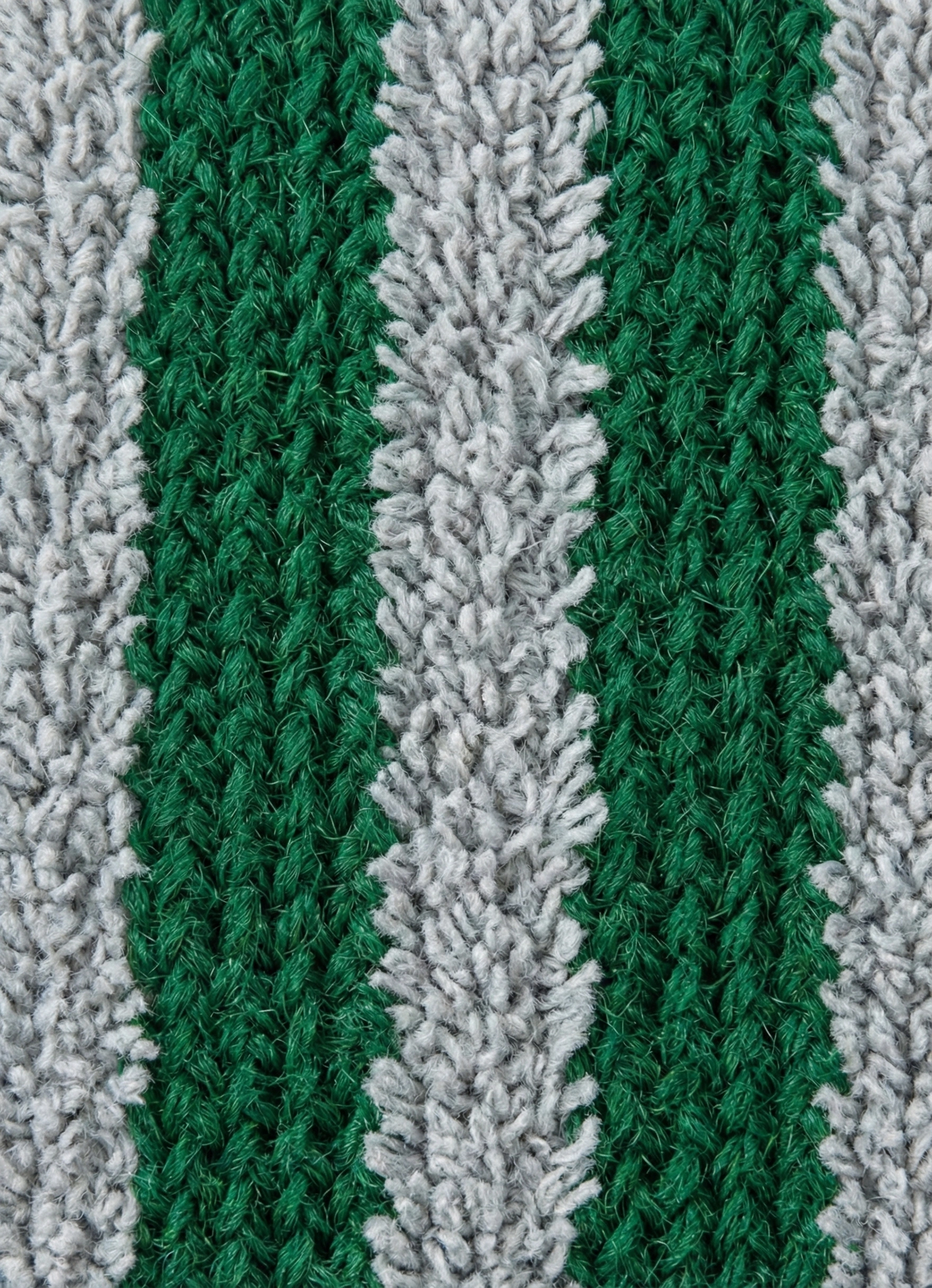
Os esfregões de microfibra para salas limpas podem usar construções de superfície em laço ou com pilha cortada. As construções em laço geralmente liberam menos fibras soltas durante o uso porque cada filamento está ancorado em ambas as extremidades; construções com pilha cortada expõem mais extremidades dos filamentos, aumentando potencialmente a liberação de partículas. Esta é uma variável de qualidade crítica para aplicações em salas limpas. Produtos como o esfregão de microfibra para sala limpa com listras utilize construção em loop com bordas seladas para compatibilidade com salas limpas.
Como cada filamento original é dividido em múltiplos microfilamentos, a área superficial total da fibra por grama de material é substancialmente maior do que a do poliéster fiado convencionalmente. Esta é a base estrutural para a maior capacidade de absorção e captura de partículas da microfibra—mas a mesma área de superfície também significa mais locais potenciais para degradação de fibras e liberação de partículas à medida que o material envelhece.
A distinção estrutural entre poliéster de filamento contínuo e microfibra de filamento dividido não é meramente acadêmica. Explica diretamente as compensações de desempenho observáveis:
| Dimensão | Poliéster (Malha de Filamento Contínuo) | Microfibra (filamento dividido) |
|---|---|---|
| Tipo de fibra | Filamento único contínuo | Cunha multifilamento dividida |
| Composição | 100% poliéster (PET) | Mistura de poliéster/poliamida (típico: 70–80/20–30) |
| Área de superfície por grama | Relativamente mais baixo | Relativamente mais alto (geometria dividida) |
| Mecanismo de liberação de partículas primárias | Principalmente relacionado à borda; baixo do corpo de filamento contínuo | Quebra de fibra devido a filamentos divididos; também relacionado à borda |
| Acabamento de borda | Corte a laser, ultrassônico ou selado a quente | Varia de acordo com o fabricante; bordas seladas necessárias para uso em salas limpas |
| Adequação típica para salas limpas | ISO 5–8 / BPF A–D (dependendo da qualidade da construção) | ISO 7–8/BPF C–D mais comumente; ISO 5–6 com qualificação |
| Interação com a Água | Inerentemente hidrofóbico; absorção da estrutura da malha | Ação capilar a partir da geometria em cunha; naturalmente hidrofílico em componente de poliamida |
Observação: Esta tabela compara características estruturais em nível de material. O desempenho real do produto depende de variáveis específicas do fabricante, incluindo qualidade de ancoragem do filamento, densidade da malha, consistência do método de vedação de borda e controle geral de qualidade de fabricação. Estas características devem ser verificadas com o produto e fornecedor específicos, e não presumidas apenas com base no tipo de material.
Esta é a dimensão que determina mais diretamente se um material de esfregona é adequado para uma determinada classificação de sala limpa. A questão não é simplesmente “qual material é mais limpo?” mas “qual material gera partículas através de qual mecanismo e sob quais condições?”
Os esfregões para salas limpas geram partículas através de três mecanismos principais:
The filament type—continuous or split—directly affects which of these mechanisms dominates and at what magnitude. Fluid presence and mechanical action accelerate all three mechanisms, which is why wet-mopping particle data may differ from dry-state measurements.
Continuous filament polyester’s structural advantage for particle control is straightforward: fewer filament ends = fewer potential particle sources. Como cada filamento corre ininterruptamente através do tecido, há menos pontos de início de ruptura em comparação com um tecido composto por fibras individuais mais curtas ou microfilamentos divididos.
Fatores adicionais que contribuem para o perfil de partículas normalmente mais baixo do poliéster:
Advertência importante: Este perfil pressupõe um produto bem fabricado. O desempenho das partículas depende do processo de fabricação. Um esfregão de poliéster com bordas mal vedadas e fibras superficiais soltas gerará mais partículas do que um esfregão de microfibra bem feito com bordas seladas e filamentos ancorados. O tipo de material estabelece uma tendência estrutural; a qualidade da fabricação determina se essa tendência será concretizada.
A construção de filamento dividido da microfibra cria uma compensação inerente ao risco de partículas: a mesma característica estrutural que fornece captura superior de partículas também cria mais pontos potenciais de liberação de partículas. Cada microfilamento dividido é mais fino e mais frágil do que um filamento contínuo de poliéster, e há muito mais deles por unidade de área.
Principais variáveis que afetam a geração de partículas de microfibra:
Advertência importante: Quality-grade microfiber from a reputable manufacturer, with sealed edges and anchored loop construction, can perform well within the particle requirements of ISO 7–8 environments and may, with qualification testing, be suitable for ISO 5–6 zones. The material type alone does not disqualify microfiber from cleanroom use; it signals that particle performance must be verified rather than assumed.
Particle generation data from different mop suppliers can be difficult to compare directly because test methodologies differ. When evaluating supplier particle data, consider:
Isenção de responsabilidade crítica: Esta comparação descreve tendências estruturais em nível material. O desempenho das partículas deve ser verificado no produto específico em consideração, utilizando condições de teste relevantes para a aplicação pretendida em sala limpa. Nenhuma declaração de nível material neste artigo constitui uma garantia de desempenho para qualquer produto específico.
Se a geração de partículas é a dimensão em que o poliéster tende a ter vantagem, a eficácia da limpeza é a dimensão em que a microfibra ganha seu lugar nas operações em salas limpas. A diferença de desempenho observável na absorção e remoção mecânica de partículas é real—mas deve ser ponderado em relação à compensação de geração de partículas e aos requisitos específicos de cada zona de sala limpa.
A vantagem de limpeza da microfibra está enraizada na sua estrutura física, e não num agente de limpeza químico:
Continuous filament polyester is inherently hydrophobic—the base polymer does not absorb water. However, this does not mean polyester cleanroom mops cannot absorb liquid. Absorbency in polyester mops is a function of the fabric construction:
The cleaning efficacy paradox: Microfiber’s superior cleaning power is real and demonstrable in standardized cleaning efficacy tests. However, in a cleanroom, “better cleaning” is only net beneficial if it does not create a contamination risk—specifically through particle generation—that exceeds the cleaning benefit. For ISO 5 / GMP Grade A environments, particle control may be the dominant concern, and polyester’s adequate (rather than maximal) absorbency may be the more appropriate choice. For ISO 7–8 / GMP Grau C–D environments, where particle thresholds are less stringent, microfiber’s cleaning efficacy advantage can drive meaningful operational improvements.
This is a dimension that many cleanroom mop procurement evaluations overlook—and one that can render a technically correct material choice operationally problematic if the wrong mop material is paired with the facility’s disinfectant formulary.
Polyester (PET) as a polymer class exhibits broad resistance to a wide range of chemical agents commonly used in cleanroom disinfection:
The chemical compatibility profile of cleanroom microfiber is more nuanced because most cleanroom-grade microfiber is a polyester/polyamide (nylon) blend. The polyamide component introduces chemical sensitivity that pure polyester does not have:
The degradation of the polyamide component manifests as: fiber brittleness, increased particle shedding, reduced absorbency (as the capillary structure degrades), and shorter overall service life in reusable applications.
Importante: A compatibilidade química é específica do produto e não apenas do material. Variações na construção do tecido, na química da encadernação das bordas, no material da linha de costura e em quaisquer tratamentos do tecido podem afetar a resistência química geral. Sempre solicite ao fabricante do esfregão dados de compatibilidade química específicos para seu formulário de desinfetante da instalação e verifique por meio de testes de compatibilidade na instalação sob suas condições reais de uso.
The following table consolidates the material-level comparison across all six performance dimensions discussed above and in the sections that follow. Use this as a high-level reference, not as a substitute for product-specific evaluation.
| Performance Dimension | Poliéster (Malha de Filamento Contínuo) | Microfibra (filamento dividido) | When This Dimension Is Decisive |
|---|---|---|---|
| 1. Particle Generation | Generally lower (continuous filament advantage; fewer breakage points) | Generally higher (split-filament structure; more potential release points) | ISO 5–6/GMP Grau A–B: polyester typically preferred |
| 2. Absorbency / Cleaning Efficacy | Moderate; controlled liquid release; adequate for routine cleaning | Higher; capillary action + mechanical particle entrapment | ISO 7–8/BPF C–D with residue-heavy protocols: microfiber advantage |
| 3. Chemical Resistance | Broad compatibility; oxidation-resistant (100% PET) | Polyamide sensitivity to oxidizers and acids | Instalações que utilizam desinfetantes agressivos: poliéster normalmente preferido |
| 4. Durabilidade (Reutilizável) | Maior contagem de ciclos; degradação mais lenta | Menor contagem de ciclos; quebra progressiva do filamento com lavagem | Programas reutilizáveis de alta frequência: poliéster normalmente preferido |
| 5. Descartável (uso único) | Disponível; focado em esterilidade e controle de contaminação | Disponível; focado no máximo poder de limpeza por uso | A escolha depende da prioridade: controle de partículas versus poder de limpeza por uso |
| 6. Custo (Direcional) | Abaixe o adiantamento; vida útil reutilizável mais longa | Maior adiantamento; vida útil reutilizável mais curta | Programas reutilizáveis com alto volume de utilização: vantagem de custo do poliéster |
Divulgação: This table presents material-level directional comparisons. Actual product performance depends on manufacturer-specific variables including filament quality, knit density, edge-sealing method, layer construction, and overall manufacturing quality control. No absolute performance claims are made for any product or material type. All comparisons should be verified through product-specific evaluation and, where possible, in-facility testing.
Durability directly affects total cost of ownership and replacement frequency. The two materials degrade through different mechanisms and at different rates, and these differences are amplified in reusable (laundered/sterilized) applications.
Observação: Actual replacement cycle data should be obtained from suppliers and—for reusable programs—verificado em testes de lavagem específicos da instalação que reproduzem os parâmetros reais de limpeza, lavagem e esterilização da instalação. Os dados de ciclo de vida publicados pelo fornecedor são direcionais e não uma garantia.
As decisões de aquisição baseadas apenas no preço unitário do esfregão são enganosas. A estrutura a seguir identifica os componentes de custo que diferem por tipo de material, permitindo uma comparação do custo total de propriedade (TCO) específico da instalação.
However, upfront material cost is only one component of the total cost picture, and often not the largest one.
Uma comparação completa de custos deve basear-se em custo por evento de limpeza, sem custo por cabeça de esfregão:
(Custo da cabeça do esfregão / Ciclos utilizáveis por cabeça do esfregão) + (Custo de lavanderia/esterilização por ciclo) + (Custo de mão de obra por evento de limpeza) = Custo por evento de limpeza
Esta estrutura revela várias dinâmicas importantes:
Evitar: This framework does not include absolute cost numbers, “$X per mop head” claims, or specific TCO savings percentages. Each facility should build its own cost model using its actual procurement prices, labor rates, utility costs, and laundry/sterilization operational costs.
This section consolidates the preceding technical analysis into an actionable selection framework. Use the conditions and scenarios below to self-diagnose which material aligns with your facility’s profile.
In practice, several scenarios reduce the material-choice sensitivity:
Key caveat: O material é um fator entre muitos na avaliação de um esfregão para sala limpa. A compatibilidade da estrutura, o tipo de cabo, a configuração de esterilidade, o peso da cabeça do esfregão e o acabamento das bordas são critérios de seleção igualmente importantes. Esta comparação deve informar uma avaliação mais ampla do sistema de esfregona—não deve substituir um. Para uma abordagem estruturada para avaliar o sistema completo de esfregona, consulte nosso Estrutura de avaliação do comprador do sistema Cleanroom Mop.
| Cenário da Instalação | Classe de sala limpa | Recomendação típica de materiais | Justificativa principal |
|---|---|---|---|
| Enchimento farmacêutico asséptico | ISO 5 / BPF A | Poliéster | O controle de partículas é fundamental em zonas de enchimento asséptico. O poliéster de filamento contínuo com bordas seladas proporciona um perfil de baixa partícula mais previsível para esta aplicação. |
| Zona de base farmacêutica | ISO 7 / BPF B–C | Polyester or Quality-Grade Microfiber | Decision depends on disinfectant chemistry and cleaning frequency. If oxidizing disinfectants are used routinely, polyester may be the safer choice. If neutral chemistry with residue-heavy cleaning, quality-grade microfiber may offer efficacy advantages. |
| Medical device assembly | ISO 7–8/BPF C–D | Microfibra | Higher cleaning efficacy for particulate removal from device contact surfaces is beneficial. Particle thresholds are less stringent, allowing microfiber’s cleaning advantage to be fully realized. |
| Biotecnologia R&D / general labs | ISO 7–8 | Either Material | Particle requirements are less stringent. Cost, supply convenience, and compatibility with existing cleaning chemistry may be the deciding factors rather than material-specific performance distinctions. |
| Semiconductor / electronics | ISO 5–7 | Poliéster | Particle control combined with aggressive cleaning agents typical in semiconductor cleanrooms. ESD (electrostatic discharge) considerations may favor specific material configurations. |
| Hospital compounding (USP <797>/<800>) | ISO 5–7 | Poliéster | Low particle generation in primary engineering control areas is a key requirement. Polyester continuous filament knit with sealed edges supports the particle control expectations of USP compounding environments. |
Note on recommendations: These are directional material-level suggestions, not product-specific certifications. Facility-specific evaluation—including particle testing, chemical compatibility verification, and cleaning protocol validation—is always required. The recommended material should be verified against the specific product, supplier, and facility cleaning parameters.
The following six misconceptions are frequently encountered in cleanroom mop procurement discussions. Each correction is supported by the technical analysis presented in the preceding sections.
Reality: Lint generation depends on fiber type (continuous vs split), edge finishing quality, and manufacturing process control—not on a “microfiber” label. A well-made polyester knit mop with laser-cut sealed edges and anchored continuous filaments can generate fewer particles than a low-quality microfiber mop with poorly anchored split filaments and unsealed edges. The material category does not guarantee particle performance; product-specific manufacturing quality does.
Reality: Polyester’s lower absorbency compared to microfiber is a design tradeoff, not a defect. In applications where controlled disinfectant application matters—achieving specified contact time without over-wetting, managing drying time to minimize operational disruption, and ensuring consistent disinfectant volume per surface area—a liberação controlada de líquido do poliéster pode ser uma vantagem. “Absorve mais” nem sempre significa “desempenho melhor” em todos os contextos de salas limpas.
Reality: A microfibra é amplamente utilizada com sucesso na ISO 7–8 / GMP Grau C–D ambientes de sala limpa quando provenientes de fabricantes de qualidade com bordas seladas, construção de circuito ancorado e dados documentados de testes de partículas. A preocupação é com a avaliação adequada à finalidade e não com a exclusão absoluta. Muitas instalações utilizam esfregonas de microfibra em zonas de apoio com bons resultados. Excluir categoricamente a microfibra de todo o uso em salas limpas é uma simplificação excessiva que ignora a diversidade dos requisitos de salas limpas.
Reality: Polyester mop quality varies significantly across manufacturers. Key differentiating factors include: continuous vs staple filament, knit density and pattern, number of fabric layers and their bonding method, edge-sealing technology (laser-cut vs ultrasonic vs heat-seal), thread chemistry compatibility, and overall manufacturing quality control. Two “polyester cleanroom mops” from different manufacturers may perform very differently in particle testing. The material name is a starting point for evaluation, not a guarantee of equivalence.
Reality: Sterilization (gamma irradiation, EtO, or autoclave) addresses bioburden—the microbial contamination on the mop at the point of use. It does not address non-viable particulate contamination. A sterile mop made from a particle-shedding material can still introduce non-viable particles into the cleanroom environment, which is a concern in ISO 5 and higher-classification zones where total particulate counts—not just viable counts—are monitored and controlled. Material and sterility are independent selection criteria that must both be evaluated.
Reality: A zone-based hybrid approach is common and often optimal. Many facilities deploy polyester mops in critical/Grade A–B zones (where particle control is paramount) and microfiber mops in support/Grade C–D zones (where cleaning efficacy drives the choice). The key to a successful hybrid approach is protocol management: clear zone segregation, zone-specific mop assignment with visual identification (color-coding), and staff training to prevent cross-use. The materials are complementary, not mutually exclusive.
The technical analysis in this article equips you to evaluate cleanroom mop materials. The following questions translate that analysis into a practical supplier evaluation framework. Asking these questions when engaging any cleanroom mop supplier helps differentiate between marketing claims and verifiable product characteristics.
This question establishes the baseline material identity. The answer should be specific: “100% continuous filament polyester, X denier per filament” or “X% polyester / Y% polyamide split-filament microfiber, Z denier per filament before splitting.” Vague answers (“it’s polyester” or “it’s microfiber”) should be clarified before proceeding.
A borda é uma zona concentrada de potencial liberação de partículas. Bordas cortadas a laser, ultrassônicas e seladas a quente produzem perfis de borda diferentes. Um fornecedor que consegue fornecer uma imagem microscópica de sua borda selada demonstra capacidade e transparência. Se a qualidade da vedação das bordas não puder ser confirmada visualmente, o desempenho das partículas no perímetro não será verificado.
Request particle data with the test method clearly identified (e.g., Helmke drum, biaxial shake, liquid particle count). Without the methodology, particle numbers are not interpretable or comparable. If the supplier cannot provide particle test data from a recognized methodology, the material’s suitability for a particle-sensitive zone cannot be confirmed.
Provide the supplier with the complete list of disinfectants used in your facility, including concentrations and contact times. Ask for documented compatibility data. If the supplier cannot provide chemical compatibility information for a specific disinfectant, request that they provide material samples for your own compatibility testing.
This question addresses the reusable lifecycle question directly. The supplier should be able to describe not just the nominal cycle count, but the expected performance degradation curve—particle shedding increase, absorbency decrease, and visible wear indicators—across the stated service life. A supplier who cannot discuss lifecycle performance changes has either not tested it or is unwilling to disclose it.
This question is critical for chemical compatibility evaluation. If the material is a polyester/polyamide blend, the polyamide percentage determines the extent of potential sensitivity to oxidizing disinfectants. A supplier should be able to state the exact composition, not just “microfiber” or “polyester blend.”
A COA should confirm the material composition, physical properties, and any relevant test data for the specific production batch. This supports audit trail requirements and allows verification that the received product matches the specification that was evaluated. See our guide on documentos de validação de esfregões para salas limpas e COA for more detail.
Material consistency across batches is a critical quality attribute. Understand what tests the manufacturer performs on each batch—weight per unit area, fiber composition verification, edge-seal integrity, visual inspection criteria, and any particle testing—and at what sampling frequency. Batch-to-batch variation in material quality can create inconsistency in cleaning performance and contamination control.
A supplier that offers both materials and can provide zone-specific recommendations based on your facility’s parameters is demonstrating product breadth and consultative capability. A supplier that only offers one material may advocate for it regardless of fit, since they have no alternative to offer.
In-facility evaluation under actual use conditions is the most reliable way to confirm that a material meets the facility’s requirements. Request samples from a current production batch (not specially prepared demo samples) for your own particle testing, chemical compatibility verification, and operator feedback collection.
This comparison covers the material-level distinction between microfiber and polyester cleanroom mops. The following resources address complementary aspects of cleanroom mop evaluation and selection:
A principal distinção está no nível da fibra. Esfregonas para salas limpas de poliéster são normalmente feitos de poliéster de filamento contínuo (PET)—fibras sintéticas longas e ininterruptas de componente único tricotadas em uma estrutura de tecido. Esfregonas de microfibra para salas limpas são feitos de tecnologia de filamento dividido—filamentos bicomponentes (normalmente mistura de poliéster/poliamida) que são divididos durante a fabricação em múltiplos microfilamentos em forma de cunha. Essa diferença estrutural produz perfis diferentes para geração de partículas, absorção, compatibilidade química e durabilidade no uso em salas limpas.
O poliéster de filamento contínuo normalmente gera menos partículas do que a microfibra de filamento dividido, devido à vantagem estrutural de menos pontos de ruptura do filamento em um tecido de filamento contínuo. No entanto, a qualidade de fabricação é uma variável crítica: um esfregão de microfibra bem feito, com bordas seladas e filamentos ancorados, pode superar o desempenho de um esfregão de poliéster mal feito, com fibras soltas e bordas não seladas. O tipo de material estabelece uma tendência estrutural; o produto e o fabricante específicos determinam se essa tendência se concretiza. Sempre solicite dados de teste de partículas com a metodologia de teste especificada.
Geralmente não recomendado, a menos que o produto específico de microfibra tenha sido qualificado por meio de testes de partículas e validado para a classificação ISO 5/Grau A da instalação com dados que apoiam sua adequação. As propriedades estruturais da microfibra de filamento dividido criam um risco de liberação de partículas de base mais alto em comparação com o poliéster de filamento contínuo. Para ambientes ISO 5/Grau A e B, a malha de poliéster de filamento contínuo com bordas seladas é a recomendação mais comum. Se uma instalação estiver avaliando microfibra para uso de Grau A/B, ela deverá realizar seus próprios testes de partículas sob condições reais de uso e estar preparada para documentar a justificativa de qualificação para fins de auditoria.
Em testes padronizados de eficácia de limpeza, a microfibra geralmente demonstra maior absorção e captura mecânica de partículas superior em comparação com o poliéster do mesmo peso. Isto é impulsionado pela estrutura de filamento dividido em forma de cunha, que fornece ação capilar para absorção de líquido e aprisionamento mecânico de partículas finas. No entanto, em aplicações de salas limpas, “limpar melhor” só é benéfico se não introduzir um risco de geração de partículas que exceda o benefício de limpeza. Para ISO 7–8 / GMP Grau C–Em ambientes D, a vantagem da eficácia de limpeza da microfibra pode ser totalmente realizada. Para ISO 5–6 / Grau A–B, onde o controle de partículas é a preocupação primordial, a compensação deve ser avaliada cuidadosamente.
O poliéster (100% PET) tem compatibilidade química mais ampla com a gama de desinfetantes comumente usados em ambientes de salas limpas. Em particular, o poliéster resiste à degradação oxidativa de agentes como o peróxido de hidrogénio e o ácido peracético. Microfibra—que contém poliamida (náilon)—é mais suscetível à degradação por desinfetantes oxidantes e agentes à base de cloro. O componente de poliamida pode degradar-se com exposição repetida, levando à fragilidade da fibra, aumento da liberação de partículas e redução da absorção. Verifique sempre a compatibilidade com o seu formulário de desinfetante específico e com o produto específico do esfregão, pois a resistência química pode variar de acordo com a construção do tecido e a química da linha.
O poliéster normalmente tem menor custo inicial de material e maior vida útil em aplicações reutilizáveis, tornando-o potencialmente mais econômico em programas reutilizáveis de alta frequência. A microfibra pode ser mais econômica em configurações descartáveis/de uso único, onde seu desempenho superior de limpeza por uso reduz o tempo de limpeza ou retrabalho. A comparação deve basear-se no custo do ciclo de vida (custo por evento de limpeza) e não no preço unitário. Um modelo de custo por evento deve levar em conta: custo da cabeça do esfregão amortizado em ciclos utilizáveis, custos de lavanderia e esterilização e custo de mão de obra por evento de limpeza. O custo do material por si só costuma ser o menor componente do custo total de limpeza.
Sim. Uma abordagem híbrida baseada em zonas é comum e muitas vezes ideal para instalações multizonas. Por exemplo: implemente esfregões de malha de filamento contínuo de poliéster em ISO 5 crítico–6 / Grau A–Zonas centrais B onde o controle de partículas é a prioridade e esfregões de microfibra em ISO 7–8 / Nota C–D zonas de apoio onde a eficácia da limpeza e a remoção de resíduos determinam a escolha. A abordagem híbrida requer POPs claros, atribuição de esfregonas específicas para cada zona com identificação visual (codificação por cores) e formação do pessoal para evitar a utilização cruzada entre zonas. Os dois materiais são complementares, não mutuamente exclusivos.
As principais questões incluem: (1) Qual é o tipo de filamento e a especificação do denier? (2) Qual método de vedação de borda é usado e você pode fornecer uma imagem microscópica? (3) Você pode fornecer dados de teste de geração de partículas com a metodologia especificada? (4) O material é compatível com o formulário de desinfetante específico da nossa instalação? (5) Para esfregonas reutilizáveis, quantos ciclos são validados e que alterações de desempenho ocorrem ao longo da vida útil? (6) Qual é a composição exata do tecido e a proporção de mistura? (7) Você pode fornecer um Certificado de Análise em lote? (8) Quais testes de CQ são realizados por lote de produção? (9) Vocês oferecem opções de poliéster e microfibra? (10) Você pode fornecer amostras de um lote de produção atual para nossa avaliação interna? A estrutura completa de avaliação é abordada na seção Perguntas de avaliação de fornecedores.
A série MIDPOSI White Cleanroom Mop usa construção de malha de poliéster com filamento contínuo 100% multicamadas—projetado para baixa geração de partículas, ampla compatibilidade química e uso repetido de autoclave em ambientes controlados por GMP e ISO. Também disponível em configurações estéreis e não estéreis com pesos de 40g, 55g e 65g. Para instalações que avaliam opções de microfibra, a MIDPOSI também oferece esfregões de microfibra para salas limpas de qualidade com bordas seladas e construção de laço ancorado.
A MIDPOSI fornece documentação em nível de lote, incluindo Certificado de Análise (COA), mediante solicitação, e pode oferecer suporte à avaliação específica do material e ao fornecimento de amostras para compradores qualificados. As opções de produtos de poliéster e microfibra estão disponíveis com pacotes completos de documentação.