Figure 1: Pharmaceutical autoclave (Consolidated SR-24C) showing stainless steel chamber, digital control panel with multiple pressure gauges, and double hinged door design. Autoclaves validate cleanroom mop sterilization through biological indicator placement, parametric monitoring (temperature, pressure, time), and load configuration qualification to achieve SAL 10⁻⁶.
What Does “Autoclavable” Mean in Cleanroom Cleaning Tools?
Definition of Autoclaving: Temperature, Steam, Pressure
Autoclaving is moist-heat sterilization using saturated steam under pressure to achieve validated microbial lethality. Standard pharmaceutical cycles operate at 121–134°C (250–273°F) with 15–30 psi gauge pressure (103–207 kPa above atmospheric). At 121°C, steam penetrates porous loads and condenses on cooler surfaces, releasing latent heat that denatures proteins and disrupts cellular structures in vegetative bacteria, spores, fungi, and viruses.
Cycle design targets a Sterility Assurance Level (SAL) of 10⁻⁶—a probability of ≤1 in 1,000,000 that a viable microorganism survives the process. Validation uses biological indicators (BIs) containing spores of Geobacillus stearothermophilus (formerly Bacillus stearothermophilus), a heat-resistant organism with documented D₁₂₁-value (decimal reduction time at 121°C) typically ≥1 minute. An overkill approach delivers ≥12-log reduction (12 times the D-value) to meet SAL requirements; product-specific approaches calculate F₀ (equivalent minutes at 121°C) based on measured bioburden and D-values.
For cleanroom mops, autoclaving serves two functions: terminal sterilization (achieving SAL 10⁻⁶ for Grade A/B use) and reprocessing between uses (removing bioburden acquired during cleaning while maintaining material performance). “Autoclavable” means the material withstands repeated exposure to 121°C saturated steam without functional failure—but marketing claims rarely specify how many cycles or what performance metrics are maintained.
Required Sterility Assurance Level (SAL 10⁻⁶ for Aseptic)
EU GMP Annex 1 Section 4.29 mandates that “disinfectants and detergents should be sterile” when used in Grade A and Grade B environments. “Sterile” in regulatory terms means demonstrated SAL 10⁻⁶—not visual cleanliness, not bioburden <10 CFU, but probabilistic assurance validated through overkill cycles or bioburden/D-value calculations.
SAL validation for autoclavable mops requires:
Biological indicator placement: BIs positioned at worst-case cold spots (identified during heat distribution studies) within mop loads. Tightly packed loads, layered fabrics, and sealed pouches create steam penetration challenges. Validation confirms all BIs are inactivated across consecutive runs.
Cycle parametric monitoring: Continuous recording of chamber temperature, pressure, and time. Minimum exposure (typically 15–30 minutes at 121°C or 3–10 minutes at 134°C) must be achieved at every location in the load, with F₀ calculation confirming cumulative lethality ≥8–12 minutes equivalent.
Load configuration qualification: Worst-case scenarios (maximum mop count, densest packing, containers/pouches used in practice) must be validated. A cycle that sterilizes 10 loose mop heads may fail when 20 heads are tightly stacked or wrapped in autoclave pouches.
Routine BI monitoring: Periodic biological indicator runs (frequency defined in validation protocol, often weekly or per-batch) confirm ongoing sterilization efficacy. Environmental monitoring of autoclave water quality, steam purity, and chamber bioburden supplements parametric release.
Grade C and D areas may accept disinfected (not sterilized) mops, but pharmaceutical best practice increasingly extends SAL 10⁻⁶ validation to reusable cleaning tools across all classified zones to prevent bioburden migration from lower to higher grades.
Difference Between “Clean,” “Sterile,” and “Autoclavable”
These terms are often conflated in procurement specifications, creating qualification gaps that surface during audits:
Clean: Visibly free from soil, particulates, and gross contamination. Achieved through laundering with pharmaceutical-grade detergents, validated rinse cycles, and clean-room drying. “Clean” mops may still harbor 10³–10⁶ CFU bioburden and generate hundreds of particles per m². Acceptable for unclassified areas; insufficient for ISO-classified cleanrooms.
جراثيم کان پاڪ: Validated to SAL 10⁻⁶ via terminal sterilization (autoclaving, gamma irradiation, ethylene oxide). Microbiological testing (USP <71> sterility test) and parametric monitoring confirm absence of viable organisms. Sterile mops are required for Grade A/B areas per Annex 1 Section 4.29. Sterility degrades over time (expiration dating) and is compromised by improper storage or packaging breaches.
خودڪشي لائق: Material withstands moist-heat sterilization without unacceptable degradation. This is a material property, not a sterility state. Autoclavable materials can be made sterile through validated cycles, but “autoclavable” alone does not mean “currently sterile” or “suitable for pharmaceutical use.” A consumer-grade polyester towel may survive autoclaving but generate 10,000 particles/m² and shed fibers—technically autoclavable, functionally disqualified.
Procurement specifications must separate material capability (“autoclavable to 121°C for 50 cycles per validation data”) from process outcomes (“sterilized to SAL 10⁻⁶ per validated cycle”) and performance maintenance (“particle generation <100/m² maintained through qualified service life”).
Why Reusable Tools Must Withstand Repeated Cycles
Single-use sterile mops (gamma-irradiated, individually packaged) achieve SAL 10⁻⁶ through vendor validation and avoid the cycle count issue entirely. Reusable autoclavable systems, however, must maintain performance across 50–200+ cycles to justify capital investment and operational complexity.
Economic driver: Reusable mops cost \$60–\$150 per head but deliver \$1–\$3 per use when amortized over 100–200 uses (including laundering and autoclave costs). Single-use mops cost \$15–\$30 per use. For a 1,000 m² Grade C area mopped 5× per week (260 uses/year), reusable systems save \$3,000–\$7,000 annually per mop. Facilities mopping large areas (pharmaceutical manufacturing suites, biologics production zones, device assembly cleanrooms) realize five-figure annual savings with reusable systems—but only if mops survive the full qualified cycle count without premature failure.
Operational driver: Facilities with in-house autoclaves and laundry can turn around reusable mops overnight, supporting daily cleaning schedules without large inventory buffers. Gamma-sterilized single-use mops require 2–4 week vendor lead times and larger safety stocks, complicating inventory management for multi-shift operations.
Regulatory driver: Annex 1 Section 4.20 defines consumable service life as “the period of time or number of cycles for which a cleanroom consumable is suitable for use.” QA must document cycle limits, degradation monitoring, and retirement criteria. Mops rated for 50 cycles but used for 80 cycles without requalification create audit findings—even if they “look fine” visually.
Misconceptions: “Autoclavable” ≠ “Always Suitable for Aseptic”
Marketing materials tout “autoclavable” as a premium feature, implying suitability for aseptic manufacturing. Regulatory reality is more nuanced:
Misconception 1: All autoclavable materials are equivalent. Materials survive autoclaving through different mechanisms. Polyester relies on high glass transition temperature (Tg ~250°C) and hydrophobic structure resisting steam penetration. Polypropylene uses crystalline structure and heat-stabilizing additives. Microfiber polyester/polyamide blends depend on balanced copolymer ratios—slight formulation changes cause one material to last 100 cycles, another to fail after 20. “Autoclavable” without documented cycle validation is meaningless.
Misconception 2: If it doesn’t melt, it’s qualified. Dimensional stability is necessary but insufficient. Mops may retain shape while experiencing fiber damage (increasing particle generation from 60 to 300 particles/m²), chemical degradation (losing tensile strength, becoming brittle), or residue accumulation (binding disinfectants, harboring biofilm). Performance qualification tracks particle generation, mechanical strength, and microbial cleanliness—not just visual integrity.
Misconception 3: Sterile = contamination-free forever. Sterility applies at the moment of sterilization completion. Uncontrolled cooling, non-sterile storage, or packaging breaches introduce recontamination. Annex 1 requires sterile materials to be “used immediately” or packaged/stored under validated conditions with defined hold times. Autoclaved mops removed from the chamber and left uncovered become non-sterile within hours.
Misconception 4: Grade C/D don’t need validated autoclavable mops. While Annex 1 explicitly requires sterility for Grade A/B, contamination control strategy (CCS) risk assessments increasingly extend validated sterilization to Grade C/D to prevent bioburden migration. Mops used in Grade D gowning rooms carry contamination to personnel who then enter Grade B production areas. QA teams validating entire facility cleaning programs treat autoclavable tool qualification as a system-wide requirement, not just an aseptic-zone specification.
Why Pharma & Biologics Facilities Require Autoclavable Mops
Compliance Drivers: EU GMP Annex 1, ISO 14644, PDA TR 70
Regulatory frameworks converge on a single requirement: cleaning tools used in classified areas must be validated to not introduce contamination. Autoclavable mops fulfill this through three control pathways:
EU GMP Annex 1 (effective August 2023) establishes the sterility baseline. Section 4.29: “Disinfectants and detergents should be sterile when used in Grade A and B areas.” Section 4.20 extends to consumables: “Materials used should be selected to minimize the generation of particles and microorganisms… The number of laundry/sterilization cycles which cleanroom garments can undergo should be defined based upon their qualification.” Autoclavable mops operationalize this by enabling validated sterilization and defined service life.
ISO 14644-5 (Operations) requires that “cleaning processes shall be validated” and “materials and equipment used for cleaning shall be suitable for the cleanroom classification.” ISO 14644-18 (Assessment of Suitability of Consumables) provides the assessment framework: consumables must demonstrate controlled emissions (particles, viable organisms, chemical residues) and documented service life. Autoclavable systems meet ISO requirements by combining material qualification (low particle generation) with sterilization validation (bioburden control).
PDA Technical Report 70 (Cleaning Validation) addresses reprocessing of reusable cleaning tools. TR 70 specifies that facilities must validate laundering/sterilization processes to remove soil, residues, and bioburden to defined limits, demonstrate that reprocessing does not degrade tool performance (particle generation, absorbency, structural integrity), and establish retirement criteria (maximum cycles, inspection checkpoints). Autoclavable mop validation protocols directly implement TR 70 guidance.
Preventing Bioburden Carryover Between Grade A/B/C Rooms
Pharma facilities are zoned by contamination risk: Grade A aseptic cores (filling needles, stopper bowls) operate under unidirectional airflow with the tightest particle and microbial limits; Grade B backgrounds (rooms surrounding Grade A) provide secondary protection; Grade C supports aseptic processing preparation; Grade D covers final packaging and non-sterile compounding.
Non-sterile or inadequately sterilized mops create bioburden migration pathways:
Scenario 1: Grade C → Grade B contamination. A mop used in a Grade C material prep area (bioburden limit: ≤100 CFU/m³ active air) picks up environmental organisms (spore-forming بيسلس species, environmental molds, skin flora shed by gowned personnel). If the mop is “disinfected” with 70% IPA but not sterilized, surviving spores remain viable. The same mop used in Grade B (bioburden limit: ≤10 CFU/m³) introduces spores to floors directly adjacent to Grade A zones. Spores aerosolize during mopping, contaminate gowns, and transfer to Grade A during personnel/material entry.
Scenario 2: Cross-contamination between product lines. A facility manufactures penicillin-based antibiotics in one suite and cephalosporin antibiotics in another. Beta-lactam cross-contamination is a regulatory red-flag; even trace penicillin residues in cephalosporin products trigger allergic reactions in sensitized patients. Mops used in penicillin areas and then “cleaned” with detergent retain API residues that migrate to cephalosporin areas. Autoclave sterilization at 121°C combined with validated laundering removes residues below HPLC detection limits, breaking the cross-contamination chain.
Scenario 3: Biofilm formation in non-sterilized tools. Mops stored damp or incompletely sterilized develop biofilms—matrix-encased microbial communities resistant to disinfectants. Pseudomonas, Burkholderia, and other water-associated organisms colonize mop fibers, bucket interiors, and wringer mechanisms. Biofilm bacteria shed during use, contaminating floors and triggering environmental monitoring failures. Autoclave cycles disrupt biofilms through thermal destruction and steam penetration, preventing chronic contamination sources.
Autoclavable systems prevent these scenarios by ensuring every mop entering a classified area is at SAL 10⁻⁶, eliminating viable contamination before use.
Ensuring Disinfectant Integrity — No Shedding, No Leachables
Disinfectant efficacy depends on concentration, contact time, and absence of interference. Mop materials affect all three:
Particle shedding neutralizes disinfectants. Mops generating 1,000+ particles/m² release fiber fragments, textile debris, and polymer particles into disinfectant solutions. Particles adsorb quaternary ammonium compounds (quats), reducing free active concentration below validated efficacy thresholds. Hydrogen peroxide decomposes on cellulose fibers and certain polymer surfaces. Autoclavable sealed-edge polyester generates <100 particles/m², minimizing disinfectant binding and maintaining solution activity throughout the cleaning cycle.
Chemical leachables compromise sterility assurance. Some polymers release plasticizers, stabilizers, or degradation products that inactivate disinfectants or promote microbial growth. Low-quality polypropylene leaches antioxidants that neutralize peroxide-based sporicides. Microfiber polyamide components can leach nylon oligomers. Autoclavable pharmaceutical-grade materials are validated for extractables/leachables (E&L) per ICH Q3D and USP <661>, ensuring no interference with cleaning agents.
Fiber retention prevents cross-contamination. Non-autoclavable microfiber mops degrade into sticky, residue-retaining surfaces that bind API powders, cleaning agents, and microbial contamination. Validated autoclavable polyester resists residue retention through smooth fiber surfaces and hydrophobic chemistry, enabling thorough laundering and preventing carryover between uses.
Risk Reduction for Environmental Monitoring Failures
Environmental monitoring (EM) programs track particle counts, viable air/surface samples, and personnel microbial contamination. Cleaning-tool-related EM failures follow three patterns:
Particle excursions during mopping. Non-validated mops generate particle bursts when wetted, wrung, or dragged across floors. ISO Class 5 areas (≤3,520 particles ≥0.5 µm/m³) have zero margin; a mop shedding 500 particles/m² temporarily pushes floor-level counts above limits. Even if the excursion resolves within 30 minutes (HEPA filtration removes particles), it triggers investigation cycles, CAPA documentation, and potential production holds. Autoclavable low-linting polyester mops generating <50 particles/m² eliminate this failure mode.
Post-cleaning bioburden increases. EM failures occur when surface swabs or contact plates show higher CFU counts after cleaning than before—evidence that mops redistributed contamination rather than removing it. Root causes: inadequate sterilization (mops harboring bioburden), biofilm growth in mop systems, or disinfectant inactivation by contaminated tools. Autoclave-validated mops at SAL 10⁻⁶ eliminate the “contaminated tool” variable, simplifying investigations and reducing false-positive findings.
Chronic low-level bioburden trends. Facilities using non-sterilized reusable mops often see persistent Grade C/D bioburden (30–50 CFU/m³ air samples, 10–20 CFU contact plates) that resists improvement despite validated disinfection protocols. The source: mops accumulating resistant organisms (spore-formers, biofilm species) through incomplete sterilization. Switching to autoclavable systems with validated 121°C cycles typically reduces baseline bioburden 50–70%, improving EM compliance margins.
Validation Requirements: Heat Resistance, Particle Shedding
Pharma QA teams qualifying autoclavable mops must document four performance attributes:
1. Heat resistance across qualified cycle count. IQ/OQ/PQ protocols include:
- IQ: Verify material specifications (polyester fiber type, sealed-edge construction, frame/handle materials), confirm autoclave calibration and biological indicator lot qualification
- OQ: Execute 3–5 consecutive autoclave cycles at 121°C/30 min with mop loads, place BIs at cold spots (center of tightly packed mop bundles), confirm all BIs inactivated and parametric limits met (minimum F₀ ≥8 min)
- PQ: Test mop performance at 0 cycles (new), 25–30 cycles (mid-life), and 50–100 cycles (end of qualified life); measure particle generation per ISO 14644-14, visual inspection (tears, edge degradation, discoloration), mechanical strength (tensile testing, abrasion resistance)
2. Particle shedding stability. ISO 14644-14 (Assessment of Suitability for Use of Equipment by Airborne Particle Concentration) provides the test method: operate mop heads in a controlled environment with optical particle counters measuring downstream concentrations. Acceptance criteria: <100 particles ≥0.5 µm/m² for ISO Class 5–7 use, <200 particles/m² for Class 8. Qualification tests mops at start of life and after every 20–25 autoclave cycles to detect degradation. Mops exceeding particle limits are retired even if they retain physical integrity.
3. Dimensional stability and functional performance. Autoclaving causes polymer shrinkage in low-quality materials. Measure mop head dimensions (length, width, thickness) before and after 10, 30, 50, 80, and 100 cycles; define tolerance limits (typically ±5% dimensional change). Test functional parameters: fluid absorbency (mL retained per gram dry weight), wring-out efficiency (% fluid released under standardized pressure), and frame attachment security (pull force required to detach mop from frame). Degradation beyond defined limits triggers retirement.
4. Disinfectant compatibility post-autoclave. Pharmaceutical cleaning programs rotate disinfectants (IPA, quats, peroxide, bleach) to prevent microbial resistance. Validation tests simulate worst-case sequential exposure: autoclave → 70% IPA → autoclave → 5% H₂O₂ → autoclave → 1000 ppm bleach → autoclave, repeating through 50 cycles. Confirm particle generation, visual integrity, and mechanical strength remain within acceptance criteria. Materials that pass autoclave-only testing but fail combined autoclave + chemical exposure are disqualified.

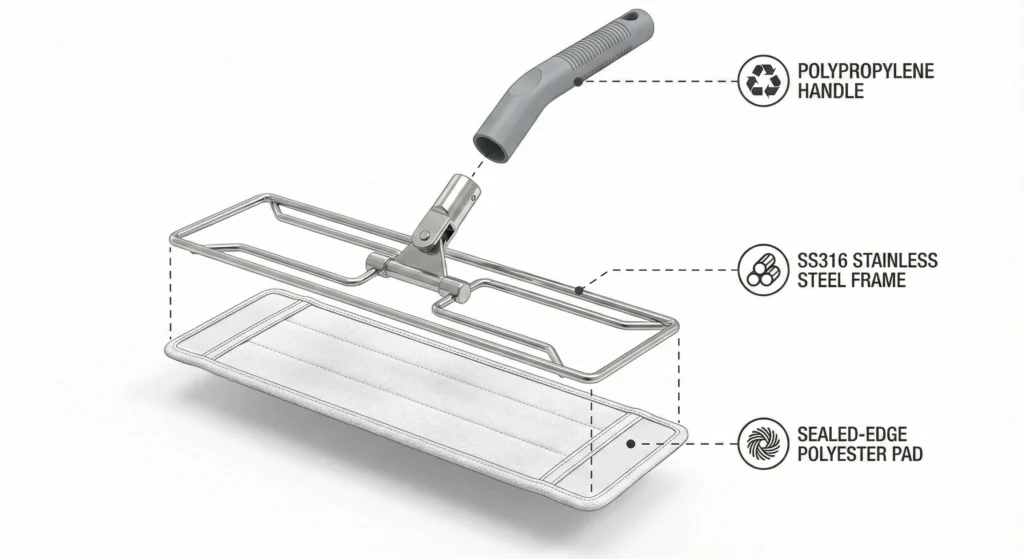
Figure 2: Sealed-edge polyester mop head showing heat-sealed perimeter construction and aluminum frame attachment. Sealed edges prevent fiber shedding and particle generation, maintaining <100 particles/m² through 50–100 autoclave cycles at 121°C. This construction is critical for pharmaceutical GMP compliance per ISO 14644-14 particle generation requirements.
Materials Suitable for Autoclaving (Pads + Frames + Handles)
Polyester Sealed-Edge Mop Pads
Polyester dominates pharmaceutical autoclavable mop heads because it uniquely combines heat resistance, chemical compatibility, and low particle generation.
Material chemistry: Polyethylene terephthalate (PET) polyester has a glass transition temperature (Tg) of ~80°C and melting point of ~260°C. At autoclave temperatures (121–134°C), polyester remains in its solid crystalline state, well below melting. The polymer’s aromatic structure and hydrophobic ester linkages resist hydrolysis from steam exposure. High-molecular-weight continuous-filament polyester (used in pharmaceutical-grade mops) maintains tensile strength >70% after 100 autoclave cycles.
Sealed-edge construction: Critical for particle control. Cut edges expose fiber ends that fray and shed particles during mopping. Pharmaceutical-grade mop pads use heat-sealed perimeters (laser-cut and thermally bonded) or ultrasonic welding to encapsulate all edges. Some designs use continuous-loop knitting (tubular construction with no cut edges). Sealed edges prevent unraveling and particle generation, maintaining <80 particles/m² through 50–100 cycles.
Performance specifications:
- Autoclave durability: 50–100 cycles at 121°C/30 min (standard polyester), 100–150 cycles (premium continuous-filament polyester)
- ذرو نسل: <50 particles ≥0.5 µm/m² (new), <100 particles/m² (after 50 cycles)
- ڪيميائي مطابقت: Resistant to 70% IPA, 3–10% H₂O₂, quats up to 2000 ppm, sodium hypochlorite up to 1% (higher bleach concentrations cause gradual yellowing and strength loss but maintain <100 particles/m² through qualified life)
- جذب ڪرڻ: 4–6× dry weight (lower than microfiber but sufficient for pharmaceutical disinfectant application)
- لاڳت: \$60–\$150 per mop head (40–60 cm width)
Procurement specifications: “100% polyester or polyester-dominant blend (≥90%), continuous-filament construction, sealed edges (heat-sealed, ultrasonically welded, or continuous-loop knit), qualified for 50–100 autoclave cycles at 121°C per vendor validation data, particle generation <100/m² per ISO 14644-14 maintained through qualified service life.”
Microfiber Blends (Cautions & Qualification Needs)
Microfiber mops (polyester/polyamide blends, typically 80/20 or 70/30) offer superior absorbency (6–8× dry weight) and soil capture compared to 100% polyester. However, microfiber presents autoclave validation challenges:
Polyamide (nylon) degradation: Polyamide 6 and 6,6 (common microfiber components) have lower heat resistance than polyester. Nylon Tg is 50–60°C with melting points of 220–260°C—closer to autoclave temperatures. Repeated 121°C exposure causes chain scission (molecular weight reduction), embrittlement, and fiber fusion. SEM imaging of microfiber after 20 autoclave cycles shows filament clumping and surface damage.
Accelerated particle generation: Studies document microfiber particle generation increases from ~100 particles/m² (new) to 300–800 particles/m² after 20–40 autoclave cycles—disqualifying performance for ISO Class 5–7 environments. The split-fiber structure (microfibers are mechanically split to create fissures for soil capture) delaminates under thermal stress, releasing sub-micron fiber fragments.
Residue retention: Damaged microfiber becomes tacky, retaining disinfectant residues, API powders, and organic soil. This increases bioburden risk (organic residues support microbial growth) and cross-contamination potential (residues transfer between cleaning cycles).
Limited service life: Pharmaceutical-grade microfiber qualified for autoclaving typically achieves 30–50 cycles—lower than polyester’s 50–100 cycles. Cost per use remains competitive due to lower unit cost (\$25–\$80 vs \$60–\$150 for polyester), but facilities must track cycle counts rigorously and retire mops earlier.
Recommended applications: Microfiber autoclavable mops are acceptable for ISO Class 7–8 (Grade C/D) areas where higher absorbency benefits outweigh reduced service life, and particle generation <200/m² meets classification requirements. Grade A/B applications should use polyester; the risk of mid-service-life particle excursions with microfiber is unacceptable in aseptic zones.
Qualification requirements: Demand vendor validation data showing particle generation curves from 0 to qualified end-of-life cycles (e.g., 0, 10, 20, 30, 40, 50 cycles), visual/SEM evidence of fiber integrity, and dimensional stability testing. Establish in-house cycle tracking and inspection protocols to detect early degradation.
Stainless Steel Frames
Mop frames connect heads to handles and must survive 200+ autoclave cycles without corrosion, warping, or mechanical failure.
Material specifications: SS316 (18% chromium, 14% nickel, 2.5% molybdenum) or SS304 (18% chromium, 8% nickel) stainless steel. SS316 offers superior corrosion resistance in high-chloride environments (important for facilities using bleach-based sporicides); SS304 is acceptable for IPA/quat/peroxide-only programs.
Construction: Continuous-bend or welded one-piece frames eliminate threaded connections and crevices that trap bioburden. Mop head attachment should use sealed pockets (polyester sleeves) or smooth clip mechanisms—no exposed Velcro or hook-and-loop fasteners that harbor contamination and shed particles.
Autoclave durability: SS316/SS304 withstand 200+ autoclave cycles at 121°C without functional degradation. Passivation (chemical treatment forming a protective chromium oxide layer) may be required after 100–150 cycles if surface discoloration or micro-pitting appears, but mechanical integrity and particle generation performance remain acceptable.
لاڳت: \$70–\$200 per frame (40–60 cm width). Higher upfront cost than polypropylene (\$25–\$80), but amortized over 200+ cycles vs 50–100 cycles for PP, stainless steel offers lower total cost of ownership.
Procurement specifications: “SS316 or SS304 stainless steel, one-piece welded or continuous-bend construction, sealed mop head attachment (no exposed Velcro), electropolished or passivated surface finish, qualified for 200+ autoclave cycles at 121°C.”
Anodized Aluminum Frames (Limitations)
Anodized aluminum frames offer lighter weight (150–250g vs 300–500g for stainless steel) and lower cost (\$40–\$120), but present qualification challenges:
Autoclave-induced corrosion: Anodization (electrochemical oxide coating) protects aluminum from oxidation, but 121°C steam gradually degrades the anodic layer. Repeated cycles cause pitting, white oxide formation, and surface roughness—increasing particle generation and creating bioburden harbors.
Limited cycle life: Pharmaceutical-grade anodized aluminum frames typically achieve 50–100 autoclave cycles before surface degradation disqualifies them. This matches polyester mop head service life, allowing synchronized retirement, but offers no advantage over polypropylene frames at similar cost.
ڪيميائي مطابقت: Aluminum corrodes rapidly in alkaline environments. Facilities using alkaline detergents for laundering or sodium hypochlorite (bleach, which generates alkalinity through hydrolysis) should avoid aluminum frames. Even anodized surfaces fail under sustained bleach exposure.
Recommended applications: ISO Class 7–8 applications with IPA/quat-only disinfection programs and weight-sensitive workflows (e.g., ceiling mopping, wall cleaning requiring extended-reach handles). Grade A/B applications should use stainless steel to avoid mid-service-life corrosion risks.
Autoclavable Polypropylene Handles
Handles connect frames to operators and must be autoclavable, ergonomic, and sealed against bioburden infiltration.
Material specifications: High-temperature polypropylene (PP) formulated with heat stabilizers, typically glass-transition temperature ~0°C and melting point ~165°C. Standard PP melts or warps at 121°C; pharmaceutical-grade autoclavable PP uses copolymers and stabilizers to maintain rigidity at sterilization temperatures.
Construction: One-piece extrusion or injection-molded design with no hollow cavities or threaded caps that trap moisture and bioburden. Frame attachment should use sealed threaded connections with autoclavable gaskets or one-piece molded frame-handle assemblies.
Autoclave durability: High-temperature PP withstands 50–100 cycles at 121°C. Degradation manifests as brittleness, surface cracking, and thread stripping on attachment points. Visual inspection after every 20–25 cycles detects early failure signs.
Stainless steel vs polypropylene handles: SS316 handles (120–150 cm, \$80–\$150) withstand 200+ cycles and offer superior chemical resistance, but are heavier (400–600g) and costlier. Autoclavable PP handles (\$30–\$70, 150–250g) provide ergonomic benefits and adequate service life for Grade C/D applications. Facilities should match handle cycle life to frame cycle life—pairing 50-cycle PP handles with 200-cycle stainless frames creates waste; pairing 100-cycle PP with 100-cycle polyester mops optimizes synchronized retirement.
Procurement specifications: “Autoclavable polypropylene (high-temperature formulation) or SS316 stainless steel, one-piece sealed construction, qualified for ≥50 autoclave cycles at 121°C, frame attachment threads sealed with autoclavable gaskets.”
Compatibility With Disinfectants (IPA, H₂O₂, QAC)
Autoclavable materials must withstand pharmaceutical disinfectant rotation without cumulative degradation:
70% Isopropyl alcohol (IPA): Daily use in Grade A/B/C areas. Polyester, stainless steel, and autoclavable PP show excellent compatibility—no swelling, discoloration, or strength loss after 100+ exposure cycles. Microfiber polyamide may swell slightly but remains functional.
Hydrogen peroxide (H₂O₂, 3–10%): Weekly sporicidal cleaning. Polyester and SS316 resist peroxide oxidation. Autoclavable PP shows gradual surface chalking (whitening) after 50+ peroxide exposures but maintains mechanical integrity. Microfiber polyamide degrades faster—yellowish discoloration and strength loss after 30–50 cycles. Combined autoclave + peroxide stress accelerates microfiber degradation; limit to 30–40 total cycles in peroxide-rotation programs.
Quaternary ammonium compounds (quats, 200–2000 ppm): 2–3× weekly general disinfection. Well-tolerated by all autoclavable materials. Residue management critical—quats form films on surfaces that reduce subsequent disinfectant activity. Validated laundering protocols must remove quat residues between uses.
Sodium hypochlorite (bleach, 500–5000 ppm): Broad-spectrum sporicidal use 1–2× weekly. Polyester withstands bleach but shows gradual yellowing and 20–30% tensile strength loss after 50+ exposures at >1000 ppm. SS316 resists chloride corrosion; SS304 may show pitting after 100+ exposures above 2000 ppm. Autoclavable PP and microfiber both degrade rapidly in bleach—surface cracking, brittleness, and accelerated particle generation. Facilities with bleach-heavy CCS should specify SS316 frames, 100% polyester mop heads, and limit mop service life to 50–70 cycles when bleach >1000 ppm is used routinely.
تصديق جو طريقو: Create a compatibility matrix documenting pass/fail for each material + disinfectant combination, with “pass” defined as: no visible degradation (cracking, yellowing, surface texture change beyond acceptable limits), particle generation <100/m² maintained, mechanical strength retention >70%, after 50 cycles of worst-case sequential exposure (autoclave → disinfectant → autoclave).
Autoclave Temperature & Cycle Limitations (Validation Explained)
121°C / 20–30 Min Standard Cycles
The 121°C/15–30 minute cycle is pharmaceutical autoclaving’s workhorse, balancing validated lethality with material preservation.
Cycle parameters: 121°C (250°F) saturated steam at 15 psi gauge pressure (103 kPa above atmospheric), exposure time 15–30 minutes depending on load density and steam penetration requirements. F₀ (cumulative lethality equivalent to 121°C exposure) typically reaches 8–15 minutes for porous loads like mop heads.
Why 121°C: At this temperature, G. stearothermophilus spores (the biological indicator standard for steam sterilization) exhibit D-value ~1.5 minutes (time to achieve 1-log or 90% reduction). A 15-minute exposure delivers 10-log reduction; 30 minutes provides 20-log reduction—massive overkill ensuring SAL 10⁻⁶ even with high bioburden or poor steam penetration.
Material tolerance: Polyester, SS316, and autoclavable PP all tolerate 121°C without acute damage. This is the qualification baseline—materials that fail at 121°C are disqualified regardless of cost or performance benefits.
Cycle qualification: IQ/OQ validates the autoclave equipment (temperature distribution, steam quality, door seal integrity). PQ validates specific loads: pack mop heads in worst-case configuration (maximum count, tightest arrangement, pouched if used in practice), place BIs at geometric center and periphery, run 3 consecutive cycles, confirm all BIs inactivated and minimum F₀ achieved at all sensor locations. Document cycle records (time/temperature/pressure charts) and BI results for regulatory inspection.
134°C Short Cycles
High-temperature short-cycle sterilization (134°C/3–10 minutes) is used in some pharmaceutical facilities to increase autoclave throughput.
Cycle parameters: 134°C (273°F) at 30 psi gauge (207 kPa above atmospheric), exposure time 3–10 minutes. F₀ equivalence: 3 minutes at 134°C delivers approximately the same lethality as 30 minutes at 121°C (due to exponential relationship between temperature and D-value per z-value ~10°C for spores).
Material risk: Higher temperature accelerates polymer degradation. Polyester maintains integrity but shows faster color fading and tensile strength loss—50-cycle life at 134°C vs 100-cycle life at 121°C. Autoclavable PP approaches its melting point (165°C); service life drops to 30–50 cycles, with warping risk if chamber temperature overshoots or cooling is too rapid. Microfiber polyamide degrades severely—fiber fusion and particle generation increases appear after 10–20 cycles at 134°C.
Recommended applications: 134°C cycles are acceptable for stainless steel frames/handles (no degradation) and premium continuous-filament polyester mops where 50-cycle life is sufficient. Avoid 134°C for microfiber, standard-grade polyester, and polypropylene components. If facility autoclaves operate at 134°C for other loads (surgical instruments, glassware), establish separate 121°C cycles for cleanroom mops or accept reduced service life and track cycle counts accordingly.
Validation: Same IQ/OQ/PQ framework as 121°C cycles. BI placement critical—134°C reduces safety margin for cold spots. Service life studies must be conducted at 134°C to determine actual cycle limits; do not extrapolate from 121°C data.
Repeated Autoclave Exposure & Aging Studies
Materials degrade cumulatively across autoclave cycles. Service life determination requires accelerated aging validation:
Aging study design: Test mops at intervals throughout projected service life—0 cycles (baseline), 20 cycles, 40 cycles, 60 cycles, 80 cycles, 100 cycles—measuring:
- Particle generation per ISO 14644-14 (<100/m² acceptance criterion)
- Visual integrity (tears, edge degradation, discoloration)
- Dimensional stability (length, width, thickness within ±5% of original)
- Mechanical strength (tensile test, abrasion resistance)
- Functional performance (absorbency, wring-out efficiency)
Plot performance metrics vs cycle count to identify degradation curves. Mop service life is defined as the cycle count where any parameter exceeds acceptance criteria—typically when particle generation reaches 100/m² (for ISO 5–7 use) or mechanical strength drops below 70% of original.
Typical degradation patterns:
- پاليسٽر: Gradual yellowing after 40–60 cycles (cosmetic only, no functional impact); particle generation stable <80/m² through 80 cycles, rising to 90–100/m² at 100 cycles; tensile strength 85–90% retention at 100 cycles. Service life: 80–100 cycles (retire before particle limit breach).
- مائڪرو فائبر: Particle generation 100–150/m² at 30 cycles, 200–400/m² at 50 cycles; fiber fusion visible under magnification after 20 cycles; absorbency drops 20–30% by 40 cycles. Service life: 30–40 cycles.
- Autoclavable PP frames: Surface cracking appears after 60–80 cycles; threads strip or crack at 80–100 cycles. Service life: 70–80 cycles (visual inspection after every 20 cycles to catch early failure).
Requalification triggers: If in-use mops show unexpected degradation (particle excursions, broken frames, premature discoloration), stop use and investigate. Possible causes: autoclave temperature overshoots, steam quality issues (superheated steam or wet steam), contamination with incompatible chemicals (e.g., bleach exposure not part of original validation), or vendor material formulation changes. Requalify using fresh samples and revise cycle limits if needed.
Shrinkage Risk in Low-Quality Pads
Polymer shrinkage from steam exposure is a common failure mode for non-pharmaceutical-grade mops:
Mechanism: Polymers contain residual stresses from manufacturing (spinning, weaving, heat-setting). Autoclave heat provides energy for polymer chains to relax toward lower-energy conformations—manifesting as dimensional contraction. Low-quality polyester may shrink 5–15% in length/width after 5–10 cycles; pharmaceutical-grade materials use controlled heat-setting and stress-relief annealing during manufacturing to minimize residual stress, limiting shrinkage to <3% over 100 cycles.
Impact: Shrunken mop heads no longer fit frames properly, creating loose attachment points that generate particles through friction. Reduced surface area decreases floor coverage and fluid capacity. Tight fabric increases stiffness, reducing operator maneuverability and particle capture efficiency.
Qualification testing: Measure mop head dimensions (length, width, thickness at three locations) at 0, 10, 20, 30, 50 cycles. Acceptance criterion: <5% dimensional change through qualified service life. Reject vendors who cannot provide shrinkage validation data or who show >5% shrinkage in first 10 cycles (indicating inadequate manufacturing heat-treatment).
Metal Deformation in Non-Lab-Grade Frames
Metal frames fail through corrosion (discussed earlier under aluminum) or mechanical deformation:
Welded joint failure: Frames using spot welds or tack welds (rather than continuous welds) develop stress cracks at weld points after 30–50 autoclave cycles. Steam penetrates cracks, accelerating corrosion and joint failure. Pharmaceutical-grade frames use continuous-bead welding or one-piece stamped/bent construction.
Thread stripping: Threaded handle attachment points experience cyclic thermal expansion/contraction. Low-quality stainless steel (e.g., SS201, a lower-nickel grade marketed as “stainless”) or soft aluminum alloys strip threads after 20–40 cycles. SS316 and high-strength aluminum alloys maintain thread integrity through 200+ cycles.
Warping: Thin-gauge aluminum (<2 mm) or stamped steel frames may warp under autoclave pressure differentials, especially during rapid cooling. Warped frames create uneven floor contact (reducing cleaning efficacy) and stress mop head attachment points (causing tears).
Qualification testing: Load frames into autoclave at maximum operational density, run 20 cycles, inspect for welds cracks (dye penetrant testing), thread damage (go/no-go gauges), and warping (flatness measurement on reference surface). Acceptance: no visible damage, thread engagement >80% of original, flatness deviation <2 mm across frame length.
How to Correctly Specify Autoclave Validation in Procurement
Procurement specifications must separate vendor marketing from validation-ready documentation:
Required vendor data:
- Material composition: Exact polymer type (e.g., “PET polyester, continuous-filament, 150 denier” not “polyester blend”), fiber construction (sealed-edge method, knit pattern), metal grade (SS316, autoclavable PP formulation)
- Autoclave cycle qualification: Temperature, time, pressure, and load configuration used in vendor validation; number of cycles tested (minimum 50 for reusable qualification); acceptance criteria for particle generation, dimensional stability, mechanical strength
- ذرات جي پيداوار ڊيٽا: ISO 14644-14 test reports showing particle counts at 0, 25, 50, 75, 100 cycles (or vendor’s qualified limit); test conditions (saturated mop, 500g downforce, standardized stroke pattern); optical particle counter specifications
- Service life determination: Method used to establish cycle limits (aging studies, accelerated testing, historical field data); retirement criteria (particle limit, visual defect list, mechanical strength threshold)
- Certificates of conformance: Lot-specific CoC confirming material matches specification; autoclave cycle records (if vendor pre-sterilizes); biological indicator results (if applicable)
Sample specification language:
“Autoclavable cleanroom mop head: 100% polyester continuous-filament, sealed-edge construction (heat-sealed or ultrasonically welded perimeter), qualified for minimum 50 autoclave cycles at 121°C/30 min per vendor validation study. Vendor shall provide: (1) ISO 14644-14 particle generation test report documenting <100 particles ≥0.5 µm/m² maintained through qualified cycle count, (2) dimensional stability data showing <5% length/width change through qualified cycles, (3) material certificates of analysis, (4) service life determination methodology and retirement criteria. Mop heads shall be supplied with lot-specific certificates of conformance and cycle tracking documentation enabling facility service life monitoring.”
Red flags in vendor claims:
- “Autoclavable” without specified cycle limits or validation data
- “Tested to 121°C” without duration, load configuration, or performance metrics
- Particle generation data only for new/unused mops (no aging study)
- “Suitable for cleanrooms” without ISO class or GMP grade specification
- Refusal to provide material composition or manufacturing process details
Facilities should pilot-test small quantities (10–20 mop heads) with in-house autoclave validation before facility-wide adoption. QA-led testing identifies vendor data gaps and verifies performance under actual use conditions (facility-specific disinfectants, autoclave equipment, operator techniques).
Autoclavable vs Disposable Cleanroom Mops — How to Choose
Comparison Table
| Criterion | Autoclavable Reusable | Gamma-Sterilized Disposable |
| Cost per use | \$2–\$7 (system cost amortized over 50–200 uses + laundering/autoclave) | \$15–\$30 (single use, vendor-sterilized) |
| sterility جي ضمانت | SAL 10⁻⁶ via in-house autoclave validation; requires BI monitoring and parametric release | SAL 10⁻⁶ via vendor gamma irradiation (25–50 kGy); sterility certificates and dose records provided |
| ذرو نسل | <100 particles/m² when qualified; degrades 30–100 cycles depending on material; requires periodic re-testing | <50 particles/m² (no degradation concern; single-use eliminates aging variable) |
| Cross-contamination risk | Low to moderate; validated laundering removes residues to <HPLC detection limits; requires segregation by room/product | Zero; single-use eliminates batch-to-batch carryover |
| SOP complexity | High; requires autoclave IQ/OQ/PQ, cycle tracking, laundering validation, service life monitoring, retirement protocols | Low; receiving inspection and disposal only |
| انوينٽري | Moderate; 3–5× daily usage quantity to support laundering/sterilization rotation (e.g., 30 mops for facility using 10/day) | High; 1–2 week supply plus safety stock for vendor lead times (e.g., 100–200 mops for facility using 10/day) |
| Infrastructure | Requires validated autoclave, pharmaceutical-grade laundry (or outsourced service), and controlled storage | No sterilization infrastructure; requires only controlled storage meeting package integrity/expiration requirements |
| Best applications | ISO 6–8 large-area manufacturing (>500 m² daily mopping), facilities with existing autoclave capacity, cost-sensitive operations | ISO 5 Grade A/B aseptic cores, multi-product/high-potency API facilities requiring zero cross-contamination risk, facilities without autoclave capacity |
| Environmental impact | Lower waste volume; reusable systems generate waste only at end-of-service-life | Higher waste volume; each use generates disposal of mop head + packaging (some vendors offer recycling programs) |
| Audit documentation | Extensive; autoclave validation records, BI monitoring logs, cycle tracking, service life studies, retirement records | Moderate; vendor sterility certificates, receiving inspection records, storage compliance, expiration tracking |
Total Cost of Ownership (TCO) Analysis
Scenario: 1,000 m² Grade C manufacturing area mopped 5× per week (260 uses/year)
Autoclavable reusable system (5-year TCO):
- System cost: \$300 × 3 sets (rotation inventory) = \$900
- Mop head replacement: \$100 × 8 replacements (80-cycle life, 260 uses/year = 3.25 mop head lifecycles/year) × 5 years = \$4,000
- Laundering: \$1.50/cycle × 260/year × 5 years = \$1,950
- Autoclave: \$0.75/cycle (utilities, BI, operator time) × 260/year × 5 years = \$975
- Validation: \$8,000 (IQ/OQ/PQ, laundering validation, service life studies, one-time)
- Total 5-year cost: \$15,825 (\$3,165/year, \$12.17 per mopping event)
Gamma-sterilized disposable system (5-year TCO):
- Mop cost: \$22/unit × 260 uses/year × 5 years = \$28,600
- Disposal: \$0.50/unit × 260/year × 5 years = \$650
- Validation: \$1,000 (receiving inspection protocols, storage procedures, one-time)
- Total 5-year cost: \$30,250 (\$6,050/year, \$23.27 per mopping event)
Reusable system saves \$14,425 over 5 years (48% TCO reduction) for this scenario.
Scenario: 200 m² Grade A/B aseptic filling suite mopped 3× per week (156 uses/year)
Autoclavable reusable:
- System cost: \$350 × 3 = \$1,050
- Mop head replacement: \$120 × 5 replacements × 5 years = \$3,000
- Laundering: \$2/cycle (higher grade for aseptic tool laundering) × 156/year × 5 years = \$1,560
- Autoclave: \$1/cycle (dedicated aseptic tool autoclave) × 156/year × 5 years = \$780
- Validation: \$12,000 (higher validation burden for Grade A/B qualification)
- Investigation risk: 2 EM failures/5 years (reduced from 3 with non-validated tools) × \$8,000 avg cost = \$16,000
- Total 5-year cost: \$34,390 (\$6,878/year, \$44.10 per mopping event)
Gamma-sterilized disposable:
- Mop cost: \$28/unit × 156 uses/year × 5 years = \$21,840
- Disposal: \$0.50/unit × 156/year × 5 years = \$390
- Validation: \$2,000 (receiving/storage protocols)
- Investigation risk: 0.5 EM failures/5 years (lowest risk option) × \$8,000 = \$4,000
- Total 5-year cost: \$28,230 (\$5,646/year, \$36.17 per mopping event)
Disposable system saves \$6,160 (18% TCO reduction) for this high-risk, lower-volume application.
TCO decision framework: Reusable systems achieve ROI advantage at higher usage volumes (>200–300 uses/year) and lower risk classifications (Grade C/D). Disposable systems optimize for high-risk low-volume applications (Grade A/B <200 uses/year) where investigation cost avoidance outweighs higher per-use cost.
Cross-Room Contamination Risk
Reusable systems require validated cleaning between uses to prevent room-to-room contamination:
Laundering validation: Pharmaceutical textile reprocessing follows PDA TR 70 guidance. Validation demonstrates that laundering removes soil, API residues, and bioburden to below detection limits. Critical parameters: water quality (WFI or purified water for final rinse), detergent type/concentration (pharmaceutical-grade, residue-tested), wash temperature and cycle time, rinse cycles (minimum 3–5 with final rinse <10 CFU/100 mL, <0.25 EU/mL endotoxin), and drying method (HEPA-filtered air, validated temperature/time preventing microbial growth).
Segregation protocols: Color-coding (blue for Grade A/B, green for Grade C, yellow for Grade D, red for waste areas) prevents accidental cross-use. Physical segregation (separate storage for each grade/product line) reinforces procedural controls. Labeling (room assignment, service date, cycle count) enables traceability.
Worst-case residue testing: Intentionally contaminate mops with worst-case challenge (high-potency API powder, concentrated cleaning agent, high bioburden organism cocktail), launder per validated protocol, test for residues via HPLC (API) or TOC (cleaning agents) and bioburden via surface swab. Acceptance: API <1% of lowest therapeutic dose (product-specific calculation), cleaning agents <LOD, bioburden <10 CFU/mop.
Disposable systems eliminate laundering validation complexity and provide absolute assurance of zero carryover—the regulatory preference for multi-product facilities, high-potency APIs, and beta-lactam manufacturing.
SOP Integration and Workflow Design
Autoclavable reusable workflow:
- Use mop in designated area per validated mopping SOP
- After use, collect in designated contaminated-tool container
- Transfer to laundry area (daily or per batch protocol)
- Launder per validated cycle (document batch, date, operator)
- Inspect for damage (tears, edge degradation, discoloration); retire if defects present
- Load into autoclave in qualified configuration, place BIs per PQ protocol (if routine BI run scheduled)
- Execute validated autoclave cycle; record parametric data (time, temp, pressure, F₀)
- Allow controlled cool-down; transfer to sterile storage area maintaining packaging/hold time per validation
- Issue to production with cycle count documentation (track toward service life limit)
- Repeat steps 1–9 until mop reaches qualified cycle limit, then retire per validated destruction procedure
Disposable workflow:
- Receive gamma-sterilized mops in sealed vendor packaging
- Inspect packaging integrity (no tears, seals intact) and verify documentation (sterility certificate, expiration date, lot traceability)
- Store in controlled conditions (temperature, humidity, segregated by lot) per validation
- Issue to production maintaining packaging integrity until point of use
- Open in designated gowning/airlock area per aseptic technique
- Use once per validated mopping SOP
- Dispose per pharmaceutical waste protocols (segregated by grade/product if needed for investigation traceability)
Disposable workflows eliminate steps 3–8 from reusable protocols, reducing operator training burden and procedural deviation risk. However, reusable workflows offer greater operational flexibility (no vendor dependency for emergency restocking, overnight turnaround vs 2–4 week lead times).
Environmental Monitoring Performance
EM programs track cleaning tool performance through two metrics:
Particle count trends: Optical particle counters positioned during mopping operations (or post-mopping recovery testing) detect degrading mops. Baseline: <50 particles/m² for new autoclavable mops, <30 particles/m² for disposables. Trending: monthly average particle generation during mopping should remain flat. Upward trends (e.g., 50 → 70 → 95 particles/m² over 3 months) indicate mop degradation requiring earlier retirement or investigation of autoclave/laundry process drift.
EM failure investigations should differentiate tool failure from operator technique or disinfectant issues. If multiple rooms show particle/bioburden increases simultaneously, suspect tool degradation (mops approaching end-of-service-life). If isolated to one room or operator, suspect technique or disinfectant preparation.
Bioburden reduction verification: Pre-mopping and post-mopping surface swabs or contact plates measure cleaning efficacy. Acceptance: ≥2-log reduction (99% removal) for routine cleaning, ≥3-log reduction (99.9% removal) for sporicidal cleaning. Autoclavable mops at SAL 10⁻⁶ and disposable sterile mops both achieve this when used with validated disinfectants and techniques. Non-sterile or inadequately sterilized mops often show <1-log reduction or even bioburden increases (contaminated tool redistributing organisms).
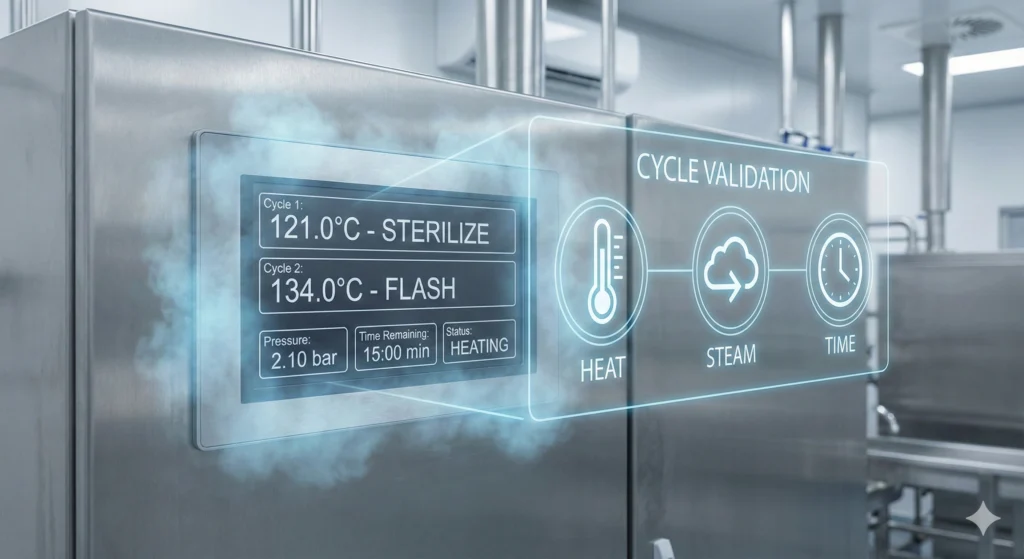
Figure 3: Pharmaceutical Grade B/C cleanroom showing gowned personnel in proper protective equipment and manufacturing environment. EU GMP Annex 1 Section 4.29 requires sterile cleaning materials (including mops) in Grade A/B areas, achieved through validated autoclave cycles delivering SAL 10⁻⁶.
MIDPOSI Autoclavable Mop System Recommendation (ISO 5–8)
MIDPOSI autoclavable cleanroom mop systems are engineered for pharmaceutical contamination control, combining validated material performance with turnkey documentation packages that reduce facility qualification timelines from months to weeks.
Autoclave-Validated Polyester Mop Pads
MIDPOSI sealed-edge polyester mop pads use continuous-filament PET polyester in a tubular-knit construction with heat-sealed perimeters. No exposed fiber ends; no cut edges; no particle shedding pathways.
Performance specifications:
- ذرات پيدا ڪرڻ: <80 particles ≥0.5 µm/m² (new), <100 particles/m² maintained through 80 autoclave cycles at 121°C/30 min (per ISO 14644-14 testing)
- Autoclave durability: Qualified for 80–100 cycles with visual, dimensional, and mechanical integrity acceptance criteria documented
- Chemical compatibility: Validated for pharmaceutical disinfectant rotation (70% IPA daily, 5% H₂O₂ weekly, 1000 ppm quat 2× weekly, 500 ppm sodium hypochlorite weekly) with no particle generation increase or mechanical strength loss >15% after 80 combined cycles
- Absorbency: 5× dry weight (460 mL per 40 cm mop head, 780 mL per 60 cm head)
- Available sizes: 30 cm, 40 cm, 60 cm width options for flat mops; 350 mm and 450 mm for tubular mop heads
Validation package: Particle generation test report (ISO 14644-14 protocol, tested at 0, 20, 40, 60, 80 cycles), autoclave aging study (dimensional stability, tensile strength retention, visual integrity across 100 cycles), chemical compatibility matrix (pass/fail for IPA, peroxide, quats, bleach), material certificates of analysis (fiber type, dye compliance, heavy metals), lot traceability (batch records linking raw material source to finished product).
Stainless-Steel Frames
MIDPOSI mop frames use SS316 stainless steel in continuous-bend or TIG-welded one-piece construction. Mop head attachment via sealed polyester pockets (no Velcro, no exposed fasteners).
Performance specifications:
- Material: SS316 (18% Cr, 14% Ni, 2.5% Mo) with electropolished finish (<0.4 µm Ra surface roughness)
- Autoclave durability: >200 cycles at 121°C without functional degradation; passivation service available if discoloration appears after 150+ cycles
- Construction: Continuous-bend design (30 cm, 40 cm, 60 cm widths) or welded tube frame (for adjustable/articulating heads)
- Handle attachment: Threaded stainless steel connection with sealed gasket (autoclavable silicone, rated 200+ cycles)
Validation package: Material certificates (mill certs confirming SS316 composition), weld inspection reports (dye penetrant testing for weld integrity), autoclave qualification (200-cycle test with visual and mechanical inspection at 50, 100, 150, 200 cycle intervals), particle generation testing (frame + mop head assembly <100 particles/m² system performance).
Polypropylene / Aluminum Handles
MIDPOSI offers both high-temperature polypropylene (cost-optimized, 80-cycle life) and SS316 stainless steel (premium durability, 200+ cycle life) handles.
Autoclavable PP handles:
- Material: High-temperature polypropylene copolymer with heat stabilizers, melting point 165°C
- Autoclave durability: 80 cycles at 121°C (tested to 100 cycles with retirement at 80 to maintain safety margin)
- Construction: One-piece injection-molded tube, sealed threaded frame connection with autoclavable gasket
- Lengths: 120 cm, 140 cm, 160 cm fixed-length; 90–180 cm telescoping (sealed joint design)
- Cost: \$38–\$68 depending on length
SS316 handles:
- Material: SS316 stainless steel tube, electropolished
- Autoclave durability: >200 cycles
- Construction: One-piece welded tube or seamless extrusion, sealed frame connection
- Lengths: 120 cm, 150 cm fixed-length; 100–200 cm telescoping
- Cost: \$95–\$145 depending on length
Selection guidance: Match handle cycle life to mop head and frame life. If using 80-cycle polyester mops with 200-cycle SS316 frames, choose PP handles (80 cycles) for synchronized retirement—or choose SS316 handles (200 cycles) that outlast 2–3 mop head lifecycles, reducing long-term cost.
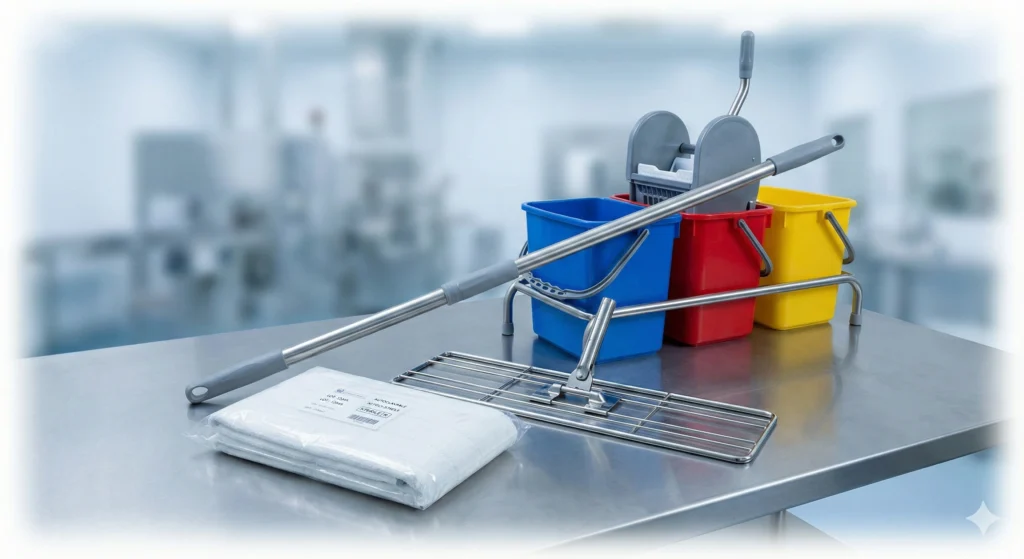
Triple-Bucket System for Disinfectant Integrity
MIDPOSI triple-bucket cart systems integrate with autoclavable mop heads/frames/handles to deliver complete workflow validation.
Configuration: Three 12-liter stainless steel buckets on wheeled cart frame, graduated volume markings (500 mL increments), integrated press-type wringer positioned over waste bucket. Color-coded lids (blue = disinfectant, green = rinse, red = waste) prevent operator confusion.
مواد: SS316 stainless steel buckets and frame, autoclavable casters (high-temperature nylon or stainless), welded construction (no particle-generating joints).
Autoclave compatibility: Entire cart (buckets, frame, wringer) autoclavable at 121°C as assembled unit. Qualification supports Grade B/C use with sterilized mop systems.
Validation package: Fluid segregation validation (worst-case testing: mop 500 m² with single bucket fill, measure disinfectant concentration every 100 m², verify remains within 90–110% of target through completion), disinfectant contact time verification (measure residual wetness duration on floor surface), bucket/wringer bioburden testing (swab test post-autoclave confirming <1 CFU per 25 cm² surface area), operator training SOP with photographic workflow documentation.
Qualification Reports Available
MIDPOSI provides turnkey validation documentation reducing facility IQ/OQ/PQ burden:
Particle generation report: ISO 14644-14 protocol testing; mop + frame + handle system tested as-used; optical particle counter specifications and calibration records; test environment (ISO Class 5 chamber, controlled temperature/humidity); results table showing particle counts at 0, 20, 40, 60, 80 cycle intervals with acceptance criteria and pass/fail determination.
Autoclave qualification report: Aging study design (cycle count intervals, test parameters); visual inspection results (photographs showing mop condition at each interval); dimensional stability measurements (length, width, thickness at three locations per mop); mechanical strength testing (tensile test results, abrasion resistance, thread pull force for frames); functional performance (absorbency, wring-out efficiency); retirement criteria and service life determination rationale.
Chemical compatibility report: Test matrix (all facility disinfectants vs all system components); exposure protocol (concentration, contact time, number of cycles); evaluation criteria (visual degradation, particle generation re-test, mechanical strength retention); pass/fail results per material-chemical combination; recommendations for facility-specific disinfectant rotation.
Disinfectant compatibility testing: Sequential exposure simulation (autoclave → IPA → autoclave → peroxide → autoclave → quat → autoclave through 50 cycles); particle generation trending (verify <100/m² maintained); visual/mechanical assessment; acceptance statement.
Material certificates: Lot-specific certificates of analysis (fiber type, dye batch, metal composition); certificates of conformance (product meets specification); traceability documentation (batch records linking CoA to finished product lot numbers).
IQ/OQ/PQ ٽيمپليٽ: Pre-written protocols customizable to facility-specific details (autoclave model, cycle parameters, room classifications); includes acceptance criteria, data recording forms, deviation/investigation procedures; reduces validation authoring time from 40–60 hours to 8–12 hours of customization.
Fast Lead Time, Engineering Support
MIDPOSI supply chain and technical support:
Lead times: Stock items (standard polyester mop heads 40 cm and 60 cm, SS316 frames, PP handles 120 cm and 150 cm) ship within 5 business days. Custom configurations (special sizes, logo printing, color-coded options) ship within 15 business days. Validation documentation packages deliver within 3 business days of order (electronic PDF delivery).
Engineering support: Pre-sale technical consultation (30–60 min call with QA/validation teams to review facility requirements, recommend configurations, discuss validation approach). Sample evaluation programs (facilities can request 5–10 sample mops for in-house pilot testing before capital commitment). Validation protocol review (MIDPOSI technical team reviews facility IQ/OQ/PQ drafts and provides feedback on acceptance criteria, test methods, data recording). Post-sale troubleshooting (investigation support if mops show unexpected degradation or EM impacts).
Training: On-site or virtual operator training covering proper mopping technique, autoclave loading configuration, cycle count tracking, visual inspection for retirement criteria, and corrective actions for damaged tools.
Conversion CTA:
Request Validation Report — Download complete ISO 14644-14 particle generation test report, autoclave aging study, and chemical compatibility matrix for MIDPOSI polyester mop systems. Includes IQ/OQ/PQ protocol templates. [Request button]
Request OEM Quotation (12h Response) — Submit facility requirements (ISO class, floor area, autoclave specifications, disinfectant program) for custom system quotation. Pricing includes volume discounts for multi-site procurement. Engineering consultation included. [Request button]
Download Technical Data Sheet (PDF) — Printable specification sheet covering material composition, performance specifications, autoclave durability, chemical compatibility, available sizes, and ordering information. [Download button]
FAQ — Autoclavable Cleanroom Mops
What is the difference between “autoclavable” and “sterile”?
“Autoclavable” describes a material property—the ability to withstand moist-heat sterilization at 121–134°C without unacceptable degradation. “Sterile” describes a microbiological state—validated absence of viable organisms to Sterility Assurance Level (SAL) 10⁻⁶. An autoclavable mop can be made sterile through validated autoclave cycles, but merely being autoclavable does not mean it is currently sterile. Sterility is achieved through a validated process (autoclaving, gamma irradiation) and maintained through controlled storage/packaging until point of use. Procurement specifications must address both: materials must be autoclavable (withstand repeated cycles without performance loss) ۽ the sterilization process must be validated (demonstrate SAL 10⁻⁶ through biological indicators and parametric monitoring).
How many autoclave cycles can a polyester mop withstand?
Pharmaceutical-grade sealed-edge polyester mops withstand 50–100 autoclave cycles at 121°C/30 min before reaching performance limits. Premium continuous-filament polyester achieves 80–100 cycles; standard pharmaceutical-grade polyester achieves 50–80 cycles. The limiting factor is not acute material failure (melting, tearing) but gradual particle generation increase—mops generating <80 particles/m² when new typically reach 90–100 particles/m² by 80 cycles, approaching the ISO Class 5–7 acceptance limit of <100 particles/m². Facilities should retire mops at 70–80% of vendor-validated cycle count (e.g., if vendor qualifies to 100 cycles, retire at 70–80 cycles) to maintain safety margin and prevent mid-service-life classification failures. Microfiber blends achieve only 30–50 cycles due to polyamide thermal degradation. Higher-temperature cycles (134°C) reduce service life 30–50% for all materials.
Can microfiber mops be autoclaved?
Yes, but with significant limitations. Microfiber (polyester/polyamide blends, typically 80/20 or 70/30) can survive autoclaving, but polyamide degrades faster than 100% polyester. Pharmaceutical-grade autoclavable microfiber achieves 30–50 cycles at 121°C before particle generation exceeds ISO limits (rising from ~100 particles/m² new to 200–400 particles/m² by 40–50 cycles). Microfiber also shows fiber fusion (filaments melting together under SEM), dimensional shrinkage (5–10% by 30 cycles), and residue retention (damaged fibers become tacky). For Grade A/B applications, sealed-edge 100% polyester is superior (longer service life, more stable particle generation, better dimensional stability). Microfiber remains acceptable for ISO Class 7–8 (Grade C/D) where enhanced absorbency (6–8× dry weight vs 4–6× for polyester) benefits outweigh reduced durability and particle generation <200/m² meets classification. Facilities using microfiber should: (1) qualify to 30–40 cycles maximum, (2) trend particle generation every 10 cycles, (3) avoid 134°C cycles (severe polyamide degradation), (4) restrict use to Grade C/D areas.
Do all autoclavable mop components need the same cycle life?
No, but mismatched cycle life creates waste or operational complexity. Optimal strategy: match component service life to enable synchronized retirement.
Matched service life example: 80-cycle polyester mop heads + 80-cycle polypropylene frames + 80-cycle PP handles. All components retire together after 80 cycles—no waste from discarding functional long-life components, no risk from using short-life components beyond qualification.
Mismatched service life example: 80-cycle polyester mop heads + 200-cycle SS316 frames + 200-cycle SS316 handles. Frames and handles outlast 2–3 mop head lifecycles. Economically optimal (lower long-term cost), but requires inventory tracking (pairing new mop heads with used frames/handles of known cycle history) and periodic frame/handle inspection (verify no degradation after 80, 160 cycles before re-pairing).
Worst mismatch scenario: 80-cycle mop heads + 50-cycle frames + 80-cycle handles. Frames fail mid-service-life, forcing retirement of functional mop heads and handles—wasting capital and requiring emergency frame procurement.
Procurement guidance: For operational simplicity, match all component service life (accept higher upfront cost for long-life components or accept shorter system life with lower-cost components). For cost optimization, pair long-life frames/handles (SS316, 200+ cycles) with shorter-life mop heads (polyester, 80 cycles), accepting inventory complexity for multi-decade frame/handle utilization.
Are gamma-sterilized mops better than autoclavable for Grade A?
Not necessarily “better,” but often preferred for specific risk/operational profiles:
Gamma-sterilized disposable advantages for Grade A:
- Zero cross-contamination risk (single-use eliminates batch-to-batch carryover)
- No service life degradation (every mop is “new” performance)
- Simpler validation (vendor supplies sterility certificates; facility only validates receiving/storage)
- Lower investigation burden (if EM failure occurs, single-use mops are eliminated as chronic contamination source)
Autoclavable reusable advantages for Grade A:
- Lower cost per use (\$3–\$7 vs \$20–\$30 for disposables)
- Operational independence (overnight turnaround vs 2–4 week vendor lead times)
- Environmental benefit (lower waste volume)
Decision framework: If Grade A area is small (<200 m²) and mopping frequency is low (2–3× per week), disposables justify premium cost through investigation risk reduction—a single EM failure investigation (\$8,000–\$15,000 cost) negates years of per-use savings. If Grade A area is large (>500 m²) or usage is high (daily mopping), reusable systems deliver strong ROI—but require robust autoclave validation, service life tracking, and laundering protocols. Multi-product or high-potency API facilities should default to disposables due to cross-contamination risk intolerance regardless of area size. Facilities with validated autoclave infrastructure and GMP laundry capabilities can safely use autoclavable systems in Grade A, accepting higher validation burden for long-term cost savings.
How do I validate that autoclaving actually sterilizes my mops?
Sterilization validation follows a three-tier IQ/OQ/PQ framework:
IQ (Installation Qualification): Verify autoclave meets specifications (chamber size, temperature range, pressure capability), confirm calibration of temperature probes and pressure gauges (within ±1°C and ±0.5 psi), document biological indicator lot qualification (species confirmation, population count, D-value and z-value certificates), verify steam quality (condensate conductivity <5 µS/cm, non-condensable gas content <3.5%).
OQ (Operational Qualification): Execute empty-chamber heat distribution studies (thermocouples at 9–12 locations throughout chamber, map temperature uniformity, identify cold spots—typically geometric center and near door). Run loaded-chamber heat penetration studies with mop loads in worst-case configuration (maximum mop count, tightest packing, autoclave pouches if used). Place thermocouples at suspected cold spots (center of tightly stacked mops, center of pouches). Confirm minimum temperature ≥121°C and minimum exposure time ≥15 min achieved at all locations. Calculate F₀ (cumulative lethality) from time-temperature data; acceptance ≥8 min for steam cycles.
PQ (Performance Qualification): Run 3 consecutive successful cycles with worst-case loads. Place biological indicators (Geobacillus stearothermophilus spore strips or self-contained BIs, population ≥10⁶ CFU, D₁₂₁ ~1.5 min) at cold spots identified in OQ plus center and periphery of mop loads. Include positive control BI (unsterilized, incubated to confirm viability). After cycle, aseptically transfer BIs to growth medium (tryptic soy broth), incubate at 55–60°C for 7 days. Acceptance: all process BIs show no growth (indicating ≥6-log reduction); positive control shows growth (confirming BIs were viable). Document parametric data (time/temperature/pressure charts) showing cycle met validated parameters.
Routine monitoring: Ongoing sterilization assurance via: parametric release (every cycle’s time/temp/pressure data confirms validated parameters met), periodic BI runs (frequency per facility protocol—weekly, monthly, or per-batch), autoclave maintenance (annual preventive maintenance, steam quality testing quarterly, chamber leak testing semi-annually).
What documentation do I need for FDA/EMA audits?
Regulatory inspectors examining autoclavable cleanroom mop validation expect:
1. Equipment qualification records: Autoclave IQ/OQ/PQ protocols with executed data, biological indicator lot certificates (species, D-value, z-value, expiration), autoclave maintenance records (PM schedules, calibration certificates for temperature/pressure instrumentation), steam quality test results.
2. Material qualification records: Vendor validation reports (particle generation per ISO 14644-14, autoclave durability studies, chemical compatibility matrices), material certificates of analysis and conformance, service life determination studies (dimensional stability, mechanical strength retention, visual integrity across qualified cycle count).
3. Process validation records: Laundering validation (demonstrating residue removal to below detection limits), autoclave cycle qualification (heat distribution and penetration studies for mop loads), worst-case load definition (maximum mop count, packaging configuration), acceptance criteria for parametric and BI data.
4. Routine monitoring records: Batch records for each sterilization cycle (date, operator, cycle parameters, load description, BI results if applicable), cycle count tracking logs (linking mop serial numbers or lot codes to cumulative cycles, retirement at qualified limit), visual inspection records (periodic inspection for tears, edge degradation, discoloration), EM trending (particle counts and bioburden data correlated to mopping operations).
5. Standard Operating Procedures: Autoclave operation SOP (loading, cycle selection, unloading, hold times), laundering SOP (wash parameters, water quality requirements, detergent specifications), mop use and storage SOP (room assignments, sterile handling technique, storage conditions/hold times), retirement and disposal SOP (cycle count limits, visual defect criteria, disposal procedures).
6. Contamination Control Strategy (CCS): Risk assessment justifying autoclavable vs disposable selection per facility zone, equipment suitability statements (why chosen mop materials/sterilization method meet Annex 1 requirements), training records (operator qualification on mopping technique, autoclave operation, cycle tracking, inspection procedures).
7. Investigation records (if applicable): CAPA documentation for any EM failures traced to cleaning tools, OOS investigations when particle generation exceeded limits, sterilization failures (BI positive results, parametric deviations).
Auditors may ask: “How do you know your mops remain suitable through their service life?” (expect trending data showing stable particle generation across cycles). “What happens if this mop is accidentally used beyond its qualified cycle count?” (expect SOP describing deviation reporting, risk assessment, potential product impact evaluation). “How do you prevent cross-contamination between products/rooms?” (expect laundering validation data, segregation protocols, worst-case residue testing results).