

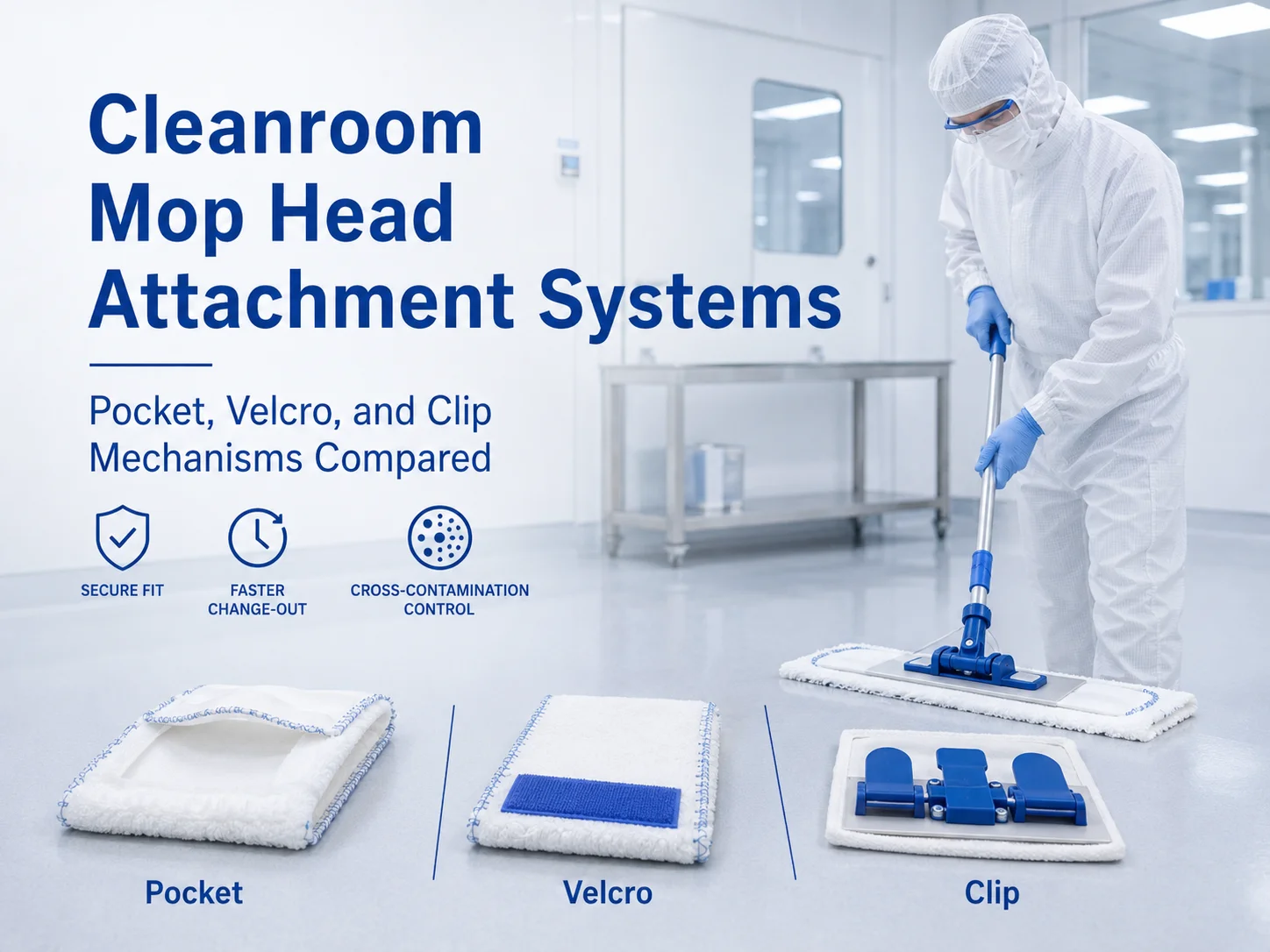
The attachment mechanism between mop head and frame directly affects three operational variables: change-out speed (velcro is fastest, clip is most secure), contamination risk during handling (pocket attachment minimizes operator contact with the soiled mop surface), and long-term reliability (clip mechanisms maintain consistent attachment force through more cycles than velcro, which degrades with repeated laundering and autoclaving). A facility that specifies the mop head material and weight but not the attachment type has left one specification variable to default — and defaults introduce unvalidated operational risk.
| ميڪانيزم | Change-Out Speed | Attachment Security | Contamination Risk | Laundering Durability | لاء بهترين |
|---|---|---|---|---|---|
| Moderate — requires sliding frame into pocket | High — frame is fully enclosed | Lowest — operator touches clean pocket exterior only | Excellent — no adhesive or mechanical parts to degrade | High-frequency change-outs, Grade A/B, sterile workflows | |
| Velcro | Fastest — press-on, pull-off | Moderate — hook-loop engagement degrades with cycles | Higher — operator may contact soiled surface during detachment | Declining — hook-loop holding force reduces after 20-30 launderings | Low-to-moderate change frequency, Grade C/D, non-sterile |
| Clip | Slowest — requires aligning and engaging clips | Highest — mechanical lock, no degradation from laundering | Moderate — depends on clip design and operator technique | Excellent — mechanical parts may wear but do not degrade from laundering | Long-duration use, maximum security, Grade A/B |
Pocket attachment uses fabric pockets sewn into both ends of the mop head. The frame ends slide into these pockets, fully enclosing the frame within the mop head fabric. This is the most common cleanroom mop attachment for two reasons: it minimizes operator contact with the soiled mop surface during change-out (the operator handles the clean pocket exterior to remove the head), and it has no mechanical or adhesive components that can degrade with laundering or autoclaving. The trade-off: change-out is moderately slower than velcro — the operator must align the frame with the pocket opening and slide it in, which takes 5-10 seconds longer per change. For mop head types and compatibility, see صاف ڪمرو ايم پي سر جا قسم ۽ چونڊ.
Velcro (hook-and-loop) attachment is the fastest change-out mechanism — press the mop head onto the frame’s hook strip and it is secured. Change-out time is 2-3 seconds, compared to 8-12 seconds for pocket attachment. This speed advantage is meaningful in high-change-frequency workflows where multiple mop heads are changed per cleaning session. The durability trade-off: hook-and-loop holding force degrades with repeated laundering cycles — typically showing measurable reduction after 20-30 wash/dry cycles. Autoclave exposure accelerates this degradation. Facilities evaluating velcro should request cycle-life data from the supplier and establish a retirement criterion based on holding force, not calendar age. For frame compatibility, see صاف ڪمرو ايم پي فريم جا قسم.
Clip mechanisms use mechanical fasteners — spring-loaded clips, snap-locks, or toggle clamps — to secure the mop head to the frame. This provides the highest attachment security: a properly engaged clip will not release during aggressive mopping, and unlike velcro, the holding force does not degrade with laundering or autoclaving. The trade-off: change-out is the slowest of the three mechanisms, and the mechanical parts introduce additional components that must be inspected and maintained. Clip mechanisms are most commonly evaluated for applications where attachment failure during use is unacceptable — Grade A/B zones, critical surface cleaning — and where change-out frequency is low enough that the slower change speed does not impact workflow.
Attachment mechanism selection affects more than change-out time — it affects operator training requirements and error rate. Velcro is the most intuitive (press to attach, pull to remove) and requires the least training. Pocket attachment requires the operator to align the frame with the pocket — a simple motion but one that new operators may fumble. Clip attachment requires training on the specific clip mechanism and verification that all clips are engaged. For the system-level integration argument, see why the full cleanroom mop system matters.
The attachment mechanism determines how the operator handles the soiled mop head during removal — and this is the contamination control variable that most procurement specifications overlook. Pocket attachment allows the operator to grip the clean exterior of the pocket to pull the head off the frame — the soiled cleaning surface is never touched. Velcro attachment may require the operator to grip near the soiled surface to generate enough pull force to separate the hook-loop engagement. Clip mechanisms vary by design — some allow tool-free detachment from the clean side, others require handling closer to the soiled surface. For Grade A/B sterile workflows where every operator-surface interaction is a contamination variable, the attachment mechanism’s effect on change-out hygiene should be part of the specification.
Most procurement specs list mop head material and weight but omit attachment type. The supplier defaults to whatever is standard in their catalog — which may not match the facility’s workflow.
Velcro holding force degrades with laundering. In Grade A/B where attachment failure during use is a contamination event, velcro without verified cycle-life data at the facility’s laundering parameters is an unvalidated variable.
A pocket mop head will not attach to a velcro frame. Specifying attachment type on the head without verifying frame compatibility creates a procurement mismatch.
In sterile workflows, how the operator removes the soiled mop head matters. An attachment mechanism that forces contact with the soiled surface introduces a contamination vector that the rest of the sterile protocol is designed to prevent.
If a velcro attachment releases mid-cleaning or a clip disengages, is the operator trained on the response? An attachment failure during use is a deviation event — and the SOP should address it.
Velcro is the fastest — 2-3 seconds to press on and pull off. Pocket attachment takes 8-12 seconds. Clip mechanisms are typically the slowest due to the need to align and engage individual fasteners.
Yes. Hook-and-loop holding force measurably decreases after 20-30 laundering cycles, and autoclave exposure accelerates degradation. Facilities using velcro should establish a holding-force retirement criterion and request cycle-life data from the supplier.
Yes. The frame is fully enclosed within the fabric pocket — it cannot release during use unless the pocket fabric tears. Velcro can release if the hook-loop engagement is insufficient due to wear or inadequate pressing during attachment.
Pocket attachment minimizes operator contact with the soiled surface — the operator grips the clean pocket exterior to remove the head. Velcro may require gripping closer to the soiled surface. Clip mechanisms vary by design.
Only if the attachment type is identical and dimensions are verified. A pocket mop head from Supplier A may fit a pocket frame from Supplier B — but the pocket dimensions must match the frame dimensions. Verify before procurement.
Attachment type primarily affects cleaning pressure through security — a secure attachment (pocket or clip) maintains consistent pressure across the stroke. A degraded velcro attachment may allow slight movement between the head and frame, reducing pressure transfer efficiency.
Velcro detachment during use — typically caused by worn hook-loop material that was not identified during pre-use inspection. Pocket tears at the seam are less common but more severe when they occur. Clip disengagement is typically caused by incomplete engagement, not mechanical failure.
Specify your change-out frequency, cleanroom grade, and sterilization requirements. MIDPOSI can help match mop head attachment type to your facility’s contamination control workflow.
White Cleanroom Mop Series — pocket attachment standard — compatible with SS frames — sterile and non-sterile configurations — batch documentation for GMP audit support



اسان توهان سان 1 ڪم ڪندڙ ڏينهن اندر رابطو ڪنداسين، مهرباني ڪري لاتعداد سان اي ميل ڏانهن ڌيان ڏيو "*@midposi.com".
 Optimized by Seraphinite Accelerator