Cleanroom Garments: The Complete Guide for GMP, ISO, and Controlled Environment Facilities
Autoclavable coveralls, hoods, boots, gloves, and undergarments selected as a coordinated system — not as individual items. A grade-by-grade reference for procurement, QA, and gowning program managers.
What Is a Cleanroom Garment System?
A cleanroom garment systemis a coordinated set of apparel components — including coveralls, hoods, face masks, boots or shoe covers, gloves, and undergarments — selected by cleanroom grade, sterilization method, and gowning procedure to control personnel-generated contamination in GMP, ISO 14644, and controlled-environment facilities.
Each component serves a specific contamination-control function. The coverall contains the largest body-surface area. The hood prevents hair and skin particles from reaching the controlled zone. Boots or shoe covers prevent floor-level contamination transfer. Gloves are the primary contact surface for operators handling products, equipment, and surfaces. Undergarments provide a first layer of particle containment beneath the outer garments.
When these components are selected as a coordinated system — rather than as independent purchases — the contamination-control chain is complete. A gap in any single component creates risk for the entire cleanroom, regardless of how well the other components perform. This is why cleanroom garment selection should follow a system-level approach: define the cleanroom grade first, then select all components to match that grade, the sterilization method, and the gowning sequence.
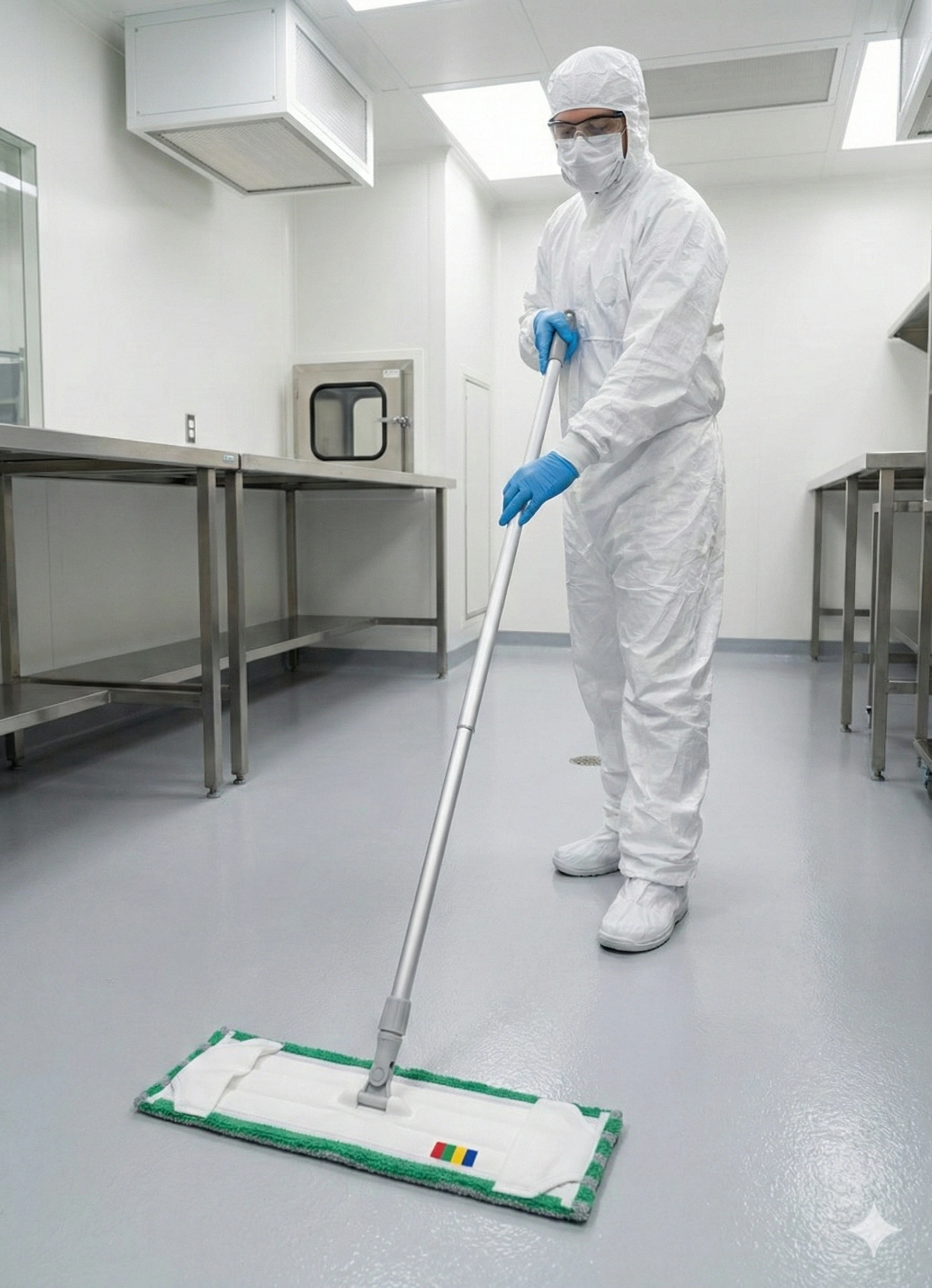
Key principle:A cleanroom garment program is only as strong as its weakest component. A Grade A coverall worn with Grade D shoe covers creates a contamination path that bypasses the coverall’s protection entirely. For a complete contamination-control strategy that covers both personnel and surface cleaning, see oursystemguide för renrumsmopp.
Cleanroom Garment Components — A System-Level Overview
A complete cleanroom garment system includes six component categories. Each category has specific selection criteria based on cleanroom grade, sterilization method, material compatibility, and operator workflow.
1. Coveralls
The foundation of any cleanroom garment program. Coveralls are available in hooded or non-hooded configurations, with or without integrated boots. The primary selection factors are cleanroom grade, material, and sterilization compatibility.
For Grade A/B (ISO 5):Sterile, hooded coverall with integrated boots
For Grade C (ISO 7):Autoclavable hooded coverall, separate boots acceptable
For Grade D (ISO 8):Autoclavable or disposable coverall
Hoods prevent hair, skin flakes, and respiratory particles from entering the cleanroom environment. Selection depends on the gowning sequence, cleanroom grade, and whether a separate face mask is required.
Full-coverage bouffant hood— maximum particle containment, used in Grade A/B
Standard cleanroom hood— suitable for Grade C/D with separate mask
Integrated hood (coverall-attached)— eliminates the hood-coverall interface gap
Face masks capture respiratory particles and prevent operator-generated contamination. In Grade A/B aseptic areas, masks are mandatory and must be sterile. Selection criteria include breathability, filtration efficiency, and compatibility with goggles.
Steril ansiktsmask— required for Grade A/B aseptic zones
Non-sterile surgical-style mask— sufficient for Grade C/D
Full-face shield integrated— for processes requiring splash protection
Footwear containment prevents floor-level contamination from entering or spreading within the cleanroom. Options range from over-boots to integrated booties attached to coveralls, and from disposable shoe covers to autoclavable cleanroom boots.
Autoclavable cleanroom boots— reusable, compatible with steam sterilization
Integrated booties (coverall-attached)— no boot-coverall interface gap
Disposable shoe covers— single-use, convenient for Grade D and visitor areas
Gloves are the most frequently changed garment component and the primary contact surface between the operator and the cleanroom environment. Double-gloving is standard practice in Grade A/B aseptic areas. Material selection depends on chemical exposure, tactile sensitivity requirements, and sterilization method.
Undergarments serve as the first particle-containment layer beneath outer cleanroom garments. In higher-grade cleanrooms (A/B), dedicated cleanroom undergarments reduce the particle load that reaches the outer garment layer and extend the outer garment’s effective protection.
For Grade A/B:Full cleanroom undergarments (top and bottom) under the coverall
For Grade C:Cleanroom undergarment top recommended, bottom optional
For Grade D:Personal undergarments acceptable if fully covered by the outer garment
Autoclavable vs Disposable Cleanroom Garments
The choice between reusable (autoclavable) and disposable cleanroom garments is the first strategic decision in building a garment program. Each approach has different cost structures, operational workflows, and validation requirements.
Dimensionera
Autoclavable (Reusable)
Disposable (Single-Use)
Garment Lifecycle
Multiple sterilization cycles (typically 30-100+ depending on material and sterilization method)
Single use — disposed after each wear session
Laundry Requirement
Requires validated cleanroom laundry process (in-house or outsourced)
No laundry needed — eliminates laundry validation entirely
Sterilisering
Autoclave (121 deg C or 134 deg C), gamma-compatible options available
Gamma-sterilized by supplier; arrives ready-to-use in sterile packaging
Dokumentation
Laundry validation records, autoclave cycle logs, garment inspection records per use
Certificate of Irradiation per batch, lot traceability, sterile packaging integrity records
Cost Profile
Higher upfront investment per garment; lower per-use cost over lifecycle
Lower upfront investment per garment; higher per-use cost over time
Bäst för
Facilities with established laundry and sterilization programs; high daily gowning volume
Low-volume facilities; R&D labs; visitor gowning; facilities without laundry capability
Many facilities operate a hybrid program: autoclavable garments for daily production staff and disposable garments for visitors, maintenance personnel, or low-frequency cleanroom entry. For a complete comparison framework, see the detailed guide onautoclavable vs disposable cleanroom garments.
Cleanroom Garment Materials — Polyester, Polypropylene, SMS, and Tyvek
The fabric selection determines the garment’s particle-shedding performance, chemical resistance, sterilization compatibility, and operator comfort. Four materials dominate cleanroom garment manufacturing, each with distinct properties.
Material
Partikelavfall
Autoclave
Kemisk beständighet
Bekvämlighet
Typisk användning
Polyester (continuous filament)
Låg
Yes (121-134 deg C)
Good — compatible with QACs, hydrogen peroxide, alcohols
Good — lightweight, breathable
GMP Grade A/B/C reusable coveralls, hoods
Polypropen (PP)
Medium
No — degrades above ~130 deg C
Moderate — limited resistance to strong oxidizers
Moderate — less breathable than polyester
Disposable coveralls, visitor gowning, Grade D
SMS (Spunbond-Meltblown-Spunbond)
Medium-High
Inga
Low-Moderate
Good — breathable barrier fabric
Disposable coveralls, lab coats, visitor wear
Tyvek (flash-spun HDPE)
Låg
No — polyethylene-based
Excellent — resistant to most chemicals
Low — non-breathable, can be warm
Hazardous drug compounding, chemical handling, semiconductor
Polyester continuous filament knit is the standard for GMP pharmaceutical cleanroom garments because it balances low particle shedding, autoclave compatibility, operator comfort, and reasonable cost. For a complete material comparison, see thecleanroom garment materials guide.
Selecting Garments by Cleanroom Grade — GMP A/B/C/D and ISO 5-8
Cleanroom garment requirements increase with the stringency of the cleanroom classification. The following table provides grade-based garment recommendations aligned with EU GMP Annex 1 and ISO 14644 expectations.
Personal undergarments acceptable if fully covered
Glasögon
Autoclavable cleanroom goggles, sterile or sanitized
Cleanroom goggles, sanitized
Safety glasses as needed
This table provides a starting recommendation. Each facility should validate its garment program against its specific contamination-control risk assessment, environmental monitoring data, and internal SOP requirements. The same garment category at different grades may require different material specifications, sterilization methods, and change frequencies.
Garment Sizing, Fit, and Operator Comfort
Garment sizing is a procurement-operational challenge that directly affects contamination control. A coverall that is too tight restricts movement, increases the risk of fabric stress and particle shedding, and may tear at seams during use. A coverall that is too loose creates excess fabric that can brush against surfaces and equipment, carrying contamination into controlled zones.
Size by measurement, not assumption.Operators should be measured (height, chest, waist, inseam) and matched to a standardized sizing chart provided by the garment supplier. Guessing sizes leads to inconsistent fit across the production team.
Plan for size distribution.A typical production team will need 3-4 different sizes. Stocking a single size or two sizes creates procurement gaps when new operators join or body measurements change.
Separate sizing for separate components.An operator may wear a size L coverall, size M hood, size 9 boots, and size 8 gloves. Each component should be sized independently — there is no universal size that fits all components for a given operator.
Build replacement cycles into procurement planning.Garments degrade over autoclave cycles. Knowing the expected cycle life of each garment type allows procurement to plan replacement orders before garments fail inspection — rather than reacting to failures.
Cleanroom Gowning — How Garments Fit Into the Gowning Sequence
The gowning sequence determines the order in which garment components are donned, moving from the innermost layer to the outermost. A standardized gowning sequence ensures that each garment component is applied in an order that minimizes contamination risk during the gowning process itself.
Standard GMP gowning sequence (Grade C/D to Grade B entry):
Undergarments— Don dedicated cleanroom undergarments (Grade A/B) or personal undergarments (Grade C/D) in the pre-change area.
Overall— Don the coverall, starting with legs, then arms, then zip/fasten. Ensure no skin or personal clothing is visible at the neck, wrists, or ankles.
Boots— Put on cleanroom boots or shoe covers. Tuck coverall legs into boots or pull boot covers over coverall legs, depending on facility SOP.
Huva— Place the hood over the head, ensuring all hair is contained. The hood should overlap the coverall collar to eliminate the neck gap.
Face Mask— Apply the face mask, covering nose and mouth completely. Pinch the nose bridge for a secure fit.
Glasögon— Position goggles over the eyes. Ensure the goggles sit outside the hood and mask edges. Fog-resistant models are recommended.
Handskar— Don gloves last, pulling the glove cuffs over the coverall sleeves. For Grade A/B, double-glove and change the outer glove at defined intervals.
After gowning, perform a visual inspection (full-length mirror, partner check) before entering the cleanroom. Any visible skin, hair, or personal clothing is a gowning failure and must be corrected before entry.
Documentation and Validation for Garment Procurement
QA teams evaluating a new garment supplier or qualifying a new garment type should request a standard documentation package. The minimum documentation set depends on the cleanroom grade and whether the facility is GMP-regulated.
Material Certifications
Fabric composition statement, particle-shedding test data (Helmke drum or Gelbo flex), chemical resistance data for commonly used disinfectants. For Grade A/B garments: biocompatibility data may be requested.
Steriliseringsdokumentation
For sterile garments: Certificate of Irradiation (gamma dose, batch number, date). For autoclavable garments: autoclave cycle validation data, maximum cycle life statement, material compatibility with standard autoclave parameters (121 deg C / 134 deg C).
Batchspårbarhet
Lot or batch numbers printed on garment packaging or garment labels. Traceability from garment batch back to raw material lot. Shelf-life statement for sterile-packaged garments. Expiry date management system.
Supplier Quality Documents
ISO 13485 certificate (MIDPOSI). Manufacturing facility classification statement. Quality management system overview. Change notification policy — how the supplier communicates material, process, or specification changes to buyers.
Buyers should request the full documentation package during supplier qualification — not after placing the first order. A supplier that cannot provide material and sterilization documentation before the order is unlikely to have robust quality systems supporting the product.
Cleanroom Garments FAQ
What is the difference between autoclavable and disposable cleanroom garments?
Autoclavable (reusable) garments are designed for repeated sterilization cycles — typically 30-100+ cycles depending on material and sterilization parameters. They require a validated laundry program and autoclave cycle tracking. Disposable garments are single-use, gamma-sterilized, and arrive ready-to-use. They eliminate laundry validation but have a higher per-use cost over time. The choice depends on facility volume, laundry capability, and sterilization infrastructure.
What cleanroom garments do I need for ISO 7 / Grade C?
For ISO 7 (GMP Grade C), a typical garment set includes: autoclavable hooded coverall (continuous-filament polyester), cleanroom hood, face mask, cleanroom boots or dedicated shoes, and non-sterile cleanroom gloves. A cleanroom undergarment top is recommended but not always mandatory — check your facility SOP. Goggles should be worn if the process or cleaning activity creates splash risk.
How many autoclave cycles can reusable garments withstand?
Continuous-filament polyester garments typically withstand 50-100+ autoclave cycles at 121 deg C. At 134 deg C, the cycle life is typically lower — in the range of 30-60 cycles. Actual cycle life depends on the specific fabric construction, sterilization parameters, handling procedures, and inspection criteria. Garments should be inspected after each cycle and retired when visual inspection reveals fabric thinning, seam stress, or particle-shedding test failure.
How should I size cleanroom coveralls for a production team?
Measure each operator (height, chest, waist, inseam) and match against the supplier’s sizing chart. Plan for 3-4 different sizes across a production team. Each garment component (coverall, hood, boots, gloves) is sized independently — an operator who wears size L coverall may need size M hood and size 8 gloves. Build replacement stock for the most common sizes and maintain a small inventory of less common sizes for new hires.
What documentation do I need for GMP garment procurement?
Request: material certification (fabric composition, particle test data), sterilization documentation (Certificate of Irradiation for sterile garments, autoclave validation data for autoclavable garments), batch traceability records (lot numbers, expiry dates), and supplier quality documents (ISO 13485 certificate, quality management system overview, change notification policy). Request the full documentation package during supplier qualification — not after placing the first order.
Can cleanroom garments be shared between different cleanroom grades?
No. Garments should be dedicated to a specific cleanroom grade and not transferred between grades without re-sterilization or re-processing. Moving a garment from Grade C to Grade B without re-sterilization creates a contamination pathway. The garment storage, laundering, and sterilization process should maintain grade segregation. Color-coded garments or labels by grade are a practical way to prevent mixing.
What is the proper gowning order for GMP Grade B?
The standard Grade B gowning sequence is: (1) undergarments in pre-change area, (2) coverall, (3) boots or shoe covers, (4) hood, (5) face mask, (6) goggles, (7) gloves (double-glove for aseptic operations). Each layer is donned from innermost to outermost. After gowning, perform a visual inspection using a full-length mirror and partner check before entering the cleanroom.
How often should cleanroom garments be replaced?
Replacement should be based on inspection — not a fixed calendar schedule. Each garment should be visually inspected after every sterilization cycle. Retirement criteria include: visible fabric thinning, seam separation, loss of elasticity at cuffs or ankles, particle-shedding test failure, or exceeding the supplier’s stated maximum cycle life. Disposable garments are replaced after each use. Keep a garment retirement log to track replacement patterns and forecast procurement needs.
Need Autoclavable Cleanroom Garments for Your Facility?
MIDPOSI supplies reusable cleanroom coveralls, hoods, boots, suits, lab coats, undergarments, goggles, and accessories for GMP and ISO-classified environments. Tell us your cleanroom grade, garment type, quantity, and sterilization requirements — our team will recommend suitable options for your workflow.