Vad är en renrumsmopp?
En renrumsmoppe är ett specialiserat verktyg för golvrengöring som är konstruerat för att möta kraven på föroreningskontroll i kontrollerade miljöer – farmaceutiska tillverkningssviter, biotekniska laboratorier, monteringsområden för medicinsk utrustning och halvledarfabriker. Till skillnad från konventionella vaktmästarmoppar, som i första hand är designade för att ta bort smuts och kostnadseffektivitet, är renrumsmoppar föroreningskontrollenheter först och rengöringsverktyg sedan.
Den avgörande egenskapen ärlåg partikelgenerering. Där en vanlig bomulls- eller rayonmopp kan ta bort tusentals fibrer och partiklar med varje slag, är en renrumsmoppe konstruerad av tätt vävda, kantförseglade material (vanligtvis mikrofiber, polyesterstickat eller icke-avfallande skum) som genererar minimal luftburen eller ytförorening under användning. Dessa moppar är testade och kvalificerade för att fungera i ISO-klassade renrum (ISO klass 5 till klass 8) utan att bryta mot gränsvärden för partikelantal eller införa mikrobiell kontaminering som kan äventyra steril tillverkningsverksamhet eller utlösa regulatoriska fynd.
För läkemedels- och GMP-anläggningar är renrumsmoppen en del av ett validerat rengörings- och desinfektionsprogram. Det måste vara kompatibelt med aggressiva sporicida medel (isopropylalkohol, väteperoxid, kvartära ammoniumföreningar, natriumhypoklorit), kunna motstå upprepade steriliseringscykler där så krävs (autoklavering för områden av grad A/B), och stödjas av dokumentation som visar partikelavskiljning, kemisk resistens och sterilitetssäkerhet. I lagstadgade termer är renrumsmoppen inte ett råvaruköp – det är en kritisk del av kontamineringskontrollinfrastruktur som måste väljas, valideras och underhållas i enlighet med din anläggnings föroreningskontrollstrategi (CCS) och kvalitetsledningssystem.
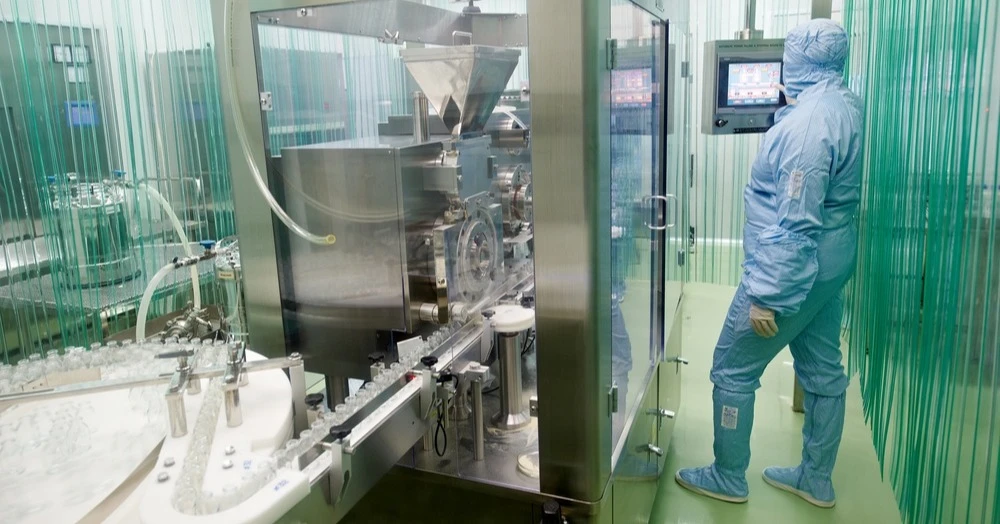
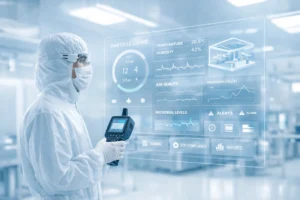
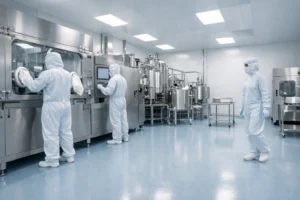
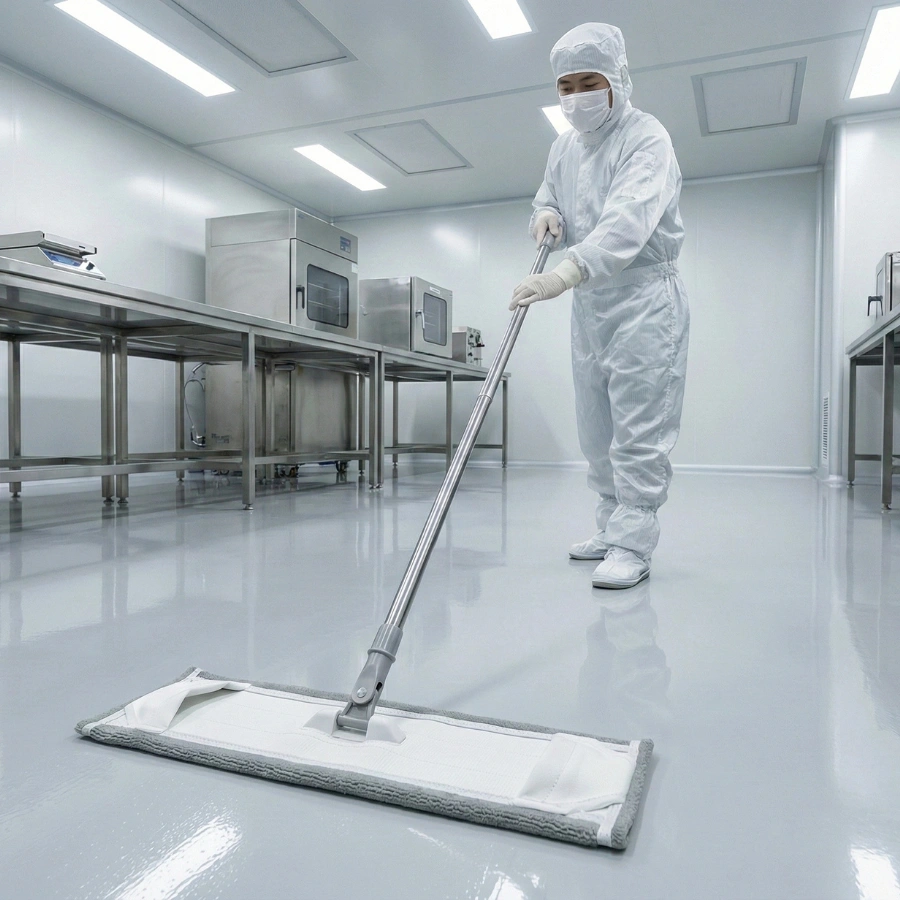
Figure 1: Aseptic manufacturing environment where cleanroom mops are critical contamination-control devices. Personnel in full sterile gowning demonstrate the high-stakes environment where even minor particle generation from cleaning equipment can compromise product sterility and trigger regulatory findings.
Why Cleanroom Mops Are Different from Normal Mops
The gap between a standard janitorial mop and a cleanroom mop is not a matter of quality grade—it is a difference in design philosophy and performance requirements.
Partikelgenerering: Conventional mops (cotton, rayon, blended fibers) are optimized for absorbency and scrubbing power. Their fibers are often loosely twisted, cut, or looped, and edges may be unfinished. During use, mechanical friction causes fiber breakage and particle shedding. In a typical office or hospital corridor, this creates no issue. In an ISO Class 7 aseptic processing support area (particle limit: 352,000 particles/m³ at ≥0.5 µm), a shedding mop can single-handedly violate classification limits and trigger an out-of-specification (OOS) event.
Cleanroom mops use continuous-filament polyester, tightly knitted microfiber, or sealed foam structures withheat-sealed or ultrasonically welded edges för att förhindra upplösning. Partikelgenereringshastigheter kvantifieras under kvalifikationstestning enligt ISO 14644-14 (bedömning av utrustningens lämplighet genom luftburna partikelkoncentration). Acceptabla renrumsmopper genererar vanligtvis färre än 100 partiklar ≥0,5 µm per slag under kontrollerade testförhållanden, jämfört med tusentals för konventionella moppar.
Kemisk kompatibilitet: Standardmoppar är designade för användning med rengöringsmedel med neutralt pH, utspädda desinfektionsmedel och enstaka blekmedel. Farmaceutiska renrum kräver kompatibilitet med högkoncentrerad isopropylalkohol (70 % IPA), väteperoxid (3–35 %), sporicida medel och kontakttider mätt i minuter snarare än sekunder. Material som fungerar bra med hushållsrengöringsmedel kan försämras, missfärgas eller tappa partiklar när de utsätts upprepade gånger för dessa aggressiva kemikalier. Renrumsmoppmaterial är utvalda och testade för kemikaliebeständighet, dimensionsstabilitet och bibehållen prestanda med låg luddighet under hundratals rengöringscykler och steriliseringshändelser.
Steriliseringsförmåga: I miljöer av EU GMP Annex 1 Grad A och Grad B (aseptiska bearbetningszoner, fyllningslinjer under enkelriktat luftflöde) måste all utrustning och material som kommer in i området steriliseras. Standardmoppar tål inte autoklavering vid 121°C eller exponering för förångad väteperoxid utan att smälta, krympa eller äventyra den strukturella integriteten. Renrumsmopper avsedda för dessa områden är tillverkade av autoklaverbara polymerer (vissa polyestrar, polypropenblandningar) som överlever upprepade steriliseringscykler utan prestandaförlust, eller levereras som försteriliserade, validerade engångssystem med sterilitetsgarantidokumentation.
Spårbarhet och dokumentation: Cleanroom mops are supplied with certificates of conformance, material safety data sheets, extractables and leachables data (where required), and particle generation test reports. Batch records and lot traceability support regulatory audits and root-cause investigations. Standard mops come with a price tag and little else.

Figure 2: Cleanroom-grade microfiber mop head showing tightly woven, continuous-filament fiber construction. The dense fiber structure provides high absorbency and particle capture while maintaining low linting performance across 100+ sterilization cycles—characteristics that distinguish cleanroom mops from conventional janitorial equipment.
Key Features Required for Pharma & GMP-anläggningar
När du specificerar renrumsmoppar för läkemedels- och GMP-verksamhet, avgör fyra kärnfunktioner om en produkt kommer att stödja eller undergräva ditt program för föroreningskontroll.
Låg ludd & icke-avfallande struktur
Partikelgenerering är det primära kvalificeringskriteriet. EU GMP Annex 1 och FDA aseptisk bearbetningsvägledning kräver att material och utrustning som används i klassificerade områden minimerar partikelavgivningen. ISO 14644-14 tillhandahåller testramen: mopphuvuden utsätts för simulerade användningsförhållanden (våta/torra cykler, mekanisk omrörning, kontakt med representativa ytor) medan luftburna partikelräknare mäter frigöring vid ≥0,5 µm och ≥5 µm.
Acceptabla renrumsmopper uppvisar partikelgenereringshastigheter långt under klassificeringsgränserna för deras avsedda användningsområde. För ISO klass 5 (3 520 partiklar/m³ vid ≥0,5 µm) måste moppar generera praktiskt taget noll ytterligare partiklar under användning. För klass 7 eller klass 8 stödområden kan något högre generation tolereras, men varje mopp som bidrar med en mätbar partikelbörda riskerar att trycka miljön ur specifikationen under rutinoperationer eller bracketingstudier.
Konstruktionsdetaljer är viktiga:kontinuerliga filamentfibrer (inga klippta ändar att nöta),förseglade kanter (värmeförseglad, ultraljudssvetsad eller innesluten i en kantbindning),tätt stickad eller vävtäthet (förhindrar fiberutdragning), ochprotokoll för kontrollerad tvätt eller sterilisering that do not degrade the material over the product’s qualified use life. Vendors should provide particle generation test data from independent labs or internal quality systems that reference ISO 14644-14 methodology.
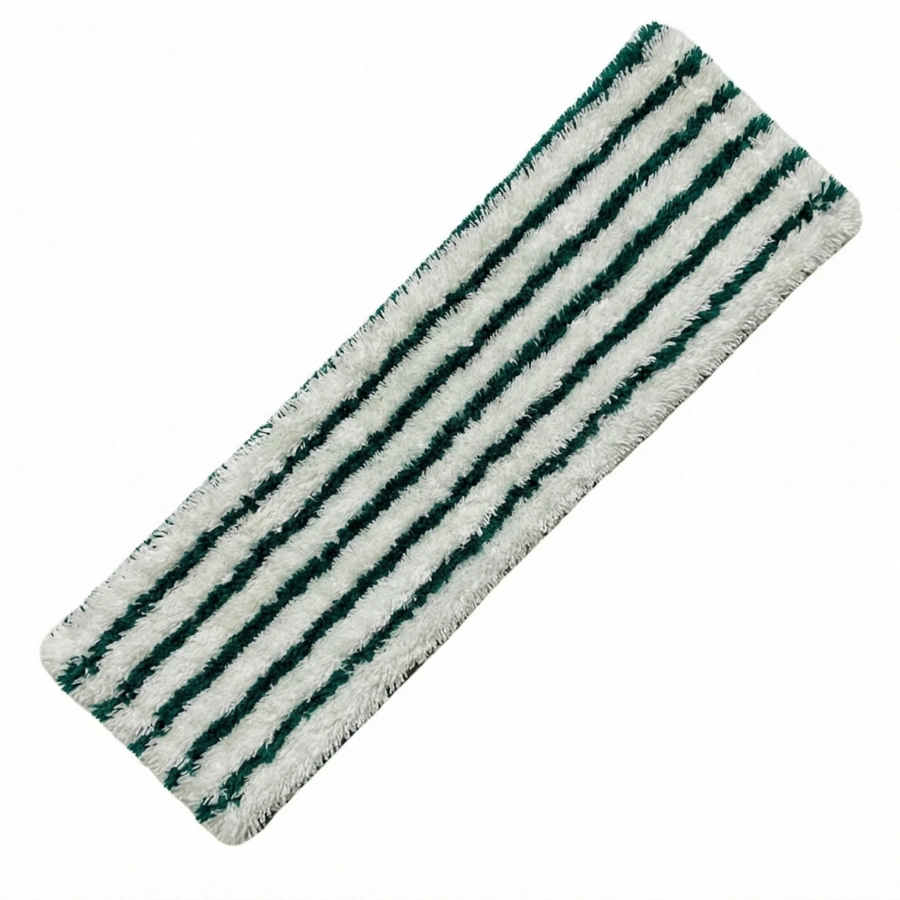
Figure 3: Cleanroom mop anatomy showing key contamination-control features. Cross-section reveals continuous-filament fiber structure (no cut ends to fray), heat-sealed edges (preventing unraveling), tight weave density (minimizing fiber pull-out), and sealed handle interface. These design elements work together to achieve particle generation rates below ISO 14644-14 qualification thresholds.
Compatibility with disinfectants (IPA / Quat / Bleach / H₂O₂)
Pharmaceutical cleaning programs rotate or layer multiple disinfectant chemistries to achieve broad-spectrum microbial kill and prevent resistance development. Your mop must survive this chemical gauntlet without performance loss.
Isopropyl alcohol (IPA, 70%): The most common pharmaceutical disinfectant. Many polymers tolerate IPA well, but repeated exposure can cause some materials to swell, stiffen, or lose tensile strength. Microfiber blends and polyester knits generally perform well; certain foam substrates may degrade.
Kvaternära ammoniumföreningar (quats): Widely used for routine disinfection. Generally well-tolerated by cleanroom mop materials. Residue management is important—quats can leave films that attract particles or interfere with subsequent sporicidal treatments.
Sodium hypochlorite (bleach): Effective sporicidal agent but aggressive. Concentrations above 0.5% can cause color fading, fiber weakening, and accelerated wear in some polyester and microfiber constructions. If bleach is part of your CCS, specify mops validated for bleach compatibility and monitor for performance degradation over the qualified use period.
Hydrogen peroxide (H₂O₂, 3–35%): Increasingly popular for sporicidal bio-decontamination, especially in isolators and RABS. Peroxide is an oxidizer; materials must be tested for resistance to oxidative degradation, color stability, and maintained structural integrity. Some foam-core mops and certain microfiber blends show excellent H₂O₂ compatibility; others do not.
Request chemical compatibility matrices from vendors and validate in-house under your actual use conditions (concentrations, contact times, temperatures, number of cycles). Include visual inspection (color change, fiber damage), mechanical testing (tensile strength retention), and particle generation re-testing after simulated aging.
Autoclavable vs Disposable
Your choice between reusable (autoclavable) and single-use (disposable) mop systems hinges on area classification, throughput, validation complexity, and cost structure.
Autoclavable (reusable) systems: Designed for repeated sterilization at 121°C (or higher) in steam autoclaves. Constructed from polymers that maintain dimensional stability, mechanical strength, and low-linting performance across 50–200+ autoclave cycles (depending on material and vendor qualification). These systems require validated autoclave cycles (temperature, pressure, time, load configuration), documented post-sterilization hold times and sterility assurance, and routine inspection for wear (fiber damage, edge degradation, discoloration). Reusable systems offer lower per-use cost and reduced waste generation but demand robust laundry/sterilization infrastructure, operator training, and periodic requalification.
Disposable (single-use) systems: Levereras försteriliserat (gammastrålning eller etylenoxid) i förseglad, validerad förpackning. Använd en gång och kasserad. Dessa eliminerar tvättkomplexitet, korskontamineringsrisk mellan batcher eller produktlinjer och behovet av intern autoklavvalidering. Engångsmopper föredras i aseptiska högriskområden (påfyllningslinjer av grad A, isolatormiljöer) där eventuell återanvändningsrisk är oacceptabel, och i anläggningar med begränsad steriliseringskapacitet. Avvägningar inkluderar högre kostnad per användning och ökad avfallsvolym (även om många leverantörer nu erbjuder återvinningsprogram för använda renrumsförbrukningsartiklar).
Annex 1 does not mandate one approach over the other; your Contamination Control Strategy should document the rationale, include risk assessments for both options, and define the validation and monitoring requirements for your chosen system.
Mop handle & bucket pairing
Mops do not operate in isolation. The complete cleaning system—mop head, handle, frame, and bucket—must be designed, validated, and maintained as an integrated contamination-control assembly.
Handles and frames: Bör konstrueras av släta, icke-porösa material (rostfritt stål, elektropolerad aluminium, autoklaverbara polymerer) som inte avger partiklar, motstår korrosion från upprepad exponering för desinfektionsmedel och kan steriliseras (för användning av klass A/B) eller grundligt desinficeras (för användning av klass C/D). Teleskophandtag och justerbara ramar introducerar ytterligare sprickor och leder som kan hysa föroreningar; konstruktioner med fast längd, förseglade fogar föredras i högklassiga områden. Ergonomi spelar roll – klädda operatörer som arbetar i övertrycksdräkter eller isolatorer behöver lätta, balanserade handtag som minimerar trötthet och minskar risken för okontrollerade rörelser som genererar partikelsprängningar.
Skopor och vridsystem: Must be autoclavable or supplied as sterile disposables for high-grade areas. Bucket material (often stainless steel or autoclavable polypropylene) should resist chemical attack and allow visual confirmation of solution clarity (indicating absence of particulate contamination or microbial growth). Two-bucket systems (one for clean solution, one for waste) prevent cross-contamination and are standard practice in GMP cleanrooms. Some facilities use pre-saturated mop systems (mop heads pre-wetted with disinfectant, sealed in sterile pouches) to eliminate bucket handling entirely in Grade A/B zones.
Color coding and segregation: Implement color-coded systems (e.g., blue for production areas, red for waste handling zones, green for personnel gowning areas) to prevent cross-contamination between classified and non-classified spaces. Color coding must extend to mop heads, handles, frames, and buckets, with documented procedures and operator training to ensure compliance.

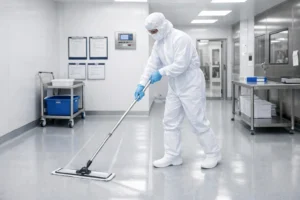
Figure 4: Validated mopping procedure in a pharmaceutical cleanroom. Personnel in full protective coverall, hood, and gloves demonstrate proper technique with color-coded equipment and two-bucket system. This integrated approach—qualified mops, validated procedures, trained operators—forms the foundation of effective contamination control in GMP facilities.
Types of Cleanroom Mops (Microfiber / Polyester / Foam-Core / Disposable)
Cleanroom mops fall into four primary categories, each optimized for different contamination-control requirements, chemical exposures, and operational workflows.
Microfiber mops
Microfiber mops use ultra-fine synthetic fibers (typically polyester/polyamide blends) with diameters below 1 denier (roughly 10 micrometers). The high surface-area-to-weight ratio delivers exceptional absorbency and particle capture. Microfiber’s split-fiber construction creates microscopic channels that trap particles mechanically rather than relying solely on chemical cleaning action, making these mops effective for both wet mopping (with disinfectants) and damp dusting (residual particle removal between disinfection cycles).
Fördelar: Superior liquid retention (often 6–8 times the mop’s dry weight), excellent particle capture efficiency, durability across 100–200+ launder/autoclave cycles (when properly maintained), and compatibility with most pharmaceutical disinfectants including IPA, quats, and hydrogen peroxide. Microfiber performs well in ISO Class 6–8 environments and is a workhorse for routine cleaning in aseptic processing support areas, gowning rooms, and material airlocks.
Begränsningar: Some microfiber blends show reduced performance or fiber damage after repeated exposure to high-concentration bleach (>1%). Microfiber requires validated laundering protocols—improper washing (high heat, fabric softeners, or contaminated laundry equipment) can introduce particles or residues that compromise cleanroom performance. Pre-saturated or disposable microfiber options are available for facilities that prefer to avoid laundry complexity.
Polyester knit mops
Polyester knit mops are constructed from continuous-filament 100% polyester yarns, typically in a tubular knit or flat-weave configuration. Edges are heat-sealed or ultrasonically welded to prevent fraying. These mops emphasize durability, dimensional stability, and chemical resistance.
Fördelar: Excellent compatibility with aggressive disinfectants, including sustained exposure to bleach, hydrogen peroxide, and phenolic compounds. Polyester knit withstands autoclaving across 200+ cycles with minimal loss of tensile strength or dimensional change. Low lint generation and high abrasion resistance make polyester knit suitable for ISO Class 5–7 environments, including areas with frequent disinfectant rotation and heavy-use schedules (multiple shifts, high-throughput manufacturing lines). Many vendors offer polyester knit mops validated to ISO 14644-14 with particle generation data supporting use in Grade B and Grade C environments.
Begränsningar: Slightly lower absorbency than microfiber (typically 4–6 times dry weight). Polyester knit may feel stiffer than microfiber, which can affect operator preference and maneuverability in tight spaces. Cost per unit is often higher than microfiber, though total cost of ownership may be lower due to extended use life.
Foam-core mops
Foam-core (or sponge-core) mops feature a central foam substrate encased in a non-woven or knit outer layer. The foam core provides structural rigidity and fluid distribution, while the outer layer handles particle capture and surface contact.
Fördelar: Uniform fluid distribution across the mop head, reducing streaking and ensuring consistent disinfectant contact. Foam-core designs excel in applications where controlled, even wetting is critical—such as applying sporicidal agents to isolator interiors or cleaning validated surfaces where residue patterns must be minimized. Some foam-core mops are specifically formulated for hydrogen peroxide compatibility and are used in automated bio-decontamination systems (e.g., isolator foggers followed by manual wipe-down with foam-core mops).
Begränsningar: Foam substrates vary widely in chemical resistance; not all formulations tolerate repeated bleach or peroxide exposure. Foam can degrade (crumbling, discoloration, loss of structural integrity) over time, especially under aggressive chemical regimens or high autoclave temperatures. Particle generation testing is critical—some foam-core mops generate acceptable particle levels, while others shed foam fragments or fibers from the outer layer. Always request vendor validation data and conduct in-house qualification before deploying foam-core mops in ISO Class 7 or higher environments.
Disposable (single-use) mops
Disposable mops are supplied pre-sterilized, individually packaged, and intended for one-time use. Materials range from non-woven polyester/polypropylene blends to sealed-edge microfiber or foam-core constructions identical to their reusable counterparts, but packaged and sterilized for single use.
Fördelar: Eliminate cross-contamination risk between production batches, eliminate the need for validated laundering or in-house sterilization, simplify logistics and inventory management (especially for multi-site organizations), and provide audit-ready documentation (sterility certificates, lot traceability, expiration dating). Disposable mops are the default choice for high-risk Grade A operations, small-batch or clinical-trial manufacturing (where batch-to-batch segregation is paramount), and facilities undergoing cleaning validation or investigating contamination events (disposables remove laundry and reprocessing as variables).
Begränsningar: Higher per-use cost (often 3–10× the cost per use of reusable mops, depending on volume and vendor). Increased waste generation raises environmental and disposal costs, though some vendors offer take-back programs and recycling services. Facilities must manage inventory expiration dates and storage conditions to maintain sterility assurance.
Selection guidance: For routine, high-volume cleaning in ISO Class 6–8 environments with robust laundry infrastructure, reusable microfiber or polyester knit mops offer the best cost-performance balance. For Grade A/B aseptic cores, isolators, or operations with limited sterilization capacity, disposable mops reduce risk and operational complexity. Hybrid approaches—reusable mops for Grade C/D support areas, disposables for Grade A/B cores—are common and pragmatic.
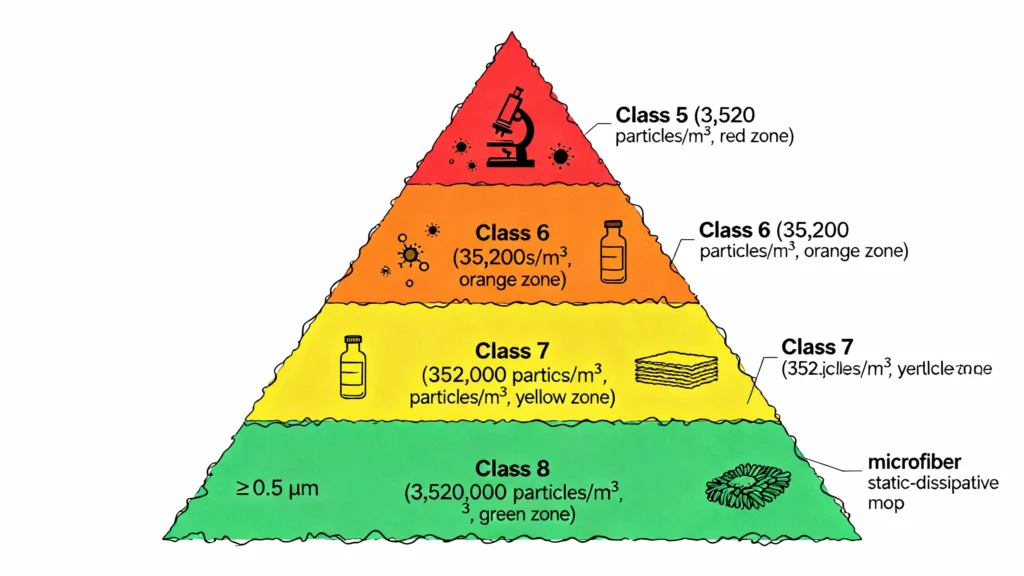
Figure 5: Material comparison matrix for cleanroom mop selection. Each material type offers distinct performance characteristics: microfiber excels in absorbency and particle capture; polyester knit provides superior chemical resistance and durability; foam-core delivers uniform fluid distribution; disposables eliminate cross-contamination risk. Selection should align with area classification, disinfectant program, and operational workflow requirements.
How Cleanroom Mops Help Maintain ISO & GMP Compliance
Cleanroom mops are not incidental to regulatory compliance—they are integral components of the control systems that keep your facility in specification and audit-ready.
Particle control and ISO classification maintenance: ISO 14644-1 classifies cleanrooms by measured airborne particle concentration. Your facility’s environmental monitoring program continuously tracks particle counts at designated locations, and any excursion above classification limits triggers investigations, corrective actions, and potential production holds. Introducing a non-qualified, particle-shedding mop into a classified area can generate enough particles to push the environment out of spec, especially during high-activity periods (shift changes, material transfers, cleaning operations). Qualified cleanroom mops, tested per ISO 14644-14, provide documented evidence that your cleaning equipment does not contribute to particle burden. This documentation supports your Contamination Control Strategy (CCS) and demonstrates due diligence during inspections.
Microbial contamination control: EU GMP Annex 1 mandates routine microbiological monitoring and sets colony-forming unit (CFU) limits for each cleanroom grade (Grade A: <1 CFU per contact plate; Grade D: ≤100 CFU/m³ active air sample). Mops must not introduce microbial contamination. For Grade A/B environments, sterile mops (autoclaved reusables or pre-sterilized disposables) are required. For Grade C/D areas, mops must be disinfected and managed to prevent microbial growth during storage. A contaminated mop—whether from inadequate sterilization, improper storage, or use beyond its validated shelf life—can seed microbial contamination across floors, walls, and equipment, leading to failed environmental monitoring results, product holds, and regulatory observations.
Cleaning validation and residue management: Annex 1 and FDA CGMP regulations require validated cleaning procedures for equipment and facility surfaces. Your cleaning validation protocol must demonstrate that cleaning agents and methods consistently reduce microbial and particulate contamination to acceptable levels, and that residues from cleaning agents do not adversely affect product quality. The mop is a critical variable in this validation: its absorbency, particle capture efficiency, and compatibility with disinfectants directly affect cleaning efficacy. Mop material must not leach substances that interfere with disinfectant activity or leave residues that attract particles. Validation studies often include worst-case testing with the actual mops, disinfectants, and surface materials used in production, providing documented evidence that the complete cleaning system meets acceptance criteria.
Audit readiness and traceability: During FDA inspections, EMA audits, or third-party certifications, inspectors examine your CCS, cleaning procedures, equipment qualification records, and environmental monitoring trends. They expect to see documented rationale for equipment selection, vendor certificates of conformance, particle generation test data, autoclave validation (for reusable systems), sterility assurance documentation (for disposables), and evidence of operator training. Cleanroom mops with full traceability (lot numbers, material certifications, sterilization records) provide the documentation trail that closes out inspection observations and demonstrates systematic contamination control.
Regulatory expectations across regions: FDA’s 2004 Aseptic Processing Guidance emphasizes environmental control, personnel training, and validated cleaning for aseptic manufacturing. EU GMP Annex 1 (2022 revision) requires a facility-wide CCS, explicit controls for cleaning and disinfection, and qualification of materials and equipment used in classified areas. PIC/S (Pharmaceutical Inspection Co-operation Scheme) and WHO GMP guidelines align closely with these expectations. In all cases, the cleanroom mop is part of the control system that must be designed, validated, and maintained to regulatory standards. Failure to qualify cleaning equipment has been cited in FDA 483 observations and EMA deficiency letters, often linked to environmental monitoring excursions or contamination events during product campaigns.
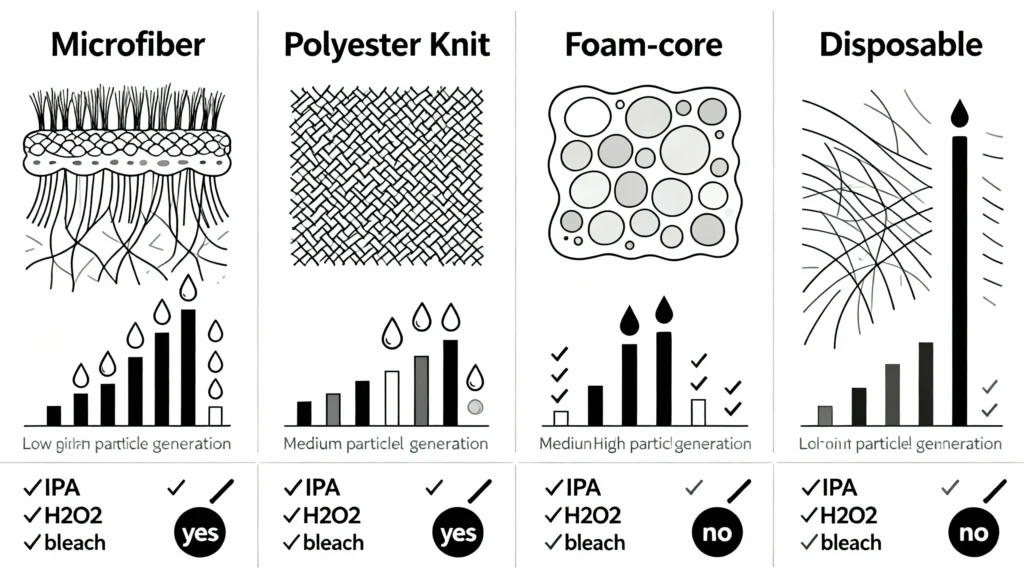
Figure 6: ISO 14644-1 cleanroom classification and corresponding mop requirements. Higher-grade environments (Class 5, Grade A/B) demand sterile mops with near-zero particle generation, while lower-grade support areas (Class 7-8, Grade C/D) can accept validated reusable systems. Particle count limits shown at ≥0.5 µm per cubic meter; these thresholds drive equipment qualification criteria and validation protocols.
How to Choose the Right Mop for Your Facility
Selecting cleanroom mops is a multi-variable decision that balances contamination risk, operational complexity, regulatory requirements, and cost structure. Use this framework to guide your specification process.
1. Define area classification and contamination riskStart with your cleanroom classification map. ISO Class 5 / EU GMP Grade A and B environments (aseptic cores, filling lines, lyophilization loading) demand the highest level of contamination control: sterile mops (autoclaved reusables or pre-sterilized disposables), materials validated to generate <10 particles ≥0.5 µm per stroke, and full traceability. ISO Class 6–7 / Grade C areas (aseptic processing support zones, gowning rooms, material prep) can often use reusable microfiber or polyester knit mops with validated laundering and disinfection protocols. ISO Class 8 / Grade D areas (final packaging, non-sterile compounding) may accept less stringent specifications, but mops must still demonstrate low linting and compatibility with facility disinfectants.
2. Map your disinfectant programList all cleaning and disinfection agents used in each area: IPA concentrations, quat formulations, bleach protocols, hydrogen peroxide schedules. Cross-reference with vendor chemical compatibility matrices. If your CCS includes aggressive oxidizers (bleach >0.5%, H₂O₂ >10%) or requires daily sporicidal treatment, prioritize polyester knit or foam-core mops with validated chemical resistance data. If you rotate disinfectants to prevent microbial resistance, confirm that your chosen mop material tolerates all agents in the rotation without cumulative degradation.
3. Evaluate reusable vs disposable economics and infrastructureFor Grade A/B areas, disposable mops eliminate sterilization complexity and cross-contamination risk, but cost 3–10× more per use. Calculate annual consumption (number of areas × cleaning frequency × mop heads per cleaning event) and compare total cost of ownership: reusable mops require laundering infrastructure, autoclave capacity, validation studies, and operator training, but offer lower per-use cost at scale. For multi-product facilities or clinical trial manufacturers where batch segregation is critical, disposables may justify the premium through risk reduction and simplified logistics.
4. Assess operational workflows and ergonomicsConsider operator experience. Gowned personnel working in Grade A environments (full sterile suits, positive-pressure hoods) need lightweight, balanced mop systems that minimize fatigue and reduce the risk of uncontrolled movements. Telescoping handles introduce crevices; fixed-length handles sealed at joints are preferred. If your facility uses pre-saturated mop systems or sterile pouches, confirm that packaging integrates smoothly with gowning and material transfer procedures (e.g., outer pouch removed in airlock, inner sterile pouch opened inside classified area).
5. Demand documentation and qualification dataRequest from vendors: particle generation test reports (per ISO 14644-14), chemical compatibility studies (exposure concentrations, number of cycles, visual and mechanical testing), autoclave validation data (cycles to failure, dimensional stability), sterility assurance documentation (for disposables: sterilization method, D-value data, sterility test results), material certifications (FDA Drug Master File numbers, EU Pharmacopeia compliance), and extractables/leachables testing (if mops contact product-contact surfaces or are used in isolators where residues could migrate). Reputable vendors provide this documentation as standard; if a vendor cannot supply it, look elsewhere.
6. Pilot and validate before full deploymentRun pilot studies in representative areas before committing to facility-wide adoption. Include: environmental monitoring (particle counts before, during, and after mopping; microbial surface sampling post-cleaning), operator feedback (ease of use, perceived effectiveness, ergonomics), visual inspection of mops after multiple use cycles (fiber integrity, edge condition, discoloration), and integration with existing workflows (compatibility with current buckets/handles, fit with gowning procedures, storage and disposal logistics). Document findings in your CCS and use pilot data to support vendor selection and regulatory justification.
Figur 7: Komplett parning av moppsystem efter renrumsklass. Aseptiska kärnor av klass A/B kräver sterila engångsartiklar med förmättade påsar och komponenter i rostfritt stål; Grad C stödzoner använder autoklaverbar mikrofiber med två-hinksystem; Förpackningsområden av grad D kan acceptera återanvändbara standardkonfigurationer med validerade desinfektionsprotokoll. Färgkodning över alla komponenter förhindrar korskontaminering mellan klassificerade och icke-klassificerade utrymmen.
MIDPOSI Renrumsmopplösningar
MIDPOSI är specialiserat på föroreningskontroll förbrukningsvaror för läkemedels-, bioteknik- och medicinteknisk tillverkning. Vår renrumsmoppportfölj är konstruerad för att möta de krävande kraven i ISO-klassade miljöer och GMP-drift, med fokus på validerad prestanda, regulatorisk dokumentation och tillförlitligt stöd för leveranskedjan.
Produktsortiment: MIDPOSI erbjuder mikrofiber, stickat 100 % polyester och mopphuvuden med skumkärna i både återanvändbara (autoklaverbara) och försteriliserade engångskonfigurationer. Våra återanvändbara moppar är validerade för 150+ autoklavcykler vid 121°C med bibehållen partikelgenereringsprestanda och dimensionsstabilitet. Engångsmopper är gamma-steriliserade och individuellt förpackade med lotspecifika sterilitetsintyg och utgångsdatum.
Validerad prestation: Alla MIDPOSI renrumsmopper genomgår partikelgenereringstest enligt ISO 14644-14, med testrapporter för varje produktlinje. Typiska partikelgenereringshastigheter är <50 partiklar ≥0,5 µm per slag för stickade moppar av mikrofiber och polyester, stödjer användning i miljöer i ISO klass 5–8. Kemisk kompatibilitet har validerats för 70 % IPA, 3–10 % väteperoxid, kvartära ammoniumföreningar (upp till 2 000 ppm) och natriumhypoklorit (upp till 1 %), med visuell, mekanisk och partikelgenereringstestning efter 100 simulerade användningscykler.
Kompletta systemlösningar: MIDPOSI provides integrated mop systems including autoclavable stainless-steel handles with sealed joints, color-coded mop frames (preventing cross-contamination between areas), and autoclavable or disposable bucket systems. Pre-saturated mop options (mop heads pre-wetted with 70% IPA, sealed in double-pouch sterile packaging) streamline workflows in Grade A/B environments and eliminate the need for on-site solution preparation.
Regulatory documentation: Every MIDPOSI product shipment includes certificates of conformance, material safety data sheets, particle generation test summaries, and (for disposables) sterility assurance documentation traceable to gamma irradiation dose records. Our quality management system is ISO 13485-certified, and select products are registered with FDA Drug Master Files to support customer regulatory filings.
Technical support and validation assistance: MIDPOSI’s technical team works with facility QA and engineering groups to support pilot studies, cleaning validation protocols, and regulatory justification documentation. We provide sample kits for in-house evaluation, on-site training for cleaning personnel, and customized product configurations (size, material, sterilization method) to meet specific facility needs.
For more information on MIDPOSI cleanroom mop solutions, request a product catalog and technical specification package through our website or contact your regional representative.