

The attachment mechanism connecting a cleanroom mop head to its frame is the invisible component that directly affects change-out speed, connection security, particle generation, and cross-contamination risk. This is the interface where textile meets structure — and where the consequences of a mismatch surface as detachment during use, inconsistent floor coverage, or particles released from mechanical friction. This guide compares the three primary attachment systems so procurement, facility, and QA teams can evaluate the attachment as a deliberate selection criterion rather than an afterthought.
A cleanroom mop head attachment mechanism is the physical interface that secures the textile cleaning surface to the rigid frame during use. When this connection is reliable, the operator can focus on the cleaning protocol. When it is unreliable — when the head shifts, slips, or detaches — the result is not an inconvenience; it is a contamination event that requires documentation, re-cleaning, and in regulated environments, a deviation investigation. Attachment selection is therefore not a convenience decision. It is a contamination-control decision.
In practice, the attachment mechanism determines three operational variables:
The attachment must withstand the push-pull forces, directional changes, and occasional snagging that occur during routine mopping. A head that detaches during a cleaning cycle introduces uncontrolled contact between the frame and the floor — a direct contamination vector — and requires the operator to stop, reattach, and potentially restart the cleaning sequence.
In multi-zone GMP facilities where mop heads are changed between Grade areas, the attachment mechanism directly determines how long each change takes and how much human contact with the dirty head surface is required. A 5-second change versus a 30-second change may seem trivial, but across 20 zone transitions per shift, the cumulative difference affects both operational efficiency and contamination risk.
Every attachment mechanism generates some degree of particle release during connection and disconnection. Mechanical friction between two surfaces — whether fabric sliding over a frame (pocket), hooks engaging loops (Velcro), or metal clips snapping into place (clip) — produces particulate that enters the cleanroom. The type and quantity of these particles differ by mechanism, and higher-grade cleanrooms have tighter tolerance for this source.
| Attachment Failure Mode | Typical Root Cause | Operational Consequence | Most Likely In |
|---|---|---|---|
| Head slips during mopping | Pocket too shallow or stretched; Velcro loop worn; clip not fully seated | Uneven floor coverage; operator stops to readjust; possible frame-to-floor contact | Pocket, Velcro |
| Head detaches completely | Undersized pocket for frame width; clip not engaged; hook-and-loop shear failure on direction change | Full contamination event; frame contacts floor; cleaning cycle restarted; deviation report required | Pocket (wrong size), Clip (user error) |
| Excessive fiber/particle release from attachment area | Hook-and-loop shedding; frame abrasion inside pocket; metal-on-metal clip friction with no lubrication | Particle counts exceed zone limits; cleaning tool itself becomes contamination source | Velcro, Clip (metal variants) |
| Attachment surface degradation | Wash/autoclave cycles exceeding tolerance of hook material or pocket stitching | Progressive loss of holding strength; attachment unreliable even when visually intact | Velcro (hook fatigue), Pocket (seam fatigue) |
| Cross-brand incompatibility | Frame width does not match pocket dimensions; clip receiver not standard across suppliers | Procurement locked into single supplier; cannot mix components without attachment verification | Pocket, Clip |
The key insight: The attachment mechanism is not an accessory feature. It is a structural interface that determines whether the entire mop system functions as a single controlled tool — or as two independent components that happen to be connected at the moment of use. For a foundational understanding of how head, frame, and handle interact as a system, see the cleanroom mop head frame handle integration guide. For the broader system context, see the renrumsmoppsystem översikt.
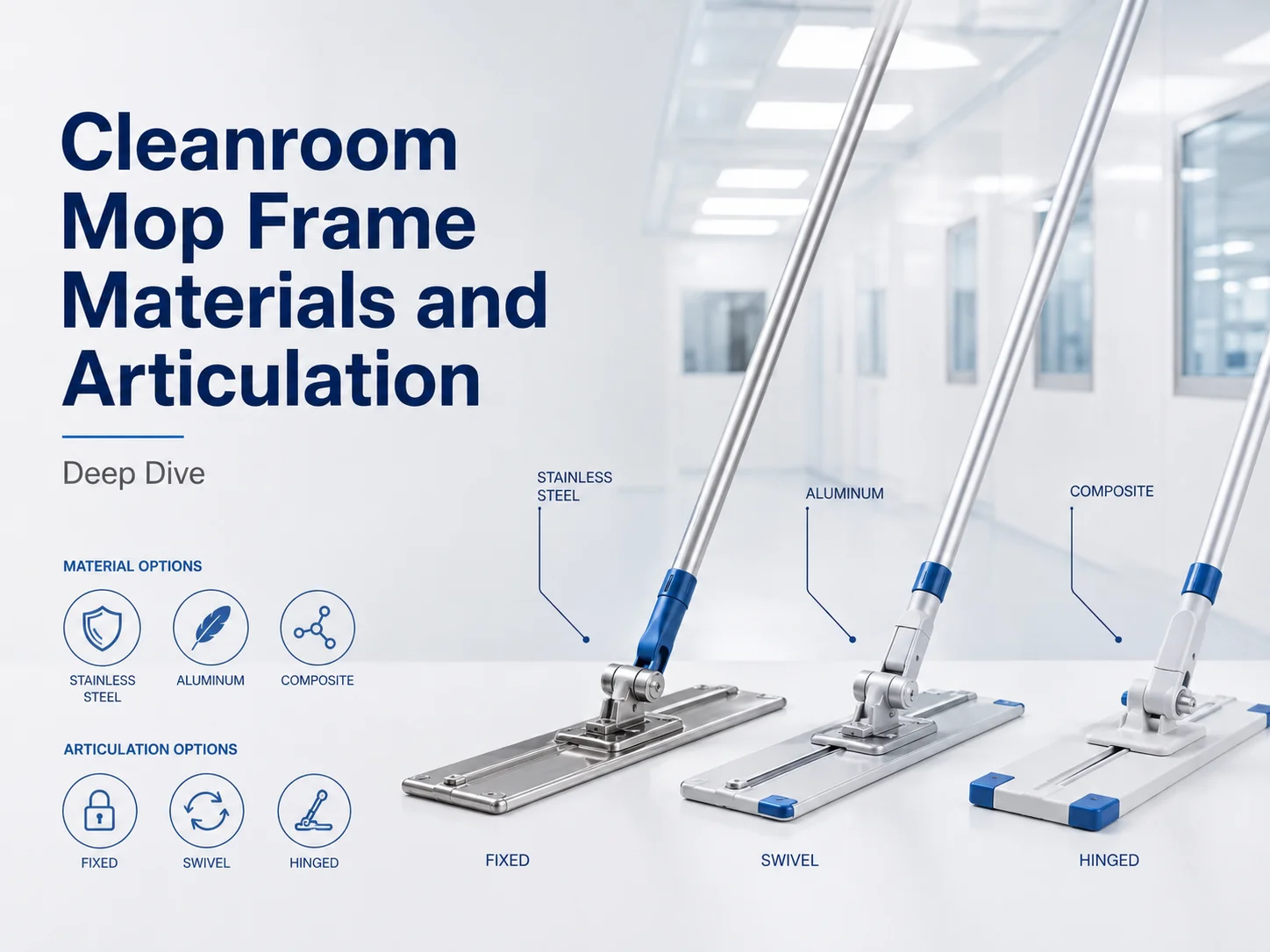
Pocket-style attachment is the most widely used cleanroom mop head attachment mechanism. It is the default configuration for the majority of flat mop systems in GMP pharmaceutical and medical device facilities, and it is the system most buyers encounter first when evaluating typer och urval av mopphuvuden för renrum.
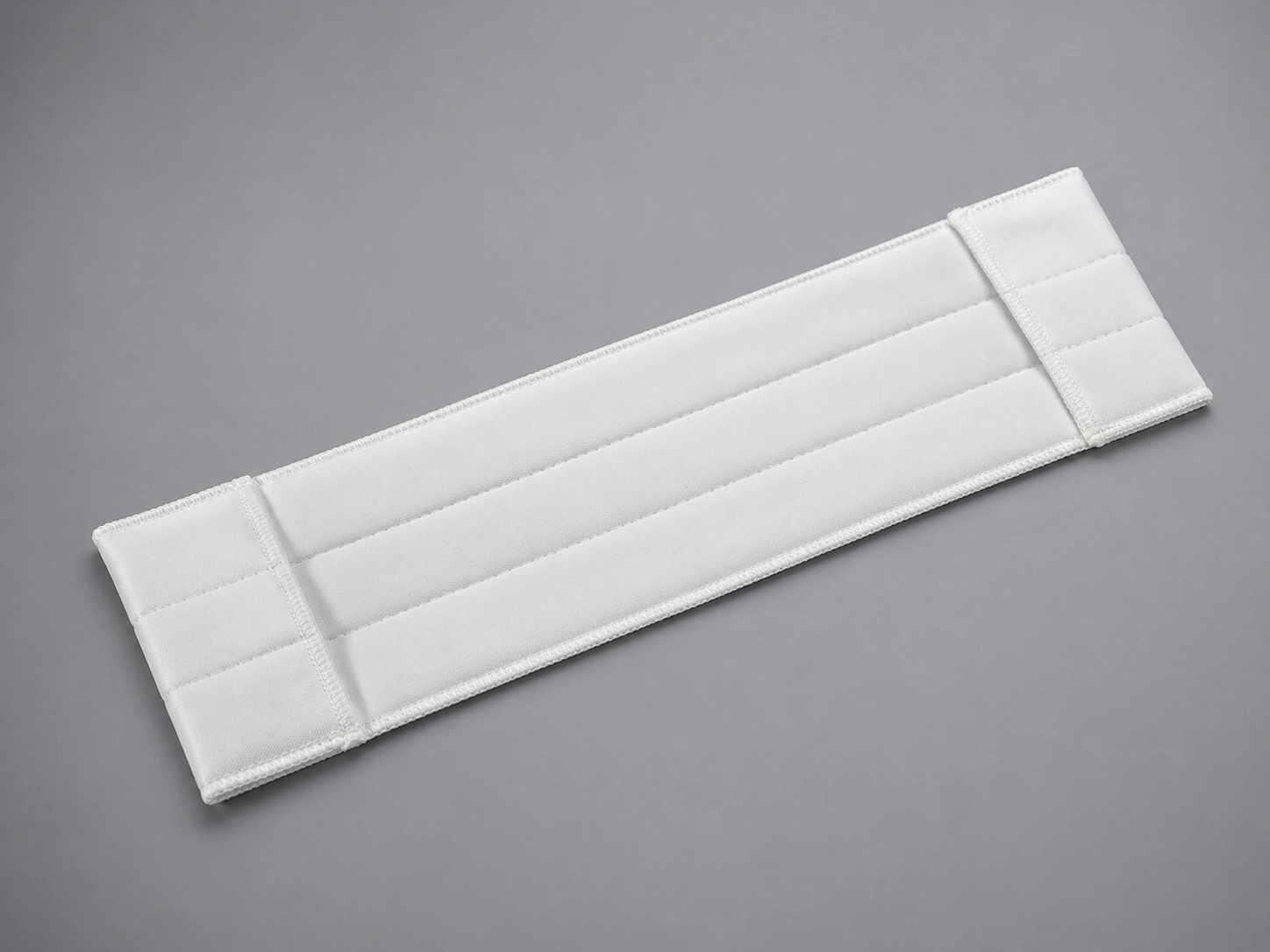
The mop head is a rectangular textile pad with an open-end pocket sewn into each short side. The rigid mop frame is inserted into both pockets — one side first, then the other — creating a friction-fit connection that holds the head flat against the underside of the frame. The holding force comes from the dimensional match between pocket width/depth and frame width, combined with the tension of the fabric as it wraps around the frame edge.
There are no mechanical fasteners. There is no adhesive. The connection is maintained purely by the geometry of the pocket and the tension of the textile under load.
Pocket attachment reliability depends on three dimensional variables that must be matched between the head and the typer av ramtyper för renrumsmopp:
| Dimensionera | Vad den kontrollerar | Consequence of Mismatch |
|---|---|---|
| Pocket Width | The opening span must correspond to the frame width. Pocket opening should be slightly wider than frame width for insertion clearance, but not so wide that the frame can shift laterally during use. | Too tight: operator struggles to insert frame; risk of tearing pocket seam during attachment. Too loose: lateral drift during mopping; uneven pressure distribution. |
| Pocket Depth | The depth of insertion determines how much of the frame is captured. A minimum insertion depth is required to prevent the frame from slipping out during directional changes. | Too shallow: frame end pulls out when operator reverses direction; the most common pocket failure mode, especially with frames that have rounded or tapered ends. |
| Pocket Seam Strength | The stitching at the inner pocket seam must withstand repeated insertion and removal cycles, plus the pull force transmitted through the frame during mopping. | Seam failure: pocket tears during use; head no longer securable to frame. Common after repeated autoclaving of heads not designed for that sterilization method. |
Velcro attachment — also referred to as hook-and-loop attachment — uses a field of small hooks on the frame surface that engage a field of loops on the back of the mop head. The head is pressed against the frame, and the hooks catch the loops, locking the head in place. Removal is achieved by peeling the head away from the frame, which disengages the hooks from the loops.
This mechanism is common in facilities where rapid mop head changes between zones are a high operational priority, and where the attachment-generated particle load has been evaluated and accepted within the relevant cleanroom grade limits.
The frame carries a strip (or multiple strips) of hook material — typically nylon or polyester hooks — bonded or mechanically fixed to the frame surface. The mop head carries a corresponding strip (or full-cover pad) of loop material on its back side. When the head is pressed against the frame, hundreds of individual hook-to-loop engagements distribute the holding force across the entire attachment surface. The holding mechanism is different from pocket attachment: the force is distributed across many small connection points rather than concentrated at two pocket seams.
The peel force required to remove the head — typically a deliberate, angled motion — is significantly higher than the shear force the attachment can resist during mopping, which is the desired characteristic: secure during use, removable with intentional action.
Every hook-and-loop engagement and disengagement cycle generates particulate. The hooks scrape across the loop surface during attachment, and the loops stretch and deform as they release during detachment. This mechanical abrasion produces:
The particle question for Velcro attachment is not whether particles are generated — they always are — but whether the quantity and type are acceptable for the target cleanroom grade. In Grade A/B (ISO 5) environments, the particle burden from repeated Velcro attachment cycles may exceed acceptable limits and must be evaluated through actual monitoring data, not supplier claims.
The performance life of a Velcro attachment system is limited by material fatigue in ways that pocket systems are not:
| Degradation Factor | Effect | Operational Signal |
|---|---|---|
| Hook fatigue | Hooks permanently deform after repeated engagement; they no longer “spring back” to catch loops effectively | Head peels off with noticeably less resistance; head shifts during mopping when it did not before |
| Loop compression | Loop fibers flatten and mat over time; fewer available loops for hooks to engage | Holding strength degrades even with a new frame; reusable heads lose grip after 50–100+ cycles (material-dependent) |
| Contamination of hook field | Debris, disinfectant residue, or fibers accumulate between hooks, reducing the effective number of engagement points | Attachment feels inconsistent; some areas grip while others slide; requires manual cleaning of hook strip |
| Sterilization impact | Autoclave temperatures can soften or warp hook material; gamma irradiation can embrittle polymer hooks | Post-sterilization attachment failure; holding strength reduced after processing cycle |
Clip or mechanical attachment systems use a positive-lock mechanism — typically spring-loaded metal or polymer clips, latches, or clamps — to physically secure the mop head to the frame. Unlike pocket systems (friction) or Velcro systems (distributed hook engagement), clip systems create a rigid mechanical connection at specific attachment points.
This mechanism is less common than pocket and Velcro in standard cleanroom mop applications, but it serves specific use cases where the consequences of detachment outweigh all other considerations — and where the facility is willing to accept higher component cost and more complex change-out procedures.
The frame incorporates clip receivers — fixed anchor points at defined positions — into which the head’s corresponding attachment points lock. The operator positions the head on the frame, aligns the attachment points with the receivers, and engages each clip individually. A properly engaged clip produces an audible or tactile confirmation (a click or snap) that the connection is locked. Disengagement requires a deliberate release action — pressing a tab, squeezing a release, or sliding a latch — which prevents accidental detachment during use.
Clip systems have the highest frame dependency of the three mechanisms. Pocket attachment requires only that the frame width matches pocket width. Velcro attachment requires only that the frame has a hook strip in the correct position. Clip attachment requires a frame specifically designed with clip receivers — and those receivers must match the head’s clip type, position, and engagement geometry. This is not a standard across suppliers. A head with Clip Type A will not attach to a frame with Receiver Type B, even if both are described as “clip attachment.”
This dependency has a procurement implication: clip-attachment heads and frames are typically sourced as a matched set from a single supplier. For more context on frame specifications across different attachment types, see the typer av ramtyper för renrumsmopp sida.
| Clip System Variable | Procurement Consideration |
|---|---|
| Clip material | Stainless steel clips: durable, autoclavable, heavier. Polymer clips: lighter, no corrosion risk, but may degrade under repeated autoclaving or gamma irradiation. |
| Number of attachment points | 2-point (one per end): simpler, faster change-out, but head can pivot if one clip releases. 4-point (two per end): more secure, better pressure distribution, but change-out takes longer. |
| Lock confirmation | Audible click: operator hears engagement, reducing the risk of false attachment. Visual indicator (exposed red mark when unlocked): provides post-attachment verification. Neither: operator must physically tug-test each clip. |
| Release mechanism | Thumb-release: faster but requires finger contact near the possibly contaminated head surface. Tool-release: clean but slower; requires a separate release tool or handle-mounted release lever. |
The following matrix evaluates the three attachment mechanisms across the five dimensions that matter most for cleanroom procurement and operations. Each dimension is rated on a three-tier scale based on the mechanism’s inherent characteristics — not on any specific supplier’s implementation.
| Dimensionera | Pocket-Style | Velcro / Hook-and-Loop | Clip / Mechanical |
|---|---|---|---|
| Connection Security | Relies on dimensional fit and fabric tension. Secure when head and frame are correctly matched; degrades when pocket stretches or frame width is marginally compatible. | Distributed grip across many points. Degrades gradually as hooks and loops fatigue. Holding force in wet conditions may differ from dry. | Positive mechanical lock. Connection secure until deliberately released. Sudden failure possible if clip mechanism breaks, but no gradual degradation during use. |
| Change-Out Speed | 15–25 seconds. Requires two hands, frame manipulation, and visual check. Head must be aligned and both pockets seated. | 3–8 seconds. Press to attach, peel to remove. Single-handed possible on handle-mounted frames. No alignment precision required. | 20–40 seconds. Each clip engaged individually. Alignment critical. Removal requires deliberate release action per clip. |
| Partikelgenerering | Minimal particle release during attachment. Fabric-to-frame friction is the primary source; well-controlled with proper frame finish and clean pocket interior. | Inherent particle generation from hook-loop engagement. Increases with cycle count as hook and loop materials degrade. Primary limitation for high-grade cleanrooms. | Metal clips: low particle risk at attachment points but metal-on-metal friction possible. Polymer clips: lower friction but material wear particles over time. |
| Cross-Brand Compatibility | Widest available compatibility but pocket dimensions vary by supplier. Head from Supplier A may not fit frame from Supplier B if pocket width/depth differ beyond tolerance. | Hook strip position, width, and material type differ across frames. Loop material density differs across heads. Cross-brand mixing is possible with verification but not guaranteed. | Effectively zero cross-brand compatibility. Clip geometry is proprietary. Heads and frames must be sourced as a matched set from the same supplier. |
| Total Cost of Use | Simplest construction = lowest per-unit head cost. No mechanical parts on frame to service. Highest head availability across suppliers. | Hook-and-loop construction adds cost to both head and frame. Scheduled frame replacement needed when hook field degrades — an additional operational cost. | Highest per-unit cost. Clip mechanism adds manufacturing complexity. Frame cost higher due to clip receiver integration. Supplier lock-in limits price competition. |
Reading the matrix: No attachment mechanism scores highest across all five dimensions. This is the nature of the trade-off: the mechanism that provides the fastest change-out (Velcro) generates the most particles. The mechanism that provides the most secure connection (Clip) has the slowest change-out and highest cost. The mechanism with the broadest compatibility and lowest cost (Pocket) provides moderate connection security and moderate change-out speed. The correct choice is never “which is best overall” — it is “which trade-off profile matches the cleaning zone grade, operational workflow, and risk tolerance of this specific facility.”
For a broader view of how component choices interact — including how attachment mechanism fits into the overall system selection logic — see the full system integration guide.
The attachment mechanism that works for a Grade D pharmaceutical packaging area is not necessarily the right choice for a Grade B aseptic filling suite. The selection must be driven by the intersection of cleanroom grade requirements, operator workflow, mop head usage model (disposable vs reusable), and audit expectations. The following table maps common facility profiles to their most suitable attachment mechanism.
| Facility Profile | Grade / ISO | Primary Priority | Recommended Mechanism | Logisk grund |
|---|---|---|---|---|
| Pharmaceutical aseptic filling | Grade A/B (ISO 5) | Minimize particle generation; connection security must be absolute | Pocket (preferred) or Clip (if validated) | Lowest particle release during attachment. Pocket system with correct dimensional match provides sufficient security for standard mopping forces in aseptic areas. Clip only if operational conditions require mechanical lock beyond what pocket provides. |
| Pharmaceutical secondary packaging / warehouse | Grade C/D (ISO 7–8) | Operational throughput; faster change-out between batches | Velcro or Pocket | Particle tolerance accommodates Velcro. If change-out speed between production batches is the bottleneck, Velcro provides measurable time savings. If speed is not the primary constraint, Pocket offers lower cost. |
| Biotech R&D / pilot plant | Grade B/C (ISO 5–7) | Flexibility; different mop heads for different process steps | Broadest head selection across suppliers. Operators can switch between head types (disposable, reusable, different materials) using the same frame. No attachment-specific head modifications required. | |
| Medical device cleanroom assembly | ISO 7–8 | Reliable attachment with moderate cost; standardized operator training | Lowest complexity to train, lowest procurement risk. Medical device facilities with structured cleaning programs benefit from attachment consistency — every operator uses the same mechanism, reducing training variance. | |
| Multi-shift GMP production (24/7) | Grade C/D (ISO 7–8) | Minimum change-out time per zone transition; operator efficiency across shifts | Velcro | Across three shifts, the 15–20 second saving per head change with Velcro versus Pocket accumulates to measurable operational time. Combined with disposable mop heads, this maximizes throughput without compromising cleaning consistency. |
| Sterile API manufacturing | Grade A/B (ISO 5) | Connection security above all else; detachment = batch contamination risk | Clip (validated) or Pocket (tight-tolerance) | Where the consequence of a single detachment event can trigger batch investigation, the positive-lock nature of a clip mechanism becomes worth the higher cost and slower change-out. Pocket with tight-tolerance head-to-frame matching is the alternative if clip system cost or complexity is not justified. |
| Cleanroom distributor / multi-client facility | Varies by client | Compatibility across multiple end-user requirements | Pocket (primary) + Velcro (option) | Distributors serving diverse clients should offer pocket as the baseline — highest cross-supplier compatibility — with Velcro as an option for clients with documented throughput requirements. |
The mop head usage model interacts with attachment mechanism selection in ways that are not always obvious. Disposable heads are used once and discarded — so pocket stretch, Velcro loop fatigue, and clip wear are not cumulative problems. Reusable heads, especially those subjected to repeated laundering or autoclaving, accumulate material degradation at the attachment interface over time. This means the attachment mechanism that works reliably with disposables may show progressive performance loss with reusables.
For a structured comparison of disposable and reusable strategies, see the beslutsguide för engångs- vs återanvändbar renrumsmopp. For handle options that support different attachment types in different zone configurations, see the val av renrumsmopphandtag sida.
The attachment mechanism not only determines how a head is secured to a frame — it also determines how the operator changes the head during cleaning operations. In GMP facilities where head-change procedures must be documented in SOPs and operator actions must be consistent and verifiable, the attachment mechanism has a procedural dimension that procurement should consider before standardizing on one type.
Typical duration: 15–25 seconds
Operator contact: Hands contact used head edges
Verification: Visual (seating check)
Risk point: Partial seating — frame end not fully inserted into pocket, creating risk of detachment during directional change. Most common when operator is under time pressure.
Typical duration: 3–8 seconds
Operator contact: Hands contact used head edges
Verification: Tactile (press resistance)
Risk point: Partial engagement — head attached at some points but not all; missed areas create uneven holding force. Head appears attached but can peel during use. More common when operator does not press across full attachment surface.
Typical duration: 20–40 seconds
Operator contact: Hands contact clip mechanisms
Verification: Audible/visual + manual check
Risk point: False lock — clip appears engaged but has not fully seated. Operator proceeds with cleaning; clip releases under load. Most dangerous on 4-clip systems where one unseated clip is harder to detect visually.
Attachment mechanism standardization has a direct effect on operator training burden and SOP consistency:
For GMP-compliant cleaning programs, the head change-out procedure is part of the documented cleaning protocol. Attachment mechanisms that rely on operator judgment (pocket seating depth, Velcro press pressure) are harder to proceduralize precisely than mechanisms with positive confirmation (clip lock). This is not an argument against pocket or Velcro — it is a documentation consideration that QA should weigh when selecting an attachment system for GMP environments where procedural precision is a compliance expectation.
For the facility-level GMP cleaning framework that determines which attachment mechanism is appropriate at each grade, see the GMP-guide för val av renrumsmoppe.
The attachment mechanism is rarely the headline item in a GMP audit. But when an auditor asks about cleaning tool control, the follow-up questions can reach the attachment system faster than most facilities expect. The attachment is one of the few physical interfaces in a cleaning tool that the operator interacts with directly during cleaning — and any variability in that interaction translates to variability in cleaning consistency, which is an audit-relevant concern.
A cleaning SOP that says “attach mop head to frame” without specifying the attachment mechanism, the correct procedure, and the post-attachment verification step is incomplete. The SOP should name the attachment type and describe the correct procedure — including the verification that the head is properly secured before mopping begins.
Reusable heads with Velcro attachment lose loop integrity over laundering cycles. Pocket seams stretch over repeated frame insertions. Clip springs fatigue. If the attachment mechanism degrades at a different rate than the head’s visible cleaning surface, operators may continue using heads that appear fine but have compromised attachment security. The replacement schedule should account for attachment-specific wear, not just visual head condition.
Frame-side attachment surfaces accumulate residue over time. Pocket interiors can trap particles shed from the frame. Velcro hook fields trap fibers and debris between hooks. Clip mechanisms have recesses that are difficult to clean and inspect. Each attachment type introduces specific cleaning and inspection requirements for the frame — and those requirements should be part of the frame maintenance procedure.
When an operator changes a mop head at the boundary between Grade B and Grade C, the change itself is a transient event that can introduce contamination if the protocol does not account for the attachment mechanism’s specific handling requirements. A pocket change-out that requires manipulating the frame near the used head surface differs in contamination risk from a Velcro peel-off that keeps the operator’s hands further from the soiled surface.
In GMP environments, suppliers should be able to provide attachment-specific performance information: the number of rated attachment cycles, material compatibility with specified disinfectants and sterilization methods, and particle release data under controlled conditions. General statements like “secure attachment” are insufficient for QA evaluation — request attachment-specific documentation as part of the supplier qualification process.
For a broader framework on how GMP cleaning expectations map to specific cleanroom grades and tool selections, see the GMP-guide för val av renrumsmoppe. For the foundational system overview, see the renrumsmoppsystem översikt.
Pocket-style attachment generates the fewest particles during normal operation. The attachment does not involve repeated mechanical abrasion of two surfaces — once the frame is seated in the pocket, the textile-to-metal contact is static during mopping. Velcro/hook-and-loop attachment generates more particles because each engagement cycle involves hook-to-loop abrasion, and the hooks continue to shed material over repeated cycles. Clip mechanisms fall between the two, with particle generation dependent on clip material (polymer clips produce fewer particles than metal-on-metal clip mechanisms) and the presence of any lubricant or coating at the contact point.
You can, but you must verify dimensional compatibility first — and not assume it. The two critical measurements are pocket opening width (must clear the frame width with a slight tolerance) and pocket depth (must capture enough of the frame end to prevent slip-out). Even if both products are described as “standard flat mop,” pocket dimensions are not standardized across the industry. Request the head’s pocket dimensions from the head supplier and compare against the frame width from the frame supplier. If either supplier cannot provide this information, assume incompatibility until verified by physical test.
There is no universal replacement interval — it depends on the hook material quality, the number of attachment cycles per shift, the disinfectant chemistry the frame is exposed to, and whether the frame is autoclaved. The practical indicator is a reduction in peel resistance. When an operator notices that head removal requires noticeably less force than when the frame was new, the hook field is degrading. QA-driven programs should establish a cycle-count threshold based on the supplier’s rated life, then validate through periodic peel-force testing. Visual inspection of hook tips is unreliable — hooks can appear intact while having lost their spring-back characteristic.
It depends on the facility’s particle monitoring data and risk assessment. Velcro attachment generates particles as a function of the attachment mechanism itself — this is an inherent characteristic, not a quality defect. Whether that particle load is acceptable in an ISO 5 environment depends on the frequency of head changes (more changes = more particles), the proximity of the attachment action to critical surfaces, and the facility’s particle count limits. Many ISO 5 facilities choose pocket attachment specifically to avoid introducing this variable. If Velcro is under consideration for Grade A/B, request particle generation data from the supplier and validate through in-situ monitoring before adoption.
Insufficient pocket depth for the frame end is the most common cause. When the frame is not fully inserted into the pocket — either because the pocket is too shallow or because the operator did not seat it completely — the frame end can slip out when the operator reverses the mopping direction. This is a dimensional compatibility problem first and an operator procedure problem second. It is best addressed at procurement: verify pocket depth against frame end length before standardizing on a head-frame combination, and set a minimum insertion depth specification that is checked during operator training.
Yes, typically. Clip-attachment heads carry a higher manufacturing cost because they integrate mechanical attachment components — clips, receivers, or reinforced attachment points — into a textile product. The frame cost is also higher because the frame must include matching clip receivers. The total system cost premium for clip attachment versus pocket attachment can be meaningful, particularly in high-volume disposable applications. However, the decision should be evaluated on total operational cost, not unit cost alone: if clip attachment prevents even one contamination-related batch investigation per year, the premium may be justified.
Some can, but this must be confirmed per product specification — it is not a universal capability. Autoclave temperatures can soften or deform the polymer hooks on the frame side and can affect the loop fiber structure on the head side. Gamma irradiation can embrittle polymer hooks, reducing their spring-back characteristic. If a reusable Velcro-attachment system is intended for autoclave or gamma sterilization, request the supplier’s sterilization compatibility documentation specifically for the attachment components — not just for the cleaning fabric.
Many multi-grade facilities standardize on pocket attachment across all zones for operational consistency — one SOP, one training program, one attachment mechanism that works from Grade D to Grade A/B. This simplifies procurement, training, and audit preparation. However, if a specific zone (typically Grade A/B) has attachment security requirements that exceed what pocket provides with the available head-frame combination, a clip mechanism may be introduced for that zone only. The key principle is: standardize unless a specific zone’s requirements demand a different mechanism, and document the rationale for the exception.
The attachment mechanism is one component in a five-part system — head, frame, handle, bucket, and attachment — that must be evaluated as a whole. Before committing to one attachment type, confirm that the heads, frames, and handles in your evaluation pipeline are compatible across all three interface points.
Designed for structured cleanroom cleaning programs across GMP and ISO-controlled facilities. Discuss your attachment requirements, zone grades, and component compatibility questions with MIDPOSI’s technical team.


 Optimized by Seraphinite Accelerator