Choosing cleanroom mops for ISO 5–8 environments isn’t about finding the “best” product—it’s about matching contamination-control requirements to operational reality. The wrong mop triggers environmental monitoring failures and audit findings; over-specifying wastes budget on features you don’t need. This guide evaluates five leading cleanroom mop systems using transparent criteria: particle generation performance, ISO classification validation, chemical compatibility, sterilization capability, and total cost of ownership. Whether you’re outfitting a pharmaceutical aseptic suite, medical device assembly area, or semiconductor fab, you’ll find objective data to build your vendor shortlist and defend your selection to stakeholders.
Why ISO Class Matters in Mop Selection
ISO 14644-1 defines cleanroom particle limits that your mop must not violate. An ISO Class 5 pharmaceutical filling line allows 3,520 particles ≥0.5 µm per cubic meter; Class 7 support areas permit 352,000; Class 8 packaging zones tolerate 3,520,000. A conventional janitorial mop sheds thousands of particles per stroke—acceptable in an office, catastrophic in a sterile processing suite.
The classification dictates three mop specifications:
Particle generation threshold: Your mop’s shedding rate must stay well below the room’s classification limit during actual use (wet mopping with disinfectants, mechanical abrasion, repeated sterilization cycles). Vendors should provide particle generation test data per ISO 14644-14; accept only mops with documented particle counts below your target class. For ISO Class 5 operations, demand near-zero shedding (<10 particles ≥0.5 µm per stroke under test conditions). Class 7 and 8 environments can accept slightly higher generation but still require qualified low-lint materials.
Sterilization requirement: EU GMP Annex 1 Grade A and B zones (roughly equivalent to ISO Class 5 at-rest) require sterile equipment. Your mop must be autoclavable (withstanding 121°C steam cycles without degradation) or supplied pre-sterilized as a validated single-use system. ISO Class 6–8 areas typically accept thoroughly disinfected reusable mops but verify your facility’s contamination control strategy.
Material compatibility with disinfectants: Higher-grade environments use aggressive sporicidal agents (hydrogen peroxide, sodium hypochlorite) and frequent disinfectant rotation. The mop material must survive these chemistries across its qualified use life (50–200 cycles for reusables) without fiber damage, dimensional change, or increased particle shedding. Lower-grade areas may use gentler quaternary ammonium compounds, widening material options.
Mismatching mop specification to ISO class triggers three failure modes: environmental monitoring excursions (particle counts exceed limits), regulatory findings during audits (equipment not validated for intended use), and wasted budget (buying Grade A sterile mops for Grade D packaging areas or deploying inadequate mops in aseptic cores). For foundational contamination control principles, start with understanding what qualifies a mop for cleanroom use.

Figure 1: ISO cleanroom classification pyramid showing mop requirements by grade. Class 5 environments demand near-zero particle generation (<10 particles ≥0.5 µm per stroke) and validated sterility assurance, while Class 8 support areas accept slightly higher generation from qualified low-lint materials. Particle count limits drive equipment qualification criteria and sterilization method selection.
Ranking Criteria for Cleanroom Mops
This guide scores each mop system across five weighted criteria. Scores reflect documented specifications from vendor literature and distributor listings (late 2024/early 2025); pricing is directional from published web stores. Your procurement decision should layer these rankings against facility-specific variables (existing autoclave capacity, laundry infrastructure, QA validation workload, annual volume).
1. Particle generation & ISO validation (30% weight): Low-lint construction (sealed edges, continuous-filament fibers) and documented particle generation test data per ISO 14644-14. Products explicitly validated for ISO Class 5–7 score highest; those without published test data or generic “cleanroom” claims score lowest. This criterion directly impacts environmental monitoring compliance.
2. Sterilization capability & compliance (25% weight): Autoclavable reusables (validated cycle life >100) and pre-sterilized disposables (gamma/EO, SAL 10⁻⁶ documentation) score highest. Mops requiring only chemical disinfection score lower. Sterilization capability determines whether the mop can enter Grade A/B zones or remains limited to Grade C/D support areas.
3. Chemical compatibility & durability (20% weight): Resistance to pharmaceutical disinfectants (70% IPA, hydrogen peroxide, bleach, quats) without fiber degradation, color fading, or dimensional change across the qualified use life. Polyester knit and certain foam cores with validated chemical resistance score highest; microfiber with limited bleach tolerance scores mid-range.
4. Total cost of ownership (15% weight): Per-use cost over 12 months, factoring kit price, replacement head costs, and cycle life. Reusable mops with 150+ cycle life and low per-unit head costs score highest; expensive disposables used daily score lowest. TCO matters most for high-volume facilities (multiple daily cleaning cycles, large floor areas).
5. System completeness & supplier reliability (10% weight): Availability of validated accessories (autoclavable handles, frames, buckets), documentation quality (certificates of conformance, sterility assurance, particle generation reports), and distributor network breadth. Systems with comprehensive ecosystems score highest; standalone mop heads requiring separate frame sourcing score lower.
Selection Checklist: Before comparing products, answer these five questions to weight criteria for your facility: (1) What is your most restrictive ISO class? (2) Do you have validated autoclave capacity or prefer disposables? (3) What disinfectants does your contamination control strategy require? (4) What is your annual mopping volume (shifts/day × areas × 365)? (5) Does your QA team have bandwidth for reusable mop validation or prefer turnkey sterile consumables?
Top 5 Cleanroom Mop Options (2025 Edition)
1. Contec VertiKlean MAX Mop Wipe System — Best for Regulated Pharma & Biologics
Material: Foam-core with microfiber laminate, laser-cut sealed edgesISO suitability: Class 5–7 (validated for Grade B/C environments)Sterilization: Autoclavable frame; mop heads available sterile (gamma, EO, or autoclave; SAL 10⁻⁶)Kit price: Frame ~$86–$114; sterile mop heads ~$312/case (medium, ribbed microfiber)Cycle life: Sterile disposables (single-use); reusable heads validated for 50+ autoclave cycles
Why it leads: Contec’s VertiKlean MAX combines validated sterility assurance (critical for FDA/EMA audits) with a comprehensive accessory ecosystem—QuickConnect frames, multiple mop head sizes (small/medium/large), sealed-edge and ribbed microfiber variants. The foam core distributes disinfectant evenly, reducing streaking and ensuring consistent sporicidal contact on isolator interiors and aseptic processing surfaces. Contec explicitly markets to Life Sciences and provides the documentation density (certificates of conformance, particle generation test summaries, sterility lot traceability) that closes out regulatory observations.
Strengths: Sterile documentation meets Annex 1 Grade A/B requirements; broad distributor network (easy to source in North America, Europe, Asia); validated across gamma, EO, and autoclave sterilization methods; comprehensive frame and handle options with autoclavable stainless steel or polymer choices.
Limitations: Higher per-use cost than reusable polyester alternatives (~$10–$15 per sterile head vs. $2–4 per laundered cycle for reusables); foam core may degrade faster than knit materials under aggressive bleach protocols (>1% sodium hypochlorite); requires inventory management for sterile expiration dates.
Best for: Multi-product pharmaceutical manufacturers, biologics facilities, clinical trial sites requiring batch-to-batch segregation, and any operation where sterility assurance documentation is non-negotiable. If your QA team spends more time closing audit observations than validating laundry cycles, Contec’s turnkey sterile consumables justify the premium.
2. Texwipe AlphaMop Kit (TX7108) — Best for Cost-Effective ISO 3–7 Compliance
Material: Polyester pad with thermoplastic head, fiberglass handleISO suitability: Class 3–7 (vendor-stated; suitable for Grade C/D and cleanroom support areas)Sterilization: Autoclavable components; covers available pre-wetted or dryKit price: $102–$150 (varies by distributor; includes 15”×8” head, 60” handle, polyester pad, fastening pins)Cycle life: Polyester pads withstand 100+ launder/autoclave cycles
Why it’s competitive: Texwipe delivers ISO Class 3–7 validation at a mid-market price point with wide distributor availability. The large-format head (15”×8”) covers more area per stroke than compact mop systems, improving productivity in gowning rooms, airlocks, and material staging areas. AlphaMop’s fiberglass handle resists chemical attack and survives repeated disinfectant exposure without corrosion or particle shedding. Texwipe’s established reputation (decades in cleanroom consumables) provides supply-chain confidence; replacement covers and accessories are readily stocked by major distributors.
Strengths: Strong cost-performance ratio; large head improves coverage efficiency (fewer passes = less operator fatigue and reduced particle generation from activity); fiberglass handle durability; broad distributor network makes sourcing and emergency reordering straightforward; optional pre-wetted AlphaSat covers available for facilities preferring no on-site solution preparation.
Limitations: Polyester pads show reduced performance after sustained exposure to high-concentration bleach (>0.5%); thermoplastic head may be less chemically resistant than all-stainless or sealed-edge microfiber designs; not supplied pre-sterilized (requires in-house autoclave validation for Grade A/B use).
Best for: High-volume ISO Class 6–8 operations (medical device assembly, pharmaceutical packaging, electronics cleanrooms) where reusable systems and validated autoclave capacity already exist. Ideal for procurement teams balancing compliance with budget constraints, and facilities needing large-format mops for expansive floor areas or wall/ceiling cleaning.
3. Berkshire BCR Double-Sided Flat Mop + BCR Mop 4 Laundered Heads — Best for High-Coverage Efficiency
Material: 100% knitted polyester (BCR Mop 4), looped/fantail edge design, laundered and packaged in ISO Class 4 cleanroomISO suitability: Class 3–8 (hardware); BCR Mop 4 heads listed as ISO Class 4 compliantSterilization: Autoclavable hardware and mop heads; validated for repeated 121°C cyclesKit price: Double-sided mop head hardware ~$148; laundered BCR Mop 4 heads priced per pack (varies by size/distributor)Cycle life: 150+ autoclave cycles for polyester knit heads; double-sided design doubles surface coverage per head change
Why it’s competitive: Berkshire’s double-sided mop head design is a productivity multiplier. When one side becomes soiled, flip the head and continue mopping—no mid-task head changes, no waste of partially used mops. The BCR Mop 4 heads are laundered and packaged in an ISO Class 4 environment, reducing incoming particle contamination risk compared to mops packaged in conventional facilities. Knitted polyester with looped/fantail edges minimizes fiber pull-out and particle generation; the material tolerates aggressive disinfectants (including moderate bleach concentrations) better than standard microfiber.
Strengths: Double-sided design cuts mop head consumption in half and reduces operator downtime for head swaps; ISO Class 4 laundering/packaging provides particle control confidence; excellent chemical resistance for rotating disinfectant protocols; 150+ cycle life delivers strong total cost of ownership; autoclavable for full GMP compliance.
Limitations: Higher upfront hardware cost (~$148 vs. $86–$102 for single-sided frames); sourcing laundered BCR Mop 4 heads may require direct Berkshire relationship or specialized distributors (less ubiquitous than Texwipe or Contec); heavier hardware may increase operator fatigue during extended mopping tasks.
Best for: Facilities with validated laundry or in-house autoclave capacity, large-floor-area cleanrooms (where high coverage efficiency matters), and operations with aggressive disinfectant rotation (hydrogen peroxide, moderate bleach) requiring durable polyester knit. Ideal for pharmaceutical contract manufacturers and medical device facilities balancing compliance with per-use cost control.
4. Perfex TruCLEAN Sponge Mop (CLP) — Best for Frequent Change-Out & Budget-Conscious ISO 6–8
Material: Polyurethane foam sponge, laundered and packaged in ISO Class 5 cleanroomISO suitability: Class 5–8 (packaging environment indicates suitability; no explicit ISO validation claims found)Sterilization: Compatible with gamma, EO, and autoclave (250°F/121°C for 30 min)Unit price: ~$12–$15 per mop (among the lowest per-unit costs in the category)Cycle life: Shorter than polyester knit (typically 20–50 autoclave cycles before foam degradation)
Why it’s competitive: Perfex’s TruCLEAN offers the lowest per-unit entry cost in this comparison, making it attractive for frequent change-out SOPs, pilot studies, or facilities with limited autoclave capacity preferring disposable-like workflows at reusable-like pricing. The polyurethane foam is absorbent and compatible with multi-modal sterilization (gamma, EO, autoclave), providing flexibility for different facility infrastructures. Laundered and packaged in ISO Class 5, the mops arrive with reduced particle burden compared to conventionally packaged products.
Strengths: Lowest upfront cost enables frequent replacement without budget strain; multi-modal sterilization compatibility (gamma/EO/autoclave) suits diverse facility setups; absorbent foam distributes disinfectant evenly; ISO Class 5 packaging reduces incoming contamination risk; simple design lowers operator training requirements.
Limitations: Foam material shows shorter cycle life than polyester knit (20–50 cycles vs. 100–200); may degrade faster under aggressive oxidizers (high-concentration peroxide, bleach); less chemical resistance documentation compared to Contec or Berkshire; sponge structure can harbor residues if not thoroughly rinsed; no pre-sterilized option (requires in-house sterilization for Grade A/B).
Best for: ISO Class 6–8 support areas (gowning rooms, material airlocks, packaging zones) with moderate disinfectant protocols (IPA, quats); facilities implementing daily or per-shift mop change-out SOPs where per-use cost is the primary driver; small-batch or clinical-trial manufacturers where simplified inventory (low-cost, frequent replacement) reduces validation complexity; budget-conscious startups outfitting initial cleanroom operations.
5. Micronova MicroMop (NovaPoly/PolyGen) — Best for High Fluid Loading & Fast Drying
Material: 100% polyester herringbone (PolyGen) or smooth knit polyester (NovaPoly); flat-strand string mop configurationISO suitability: Vendor positions for microelectronics/semiconductor, medical device, and pharma (no explicit ISO class validation published)Sterilization: Autoclavable; validated for repeated 121°C cyclesPrice: Mid-range (specific pricing varies by distributor and head size; typically $8–$15 per head)Cycle life: 100+ autoclave cycles for polyester variants
Why it’s competitive: Micronova’s string-style MicroMop excels in applications requiring high absorbency (large disinfectant volumes, flooded-floor mopping) and fast drying between uses. The flat-strand configuration provides more surface contact than tubular-knit or foam designs, improving particle capture and fluid pickup. PolyGen’s herringbone weave and NovaPoly’s smooth knit both offer excellent chemical compatibility with strong disinfectants, making these mops suitable for facilities rotating hydrogen peroxide, bleach, and phenolic protocols. Micronova’s cross-industry positioning (electronics, medical device, pharma) reflects versatile contamination-control performance.
Strengths: High absorbency (6–8× dry weight) handles large-area mopping or heavy disinfectant application; fast drying reduces microbial growth risk during storage; strong chemical resistance for aggressive disinfectant rotation; autoclavable for GMP compliance; string design conforms to irregular floor surfaces and equipment bases.
Limitations: String mops require more careful laundering to prevent tangling and fiber damage; less documentation (particle generation test data, sterility assurance) compared to Contec or Texwipe; string configuration may be less intuitive for operators trained on flat-head systems; no pre-sterilized option.
Best for: Facilities with high fluid-loading requirements (large floor areas, heavy disinfectant application, flooded mopping protocols); electronics cleanrooms and semiconductor fabs where fast drying minimizes downtime; medical device and pharmaceutical operations with strong chemical disinfection protocols requiring durable polyester; facilities with validated laundry infrastructure and autoclave capacity. For detailed material comparisons, explore how microfiber, polyester knit, and foam-core constructions differ in contamination control performance.
Comparison Table: Material / ISO Rating / Cost
| Product | Material Type | ISO Class | Sterilization | Kit/Unit Price | Cycle Life | Best Use Case |
| Contec VertiKlean MAX | Foam + microfiber, sealed edges | 5–7 | Gamma/EO/autoclave (SAL 10⁻⁶) | $86–$114 frame + $312/case heads | 50+ (reusable) / Single-use (sterile) | Regulated pharma, biologics, Grade A/B zones requiring sterility documentation |
| Texwipe AlphaMop TX7108 | Polyester pad, thermoplastic head | 3–7 | Autoclavable | $102–$150 kit | 100+ cycles | High-volume ISO 6–8, cost-effective compliance, large floor areas |
| Berkshire BCR + Mop 4 | Knitted polyester, looped edges, ISO 4 packaged | 3–8 | Autoclavable | $148 hardware + heads per pack | 150+ cycles | High-coverage efficiency, aggressive disinfectant rotation, large facilities |
| Perfex TruCLEAN CLP | Polyurethane foam sponge, ISO 5 packaged | 5–8 | Gamma/EO/autoclave | $12–$15 per unit | 20–50 cycles | Budget-conscious ISO 6–8, frequent change-out SOPs, startups |
| Micronova MicroMop | Polyester herringbone/knit, string style | Not specified | Autoclavable | $8–$15 per head | 100+ cycles | High fluid loading, fast drying, electronics/semiconductor, large-area mopping |
How to use this table: Match your ISO class to the validated range (column 3); confirm sterilization method aligns with your facility infrastructure (column 4); calculate 12-month TCO using kit price, cycle life, and annual volume (columns 5–6); verify material type suits your disinfectant protocol (column 2). For facilities operating across multiple ISO classes, consider tiered procurement: sterile disposables (Contec) for Grade A/B cores, reusable polyester (Berkshire, Texwipe) for Grade C/D support areas, and budget options (Perfex) for non-critical zones.
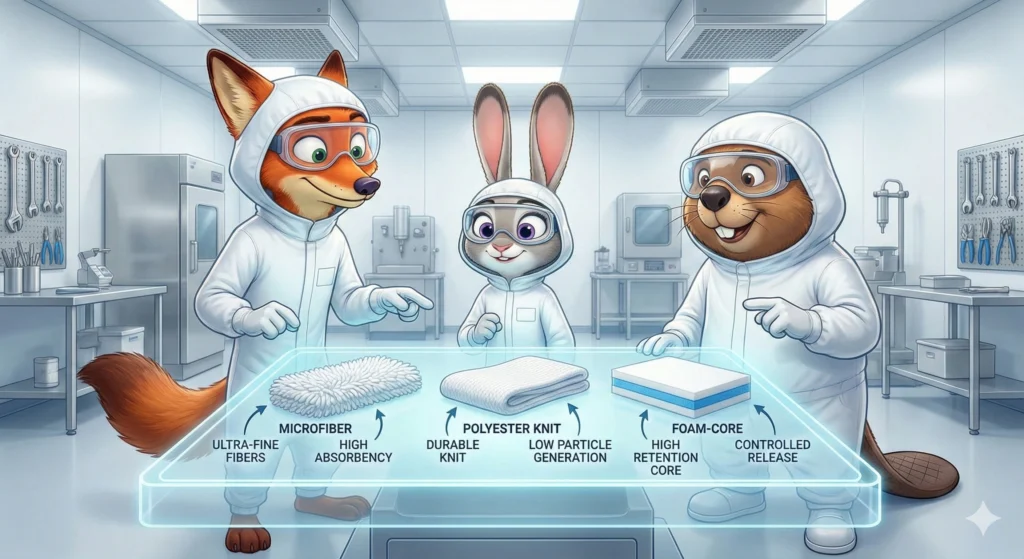
Figure 2: Side-by-side comparison of the five featured cleanroom mop systems. From left: Contec VertiKlean MAX (foam + microfiber, sterile), Texwipe AlphaMop (polyester pad, large format), Berkshire BCR (double-sided polyester knit), Perfex TruCLEAN (foam sponge, budget), and Micronova MicroMop (string-style polyester). Each product addresses different procurement priorities—regulatory compliance, cost efficiency, coverage productivity, or chemical durability.
Best Mop for Pharma / Medical Device / Electronics
Pharmaceutical Manufacturing: Contec VertiKlean MAX and Berkshire BCR + Mop 4 lead for pharma. Contec wins in aseptic processing areas (Grade A/B fill lines, isolators, lyophilization loading) where pre-sterilized, validated consumables close audit observations faster than in-house reusable validation. Berkshire’s double-sided polyester knit excels in Grade C/D support zones (gowning, airlocks, material staging) where high-volume mopping, aggressive disinfectant rotation, and strong TCO matter. Perfex TruCLEAN serves as a budget backup for non-critical packaging areas. Recommendation: For multi-area facilities, deploy Contec in aseptic cores and Berkshire in support zones to balance compliance rigor with cost control.
Medical Device Manufacturing: Texwipe AlphaMop and Berkshire BCR dominate medical device cleanrooms. Texwipe’s large-format head (15”×8”) and wide distributor network suit high-throughput device assembly operations (Class 6–8 ISO environments) where reusable systems, productivity, and straightforward sourcing are priorities. Berkshire’s double-sided design and ISO Class 4-packaged heads reduce particle risk in Class 100/10,000 legacy environments transitioning to ISO standards. Both handle moderate disinfectant protocols (IPA, quats, low-concentration peroxide) without degradation. Recommendation: Texwipe for established facilities with validated autoclave capacity; Berkshire for operations emphasizing particle control and coverage efficiency.
Electronics & Semiconductor: Micronova MicroMop and Texwipe AlphaMop fit electronics cleanrooms. Micronova’s high absorbency and fast-drying polyester suit semiconductor fabs and electronics assembly areas where large disinfectant volumes, rapid turnaround between shifts, and chemical compatibility (solvents, oxidizers) are critical. The string design conforms to equipment bases and cable trays common in electronics environments. Texwipe provides a flat-head alternative for facilities preferring conventional mop formats. Both are autoclavable and durable across 100+ cycles. Recommendation: Micronova for high-throughput fabs with heavy fluid-loading requirements; Texwipe for smaller electronics cleanrooms prioritizing cost-performance balance.

Disposable vs Reusable
The disposable-versus-reusable decision hinges on four variables: ISO class requirements, validation infrastructure, annual volume, and risk tolerance.
When disposables win: Choose pre-sterilized single-use mops (Contec VertiKlean MAX sterile heads) for Grade A/B aseptic cores, facilities without validated autoclave capacity or cleanroom laundry, clinical trial manufacturers requiring batch-to-batch segregation, and operations where sterility assurance documentation (SAL 10⁻⁶, gamma dose records) closes regulatory observations faster than in-house validation. Disposables eliminate cross-contamination risk, laundry validation complexity, and operator training for reprocessing. Trade-off: 3–10× higher per-use cost.
When reusables win: Choose autoclavable polyester knit or microfiber (Berkshire BCR, Texwipe AlphaMop, Micronova MicroMop) for Grade C/D support areas, facilities with existing validated autoclave/laundry infrastructure, high-volume operations (multiple daily cleaning cycles where per-use cost compounds rapidly), and organizations prioritizing sustainability (reduced waste generation). Reusables deliver strong TCO at scale—a $150 kit lasting 100 cycles costs $1.50/use; a $15 disposable costs $15/use. Trade-off: validation workload (autoclave cycle qualification, periodic requalification, operator SOPs).
Hybrid approach: Most multi-area pharmaceutical and medical device facilities deploy both. Use sterile disposables in the highest-risk aseptic cores (filling lines, isolators) and reusable systems in lower-grade support zones (gowning rooms, airlocks, packaging). This balances compliance rigor with cost efficiency. Track per-area mop consumption and TCO quarterly; adjust the disposable/reusable split as production volume or product mix changes.
Bucket System Compatibility

Figure 3: Decision tree for disposable versus reusable cleanroom mop selection. ISO class requirements drive the initial branch—Class 5-6 operations typically require sterile disposables for compliance certainty, while Class 7-8 facilities can leverage reusable systems if validated autoclave capacity exists. Annual volume and TCO modeling refine the final decision, with hybrid approaches common in multi-area facilities.
Mops don’t work in isolation. The complete cleanroom mop system—mop head, handle, frame, bucket, and wringer—must be designed and validated as an integrated contamination-control assembly.
Frame and handle requirements: All five featured mops require compatible frames. Contec VertiKlean uses QuickConnect frames (autoclavable stainless steel or polymer); Texwipe AlphaMop includes a fiberglass handle in the kit; Berkshire BCR hardware is sold as a complete double-sided assembly; Perfex and Micronova mops require separate frame purchases. Verify frame material (stainless steel, electropolished aluminum, autoclavable polymer) matches your sterilization method and disinfectant exposure. Fixed-length handles with sealed joints reduce crevice contamination compared to telescoping designs.
Bucket and wringer systems: For Grade A/B environments, use autoclavable stainless-steel buckets or pre-saturated mop pouches (Contec offers pre-wetted sterile options). For Grade C/D areas, two-bucket systems (one clean solution, one waste) prevent cross-contamination. Bucket material must resist chemical attack from your disinfectant rotation (70% IPA, peroxide, bleach). Some facilities eliminate buckets entirely by deploying pre-saturated disposable mops sealed in sterile pouches—this approach reduces equipment validation burden but increases per-use cost.
Color coding: Implement color-coded systems (blue for production, red for waste zones, green for gowning) across mop heads, handles, frames, and buckets to prevent cross-contamination between classified and non-classified areas. Most vendors offer color-coded accessories; specify during procurement and document in SOPs.

Best Value for Procurement Teams
For budget-constrained startups or pilot facilities: Perfex TruCLEAN ($12–$15/unit) provides ISO 5–8 compliance at the lowest entry cost. Use for initial facility setup, validation studies, or low-volume operations where TCO modeling favors frequent replacement over reusable validation workload.
For high-volume manufacturers optimizing TCO: Berkshire BCR + Mop 4 ($148 hardware + per-pack heads, 150+ cycles) and Texwipe AlphaMop ($102–$150 kit, 100+ cycles) deliver the strongest per-use economics at scale. A facility mopping 10 areas twice daily (7,300 cycles/year) saves $50,000+ annually with reusables versus disposables.
For regulated pharma minimizing audit risk: Contec VertiKlean MAX ($312/case sterile heads) trades higher per-use cost for turnkey compliance. When QA labor (validation protocols, investigation time, regulatory response) costs $10,000+ per audit observation, Contec’s documentation density ($15/head premium) becomes negligible compared to risk mitigation value.
Procurement checklist: Request from all vendors: (1) Particle generation test reports (ISO 14644-14), (2) Chemical compatibility matrices with your facility’s disinfectant list, (3) Autoclave validation data (cycles to failure, dimensional stability), (4) Sterility assurance documentation (for disposables), (5) Certificates of conformance and material safety data sheets. Evaluate 12-month TCO using actual facility consumption data, not vendor-provided “typical use” assumptions. Run pilot studies in 2–3 representative areas before facility-wide deployment.

MIDPOSI Cleanroom Mop Solutions (GMP-Ready & ISO Validated)
MIDPOSI supplies a full range of ISO-qualified cleanroom mop systems engineered for pharmaceutical, biotechnology, and medical device facilities. Our microfiber, polyester knit, and foam-core mop heads are manufactured in controlled environments and validated for low particle generation, chemical compatibility, and ISO Class 5–8 suitability.
For regulated operations, MIDPOSI offers:
- ISO 14644-14 particle generation test data
- Autoclavable reusable mop heads (150+ cycles)
- Gamma-sterilized disposable mop heads (SAL 10⁻⁶)
- Stainless-steel and autoclavable polymer handles and frames
- Two-bucket and color-coded systems aligned with Annex 1 CCS requirements
Every shipment includes certificates of conformance, material safety documentation, and traceable lot information to support GMP audits and cleaning validation programs.
To request a technical data package or evaluation samples, contact MIDPOSI’s cleanroom engineering team.