Cleanroom wall and ceiling cleaning requires different tools, techniques, and sequences than floor cleaning. Using floor mops on walls creates cross-contamination risk — gravity pulls ceiling and wall particles down onto work surfaces and product-contact zones. The correct approach uses lightweight 40g mop heads Açık articulated frames with telescoping handles, following a top-down sequence (ceiling to walls to floors) with designated wall/ceiling tools segregated from floor tools. Overhead cleaning with standard 65g floor mops causes operator fatigue, incomplete coverage, and dripping contamination risks — all of which threaten GMP compliance and audit readiness.
In any cleanroom, the most overlooked contamination vector is not the floor — it is the ceiling and walls above work surfaces. Particles that settle on overhead and vertical surfaces fall downward under gravity. If ceiling panels and wall surfaces above filling lines, laminar flow hoods, or open product zones are not cleaned regularly, they become reservoirs of particulate contamination that cascade onto critical surfaces.
This is not theoretical. In GMP pharmaceutical facilities, environmental monitoring data frequently identifies ceiling-mounted HEPA filter housings, light fixtures, and ceiling panel joints as particle accumulation zones. When personnel movement or HVAC cycling dislodges these particles, they can enter the product stream. Wall surfaces at operator height also accumulate aerosolized residues from spraying and filling operations — residues that a floor mop cannot reach and should not be expected to address.
The most common operational shortcut — and one of the most common audit findings — is using the same mop tool for floors and walls. A floor mop head, even after rinsing, carries microbial and particulate residues from the highest-risk surface in any cleanroom: the floor. When that same mop head is raised to wall height or ceiling height, it transfers floor-level contamination upward.
In a structured temiz oda paspas sistemi, wall and ceiling cleaning requires designated tool sets — separate mop heads, separate frames, and ideally separate handles — color-coded or clearly labeled to prevent cross-use. A dedicated wall cleaning mop is not an optional upgrade; it is a contamination control requirement.
Floor cleaning frequencies in cleanrooms are well-established — often per shift, per batch, or daily depending on grade. Wall and ceiling cleaning frequencies are lower, but this lower frequency creates a different risk: when walls and ceilings are cleaned infrequently, the accumulated particle load is higher, and the cleaning event itself becomes a more significant contamination risk if not managed correctly.
Wall and ceiling cleaning in GMP environments is typically event-driven: scheduled at longer intervals (weekly, monthly, or between campaigns), but with higher thoroughness expectations per event. The cleaning tools must be capable of covering large surface areas efficiently while minimizing the time operators spend in overhead positions.
The top-down cleaning sequence — ceiling first, walls second, floors last — is not a preference. It is a contamination control principle. Any particles dislodged during ceiling cleaning fall onto walls. Any particles from wall cleaning fall onto floors. The floor is cleaned last because it is the final collection point for all dislodged contamination.
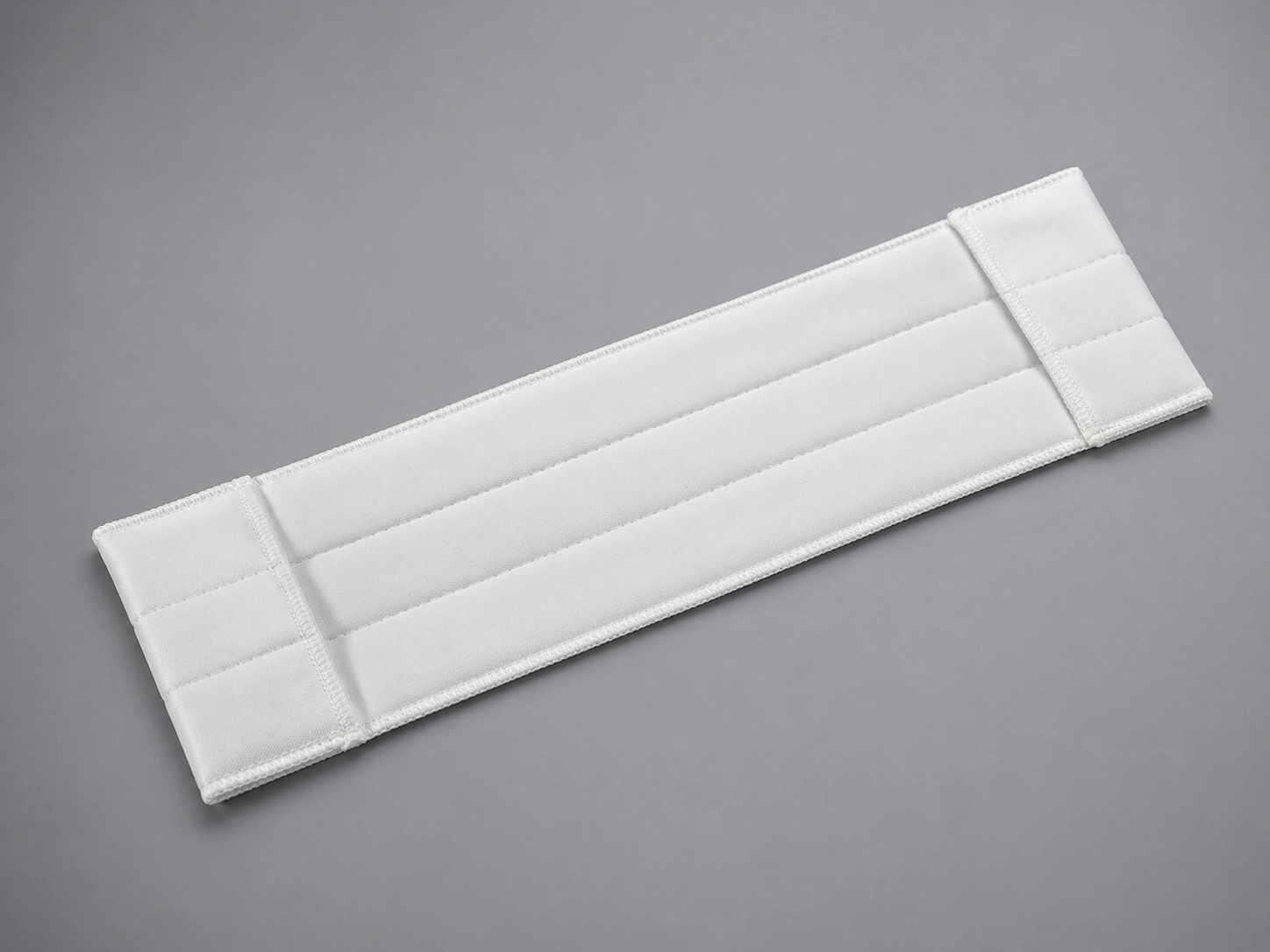
Clean ceiling panels, HEPA filter housings, light fixtures, and overhead utility runs. Use a lightweight 40g mop head on a fully articulated frame with a telescoping handle set to the required ceiling height.
Clean wall surfaces from top to bottom. Start at the highest reachable point and work downward in overlapping vertical or horizontal strokes. Use a dedicated wall mop head — never the same head used on ceilings, and never one used on floors.
Clean floors last using floor-designated mop heads, typically heavier (55g or 65g) for floor coverage efficiency. All particles from ceiling and wall cleaning have settled onto the floor surface by this point.
Within the top-down sequence, the room-to-room or zone-to-zone order also matters. The highest-grade areas — Grade A / ISO 5 critical zones — are cleaned first. Lower-grade areas (Grade C, Grade D) are cleaned afterward. This prevents personnel movement and equipment transit from introducing contamination from lower-grade areas into higher-grade ones.
In practice, this means the cleaning team starts in the aseptic filling suite (Grade A/B background), completes all ceiling, wall, and floor cleaning, then moves outward through Grade C support corridors and finally Grade D material airlocks. Mop heads, frames, and handles should be changed between zones to maintain segregation.
A best-practice wall and ceiling cleaning program assigns dedicated mop heads by surface type. At minimum, three categories should be maintained: ceiling tools, wall tools, and floor tools. This segregation can be managed through color-coded mop heads, clearly labeled handles, or separate storage locations for each category. The investment in segregated tooling is modest compared to the cost of an audit observation or product contamination event.
Mop head weight is the single most impactful specification for wall and ceiling cleaning — and 40g is the recommended starting point for overhead applications. The rationale is grounded in three practical realities:
Holding a mop overhead for 10-20 minutes per ceiling section places significant strain on shoulders, arms, and back. A 40g mop head plus frame and handle creates markedly less cumulative fatigue than a 65g equivalent. Fatigued operators apply inconsistent pressure, miss areas, and increase the risk of accidental surface contact with the mop handle or frame.
When operating above shoulder height, lighter tools produce more consistent stroke pressure across the entire cleaning surface. Heavier mop heads tend to sag at the far end of the stroke, creating uneven contact and leaving streaks of uncleaned or partially cleaned surface — a pattern visible under UV inspection after cleaning.
A 40g mop head holds less cleaning or disinfectant solution than heavier alternatives. This is an advantage for overhead work: less dripping onto the operator, less solution running down walls onto already-cleaned surfaces, and better control over disinfectant contact time on vertical surfaces where solution retention is inherently limited.
A 55g mop head can be effective for large, flat wall surfaces — particularly in Grade C or D areas where wall surface area is extensive and contamination risk is lower than in aseptic zones. The additional weight provides more solution capacity for large continuous wall sections, reducing the number of solution re-wetting cycles. However, for any overhead ceiling work or walls above shoulder height, 40g remains the preferred specification.
For a detailed comparison of mop head weight options across all cleanroom applications, refer to the mop head weight selection guide.
| Mop Head Weight | Recommended For | Not Recommended For |
|---|---|---|
| 40g | Ceilings, overhead surfaces, walls above shoulder height, Grade A/B areas | Large floor areas where coverage speed matters |
| 55g | Large flat walls in Grade C/D areas, below-shoulder-height walls | Ceilings, overhead cleaning in Grade A/B |
| 65g | Floor cleaning only | All wall and ceiling applications (excessive weight causes fatigue, dripping, and poor coverage consistency) |
Material choice for wall and ceiling mop heads involves different trade-offs than floor applications. Two factors become more important for overhead and vertical cleaning than for floors: lint generation and solution retention on vertical surfaces.
| Malzeme | Lint Risk (Overhead) | Vertical Solution Retention | En İyi Kullanım |
|---|---|---|---|
| Polyester Knit (Multi-layer) | Low — continuous filament structure minimizes fiber breakage and shedding | Good — knit structure holds solution evenly across pad surface | Grade A/B ceilings and walls, any area where lint generation must be minimal. Primary recommendation for wall/ceiling applications. |
| Mikrofiber | Moderate — split fibers can release microfilaments during overhead friction | Excellent — high surface area retains more solution | Grade C/D wall cleaning where solution-to-surface contact time is the priority and lint is less critical. Not recommended for ceiling cleaning in Grade A/B. |
When a mop head is used overhead, any fibers or particles it sheds fall directly downward — potentially into open product zones, onto equipment surfaces, or into laminar airflow paths. Low-lint polyester knit mop heads are strongly preferred for any ceiling or overhead wall cleaning in Grade A, B, and ISO 5/7 environments.
Sterility requirements for wall and ceiling mop heads follow the same grade logic as floor mop heads, but with an additional consideration: walls and ceilings in Grade A/B zones are rarely cleaned during active production. When they are cleaned — typically between campaigns, during shutdowns, or in scheduled maintenance windows — the sterility status of the cleaning tool must match the zone requirement.
| Temiz Oda Sınıfı | Sterilite Gereksinimi | Mop Head Recommendation |
|---|---|---|
| A Sınıfı / ISO 5 | Sterile (gamma-irradiated or equivalent validated sterilization) | 40g sterile polyester knit, individually packaged, single-use per cleaning event |
| B Sınıfı / ISO 7 | Sterile or validated non-sterile with documented bioburden control | 40g sterile polyester knit preferred; autoclaved reusable heads may be acceptable depending on facility SOP |
| C Sınıfı / ISO 8 | Non-sterile acceptable; validated cleaning process required | 40g or 55g non-sterile polyester knit, reusable with validated laundering if facility protocol permits |
| Grade D / ISO 8 | Steril olmayan kabul edilebilir | 55g non-sterile polyester knit or microfiber, reusable with laundering |
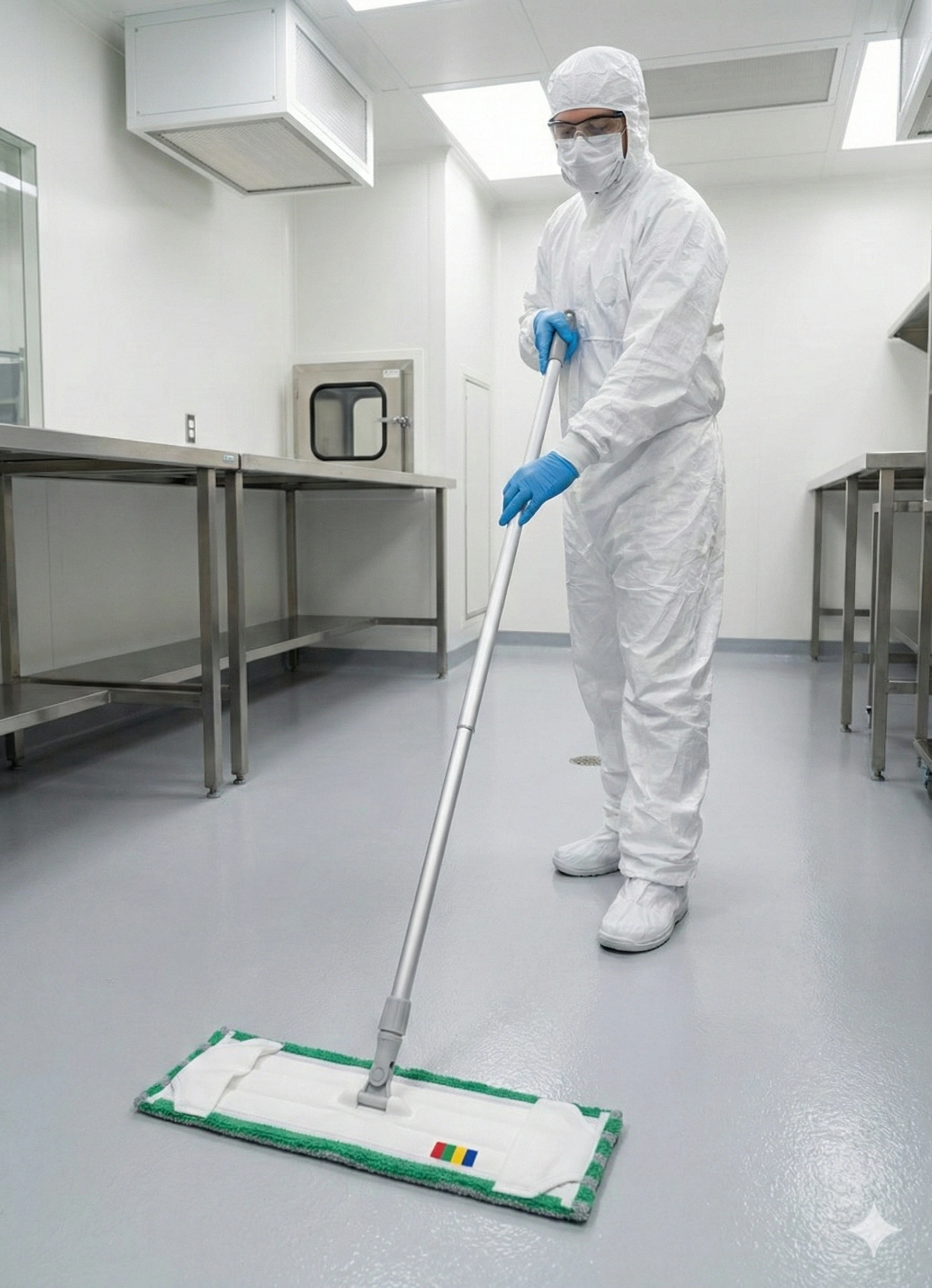
In floor mopping, frame articulation is a convenience. In wall and ceiling mopping, it is a necessity. A frame that cannot articulate to match the surface angle will leave uncleaned corners, edges, and ceiling-to-wall junctions — the very areas where particles accumulate most heavily.
Three frame types are relevant to wall and ceiling cleaning, and selecting the wrong one has measurable consequences for cleaning effectiveness:
| Çerçeve Türü | Articulation | Wall/Ceiling Suitability | Sınırlama |
|---|---|---|---|
| Sabit Çerçeve | None — rigid 90-degree angle to handle | Poor for walls and ceilings. Only maintains full contact on perfectly flat, accessible surfaces directly in front of the operator. | Cannot angle to match wall surface when operator is at a distance. Leaves triangular uncleaned zones at ceiling-wall junctions. |
| Swivel Frame | Rotates on a single axis (horizontal plane) | Moderate for walls. Swivel allows the mop head to follow the operator’s side-to-side arm movement, maintaining better contact at various working angles. | Does not tilt in the vertical plane — limited ceiling-to-wall transition capability. |
| Hinged / Articulated Frame | Multi-axis articulation — tilts and swivels | Best for walls and ceilings. Hinged frames allow the mop head to tilt to match vertical wall angles right up to ceiling junctions, and can flatten for ceiling panels. Provides full surface contact regardless of operator position. | Typically lighter frame weight is desirable for overhead use — select aluminum or lightweight stainless steel construction. |
Ceiling cleaning presents the most demanding articulation requirements. The mop head must press flat against ceiling panels, angle into ceiling-to-wall corners, and reach around ceiling-mounted obstructions (HEPA housings, light fixtures, sprinkler heads, cable trays). An articulated frame with hinged connection points allows the operator to maintain mop head contact with the ceiling surface while keeping the handle at a comfortable working angle — typically 30-45 degrees from vertical.
This is a critical ergonomic consideration. Without articulation, the operator must stand directly under the ceiling section being cleaned and hold the handle nearly vertical — a position that rapidly causes shoulder fatigue and creates a safety risk from solution dripping directly onto the operator’s face shield and gown.
Standard cleanroom mop frames are 40 cm in width — optimized for floor coverage efficiency. For wall and ceiling applications, especially in areas with equipment against walls, narrow wall returns, or ceiling sections interrupted by service panels, a narrower frame (30 cm or less) provides better access to confined spaces. The trade-off is coverage rate per stroke, which is an acceptable compromise when the alternative is incomplete access.
For a complete technical breakdown of frame types and materials, see the temiz oda paspas çerçevesi türleri guide. The importance of selecting the right frame as part of a full system is discussed in cleanroom mop system integration.

Cleanroom ceiling heights vary from approximately 2.4 m (8 ft) in standard facilities to over 3.5 m (12 ft) in some production suites with raised ceiling plenums. A fixed-length handle cannot serve all ceiling heights in a multi-room facility. Telescoping handles with lockable extension sections allow a single handle to be adjusted to the precise ceiling height of each room, eliminating the need for multiple fixed-length handles or, worse, operators improvising with step stools or ladders in aseptic environments.
The telescoping mechanism should lock securely at intermediate positions and be operable with gloved hands. Quick-twist or push-button locking mechanisms are preferred over threaded collars, which are difficult to operate with cleanroom gloves and prone to insufficient tightening.
Handle material choice has an outsized impact on overhead cleaning ergonomics. An aluminum handle weighs approximately one-third of a stainless steel handle of equivalent length. When extended to 2.5-3.0 m and held overhead, this weight differential translates directly into operator endurance and coverage quality.
| Sap Malzemesi | Typical Weight (2m length) | Overhead Suitability | Best Application |
|---|---|---|---|
| Aluminum | ~0.4 – 0.6 kg | Excellent — lightest option, minimal operator fatigue during extended overhead sessions | All ceiling cleaning, wall cleaning above shoulder height. Preferred choice for dedicated wall/ceiling handles. |
| Paslanmaz çelik | ~1.2 – 1.8 kg | Poor for overhead — weight becomes significant when extended and held above shoulders for more than 5-10 minutes | Floor mopping only. Not recommended for ceiling or extended overhead wall cleaning. |
| Composite / Reinforced Polymer | ~0.3 – 0.5 kg | Good — very lightweight, but may lack rigidity at full extension for ceiling work | Lower-height walls, Grade C/D areas. Check autoclave compatibility if sterilization of handle is required. |
For a comprehensive guide to handle types, materials, and attachment systems, see the temiz oda paspas sapı seçimi sayfa.
During wall and ceiling cleaning, mop heads are changed frequently — between ceiling and wall sections, between rooms, and between zones. A quick-connect system between handle and frame allows head changes without the operator fumbling with threaded connections while wearing double gloves in a Grade B environment. Push-button or snap-lock connections are preferred for cleanroom use. The connection must be secure enough that the mop head does not detach during vigorous overhead strokes, but easy enough that changes do not slow the cleaning sequence or introduce operator error.
The standard floor mopping pattern — systematic overlapping strokes with approximately 25% overlap — applies to walls and ceilings with one modification: the stroke direction on walls should be vertical (top-to-bottom) rather than horizontal, to work with gravity rather than against it. On ceilings, strokes should follow a systematic grid pattern, with each pass overlapping the previous by 25% to ensure complete coverage of the ceiling panel or section.
A common operational failure pattern occurs at section boundaries: the operator finishes one ceiling panel or wall section, moves to the adjacent section, and leaves a thin uncleaned strip at the boundary. A deliberate 5 cm overlap into the previously cleaned section prevents this gap.
Over-wetting a mop head before overhead use is one of the most frequent causes of cleaning-related contamination. Excess solution drips onto the operator, onto already-cleaned surfaces below, and onto equipment. The mop head should be dampened — not saturated — before ceiling use. A practical standard: after wetting, the mop head should be pressed or wrung to the point where no free liquid drips when held vertically for 5 seconds.
For disinfectant application on vertical surfaces, the challenge is contact time. Disinfectant applied to a vertical wall surface runs downward under gravity faster than on a horizontal floor. Operators should be trained to apply solution in controlled amounts and to re-apply if necessary rather than over-wetting in a single pass. The cleaning SOP should specify the target disinfectant contact time and confirm that vertical surface application achieves it.
Mop head change frequency during wall and ceiling cleaning should be specified in the cleaning SOP — not left to operator discretion. As a practical guideline:
The following table provides a grade-by-grade reference for wall and ceiling cleaning specifications in GMP cleanrooms. These are industry-practice recommendations aligned with GMP expectations for contamination control; specific facility SOPs and validated cleaning protocols take precedence. For a complete grade-by-grade selection framework across all mop system components, see the GMP mop grade selection guide.
| GMP Notu | ISO Eşdeğeri | Wall Cleaning Frequency | Ceiling Cleaning Frequency | Recommended Mop Head | Kısırlık | Documentation Level |
|---|---|---|---|---|---|---|
| A notu | ISO 5 | Per campaign / between batches (minimum); daily wipe-down of critical surfaces within arm’s reach of filling zone | Per campaign / between batches; all ceiling panels, HEPA faces, and overhead utilities | 40g sterile polyester knit | Sterile (gamma-irradiated), single-use | Full batch record entry: date, time, operator, mop lot number, disinfectant lot number, contact time, any observations |
| B seviyesi | ISO7 | Weekly (routine); more frequent during campaign operations if risk assessment indicates | Monthly or per campaign (whichever is more frequent) | 40g sterile polyester knit | Sterile preferred; validated non-sterile with bioburden monitoring may be acceptable per facility SOP | Cleaning log entry: date, operator, area, mop head type, disinfectant used |
| C sınıfı | ISO 8 | Weekly; twice weekly in high-traffic corridors or material transfer zones | Monthly or quarterly per facility risk assessment | 40g or 55g non-sterile polyester knit | Non-sterile; reusable with validated laundering | Cleaning log / checklist completion; periodic QA review |
| D sınıfı | ISO 8 | Haftalık | Quarterly or as required by cleaning schedule | 55g non-sterile polyester knit or microfiber | Non-sterile; reusable with laundering | Checklist sign-off; trend review during periodic quality review |
The frequencies above represent industry-practice baselines. Actual frequencies should be determined by facility risk assessment, environmental monitoring trend data, and validated cleaning protocols. Facilities with historical EM excursions on ceiling or wall surfaces should increase frequency accordingly. Any change to cleaning frequency should be managed through change control and reflected in updated SOPs.
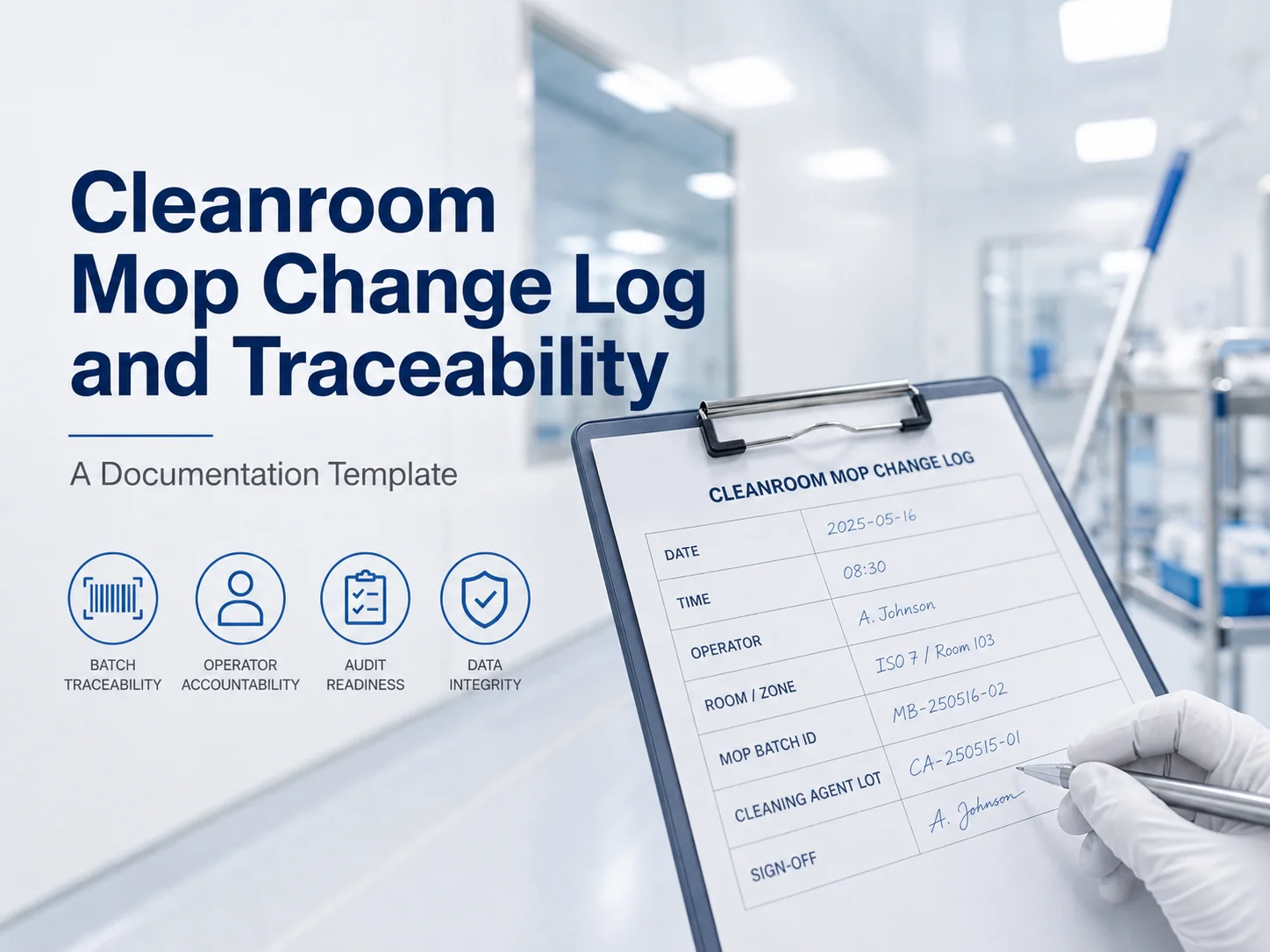
Wall and ceiling cleaning documentation is often less detailed than floor cleaning documentation — and this is precisely what auditors look for. A GMP auditor reviewing cleaning records will check whether wall and ceiling cleaning events are documented with the same rigor as floor cleaning. At minimum, a wall/ceiling cleaning log should capture:
In a GMP audit, the question is not just “did you clean the walls and ceilings?” but “can you prove it?” Two documentation practices strengthen audit readiness:
First, cleaning log traceability to the batch record. For Grade A and B areas, wall and ceiling cleaning events between production campaigns should be referenced in the relevant batch records or campaign documentation. If a batch was produced in a Grade A zone and the previous ceiling cleaning was documented three weeks earlier in a standalone log, the auditor will ask whether that cleaning event was reviewed as part of batch release.
Second, periodic review of wall and ceiling cleaning completeness. Quarterly or semi-annual QA review of cleaning logs should specifically assess whether all scheduled wall and ceiling cleaning events were completed, whether any were deferred or missed, and whether any trends in observations (visible residue, staining, particulate accumulation) indicate a need to increase frequency.
Facilities using a GMP tesisi için temiz oda paspası applications should maintain supplier documentation — Certificates of Analysis, Certificates of Sterility, and material specifications — for wall and ceiling mop heads alongside the equivalent documents for floor mop heads. The tool is different; the documentation standard should be the same.
Changing the mop head addresses one cross-contamination vector but does not fully mitigate the risk. The mop frame and handle can carry residues from floor contact (splashed liquids, aerosolized particles from floor cleaning). Best practice is to maintain separate, labeled or color-coded frames and handles for wall/ceiling cleaning. At minimum, if the same handle and frame must be used, they should be thoroughly disinfected between floor and wall applications and the cleaning procedure should specify this step explicitly.
A 40g mop head is the preferred starting point for all overhead ceiling cleaning and for walls above shoulder height in Grade A/B areas. It minimizes operator fatigue, provides better drip control, and delivers more consistent coverage at height. A 55g head can be appropriate for large, below-shoulder-height wall surfaces in Grade C/D areas where solution capacity and coverage speed are priorities. In all cases, the mop head should be dedicated to wall/ceiling use and not shared with floor cleaning operations.
The correct order is ceiling first, then walls, then floors. This top-down sequence ensures that particles dislodged from higher surfaces are collected during the cleaning of lower surfaces. Cleaning floors before walls or ceilings would leave freshly cleaned floor surfaces exposed to falling contamination from above. In multi-room cleaning, the sequence should also progress from highest-grade areas (Grade A/B) to lower-grade areas (Grade C/D) to avoid transporting contamination inward.
No. Non-sterile mop heads are generally acceptable for Grade C (ISO 8) wall and ceiling cleaning, provided a validated cleaning process is in place and environmental monitoring data supports the use of non-sterile cleaning tools. Reusable polyester knit or microfiber mop heads with documented laundering procedures are commonly used. Sterile mop heads are required for Grade A/B zones and should be considered for any area where environmental monitoring data indicates a trend toward action limits.
Frequency depends on cleanroom grade. Grade A (ISO 5) walls and ceilings are typically cleaned between production campaigns or batches — this may mean daily for continuously operating facilities. Grade B (ISO 7) wall cleaning is typically weekly, with ceiling cleaning monthly or per campaign. Grade C/D (ISO 8) walls are cleaned weekly to monthly, and ceilings quarterly or as scheduled. These are industry-practice baselines; actual frequency should be determined by facility risk assessment, environmental monitoring trend data, and validated cleaning protocols.
An articulated (hinged) frame is the best choice for ceiling cleaning. It allows the mop head to tilt and swivel independently of the handle angle, maintaining flat contact with ceiling panels while the operator holds the handle at a comfortable working angle. A fixed frame forces the operator to stand directly under the cleaning zone with the handle nearly vertical — a position that causes rapid fatigue, poor coverage, and safety concerns from dripping solution. For ceiling cleaning, combine an articulated aluminum frame (for weight reduction) with a telescoping handle adjusted to the exact ceiling height.
Auditors expect wall and ceiling cleaning to be documented with the same rigor as floor cleaning. Key documentation includes: a cleaning log with date, time, room/zone, surfaces cleaned, mop head type and lot number, disinfectant used with lot number and contact time, operator identification and signature, and QA review. For Grade A/B areas, cleaning events between campaigns should be referenced in batch records or reviewed as part of batch release. Periodic QA review of cleaning completeness and any trends in observations or deviations should also be documented.
Microfiber mop heads are generally not recommended for ceiling cleaning in Grade B (ISO 7) areas. The primary concern is lint and particle generation: microfiber’s split-fiber structure can release microfilaments during overhead friction, and these particles fall directly downward into the working zone. Polyester knit mop heads with continuous filament construction generate fewer particles and are recommended for overhead use in Grade A/B environments. For Grade C/D wall cleaning where lint risk is less critical, microfiber can offer excellent solution retention and cleaning performance on vertical surfaces.
MIDPOSI’s white cleanroom mop series includes 40g and 55g mop heads, articulated aluminum frames, and telescoping handles — a complete system designed for controlled vertical and overhead cleaning in GMP environments. Available in sterile and non-sterile configurations to match your cleanroom grade requirements.
İlaç, biyoteknoloji ve tıbbi cihaz tesislerinde yapılandırılmış temiz oda temizleme programları için tasarlandı.