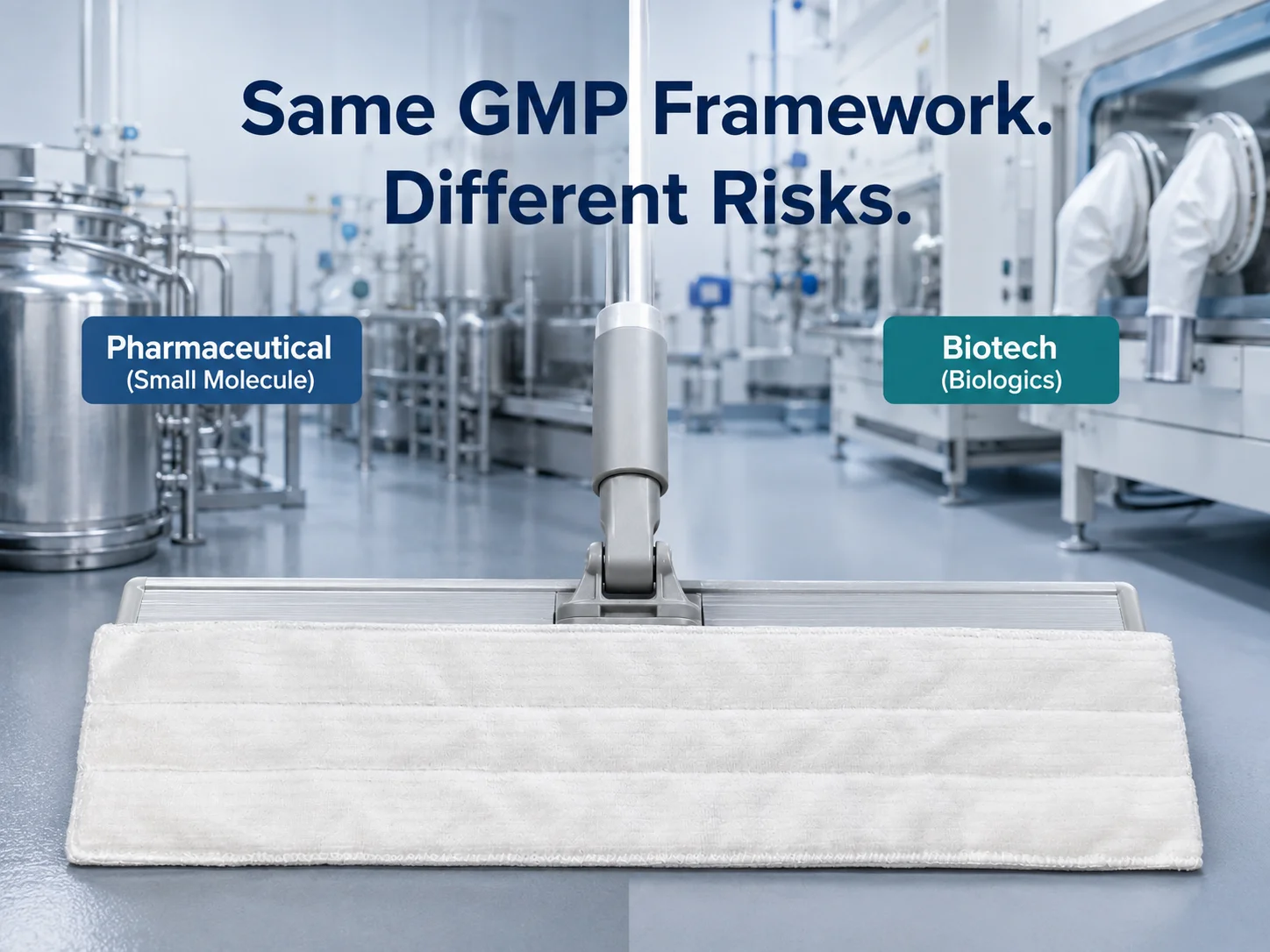
Biotech and pharmaceutical facilities share GMP classification frameworks — but they manage fundamentally different contamination risks. Pharma facilities primarily control chemical cross-contamination and particulates. Biotech facilities additionally manage biological contamination: living organisms, protein-based residues, and endotoxins. These differences flow through every level of cleanroom mop specification — material selection, cleaning chemistry compatibility, zone-specific tool requirements, and documentation expectations during audits. This guide maps the distinctions that matter for procurement, QA, and facility teams operating in either industry — or both.
The core difference is what is being controlled. Pharmaceutical (small-molecule) facilities manage chemical cross-contamination — an active ingredient from one batch contaminating the next. Biotech (biologics) facilities manage biological contamination — living organisms from a fermentation run, protein-based residues from cell culture media, and endotoxins from bacterial cell walls. This difference propagates through every dimension of cleanroom mop specification: material selection must account for protein residue behavior rather than just chemical solubility; cleaning chemistry must be compatible with enzymatic and alkaline cleaners that break down biological residues; documentation must address bioburden control and endotoxin testing — not just chemical residue verification.
| Decision Dimension | Pharmaceutical (Small Molecule) | Biotech (Biologics) |
|---|---|---|
| Primary Contamination Concern | Chemical cross-contamination between batches. Particulate contamination from operators and environment. | Biological contamination: living organisms, protein residues, endotoxins, viable particulates. Chemical cross-contamination still applies. |
| Residue Behavior | Small-molecule residues are typically dissolvable in organic solvents or aqueous solutions. Predictable solubility profiles. | Protein-based residues may denature on surfaces, adhere strongly, and require enzymatic or alkaline cleaning chemistry for removal. |
| Cleaning Frequency | Between-batch cleaning. Frequency driven by product changeover schedule. | Between-batch + between-campaign cleaning. Nutrient-rich residues (cell culture media) support microbial growth — more frequent cleaning may be required even in Grade D support zones. |
| Documentation Emphasis | Chemical residue verification (TOC, conductivity). Cleaning validation reports per batch changeover. | Chemical residue + bioburden control documentation + endotoxin testing records. More rigorous traceability between cleaning events and environmental monitoring data. |
The takeaway: The GMP grade classification (A/B/C/D) applies to both industries, but what happens inside each grade — the contamination type, the residues produced, and the documentation expected — differs. A mop specification written for a pharma Grade C suite may be inadequate for a biotech Grade C fermentation suite unless the specification accounts for these differences. For the foundational GMP grade framework, see the cleanroom mop system overview. For the grade-by-grade selection guide, see the GMP cleanroom mop grade selection guide.
Before mapping mop specifications to each industry, it is necessary to understand why the cleaning requirements differ at a fundamental level. The distinction is not regulatory — both industries operate under GMP — but operational: what is being produced, what residues are generated, and what contamination types represent the highest risk.
In a small-molecule pharmaceutical facility, the primary contamination risk is chemical: an active pharmaceutical ingredient (API) from Product A contaminating Product B during changeover. Cleaning validation focuses on demonstrating that residues are below acceptable limits — measured by total organic carbon (TOC), conductivity, or specific analytical methods for the API. Particulate contamination from operators and the environment is an additional concern managed through gowning and environmental monitoring.
In a biologics facility, the contamination risk adds a biological dimension. A fermentation run produces living organisms. Cell culture processes generate protein-rich media residues. Downstream purification releases host cell proteins and DNA fragments. Endotoxins — lipopolysaccharides from gram-negative bacterial cell walls — are a specific concern in injectable biologics. A cleaning protocol that removes chemical residues may not inactivate biological contamination, and a protocol that inactivates organisms may not remove the residues they leave behind.
Both industries operate under GMP frameworks — 21 CFR Parts 210 and 211 in the US, EU GMP Annex 1 (sterile products) and Annex 2 (biological active substances) in Europe. The difference is in emphasis: biologics GMP places greater weight on contamination control strategy as a holistic program, bioburden monitoring throughout the process (not just at final product testing), and documented demonstration that cleaning procedures control both chemical and biological contamination. For a detailed discussion of pharmaceutical cleanroom mop GMP Annex 1 requirements, see the dedicated guide.
GMP classification (Grade A/B/C/D) provides a common framework across both industries. But the application of that framework — what each grade actually contains and what cleaning challenges it presents — differs between pharma and biotech.
| Grade | Pharmaceutical (Small Molecule) | Biotech (Biologics) | Mop Specification Implication |
|---|---|---|---|
| گریڈ اے | Aseptic filling zone. Sterile mop heads required. Contamination risk primarily from operators and environment. | Same sterility requirements. Additional concern: the biologic product itself can be a contaminant. Endotoxin control adds a documentation dimension absent in pharma Grade A. | Sterile mops with Certificate of Irradiation or Sterility. Biotech facilities may additionally require endotoxin testing documentation from the mop supplier. |
| گریڈ بی | Background to Grade A. Typically sterile mops. Cleaning protocol supports Grade A integrity. | Same sterility logic. Higher cleaning frequency may be required if the Grade B zone supports multiple biologic product campaigns with different organisms. | Sterile mops. For biotech CDMOs, consider color-coded mops per campaign to provide visual segregation — reference the cleanroom mop color-coding guide for implementation. |
| گریڈ سی | Chemical synthesis or formulation. Non-sterile mops typically acceptable. Residue is chemically defined. | Fermentation, cell culture, or purification suites. Non-sterile mops may be acceptable — but protein-based residues require cleaning chemistry that the mop material must tolerate. Cleaning frequency may be higher due to nutrient-rich residues. | Mop material must be compatible with enzymatic or alkaline cleaners. Verify chemical compatibility with both disinfectants and residue-removal agents. More frequent head changes may increase consumable consumption. |
| گریڈ ڈی | Support zones: warehouse ante-rooms, solution prep areas. Non-sterile mops. Lower cleaning frequency. | Media preparation, buffer preparation, equipment wash areas. Nutrient-rich residues (media powders, buffer components) support microbial growth. Cleaning frequency may be higher than pharma Grade D. | Same mop specification as pharma Grade D may be acceptable — but cleaning frequency and head change intervals should be validated against biotech-specific residue profiles, not adopted from pharma protocols unchanged. |
The above describes directional differences. Specific mop specifications should be validated against each facility’s cleaning protocol, residue profile, and regulatory requirements. For sterile mop transfer protocols that apply to both industries, see the sterile cleanroom mop aseptic transfer guide.
The cleaning agents used in biotech facilities expose mop heads to a different chemical environment than those used in pharma facilities. Understanding these differences is essential for mop material selection — a mop that performs reliably under pharma cleaning chemistry may degrade faster under biotech cleaning chemistry.
Small-molecule pharmaceutical residues are typically removed with organic solvents or aqueous detergent solutions — chemistries that are relatively gentle on polyester and microfiber mop materials. Protein-based residues from biologics manufacturing are different: proteins denature and adhere to surfaces, forming films that are not removed by standard detergents alone. Biotech facilities frequently use:
GMP facilities in both industries practice disinfectant rotation — alternating between a broad-spectrum disinfectant (e.g., quaternary ammonium) and a sporicidal agent (e.g., peracetic acid / hydrogen peroxide) — to prevent microbial resistance. In biotech, the rotation is typically more aggressive: sporicidal agents are used more frequently because the consequences of a biological contamination event (a batch lost to viable organisms) are catastrophic. Each sporicidal cycle exposes the mop head to oxidative chemistry. Over weeks and months, this cumulative exposure degrades polyester fibers and accelerates microfiber breakdown. Biotech facilities should expect shorter mop head service life if using aggressive sporicidal rotations — and should factor this into procurement quantity planning.
The method used to verify cleaning efficacy also differs between industries:
For a complete framework of documentation that should accompany mop procurement and cleaning validation, see the cleanroom mop validation documents checklist.
Biotech GMP audits — whether from regulatory inspectors or client quality teams at CDMOs — place distinctive emphasis on contamination control documentation. Understanding these emphasis areas helps procurement and QA teams build a documentation package that anticipates auditor questions.
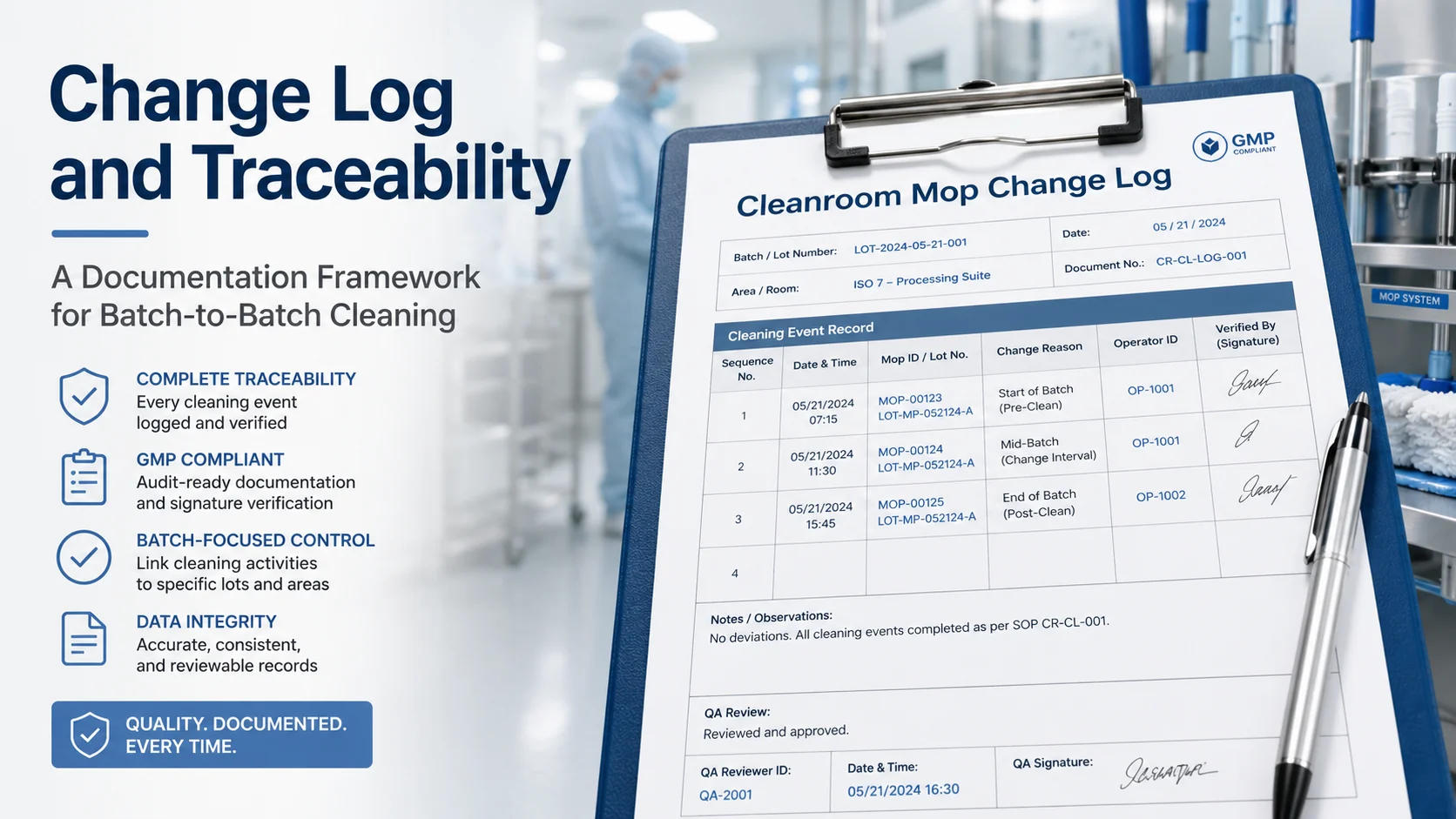
Biotech auditors trace the complete bioburden control chain: from disinfectant preparation records → cleaning event logs → mop head change records → environmental monitoring data for the cleaned zone. A gap in any link raises questions about the validity of the entire chain. Pharma auditors review cleaning records; biotech auditors connect them to bioburden trending data and expect documented correlation.
Injectable biologics are subject to endotoxin limits (measured in EU/mL). Cleaning tools — including mop heads — that contact surfaces in aseptic processing areas should be supported by documentation confirming they do not introduce endotoxins. This is rarely required in small-molecule pharma but is a standard biotech audit expectation for Grade A/B consumables.
Pharma cleaning validation typically uses chemical markers (a known concentration of API applied to a surface, then swabbed after cleaning to verify removal). Biotech cleaning validation may additionally use biological indicators — a known microbial load applied to a test surface, cleaned, and then sampled for viable organisms. This adds a dimension to cleaning validation that the mop specification must support: the mop must be compatible with both the cleaning chemistry and the biological indicator recovery method.
Biotech facilities often operate in campaigns — a production suite runs Product A for six weeks, then is completely cleaned and turned over to Product B. Pharma facilities also do changeover cleaning, but the documentation emphasis in biotech campaigns is heavier: the mop change log must demonstrate that mops used in Product A campaign were retired or segregated before Product B campaign began. This is a cross-contamination control requirement that applies with particular force when Product A and Product B are different organisms.
For the full supplier documentation checklist that supports both pharma and biotech audit preparation, see the cleanroom mop validation documents buyer checklist.
Contract manufacturing organizations (CMOs/CDMOs) frequently operate both small-molecule pharma and biologics production in the same facility. This creates a unique cleaning tool management challenge: the same GMP framework governs both operations, but the contamination control requirements differ — and the cleaning tools must not become the vector that connects the two production streams.
In a mixed biotech/pharma facility, mops used in biotech zones must never enter pharma zones — and vice versa. The cross-contamination risk is bidirectional: a mop used in a cell culture suite carries biological residue into a chemical synthesis suite; a mop used in a chemical synthesis suite carries API residue into a biologics processing area. The segregation must be physical, documented, and auditable.
Practical implementation: Assign dedicated mop inventories per production type. Biotech mops are stored, used, and laundered separately from pharma mops. This may mean maintaining two parallel mop inventories — which increases inventory complexity but eliminates the highest-risk cross-contamination vector. For a structured approach to tool segregation, the cleanroom mop color-coding guide provides an implementation framework that applies directly to mixed biotech/pharma facilities.
A facility that runs both biotech and pharma processes faces a compound documentation burden: the pharma zones require chemical residue verification records; the biotech zones additionally require bioburden control and endotoxin records. One approach that simplifies this without compromising compliance:
For the upstream decision of whether to specify sterile or non-sterile mops per zone — which is the same decision framework in both industries — see the sterile vs non-sterile cleanroom mop decision framework.
The following five mistakes are patterns observed when biotech facilities adopt cleaning tool specifications designed for small-molecule pharma without adapting them to biologics-specific requirements.
“We use the same mop spec as the pharma facility next door.” The mop material and sterility level may be the same, but the cleaning chemistry compatibility, documentation requirements, and cleaning frequency are not. A polyester mop that works in a pharma Grade C suite with standard detergents may degrade faster in a biotech Grade C suite with enzymatic cleaners and more frequent sporicidal disinfectant exposure.
Correction: Review the mop specification against the specific cleaning agents, disinfectants, and residue types in each biotech zone. Verify material compatibility with enzymatic and alkaline cleaners if used. Adjust head change frequency and mop retirement criteria based on observed degradation under biotech-specific chemistry.
Cell culture media, fermentation broths, and buffer solutions contain nutrients that support microbial growth. A media preparation area (Grade D in biotech) that is cleaned once per shift — the same frequency as a pharma Grade D warehouse ante-room — may develop microbial growth between cleanings because the residue is nutrient-rich, not inert.
Correction: Base cleaning frequency on the residue profile, not the GMP grade classification alone. A biotech Grade D zone with nutrient-rich residues may require cleaning frequency comparable to a pharma Grade C zone. Validate cleaning frequency through environmental monitoring data, not by adopting pharma schedules.
An aseptic filling facility for injectable biologics specifies sterile mops — but the mop supplier’s documentation package does not include endotoxin testing data. The facility accepts this because “the mop is sterile.” Sterility and low endotoxin are not the same property. A gamma-sterilized mop can carry endotoxins from the original manufacturing process unless the supplier has validated endotoxin control.
Correction: Request endotoxin testing documentation (LAL test results) for mop heads used in Grade A/B zones of injectable biologics facilities. If the supplier cannot provide this, document a risk assessment justifying why endotoxin levels from the mop are not a product safety concern — or switch to a supplier that provides endotoxin documentation.
A CMO facility operates biotech and pharma suites in the same building. Mop heads are ordered in bulk from a single SKU and stored in a central inventory. Operators draw from the same inventory for both production types. This eliminates the segregation that is required to prevent cross-contamination between production streams — a mop used in a fermentation suite on Monday and a chemical synthesis suite on Tuesday has carried biological residue into an area that does not have the cleaning protocol to manage it.
Correction: Segregate mop inventories by production type. This does not necessarily require different mop products — the same mop SKU can be used in both zones IF the inventory is physically separated, color-coded, and the segregation is documented in the cleaning SOP. The key is that a mop assigned to biotech stays in biotech.
A biotech facility validates its mopping procedure using the same chemical residue markers as a pharma facility — apply a known chemical to a test surface, mop, swab, and measure recovery. The validation passes. But the cleaning protocol’s effectiveness against biological contamination — the primary concern in the facility — has not been tested.
Correction: Include biological indicator testing in the cleaning validation protocol for biotech facilities. Apply a known microbial load (e.g., a spore strip or a bacterial suspension) to a test surface, execute the mopping procedure, and sample for viable organisms post-cleaning. This confirms that the cleaning protocol — including the mop, cleaning agent, and technique — achieves both chemical and biological decontamination.
The biotech-pharma distinction is one dimension of cleanroom mop selection. The following related topics address other dimensions that interact with the industry-specific considerations discussed in this guide.
Biotech facilities must manage biological contamination in addition to chemical and particulate contamination. This includes viable organisms from fermentation or cell culture processes, protein-based residues that adhere strongly to surfaces and require enzymatic or alkaline cleaning chemistry, and endotoxins from gram-negative bacterial cell walls that are a specific safety concern in injectable biologics. The cleaning protocol must both inactivate biological contaminants and remove the residues they leave behind — two distinct requirements that are not always achieved by the same cleaning step.
The sterility requirement is the same — both require sterile mop heads. The differences are in documentation expectations (biotech may require endotoxin testing data for the mop, which is rarely requested in pharma) and in cleaning frequency (biotech Grade A/B zones operating on campaign-based schedules may require more frequent cleaning between campaigns with different organisms). The mop product specification may be identical, but the supporting documentation and the operational protocol around the mop differ.
Protein residues require enzymatic or alkaline cleaners that are more chemically aggressive than the standard detergents used in pharma. These cleaners can accelerate degradation of the polyamide component in microfiber mop heads and increase polyester hydrolysis rates. Polyester mop heads generally tolerate enzymatic and alkaline cleaners better than microfiber — making polyester the more conservative material choice for biotech facilities with heavy protein residue loads. Regardless of material, biotech facilities should expect shorter mop head service life than pharma facilities using comparable mop products, and should adjust procurement quantities and inspection frequency accordingly.
In addition to the standard documentation package (Certificate of Analysis, material composition, sterility certificate), biotech facilities should consider requesting: (1) endotoxin testing data for mop heads used in aseptic processing areas; (2) chemical compatibility data with enzymatic and alkaline cleaners if these are used in the facility; (3) particle shedding test data that includes biological particle considerations (not just inert particles); and (4) documentation confirming that the mop manufacturing process does not introduce biological contaminants that survive the sterilization process.
Cleaning frequency in biotech suites is typically higher than in pharma suites at the same GMP grade because nutrient-rich residues (cell culture media, fermentation broths) support microbial growth between cleanings. A biotech Grade D media preparation area may require cleaning every shift rather than once daily. Additionally, campaign-based production in biotech requires complete cleaning and changeover between campaigns with different organisms — which may involve more intensive cleaning than a standard between-batch changeover in pharma. The higher frequency increases mop head consumption and should be reflected in both the cleaning SOP and the procurement plan.
The mop product itself may be the same — a polyester mop head with the same material and weight specification can serve both biotech and pharma zones. What must NOT be shared is the mop inventory across zones. Biotech mops must be physically segregated from pharma mops to prevent cross-contamination. This segregation should be documented, color-coded where practical, and enforced through the cleaning SOP. The mop product specification can be unified; the mop usage protocol must be segregated by production type.
Biologics GMP places greater emphasis on contamination control as a holistic program rather than individual cleaning step verification. For mop workflow validation, this means: (1) the validation protocol should include biological indicators, not just chemical residue markers; (2) the mop change log should be linkable to environmental monitoring data to demonstrate that cleaning events correlate with controlled bioburden levels; and (3) campaign changeover documentation should demonstrate that mops used in one campaign were retired or segregated before the next campaign began. These are documentation linkages that pharma GMP audits may not require but biologics audits often do.
Not necessarily — both fermentation suites and cell culture areas generate nutrient-rich, biologically active residues that require similar cleaning chemistry. The difference is in the scale and containment: fermentation suites typically involve larger vessels and higher organism concentrations, which means larger potential spill volumes and higher bioburden. The mop specification (material, weight, sterility) may be the same, but the head change frequency, cleaning frequency, and spill response protocol should be scaled to the larger contamination potential in the fermentation area. The mop head weight should also be selected for the larger floor area typical of fermentation suites — heavier heads (55g–65g) for larger areas, lighter heads (40g) for tighter spaces around vessel skids.
Whether biotech biologics or pharmaceutical small-molecule, MIDPOSI provides mop specifications matched to your contamination control priorities, zone grades, and documentation requirements.
Documentation availability may vary by product configuration. Standard technical documentation provided with every inquiry.