~9 min read
Three configuration decisions define every cleanroom coverall. This guide helps procurement, QA, and gowning program managers match the right configuration to the right cleanroom grade.
What Is a Cleanroom Coverall and Why Configuration Matters
A cleanroom coverall is a one-piece full-body garment that covers the torso, arms, and legs — the single largest surface-area containment component in any cleanroom garment program. Unlike general-purpose protective clothing, a cleanroom coverall is engineered to minimize particle shedding from the operator while providing a consistent barrier between the person and the controlled environment.
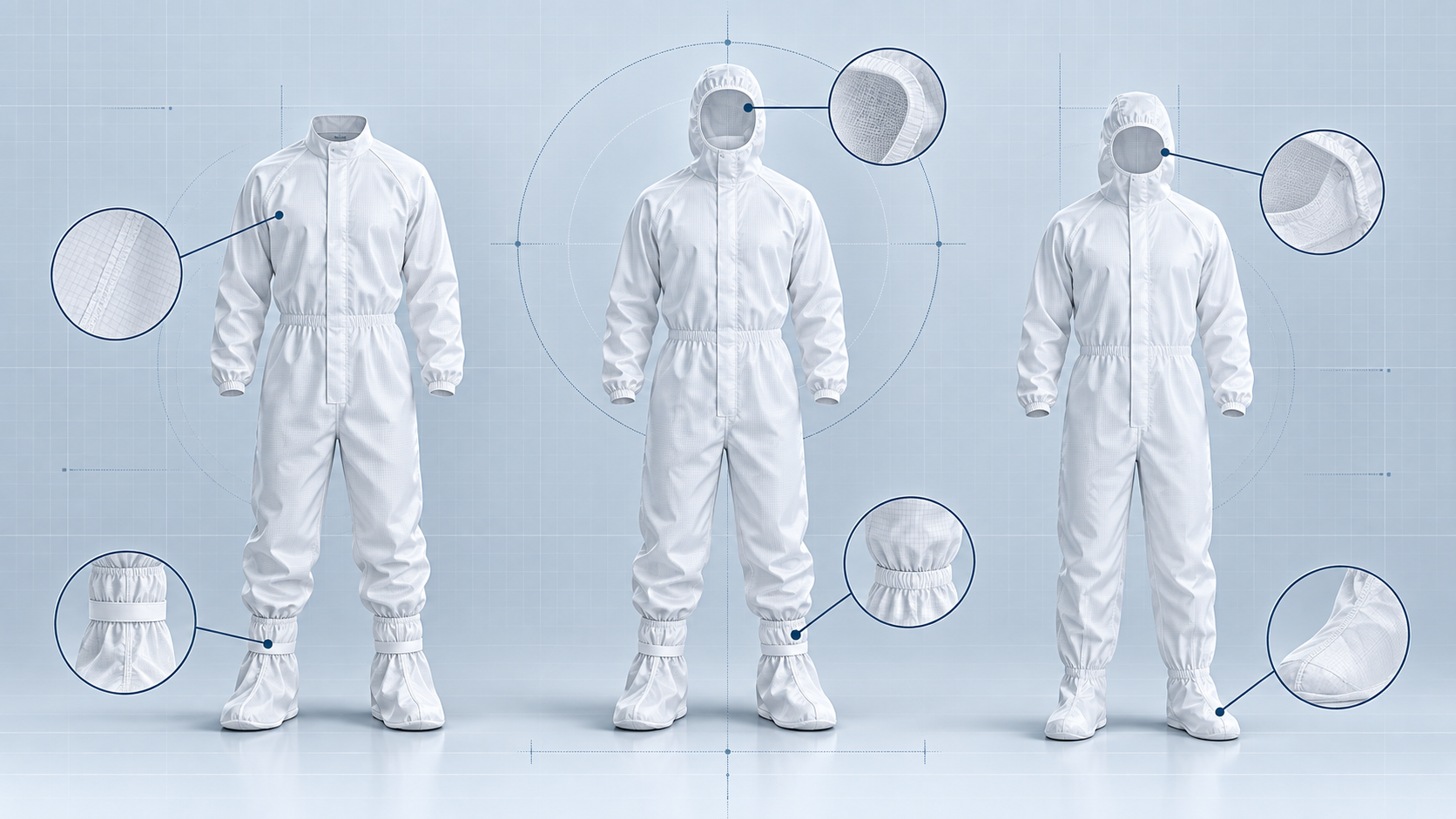
Every coverall is defined by three configuration decisions that directly affect contamination-control performance, operator comfort, and gowning efficiency:
These three decisions are interdependent. A Grade A/B aseptic area demands a specific combination (sterile, hooded, integrated boots, polyester) where changing any one configuration creates a contamination risk. Understanding the trade-offs for each decision is the starting point for coverall selection. For the complete garment system context, see the cleanroom garments system guide.
Coverall Configuration — Decision #1: Hood Style
The hood is the interface between the operator’s head (a primary particle source) and the cleanroom environment. Whether the hood is integrated into the coverall or worn as a separate component affects contamination risk, sizing flexibility, and operator convenience.
| Dimension | Hooded Coverall | Non-Hooded Coverall |
|---|---|---|
| Construction | Hood is permanently attached to the coverall body at the collar — one continuous garment from head to ankles | Coverall ends at the collar; a separate hood is donned independently |
| Contamination Risk | Lower — no hood-coverall interface gap. Particles from the head and neck have no path to escape between garment components | Higher — the hood-coverall interface creates a potential gap at the neck. Proper overlap and tucking reduce but do not eliminate this risk |
| Sizing Flexibility | Lower — the operator receives one combined size for head + body. A size L coverall means a size L hood | Higher — hood and coverall can be sized independently. An operator can wear a size L coverall with a size M hood |
| Gowning Speed | Faster — one garment instead of two. Reduces the number of gowning steps | Slower — requires a separate hood-donning step in the gowning sequence |
| Cost | Slightly higher per garment (integrated construction) | Slightly lower per garment; hoods can be replaced independently |
| Best For | Grade A/B aseptic areas, Grade C production — where contamination control outweighs sizing convenience | Grade D areas, R&D labs, visitor gowning — where sizing flexibility and independent replacement matter more |
Recommendation: For GMP Grade A/B and C, hooded coveralls are the standard because eliminating the hood-coverall interface gap reduces a known contamination pathway. For Grade D and non-GMP controlled environments, non-hooded coveralls with separate hoods offer acceptable protection with better sizing flexibility and lower replacement cost.
Coverall Configuration — Decision #2: Boot Style
Footwear containment is the second configuration decision. The choice between integrated booties and separate boots affects the ankle seal — a critical contamination-control point because the ankle is one of the most mechanically active areas during operator movement.
| Dimension | Integrated Booties | Separate Boots |
|---|---|---|
| Construction | Coverall fabric extends to cover the feet with a bootie-shaped foot section. The garment runs continuously from hood to toes | Coverall ends at the ankle with an elastic or snap closure. Separate cleanroom boots are worn over or under |
| Ankle Gap | None — the coverall fabric covers the ankle and foot as one continuous barrier | Present — the ankle is the transition point between coverall and boot. The closure method (elastic, snap, tuck) determines how well this gap is sealed |
| Sizing Complexity | Single size for body + feet. A size L coverall means size L feet. Operators with disproportionate body-to-foot sizing may have fit issues | Two independent sizes — coverall size and boot size. Each can be matched to the operator independently |
| Replacement Cost | Higher — if the bootie section wears out, the entire coverall must be replaced | Lower — boots wear faster than coveralls. Separate boots can be replaced without replacing the coverall |
| Best For | Grade A/B aseptic — maximum contamination control. Eliminate the ankle gap entirely | Grade C/D — where some ankle-gap risk is acceptable in exchange for sizing flexibility and lower replacement cost |
Elastic ankle closure — the middle ground: Some coveralls use an elastic ankle closure without integrated booties. The elastic creates a seal at the ankle, and separate boots are worn over — either covering the elastic or with the coverall leg tucked inside. This option reduces (but does not eliminate) the ankle gap while preserving independent boot sizing and replacement. It is commonly used in Grade C facilities where integrated booties are not mandatory but a better ankle seal than an open cuff is desired.
Coverall Configuration — Decision #3: Material Selection
The fabric determines the coverall’s particle-shedding performance, autoclave compatibility, chemical resistance, and operator comfort. Three materials dominate cleanroom coverall manufacturing.
| Material | Particles | Autoclave | ESD | Comfort | Best Grade |
|---|---|---|---|---|---|
| Continuous-filament polyester | Low — no cut fiber ends to shed | Yes — 121-134 deg C, 50-100+ cycles | No | Good — lightweight, breathable | Grade A/B/C aseptic and production |
| Polyester-carbon blend (ESD) | Low-Medium — carbon fibers add particle load | Yes — 121 deg C, fewer cycles (30-60) | Yes — conductive grid dissipates static | Good — slightly heavier than pure polyester | Semiconductor, electronics, ESD-sensitive Grade C/D |
| Polypropylene (PP) disposable | Medium — staple-fiber construction | No | No | Moderate — less breathable | Grade D, visitor areas, R&D labs |
Continuous-filament polyester is the standard for GMP pharmaceutical and biotech cleanrooms. Its low particle shedding and autoclave compatibility make it the default choice for Grade A/B/C. ESD polyester-carbon blends add static-dissipative properties for electronics manufacturing at a slight trade-off in particle performance and cycle life. Disposable polypropylene coveralls serve low-grade and visitor applications where laundry infrastructure is absent. For a complete material comparison across all garment types, see the cleanroom garment materials guide. For the reusable-vs-disposable decision framework, see autoclavable vs disposable garments.
Coverall Selection by Cleanroom Grade — GMP A/B/C/D and ISO 5-8
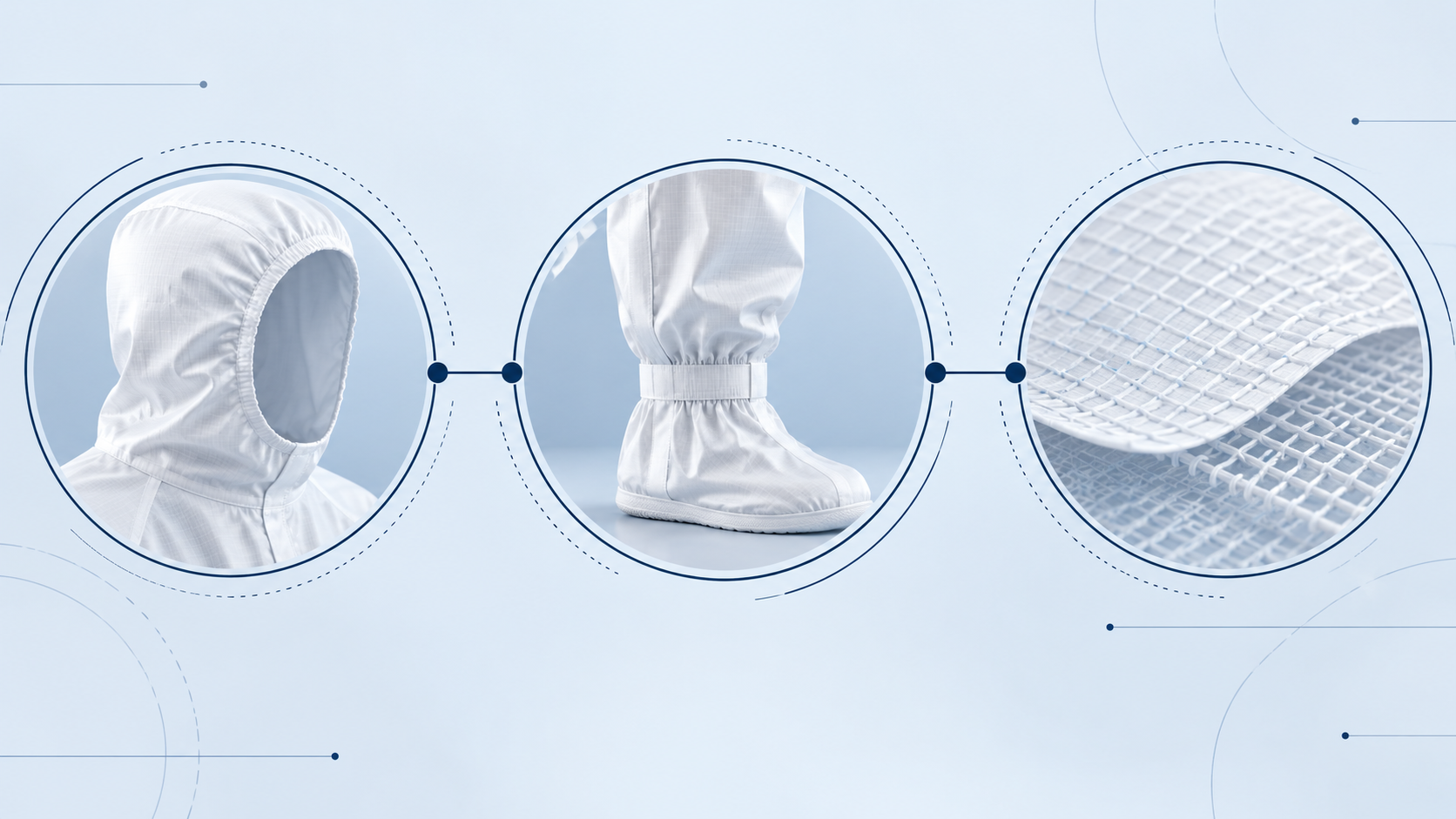
Combining the three configuration decisions produces grade-specific coverall recommendations. The following table provides the standard configuration for each cleanroom grade.
| Parameter | Grade A/B (ISO 5) | Grade C (ISO 7) | Grade D (ISO 8) |
|---|---|---|---|
| Hood Style | Hooded (integrated) | Hooded (integrated) | Hooded or non-hooded |
| Boot Style | Integrated booties | Separate boots or elastic ankle with separate boots | Separate boots or shoe covers |
| Material | Continuous-filament polyester | Continuous-filament polyester | Polyester (autoclavable) or PP (disposable) |
| Sterilization | Sterile (gamma or validated autoclave) | Autoclavable, non-sterile acceptable | Non-sterile acceptable; sterile if SOP requires |
| Change Frequency | Per session or per shift — validated by EM data | Per shift or daily — defined by SOP | Daily or per defined interval |
| Key Requirement | No exposed skin, no interface gaps, sterile packaging, double-bagged for aseptic transfer | Full-body coverage, hooded, controlled particulate release | Basic body coverage, general contamination control |
Each facility should validate these recommendations against its own environmental monitoring data, gowning SOP, and risk assessment. A Grade B facility with strong EM data and a validated gowning protocol may accept separate boots if the data supports it. A Grade C facility preparing for an Annex 1 audit may choose to elevate its coverall specification to integrated booties as a proactive measure.
Coverall Sizing — How to Size a Production Team
Coverall sizing is a procurement and operational challenge. A poorly sized coverall creates contamination risk regardless of its material or configuration quality. The sizing approach depends on whether the coverall has integrated booties.
For a complete sizing reference across all garment types, see the cleanroom garment sizing and fit guide.
Coverall Inspection and Replacement — Lifecycle Management
Autoclavable coveralls degrade over repeated sterilization cycles. A structured inspection program catches degradation before it becomes a contamination event.
Pre-Use Inspection (Every Donning)
- Check the zipper — does it run smoothly the full length without catching or separating?
- Inspect cuffs at wrists and ankles — is the elastic intact and providing a seal, not loose or stretched?
- Check seams — any visible thread separation, thinning, or holes at stress points (shoulders, crotch, knees)?
- Verify the hood attachment (hooded coveralls) — is the collar seam intact with no gaps?
- Look for fabric discoloration, thinning, or pilling — indicators of chemical or thermal degradation
Post-Sterilization Inspection (Each Cycle)
- Repeat all pre-use checks after the sterilization cycle
- Check for new fabric stiffness or brittleness — signs of over-autoclaving
- Verify that labels and markings remain legible — fading indicates excessive cycle exposure
- If the facility performs particle testing, test a sample from each batch at defined intervals
Retirement Criteria
- Fabric thinning visible to the naked eye or confirmed by thickness measurement
- Seam separation >5mm at any stress point
- Zipper malfunction — catching, separating, or failing to close completely
- Elastic failure at cuffs or ankles — no longer providing a seal
- Particle-shedding test failure against the facility’s acceptance criteria
- Exceeding the supplier’s stated maximum cycle life, even if visual inspection passes
Keep a garment retirement log. Record the date, garment ID, cycle count at retirement, and the specific failure reason. This log provides audit evidence of a functioning garment management program and helps procurement forecast replacement orders. For gowning procedure integration, see the cleanroom gowning procedure SOP guide.
Cleanroom Coverall FAQ
Should I choose a hooded or non-hooded cleanroom coverall?
Hooded coveralls are recommended for GMP Grade A/B/C because they eliminate the hood-coverall interface gap — a known contamination pathway. Non-hooded coveralls are acceptable for Grade D, R&D labs, and visitor gowning where sizing flexibility and independent hood replacement are more valuable than the incremental contamination-control benefit of an integrated hood.
Are integrated booties better than separate cleanroom boots?
Integrated booties provide the best contamination control because they eliminate the ankle gap — there is no transition point between coverall and footwear. However, they reduce sizing flexibility (foot size is tied to coverall size) and increase replacement cost (bootie wear means replacing the entire coverall). For Grade A/B, integrated booties are standard. For Grade C/D, separate boots with elastic ankle closure offer a practical balance.
What material is best for a GMP Grade B coverall?
Continuous-filament polyester is the standard for GMP Grade B. It combines low particle shedding (no cut fiber ends), autoclave compatibility (121-134 deg C, 50-100+ cycles), good chemical resistance to common disinfectants, and operator comfort. The coverall should be sterile, hooded, and have integrated booties for full aseptic protection.
How many autoclave cycles can a polyester coverall withstand?
Continuous-filament polyester coveralls typically withstand 50-100+ autoclave cycles at 121 deg C, and 30-60 cycles at 134 deg C. Actual cycle life depends on fabric construction, sterilization parameters, chemical exposure, and handling. Inspect after every cycle and retire when any retirement criterion is met — not based on a fixed cycle count.
How do I size a coverall with integrated boots?
Measure height, chest, waist, inseam, and foot length. Use the supplier’s sizing chart. For operators with disproportionate body-to-foot sizing, prioritize body fit (a slightly loose bootie is preferable to a tight coverall that restricts movement or stresses seams). If more than 10-15% of operators have sizing conflicts, consider switching to elastic-ankle coveralls with separate boots.
How often should cleanroom coveralls be replaced?
Based on inspection, not a calendar schedule. Retire a coverall when: fabric thinning is visible, seams show separation >5mm, the zipper malfunctions, cuffs or ankle elastic fail, particle-shedding test fails acceptance criteria, or the supplier’s maximum cycle life is exceeded. Keep a retirement log for audit evidence and procurement forecasting.
Need Autoclavable Cleanroom Coveralls?
MIDPOSI offers hooded coveralls with integrated boots, hooded coveralls with elastic ankle, ESD-safe coveralls, and autoclavable lab coats. Tell us your cleanroom grade, required configuration, quantity, and sterilization method — our team will recommend suitable options.