The wrong mop specification doesn’t just waste budget—it triggers environmental monitoring failures, audit findings, and expensive investigation cycles. Type “clean room mop” (two words) into your vendor’s search bar and you might receive a consumer-grade microfiber mop with cut edges that sheds particles into ISO Class 5 airflow. Search for “cleanroom mop” (one word) and you’re more likely to find sealed-edge, low-lint pharmaceutical-grade tools validated for GMP manufacturing. This isn’t vendor inconsistency—it’s linguistic separation that maps to real technical distinctions. ISO 14644 and EU GMP Annex 1 use “cleanroom” as a closed compound term of art; general cleaning suppliers and dictionaries retain “clean room” as two words for non-regulated spaces. Understanding which term signals which product specification prevents the procurement errors that lead to compliance failures. This guide explains why the terminology split exists, defines what each term actually means in practice, and provides the decision framework to write specifications that deliver pharmaceutical-grade contamination control—not just clean floors.
Why “Clean Room Mop” and “Cleanroom Mop” Are Searched Differently
How the Hyphen/Space Affects Search Behavior
The terminology split isn’t arbitrary—it reflects how different user groups conceptualize “clean” spaces. Users searching “clean room mop” (two words) typically fall into three categories: facility managers in light industrial settings (packaging warehouses, electronics assembly), general janitorial purchasers seeking “cleaner than normal” floors, and first-time pharmaceutical procurement staff who haven’t yet learned the regulated terminology. These searches often surface consumer-grade microfiber mops, commercial janitorial supplies, and general-purpose cleaning equipment—products designed for visual cleanliness but not validated for particle control or disinfectant compatibility.
Searchers using “cleanroom mop” (one word) signal familiarity with regulated environments. This term correlates strongly with ISO classification queries (“ISO 5 cleanroom mop,” “Grade A mopping”), GMP compliance searches, and pharmaceutical vendor sites. The closed compound “cleanroom” acts as a technical filter: users employing this spelling are more likely to understand particle concentration limits, environmental monitoring requirements, and the need for sealed-edge construction. Vendor sites serving pharmaceutical manufacturers overwhelmingly adopt “cleanroom” as the category taxonomy, reinforcing the term’s association with compliance-grade products.
Geographic Differences (US vs Europe)
European regulatory language standardizes on “cleanroom” as a single word. EU GMP Annex 1—the binding regulation for sterile medicinal product manufacture across the European Union—uses “cleanroom” throughout its text and explicitly references ISO 14644 for classification and qualification protocols. This regulatory consistency means European pharmaceutical procurement teams, QA specialists, and facility engineers default to “cleanroom” as the correct professional term. UK facilities post-Brexit continue this convention, as UK GMP guidance mirrors Annex 1 language.
يُظهر الاستخدام في الولايات المتحدة مزيدًا من الاختلاف. في حين أن ISO 14644 (الذي يحمل عنوان "غرف الأبحاث والبيئات الخاضعة للرقابة المرتبطة بها") هو المعيار الفني في جميع أنحاء العالم، فإن قواميس اللغة الإنجليزية العامة الأمريكية مثل Merriam-Webster تحافظ على عبارة "غرفة نظيفة" كمدخل للكلمة الرئيسية. وهذا يخلق احتكاكًا لغويًا: لا تنص وثائق توجيهات إدارة الغذاء والدواء الأمريكية (FDA) ولوائح CGMP صراحةً على تهجئة واحدة، مما يؤدي إلى الاستخدام المختلط عبر مواقع الأدوية الأمريكية. ومع ذلك، فإن البائعين الأمريكيين الذين يخدمون الصناعات الخاضعة للتنظيم (الأدوية والأجهزة الطبية والفضاء) يتبعون مصطلحات ISO ويسوقون المنتجات على أنها "مماسح غرف الأبحاث" للتوافق مع المعايير الدولية. الفكرة العملية: عند كتابة المواصفات للمنشآت التي تخضع للتفتيش من قبل إدارة الأغذية والعقاقير (FDA)، استخدم "غرفة الأبحاث" (كلمة واحدة) لمطابقة ISO 14644 وتأكد من أن نتائج البحث عن البائعين تعرض منتجات ذات درجة امتثال بدلاً من مستلزمات النظافة.

Industry Jargon Differences (General Cleaning vs High-Grade Cleanrooms)
In non-regulated industries—food service, hospitality, education, light manufacturing—”clean room” appears as two words when describing spaces maintained to higher-than-normal hygiene standards but without particle count requirements. A hospital corridor might be termed a “clean room” in housekeeping SOPs, distinguishing it from patient rooms or surgical suites, but this usage doesn’t imply ISO classification or GMP compliance. Janitorial supply vendors serving these markets use “clean room mop” to indicate products suitable for hygienic environments without positioning them as pharmaceutical-grade.
Pharmaceutical and biotech professionals use “cleanroom” as a term of art with specific regulatory meaning. When a contamination control specialist says “cleanroom,” they’re referencing an ISO 14644-qualified space with defined particle concentration limits, validated HVAC systems, and documented environmental monitoring. “Cleanroom mop” in this context signals a tool designed for that regulatory framework: sealed-edge construction to prevent fiber shedding, materials compatible with pharmaceutical disinfectants (70% IPA, hydrogen peroxide, quaternary ammonium compounds), and often gamma irradiation or autoclave sterilization for use in Grade A/B areas. The terminology functions as professional shorthand—procurement specs that specify “cleanroom mop” immediately exclude consumer products and focus vendor responses on compliance-grade tools.
What “Clean Room Mop” Usually Refers To
For General Clean Environments (Non-ISO Areas)
“Clean room mop” (two words) typically describes microfiber or cotton mops sold through janitorial supply channels for spaces where cleanliness matters but particle counts don’t. These are the mops you’ll find in hospital hallways, school cafeterias, light manufacturing packaging rooms, and office environments. The “clean room” designation in these contexts means “cleaner than a standard facility”—better hygiene, more frequent mopping, perhaps disinfectant use—but without the rigor of ISO 14644 qualification or GMP validation.
These mops often feature standard cut-edge construction: fabric strips or microfiber loops attached to a backing with exposed, unfinished edges. While effective for removing soil and applying disinfectant to floor surfaces, cut edges shed lint and fibers during use—a non-issue for office floors but a contamination source in particle-controlled environments. Materials prioritize cost and durability over low-particulate performance. You’ll see polyester-cotton blends, standard commercial-grade microfiber (not cleanroom-knit), and conventional stitching that creates particle traps.
Microfiber/Housekeeping Cleaning Tools
Microfiber mops marketed as “clean room” tools (two words) occupy a middle ground: better than traditional string mops but not pharmaceutical-grade. These use twisted microfiber loops or flat microfiber pads to increase surface contact and improve soil pickup versus cotton. The microfiber material itself generates fewer particles than cotton and offers better disinfectant retention, making these mops suitable for environments where hygiene is important but ISO classification isn’t required.
However, construction details reveal their limitations for regulated use. Most consumer microfiber mops use:
- Cut or bound edges rather than sealed edges, allowing fiber ends to fray and shed over time
- Standard polyester blends (80/20 polyester-polyamide) optimized for cost, not low-lint performance
- Velcro or pocket attachments with hook-and-loop fasteners that trap particles and can’t withstand repeated autoclave cycles
- No particle generation testing—vendors provide no data on lint shedding or particle release rates
- Basic disinfectant compatibility—materials tolerate bleach and quaternary ammonium compounds but aren’t validated for pharmaceutical-grade disinfectant rotation (alcohols, peroxides, sporicidals) These mops excel in their intended application: high-traffic commercial floors where mechanical cleaning and visual results matter more than contamination control. They’re perfectly appropriate for packaging areas outside classified spaces, gowning room anterooms, or support corridors in pharmaceutical facilities—but not for the cleanrooms themselves.
Suitable for Labs, Schools, Offices, Packaging Rooms
The two-word “clean room mop” finds its proper niche in environments that need better-than-standard hygiene without regulatory oversight. University research labs preparing biological samples (but not manufacturing pharmaceuticals under GMP), food packaging facilities maintaining sanitary conditions (but not sterile processing), and electronics assembly areas protecting against static and gross contamination (but not meeting ISO Class limits) all benefit from upgraded janitorial tools without requiring pharmaceutical-grade specifications.
تدفع التكلفة الاعتماد في هذه الإعدادات. يتكلف نظام الممسحة المصنوع من الألياف الدقيقة عالي الجودة ما بين 15 إلى 30 دولارًا لكل رأس ممسحة مقابل 50 إلى 150 دولارًا لمماسح غرف الأبحاث الصيدلانية ذات الحواف المغلقة. بالنسبة لمنشأة تعبئة تبلغ مساحتها 10000 قدم مربع يتم تنظيفها يوميًا، يكون التوفير كبيرًا ومبررًا، نظرًا لعدم مراقبة عدد الجسيمات والمساحة ليست مصنفة وفقًا لمعايير ISO. والمفتاح هو التعرف على الوقت الذي تكون فيه هذه المواصفات كافية مقابل الوقت الذي تؤدي فيه إلى مخاطر الامتثال.
غير مصممة للبيئات الحساسة للجسيمات
The fundamental design disconnect: “clean room mops” (two words) optimize for mechanical cleaning efficiency and visual results, while “cleanroom mops” (one word) optimize for contamination control and regulatory compliance. Cut-edge construction that’s perfectly acceptable for removing soil from a hospital corridor becomes a particle generation source under laminar airflow. Microfiber blends that excel at trapping dirt fail when the cleanroom requires demonstrated <100 particles released per square meter of mopping.
Three technical gaps disqualify general “clean room mops” from pharmaceutical use:
- Uncontrolled particle generation: Without sealed edges and low-lint materials, these mops shed fibers that accumulate in unidirectional airflow, settle on product contact surfaces, and trigger environmental monitoring failures.
- التوافق المطهر غير المعتمد: Pharmaceutical cleanrooms rotate disinfectants (alcohols Monday/Wednesday, peroxide Tuesday/Thursday, bleach Friday, sporicidal weekly) to prevent microbial resistance. General mops may degrade under this regimen, releasing particles or harboring bioburden in damaged fibers.
- لا يوجد طريق التعقيم: Grade A/B pharmaceutical areas require sterile cleaning tools. General microfiber mops can’t withstand gamma irradiation (causes material breakdown) or repeated autoclave cycles (velcro attachments, pocket seams, and backing materials fail after 5–10 cycles).
If your environmental monitoring shows increasing particle counts correlated with mopping schedules, or if microbial surface sampling reveals post-cleaning contamination, the wrong mop specification is a likely cause—often traced back to purchasing “clean room” products when “cleanroom” tools were required.
What “Cleanroom Mop” Means in a GMP/ISO Context
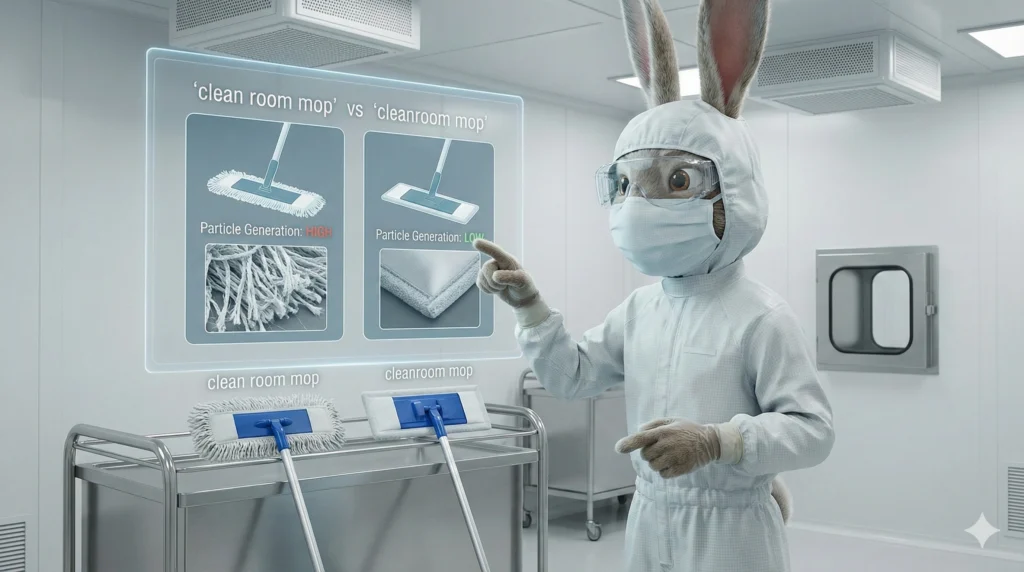
Figure 1: Material and construction comparison illustrating the fundamental difference between “clean room mop” and “cleanroom mop” products. Left: Consumer-grade microfiber mop with cut edges showing exposed fiber ends that shed particles during use—suitable for general janitorial applications but disqualified from pharmaceutical cleanrooms. Right: Pharmaceutical-grade cleanroom mop with sealed-edge polyester construction, heat-sealed perimeter encapsulating all fiber ends to prevent particle generation—validated for ISO Class 5–8 GMP manufacturing environments.
Defined by ISO 14644 & GMP Annex 1 Usage
ISO 14644-1 defines cleanrooms as controlled environments “in which the concentration of airborne particles is controlled, and which is constructed and used in a manner to minimize the introduction, generation, and retention of particles inside the room.” This three-part mandate—control airborne particles, prevent introduction, minimize generation—extends to every activity inside the cleanroom, including cleaning. The “cleanroom mop” (one word) exists specifically to meet this standard: it must not generate particles during use, must not introduce contamination from outside the space, and must support validated protocols that remove particles rather than redistribute them.
EU GMP Annex 1 operationalizes these principles for pharmaceutical manufacturing. The regulation requires that “cleaning materials used in Grade A/B areas should be sterile” and that “disinfectants and detergents should be monitored for microbial contamination.” Cleanroom mops for aseptic manufacturing must therefore support pre-sterilization (gamma irradiation, ethylene oxide, or autoclave), resist degradation from repeated disinfectant exposure, and enable validated cleaning workflows that maintain environmental monitoring compliance. The regulatory text consistently uses “cleanroom” as one word, reinforcing the term’s technical specificity.
Low-Lint, Sealed-Edge Construction
Sealed-edge construction is the defining physical characteristic of pharmaceutical-grade cleanroom mops. Rather than cutting fabric and exposing fiber ends, sealed-edge manufacturing uses heat-sealing, ultrasonic bonding, or continuous-edge knitting to encapsulate all fabric edges. This prevents fiber ends from fraying, catching on rough floor surfaces, or releasing particles into airflow. The difference is immediately visible: cut-edge mops show loose threads and fuzzy borders, while sealed-edge mops present smooth, continuous perimeters with no exposed fiber ends.
Knit construction matters as much as edge treatment. Pharmaceutical cleanroom mops use closed-loop knit polyester or polyester-blend fabrics where the knitting process creates continuous loops without cutting. The fabric is knitted as tubes or sheets, then converted into mop heads with all edges sealed. This construction yields particle generation rates below 100 particles ≥0.5 µm per square meter of mopping—validated through IEST-RP-CC003 or equivalent testing. Compare this to cut-edge microfiber mops generating 1,000–10,000 particles per square meter, and the contamination control difference becomes quantifiable.
Mop head attachment systems also receive sealed-edge treatment. Pharmaceutical mops use pocket-style frames where the mop head slides into a continuous fabric pocket, or hook-and-release systems with sealed attachment strips. No exposed Velcro, no hook-and-loop fasteners that trap particles, no threaded connections that loosen under repeated autoclave cycles.
Non-Shedding Materials Used in Pharmaceutical Areas
Polyester dominates pharmaceutical cleanroom mop construction—typically 100% polyester knit or polyester-cellulose blends (for specific absorbency requirements). Polyester offers the best combination of low-lint performance, chemical resistance, autoclave durability, and mechanical strength. The polymer structure resists fiber breakage during wringing and floor contact, preventing the particle shedding that occurs with natural fibers (cotton) or lower-quality synthetics.
For critical Grade A/B applications, some manufacturers use continuous-filament polyester: ultra-long fibers knitted into fabric without cutting or splicing. This eliminates short fiber ends entirely, reducing particle generation to the absolute minimum. The material cost is higher ($80–$150 per mop head versus $40–$70 for standard polyester knit), but the contamination control benefit justifies the expense in aseptic filling suites and isolator environments where a single particle excursion can halt production.
Absorbency-enhancing materials must also meet low-lint standards. Some pharmaceutical mops incorporate microdenier polyester (fibers <1 denier) or controlled amounts of rayon/cellulose to increase fluid retention for larger mopping areas. These additives are knitted into the base polyester structure with sealed-edge construction maintained throughout, ensuring the absorbency benefit doesn’t compromise particle control.

Compatibility with Disinfectants (IPA, Quat, Bleach, H₂O₂)
Pharmaceutical cleanrooms rotate disinfectants to prevent microbial resistance, requiring mop materials to withstand sequential exposure to:
- 70% كحول الأيزوبروبيل (IPA): Daily use in Grade A/B areas; causes swelling and potential degradation in some polymers
- Quaternary Ammonium Compounds (Quats): General disinfection; relatively mild but requires rinsing to prevent residue buildup
- هيبوكلوريت الصوديوم (المبيض، 500-5000 جزء في المليون): Broad-spectrum antimicrobial but oxidizes many materials
- بيروكسيد الهيدروجين (3-6%): Sporicidal agent for periodic deep cleaning; degrades cellulose and some polyester blends
Cleanroom-grade polyester mops are validated for this rotation. Manufacturers conduct compatibility testing: soak mop heads in each disinfectant at validated concentrations for 2× typical contact time, perform particle generation testing post-exposure, measure mechanical strength retention, and verify no fiber breakage or material degradation. Specification sheets document pass/fail for each disinfectant class, enabling procurement teams to match mop selection to their facility’s disinfectant rotation protocol.
Material compatibility extends beyond chemical resistance to functional performance. Some disinfectants (high-concentration bleach, strong peroxides) cause temporary stiffening or texture changes in polyester. If these changes impair the mop’s ability to maintain floor contact or release trapped particles during wringing, the material is unsuitable despite passing basic chemical resistance tests. Pharmaceutical mop vendors provide application notes specifying maximum disinfectant concentrations, required rinse protocols, and recommended change-out frequencies to maintain validated performance.
Compatible with Autoclavable Buckets & مقابض
Cleanroom mops function as part of complete validated systems: mop heads + handles + buckets + carts, all qualified together. For Grade A/B use, every component must withstand 121°C steam autoclaving for 30 minutes without degradation. Polyester mop heads tolerate 50–100 autoclave cycles before material embrittlement requires replacement—dramatically better than microfiber mops (5–10 cycles) but still finite. Vendors specify autoclave service life in their qualification protocols.
Handle compatibility determines whether the complete mop system can be sterilized as a unit. Pharmaceutical mop handles use stainless steel (SS304 or SS316) or autoclave-grade polypropylene, with sealed construction that prevents water intrusion during steam cycles. Thread connections, if used, are sealed with autoclavable gaskets; most high-end handles eliminate threads entirely, using continuous-weld or friction-lock designs. The mop head attachment mechanism—typically a frame that clamps or slides onto the handle—must maintain secure connection through 50+ autoclave cycles without loosening or corroding.
For foundational contamination control principles and comprehensive cleaning tool selection, see the complete cleanroom mop guide covering materials, validation, and GMP workflows.
Technical Differences That Matter
Material selection determines particle generation, disinfectant compatibility, and service life—the three factors that drive total cost and compliance risk.
Material: Polyester vs Microfiber vs Foam
البوليستر (100% or polyester-dominant blends): The pharmaceutical industry standard. Continuous-filament or knit polyester with sealed edges generates <100 particles ≥0.5 µm per m² of mopping when properly manufactured. Polyester resists alcohols, quats, and moderate-concentration bleach/peroxide, withstands 50–100 autoclave cycles, and maintains mechanical integrity across 200–300 uses with proper laundering. Cost: $40–$150 per mop head depending on construction quality (standard knit vs continuous-filament). Best for: ISO Class 5–8 pharmaceutical manufacturing, medical device cleanrooms, biotech aseptic areas.
ستوكات (polyester-polyamide blends, typically 80/20): Offers superior absorbency and soil pickup versus standard polyester but comes with trade-offs. Quality varies widely—pharmaceutical-grade microfiber uses sealed-edge construction and low-lint knitting, while commercial microfiber (the type marketed as “clean room” with two words) uses cut edges and sheds particles. Even sealed-edge microfiber generates 100–500 particles per m²—acceptable for ISO Class 7–8 but marginal for Class 5–6. Microfiber degrades faster under bleach and peroxide (30–50 autoclave cycles vs 50–100 for polyester) and requires more frequent replacement. Cost: $25–$80 per mop head. Best for: ISO Class 7–8 general manufacturing areas, gowning rooms, Grade C/D support spaces.
Foam (polyurethane or polyvinyl alcohol): Specialized use in high-purity electronics (semiconductor fabs) and specific pharmaceutical applications requiring ultra-smooth surface contact. Foam mops generate minimal particles (<50 per m²) because there are no fibers to shed, but absorbency is lower than polyester/microfiber and disinfectant compatibility is more limited. PVA foam dissolves in hot water, enabling single-use workflows; polyurethane foam can be autoclaved but degrades under bleach. Cost: $15–$40 per mop head (disposable PVA) or $60–$120 (reusable polyurethane). Best for: ISO Class 4–5 semiconductor cleanrooms, isolator maintenance, specialty pharmaceutical applications where low particle generation justifies the cost/limitation trade-off.
Manufacturing: Sealed-Edge vs Cut-Edge
Edge treatment is the binary dividing line between pharmaceutical-grade and general cleaning products. The manufacturing process determines whether the mop will shed particles or maintain its low-lint performance across hundreds of uses.
Sealed-Edge Manufacturing: Fabric edges are heat-sealed (thermoplastic melting), ultrasonically bonded (high-frequency vibration welding), or knit-closed (continuous-loop construction with no cut ends). The sealing process encapsulates fiber ends, preventing fraying and particle release. Sealed edges withstand the mechanical stress of wringing, floor abrasion, and repeated laundering without opening or degrading. Visual inspection reveals smooth, continuous borders; tactile examination shows no loose threads or fiber ends. Cost adder: $10–$30 per mop head versus cut-edge equivalent. Performance benefit: 10–100× reduction in particle generation. Pharmaceutical cleanrooms universally require sealed-edge construction for ISO Class 5–8 compliance.
Cut-Edge Manufacturing: Fabric is cut to shape with scissors, rotary blades, or die-cutting, leaving exposed fiber ends. Edges may be overlock-stitched (serged) to slow fraying but fibers still protrude and shed. This is the standard manufacturing method for consumer and commercial janitorial mops because it’s fast, inexpensive, and adequate for non-particle-controlled environments. Cut-edge mops shed 1,000–10,000 particles per m² of mopping—two to three orders of magnitude worse than sealed-edge equivalents. These mops are disqualified from pharmaceutical use by their particle generation profile alone, regardless of material or disinfectant compatibility.
يعد فرق التكلفة (10 إلى 30 دولارًا لكل رأس ممسحة) تافهًا مقارنة بالتكلفة التشغيلية لفشل المراقبة البيئية، ودورات التحقيق، وتوقف الإنتاج المحتمل الناتج عن رحلات الجسيمات. ومع ذلك، تستمر أخطاء الشراء - عادةً عندما يبحث المشترون عن "ممسحة غرفة نظيفة" (كلمتين) ويحصلون على منتجات متطورة يسوقها البائعون على أنها "مناسبة لغرف الأبحاث" دون تحديد قيود فئة ISO.
تصنيف غرف الأبحاث: ISO 3–9
يصنف المعيار ISO 14644-1 غرف الأبحاث حسب حدود تركيز الجسيمات المحمولة جوًا. يحدد التصنيف الذي تستهدفه مواصفات الممسحة التي تحتاجها:
| فئة الأيزو | الجسيمات ≥0.5 ميكرومتر/م³ (في حالة الراحة) | درجة GMP الصيدلانية | مواصفات الممسحة مطلوبة |
| ايزو 3 | .235.2 | (تطبيقات خاصة) | رغوة أو بوليستر ذو خيوط مستمرة؛ <تم التحقق من صحة 50 جسيمًا/م²؛ معقمة بأشعة غاما |
| ايزو 4 | ≥352 | (تطبيقات خاصة) | بوليستر ذو خيوط مستمرة؛ <تم التحقق من صحة 50 جسيمًا/م²؛ التعقيم بأشعة غاما أو الأوتوكلاف |
| ايزو 5 | ≥3,520 | الصف أ | بوليستر ذو حافة محكمة الغلق؛ <تم التحقق من صحة 100 جسيم/م²؛ معقمة (غاما أو الأوتوكلاف) |
| ايزو 6 | ≥35,200 | درجة ب | بوليستر ذو حافة محكمة الغلق؛ <تم التحقق من صحة 100 جسيم/م²؛ معقمة (غاما أو الأوتوكلاف) |
| ايزو 7 | .352,000 | الصف ج | بوليستر ذو حافة محكمة الغلق أو ألياف دقيقة عالية الجودة؛ <تم التحقق من صحة 200 جسيم/م² |
| ايزو 8 | ≥3,520,000 | الصف د | بوليستر ذو حافة محكمة الغلق أو ألياف دقيقة عالية الجودة؛ <تم التحقق من صحة 500 جسيم/م2 |
| ايزو 9 | ≥35,200,000 | (دعم غير مصنف) | ألياف دقيقة عالية الجودة؛ البناء العام منخفض الوبر مقبول |
The tighter the particle limit, the more critical sealed-edge construction and material selection become. ISO Class 5 (Grade A) aseptic processing areas have zero tolerance for particle-generating cleaning tools—a single mop shedding 1,000 particles per pass will cause immediate environmental monitoring failures and investigation cycles. ISO Class 7–8 (Grade C/D) areas have more margin, but over-specification wastes budget while under-specification creates compliance risk.
Particle Release Test Data (Include MIDPOSI Data if Available)

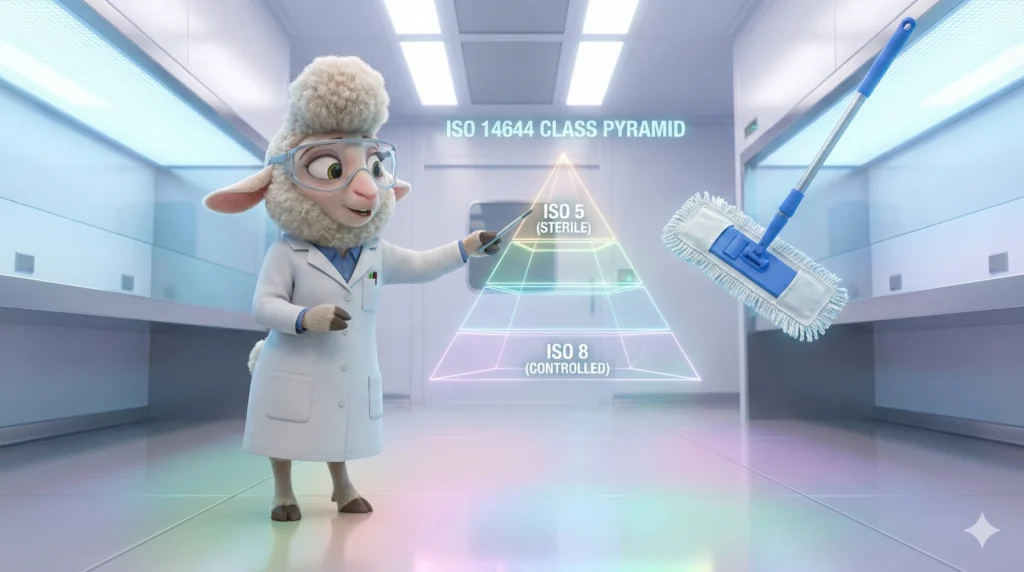
Figure 2: ISO 14644 cleanroom classification pyramid showing particle concentration requirements from ISO Class 3 (most stringent, ≤35.2 particles ≥0.5 µm/m³) to ISO Class 9 (least stringent, ≤35,200,000 particles/m³), with corresponding pharmaceutical GMP grades (A/B/C/D) and required mop specifications. Tighter particle limits demand stricter mop construction: ISO 5 (Grade A) requires sealed-edge polyester generating <100 particles/m² with gamma or autoclave sterilization, while ISO 8 (Grade D) accepts sealed-edge polyester or high-grade microfiber with <500 particles/m² validation.
Reputable pharmaceutical mop vendors provide particle generation test data conducted per IEST-RP-CC003.4 (“Garment System Considerations for Cleanrooms and Other Controlled Environments”) or equivalent protocols. Testing methodology: saturate the mop head with DI water or representative disinfectant, mop a controlled surface area (typically 1 m²) using standardized stroke pattern and pressure, measure airborne particle concentration using optical particle counter positioned downstream of the mopping operation, calculate particles released per square meter of mopping.
Typical results for pharmaceutical-grade mops:
- Sealed-edge knit polyester: 60–120 particles ≥0.5 µm per m²
- Sealed-edge continuous-filament polyester: 30–80 particles ≥0.5 µm per m²
- Sealed-edge knit polyester: 60–120 particles ≥0.5 µm per m²
- Sealed-edge microfiber (pharmaceutical-grade): 100–300 particles ≥0.5 µm per m²
- Cut-edge microfiber (commercial): 1,000–10,000 particles ≥0.5 µm per m²
MIDPOSI cleanroom mopping systems use sealed-edge knit polyester construction validated to generate <100 particles ≥0.5 µm per m² of mopping, meeting ISO Class 5–8 requirements. Mop heads undergo particle release testing at third-party cleanroom certification labs with results documented in product qualification protocols. The sealed-edge manufacturing process and polyester material selection ensure consistent low-lint performance across 200+ uses when mops are laundered per specification (neutral detergent, no fabric softener, validated rinse cycles) and autoclaved within service life limits (50–100 cycles depending on autoclave frequency and disinfectant exposure).
Sterilization Method Compatibility (Gamma, EO, Autoclave)
Grade A/B pharmaceutical areas require sterile cleaning tools. The sterilization method you specify determines which mop materials and construction types are compatible:
Gamma Irradiation: Exposes mops to 25–50 kGy ionizing radiation, achieving SAL 10⁻⁶ without heat or chemical residues. Polyester tolerates gamma well; microfiber shows some strength loss at >40 kGy; foam degrades significantly. Advantage: vendor can supply pre-sterilized mops in sealed packaging, eliminating in-house sterilization workload. Disadvantage: single-use workflow (re-sterilization requires returning mops to vendor) and higher cost ($8–$15 per mop head for gamma sterilization service). Best for: facilities without autoclave capacity, single-use mop protocols, or when contamination risk justifies disposable workflows.
Ethylene Oxide (EO): Gas sterilization at 50–60°C, compatible with most polymers but requires aeration time (12–24 hours) to eliminate toxic residues. Rarely used for mops (more common for medical devices and heat-sensitive equipment) because autoclave is faster and doesn’t leave chemical residues requiring validation. Polyester and microfiber tolerate EO; foam compatibility varies by formulation.
Autoclave (Steam Sterilization): 121 درجة مئوية لمدة 30 دقيقة (دورة الجاذبية) أو 15 دقيقة (دورة ما قبل التفريغ)، وهي طريقة التعقيم الداخلي الأكثر شيوعًا لغرف الأبحاث الصيدلانية. يتحمل البوليستر 50-100 دورة؛ تتحلل الألياف الدقيقة بشكل أسرع (30-50 دورة)؛ تذوب رغوة PVA (مخصصة لبروتوكولات الاستخدام الفردي)؛ تتحمل رغوة البولي يوريثان 20-30 دورة. الميزة: التحول السريع (المماسح معقمة وجاهزة للنوبة التالية)، عدم الاعتماد على البائع، أقل تكلفة لكل دورة (0.50 دولار - 1.00 دولار تكلفة الطاقة/العمالة). العيب: يتطلب جهاز تعقيم معتمدًا، ودورات مؤهلة، ومراقبة المؤشرات البيولوجية، وسجلات الدورة الموثقة وفقًا لـ 21 CFR 211.182. الأفضل بالنسبة إلى: المرافق ذات البنية التحتية الحالية للأوتوكلاف، وبروتوكولات الممسحة القابلة لإعادة الاستخدام، ومخزون ممسحة كافٍ لدعم دورة الغسيل/التعقيم.
For detailed specifications on mop head materials and edge construction, see the mop head types guide covering polyester vs microfiber performance data, sealed-edge manufacturing processes, and selection criteria by ISO class.
Cleanroom Standard Requirements That Mops Must Meet
ISO 5–8 Contamination Control Standards
يحدد المعيار ISO 14644-1 حدود تركيز الجسيمات التي يجب ألا تتنازل عنها مماسح غرف الأبحاث. يحدد المعيار الظروف "في حالة الراحة" (غرفة الأبحاث تعمل مع تشغيل نظام التدفئة والتهوية وتكييف الهواء (HVAC) ولكن لا يوجد موظفون أو عمليات نشطة) والظروف "التشغيلية" (نشاط التصنيع العادي). تُستخدم المماسح أثناء الحالات التشغيلية، مما يعني أن مساهمتها الجزيئية تضيف إلى الخلفية الموجودة. بالنسبة إلى فئة ISO 5 (≥3,520 جسيمًا ≥0.5 ميكرومتر/م³)، يمكن للممسحة التي تولد 1000 جسيم لكل متر مربع من المسح أن تدفع أعداد الجسيمات الموضعية إلى أعلى من حدود التصنيف - خاصة في المناطق ذات سرعة تدفق الهواء المنخفضة (المناطق الميتة على مستوى الأرض، والزوايا، وخلف المعدات).
The standard also addresses microbial contamination, though particle limits are the primary classification criteria. ISO 14698 (“Cleanrooms and associated controlled environments — Biocontamination control”) provides bioburden control guidance, noting that viable particles (bacteria, fungi) adhere to non-viable particles and surfaces. A mop that sheds particles creates attachment sites for microorganisms, increasing both particle counts and microbial contamination risk. Pharmaceutical facilities typically set internal limits stricter than ISO minimums: a Grade A area (ISO 5 at rest) might require mop particle generation <50 per m² to maintain adequate contamination control margin.
GMP Annex 1 Environmental Cleaning Expectations
قام الملحق 1 لممارسات التصنيع الجيدة للاتحاد الأوروبي (اعتبارًا من أغسطس 2023) بتشديد متطلبات مواد التنظيف والتحقق من صحة التطهير. الأحكام الرئيسية:
- شرط العقم: "يجب أن تكون المواد المستخدمة للتنظيف والتطهير في مناطق الدرجة A/B معقمة. وعندما يكون تطهير المواد مناسبًا، يجب تحديد الطريقة والتركيز ووقت الاتصال والتحقق من صحتها."
- التحقق من صحة برنامج التنظيف: "يجب أن يتبع التنظيف والتطهير برنامجًا مكتوبًا ومعتمدًا. ويجب مراقبة المطهرات والمنظفات بحثًا عن التلوث الميكروبي، ويجب حفظ التخفيفات في حاويات تم تنظيفها مسبقًا ويجب تخزينها فقط لفترات محددة ما لم يتم تعقيمها."
- دوران المطهر: "يجب استخدام أكثر من نوع من المطهرات. ويجب إجراء المراقبة بانتظام للكشف عن تطور سلالات مقاومة."
- إزالة البقايا: "يجب تصميم إجراءات التنظيف لإزالة البقايا بشكل فعال ويجب التحقق من صحتها. يتطلب استخدام المنظفات أو المواد الأخرى في عملية التنظيف عناية خاصة لمنع التلوث."
تؤثر هذه المتطلبات بشكل مباشر على مواصفات الممسحة. "معقم" يعني تعرض لأشعة غاما أو تم تعقيمه باستخدام SAL 10⁻⁶ الموثق. "تم التحقق من صحته" يعني اختبارًا موثقًا يثبت أن نظام مطهر دلو الممسحة يحقق الحد المطلوب من العبء الحيوي (عادةً >3-log) without generating particles or leaving residues. “Rotation” means the mop must tolerate alcohols, quats, bleach, and peroxides without degrading. Facilities must document mop sterilization methods, change-out frequencies, particle generation data, and disinfectant compatibility in their cleaning validation protocols.
Why Consumer-Grade Microfiber Fails Compliance
Consumer microfiber mops fail pharmaceutical qualification on multiple fronts:
- تنحية توليد الجسيمات: Cut-edge construction sheds 1,000–10,000 particles per m², exceeding acceptable limits by 10–100× for ISO Class 5–8 environments.
- لا يوجد طريق التعقيم: Velcro attachments, foam backings, and polyamide blend fibers degrade after 5–10 autoclave cycles; gamma irradiation causes strength loss and material breakdown.
- التوافق المطهر غير المعتمد: Materials may tolerate bleach or quats individually but fail under pharmaceutical rotation protocols (Monday alcohol, Tuesday peroxide, Friday bleach).
- لا توجد وثائق التأهيل: Consumer vendors provide no particle generation test data, no sterilization validation, no chemical compatibility matrices—leaving pharmaceutical QA teams unable to complete IQ/OQ/PQ protocols.
- Material traceability gaps: Pharmaceutical regulations require material certifications, lot traceability, and change control for cleaning tools. Consumer mops lack these controls.
Auditors flag consumer-grade mops during facility inspections because the specification gap is obvious: if your cleaning SOP references ISO 14644 and GMP Annex 1, but your mop supplier can’t provide particle generation data or sterilization validation, you have a documentation gap that won’t survive regulatory scrutiny.
Cleanroom Mop Validation & التوثيق
Pharmaceutical cleanroom mops require three-tier qualification:
الذكاء (تأهيل التثبيت): Document mop specifications (material composition, sealed-edge construction, dimensions), verify lot numbers and certificates of conformance, confirm sterilization method and SAL documentation, inspect for physical defects (loose threads, damaged edges, contamination).
OQ (التأهيل التشغيلي): Demonstrate the mop functions as specified within the validated cleaning system. Test disinfectant compatibility (no degradation after 10 cycles of each disinfectant type), verify autoclave survivability (no performance loss after 20 cycles if applicable), measure particle generation per IEST-RP-CC003.4 (<100 particles per m² for ISO 5–8 use), confirm mechanical integrity (no fiber shedding during wringing, floor contact).
PQ (تأهيل الأداء): Prove the complete mop system (mop + bucket + disinfectant + technique) achieves required contamination control in actual use. Conduct environmental monitoring pre- and post-cleaning (particle counts, microbial surface sampling), demonstrate >3-تسجيل تقليل العبء الحيوي، والتحقق من ثبات تركيز المطهر طوال دورة التنظيف، والتحقق من أن التطهير لا يرفع عدد الجسيمات فوق حدود فئة ISO.
تتضمن حزم التوثيق مواصفات الشركة المصنعة وبيانات الاختبار، وشهادات التحليل والمطابقة لكل دفعة، وشهادات التعقيم (سجلات جرعة جاما أو وثائق دورة الأوتوكلاف)، وإجراءات التحكم في التغيير (ماذا يحدث إذا قامت الشركة المصنعة بتغيير المواد أو العمليات)، وجداول إعادة التأهيل الدورية (التحقق السنوي من توليد الجسيمات، وعمليات الفحص البصري ربع السنوية).
ما هو المصطلح الذي يجب على شركات الأدوية استخدامه؟
المصطلحات المستخدمة من قبل ادارة الاغذية والعقاقير & من
تشير وثائق إرشادات إدارة الغذاء والدواء الأمريكية بشأن المعالجة المعقمة ("منتجات الأدوية المعقمة التي تنتجها المعالجة المعقمة - CGMP،" سبتمبر 2004) إلى "غرف الأبحاث" دون تحديد تهجئة مكونة من كلمة واحدة مقابل كلمتين، ولكنها تستخدم باستمرار "غرفة الأبحاث" المركبة المغلقة عند مناقشة بيئات التحكم في التلوث. ترجع التوجيهات إلى ISO 14644 لمنهجية التصنيف، وتعتمد ضمنيًا مصطلحات ISO المكونة من كلمة واحدة. تستخدم أدلة التفتيش وخطابات التحذير الخاصة بإدارة الغذاء والدواء "الغرف النظيفة" عند الإشارة إلى أوجه القصور المتعلقة بالغرف النظيفة، بما يتماشى مع اللغة التنظيمية الدولية.
تستخدم سلسلة التقارير الفنية لمنظمة الصحة العالمية 1044، الملحق 2 ("ممارسات التصنيع الجيدة للمنتجات الصيدلانية: المبادئ الرئيسية") "غرف الأبحاث" في جميع أنحاءها وتشير بوضوح إلى ISO 14644 للتصنيف. تنص الوثيقة على ما يلي: "يجب تأهيل غرف الأبحاث وأجهزة الهواء النظيف ومراقبة أدائها بشكل روتيني. ويجب إجراء التأهيل والمراقبة وفقًا للمبادئ الواردة في ISO 14644." وهذا يعزز مصطلح "الغرفة النظيفة" باعتباره المصطلح الصحيح في التصنيع الدوائي الدولي.
التسمية الموصى بها للمشتريات
يجب أن تستخدم مواصفات المشتريات "ممسحة غرف الأبحاث" (كلمة واحدة) من أجل:
- مطابقة اللغة التنظيمية: يتوافق مع ISO 14644، والملحق 1 لممارسات التصنيع الجيدة للاتحاد الأوروبي، ومصطلحات منظمة الصحة العالمية، مما يضمن أن استجابات البائعين تلبي المعايير الصيدلانية.
- تصفية نتائج البحث: يقوم البائعون الذين يخدمون الصناعات الخاضعة للتنظيم بفهرسة المنتجات على أنها "مماسح غرف الأبحاث"؛ يؤدي البحث عن "ممسحة غرفة نظيفة" (كلمتان) إلى إرجاع المزيد من نتائج مستلزمات النظافة التي تتطلب تصفية يدوية.
- المتطلبات الفنية للإشارة: تقوم "ممسحة غرف الأبحاث" بإعلام البائعين بأنك بحاجة إلى بناء محكم الغلق، وبيانات توليد الجسيمات، وتوافق التعقيم، ووثائق التأهيل - وليس مجرد ممسحة "أنظف من المعتاد".
- دعم الدفاع التدقيق: عندما يقوم المفتشون بمراجعة سجلات المشتريات، فإن المواصفات التي تستخدم المصطلحات المتوافقة مع القواعد التنظيمية توضح الكفاءة الفنية ونية الامتثال.
قالب لغة المواصفات:
"يجب على المورد توفير مماسح غرف الأبحاث (بنية البوليستر ذات الحواف المختومة) التي تم التحقق من صحتها لاستخدام فئة ISO [5/6/7/8]. الوثائق المطلوبة: بيانات اختبار توليد الجسيمات وفقًا لمعيار IEST-RP-CC003.4 <[50/100/200/500] جسيمات ≥0.5 ميكرومتر لكل متر مربع من التطهير؛ التحقق من التوافق الكيميائي لـ 70% من IPA، ومركبات الأمونيوم الرباعية، و3-6% H₂O₂، و500-5000 جزء في المليون من هيبوكلوريت الصوديوم؛ التحقق من صحة التعقيم (تشعيع جاما إلى SAL 10⁻⁶ أو التوافق مع الأوتوكلاف عند 121 درجة مئوية/30 دقيقة لمدة 50 دورة على الأقل)؛ شهادات مطابقة المواد وإمكانية تتبع الكمية."
منع شراء اللوازم غير المتوافقة
ثلاثة ضوابط للمشتريات تمنع عمليات شراء الممسحة ذات المواصفات الخاطئة:
1. قائمة الموردين المعتمدين (AVL): تأهيل البائعين قبل إصدار أوامر الشراء. معايير التأهيل: يوفر البائع منتجات غرف نظيفة من الدرجة الصيدلانية (وليس مستلزمات النظافة العامة)، وتتضمن حزم الوثائق بيانات توليد الجسيمات والتحقق من صحة التعقيم، ويمتلك البائع أنظمة إمكانية التتبع والتحكم في التغيير، ويخدم البائع الشركات المصنعة للأجهزة الصيدلانية/الطبية الأخرى (مراجع يمكن التحقق منها). يجب أن تقوم أنظمة الشراء بحظر أوامر الشراء للبائعين غير AVL للمواد الاستهلاكية في غرف الأبحاث.
2. الشراء المبني على المواصفات: ربط طلبات الشراء بالمواصفات الرئيسية. عندما يطلب المستخدم "مماسح لغرفة الأبحاث من الدرجة ب"، يقوم النظام تلقائيًا بتعبئة المواصفات (البوليستر ذو الحواف المختومة، <100 جسيم/م²، معقمة بأشعة غاما، ومتوافقة مع دوران المطهرات الصيدلانية) والمسارات إلى بائعي AVL الذين لديهم منتجات مؤهلة مسبقًا تفي بهذه المواصفات. وهذا يمنع المستخدمين من البحث عن المصطلحات العامة ("ممسحة الغرفة النظيفة") واختيار المنتجات غير المتوافقة.
3. استلام التفتيش: تحقق من مطابقة المماسح الواردة للمواصفات قبل إطلاقها لاستخدام غرف الأبحاث. الفحص البصري للحواف المختومة (بدون خيوط فضفاضة، محيطات مستمرة)، ومراجعة الوثائق (شهادات التحليل، وسجلات التعقيم، وأرقام الدفعة)، واختبار دوري من طرف ثالث (إرسال عينات عشوائية للتحقق المستقل من توليد الجسيمات). رفض الدفعات التي تصل دون الوثائق المطلوبة أو تظهر عيوب الجودة.
وضع فشل المشتريات الشائع: تحدد المنشآت "ممسحة غرفة الأبحاث" بشكل صحيح في المواصفات الرئيسية ولكنها تسمح بعد ذلك للأقسام الفردية بإجراء عمليات شراء مخصصة من خلال الموردين العامين (Amazon Business، Grainger، Uline) الذين يبحثون عن "ممسحة غرفة نظيفة". تتجاوز هذه الطلبات ضوابط AVL وتقدم منتجات غير متوافقة تفشل أثناء الاستخدام.
كيف تتوافق ممسحة غرف الأبحاث MIDPOSI مع تعريف الفئة الصيدلانية
تم تصميم أنظمة تنظيف غرف الأبحاث MIDPOSI خصيصًا للامتثال لممارسات التصنيع الجيدة الصيدلانية:
- هيكل من البوليستر ذو حافة محكمة الغلق: نسيج بوليستر محبوك مع حواف محكمة الغلق بالحرارة تغطي جميع أطراف الألياف، وتم التحقق من إنتاجه <100 جسيم ≥0.5 ميكرومتر لكل متر مربع من المسح (تم اختباره وفقًا لـ IEST-RP-CC003.4).
- مؤهل من فئة ISO 5-8: Particle generation performance meets requirements for pharmaceutical Grade A/B/C/D areas; test data available in product qualification documentation.
- Pharmaceutical disinfectant compatibility: Validated for 70% IPA, quaternary ammonium compounds, 3–6% hydrogen peroxide, and sodium hypochlorite (500–5000 ppm); withstands pharmaceutical rotation protocols without degradation.
- Autoclave-compatible: Mop heads tolerate 50–100 steam sterilization cycles at 121°C/30 min; compatible with stainless steel and polypropylene handles/frames that survive equivalent autoclave duty.
- Complete system qualification: Mops integrate with validated bucket systems (dual- and triple-bucket configurations), frames, and carts to deliver turnkey GMP cleaning workflows.
- Documentation packages: تشتمل كل دفعة على شهادات التحليل، وشهادات المواد، وبيانات توافق التعقيم (حدود دورة الأوتوكلاف)، وتقارير اختبار توليد الجسيمات، وسجلات التتبع التي تدعم بروتوكولات IQ/OQ/PQ.
لأنظمة مسح غرف الأبحاث الكاملة بما في ذلك الدلاء والإطارات وسير العمل الذي تم التحقق منه، راجع دليل النظام المتكامل.
جدول ملخص - ممسحة الغرفة النظيفة مقابل ممسحة الغرفة النظيفة
| معيار | ممسحة الغرفة النظيفة (كلمتان) | ممسحة غرف الأبحاث (كلمة واحدة) |
| أصل المصطلحات | اللغة الإنجليزية العامة (معيار القاموس) | المصطلح الفني ISO 14644 / GMP الملحق 1 |
| البيئة المستهدفة | المجالات غير الخاضعة لمعايير ISO: المكاتب والمدارس والتعبئة والتغليف والتصنيع الخفيف | غرف الأبحاث الصيدلانية ISO 5–8 (الدرجة A/B/C/D) |
| بناء | قماش ذو حافة مقطوعة، وأطراف من الألياف المكشوفة | بوليستر ذو حافة محكمة الغلق، أطراف من الألياف المغلفة |
| مادة | مزيج من القطن والألياف الدقيقة القياسية والبوليستر | بوليستر محبوك (100% أو مزيج مهيمن)، خيارات خيوط مستمرة |
| توليد الجسيمات | 1000-10000 جسيم ≥0.5 ميكرومتر/م² | <100 جسيم ≥0.5 ميكرومتر/م² (تم التحقق من صحة ISO 5–8) |
| التوافق مع المطهر | الأساسية (التبييض، القرفصاء)؛ لا التحقق من صحة التناوب | تم التحقق من صحته للدورة الصيدلانية (IPA، الكوات، المبيض، H₂O₂) |
| تعقيم | غير قابل للتعقيم (5-10 دورات كحد أقصى)؛ لا يوجد خيار جاما | 50-100 دورة الأوتوكلاف؛ تتوفر خيارات معقمة بأشعة جاما |
| الوثائق التنظيمية | لا يوجد (منتج استهلاكي) | بيانات الجسيمات، والتوافق الكيميائي، والتحقق من صحة التعقيم، وإمكانية تتبع الدفعة |
| التكلفة لكل رأس ممسحة | 15 دولارًا - 30 دولارًا | 40 دولارًا - 150 دولارًا |
| خدمة الحياة | 50-100 استخدام قبل التدهور المرئي | 200-300 استخدام (مع الغسيل/التعقيم المناسب) |
| فئات ISO المناسبة | ISO 9 / مناطق الدعم غير المصنفة فقط | ISO 5–8 (تصنيع الأدوية والأجهزة الطبية والتكنولوجيا الحيوية) |
| الامتثال لممارسات التصنيع الجيدة | ❌ فشل في متطلبات الملحق 1 | ✅ يلبي متطلبات أدوات التنظيف المعقمة الملحق 1 |
| قنوات الشراء | إمدادات النظافة، التجارة الإلكترونية العامة (Amazon، Grainger) | موردي غرف الأبحاث الدوائية والموزعين المتخصصين |
| توثيق التأهيل | ❌ لا يوجد دعم IQ/OQ/PQ | ✅ تتوفر حزم وثائق IQ/OQ/PQ الكاملة |
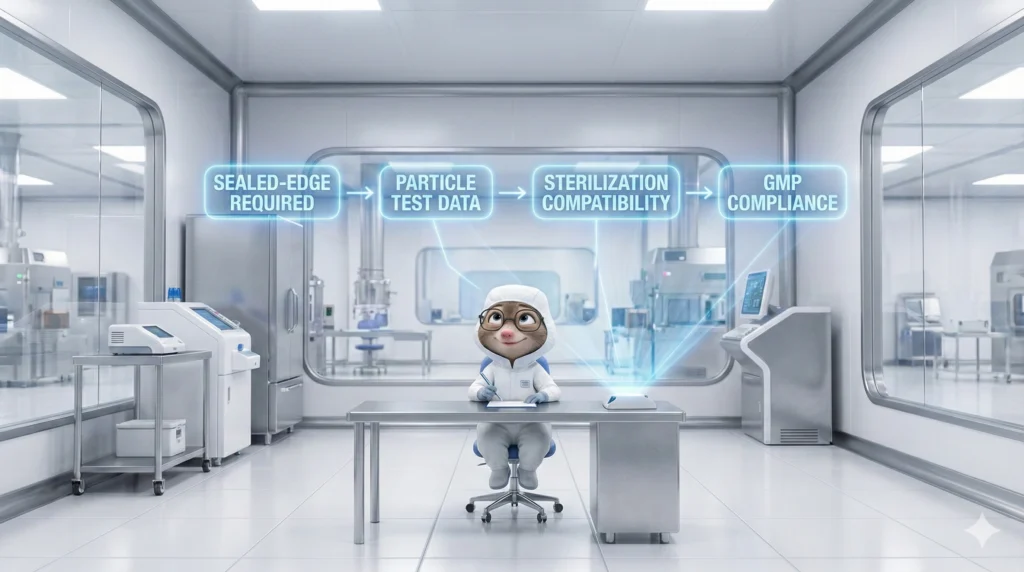
الشكل 3: غرفة الأبحاث من الدرجة B/C الصيدلانية تظهر عمليات التطهير المناسبة لبرنامج الرصد العالمي (GMP) مع مشغل يرتدي ملابس كاملة باستخدام نظام الدلو الثلاثي المعتمد، وممسحة غرف الأبحاث ذات الحافة المختومة، وتقنية التحكم في التلوث الخاضعة للرقابة. تتطلب هذه البيئة مواصفات "ممسحة غرف الأبحاث" (كلمة واحدة) - أدوات بوليستر ذات حواف محكمة الغلق من الدرجة الصيدلانية تم التحقق من صحتها للتحكم في الجسيمات وفقًا لمعايير ISO 5-8، وليس "مماسح غرف نظيفة" عامة (كلمتين) مصممة للاستخدام التجاري في أعمال النظافة. تضمن المصطلحات المناسبة أن عملية الشراء توفر أدوات متوافقة مع GMP والتي تحافظ على الامتثال للمراقبة البيئية وتنجو من التفتيش التنظيمي.
منصات ممسحة غرف الأبحاث يمكن التخلص منها
الأفضل ل: سير العمل ذو الاستخدام الواحد، والمرافق التي لا تحتوي على بنية تحتية لغسيل الملابس، والمناطق ذات مخاطر التلوث العالية التي تتطلب أدوات جديدة لكل غرفة.
تحديد: وسادات بوليستر ذات حواف محكمة الغلق معقمة مسبقًا (تشعيع جاما)، ومعبأة بشكل فردي. حجم نموذجي بعرض 40-60 سم، متوافق مع إطارات ممسحة غرف الأبحاث القياسية. لا حاجة للغسيل أو إعادة التعقيم - استخدمه مرة واحدة ثم تخلص منه وفقًا لبروتوكولات النفايات الصيدلانية.
الايجابيات: صفر خطر التلوث المتبادل بين الغرف/الدفعات، لا يوجد عبء عمل على الغسيل/التعقيم، عقم مضمون (SAL 10⁻⁶ من البائع)، أداء متسق (لا يوجد تدهور بسبب دورات الأوتوكلاف المتكررة).
سلبيات: التكلفة الأعلى لكل استخدام (8 - 15 دولارًا أمريكيًا لكل لوحة مقابل 0.50 دولارًا أمريكيًا - 1.50 دولارًا أمريكيًا لكل استخدام قابل لإعادة الاستخدام)، يولد المزيد من النفايات (التأثير البيئي، تكلفة التخلص)، ويتطلب مساحة تخزين أكبر للمخزون.
تطبيقات نموذجية: أجنحة التعبئة المعقمة (الدرجة أ/ب) حيث تبرر مخاطر التلوث تكلفة الاستخدام الفردي، ومرافق المنتجات المتعددة التي تمنع التلوث المتبادل بين الحملات، والمرافق ذات سعة الأوتوكلاف المحدودة أو لا توجد عملية غسيل معتمدة.
أنظمة الممسحة القابلة للتعقيم
الأفضل ل: المرافق ذات البنية التحتية الحالية للأوتوكلاف، وبروتوكولات الممسحة القابلة لإعادة الاستخدام، والعمليات الحساسة من حيث التكلفة لمسح مساحات كبيرة من الأرضيات يوميًا.
تحديد: رؤوس ممسحة من البوليستر ذات حواف محكمة الغلق مع إطارات متوافقة مع الأوتوكلاف (الفولاذ المقاوم للصدأ SS316 أو البولي بروبيلين عالي الحرارة). تتحمل رؤوس الممسحة ما بين 50 إلى 100 دورة للأوتوكلاف عند درجة حرارة 121 درجة مئوية/30 دقيقة. تشتمل الأنظمة الكاملة على رؤوس الممسحات، والمقابض، والإطارات، وغالبًا عربات الدلاء - وكلها قابلة للتعقيم كوحدة واحدة.
الايجابيات: أقل تكلفة لكل استخدام (0.50 إلى 1.50 دولار بعد استهلاك تكلفة رأس الممسحة لأكثر من 200 إلى 300 استخدام)، والتحول السريع (تعقيم المماسح طوال الليل لاستخدامها في اليوم التالي)، وعدم الاعتماد على البائع للتعقيم، وتقليل النفايات مقابل المواد التي تستخدم لمرة واحدة.
سلبيات: يتطلب دورات الأوتوكلاف والصيانة المعتمدة، وعمر خدمة محدود (استبدال رؤوس الممسحات بعد 50-100 دورة أوتوكلاف كهشاشات مادية)، والبنية التحتية اللازمة لغسيل الملابس (أو خدمة غسيل الاستعانة بمصادر خارجية)، وإدارة المخزون (مماسح كافية لدعم التناوب أثناء غسل/تعقيم الدفعات).
تطبيقات نموذجية: مناطق التصنيع من فئة ISO 6-8 (الدرجة B/C/D)، مرافق مزودة ببروتوكولات تنظيف يومية تغطي مساحة أرضية تزيد عن 1000 متر مربع، وعمليات باستخدام جهاز تعقيم مؤهل يدعم بالفعل تعقيم المعدات/المواد.
ممسحة مسح غرف الأبحاث المشععة بأشعة غاما
الأفضل ل: البيئات الحرجة من الدرجة الأولى، والمرافق التي تتطلب أعلى مستويات ضمان التحكم في التلوث، والعمليات التي يبرر فيها عبء التوثيق التكلفة العالية.
تحديد: مماسح بوليستر ذات حواف محكمة الغلق ومعقمة مسبقًا، ومشععة بأشعة غاما إلى SAL 10⁻⁶، ومزودة في عبوات معقمة معتمدة مع شهادات جرعة التشعيع. تُباع غالبًا كرؤوس ممسحة + عبوات مطهرة مشبعة مسبقًا (IPA معقمة أو محلول مبيد للأبواغ) لضمان سير عمل كامل تم التحقق من صحته.
الايجابيات: أقصى ضمان للتعقيم (SAL 10⁻⁶ تم التحقق من صحته من قبل البائع، لا يوجد خطر تعقيم داخلي)، وثائق كاملة (شهادات التشعيع، شهادات التحليل، إمكانية تتبع الكمية التي تدعم عمليات التدقيق التنظيمية)، لا يوجد عبء عمل للأوتوكلاف.
سلبيات: أعلى تكلفة لكل استخدام (10 إلى 20 دولارًا لكل ممسحة اعتمادًا على الحجم/التكوين)، للاستخدام الفردي فقط (لا يوجد خيار إعادة التعقيم)، وفترات زمنية أطول (قد يؤدي تجميع التعقيم بأشعة جاما إلى تمديد تلبية الطلب إلى 2-4 أسابيع).
تطبيقات نموذجية: تنظيف العوازل (التعبئة المعقمة، والتجفيد)، والمناطق الأساسية المعقمة من الدرجة الأولى، وتصنيع المنتجات عالية القيمة حيث تتجاوز تكلفة حدث التلوث التكلفة الاستهلاكية بكثير، والمرافق التي لا تحتوي على سعة الأوتوكلاف أو تسعى إلى التخلص من عبء التحقق من صحة التعقيم الداخلي.
نظام التطهير GMP الثلاثي الدلو
الأفضل ل: حل متكامل متكامل لبناء المرافق أو تحديث برامج تنظيف غرف الأبحاث، والعمليات التي تتطلب فصل الجرافة بشكل معتمد (امتثال الملحق 1 من الدرجة A/B/C).
تحديد: نظام متكامل يشتمل على رؤوس ممسحة مصنوعة من البوليستر ذات حواف محكمة الغلق، وعربة ثلاثية الدلاء من الفولاذ المقاوم للصدأ أو البولي بروبيلين (مطهر/شطف/فصل النفايات)، وعصارة من النوع المكبس أو الأسطوانة، وإطارات ومقابض قابلة للتعقيم. يتم تأهيل الأنظمة مسبقًا كوحدات كاملة مزودة ببروتوكولات IQ/OQ.
الايجابيات: سير عمل كامل تم التحقق منه (لا حاجة لتأهيل الدلاء والمماسح والعصارات بشكل منفصل)، مصمم للامتثال للملحق 1 (فصل السوائل يمنع تخفيف المطهر والتلوث المتبادل)، يتضمن عادةً التدريب ونماذج إجراءات التشغيل القياسية، ومورد واحد للنظام بأكمله (الشراء المبسط والتحكم في التغيير).
سلبيات: تكلفة رأس المال الأولية المرتفعة (2000 - 5000 دولار أمريكي لكل نظام كامل مقابل 200 - 500 دولار أمريكي للمماسح وحدها)، تتطلب مساحة أرضية لعربة ذات دلو ثلاثي، وتدريب مشغلين أكثر تعقيدًا (تسلسل تم التحقق منه: التطهير ← عصر النفايات ← شطف ← عصر النفايات ← إعادة التحميل).
تطبيقات نموذجية: مرافق تصنيع الأدوية الجديدة التي تنشئ برامج تنظيف GMP، والمرافق الحالية التي تعالج فشل المراقبة البيئية أو نتائج التدقيق المتعلقة بالتحقق من صحة التنظيف، والمناطق من الدرجة A/B/C التي تتطلب فصل المطهرات المتوافقة مع الملحق 1.
استكشف مجموعة MIDPOSI الكاملة من أنظمة مسح غرف الأبحاث القابلة لإعادة الاستخدام بما في ذلك رؤوس الممسحة ذات الحواف المغلقة، والإطارات القابلة للتعقيم، وتكوينات الدلاء المعتمدة لتصنيع الأدوية وفقًا لمعايير ISO 5–8.