What Cleanroom Mop Should Be Used in a GMP Facility?
The grade-stratified answer QA managers and procurement leads need — with a quick selection table you can reference in 30 seconds. For the complete selection framework with regulatory reasoning, see our GMP cleanroom mop grade selection guide.
1. Quick Answer — Which Mop for Which GMP Grade?
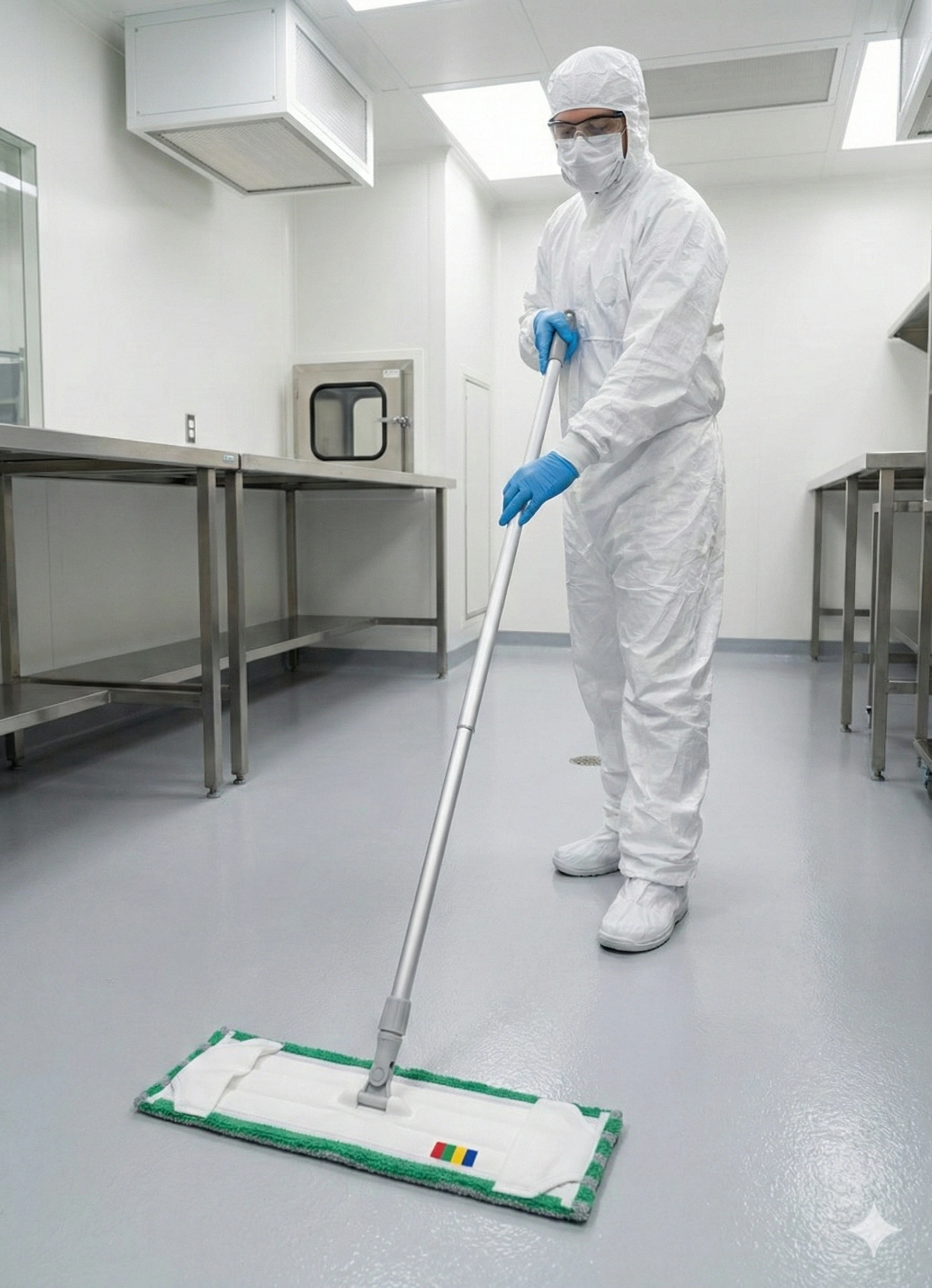
GMP cleanroom mop selection follows the cleanroom grade, not a single universal product choice. The four EU GMP Annex 1 cleanroom grades each require a different mop specification, driven by particle control requirements, sterility expectations, and the validated cleaning protocol.
| GMP Grade | Mop Type | مادة | العقم | متطلبات المفتاح |
|---|---|---|---|---|
| الصف أ | Sterile mop head | البوليستر خيوط مستمرة | Sterile (gamma irradiation or EtO) | Certificate of Irradiation, validated aseptic transfer, double-bag packaging |
| درجة ب | Sterile mop head | البوليستر خيوط مستمرة | Sterile (typically) — risk-based exception may apply | Same as Grade A; exception requires documented risk assessment |
| الصف ج | Non-sterile mop head | Polyester or microfiber | Non-sterile (typically) | Documented chemical compatibility with cleaning agents; validated SOP |
| الصف د | Non-sterile mop head | Polyester or microfiber | Non-sterile | Standard material specifications; validated cleaning protocol required |
The table above is designed for quick reference. In all four grades, the mop must be part of a validated cleaning protocol — the product specification alone is not GMP compliance. For the complete grade-by-grade framework including Annex 1 regulatory reasoning, cleaning frequency, and documentation requirements per grade, see the GMP cleanroom mop grade selection guide.
2. What Makes a Mop “GMP-Grade”?
A mop becomes “GMP-grade” when five elements are satisfied — material, construction, documentation, system integration, and protocol compliance — not when a supplier labels it as such. Each element is evaluated by QA during supplier qualification and cleaning validation.
مادة
Continuous filament polyester is the preferred material for GMP Grade A and B zones because it has the lowest particle shedding of all common cleanroom mop materials. Unlike microfiber — which combines polyester and polyamide through a split-fiber process that can release fiber fragments during use — continuous filament polyester is produced as a single unbroken strand with sealed edges, reducing lint generation during mopping.
بناء
GMP-grade mop heads use sealed or heat-cut edges rather than mechanically cut edges. Reinforced quilting patterns secure the fabric layers together. The pocket or attachment mechanism must be cleanly integrated into the mop head construction without loose threads or exposed stitching that could detach during use.
التوثيق
A GMP-grade mop supplier should provide, as a baseline: a Certificate of Analysis covering the material specification, a Certificate of Irradiation or Certificate of Sterility (if the mop is supplied as sterile), and batch-level traceability. Without batch traceability, a QA department cannot connect a contamination event to a specific mop batch during investigation.
نظام
A GMP-grade mop is not a standalone mop head. It is a validated assembly of mop head, frame, handle, and bucket or trolley. If you change one component — for example, switching from a plastic frame to a stainless steel wire frame — the cleaning performance characteristics may change, and the system should be re-validated for the zone in which it is used.
Protocol
The mop must be used within a documented, validated cleaning SOP. The product alone does not deliver GMP compliance — it is the combination of the correct mop specification plus a validated cleaning procedure (including disinfectant selection, contact time, mopping pattern, frequency, and post-use handling) that satisfies regulatory expectations.
3. Sterile vs Non-Sterile — When Does It Matter?
The sterile vs non-sterile decision for GMP cleanroom mops is primarily driven by the cleanroom grade and the product-contact risk, not by a blanket preference for sterility. Sterile mops are essential in aseptic processing zones (Grade A/B), add proportional value in Grade C only under specific transfer-path risk conditions, and create unnecessary cost without meaningfully improving contamination control in Grade D.
Grade A / Grade B — Sterile Required
In Grade A (aseptic filling zones) and Grade B (background to Grade A), sterile mop heads are required. This is driven by EU GMP Annex 1, which mandates that all consumables entering Grade A/B zones must be sterile and transferred via a validated aseptic transfer process. A non-sterile mop introduced into a Grade A zone introduces microbial contamination risk that cannot be justified for aseptic processing environments. The sterile mop should be double-bagged and undergo a documented aseptic transfer at the zone boundary.
Grade C — Non-Sterile (with One Exception)
Grade C zones that operate independently of Grade B typically use non-sterile mop heads. The cleaning validation focuses on chemical compatibility and particle control rather than sterility. However, if a Grade C zone shares an airlock or material-transfer path with a Grade B zone, and a mop could enter Grade B through that path, a sterile specification may be evaluated as a risk mitigation measure. This is a facility-specific risk assessment, not a regulatory requirement.
Grade D — Non-Sterile
Grade D cleanrooms use non-sterile mop heads. Specifying sterile mops for Grade D adds procurement cost without proportional contamination-control benefit, because Grade D does not require sterility for cleaning tools and the microbial limits in Grade D are orders of magnitude higher than in Grade A/B. The QA focus in Grade D should be on material specification, chemical compatibility, and cleaning frequency, not on sterility.
For a more detailed decision framework covering cost-validity tradeoffs, documentation implications, and a structured decision tree, see the sterile vs non-sterile cleanroom mop decision framework.
4. Frequently Asked Questions
What type of mop is used in a Grade A cleanroom?
Grade A cleanrooms require sterile mop heads made from continuous filament polyester. The mop must be gamma-irradiated or EtO-sterilized, double-bag packaged, and transferred into the aseptic zone through a validated aseptic transfer process. A Certificate of Irradiation or Certificate of Sterility with batch traceability is a baseline documentation requirement.
Can I use the same mop for Grade B and Grade C areas?
Generally no. Grade B requires sterile mop heads; Grade C typically uses non-sterile. Even if both use the same material type, cross-zone use risks sterility downgrade (from Grade B to C direction) or contamination transfer (from Grade C to B direction). Dedicated mop inventory per grade, with color-coded or labeled segregation, is the standard GMP practice.
Is microfiber or polyester better for GMP cleanrooms?
It depends on the GMP grade. For Grade A/B, continuous filament polyester is preferred because it sheds fewer particles than microfiber, which splits polyamide fibers during use. For Grade C/D, microfiber offers advantages in cleaning efficacy (fluid absorption and particle pickup) but requires inspection for fiber degradation. See our microfiber vs polyester cleanroom mop comparison for the full analysis.
Do I need sterile mops for a Grade D facility?
No. Grade D cleanrooms do not require sterile mops. The microbial limits for Grade D are substantially higher than for Grade A/B, and specifying sterile mops adds procurement cost without proportional contamination-control benefit. Focus your QA resources on material specification, chemical compatibility, and cleaning frequency in Grade D zones.
What documentation should a GMP mop supplier provide?
At minimum, a GMP mop supplier should provide: a Certificate of Analysis for material specification, a Certificate of Irradiation or Sterility if the product is sterile, batch-level traceability documentation, a chemical compatibility statement for the disinfectants used in the facility, and a declaration of the mop’s particle-shedding characteristics under relevant test conditions.
Where can I find a complete GMP mop selection guide?
This page is a quick-answer reference. For the comprehensive framework — including Annex 1 regulatory reasoning, zone-specific cleaning frequency guidance, and a detailed documentation checklist per grade — see our GMP cleanroom mop grade selection guide. It covers all four grades with in-depth decision criteria suitable for supplier qualification and audit preparation.
Need a Detailed Grade-by-Grade Selection Framework?
This page gave you the direct answer. For the complete framework covering Annex 1 regulatory reasoning, cleaning frequency per grade, documentation requirements, and a structured decision tree that your QA auditor will expect to see — read our comprehensive GMP mop grade selection guide.
Evaluating mop specifications for a multi-grade GMP facility? الاتصال بميدبوسي to discuss your grade-specific requirements.