When pharmaceutical QA managers specify cleaning consumables for Grade A/B aseptic processing rooms, one term appears repeatedly in vendor documentation: gamma-irradiated. But what does this label mean beyond the marketing copy? More importantly, when do sterile operations actually need gamma-sterilized mop pads versus autoclavable alternatives?
This guide cuts through the terminology confusion. We’ll explain the science behind gamma irradiation, decode Sterility Assurance Level (SAL 10⁻⁶) requirements, and build a decision framework for when your facility should specify gamma-sterilized versus autoclaved cleaning tools.
What Does Gamma Irradiation Mean? (SAL 10⁻⁶ Explained Simply)
The Science: Cobalt-60 and Ionizing Radiation
Gamma irradiation is a terminal sterilization method using high-energy photons emitted by radioactive Cobalt-60 (⁶⁰Co) isotopes. As Cobalt-60 decays to stable Nickel-60, it releases two gamma-ray photons at 1.17 and 1.33 MeV—energies high enough to penetrate sealed packaging and destroy microorganisms but not high enough to make materials radioactive.
The mechanism is simple: gamma photons ionize water molecules and DNA within microbial cells, causing lethal damage to cellular structures. Because gamma rays penetrate deeply, products can be sterilized in their final sealed packaging—a critical advantage for single-use cleanroom consumables like mop pads that must remain sterile until point of use.
What SAL 10⁻⁶ Actually Means
Sterility Assurance Level (SAL) quantifies the probability of a viable microorganism remaining on a product after sterilization. The pharmaceutical industry standard is SAL 10⁻⁶—meaning there is no more than a one-in-a-million probability of encountering a non-sterile unit in a batch.
In practical terms: if you sterilize one million mop pads to SAL 10⁻⁶, you can statistically expect fewer than one to harbor viable contamination. This is the same SAL required for terminally sterilized medical devices and injectable drugs—the gold standard for sterility assurance in regulated environments.

Figure 1: Gamma irradiation process diagram. Products move through radiation chamber on conveyor system, receiving validated dose from Cobalt-60 source. Dosimetry monitors ensure SAL 10⁻⁶ achievement per ISO 11137 standards.
Validated gamma sterilization processes deliver a target dose—typically 25 kGy (kiloGrays) for pharmaceutical consumables—measured through dosimetry at multiple locations within product loads. Unlike visual process indicators (like autoclave tape or radiation color patches), SAL achievement is verified through dose mapping, bioburden testing, and microbial kill validation per ISO 11137 standards.
Gamma Irradiation vs “Pre-Sterilized”: Professional Distinctions
Marketing terminology creates confusion. Some vendors label products “pre-sterilized” without specifying the method or achieved SAL. Others use “disinfected” or “sanitized” interchangeably with “sterilized”—a critical regulatory distinction.
Gamma-irradiated (terminally sterilized) means:
- Products exposed to validated ionizing radiation achieving SAL 10⁻⁶
- Sterilization dose verified through dosimetry and batch records
- Sterility maintained through validated packaging until opened
- Meets EU GMP Annex 1 and FDA CGMP requirements for sterile areas
Pre-sterilized (unspecified method) often means:
- Method may be autoclave, EO, or gamma—but not disclosed
- SAL may not meet 10⁻⁶ standard
- Packaging integrity and sterility maintenance not necessarily validated
When specifying for Grade A/B environments, always require method disclosure and SAL documentation.
Material Compatibility: Why Some Fabrics Work and Others Don’t
Not all materials tolerate gamma radiation without degradation. Ionizing radiation can break polymer chains, causing embrittlement, discoloration, or loss of tensile strength in certain fabrics.
Gamma-compatible materials for cleanroom mop pads:
- Polyester (PET): Excellent gamma stability; commonly used for sealed-edge mop pads
- Polypropylen (PP): Good radiation tolerance; suitable for handles and frames
- Polyethylene (PE): Adequate for packaging films and some structural components
Materials requiring caution or alternative sterilization:
- Nylon: Can yellow and lose strength at sterilization doses
- Certain adhesives: May degrade, compromising sealed-edge integrity
- Some foam materials: Risk of cellular structure collapse or off-gassing
Reputable suppliers provide material compatibility data and validation showing that gamma-sterilized products maintain performance specifications post-irradiation. If a vendor can’t produce this documentation, their products may not be suitable for validated cleanroom use.
Benefits for Sterile & Aseptic Areas (Grade A/B)
Why do pharmaceutical facilities pay a premium for gamma-irradiated mop pads instead of autoclaving reusable tools on-site? The answer comes down to risk reduction, regulatory compliance, and operational efficiency in the most critical manufacturing environments.
1. Eliminates Bioburden Before Use
Gamma-irradiated mop pads arrive at your facility already sterile—no on-site processing required. This matters because:
Pre-use sterility = zero baseline contamination risk. Autoclaving reusable mops requires validated cleaning, inspection, and sterilization cycles. Each step introduces potential failure modes: inadequate cleaning leaves bioburden, improper loading creates steam shadows, cycle interruptions compromise sterility. Gamma-sterilized single-use pads bypass this entire risk chain.
Sterile-ready from packaging to use. Products sterilized in sealed pouches maintain sterility until opened in the classified cleanroom. No transfer through multiple gowning airlocks, no secondary disinfection steps, no hold-time limits after autoclaving. The packaging is the contamination barrier—validated for integrity and compatibility per EU GMP Annex 1 requirements.
2. Prevents Cross-Contamination Across Suites
In multi-suite aseptic facilities producing different drug products, cross-contamination is a critical quality risk. Gamma-irradiated single-use mop pads eliminate carryover concerns:
One pad, one suite, one use, then discard. Reusable mops—even when properly reprocessed—can harbor trace residues (APIs, excipients, biofilm) in fabric matrices or sealed edges. These residues risk transferring between production suites during cleaning operations. Single-use gamma pads prevent this risk entirely, especially important for potent compounds, biologics, or allergen-containing products.
Simplified change-control for fill-finish lines. Grade A filling operations require sterile cleaning tools per Annex 1. When switching between products, using fresh gamma-sterilized pads for each campaign eliminates the need to validate cleaning effectiveness of the cleaning tools themselves—a recursive validation challenge that auditors frequently flag.
3. Reduces Operator Handling Risk
Autoclave sterilization depends on flawless execution by cleanroom personnel. Gamma sterilization transfers this responsibility to validated contract sterilizers with dedicated quality systems:
Eliminates autoclave loading errors. Steam sterilization requires proper product orientation, adequate spacing for steam penetration, and correct pack density. Operator errors—overloading, improper wrapping, or blocked steam pathways—can create sterility failures that go undetected until environmental monitoring shows elevated bioburden or worse, batch contamination.
Reduces SOP deviation risk. Reusable mop workflows involve multiple SOPs: cleaning validation, inspection for damage, proper packaging, autoclave cycle selection, sterility maintenance during storage, and expiry tracking. Each step is an opportunity for deviation. Gamma-sterilized consumables collapse this into a single procedure: open sterile package in classified area, use immediately.
Shifts sterilization accountability. Contract gamma sterilizers operate under ISO 11137, with validated processes, routine dosimetry, and batch-specific sterilization records. Your facility receives a Certificate of Sterility for each lot—traceable documentation that satisfies regulatory inspection requirements without in-house sterilization validation burden.
4. Supports EU GMP Annex 1 Sterile Cleaning Requirements
The revised Annex 1 (effective August 2022) tightened requirements for sterile manufacturing, including specific language on cleaning tools for Grade A/B areas:
Annex 1 Section 4.28: “Disinfectants and detergents used in Grade A and B areas… should be sterile prior to use.”
While this clause addresses chemical disinfectants directly, the contamination control strategy principle extends to all materials entering Grade A/B zones—including mop pads. Gamma-irradiated pads meet the “sterile prior to use” intent without requiring on-site sterilization.
Annex 1 Section 8.22: “The sterilisation process should be validated… Wherever possible items should be sterilised by being passed through a double-ended steriliser built into the wall…”
For facilities without double-ended autoclaves (common in smaller operations or retrofit sites), gamma-sterilized consumables provide a validated alternative pathway. Products arrive terminally sterilized, enter through material airlocks with validated disinfection of outer packaging, and maintain sterility through qualified barrier systems.
Documentation alignment. Annex 1 requires sterilization records with unique cycle identifiers and conformity review (Section 8.23). Gamma sterilizers provide batch-specific certificates showing dose delivered, dosimetry readings, and release approval—directly meeting this requirement without adding to your facility’s document generation burden.
The regulatory message is clear: when Annex 1 demands sterile equipment in critical areas, gamma-irradiated single-use tools offer the most straightforward compliance pathway.
When Pharma Needs Gamma-Irradiated Mop Pads (Use-Case Logic)
Not every cleanroom operation requires gamma-sterilized consumables. ISO 7 (Class 10,000) warehouses and ISO 8 (Class 100,000) secondary packaging areas can often use autoclaved reusable tools effectively. So when does gamma become the right specification?
Use Case 1 — Grade A/B Aseptic Processing Rooms
If your cleaning operation takes place in a Grade A or Grade B environment—especially during active production—gamma-irradiated mop pads are the industry best practice:
Filling lines: Sterile liquid vial filling, lyophilizer loading, prefilled syringe assembly. Any spill cleanup or routine floor cleaning in the Grade A core demands sterile tools to prevent introducing viable contamination into the critical zone.
Sterile API manufacturing: Aseptic crystallization, filtration skids, sterile transfer panels. When APIs are handled without terminal sterilization of the final product, every surface and tool must maintain aseptic conditions—gamma pads align with this requirement.
Formulation vessels in Grade B background: Compounding tanks, sterile filtration housings, buffer preparation. While not Grade A, these Grade B support areas feed directly into aseptic core zones. Using sterile cleaning tools in Grade B reduces the bioburden “pressure” on Grade A and lowers environmental monitoring risk.
Barrier isolators and RABS (Restricted Access Barrier Systems): Interior cleaning of isolators used for sterile compounding or filling requires sterile consumables. Because isolators are often validated as Grade A microbial environments regardless of surrounding room classification, all materials entering the barrier—including mops—must be sterile.
Use Case 2 — Situations Where Autoclave Is Not Available or Insufficient
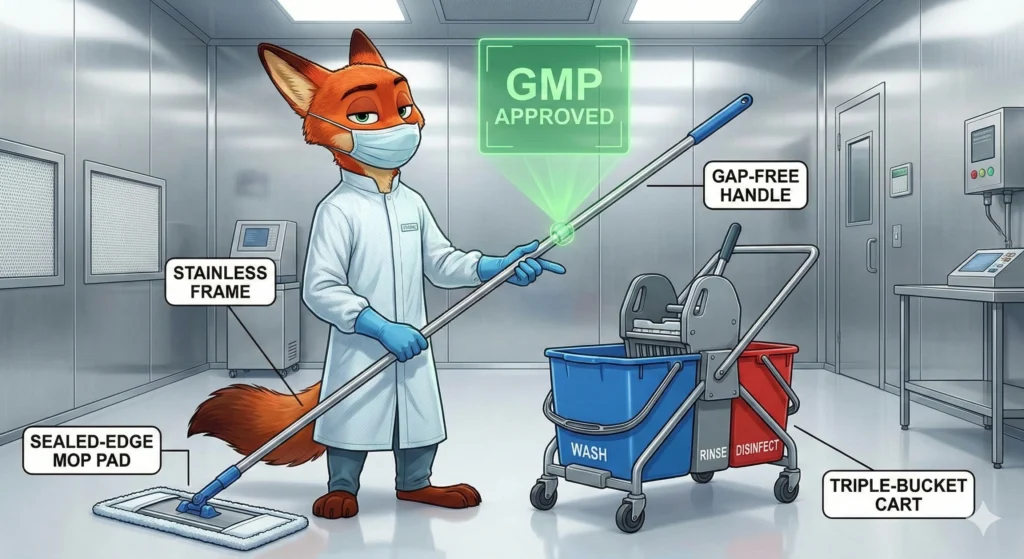
Figure 2: Grade A/B aseptic processing room where gamma-sterilized mop pads are essential. Gowned operator maintains sterile conditions during cleaning operations in fill-finish or isolator areas, per EU GMP Annex 1 requirements.
Multi-site contract manufacturing organizations (CMOs): Smaller fill-finish suites or single-product isolator lines may lack on-site autoclaves. Shipping reusable mops to a central sterilization facility introduces sterility hold-time concerns and logistics delays. Gamma-irradiated consumables eliminate this dependency.
Materials that cannot tolerate 121°C steam: Some modern mop pad designs incorporate heat-sensitive adhesives, antimicrobial treatments, or composite materials optimized for particle release that degrade under autoclave conditions. For these products, gamma (or EO, though EO has residual concerns for cleaning tools) is the only validated sterilization option.
Incomplete steam penetration risk: Densely layered or thick foam-core mop heads may not achieve full steam penetration during autoclave cycles. Even if cycle parameters meet time/temperature requirements, inadequate steam contact in fabric cores can leave surviving bioburden. Gamma radiation penetrates uniformly regardless of geometry—no steam shadows, no penetration concerns.
Rapid turnaround requirements: Autoclaving requires minimum 30–60 minutes for cycle completion, plus cooling, unloading, and quality release. During contamination events or unplanned cleaning campaigns, this lag can delay production restart. Gamma-sterilized consumables kept in ready inventory provide immediate sterile tools—no processing delay.
Use Case 3 — Emergency Contamination Response
Environmental monitoring excursions or unplanned microbial contamination events trigger intensive cleaning protocols. In these high-stakes situations, gamma-irradiated tools offer risk mitigation:
Immediate sterile tool availability: When EM alerts detect elevated bioburden or identify specific microbial isolates (mold, gram-negative bacteria, spore-formers), response SOPs demand immediate action. Having gamma-sterilized mop pads in emergency stock means sterile cleaning can begin within minutes—critical for limiting contamination spread.
Eliminates tool-as-vector risk: During contamination investigations, reusable mops become potential vehicles for spreading contamination between areas during the cleaning/reprocessing cycle. Single-use gamma pads eliminate this vector: each contaminated area is cleaned with fresh sterile tools, then immediately discarded without risk of cross-transfer.
Supports root-cause investigation: When contamination is traced to cleaning tool bioburden (a common finding), switching to gamma-sterilized consumables during investigation isolates the variable. If EM results normalize after introducing gamma pads, you’ve likely identified the root cause—your autoclave validation or reusable mop reprocessing has gaps.
Regulatory confidence during inspection: If a contamination event occurs near a regulatory inspection, inspectors will scrutinize your corrective actions. Deploying validated gamma-sterilized tools demonstrates immediate, science-based risk mitigation—stronger regulatory optics than simply re-autoclaving your existing mops.
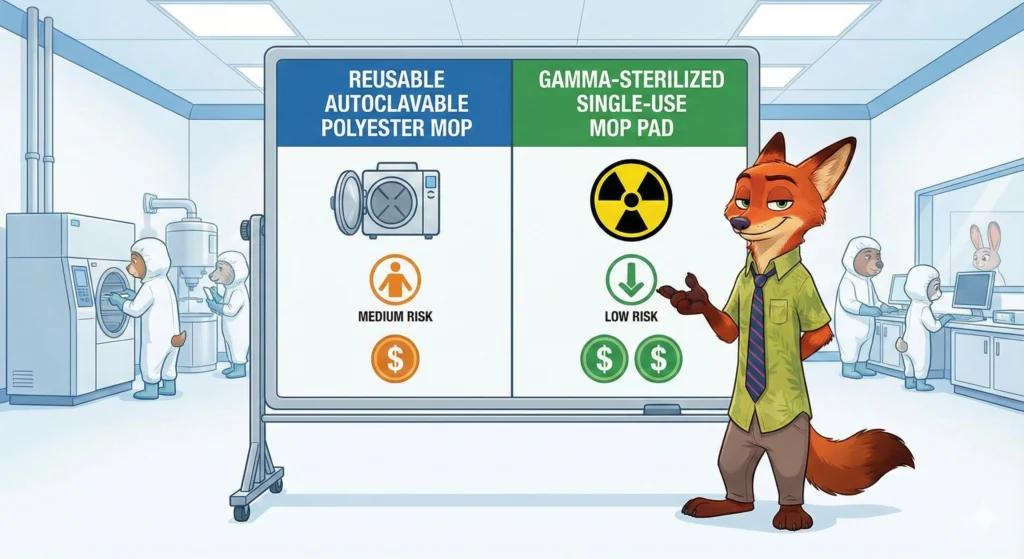
Gamma vs Autoclave vs EO Sterilization (Clear Comparison)
Pharmaceutical facilities have three primary sterilization modalities available for cleaning consumables. Each has distinct advantages, limitations, and ideal applications. Understanding these trade-offs helps you specify the right method for your operational needs.
Gamma Irradiation (SAL 10⁻⁶)
Mechanism: Ionizing radiation from Cobalt-60 isotopes penetrates products in sealed packaging, disrupting microbial DNA without heat or moisture.
Core advantages:
- Terminal sterilization in final packaging: Maintains sterility from sterilizer to point-of-use without repackaging
- Deep, uniform penetration: No geometric limitations; effective regardless of product density or configuration
- No heat or moisture: Suitable for temperature-sensitive materials and moisture-incompatible adhesives
- Contract service model: Outsourced to specialized facilities with validated processes, shifting sterilization validation burden off your site
- Excellent for single-use consumables: Economical for disposable mop pads, wipes, and garments when ordered in bulk
Material compatibility:
- Best suited: Polyester, polypropylene, polyethylene, certain sealed-edge fabrics
- Caution required: Nylon, natural fibers, some adhesives and foams may degrade
Typical dose: 25 kGy (range 15–50 kGy depending on bioburden and product)
Turnaround time: 2–4 weeks (outsource to contract sterilizer, shipping, dose delivery, release testing)
Cost model: Per-unit fee charged by sterilizer, plus shipping; economical at scale but requires minimum batch sizes
Am besten für: Grade A/B single-use cleaning consumables, multi-site operations without autoclave access, emergency sterile inventory, products incompatible with heat/steam
Autoclave Steam Sterilization (121–134°C)
Mechanism: Saturated steam under pressure (typically 121°C for 15–30 minutes or 134°C for 3–10 minutes) delivers moist heat that denatures microbial proteins and enzymes.
Core advantages:
- On-site control: In-house equipment and validation; immediate cycle initiation without outsourcing delays
- Reusable tool economics: Cost-effective for mops reprocessed dozens of times across their lifecycle
- Rapid turnaround: 30–90 minute cycles (including heating, sterilization, and cooling) enable same-day reprocessing
- Proven technology: Decades of pharmaceutical use with well-understood validation protocols (USP <1211>, ISO 17665)
- No material irradiation concerns: Verhindert Polymerabbauprobleme, die bei einigen gammaempfindlichen Materialien auftreten
Einschränkungen:
- Hitze- und Feuchtigkeitsempfindlichkeit: Die Materialien müssen Temperaturen von über 121 °C und gesättigtem Dampf standhalten. Viele moderne Verbundstoffe, Klebstoffe und Schaumstoffkerne versagen
- Anforderungen an die Dampfdurchdringung: Bei dicht gepackten oder mehrschichtigen Produkten besteht die Gefahr eines unvollständigen Dampfkontakts, wodurch lebensfähige Keime in den Kernbereichen zurückbleiben
- Aufwand für die Wiederaufbereitungsvalidierung: Erfordert validierte Reinigungs-, Inspektions-, Verpackungs-, Sterilisations- und Sterilitätswartungs-SOPs – jeder Schritt ist ein potenzieller Fehlermodus
- Grenzen der Sterilitätshaltezeit: Die Sterilität nach dem Autoklavieren lässt mit der Zeit nach (selbst in versiegelter Verpackung); strenges Ablaufdatum erforderlich
- Betreiberabhängigkeit: Das richtige Laden, die Zyklusauswahl und die Paketkonfiguration hängen von der einwandfreien SOP-Ausführung ab
Am besten für: Wiederverwendbare Mopps in ISO 6-8-Reinräumen, Hartwaren (Eimer, Griffe, Rahmen), Einrichtungen mit validierter Autoklaven-Infrastruktur und Wiederaufbereitungsabläufen, hitzebeständige Materialien
Ethylene Oxide (EO) Sterilization
Mechanism: Ethylenoxidgas alkyliert mikrobielle Proteine und DNA bei 30–60 °C in Kammern mit kontrollierter Luftfeuchtigkeit und Druck, was eine längere Belüftung erfordert, um toxische Rückstände zu entfernen.
Core advantages:
- Niedertemperaturprozess: Wirksam für hitzeempfindliche Materialien, die keinen Dampf- oder Gammaabbau vertragen
- Durchdringt komplexe Geometrien: Die Gasdiffusion erreicht geschlossene Räume, Lumen und poröse Materialien, die für Dampf unzugänglich sind
- Geeignet für diverse Materialpaletten: Kompatibel mit Elektronik, bestimmten Klebstoffen und Verbundstrukturen, die unter Hitze oder Strahlung versagen
Wesentliche Einschränkungen:
- EO-Resttoxizität: Ethylenoxid und Reaktionsnebenprodukte (Ethylenchlorhydrin, Ethylenglykol) sind giftig und krebserregend; erfordern eine validierte Belüftung (oft 7–14 Tage), um die Rückstände auf sichere Grenzwerte zu reduzieren
- Nicht ideal zum Reinigen von Werkzeugen: Wischpads, Tücher und poröse Stoffe absorbieren EO-Rückstände und geben sie langsam ab; Risiko, dass bei Reinigungsvorgängen giftige Rückstände in die Reinraumoberflächen gelangen
- Erweiterter Turnaround: Die Vorkonditionierungs-, Sterilisations- und Belüftungszyklen dauern 1–3 Wochen. Das Testen biologischer Indikatoren (Bacillus-Sporen) verlängert die Freisetzungszeit
- Regulatorische Kontrolle: EU-GMP-Anhang 1 beschränkt EO auf Situationen, in denen „keine andere Sterilisationsmethode praktikabel ist“ und schreibt eine validierte Restreduzierung vor
- Arbeitsmedizinische Bedenken: OSHA-Grenzwerte für die EO-Exposition erfordern strenge Anlagenkontrollen; Die FDA betont das langfristige Krebsrisiko durch EO-Exposition
Am besten für: Wärmeempfindliche medizinische Geräte mit komplexen Geometrien (Katheter, chirurgische Instrumente mit Elektronik), Materialien, die weder mit Dampf noch mit Gammastrahlen kompatibel sind.selten für Reinraummopps oder -tücher geeignet aufgrund von Rest- und Terminproblemen
Summary Comparison Table
| Faktor | Gammabestrahlung | Autoklav (Dampf) | Ethylenoxid (EO) |
| SAL erreichbar | 10⁻⁶ (Industriestandard) | 10⁻⁶ (bei Validierung) | 10⁻⁶ (bei Validierung) |
| Temperatur | Umgebung (keine Hitze) | 121–134°C | 30–60°C |
| Materialgrenzen | Gammaempfindliche Polymere (Nylon, einige Klebstoffe) | Hitze-/feuchtigkeitsempfindliche Materialien | Wenige Grenzwerte, aber Rückstände sind bei porösen Gegenständen problematisch |
| Bearbeitungszeit | 2–4 Wochen (ausgelagert) | 30–90 Minuten (vor Ort) | 1–3 Wochen (ausgelagert + Belüftung) |
| Verarbeitungsmodell | Vertragsservice (Batch-Outsourcing) | In-house (on-demand) | Vertragsservice (Batch-Outsourcing) |
| Cost (Single-Use) | $$ (per-unit fee; economical at scale) | $ (reusable; cost per cycle amortized) | $$$ (highest cost; restricted use) |
| Best Grade Application | A/B (sterile areas; single-use consumables) | C/D (reusable tools; controlled environments) | Device sterilization (rarely mops/wipes) |
| Regulatory Preference (Annex 1) | Strongly aligned (sterile prior to use) | Acceptable with validation | Restricted (“when no other method practicable”) |
| Sterility Maintenance | Excellent (sterile in sealed packaging until use) | Good (requires validated hold times) | Good (post-aeration packaging critical) |
Decision logic summary:
- Choose gamma when you need sterile single-use consumables for Grade A/B, lack on-site autoclave, or require validated SAL 10⁻⁶ without in-house sterilization burden.
- Choose autoclave Wenn Sie die Dampfsterilisation validiert haben, ist die Wirtschaftlichkeit wiederverwendbarer Werkzeuge sinnvoll (ISO 6-8-Bereiche) und die Materialien vertragen Hitze/Feuchtigkeit.
- Vermeiden Sie EO für Wischpads– reserviert für wärmeempfindliche Geräte mit komplexer Geometrie; Aufgrund des Restrisikos und der Bearbeitungszeit sind Verbrauchsmaterialien für die routinemäßige Reinigung ungeeignet.
MIDPOSI Gamma-Compatible Mop Pad Solutions
Nachdem Sie nun verstanden haben, wann gammabestrahlte Reinigungswerkzeuge erforderlich sind, lautet die nächste Frage: Wo beziehen Sie validierte, dokumentationsfähige Produkte, die den pharmazeutischen Standards entsprechen?
MIDPOSI liefert gammasterilisierte Einweg-Mopppads, die speziell für die aseptische Arzneimittelherstellung entwickelt wurden – mit den Validierungspaketen, die Ihr QS-Team für die Gewährleistung der regulatorischen Sicherheit benötigt.
Our Gamma-Sterilized Single-Use Mop Pads
Polyesterkonstruktion mit versiegelten Kanten:
- Aufgrund seiner Gammakompatibilität ausgewähltes Polyestergewebe – keine Zersetzung oder Verfärbung bei einer Sterilisationsdosis von 25 kGy
- Thermisch versiegelte Kanten (keine Schnittkanten oder lose Fasern) verhindern die Partikelbildung während des Gebrauchs
- Vor der Sterilisation gewaschen und vorgereinigt, um extrahierbare Stoffe zu minimieren und die Ausgangskeimbelastung zu reduzieren
Leistung bei geringer Partikelerzeugung:
- Validierte Partikelfreisetzung: <100 Partikel ≥0,5 µm pro Quadratmeter (erfüllt die Anforderungen der ISO 5 Klasse A)
- Unabhängige Labortests gemäß der ISO 14644-1-Methodik
- Partikeldaten sind im Validierungspaket für jede Produktcharge enthalten
Sterile Verpackung für aseptische Suiten:
- Gammasterilisiert in versiegelten Doppelbeuteln (äußerer Beutel an der Materialschleuse entfernt; innerer Beutel im geheimen Bereich geöffnet)
- Sterilitätsindikatoren auf der Verpackung bestätigen die Strahlenexposition (jedoch kein Ersatz für Dosisaufzeichnungen)
- Die Sterilität bleibt bis zum Öffnen des Beutels erhalten – keine Haltezeitbegrenzung oder sekundäre Desinfektion erforderlich
Mehrere Größen für verschiedene Reinigungsanwendungen:
- Kleine Pads (6″ × 8″) für die Innenreinigung des Isolators, Handschuhanschlussflächen und schwer zugängliche Bereiche
- Standard-Pads (12″ × 12″) zum Füllen von Böden, Wänden von Puffervorbereitungsräumen und zur routinemäßigen Beseitigung verschütteter Flüssigkeiten
- Große Pads (18″ × 18″) zum großflächigen Wischen auf Hintergründen der Güteklasse B und Oberflächen der Gefriertrocknungskammer

Figure 3: MIDPOSI gamma-sterilized mop pad packaging showing double-pouch sterile barrier system with chemical indicators, clear lot identification, and sealed polyester construction. Packaging validated for sterility maintenance per Annex 1 requirements.
Validation Package for QA Teams (Critical for Regulatory Compliance)
One of the most common procurement pitfalls: facilities buy gamma-sterilized consumables but receive incomplete documentation. When auditors ask for sterility validation, particle data, or material compatibility—and you can’t produce it—non-compliance findings follow.
MIDPOSI provides comprehensive validation support:
Sterility Certificate (SAL documentation):
- Batch-specific Certificate of Sterility from accredited gamma sterilization facility
- Shows dose delivered (kGy), dosimetry readings at min/max locations, and release date
- Bestätigt die Erreichung von SAL 10⁻⁶ gemäß ISO 11137-Standards
Partikeltestberichte:
- Unabhängige Labortestergebnisse zeigen die Partikelerzeugung gemäß der ISO 14644-1-Methodik
- Daten aufgeschlüsselt nach Partikelgröße (≥0,5 µm, ≥1,0 µm, ≥5,0 µm)
- Zeigt die Eignung für Anwendungen der Klassen A (ISO 5) und B (ISO 7).
Bioburden-Bericht (vor der Sterilisation):
- Ausgangswerte der Keimbelastung vor der Gamma-Exposition
- Validiert, dass die Sterilisationsdosis für die Produktkontaminationslast geeignet ist
- Erforderliche Eingabe für die SAL-Berechnung und Dosiseinstellungsvalidierung
Materialkompatibilität & Daten zu extrahierbaren Stoffen:
- Bestätigung, dass Polyestergewebe nach der Gamma-Bestrahlung seine Zugfestigkeit, Farbstabilität und Dimensionsintegrität beibehält
- Extractables testing showing minimal chemical leaching (critical for sterile drug product contact risk assessment)
- Material Safety Data Sheets (MSDS) and composition disclosure for contamination control strategy documentation
Certificate of Analysis (CoA) and Certificate of Conformance (CoC):
- Lot-specific CoA with test results (particle count, sterility, bioburden, physical dimensions)
- CoC confirming compliance with customer specifications and regulatory standards (GMP Annex 1, ISO 14644)
This complete validation package ensures your contamination control strategy documentation is audit-ready from day one.

Why Pharma Clients Choose MIDPOSI
Global aseptic supplier with pharmaceutical pedigree:
Over a decade supplying cleanroom consumables to biologics manufacturers, sterile fill-finish CMOs, and API producers across North America, Europe, and Asia-Pacific. We understand GMP expectations because we live them.
12-hour technical support response:
Questions about material compatibility, validation protocols, or Annex 1 compliance? Our contamination control specialists (with pharmaceutical manufacturing backgrounds) respond within half a business day—no generic call-center scripts.
ISO 14644 and GMP Annex 1 alignment:
Products designed specifically for pharmaceutical cleanroom use—not general industrial wipes rebranded as “cleanroom-compatible.” We track regulatory updates (Annex 1 revisions, FDA guidance) and proactively update product specifications and documentation.
Competitive sterile unit pricing:
Bulk gamma sterilization and direct-from-manufacturer pricing deliver cost efficiency without sacrificing quality. Volume discounts available for annual supply agreements; consignment inventory programs for high-throughput facilities.
Regulatory audit support:
Facing an FDA inspection or EMA GMP audit? We provide expedited documentation packages, technical justification letters, and supplier audit readiness support—helping you demonstrate contamination control rigor.
Request Sterile Samples & Preise
Ready to evaluate gamma-sterilized mop pads for your aseptic operations? Contact MIDPOSI to request:
- Sterile product samples: Small-quantity trial packs (gamma-sterilized, full validation documentation included) for hands-on evaluation in your Grade A/B environments
- Custom pricing quotes: Volume-based pricing for your annual consumption forecast; flexible ordering (standing POs, consignment, or per-campaign orders)
- Validation file review: Pre-purchase review of our validation packages with your QA team to confirm regulatory alignment before committing to supply agreements
📧 E-Mail: [email protected]
FAQ — Gamma-Irradiated Cleanroom Mop Pads
Are gamma-irradiated mop pads sterile?
Yes—when properly validated and documented. Gamma-irradiated mop pads that achieve SAL 10⁻⁶ (Sterility Assurance Level of one-in-a-million probability of non-sterile unit) meet pharmaceutical industry standards for sterility. However, the label “gamma-irradiated” alone doesn’t guarantee sterility—you must verify that the supplier provides batch-specific sterility certificates showing achieved sterilization dose (typically 25 kGy) and conformance to ISO 11137 standards. Additionally, sterile packaging integrity must be maintained from sterilization through point-of-use; any package damage compromises sterility regardless of the sterilization method.
Can gamma-sterilized pads be used in Grade A/B cleanrooms?
Absolut – sie sind speziell für diese Anwendung konzipiert. EU-GMP-Anhang 1 erfordert sterile Reinigungswerkzeuge für aseptische Verarbeitungsbereiche der Güteklasse A/B. Gammabestrahlte Wischpads erfüllen diese Anforderung, indem sie endsterilisiert in einer validierten Verpackung geliefert werden und sofort einsatzbereit sind, ohne dass eine Sterilisation vor Ort erforderlich ist. Der Schlüssel liegt darin, sicherzustellen, dass das Produkt auch die Spezifikationen für die Partikelerzeugung erfüllt: Anforderungen der Klasse A (ISO-Klasse 5). <100 Partikel ≥0,5 µm pro Quadratmeter, während Klasse B (ISO-Klasse 7) dies zulässt <3.520 Partikel ≥0,5 µm pro Kubikmeter. Fordern Sie Partikeltestdaten von Ihrem Lieferanten an, um die Eignung zu bestätigen.
Does gamma irradiation affect polyester mop pad durability?
When materials are correctly selected, no—but validation is essential. High-quality polyester fabrics maintain tensile strength, abrasion resistance, and dimensional stability after exposure to standard sterilization doses (25 kGy). However, lower-grade polyester or blended fabrics may experience yellowing, embrittlement, or fiber weakening. Reputable suppliers validate material performance post-gamma exposure and provide data showing that physical properties (strength, particle release, absorption capacity) remain within specifications. Always request material compatibility documentation showing pre- and post-irradiation testing results. If a supplier cannot provide this data, their products may not be truly gamma-compatible.
Gamma vs autoclave — which is safer for aseptic rooms?
Both methods achieve SAL 10⁻⁶ sterility when properly validated, but gamma offers operational risk advantages for Grade A/B environments. Gamma-sterilized single-use pads eliminate reprocessing variables (cleaning validation failures, autoclave loading errors, sterility hold-time expiry, cross-contamination during tool reuse)—each a potential contamination vector. Autoclave sterilization depends on flawless operator execution and validated reprocessing workflows; any SOP deviation can compromise sterility without immediate detection. For aseptic core zones where contamination consequences are highest (filling lines, lyophilizer loading, isolator interiors), gamma-sterilized disposables provide defense-in-depth risk mitigation aligned with Annex 1’s contamination control strategy principles.
What SAL level do mop pads need for sterile areas?
Pharmaceutical sterile areas require SAL 10⁻⁶ (one-in-a-million probability of viable contamination) for terminally sterilized items. This is the same standard applied to sterile injectable drugs and implantable medical devices. Some suppliers offer products with lower SAL (10⁻³ or “commercially sterile”) or unvalidated “disinfected” status—these do not meet pharmaceutical GMP requirements for Grade A/B use. Always specify SAL 10⁻⁶ in procurement specifications and require batch-specific sterility certificates confirming achieved SAL. For Grade C/D support areas (ISO 7-8), some facilities accept lower SAL or autoclaved reusable tools, but for aseptic core zones, SAL 10⁻⁶ is non-negotiable.
How long do gamma-sterilized mop pads remain sterile?
Die Sterilität bleibt erhalten, solange die Verpackungsintegrität intakt ist – normalerweise 3–5 Jahre ab dem Sterilisationsdatum, obwohl dies von der Verpackungsvalidierung abhängt. Im Gegensatz zu autoklavierten Artikeln (die selbst in versiegelter Verpackung eine begrenzte Sterilitätshaltezeit haben) behalten gammasterilisierte Produkte in validierten Sterilbarrieresystemen (Tyvek-Beutel, Folienlaminate) die Sterilität über längere Zeiträume bei. Das auf der Verpackung aufgedruckte Sterilitätsverfallsdatum spiegelt die validierte Haltbarkeit wider, die auf Alterungsstudien der Verpackung und Integritätstests (Farbstoffpenetration, Blasenlecktests) basiert. Sobald eine Verpackung geöffnet wurde, verwenden Sie das Wischpad sofort im klassifizierten Reinraum – die Sterilität kann nach einem Bruch der Verpackung nicht mehr aufrechterhalten werden.
Are there any regulatory restrictions on gamma sterilization?
No restrictions—gamma is widely accepted and preferred for single-use sterile consumables. EU GMP Annex 1 explicitly references radiation sterilization as suitable for heat-sensitive materials and requires only that the sterilization process be validated per ISO standards. FDA recognizes gamma sterilization under 21 CFR 211 (CGMP) and supports ISO 11137 as the validation framework. Unlike ethylene oxide (which Annex 1 restricts to cases where “no other method is practicable” due to toxic residuals), gamma has no such limitations. The only practical consideration is material compatibility—certain polymers degrade under ionizing radiation—but for polyester/polypropylene cleanroom mop pads, gamma is the regulatory-preferred sterilization pathway.
Can I reuse gamma-sterilized mop pads after re-sterilizing?
No—gamma-sterilized mop pads are single-use consumables by design and regulatory intent. Attempting to reprocess and re-sterilize introduces multiple risks: (1) cleaning validation challenges (proving complete removal of contaminants from fabric matrices), (2) cumulative radiation dose effects (repeated gamma exposure accelerates polymer degradation), (3) particle generation increases (fabric wear and fiber breakage from use), and (4) regulatory non-conformance (single-use labeling prohibits reuse under GMP). For cost-conscious operations, the total cost of ownership calculation should compare per-use cost of gamma single-use pads against reusable mop lifecycle costs (purchase price + reprocessing labor + validation + autoclave utilities + failure rate risk). In aseptic Grade A/B areas, single-use gamma pads typically deliver better risk-adjusted value.