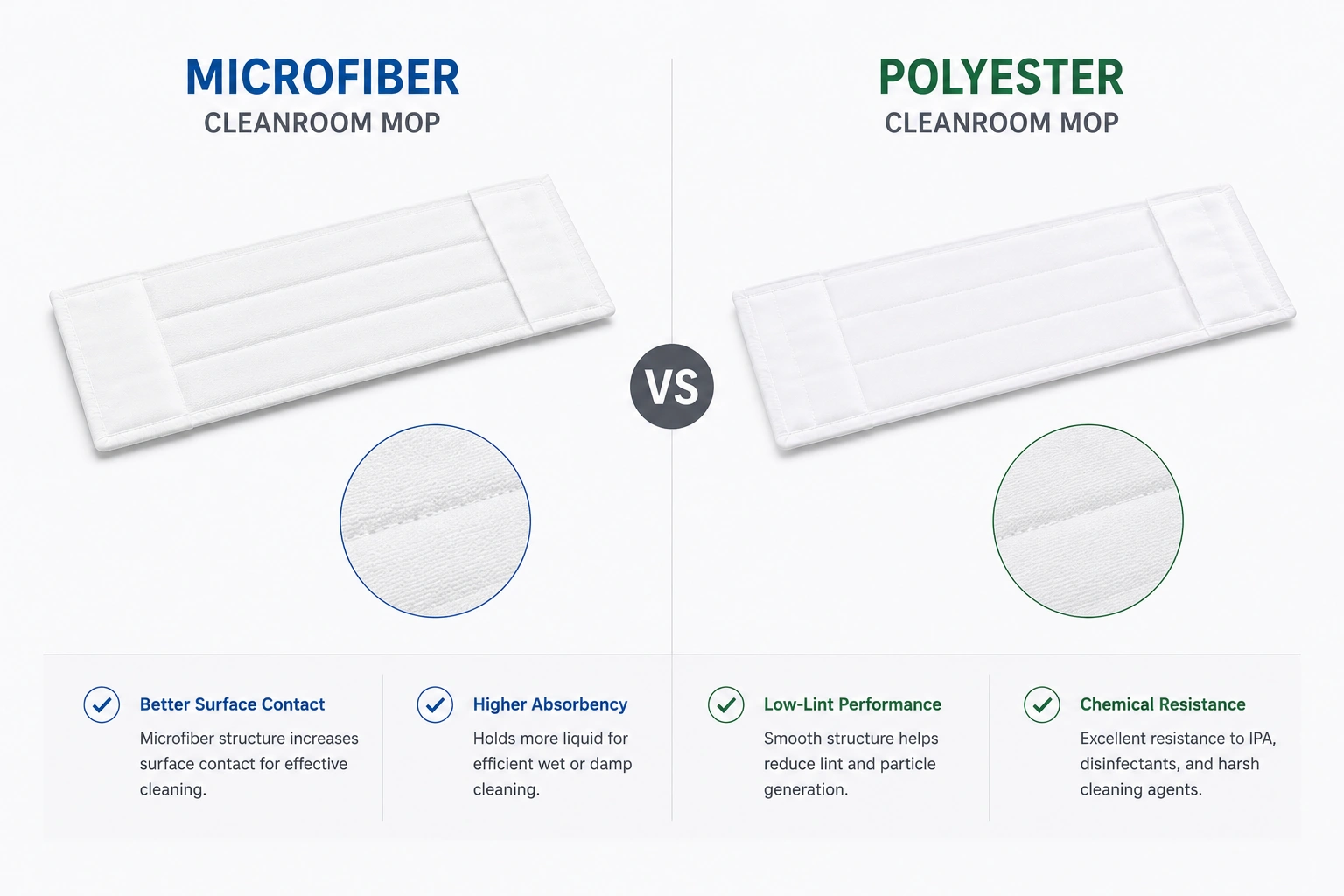
Reinraummopp aus Polyester oder Mikrofaser: Was ist besser?
Polyester and microfiber cleanroom mops serve different cleaning needs in GMP, ISO, pharmaceutical, biotechnology, semiconductor, medical device, laboratory, and controlled environments. This guide compares both materials by lint control, absorbency, particle pickup, residue removal, validation repeatability, documentation, and B2B procurement value.
Polyester cleanroom mops are often preferred when low-lint performance, material stability, and repeatable GMP cleaning are priorities. Microfiber cleanroom mops are often preferred when stronger surface contact, fine particle pickup, and residue removal are important. The best choice depends on the cleanroom grade, SOP, disinfectant, surface type, and QA requirements.
Warum die Auswahl des Moppmaterials in GMP-Reinräumen wichtig ist
In GMP environments, cleaning tools are part of the contamination-control strategy. A cleanroom mop must clean surfaces without introducing excessive fibers, particles, residues, or uncontrolled variability that can complicate SOP execution and QA review.
Teilchen & Faserkontrolle
Das Moppmaterial beeinflusst die Flusenfreisetzung, die Partikelerzeugung und die Sicherheit bei der Kontaminationskontrolle.
Entfernung von Rückständen
Unterschiedliche Faserstrukturen verhalten sich beim Entfernen von Filmen, Rückständen und Desinfektionsmittelverschleppungen unterschiedlich.
Wiederholbarkeit der Validierung
Ein stabiles Materialverhalten unterstützt wiederholbarere Reinigungsvorgänge und eine konsistentere Beschaffung.
Polyester-Reinraummopps: Technisches Profil
Polyester cleanroom mops are commonly selected for controlled environments because polyester can provide stable construction, low-lint performance, good chemical resistance, and repeatable cleaning behavior when properly designed and processed.
Wo Polyester eine starke Leistung erbringt
- Flusenarme routinemäßige Reinraumreinigung
- GMP-Boden-, Wand- und Deckenreinigung
- Stabiles Wischverhalten bei wiederholten Reinigungsaufgaben
- Kontrollierte Arbeitsabläufe, bei denen es auf Materialkonsistenz ankommt
- Einweg-Mopp-Pad-Systeme, die eine vorhersehbare Leistung erfordern
Bewertungspunkte des Käufers
- Gewicht und Aufbau des Wischpads
- Reinraumqualität und SOP-Eignung
- Sterile oder unsterile Verfügbarkeit
- Verpackungsformat und Chargenrückverfolgbarkeit
- Kompatibilität mit Mopphaltern und -stielen
Mikrofaser-Reinraummopps: Technisches Profil
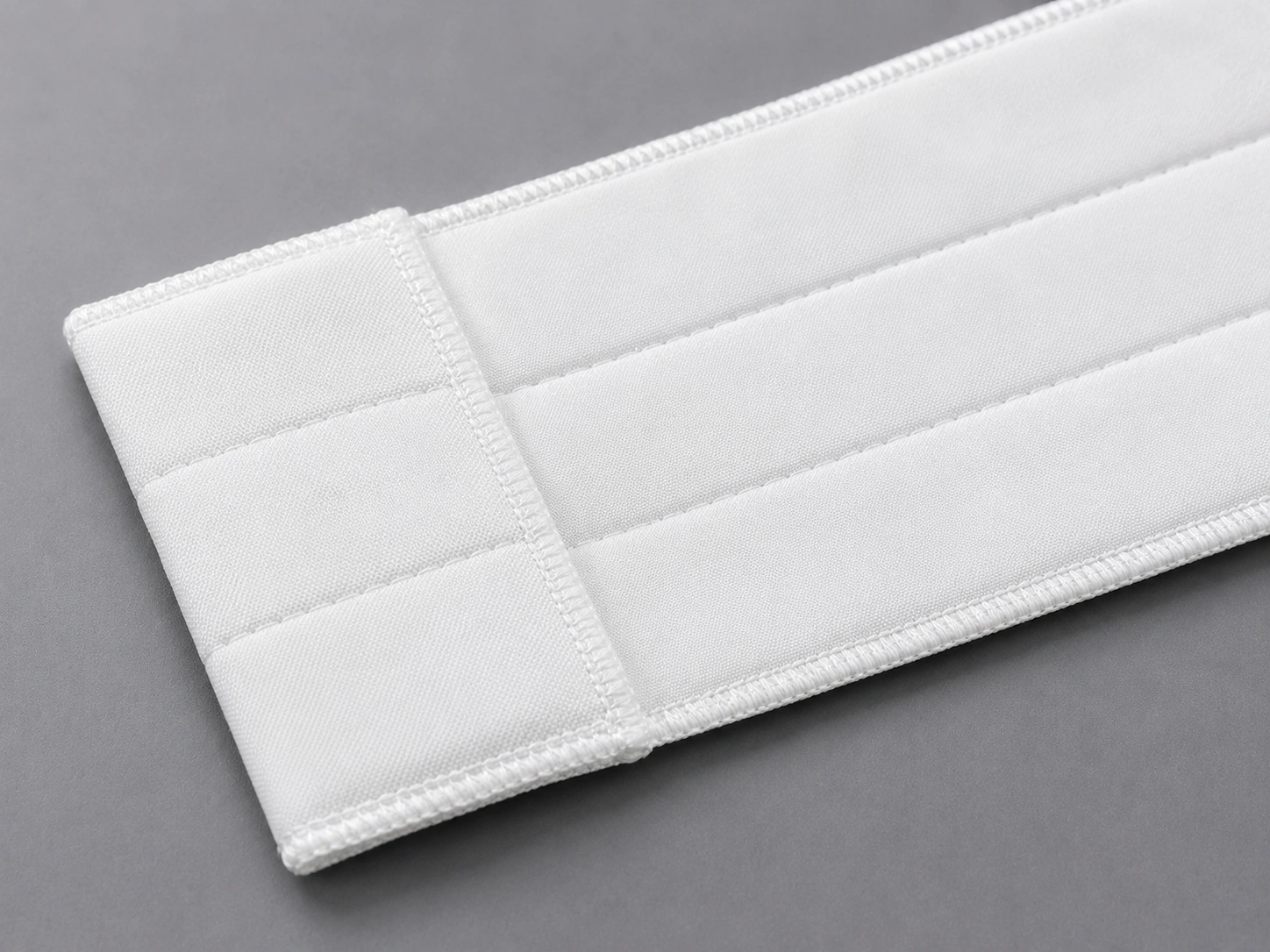
Microfiber cleanroom mops use fine fibers that increase surface area and surface contact. They can be useful for fine particle pickup, residue removal, controlled surface cleaning, and routine cleanroom cleaning where strong mechanical capture is needed.
Wo Mikrofaser eine starke Leistung erbringt
- Aufnahme feiner Partikel und Oberflächenkontakt
- Leichte Rückstands- und Filmentfernung
- Wand-, Decken-, Boden- und kontrollierte Oberflächenreinigung
- Anwendungen, bei denen Saugfähigkeit und Wischkontakt wichtig sind
Bewertungspunkte des Käufers
- Faserabwurf- und Flusenkontrollleistung
- Verarbeitungssauberkeit und Produktkonsistenz
- Desinfektionsmittelverträglichkeit
- Reinraumverpackung und Lieferantendokumentation
Vergleichstabelle für Reinraummopps aus Polyester und Mikrofaser
The table below compares polyester and microfiber cleanroom mops from the perspective of GMP buyers, QA teams, cleanroom supervisors, and procurement managers.
| Entscheidungskriterium | Reinraummopp aus Polyester | Mikrofaser-Reinraummopp |
|---|---|---|
| Flusen- und Faserkontrolle | Wird oft für eine stabile, fusselarme Leistung ausgewählt | Kann fusselarm sein, hängt aber von der Faserstruktur und der Veredelung ab |
| Aufnahme feiner Partikel | Gut für die routinemäßige, kontrollierte Reinigung | Aufgrund des höheren Oberflächenkontakts oft stärker |
| Saugfähigkeit | Je nach Konstruktion mäßig bis gut | Je nach Mikrofaserdichte und -struktur oft höher |
| Entfernung von Rückständen | Gut mit validierter Technik und geeignetem Desinfektions-Workflow | Bei leichten Filmen und feinen Oberflächenrückständen oft stärker |
| Materialstabilität | Im Allgemeinen stark für die wiederholbare Reinigung auf SOP-Basis | Erfordert eine sorgfältige Kontrolle und Dokumentation des Lieferanten |
| Bester Anwendungsfall | Routinemäßige GMP-Boden-, Wand-, Decken- und fusselarme Reinigung | Aufnahme feiner Partikel, Entfernung von Rückständen und Reinigung von Oberflächen mit hohem Kontakt |
| Bedenken des Käufers | Bestätigen Sie Gewicht, Verpackung, Sterilitätsoption und Passform des Mopprahmens | Bestätigen Sie die Flusenkontrolle, die Sauberkeit der Verarbeitung, die chemische Kompatibilität und die Chargenkonsistenz |
Welches Material eignet sich besser für die GMP-Reinigung?
There is no single best mop material for every GMP facility. Polyester is often a practical choice when buyers need stable, low-lint, repeatable, and cost-controlled mop pads. Microfiber may be more suitable when the cleaning task requires stronger surface contact, fine particle pickup, or residue removal.
Branchenspezifische Auswahlberatung
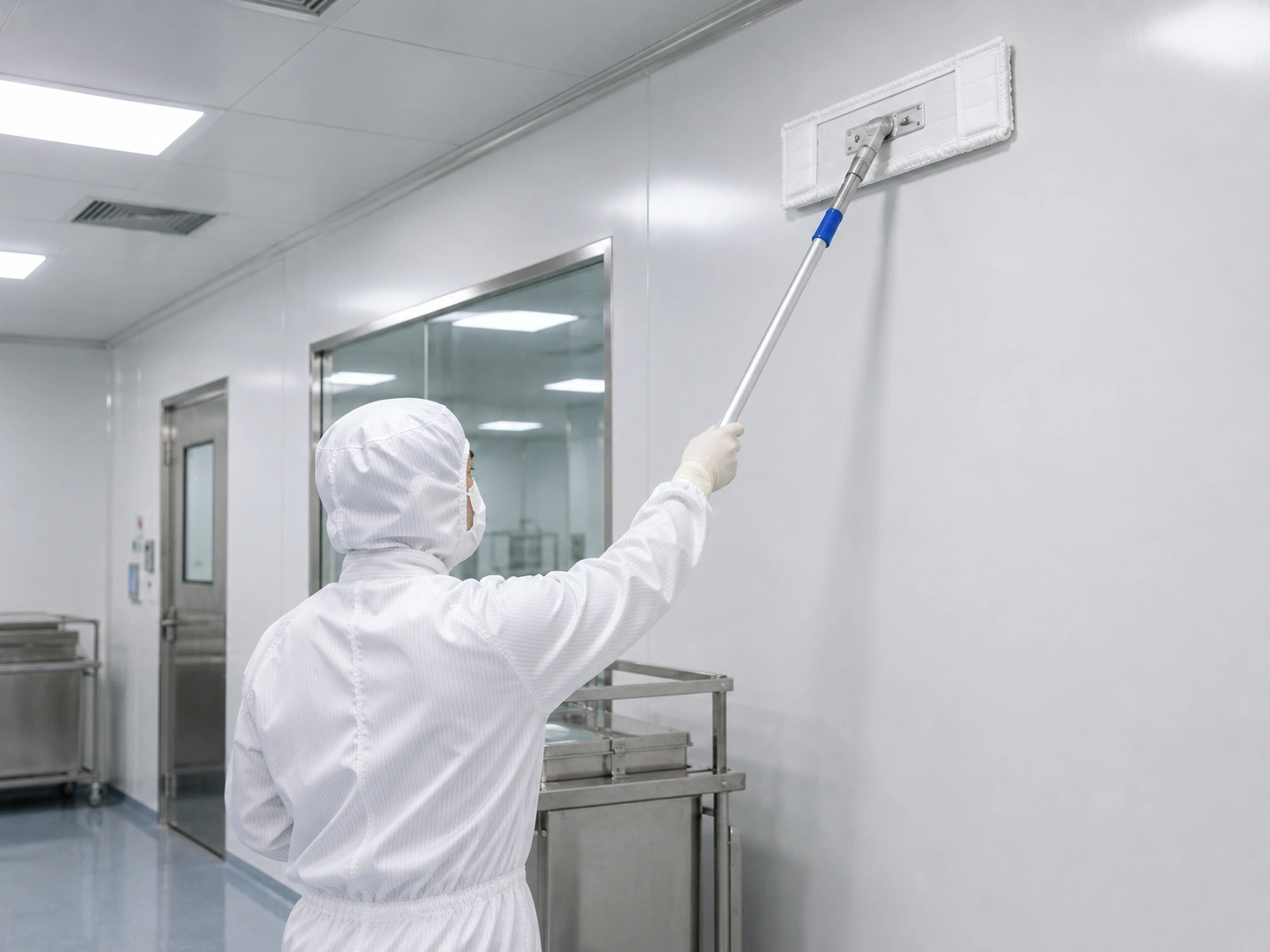
Different industries evaluate mop materials differently. Buyers should align mop selection with process risk, surface type, documentation needs, and internal cleaning procedures.
Pharmazeutisch & GMP
Priorisieren Sie fusselarme Leistung, sterile Optionen, Dokumentation, Verpackung und SOP-Wiederholbarkeit.
Biotechnologie
Überprüfen Sie die Kompatibilität des Desinfektionsmittels, den Oberflächenkontakt, den Arbeitsablauf zur Kontaminationskontrolle und die Konsistenz der Versorgung.
Halbleiter
Konzentrieren Sie sich auf Partikelkontrolle, Faserfreisetzung, Reinraumkompatibilität und Materialverhalten mit geringem Haarausfall.
Medizinisches Gerät
Berücksichtigen Sie die Faserkontrolle, die Entfernung von Rückständen, die Integrität der Verpackung und die Eignung für einen sauberen Produktionsablauf.
Labore
Bringen Sie Materialleistung, chemische Kompatibilität, Kosten und einfache Routinereinigung in Einklang.
Reinraumdienstleistungen
Wählen Sie Materialien, die für mehrere Kundenumgebungen und Wiederholungskaufprogramme praktisch sind.
Dokumentation, die Käufer anfordern sollten
For GMP and controlled cleanroom use, buyers should review more than material names. Documentation helps confirm whether the mop material can be evaluated by QA, procurement, and cleanroom operations teams.
| Dokument / Informationen | Warum es wichtig ist | Zweck der Käuferbewertung |
|---|---|---|
| Technisches Datenblatt | Zeigt Größe, Material, Gewicht, Konstruktion und Verwendungshinweise | Erste Produktbewertung |
| Materialinformationen | Erklärt die Konstruktion aus Polyester, Mikrofaser oder anderen Materialien | Überprüfung der Materialeignung |
| Informationen zur Sterilität | Bestätigt gegebenenfalls den sterilen oder nicht sterilen Status | QA- und SOP-Überprüfung |
| Verpackungsdetails | Zeigt Innenverpackung, Sterilverpackung, Kartonmenge und Handhabungsformat an | Reinraumeingangs- und Lagerplanung |
| Chargenrückverfolgbarkeit | Unterstützt die Chargenverfolgung und Nachbestellungskontrolle | Lieferantenqualifizierung und Qualitätsprüfung |
| Mustergenehmigungsprotokoll | Bestätigt, dass das getestete Produkt mit einer zukünftigen Großbestellung übereinstimmt | Verhindert Abweichungen zwischen Muster und Bestellung |
Beschaffungscheckliste für Käufer von Polyester- und Mikrofasermopps
Verwenden Sie diese Checkliste, bevor Sie einen Reinraummopp aus Polyester oder Mikrofaser für die GMP- oder ISO-Reinraumreinigung auswählen.
Technische Überprüfung
- Reinraumqualität und Reinigungsoberfläche
- Moppmaterial und Flusenkontrolle erforderlich
- Anforderungen an Saugfähigkeit und Rückstandsentfernung
- Desinfektionsmittelverträglichkeit
- Sterile oder unsterile Anforderung
- Kompatibilität von Rahmen, Griff und Eimer
Kaufbewertung
- Musterverfügbarkeit
- Mindestbestellmenge und Vorlaufzeit
- Verpackungs- und Kartondaten
- Konsistenz bei Wiederholungsbestellungen
- Dokumentationsunterstützung
- Unterstützung für Händler oder Einrichtungskäufer
MIDPOSI-Empfehlung
MIDPOSI recommends evaluating polyester and microfiber cleanroom mops based on the facility’s SOP, cleanroom grade, surface type, disinfectant program, sterility requirement, and documentation needs.
Für eine stabile, fusselarme Reinigung
Wischpads aus Polyester eignen sich häufig für die routinemäßige GMP-Reinigung, bei der es auf eine stabile, fusselarme Leistung ankommt.
Für stärkeren Oberflächenkontakt
Mikrofaser-Mopppads können dort geeignet sein, wo die Aufnahme feiner Partikel und die Entfernung von Rückständen wichtiger sind.
Für qualitätsorientierte Käufer
Fordern Sie vor dem Großeinkauf Spezifikationen, Verpackungsdetails, Musterunterstützung und Materialinformationen an.
FAQ: Reinraummopps aus Polyester vs. Mikrofaser
Was ist besser für GMP-Reinräume: Polyester- oder Mikrofasermopps?
Polyester is often better for stable low-lint cleaning and repeatable GMP workflows. Microfiber is often better for fine particle pickup and residue removal. The best choice depends on the facility SOP, cleanroom grade, disinfectant, and surface type.
Sind Polyester-Reinraummopps fusselarm?
Polyester cleanroom mops are commonly selected for low-lint controlled cleaning, but buyers should still review product construction, packaging, material information, and supplier documentation.
Sind Mikrofasermopps für Reinräume geeignet?
Microfiber mops may be suitable for cleanrooms when they are made, processed, packaged, and documented for controlled environments. Buyers should review lint control, chemical compatibility, and SOP suitability.
Welches Moppmaterial eignet sich besser zur Partikelaufnahme?
Microfiber often provides stronger fine particle pickup due to higher surface contact. Polyester can still perform well for routine controlled cleaning when selected and used properly.
Welches Moppmaterial eignet sich besser für eine fusselarme GMP-Reinigung?
Polyester is often preferred when stable low-lint behavior and repeatability are top priorities. However, the final choice should follow the facility’s SOP and QA review.
Welche Unterlagen sollten Käufer vor der Auswahl eines Moppmaterials anfordern?
Buyers should request product specifications, material information, packaging details, sterile or non-sterile status, lot traceability information, sample approval records, and supplier qualification support where required.
Benötigen Sie Hilfe bei der Auswahl von Reinraum-Mopps aus Polyester oder Mikrofaser?
Contact MIDPOSI to discuss your cleanroom grade, SOP, disinfectant program, cleaning surface, sterile requirement, documentation needs, and B2B supply plan.