
Enkonduko
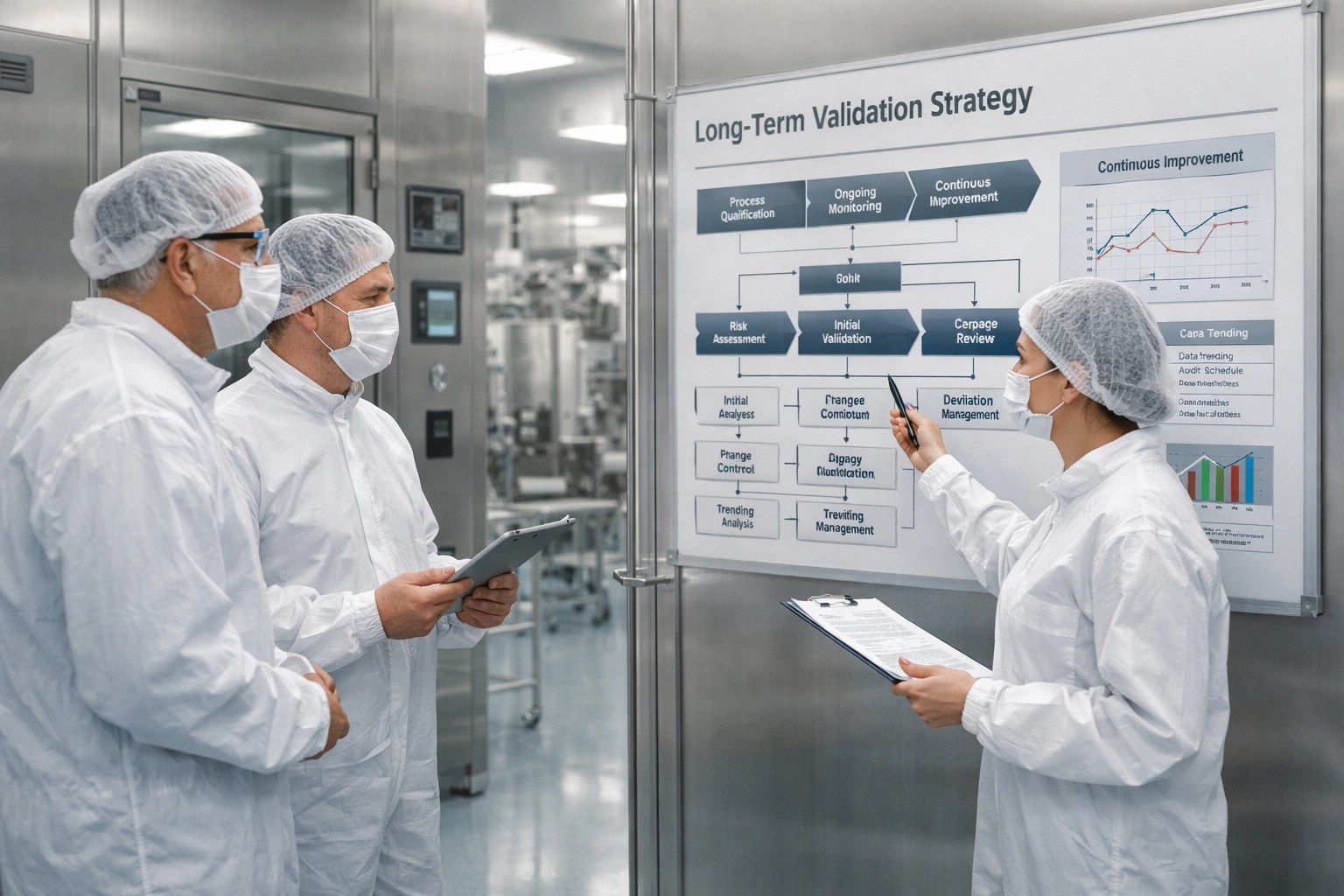
Cleanroom validation is not a single event. It is a managed lifecycle that starts before construction and continues throughout routine operation, maintenance, change control, and periodic requalification. Your original article makes this point clearly and correctly: ongoing performance verification is essential to maintain compliance and product quality over time. :contentReference[oaicite:2]{index=2}
Facilities that treat validation as “IQ OQ PQ completed = done” often develop the exact problems regulators cite later: missing requalification, weak change impact assessment, poor trend analysis, and incomplete lifecycle documentation. :contentReference[oaicite:3]{index=3}
Validation Lifecycle Overview
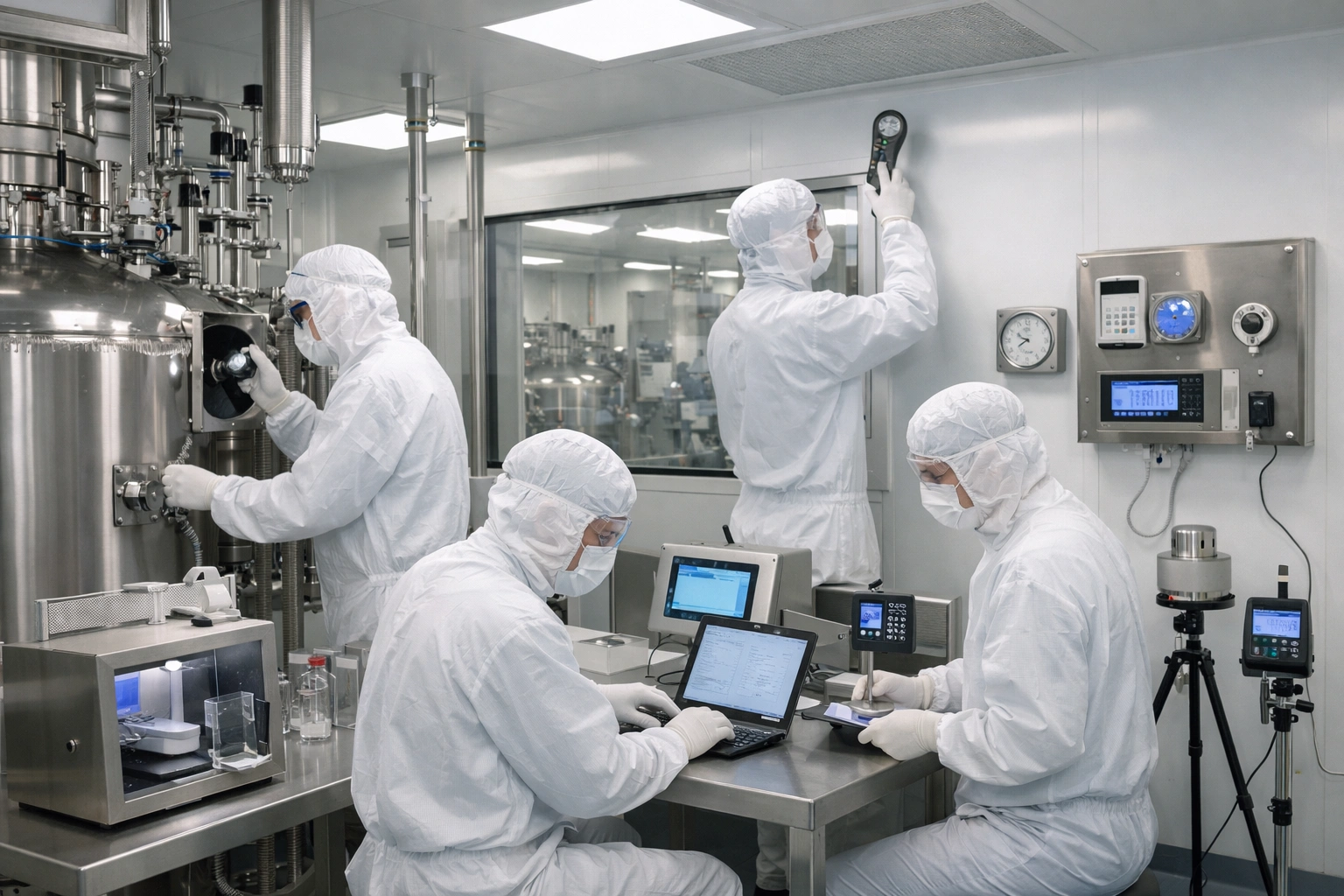
The validation lifecycle should be treated as a continuous system with three broad stages: initial validation, ongoing verification, and end-of-life or decommissioning control. The operational strength of the model comes from the fact that validation evidence continues to accumulate after initial approval. :contentReference[oaicite:4]{index=4}
| Phase | Typical purpose | Primary owner |
|---|---|---|
| DQ | Confirm design meets intended use and user requirements | Engineering / Project team |
| IQ | Confirm installation matches approved design | Facilities / Engineering |
| OQ | Confirm operation within defined limits | Valido |
| PQ | Confirm performance in normal operating conditions | Validation / QA |
| Ongoing verification | Maintain evidence of continued control | QA / Operations |
| Requalification | Reconfirm validated state at intervals or after triggers | Validation / QA |
Design Qualification (DQ)
DQ provides documented evidence that the cleanroom design is suitable for intended use. This is where user requirements, design assumptions, contamination risks, and performance targets should be translated into a design that can actually be qualified later. :contentReference[oaicite:5]{index=5}
Core DQ documents
- User Requirement Specification (URS)
- Functional Design Specification (FDS)
- Risk assessment / FMEA
- Concept design review
- DQ report
Key DQ questions
- Does the design meet the required ISO class?
- Are user requirements fully addressed?
- Are major contamination risks identified?
- Is the design verifiable and maintainable?
Instala Kvalifiko (IQ)
IQ verifies that the cleanroom and associated systems were installed correctly according to design documents. This includes equipment, utilities, calibration status, as-built documentation, and installation records. :contentReference[oaicite:6]{index=6}
Verify installed components
Confirm that room finishes, filters, HVAC components, instrumentation, and utilities match design and approved specifications.
Verify documentation completeness
As-built drawings, connection records, equipment identification, and calibration certificates should be present and accurate.
Verify readiness for OQ
IQ should not only confirm installation; it should confirm that the system is ready for operational testing.
Operacia Kvalifiko (OQ)
OQ verifies that the cleanroom operates within predetermined parameters under anticipated operating conditions. In your original draft, this includes airflow, pressure differentials, particle counts, temperature, humidity, and alarms/interlocks — exactly the right scope. :contentReference[oaicite:7]{index=7}
| OQ parameter | Why it matters | Typical expectation |
|---|---|---|
| Airflow velocity | Supports particle removal and airflow pattern control | Within approved range |
| Airflow uniformity | Detects unstable or uneven distribution | Within defined tolerance |
| Pressure differential | Protects room cascade and contamination direction | Within approved limits |
| Particle counts (at rest) | Confirms classification capability | Meets class target |
| Alarm / interlock response | Supports safe deviation control | Functional and documented |
Efikeco-Kvalifiko (PQ)
PQ confirms that the cleanroom performs effectively under normal operating conditions with actual process use. This is the stage where the room must demonstrate it can support product or process requirements over time, not just during static testing. :contentReference[oaicite:8]{index=8}
Your original article’s three-period model — baseline, process variability, and extended-duration assessment — is a strong way to present PQ because it emphasizes reproducibility, not just a single passing result. :contentReference[oaicite:9]{index=9}

Ongoing Verification
Ongoing verification is where lifecycle management becomes real. This includes environmental monitoring, continuous parameter review, trend analysis, and periodic reassessment of whether the room still behaves as expected. Your original article is right to emphasize this as a core lifecycle stage rather than an optional add-on. :contentReference[oaicite:10]{index=10}
Typical ongoing activities
- Ekologia monitorado
- Pressure / temperature / humidity trending
- Quarterly trend analysis
- Review of alert and action rates
Why facilities fail here
- No trend review
- Too much reliance on initial qualification data
- No defined requalification triggers
- Weak linkage to maintenance and change control
Requalification Strategy
Requalification should happen on schedule and by trigger. Scheduled requalification helps protect against slow drift, while trigger-based requalification responds to maintenance, change, degradation, or regulatory expectation. Your original matrix for annual, minor-maintenance, major-maintenance, and process-change scenarios is the right logic. :contentReference[oaicite:11]{index=11}
| Trigger type | Typical scope | Example |
|---|---|---|
| Annual schedule | Full or partial requalification | Routine annual review |
| Minor maintenance | Targeted OQ or affected-system verification | Sensor replacement |
| Major maintenance | Broad or full requalification | HEPA replacement / HVAC work |
| Process change | PQ-focused reassessment | New operating pattern or product exposure condition |
| Performance degradation | Risk-based requalification | High alert rate or rising trend |
Change Control
Change control is one of the most important lifecycle controls because it protects the cleanroom’s validated state when something changes. A strong change assessment should define what was changed, what validation phase could be affected, what risks are introduced, and what level of requalification is needed. :contentReference[oaicite:12]{index=12}
| Change level | Typical impact | Validation response |
|---|---|---|
| No impact | No effect on critical state | No requalification needed |
| Minor impact | Limited effect on defined parameter(s) | Targeted OQ or documented assessment |
| Major impact | Potential effect on cleanroom performance or control strategy | Broad or full requalification |
Need Help Building a Stronger Validation Lifecycle Program?
Get practical guidance on lifecycle structure, requalification triggers, ongoing verification logic, and change-control expectations for GMP cleanrooms.
- Lifecycle map from DQ to ongoing verification
- Requalification planning and documentation logic
- Change-control and audit-readiness support
Oftaj Demandoj
How often should cleanroom requalification be performed?
Annual requalification is common, with additional trigger-based requalification after major maintenance, significant changes, degradation trends, or regulatory requirements.
What is the difference between initial validation and requalification?
Initial validation establishes the first qualified state. Requalification confirms that the cleanroom still meets expectations after time, change, or identified risk.
How do I know whether a change requires requalification?
Use formal impact assessment. If the change could affect classified conditions, airflow, pressure, monitoring results, or process performance, some level of requalification is usually needed.
What documents are essential for lifecycle management?
DQ, IQ, OQ, PQ records, ongoing verification data, requalification records, change control documentation, and trend analysis records are all essential.
Why is trend analysis so important?
Trend analysis detects slow performance drift before it becomes a deviation, failed audit observation, or contamination event.
How does lifecycle validation affect product quality?
Lifecycle validation helps ensure the cleanroom remains suitable for intended use, which directly supports contamination control, process consistency, and product quality.
Recommended Internal Links
- Cleanroom IQ OQ PQ Kvalifiko Klarigita — for deeper detail on the initial validation phases
- ISO 14644 Classification Explained — for classified performance and particle-control context
- Media Monitorado-Lokoj en GMP-Puriga ĉambroj — for ongoing verification and monitoring logic
- Kiel Prepari por GMP Purĉambra Revizio — for audit readiness and validation-package review
- Cleanroom Maintenance Best Practices — for maintenance-linked requalification and continued control