
Introduction
ISO 14644-1 cleanroom classification assigns a room or clean zone to one of nine classes, ISO Class 1 (cleanest) to ISO Class 9, based on the maximum allowed number of airborne particles per cubic metre at specified particle sizes. The class must always be stated together with the occupancy state: as-built, at-rest or operational.
ISO 14644 is the international standard most widely used to classify cleanrooms according to airborne particle concentration. It gives teams a common language for describing how clean an environment is and how that cleanliness should be measured.
But classification alone is not enough. A room can meet an ISO class on a test day and still perform poorly in operation if airflow, maintenance, gowning, or cleaning control is weak. That is why ISO classification should always be viewed as one part of a broader contamination-control system.

What ISO 14644 Classification Means
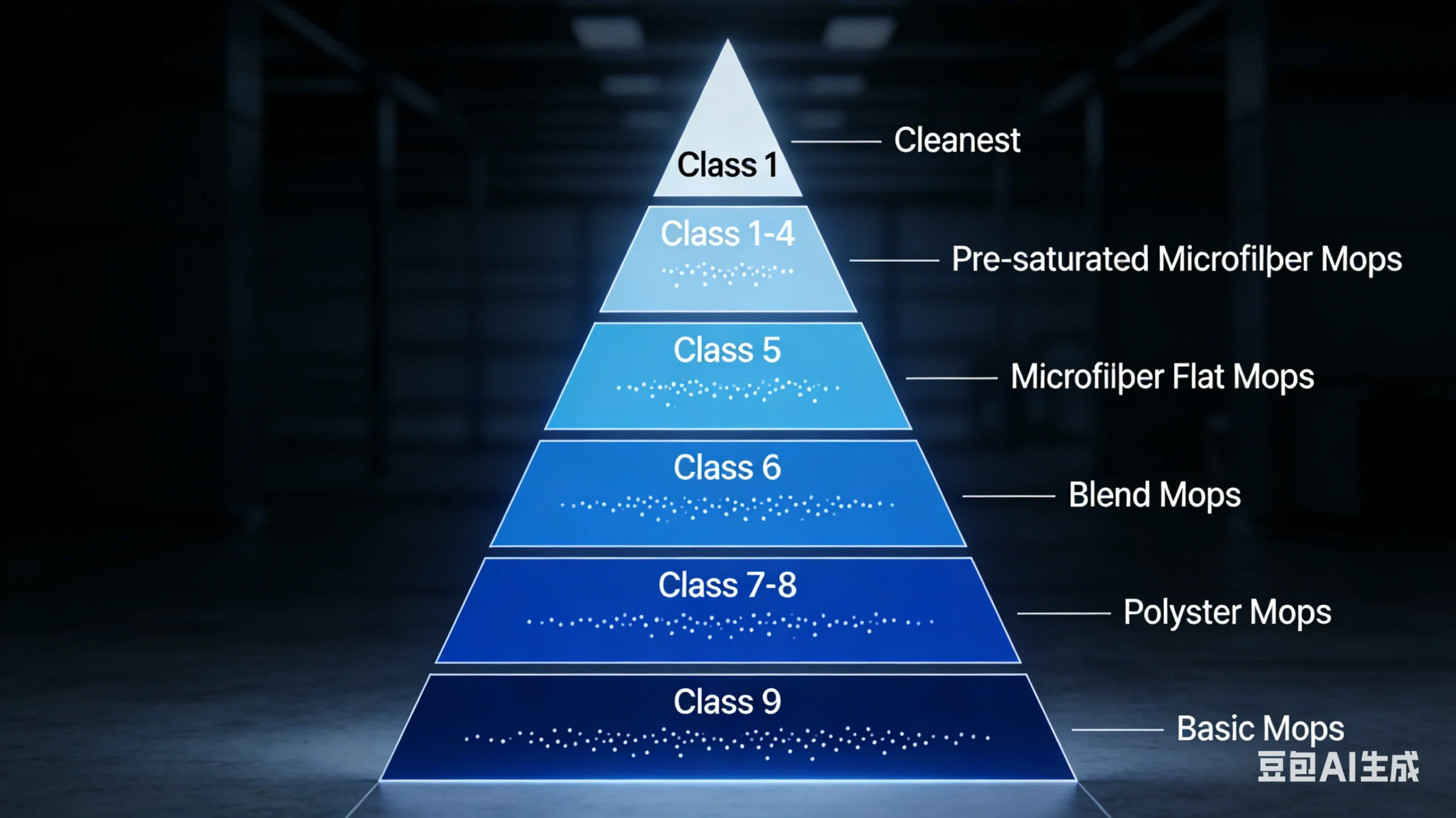
ISO 14644-1 classifies cleanrooms by the concentration of airborne particles of specified sizes. The lower the class number, the cleaner the environment.
In practical terms:
Lower ISO classes
- ISO 1–3: extremely clean environments
- Used in highly sensitive semiconductor and advanced technology processes
- Require strict airflow and particle control
Higher ISO classes
- ISO 5–8: common in pharma, medical device, and support zones
- Often mapped to GMP manufacturing environments
- Still require disciplined contamination control
ISO 14644 Classification Table
The table below shows common particle concentration limits used to understand the ISO class concept at a practical level.
| ISO Class | Maximum particles ≥0.5 µm / m³ | Typical application |
|---|---|---|
| ISO 1 | 10 | Extreme precision environments |
| ISO 2 | 100 | Advanced semiconductor / nanotechnology |
| ISO 3 | 1,000 | Semiconductor critical areas |
| ISO 4 | 10,000 | High-performance controlled zones |
| ISO 5 | 3,520 | Aseptic and high-control critical zones |
| ISO 6 | 35,200 | Supporting clean areas |
| ISO 7 | 352,000 | Background cleanroom environments |
| ISO 8 | 3,520,000 | General controlled manufacturing areas |
| ISO 9 | 35,200,000 | Comparable to typical room air |
ISO Class vs GMP Grades
One of the most common sources of confusion is mixing ISO classification with EU GMP grades. They are related, but they are not identical systems.
A practical mapping often used in pharmaceutical contexts is:
| EU GMP Grade | Common ISO equivalent | Typical context |
|---|---|---|
| Grade A | ISO 5 | Critical aseptic exposure |
| Grade B | ISO 5 at rest / ISO 7 in background use context | Background to Grade A |
| Grade C | ISO 7 | Less critical clean manufacturing |
| Grade D | ISO 8 | Basic controlled support environment |
ISO classification describes airborne particle cleanliness. GMP grading adds broader operational expectations such as gowning, microbiological control, behavior, and contamination-control strategy.
How ISO Classification Is Measured
Classification is determined using calibrated particle counters and defined sampling logic under ISO 14644-1. The goal is to measure whether the number of airborne particles meets the allowable concentration for the class being claimed.
Key measurement elements
- Defined particle size channels
- Calculated sample volume
- Multiple sampling locations
- Calibrated and controlled instrument
What teams often miss
- Insufficient sample volume
- Too few locations
- No link to airflow conditions
- No follow-up after maintenance or changes

Why ISO Classification Matters
ISO classification matters because it defines the airborne cleanliness foundation for cleanroom design, qualification, monitoring, and contamination-control planning.
Design basis
HVAC, filtration, airflow rate, and room layout are often built around the class target.
Qualification support
ISO class is closely tied to qualification and requalification activities, especially during commissioning and lifecycle review.
Monitoring strategy
Environmental monitoring and particle trend review should reflect the class and criticality of the area.
Operational control
Cleaning, maintenance, gowning, and traffic patterns all influence whether the room can remain consistent with its intended class.
Occupancy States, Sampling Locations and Retest Intervals
The three occupancy states
- As-built: the installation is complete with services connected, but there is no production equipment, materials or personnel.
- At-rest: equipment is installed and operating as agreed, but no personnel are present.
- Operational: the room is working in its normal way with the specified number of personnel.
A room classified as ISO 5 at rest is not automatically ISO 5 in operation. EU GMP Annex 1, for example, sets Grade B at ISO 5 at rest but ISO 7 in operation.
How many sampling locations are needed?
ISO 14644-1:2015 replaced the old square-root rule with a lookup table (Table A.1) that links the minimum number of sampling locations to the cleanroom floor area. Locations are spread across the room so each represents a similar area, and enough air must be sampled at each location to count at least 20 particles at the class limit for the largest particle size considered.
How often must classification be repeated?
ISO 14644-2:2015 sets a maximum interval of 12 months for demonstrating compliance with particle concentration limits, for all classes. Shorter intervals can be justified by risk assessment, and a room should also be re-tested after significant changes to airflow, layout, equipment or use.
How the class limits are calculated
The table values come from the formula Cn = 10N × (0.1/D)2.08, where Cn is the maximum particles per m³, N is the ISO class number and D is the particle size in µm. This is why each class step allows roughly ten times more particles than the class below it.
Common ISO Classification Mistakes
Many teams understand the class table but still make operational mistakes that weaken the value of classification.
| Mistake | Why it is a problem | Better approach |
|---|---|---|
| Treating classification as a one-time event | Rooms drift over time | Link class to requalification and maintenance review |
| Ignoring airflow and pressure stability | Particle counts alone do not explain root cause | Review airflow, pressure, and filter status too |
| No link to monitoring trends | Operational drift may be missed | Compare classification with ongoing EM and particle data |
| Incorrect sample logic | Weakens result credibility | Use proper ISO 14644-1 sample planning |
| Confusing ISO class with GMP grade | Can lead to wrong compliance assumptions | Use both systems correctly and in context |
Need Help Aligning ISO 14644 Classification with Real Operations?
Get practical guidance on classification logic, GMP mapping, monitoring linkage, and contamination-control workflows that are easier to operate and defend.
- ISO class to application mapping
- Monitoring and maintenance alignment
- Support for qualification and contamination-control planning
Frequently Asked Questions
What is ISO 14644?
ISO 14644 is the international standard used to classify cleanrooms based on airborne particle concentration.
What ISO class is Grade A?
Grade A is commonly associated with ISO 5 for critical aseptic exposure conditions.
Is ISO 14644 the same as GMP grading?
No. ISO classification focuses on airborne particles, while GMP grading includes broader operational and microbiological control expectations.
How often should ISO classification be checked?
Frequency depends on risk, industry, and quality system, but classification should be tied to qualification, requalification, maintenance, and major changes.
Why is ISO 5 so important in pharma?
ISO 5 is commonly required where product is exposed in critical aseptic operations, making particle control especially important.
Can a room pass classification and still have contamination risk?
Yes. A room can meet class limits during testing and still perform poorly in operation if airflow, maintenance, cleaning, or behavior control is weak.
What is the difference between at-rest and operational classification?
At-rest testing is done with equipment running but no people present; operational testing is done during normal work with personnel in the room. Operational particle counts are usually higher, so the class can differ between the two states.
How many particles are allowed in an ISO 7 cleanroom?
ISO Class 7 allows up to 352,000 particles ≥0.5 µm and 2,930 particles ≥5 µm per cubic metre of air.
What is the difference between ISO 14644-1 and ISO 14644-2?
ISO 14644-1 defines the classes and the classification test method. ISO 14644-2 covers ongoing monitoring to show that the cleanroom continues to meet its class, including the maximum interval between tests.
What is the old FED-STD-209E equivalent of ISO 5, 7 and 8?
ISO 5 corresponds to the former Class 100, ISO 7 to Class 10,000 and ISO 8 to Class 100,000. FED-STD-209E was cancelled in 2001 but these names are still widely used.
Recommended Internal Links
- Cleanroom IQ OQ PQ Qualification Explained — for linking class verification to broader qualification logic
- Environmental Monitoring Locations in GMP Cleanrooms — for operational monitoring after classification
- Cleanroom Maintenance Best Practices — for maintaining class stability over time
- Cleanroom Validation Lifecycle Management — for lifecycle control of classified environments
- Cleanroom Airflow Pattern Visualization and Verification — for understanding airflow effects on particle performance