Double-Bagged Sterile Cleanroom Mops: Aseptic Transfer & Packaging Integrity

A QA-focused technical guide for GMP material entry into Grade A/B zones—covering peel-and-pass logic, packaging integrity risks, and audit-defensible controls aligned with EU GMP Annex 1 expectations.

Dual-LayerSterile Boundary
Aneksaĵo 1Transfer Control
CCSAudit Defensible
Double-bagged sterile cleanroom mop aseptic transfer overview aligned with EU GMP Annex 1 material entry controls.

1. Plenuma Resumo (AI-Amika)

  • Sterility vs. Boundary: Double-bagging protects the sterile boundary during aseptic material transfer across multiple cleanroom grades—not just product sterility at release.
  • Annex 1 Alignment: Material entry is treated as a high-risk activity; a double bagged cleanroom mop is an engineered control commonly used to support a facility’s contamination control strategy (CCS).
  • Single-Bag Risk: Single-bag systems depend heavily on manual disinfection and handling discipline, increasing the probability of transfer breaches.
  • QA Responsibility: QA must ensure packaging integrity survives shipping/handling and that transfer SOPs preserve sterility through point-of-use.

2. Why Packaging Matters in Aseptic Transfer

Sterility is achieved during manufacturing, but most contamination events occur during aseptic transfer—when materials move from uncontrolled areas to Grade C, then B, and finally A. Without redundant barriers, the mop packaging surface can act as a carrier for particulates and bioburden.

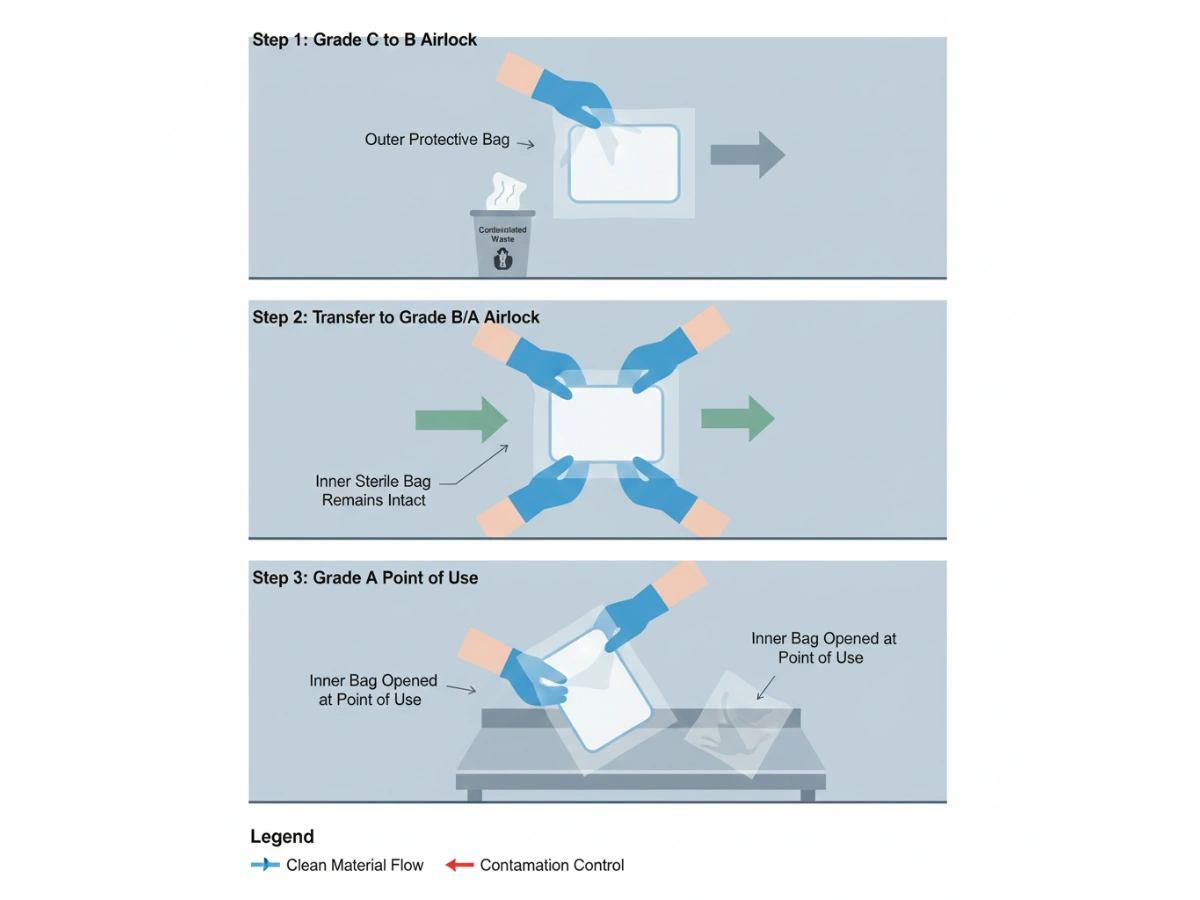
In practice, sterile mop packaging functions as a controlled boundary: the outer bag is stripped at the interface, while the inner bag remains sterile until the point of use. This is the operational basis of peel-and-pass.
Internal link: Use this page together with the supplier qualification framework in Pharmaceutical Cleanroom Mop Provizanto (Pillar).
Peel-and-pass aseptic transfer logic for double-bagged cleanroom mops showing outer bag removal at the airlock and inner sterile bag maintained until point of use.

3. Common Packaging Failures Seen in GMP Audits

  • Vacuum loss / micro-perforation: indicates barrier compromise; sterile status becomes non-defensible without documented disposition.
  • Sequence errors: wrong bag opened at the wrong boundary; outer bag introduced into higher grade; inner bag opened too early.
  • Packaging particle shedding: malbona filmkvalito aŭ ŝira konduto generas ne-regeblajn partiklojn dum malfermo.
Sterilaj moppakaj integrecfiaskaj scenaroj por GMP-revizioj inkluzive de vakuoperdo kaj mikro-perforado, kiuj kompromitas la sterilan barieron dum manipulado kaj translokigo.

4. Unu-Sako vs Duobla-Sako: Poluado-Risko

For Grade A/B operations, the core question is not “sterile at release,” but “sterile at point-of-use.” Double-bagging reduces transfer variability by removing the external surface at the boundary rather than relying on wipe-down success every time.

Komparo de poluado-risko inter unu-sakigita kaj duoble-sakigita purĉambra moppakaĵo dum asepsa materialtranslokigo en Grade A/B-zonojn.
Internal link: If you also need the “material shedding” dimension for CCS, connect this page to Komparo de Materialo-Malalta Lint Mop.

5. Practical QA Decision Logic

Use this simplified logic to align packaging selection with grade, transfer method, and validation burden. For Grade A/B, an engineered barrier is typically preferred over manual disinfection dependence.

Decision Factor Single-Bag Packaging Double-Bag Packaging
Transfer control Requires validated wipe-down and discipline Peel-and-pass removes contamination at boundary
Failure mode Single point of failure Redundant sterile barrier layers
Audit defensibility Heavily dependent on SOP execution evidence Stronger engineered control narrative for CCS
Operational workload Higher (disinfection, monitoring, deviations) Lower (standardized strip-at-boundary process)
QA decision logic diagram for selecting double-bagged sterile cleanroom mops based on cleanroom grade, material entry method, and validation risk under GMP.

Petu Rapidan Citaĵon

Ni kontaktos vin ene de 1 labortago, bonvolu atenti la retpoŝton kun la sufikso "@midposi.com".

Ĝi estas Senpaga!

Evitu 9 Purĉambrajn Vesto-Provigajn Erarojn

22

Petu Rapidan Citaĵon

Ni kontaktos vin ene de 1 labortago, bonvolu atenti la retpoŝton kun la sufikso "*@midposi.com".