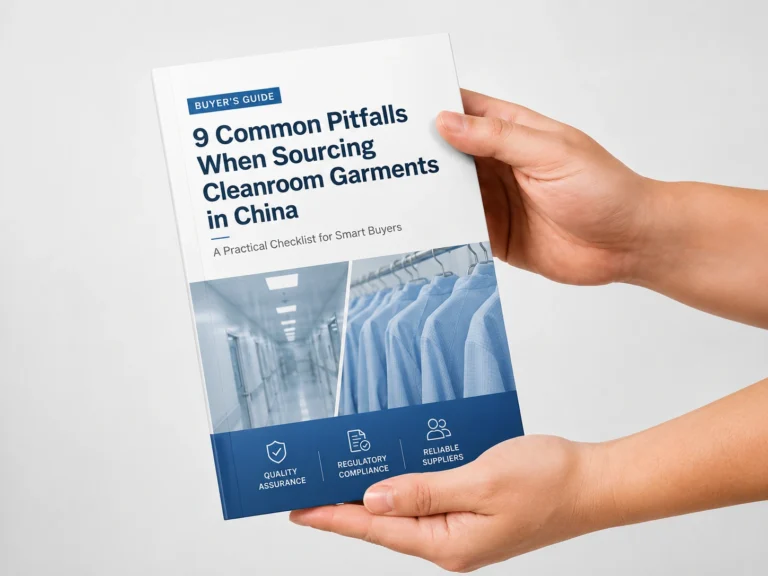
Un cadre étape par étape pour la transition vers un nouveau fournisseur de vadrouilles pour salles blanches dans une installation réglementée par les BPF. Couvre le transfert de la documentation, les tests d'échantillons et la validation interne, les mises à jour des SOP, la formation des opérateurs, les protocoles d'exécution parallèle et la conformité du contrôle des modifications. Conçu pour les responsables de l'assurance qualité, les responsables des achats et les responsables de salles blanches qui gèrent les transitions avec les fournisseurs sans perturbation de la réglementation.

L'intégration d'un nouveau fournisseur de vadrouilles pour salles blanches dans une installation GMP est un processus structuré qui peut être complété en environ quatre semaines: (1) documentation handover and quality agreement finalization, (2) sample testing and in-house validation, (3) SOP updates and operator training, and (4) a parallel run comparing old and new products before full cutover. This article provides a week-by-week framework. Actual timelines should be adjusted based on your facility’s change control procedures, available QA resources, and the complexity of the product being transitioned. If you have not yet selected a supplier, start with the Liste de contrôle d'audit des fournisseurs de vadrouilles pour salles blanches to evaluate candidates before beginning the onboarding process.
Supplier auditing and supplier onboarding serve different purposes — and confusing the two is a common source of implementation problems.
Step 1: Evaluate the supplier
Step 2: Integrate the supplier into operations
An audit confirms the supplier is qualified. Onboarding confirms the supplier’s products perform under your specific conditions — with your disinfectants, your SOPs, and your operators. A supplier can pass an audit and still fail onboarding if the product does not integrate into your existing Présentation du système de vadrouille pour salle blanche and cleaning workflow.
Before the supplier ships the first sample or production lot, four items should be in place. Skipping this pre-work is one of the most common reasons onboarding timelines stretch from weeks to months.
A written quality agreement between your facility and the supplier, defining document expectations (COA, CoI format), change notification timelines, and specification change approval processes. The agreement does not need to be fully executed before samples arrive, but the draft should be in review.
Initiate the change control process for the mop product transition. Even if the final approval requires test data that does not yet exist, opening the change control record early establishes the evaluation framework and approval criteria before testing begins.
Write the sample testing protocol before samples arrive. Define: what tests will be performed, under what conditions, with what acceptance criteria, and who signs off. Testing without a written protocol can generate data that change control reviewers are unable to use for approval decisions.
Confirm that QA, Production, Procurement, and Cleanroom Management agree on the evaluation scope and timeline before onboarding begins. A QA-approved supplier that Production refuses to use is an onboarding failure, not an audit failure.
The timeline below assumes a single mop product type (e.g., a sterile polyester mop cover) in a single cleanroom grade. Multi-product or multi-grade transitions will require proportionally more time. Each week builds on the previous; skipping a week typically results in rework rather than time saved.
The supplier provides the full documentation package for the specific product being transitioned. This should include lot-specific documents de validation des vadrouilles pour salles blanches such as COA, CoC, material composition data, particle generation test reports, and chemical compatibility documentation. For sterile products, CoI and sterility assurance documentation should also be provided. For a complete checklist of documents to request, see the liste de contrôle de l'acheteur des documents de validation.
Key actions this week:
Gate check: All documentation reviewed and filed. Quality agreement executed. Samples confirmed in transit.

Samples arrive and are tested according to the protocol defined in pre-onboarding. Testing should cover three areas:
Testing should be performed by the operators who will use the product after go-live. Their feedback on handling, weight, and ergonomics is as important as quantitative test data.
Gate check: All test data collected against protocol criteria. Any failures documented with root cause assessment. Go/no-go decision for Week 3 documented.
Assuming samples passed Week 2 testing, update the facility’s cleaning SOPs to reflect the new mop product. This is not just a product name change — the SOP should include any differences in application technique, disinfectant saturation method, wringing procedure, mop head change frequency, and traçabilité des lots pour vadrouilles pharmaceutiques pour salles blanches documentation steps.
Key actions this week:
Gate check: SOPs updated and approved. All operators trained and sign-off documented. Cleaning logs updated.

The final week is a controlled parallel run: operate the new mop product alongside the existing product in designated test zones. This is not a full facility cutover — it is a structured comparison to confirm that the new product performs equivalently or better under live conditions.
Parallel run protocol:
Go-live decision:
Gate check: Parallel run data reviewed and signed off. Change control approved. Cutover date communicated. Go-live.
Testing samples without a written protocol with pre-defined acceptance criteria is one of the most common reasons onboarding data is rejected during change control review. Write the protocol before samples arrive. Define what “pass” and “fail” look like before you see the data.
Testing a mop cover with a generic disinfectant when the facility uses a specific quaternary ammonium or hydrogen peroxide formulation can produce misleading compatibility results. Use your actual facility disinfectants for all testing. If the supplier cannot provide compatibility data with your specific disinfectant formulation, request that testing be included as a condition of purchase.
A full-facility cutover without a parallel run period introduces significant risk. If the new product underperforms, all zones are affected simultaneously with no fallback position. Start with a single zone or a single shift. Expand gradually. The parallel run should be documented as part of the change control package.
Operators will use whatever mop is in the supply closet. If old inventory remains accessible after the cutover date, some operators will continue using it — creating a period where both products are in use without the controlled comparison of a parallel run. Plan old-product depletion or removal as part of the go-live checklist.
A single-product, single-grade transition can typically be completed in 4 weeks, assuming pre-onboarding preparation is complete before Week 1 starts and samples are available without delay. Multi-product or multi-grade transitions will take longer. The most common cause of timeline extension is incomplete documentation from the supplier in Week 1 — which is why documentation review should be the first gate check.
In a GMP facility, yes — changing a cleaning tool that contacts critical surfaces should be managed through the change control process. The change control record should document the rationale for the change, the testing protocol and results, the updated SOPs, operator training records, and the parallel run data supporting the go-live decision. Opening the change control record early (before testing begins) allows the evaluation framework to be reviewed and approved upfront, which can streamline the final approval.
At minimum: Certificate of Analysis (COA) with lot-specific test data, Certificate of Conformance (CoC), material composition declaration, particle generation data with test method reference, chemical compatibility data, and dimensional specifications. For sterile products: Certificate of Irradiation (CoI) with dose data, sterility assurance documentation, and packaging integrity documentation. All documents should be traceable to the specific lots being tested. If a supplier cannot provide these documents during onboarding, they are unlikely to provide them consistently after becoming the primary supplier.
A performance difference is not necessarily a failure — it depends on whether the difference is acceptable within your acceptance criteria. If the new product absorbs less disinfectant but still meets coverage requirements, the change may be acceptable with a SOP adjustment to re-saturate more frequently. If the difference is outside acceptance criteria, document the finding, share it with the supplier, and either request product adjustment or return to your supplier shortlist. The purpose of testing is not to confirm that the new product is identical to the old — it is to confirm that it performs within your facility’s requirements.
Yes — running a dual-source supply model is a valid supply chain strategy, particularly for higher-risk sterile consumables. However, dual sourcing increases the documentation and change control burden: both suppliers require separate qualification records, separate incoming inspection protocols, and separate change notification monitoring. The quality agreement with each supplier should clearly define documentation expectations. Some facilities dual-source higher-grade products (Grade A/B) and single-source lower-grade products (Grade C/D) as a risk-based approach.
The most common reason is a documentation gap discovered during Week 1 that cannot be resolved. A supplier that provides a generic COA without lot-specific data, or a CoI without dose information, may pass a high-level audit questionnaire but fail the detailed documentation review that occurs during onboarding. This is why the documentation gate check is critical: it reveals the difference between a supplier who says they provide documentation and a supplier who actually provides audit-grade documentation.
Onboarding requires coordination across QA, Procurement, and Cleanroom Management. QA typically owns documentation review and testing protocol approval. Procurement manages the supplier relationship and quality agreement. Cleanroom Management owns SOP updates and operator training. A single project owner — often a QA lead or Procurement manager — should coordinate the overall timeline and gate checks. Without a designated owner, onboarding tasks can fall between departmental responsibilities and extend the timeline significantly.
MIDPOSI provides the documentation package, product samples, and technical support to streamline your supplier onboarding process. Request lot-specific COA and CoI documentation, sample products for in-house testing, and discuss your facility’s specific implementation requirements with our team.
MIDPOSI provides lot-specific COA, CoI, technical data sheets, and material documentation to support your supplier qualification and onboarding process. Onboarding support and technical consultation available upon request.
Disclaimer: This guide provides a general framework for supplier onboarding and does not constitute regulatory or legal advice. Onboarding timelines, change control requirements, testing protocols, and documentation expectations vary by facility, jurisdiction, product type, and cleanroom grade. Facilities should consult their quality and regulatory affairs teams to define onboarding procedures appropriate to their operations. MIDPOSI does not claim that following this framework satisfies all regulatory requirements for all facilities.