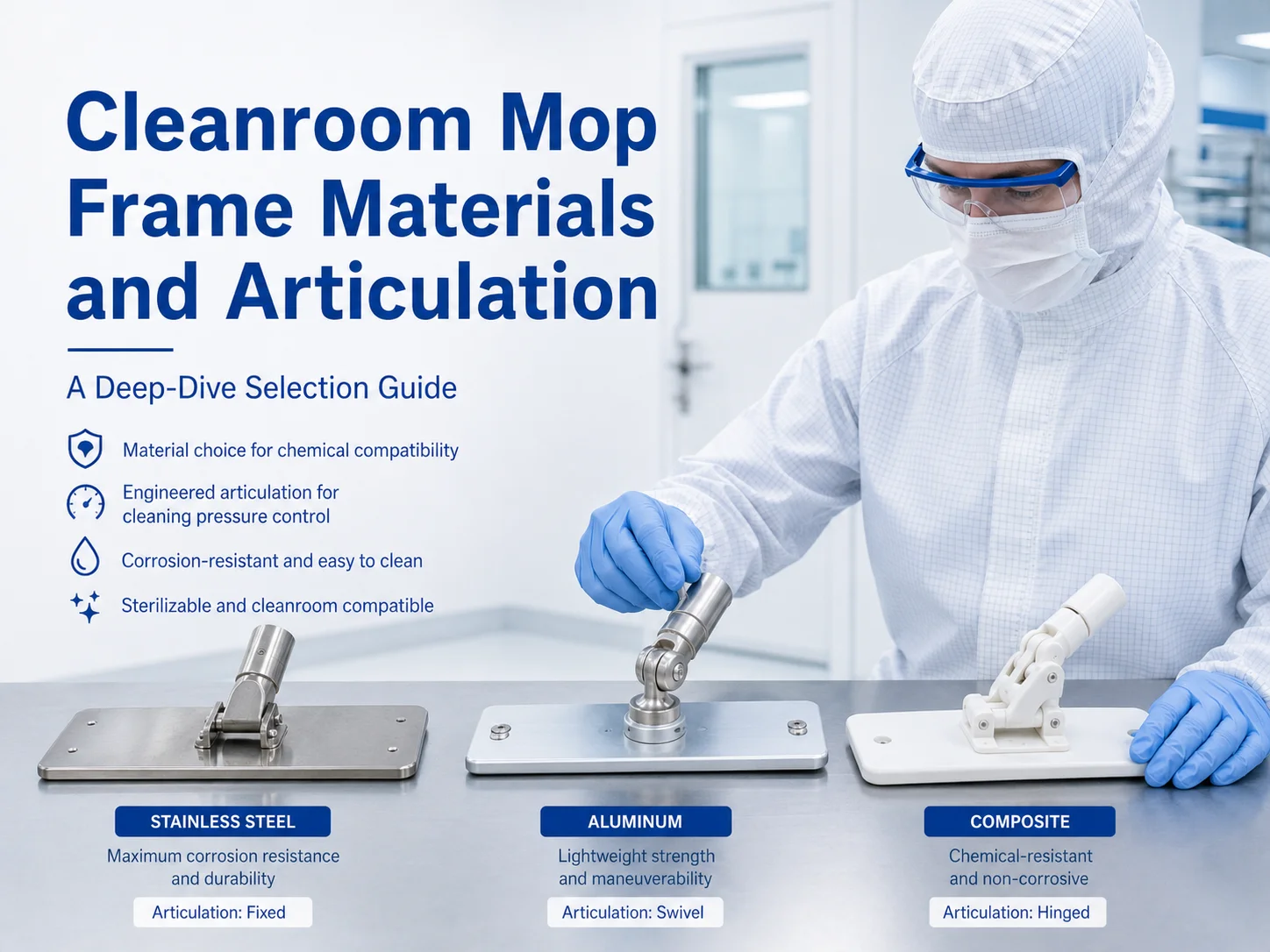
モップフレームは、他のコンポーネントではできない 3 つの動作変数を決定します。システムの総重量 (SS はアルミニウムまたはポリマーよりも 30 ~ 50% 重量が追加されます)、耐薬品性 (SS は強力な消毒剤に耐えますが、アルミニウムは電気腐食の危険があります)、および関節範囲 (旋回角度、ロック機能、およびフレームが壁や天井で位置を保持できるかどうか) です。これら 3 つの次元を評価せずにフレームを選択すると、クリーニング プロトコルに未検証の変数が導入されます。
| 材料 | 重さ | 耐薬品性 | 腐食のリスク | 最適な用途 |
|---|---|---|---|---|
| SS304 | 最も重い | 優れた — 酸化性消毒剤への耐性 | 最小限 | グレード A/B 製薬会社、積極的な消毒剤のローテーション |
| SS316 | 最も重い | 優れた - モリブデン添加により塩化物孔食を防止 | 最小限 | 塩素系消毒剤を使用したグレードA/B |
| アルマイト処理されたアルミニウム | SSより40~50%軽い | 良好 - 陽極酸化層が保護します。傷が付くと生のAlが露出します。 | SS ハンドル + 酸化消毒剤と組み合わせた場合はガルバニック | グレード C/D、複数シフト操作、重量に敏感な用途 |
| ポリマー/複合材料 | 最軽量 | 優れた — 本質的に耐腐食性 | なし | Grade C/D, aggressive chemical environments, no autoclave requirement |
SS 304 is the standard for pharmaceutical GMP cleanrooms. It provides maximum chemical resistance against the full disinfectant rotation — quaternary ammonium, hydrogen peroxide, peracetic acid — and can be autoclaved at 121°C or 134°C without degradation. SS 316 adds molybdenum, which provides additional resistance to chloride pitting — relevant for facilities using chlorine-based disinfectants or operating in coastal/high-humidity environments. The trade-off is weight: an SS frame adds 0.8-1.2 kg to the system, which is noticeable over multi-shift operations. For grade-specific GMP cleaning tool requirements, see GMPクリーンルームモップのグレード選択.
Anodized aluminum frames reduce weight by 40-50% compared to SS — making them suitable for multi-shift operations where cumulative operator fatigue is a concern. The anodized surface layer provides chemical resistance, but if the anodizing is scratched, raw aluminum is exposed. Raw aluminum in contact with oxidizing disinfectants (particularly chlorine-based) can experience pitting corrosion. The second risk: galvanic corrosion when an aluminum frame is paired with a stainless steel handle — the dissimilar metals create a galvanic cell when an electrolyte (cleaning solution) bridges the connection. Anodizing mitigates but does not eliminate this risk. Facilities evaluating aluminum frames should verify anodizing quality and assess galvanic compatibility with the handle material.
ポリマーフレームは腐食のリスクを完全に排除します。これらは本質的に、すべての標準的なクリーンルーム用消毒剤や洗浄剤に対して耐性があります。これらは最も軽いオプションであり、オペレータの疲労を大幅に軽減します。トレードオフ: ポリマーフレームは金属に比べて剛性が低下する可能性があり、特に大型のモップヘッドに必要な幅が広がった場合に顕著です。ポリマーフレームの関節機構は、金属製のラチェットシステムに比べてロック位置が少ない場合があります。ポリマーフレームは通常、オートクレーブ可能ではないため、モップアセンブリ全体をオートクレーブする施設での使用が制限されます。これらは、金属腐食が定期的なメンテナンス問題となる、グレード C/D ゾーンや積極的な化学消毒を使用する施設に最適です。
Articulation determines whether the mop head maintains flat contact with the surface being cleaned — floor, wall, or ceiling. Free swivel is the standard for floor cleaning: the frame pivots to follow the operator’s stroke direction. Locking articulation allows the frame to be set at a fixed angle — typically 30-45 degrees for wall cleaning — and hold that position without operator effort. Ratcheting articulation provides indexed angle positions, useful when the same frame is used for both floor and wall cleaning and must switch between free movement and fixed angle. For the system-level importance of frame-head-handle integration, see フルクリーンルームモップシステムが重要な理由.
The frame’s handle receiver must match the handle’s attachment type. A threaded frame receiver (M22 or 3/4-inch ACME) will not accept a quick-connect handle — and vice versa. More critically: the frame and handle materials should be evaluated for galvanic compatibility when different metals are used. An aluminum frame with a stainless steel handle creates a galvanic pair. Anodizing on the aluminum provides electrical isolation at the contact surface — but if the anodizing is worn through at the connection point, galvanic corrosion can begin. See クリーンルームモップハンドルの選択 for handle material and attachment guidance.
SS is the standard — but in multi-shift Grade C/D operations, the weight penalty may reduce cleaning consistency more than the chemical resistance benefit justifies.
This is the most common dissimilar-metal pairing in cleanroom mop systems. Anodizing provides protection — until it is scratched at the connector. Verify galvanic compatibility or use matched materials.
A free-swivel frame cannot hold a fixed angle against the wall — the operator must hold the angle manually, reducing consistency. Use locking or ratcheting articulation for wall work.
An auditor reviewing cleaning tools will ask about cleanability. A frame with no documented surface finish (Ra value for SS) cannot be validated as cleanable.
Most polymer frames are not autoclavable. If the facility’s SOP requires autoclaving the entire mop assembly, verify the frame is rated for the autoclave temperature before procurement.
SS 304 is the standard for Grade A/B pharmaceutical cleanrooms — maximum chemical resistance and autoclavable. Aluminum may be evaluated for Grade C/D where weight reduction benefits multi-shift operations. Polymer is suitable for aggressive chemical environments where metal corrosion is a recurring concern. The “best” material depends on cleanroom grade, disinfectant rotation, and shift patterns — not a universal ranking.
Anodized aluminum can be used with standard oxidizing disinfectants if the anodized surface is intact. However, scratched anodizing exposes raw aluminum — which is susceptible to pitting from chlorine-based disinfectants. Facilities using aluminum frames should inspect the anodized surface at regular intervals and replace frames showing surface damage.
SS frames are approximately 30-50% heavier than comparable polymer or aluminum frames. An SS frame that weighs 1.0 kg may have an aluminum equivalent at 0.5-0.6 kg and a polymer equivalent at 0.4-0.5 kg. The weight difference becomes operationally significant over multi-shift use.
Yes. Free-swivel articulation allows the mop head to follow floor contours but cannot hold a fixed angle for wall cleaning. Locking articulation holds a consistent wall angle — improving cleaning pressure uniformity on vertical surfaces. The articulation type should match the surfaces being cleaned.
Matching materials eliminates galvanic corrosion risk entirely. If different materials must be used, verify galvanic compatibility — particularly for aluminum + SS pairs where anodizing provides the isolation barrier. Anodizing that is worn through at the connector creates a corrosion pathway.
Frame replacement is condition-based rather than calendar-based. Inspection triggers: visible corrosion (aluminum), surface finish degradation (SS — loss of smoothness, pitting), articulation mechanism sloppiness (loose swivel, failed lock), and connector thread wear. A documented frame inspection schedule should be integrated into the cleaning tool maintenance program.
Swivel is sufficient for floor-only cleaning programs. If walls or ceilings are cleaned, locking or ratcheting articulation is recommended — it holds a consistent angle on vertical surfaces without requiring the operator to maintain the angle manually, improving cleaning uniformity.
Specify your cleanroom grades, disinfectant rotation, and cleaning surfaces. MIDPOSI can help match frame material and articulation type to your operational requirements.
White Cleanroom Mop Series — SS 304 frames with swivel articulation — compatible with full handle and mop head range — material documentation for GMP audit support

関連している: この記事は、 MIDPOSI クリーンルーム モップ システム ガイド — クリーンルームモップ調達のためのコンポーネント、選択基準、GMPワークフロー、文書サポートを網羅した完全なリソース。